
 Download PDF
Market Overview
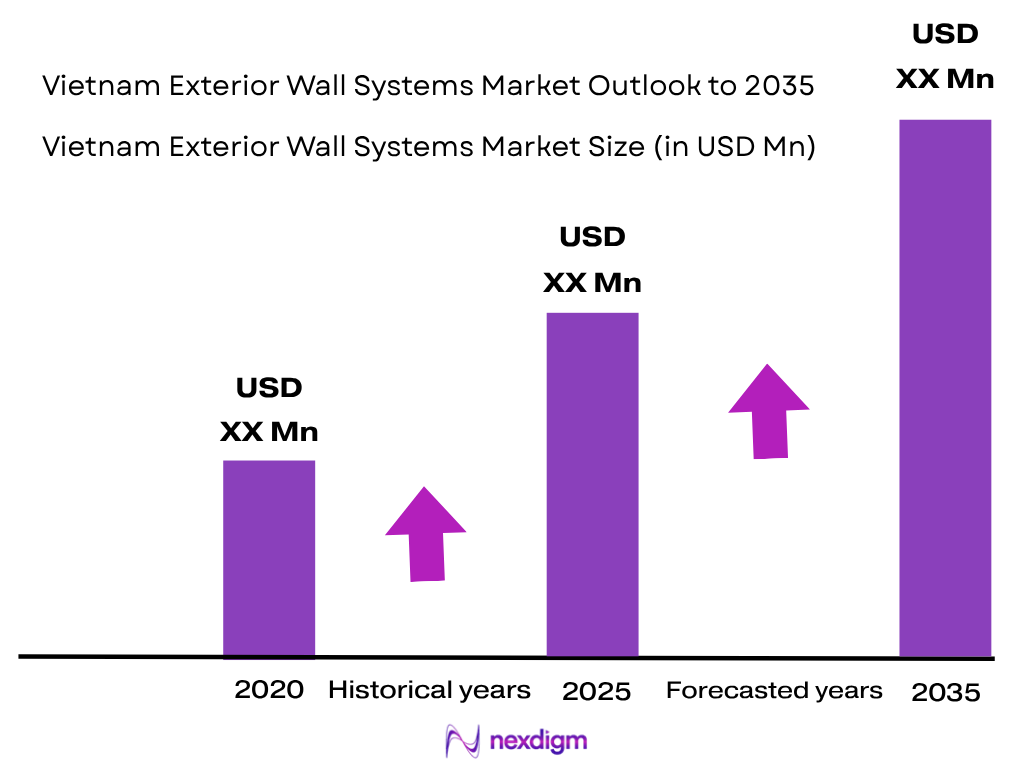
The Vietnam Exterior Wall Systems Market is valued at approximately USD ~ billion, based on historical market assessment, with the forecast CAGR for 2026–2035 placed at approximately ~% as requested. Demand is supported by Vietnam’s substantial construction pipeline: official statistics recorded 1,051 newly licensed FDI projects with registered capital of USD 15.2 billion during the first eight months of 2023, while registered FDI reached USD 38.23 billion during the corresponding full-period 2024 investment cycle. Rising industrial facilities, apartments, offices, logistics assets and hospitality developments increase requirements for curtain walls, insulated panels, fiber-cement boards, metal cladding and high-performance building-envelope systems.
Ho Chi Minh City, Hanoi, Binh Duong, Dong Nai, Hai Phong and Bac Ninh constitute important demand centers for Vietnam Exterior Wall Systems because they combine dense urban construction with industrial and commercial development. Ho Chi Minh City recorded approximately 9.46 million residents while Hanoi contained approximately 8.59 million residents in the latest official population reporting. Vietnam also recorded approximately 40.2 million urban residents in 2024. These concentrations support high-rise apartments, offices and mixed-use construction, while manufacturing-intensive provinces create additional requirements for insulated metal panels, lightweight façades, factory wall systems and weather-resistant industrial envelopes.
Market Segmentation
By Wall System Type
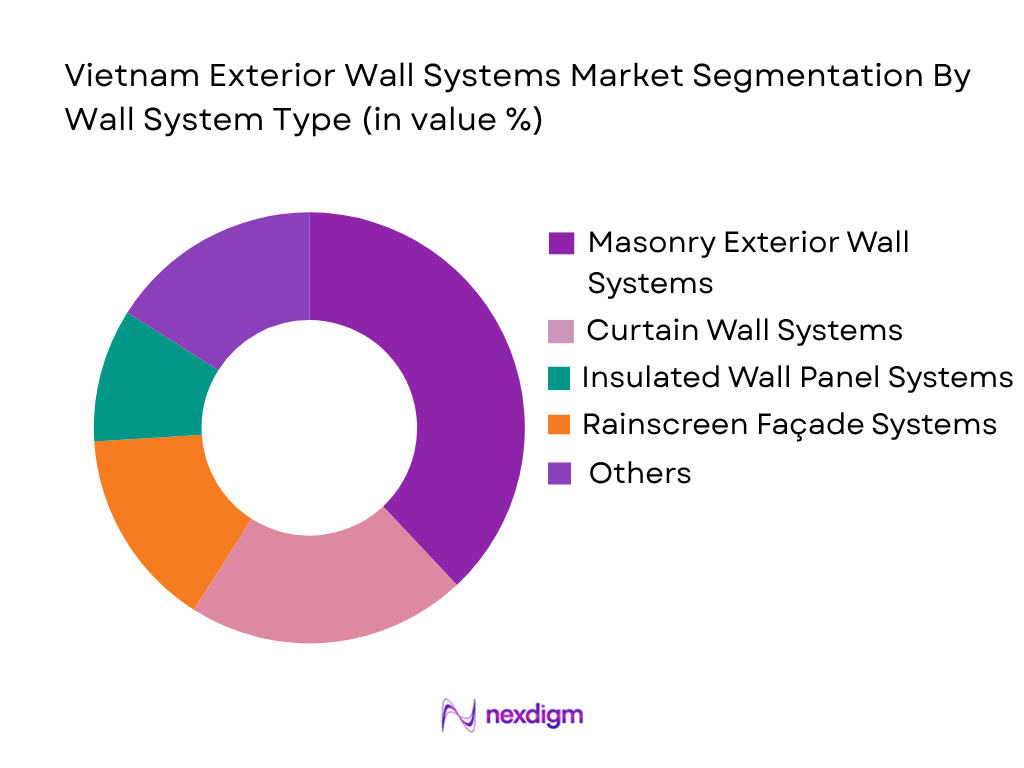
Vietnam Exterior Wall Systems Market is segmented into curtain wall systems, masonry exterior walls, insulated wall panels, rainscreen façades, precast concrete walls and lightweight framed exterior systems. Masonry exterior wall systems hold the dominant position because reinforced-concrete-frame construction combined with brick or block infill remains deeply established across Vietnam’s residential and conventional commercial building stock. Local availability of cementitious products and masonry materials supports widespread adoption, while contractors possess extensive installation familiarity. Curtain walls are particularly important in premium offices, hotels and high-rise mixed-use developments, whereas insulated metal panels have stronger relevance across factories, warehouses and logistics facilities. Fiber-cement and lightweight façade solutions are increasingly relevant where developers prioritize lower structural loads, faster installation and moisture resistance. Vietnam’s hot, humid and high-rainfall climate also makes façade water management, thermal control and durability important specification criteria, supporting gradual movement toward engineered exterior-envelope assemblies rather than relying exclusively on conventional wall construction.
By Building Type
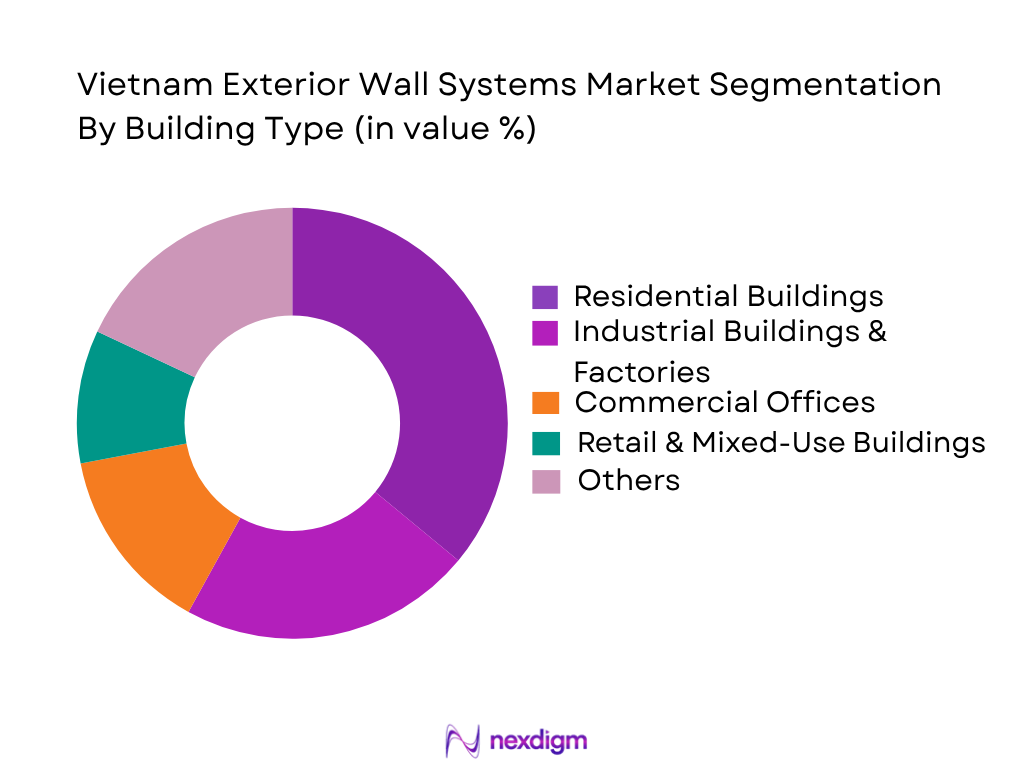
Vietnam Exterior Wall Systems Market is segmented into residential buildings, industrial buildings, commercial offices, retail and mixed-use developments, hospitality buildings, logistics facilities and institutional buildings. Residential buildings represent the dominant application because Vietnam’s urban housing requirement and continued metropolitan expansion create sustained demand for exterior masonry, fiber-cement panels, glazing, aluminum systems and decorative cladding. Industrial buildings form another strategically important segment because Vietnam has developed extensive manufacturing clusters around Binh Duong, Dong Nai, Bac Ninh, Hai Phong and other industrial provinces. Factories increasingly use pre-engineered construction, coated-steel walls and insulated panels because these systems facilitate rapid construction and large building envelopes. Commercial and hospitality developments create more specification-intensive demand for curtain walls, architectural glazing, stone, aluminum composite panels and ventilated façade solutions. Consequently, building type substantially influences product selection: residential demand emphasizes durability and weather protection, whereas premium commercial projects place greater weight on aesthetics, thermal performance and façade engineering.
Competitive Landscape
The Vietnam Exterior Wall Systems Market combines domestic construction-material producers with international building-envelope suppliers. Domestic groups have advantages in local manufacturing, steel, cementitious materials and nationwide distribution, while international suppliers compete through façade engineering, insulation, glazing, sealants and higher-performance building-envelope technologies. Competition therefore extends beyond individual cladding products toward integrated specifications covering fire resistance, thermal performance, weatherproofing, structural attachment, installation efficiency and lifecycle durability.
| Company | Established | Headquarters | Key Exterior Wall Products | Core Material Capability | Primary Building Applications | Envelope Technology | Vietnam Route-to-Market | Key Competitive Strength |
| Saint-Gobain | 1665 | Courbevoie, France | ~ | ~ | ~ | ~ | ~ | ~ |
| Viglacera | 1974 | Hanoi, Vietnam | ~ | ~ | ~ | ~ | ~ | ~ |
| Hoa Sen Group | 2001 | Ho Chi Minh City, Vietnam | ~ | ~ | ~ | ~ | ~ | ~ |
| NS BlueScope Vietnam | 1993* | Ba Ria–Vung Tau, Vietnam | ~ | ~ | ~ | ~ | ~ | ~ |
| Sika | 1910 | Baar, Switzerland | ~ | ~ | ~ | ~ | ~ | ~ |
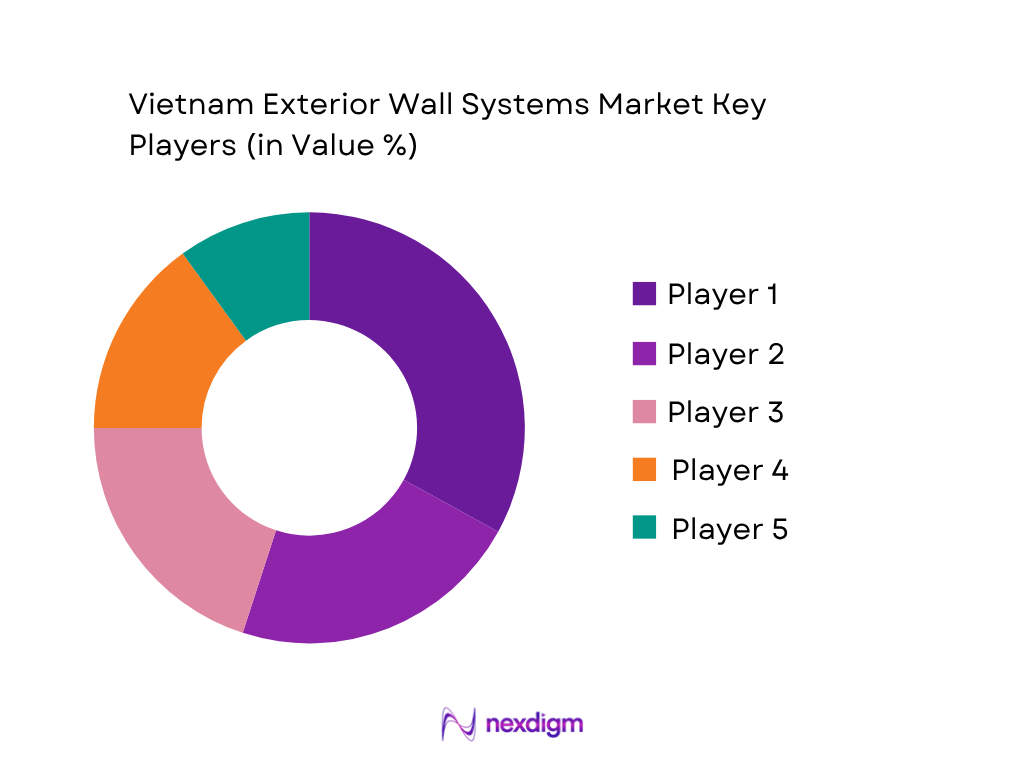
Vietnam Exterior Wall Systems Market Analysis
Growth Drivers
Expansion of Industrial and Manufacturing Construction
Vietnam’s expanding manufacturing base is directly strengthening demand for insulated metal panels, coated-steel façades, precast exterior walls, fiber-cement boards and other industrial exterior wall systems. In 2024, foreign investors registered USD 38.23 billion across new investment, additional capital and capital-contribution transactions, while realized foreign investment reached a record USD 25.35 billion. Processing and manufacturing attracted USD 25.58 billion of registered foreign capital, with 3,375 new foreign-invested projects approved nationally. Bac Ninh received USD 5.12 billion in foreign investment and Hai Phong more than USD 4.94 billion, reinforcing two major northern manufacturing clusters where factories and supporting industrial facilities require large exterior-envelope areas. Vietnam simultaneously recorded total social investment of VND 3,692.1 trillion, including VND 608.6 trillion from the foreign-invested sector. The country’s GDP reached USD 476.3 billion, providing a strong macroeconomic base for continued fixed-asset development. For exterior wall suppliers, these figures indicate a broad underlying pipeline of factories, electronics plants, supporting warehouses and industrial buildings requiring weather-resistant, rapidly installable and thermally efficient wall assemblies. Ministry of Planning and Investment
Urbanization and Construction Investment Supporting Building-Envelope Demand
Vietnam’s demographic and investment profile provides a substantial physical base for residential, commercial and institutional exterior wall demand. The country’s average population reached 101.3 million people in 2024, including 39.0 million urban residents, creating continued requirements for apartments, mixed-use buildings, offices and urban infrastructure. GDP reached VND 11,511.9 trillion, equivalent to USD 476.3 billion, while GDP per capita reached USD 4,700, an increase of USD 377 from the preceding year. Total investment across the economy reached VND 3,692.1 trillion, of which the non-state sector contributed VND 2,064.2 trillion and the state sector VND 1,019.3 trillion. Ho Chi Minh City alone recorded approximately VND 235,850 billion of investment in basic construction, illustrating the scale of construction-related capital deployment in Vietnam’s largest urban center. These conditions support demand for masonry façades, curtain walls, architectural glass, aluminum cladding, fiber-cement systems and weather-resistant exterior assemblies. Increasing urban density also favors higher-rise structures where façade engineering, moisture management and lightweight wall solutions become more technically important. NSO
Market Challenges
Dependence on Imported Industrial and Building-Envelope Inputs
Vietnam’s exterior wall systems industry operates within a construction-material supply chain that remains exposed to imported metals, polymers, machinery and specialized components. The country imported USD 380.76 billion of goods in 2024, including USD 356.43 billion of production materials. Iron and steel imports alone reached USD 12.6 billion, compared with USD 10.4 billion in the preceding year, while plastic-material imports reached USD 11.8 billion. Machinery, equipment, tools and related components accounted for another USD 48.9 billion of imports. These flows matter directly to sophisticated exterior-wall applications because curtain-wall hardware, façade machinery, aluminum-processing equipment, specialized coatings, polymer-based components and engineered fastening systems can depend on international supply chains. China alone supplied USD 144.3 billion of Vietnam’s total merchandise imports. At the same time, Vietnam’s GDP stood at USD 476.3 billion, meaning external industrial inputs remain significant relative to the scale of domestic economic activity. For façade contractors and system manufacturers, such dependence can complicate procurement schedules, inventory management and specification consistency, particularly for premium curtain walls, insulated panels and technically specialized building-envelope systems.
Skilled Construction Workforce and Execution Capacity Constraints
Exterior wall systems increasingly require specialist capabilities in façade engineering, curtain-wall installation, waterproofing, fire stopping, panel alignment, structural anchoring and building-envelope commissioning. Vietnam had a labor force of approximately 53.0 million people in 2024 and 51.9 million employed workers, but the industrial and construction sector accounted for approximately 17.4 million employed people. During the fourth quarter, industrial and construction employment reached 17.5 million, increasing by 458,600 workers from the previous quarter. Despite this large workforce, the increasing technical complexity of high-rise curtain walls, ventilated façades and insulated envelopes creates a requirement for specialized installation capabilities rather than general construction labor alone. The country’s population reached 101.3 million, while the urban population reached 39.0 million, sustaining a large pipeline of urban building requirements that must compete for trained technical personnel. Labor productivity across the economy reached approximately USD 9,182 per worker, increasing by USD 726 from the preceding year. Consequently, exterior wall manufacturers must increasingly complement product supply with technical design assistance, installation training, project supervision and quality-control systems to mitigate façade leakage, attachment and finishing risks.
Market Opportunities
Industrial Parks and FDI-Funded Facilities Creating Future Façade Demand
Vietnam’s existing foreign-investment base creates a strong platform for future demand for industrial exterior wall systems without requiring assumptions about future market values. At the end of 2024, Vietnam had 42,002 valid foreign-invested projects carrying approximately USD 502.8 billion in registered capital, while cumulative realized foreign investment stood near USD 322.5 billion. During 2024 alone, processing and manufacturing attracted approximately USD 25.58 billion, and realized foreign investment across the economy reached USD 25.35 billion. Investors deployed capital across 55 provinces and cities, demonstrating that industrial construction demand is geographically diversified rather than confined to Hanoi and Ho Chi Minh City. Bac Ninh attracted USD 5.12 billion, Hai Phong more than USD 4.94 billion, and Ho Chi Minh City approximately USD 3.04 billion. This investment footprint provides future opportunities for suppliers of insulated metal panels, coated-steel façades, prefabricated walls, fire-resistant insulation and lightweight exterior systems. Manufacturers able to serve industrial corridors with localized fabrication, engineering assistance and installation support can address factories, warehouses, clean-production buildings and supporting logistics properties generated by this established investment base.
Energy-Efficient Façades and Building Modernization Opportunity
Vietnam’s expanding urban economy creates an opportunity for higher-performance exterior wall systems that reduce building-envelope heat gain and improve durability under tropical climatic conditions. The country supported 39.0 million urban residents within a total population of 101.3 million in 2024, while GDP reached USD 476.3 billion and GDP per capita reached USD 4,700. Total social investment reached VND 3,692.1 trillion, including VND 2,064.2 trillion of non-state investment, providing a substantial capital base for private residential, commercial and industrial development. Government development-investment expenditure amounted to approximately VND 529.1 trillion, adding infrastructure and public-building activity to the construction ecosystem. Vietnam also had 233,419 enterprises entering or re-entering the market during 2024, including 76,179 enterprises returning to operation. For the exterior wall systems industry, this economic and urban development base creates room for insulated wall panels, ventilated rainscreens, fiber-cement façades, solar-control glazing, weather barriers and prefabricated envelope systems. Suppliers can particularly target new high-rise construction and existing-building modernization where thermal performance, moisture protection, installation speed and façade durability are increasingly important specification criteria.
Future Outlook
Vietnam Exterior Wall Systems Market is expected to develop alongside continued urban construction, industrialization, logistics infrastructure, factory investment and modernization of building-envelope standards. The forecast CAGR for 2026–2035 is represented as ~%, in accordance with the requested placeholder approach. Demand is expected to progressively shift toward higher-performing systems that integrate thermal insulation, fire safety, moisture control and faster installation.
Industrial construction should create substantial opportunities for insulated metal panels, coated-steel wall systems and prefabricated façades as manufacturers expand production facilities and logistics networks. Residential and mixed-use projects should sustain demand for masonry while simultaneously expanding opportunities for fiber cement, architectural glazing and lightweight cladding.
Major Players
- Saint-Gobain Vietnam
- Viglacera Corporation
- Hoa Sen Group
- Hoa Phat Group
- Nam Kim Steel
- Ton Dong A Corporation
- NS BlueScope Vietnam
- SCG
- Kingspan Group
- Knauf
- Sika
- Hilti
- AGC
- Alucobond
- ROCKWOOL Group
Key Target Audience
- Exterior Wall System Manufacturers
- Façade and Curtain Wall Fabricators
- Building Material and Cladding Manufacturers
- Property Developers and Real Estate Groups
- EPC Contractors and Construction Companies
- Industrial Park and Logistics Facility Developers
- Investments and Venture Capitalist Firms
- Government and Regulatory Bodies (Ministry of Construction, Vietnam Standards and Quality Institute, provincial Departments of Construction)
Research Methodology
Step 1: Identification of Key Variables
The initial phase develops a complete ecosystem map of the Vietnam Exterior Wall Systems Market, covering raw-material suppliers, façade manufacturers, fabricators, developers, contractors, architects and end users. Critical variables include installed façade area, construction pipeline, material penetration, domestic production, imports, building type, wall-system adoption and regional demand concentration.
Step 2: Market Analysis and Construction
Historical demand is assessed through construction activity, building completions, industrial development, façade installations and material consumption. Top-down construction indicators are reconciled with bottom-up estimates based on wall area, project categories, supplier portfolios and application patterns to establish the underlying structure of exterior-wall demand.
Step 3: Hypothesis Validation and Expert Consultation
Market hypotheses are validated through interviews with façade manufacturers, cladding suppliers, architects, building-envelope specialists, contractors, distributors and property developers. Discussions focus on material preferences, procurement criteria, project pipelines, installation practices, specification changes, import dependence, technical requirements and competitive positioning within Vietnam.
Step 4: Research Synthesis and Final Output
Primary findings are triangulated against construction indicators, company information, government publications, trade data and building-regulation developments. Supply-side and demand-side estimates are reconciled to produce segmentation, competitive analysis and forecasts while separately evaluating curtain walls, masonry, insulated panels, rainscreens and other exterior-envelope systems.

- Executive Summary
- Research Methodology (Market Definition and Scope, Exterior Wall System Classification, Façade Material Mapping, Curtain Wall Assessment, Rainscreen Cladding Analysis, Insulated Wall System Assessment, Masonry Wall Evaluation, Precast Concrete Façade Assessment, Fiber Cement Cladding Analysis, Metal Panel Assessment, Glass Façade Evaluation, Building Envelope Performance Mapping, Thermal Transmittance Assessment, Solar Heat Gain Assessment, Moisture and Weather Resistance Evaluation, Fire Performance Assessment, Acoustic Performance Evaluation, Wind Load Resistance Assessment, Façade Installation Analysis, Domestic Manufacturing Assessment, Import Dependency Analysis, Contractor and Fabricator Mapping, Supply-Side Assessment, Demand-Side Assessment, Top-Down Market Sizing, Bottom-Up Market Sizing, Primary Industry Interviews, Data Triangulation, Forecasting Framework, Limitations and Future Conclusions)

- Definition and Scope
- Vietnam Exterior Wall Systems Industry Evolution and Development of Conventional Masonry Walls, Reinforced Concrete Exterior Walls, Glass Curtain Walls, Aluminum Composite Panel Façades, Fiber Cement Cladding, Insulated Metal Panels, Rainscreen Systems, Precast Concrete Façades, Lightweight Exterior Wall Systems, Ventilated Façades, Energy-Efficient Building Envelopes and Prefabricated Façade Systems
- Exterior Wall Systems Value Chain Analysis
- Exterior Wall Systems Supply Chain Analysis
- Raw Material Suppliers, Aluminum Extrusion Producers, Flat Glass Processors, Coated Steel Producers, Cement and Fiber Cement Manufacturers, Insulation Material Suppliers, Sealant and Adhesive Suppliers, Façade System Manufacturers, Curtain Wall Fabricators, Cladding Panel Manufacturers, Architects, Façade Consultants, General Contractors, Installation Contractors, Property Developers, Building Owners and Facility Operators

- Growth Drivers (Expansion of Urban Residential Construction, High-Rise Commercial Development, Industrial Park and Factory Construction, Growth of Logistics and Warehousing Facilities, Demand for Energy-Efficient Building Envelopes, Adoption of Lightweight Façade Systems)
- Market Challenges (Raw Material Price Volatility, Imported High-Performance Façade Component Dependency, Complex Fire-Safety Compliance, Skilled Façade Installer Availability, Tropical Moisture and Weather Exposure, Wind-Load Engineering Requirements, Installation Quality Variability, Building Envelope Leakage Risk)
- Market Opportunities (Energy-Efficient Façade Retrofits, Ventilated Rainscreen Adoption, Prefabricated Exterior Wall Systems, Industrial and Logistics Building Envelopes, High-Performance Insulated Wall Systems, Fire-Resistant Cladding Solutions, Green Building Façades, Lightweight Fiber Cement Systems)
- Market Trends (Unitized Curtain Wall Adoption, Fiber Cement Cladding Expansion, Insulated Metal Panel Utilization, Low-E Glazing Integration, Prefabricated Façade Construction, Ventilated Façade Systems, Building Information Modeling Integration, High-Performance Weather Barriers)
- Government Regulations and Standards (QCVN 06 Fire Safety Requirements, QCVN 09 Energy-Efficient Building Requirements, Exterior Wall Fire Resistance, Façade Fire-Spread Prevention, Building Envelope Thermal Performance, Glazing Solar Heat Gain Requirements, Wind Load Design Requirements, Construction Material Quality Compliance) Chính phủ Việt Nam
- SWOT Analysis
- Porter’s Five Forces Analysis
- PESTLE Analysis
- Stakeholder Ecosystem
- Competition Ecosystem

- By Market Value (2020-2025)
- By Exterior Wall Installation Area (2020-2025)
- By Cladding and Façade Material Consumption Volume (2020-2025)
- By New Construction Exterior Wall Demand (2020-2025)
- By Renovation and Retrofit Exterior Wall Demand (2020-2025)
- By Curtain Wall Installation Area (2020-2025)
- By Metal and Composite Cladding Installation Area (2020-2025)
- By Fiber Cement Exterior Wall Installation Area (2020-2025)
- By Insulated Wall Panel Installation Area (2020-2025)
- By Residential and Non-Residential Exterior Wall Demand (2020-2025)

- By Wall System Type (In Value %)
Curtain Wall Systems
Rainscreen Façade Systems
Masonry Exterior Wall Systems
Precast Concrete Wall Systems
Insulated Wall Panel Systems
Lightweight Framed Exterior Walls
Ventilated Façade Systems
Exterior Insulation and Finish Systems
Prefabricated Exterior Wall Systems - By Exterior Material Type (In Value %)
Glass
Aluminum and Aluminum Composite Panels
Steel and Insulated Metal Panels
Fiber Cement Boards and Panels
Concrete and Precast Concrete
Brick and Masonry
Stone and Ceramic Cladding
High-Pressure Laminate Panels
Composite and Engineered Façade Materials - By Construction Type (In Value %)
New Construction
Building Renovation
Façade Replacement
Energy-Efficiency Retrofit
Commercial Building Refurbishment
Residential Building Rehabilitation - By Building Type (In Value %)
Residential Buildings
Office Buildings
Retail and Shopping Centers
Hotels and Hospitality Buildings
Industrial Buildings and Factories
Warehouses and Logistics Facilities
Hospitals and Healthcare Buildings
Educational Buildings
Mixed-Use Developments
Public and Institutional Buildings - By Installation Method (In Value %)
Unitized Curtain Wall Systems
Stick-Built Curtain Wall Systems
Mechanically Fixed Cladding
Adhesively Fixed Cladding
Dry-Hung Façade Systems
Wet-Applied Exterior Systems
Panelized and Prefabricated Wall Systems - By Region (In Value %)
Ho Chi Minh City
Hanoi
Binh Duong
Dong Nai
Hai Phong
Da Nang
Quang Ninh
Bac Ninh
Long An
Rest of Vietnam

- Market Share of Major Players (By Revenue, Exterior Wall System Type, Material Category, Building Type, Geographic Presence, Project Channel)
- Cross Comparison Parameters (Exterior Wall Product Portfolio Breadth, Fire-Resistance Capability, Thermal Insulation Performance, Weather and Moisture Resistance, Façade Engineering Capability, Prefabrication and Installation Capability, Building-Segment Coverage, Distribution and Contractor Network)
- SWOT Analysis of Major Players
- Competitive Positioning Matrix
- Major Companies
Saint-Gobain Vietnam
Viglacera Corporation
Hoa Sen Group
Hoa Phat Group
Nam Kim Steel
Ton Dong A Corporation
NS BlueScope Vietnam
SCG
Kingspan Group
Knauf
Sika
Hilti
AGC
Alucobond
Rockwool Group

- Property Developer Requirement Assessment
- Architect and Façade Designer Specification Analysis
- General Contractor Procurement Assessment
- Façade Contractor Requirement Analysis
- Residential Developer Exterior Wall Requirement Assessment
- Commercial Building Façade Demand Analysis
- Industrial and Logistics Facility Wall-System Requirement Assessment
- Hospitality Development Façade Requirement Analysis
- Renovation and Retrofit Customer Assessment
- Exterior Wall Product Attribute Assessment (Fire Resistance, Thermal Insulation, Weather Resistance, Acoustic Performance, Wind Resistance, Moisture Resistance, Durability, Installation Speed)

- By Market Value (2026-2035)
- By Exterior Wall Installation Area (2026-2035)
- By Cladding and Façade Material Consumption Volume (2026-2035)
- By New Construction Exterior Wall Demand (2026-2035)
- By Renovation and Retrofit Exterior Wall Demand (2026-2035)
- By Curtain Wall Installation Area (2026-2035)
- By Metal and Composite Cladding Installation Area (2026-2035)
- By Fiber Cement Exterior Wall Installation Area (2026-2035)
- By Insulated Wall Panel Installation Area (2026-2035)
- By Residential and Non-Residential Exterior Wall Demand (2026-2035)


 Request a Sample
 Ask for Customization
 Get a Quote
 Enquire Now