
 Download PDF
Market Overview
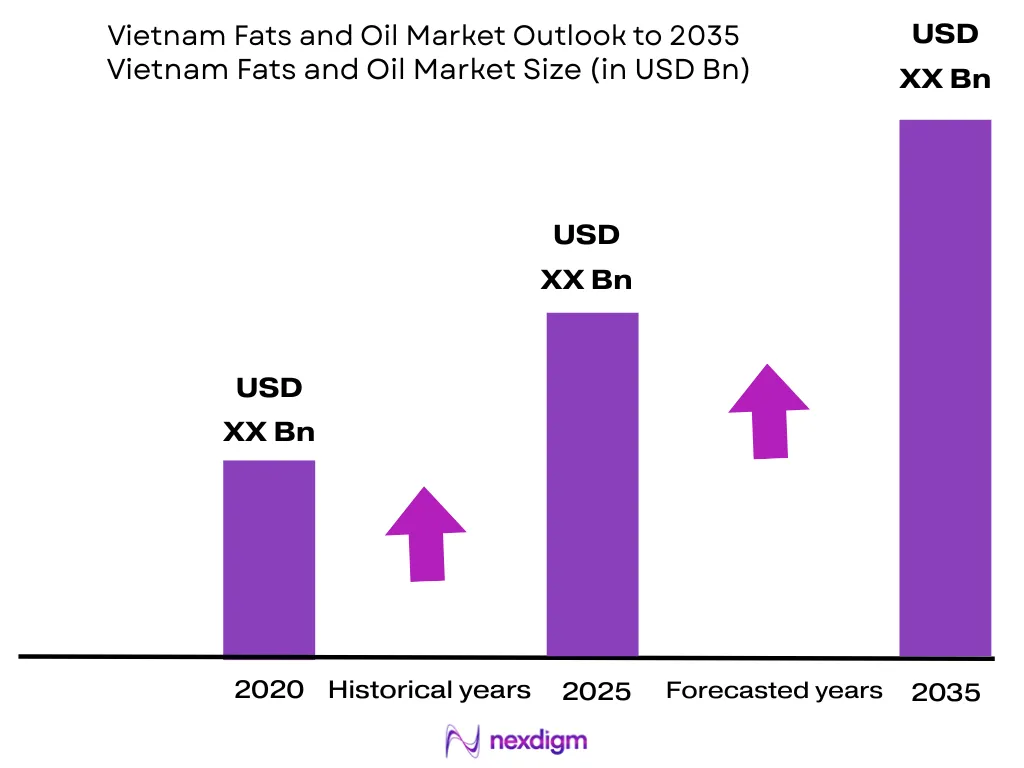
Vietnam Fats and Oil Market is valued at USD ~ billion, based on a five-year historical analysis, and is forecasted to grow at a CAGR of ~% during the forecast period. Demand is driven by palm oil, soybean oil, blended cooking oils, foodservice frying, instant noodles, bakery fats, confectionery, and packaged retail oils. Vietnam imported 1.073 million tons of palm oil after 1.110 million tons, while GDP reached USD 476.39 billion and GDP per capita reached USD 4,717.3. Ho Chi Minh City, Hanoi, Binh Duong, Dong Nai, Hai Phong, Can Tho, and Mekong Delta provinces dominate Vietnam Fats and Oil Market due to food manufacturing clusters, port access, modern retail density, street-food consumption, seafood processing, and coconut-linked value addition. Vietnam imported 81 thousand tons of soybean oil after 78 thousand tons and 14 thousand tons of rapeseed oil after 7 thousand tons, supporting refiners and distributors serving urban and industrial food demand.
Market Segmentation
By Product Type
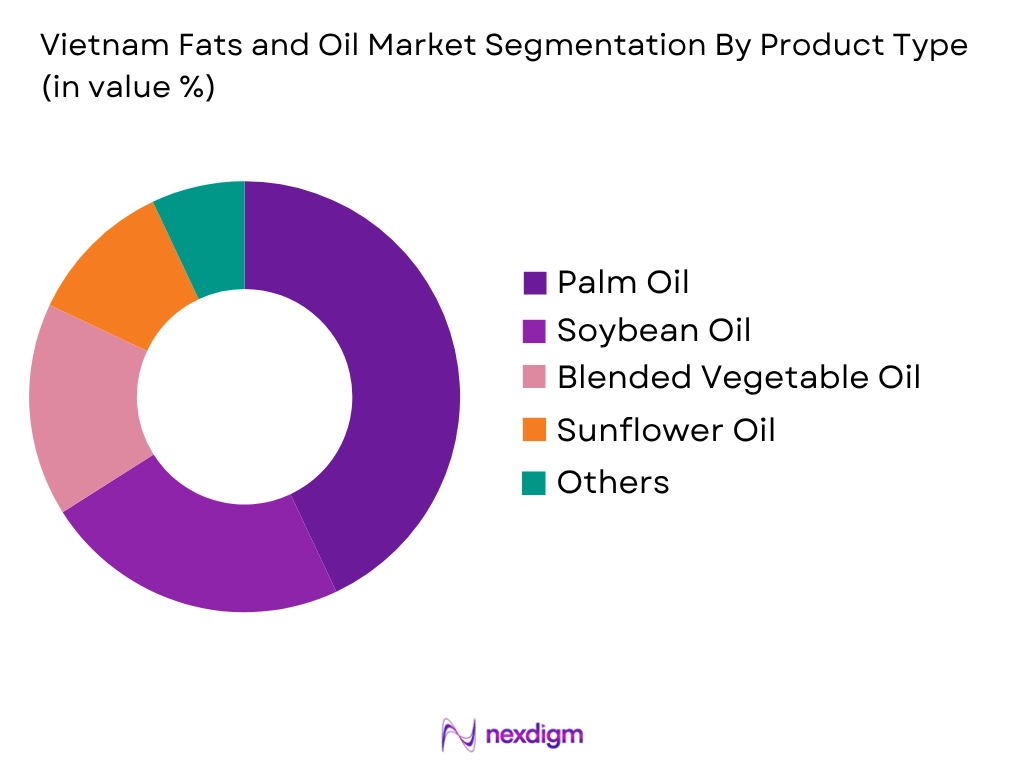
Vietnam Fats and Oil Market is segmented by product type into palm oil, soybean oil, blended vegetable oil, sunflower oil, canola oil, rice bran oil, peanut oil, coconut oil, sesame oil, olive oil, corn oil, lard, animal fats, fish oil, shortening, margarine, spreads, and specialty fats. Recently, palm oil has had the dominant market share under the product type segmentation due to its wide use in household cooking, industrial food processing, bakery, confectionery, street food, frying, and instant noodle manufacturing. Palm oil also benefits from established import flows from Indonesia and Malaysia, competitive functionality in semi-solid and frying applications, and large bulk procurement by processors. Soybean oil and blended vegetable oils remain important in packaged retail cooking oils, while sunflower, rice bran, and olive oil compete in health-positioned and premium segments. However, palm oil remains the broadest product base because it connects foodservice, manufacturing, refining, and lower-cost household usage.
By Distribution Channel
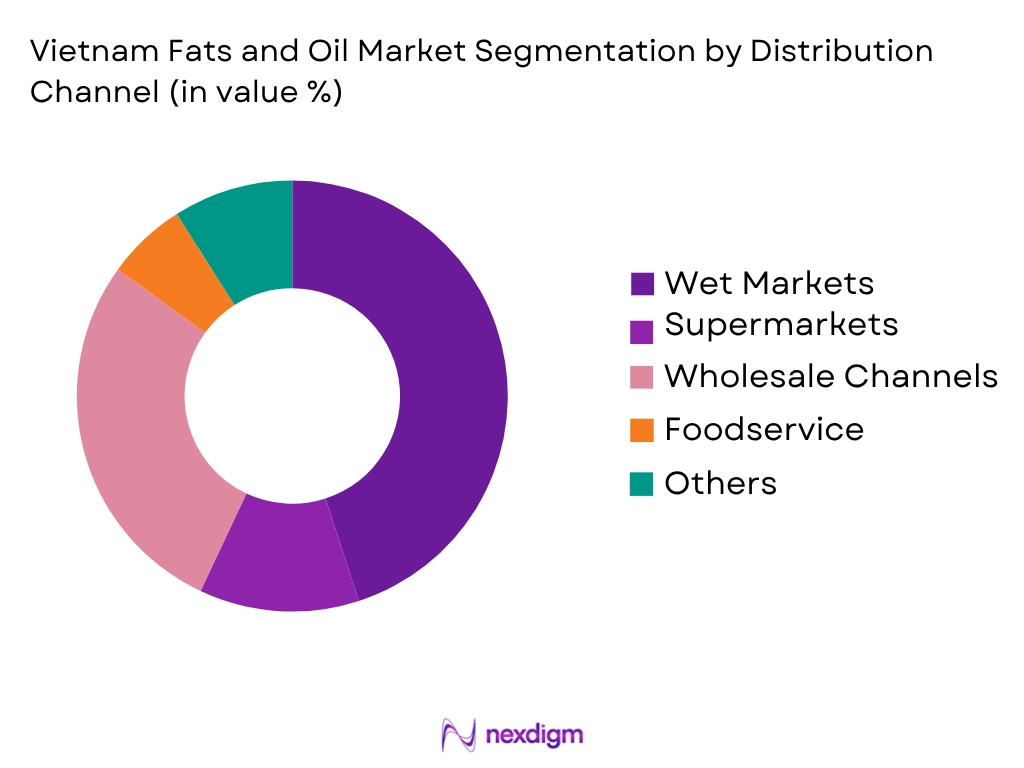
Vietnam Fats and Oil Market is segmented by distribution channel into traditional wet markets, independent grocery stores, modern trade supermarkets and hypermarkets, minimarts and convenience stores, cash-and-carry wholesalers, e-commerce, foodservice distributors, industrial ingredient suppliers, commodity traders, and direct bulk supply. Recently, traditional retail and independent grocery stores have had the dominant market share under the distribution channel segmentation because cooking oil is a high-frequency household staple purchased through neighborhood outlets, local markets, and small stores. These channels support economy cooking oils, family-size packs, regional brand loyalty, and price-sensitive buying. Modern trade is gaining importance in premium oils, health-positioned oils, and private labels, while foodservice distributors are critical for restaurants, street-food operators, hotels, QSR chains, and industrial kitchens. E-commerce remains smaller but is increasingly relevant for imported olive oil, rice bran oil, premium coconut oil, and multipack replenishment.
Competitive Landscape
Vietnam Fats and Oil Market is concentrated around a few strong domestic and joint-venture players, supported by imported palm oil, soybean oil, refining capacity, branded cooking oil portfolios, modern retail access, and industrial customer relationships. CALOFIC, Tuong An, KIDO Nha Be, Vocarimex, and Tan Binh are key companies because they have strong cooking oil brands, bottling networks, retail visibility, and foodservice or industrial relevance. KIDO’s portfolio includes Tuong An, Vocarimex, and KIDO Nha Be cooking oil products, while industry sources identify CALOFIC, Tuong An, KIDO-Nha Be, and Tan Binh as leading firms in Vietnam edible oils.
| Company | Establishment Year | Headquarters | Core Portfolio | Processing Strength | Key End Users | Channel Strength | Health / Premium Focus | Market-Specific Advantage |
| CALOFIC | 1996 | Ho Chi Minh City, Vietnam | ~ | ~ | ~ | ~ | ~ | ~ |
| Tuong An Vegetable Oil | 1977 | Ho Chi Minh City, Vietnam | ~ | ~ | ~ | ~ | ~ | ~ |
| KIDO Nha Be | 1971 legacy operations | Ho Chi Minh City, Vietnam | ~ | ~ | ~ | ~ | ~ | ~ |
| Vocarimex | 1976 | Ho Chi Minh City, Vietnam | ~ | ~ | ~ | ~ | ~ | ~ |
| Tan Binh Vegetable Oil | 1971 | Ho Chi Minh City, Vietnam | ~ | ~ | ~ | ~ | ~ | ~ |
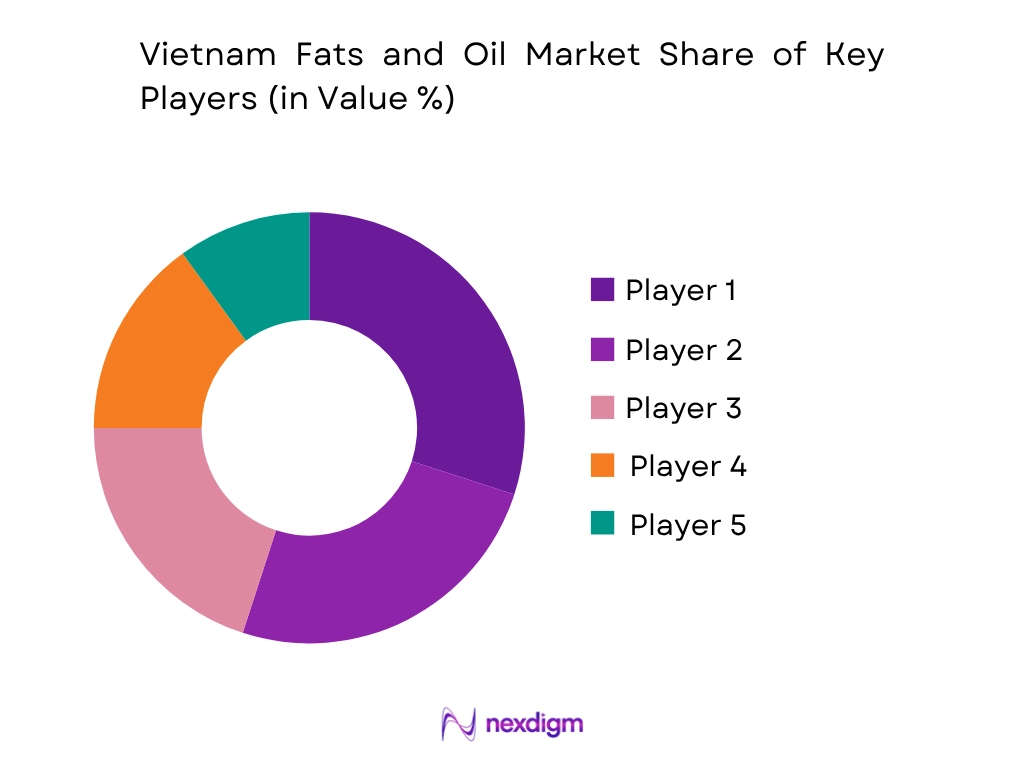
Vietnam Fats and Oil Market Analysis
Growth Drivers
Urban Household Cooking and Packaged Oil Demand
Urban household demand is a core growth driver for the Vietnam Fats and Oil Market because cooking oils are used daily across stir-frying, deep-frying, soups, sauces, home meals, street-food preparation, and small food businesses. World Bank data records Vietnam’s total population at 101,343,806 people, urban population at 38.49 out of every 100 people, GDP at USD 476.39 billion, and GDP per capita at USD 4,717.3. These macro indicators support demand for packaged palm oil, soybean oil, blended vegetable oil, rice bran oil, sunflower oil, coconut oil, and premium olive oil across Ho Chi Minh City, Hanoi, Da Nang, Binh Duong, Dong Nai, and Can Tho. USDA FAS records Vietnam palm oil imports at 1.073 million tons after 1.110 million tons, confirming the import base that supports household and retail supply. Urban consumers are also more likely to purchase branded bottles, family packs, cholesterol-free oils, and premium health-positioned oils through supermarkets, minimarts, convenience stores, and online grocery channels, which strengthens packaged edible oil penetration.
Food Processing and Foodservice Demand
Food processing and foodservice expansion drive the Vietnam Fats and Oil Market because palm oil, soybean oil, shortening, margarine, blended oils, lard, fish oil, and specialty fats are core inputs for instant noodles, snacks, bakery, confectionery, seafood processing, sauces, ready meals, restaurants, hotels, QSR chains, and street-food vendors. USDA FAS reports Vietnam palm oil imports at 1.073 million tons, soybean oil imports at 81 thousand tons after 78 thousand tons, and rapeseed oil imports at 14 thousand tons after 7 thousand tons, showing the scale of oil flows used by processors and distributors. Vietnam’s macroeconomic environment supports industrial demand, with World Bank data recording GDP at USD 476.39 billion and GDP growth at 7.09, while IMF lists Vietnam’s projected 2026 GDP at USD 538.86 billion and population at 102.207 million. These indicators show a growing manufacturing and consumer base. The market impact is direct because industrial food manufacturers require stable frying performance, neutral flavor, shelf-life support, texture control, food safety documentation, and consistent bulk oil availability.
Market Challenges
High Import Dependence and External Supply Exposure
High import dependence is a major challenge for the Vietnam Fats and Oil Market because the country relies heavily on imported palm oil, soybean oil, rapeseed oil, sunflower oil, olive oil, and other specialty oils to serve household, foodservice, and industrial demand. USDA FAS records palm oil imports at 1.073 million tons after 1.110 million tons, soybean oil imports at 81 thousand tons after 78 thousand tons, and rapeseed oil imports at 14 thousand tons after 7 thousand tons. These volumes show that domestic refiners, bottlers, food manufacturers, and foodservice distributors depend on international supply chains, especially Indonesia, Malaysia, and major soybean oil exporters. World Bank data records Vietnam’s population at 101,343,806 people and GDP at USD 476.39 billion, indicating a large consumption base that must be supplied without disruption. IMF lists the 2026 population at 102.207 million, reinforcing the demand scale. This creates operational risk for refiners and distributors because freight movement, port handling, currency movement, exporting-country policies, and crop availability can affect palm-soy-sunflower substitution and bulk supply continuity.
Traditional Retail Fragmentation and Food Safety Compliance
Traditional retail fragmentation and food safety compliance restrain the Vietnam Fats and Oil Market because cooking oil distribution remains spread across wet markets, independent groceries, wholesalers, small foodservice suppliers, minimarts, supermarkets, and industrial bulk channels. World Bank data records Vietnam’s population at 101,343,806 people and urban population at 38.49 out of every 100 people, meaning brands must serve both dense urban retail and dispersed provincial demand. This requires pack-size variety, distributor control, shelf visibility, product freshness, storage discipline, and consistent labeling across a large retail base. Vietnam’s food system is also linked to a growing economy, with World Bank data recording GDP at USD 476.39 billion and household final consumption expenditure at USD 266.24 billion. Food safety requirements increase operating complexity for edible oil companies because refined oils, blended oils, shortening, margarine, and specialty fats must meet labeling, ingredient declaration, import inspection, and product quality rules. For foodservice and industrial buyers, the challenge is ensuring traceability, safe storage, stable frying quality, and product authenticity across palm oil, soybean oil, rice bran oil, coconut oil, and premium imported oils.
Market Opportunities
Health-Positioned, Premium and Branded Oils
Health-positioned, premium, and branded oils create a strong opportunity for the Vietnam Fats and Oil Market because urban consumers and modern retailers are increasing demand for oils positioned around cholesterol-free claims, trans-fat-free formulation, omega profile, heart-health messaging, rice bran oil, coconut oil, olive oil, sunflower oil, and premium blended oils. World Bank data records GDP per capita at USD 4,717.3, population at 101,343,806 people, and internet users at 84 out of every 100 people, supporting modern retail discovery, digital grocery replenishment, and product comparison. USDA FAS records soybean oil imports at 81 thousand tons and rapeseed oil imports at 14 thousand tons, showing that non-palm oils already have a growing import base for diversification. Palm oil imports of 1.073 million tons also provide a foundation for blended and functional products. This opportunity is market specific because suppliers can move beyond economy cooking oils into higher-value packaged oils for supermarkets, minimarts, e-commerce, and affluent households while still serving mainstream demand through family-size bottles and value packs.
Industrial Specialty Fats and Foodservice Oil Solutions
Industrial specialty fats and foodservice oil solutions create future growth opportunities for the Vietnam Fats and Oil Market because food manufacturers and HoReCa buyers need oils tailored to frying stability, texture, shelf life, melting profile, neutral taste, and food safety documentation. USDA FAS records palm oil imports at 1.073 million tons and soybean oil imports at 81 thousand tons, confirming the feedstock base for bulk frying oils, shortening, margarine, bakery fats, confectionery fats, instant noodle oils, and snack-processing oils. Vietnam’s macroeconomic base supports this opportunity, with World Bank data recording GDP at USD 476.39 billion and foreign direct investment net inflows at USD 20.38 billion, while IMF lists 2026 GDP at USD 538.86 billion. These numbers indicate expanding manufacturing and investment capacity. The opportunity is market specific because industrial customers require reliable suppliers that can provide refined oil, palm olein, specialty fat blends, foodservice jugs, drums, bulk tanks, technical application support, traceability documentation, and consistent performance for instant noodles, bakery, snacks, seafood processing, restaurants, and QSR chains.
Future Outlook
Vietnam Fats and Oil Market is expected to show steady growth during the forecast period, supported by urban packaged oil demand, foodservice recovery, instant noodle manufacturing, bakery and confectionery growth, modern retail expansion, and premium health-oriented cooking oils. Palm oil will remain structurally important because it serves foodservice, bakery, confectionery, frying, and industrial food applications. The market will remain import-dependent because Vietnam relies on palm oil, soybean oil, sunflower oil, rapeseed oil, olive oil, and other edible oils from international suppliers. USDA notes that Indonesia and Malaysia are the main suppliers of palm oil, while soybean oil imports are driven by local consumption. This will keep procurement exposed to international crop conditions, freight, currency movement, and commodity price volatility.
Modern trade and minimarts will continue increasing the visibility of premium products such as rice bran oil, olive oil, sunflower oil, canola oil, and imported blended oils. Traditional trade will remain important for volume, while e-commerce will support premium discovery and household pantry replenishment. Companies with strong distribution breadth, family-oriented branding, pack-size variety, and price discipline will have an advantage. Food processing will be a central growth platform. Instant noodles, snacks, bakery products, sauces, condiments, seafood processing, and packaged foods require consistent frying stability, neutral flavor, texture performance, and bulk oil availability. Industrial buyers will increasingly demand supplier reliability, food safety documentation, traceability, and application-specific oil blends. Health positioning will shape future product development. Cholesterol-free claims, trans-fat-free formulations, omega-positioned oils, rice bran oil, coconut oil, olive oil, and lower-absorption frying oils are likely to gain space in urban retail. However, affordability will remain a constraint, requiring brands to balance health claims with mainstream price points.
Major Players
- Cai Lan Vegetable Oil Company
- Tuong An Vegetable Oil Company
- KIDO Group
- KIDO Nha Be
- Vocarimex
- Tan Binh Vegetable Oil
- Golden Hope Nha Be
- A Long Food
- Nakydaco
- CALOFIC
- Wilmar International Vietnam
- Sime Darby Oils Vietnam
- Louis Dreyfus Company Vietnam
- Cargill Vietnam
- Simply Cooking Oil
Key Target Audience
- Edible Oil Manufacturers
- Vegetable Oil Importers and Refiners
- Food Processing Companies
- Foodservice and QSR Operators
- Modern Trade and Minimart Buyers
- Industrial Ingredient Suppliers
- Investments and Venture Capitalist Firms
- Government and Regulatory Bodies (Ministry of Health Vietnam, Ministry of Industry and Trade, Ministry of Agriculture and Environment, General Department of Vietnam Customs, Directorate for Standards Metrology and Quality)
Research Methodology
Step 1: Identification of Key Variables
The initial phase involves constructing an ecosystem map encompassing all major stakeholders within the Vietnam Fats and Oil Market. This includes importers, refiners, blenders, bottlers, traditional retailers, modern grocery chains, foodservice distributors, industrial food manufacturers, port operators, packaging suppliers, and regulators. The objective is to identify variables such as product type, source, application, import dependency, processing format, channel mix, and regional demand clusters.
Step 2: Market Analysis and Construction
In this phase, historical data is compiled and analyzed for the Vietnam Fats and Oil Market. The assessment covers palm oil imports, soybean oil imports, rapeseed oil imports, coconut oil trade, packaged cooking oil movement, foodservice bulk oil demand, instant noodle and snack applications, and industrial fat usage. Top-down analysis uses trade and macroeconomic datasets, while bottom-up validation uses SKU checks, distributor mapping, and channel-level assessment.
Step 3: Hypothesis Validation and Expert Consultation
Market hypotheses are developed and validated through computer-assisted interviews with edible oil refiners, importers, packaged oil companies, supermarket buyers, minimart chains, foodservice distributors, HoReCa buyers, bakery ingredient suppliers, and industrial food manufacturers. These consultations provide operational insights into procurement, oil substitution, price sensitivity, brand recall, retail performance, food safety requirements, and application-specific product needs.
Step 4: Research Synthesis and Final Output
The final phase integrates desk research, trade data, retail checks, distributor interviews, foodservice buyer inputs, and regulatory assessment into a consolidated market model. Manufacturer inputs are compared with observed shelf presence, import flows, industrial demand indicators, and regional consumption patterns. The final output provides a validated view of market size, segmentation, competitive landscape, growth outlook, and strategic implications for Vietnam Fats and Oil Market.

- Executive Summary
- Research Methodology (Market Definitions and Assumptions, Abbreviations, Edible Fats and Oils Classification, Vegetable Oil and Animal Fat Inclusion Criteria, Packaged Cooking Oil vs Bulk Oil Inclusion Criteria, Palm Oil and Soybean Oil Import Mapping, Domestic Refining and Bottling Assessment, Retail vs Foodservice vs Industrial Demand Mapping, Market Sizing Approach, Top-Down Analysis, Bottom-Up Analysis, Demand-Side Assessment, Supply-Side Assessment, USDA Oilseed and Palm Oil Import Validation, Vietnam Customs Trade Flow Assessment, Retail SKU Audits, Distributor and Foodservice Channel Interviews, Industrial Ingredient Buyer Interviews, Primary Industry Interviews, Data Triangulation, Forecasting Framework, Limitations and Future Conclusions)

- Definition and Scope
- Market Evolution and Industry Genesis
- Timeline of Major Industry Developments
- Business Cycle and Seasonal Demand Pattern
- Vegetable Oil Import and Refining Value Chain Analysis

- Growth Drivers (Urban Household Packaged Oil Demand, Rising Foodservice and Street Food Consumption, Instant Noodle and Snack Manufacturing Demand, Imported Palm Oil Availability, Soybean Oil and Meal Processing Linkage, Modern Retail and Minimart Expansion, Health-Oriented Cooking Oil Positioning, Tourism and Hospitality Recovery, Packaged Food Manufacturing Growth)
- Market Challenges (High Import Dependency for Palm and Soft Oils, Palm Oil Price Volatility, Currency and Freight Exposure, Fragmented Traditional Retail, Consumer Price Sensitivity, Quality Differentiation Between Loose and Packaged Oils, Food Safety and Labeling Compliance, Supply Exposure to Indonesia, Malaysia, Argentina and Brazil, Premium Oil Affordability Constraints)
- Market Opportunities (Premium Blended Oils, Rice Bran Oil Expansion, Coconut Oil Value Addition, Foodservice Frying Oil Management, Sustainable Palm Oil Sourcing, Health-Positioned Retail Oils, E-Commerce Premium Oil Discovery, Industrial Specialty Fat Demand, Export-Oriented Fish Oil and Coconut Oil Processing, Modern Retail Private Label Expansion)
- Market Trends (Shift Toward Branded Packaged Cooking Oils, Palm-Soy-Sunflower Price Switching, Premiumization in Olive and Rice Bran Oils, Health Messaging Around Cholesterol-Free and Trans-Fat-Free Claims, Growth of Foodservice Bulk Packs, Imported Oil Portfolio Diversification, Minimart-Led Retail Penetration, Private Label Cooking Oils, Digital Grocery Replenishment)
- SWOT Analysis
- Porter’s Five Forces Analysis
- PESTLE Analysis

- By Market Value (2020-2025)
- By Volume Consumption (2020-2025)
- By Average Selling Price (2020-2025)

- By Product Type (In Value %)
Palm Oil
Soybean Oil
Blended Vegetable Oil
Sunflower Oil
Canola Oil - By Source Type (In Value %)
Vegetable Oils
Animal-Based Fats
Marine Oils
Blended Oils and Fats - By Distribution Channel (In Value %)
Traditional Wet Markets
Independent Grocery Stores
Modern Trade Supermarkets and Hypermarkets
Minimarts and Convenience Stores
- By Region (In Value %)
Northern Vietnam
Southern Vietnam
Central Vietnam
Mekong Delta
Red River Delta

- Market Share of Major Players (By Value, Volume, Product Type, Application, Channel, Source Type)
- Competitive Positioning Matrix (Refining Capacity, Import Sourcing Strength, Branded Cooking Oil Portfolio, Retail Distribution Reach, Traditional Trade Penetration, Modern Trade Visibility, Industrial Oil Capability, Health and Premium Oil Positioning)
- Cross Comparison Parameters (Refining and Bottling Capacity, Palm-Soy-Sunflower Portfolio Breadth, Branded Cooking Oil SKU Count, Traditional Trade Distribution Reach, Modern Retail and Minimart Presence, Foodservice Bulk Oil Capability, Health-Positioned Oil Portfolio, Import Sourcing and Port Logistics Strength)
- SWOT Analysis of Major Players
- Detailed Profiles of Major Companies
Cai Lan Vegetable Oil Company
Tuong An Vegetable Oil Company
KIDO Group
KIDO Nha Be
Vocarimex
Tan Binh Vegetable Oil
Golden Hope Nha Be
A Long Food
Nakydaco
CALOFIC
Wilmar International Vietnam
Sime Darby Oils Vietnam
Louis Dreyfus Company Vietnam
Cargill Vietnam
Simply Cooking Oil

- Household Consumption Behavior Assessment
- Regional Cooking Oil Preference Assessment
- Foodservice Demand Assessment
- Industrial Food Manufacturer Demand Assessment
- Health and Wellness Influence on Purchase Decisions

- By Market Value (2026-2035)
- By Volume Consumption (2026-2035)
- By Average Selling Price (2026-2035)


 Request a Sample
 Ask for Customization
 Get a Quote
 Enquire Now