
 Download PDF
Market Overview
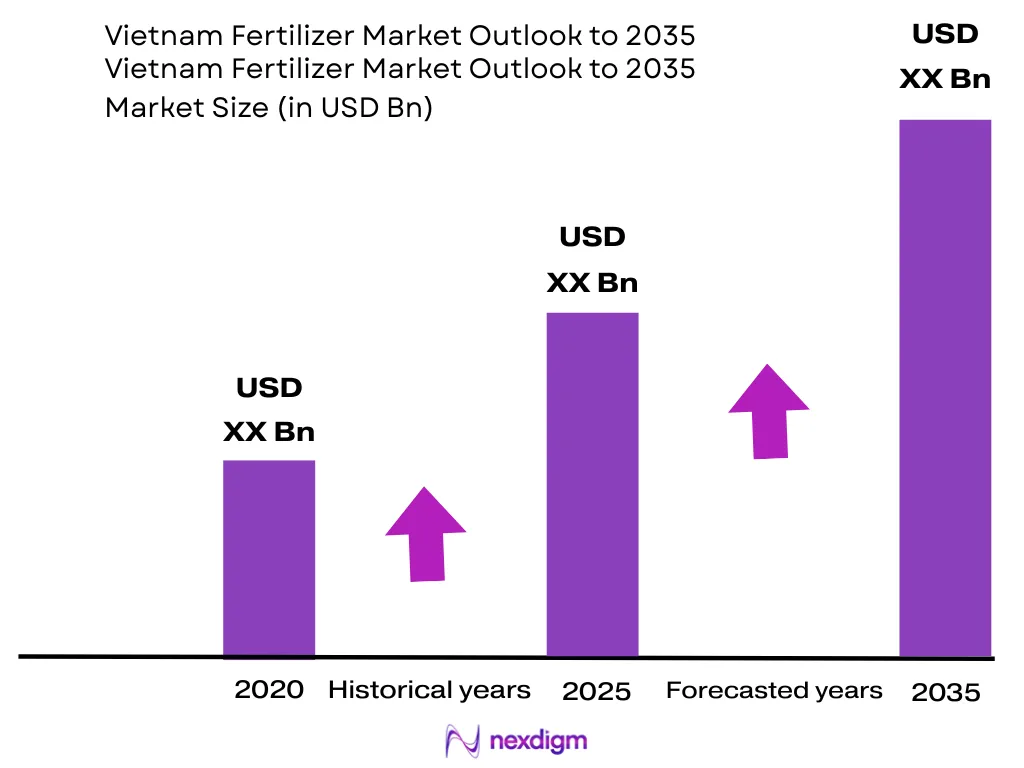
The Vietnam fertilizer market is one of the most dynamic agricultural input markets in Southeast Asia, supported by the country’s position as a leading producer and exporter of rice, coffee, rubber, cashew, and a wide range of tropical fruits and vegetables. Vietnam cultivated approximately 10 million hectares of agricultural land and produced over 43 million metric tons of food crops and export commodities, creating substantial demand for nutrient replenishment and soil fertility management. Fertilizer consumption reached approximately 11 million metric tons per year, driven by the intensive cultivation practices required to sustain high crop yields, expanding high-value export agriculture, rising demand for crop quality improvements, and government initiatives aimed at strengthening domestic fertilizer production and reducing import dependency. Vietnam’s agricultural sector accounts for approximately 12% of national GDP and supports the livelihoods of more than 40 million people in rural areas, making fertilizer availability and affordability a central element of national agricultural policy.
Market Segmentation
By Nutrient Type
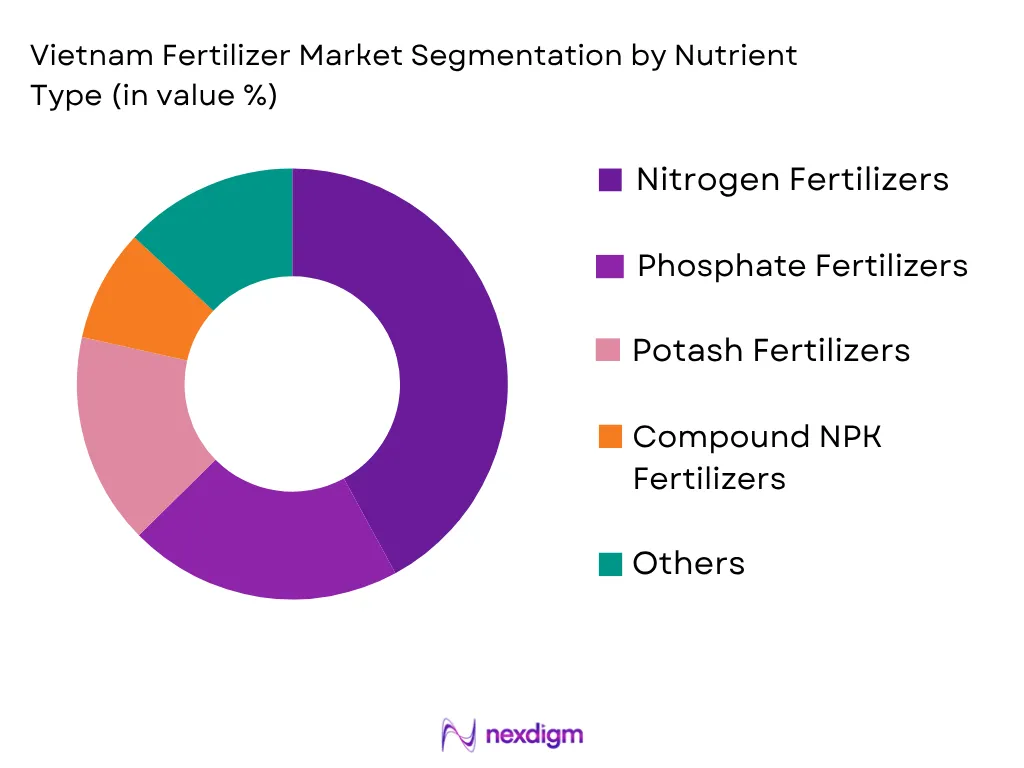
Nitrogen fertilizers dominate the Vietnam fertilizer market due to the country’s extensive cultivation of nitrogen-intensive crops such as rice, maize, sugarcane, and vegetables. Urea is the most widely consumed nitrogen product in Vietnam, supported by domestically produced supplies from the Phu My and Ca Mau fertilizer plants operated by PVFCCo and PVCFC respectively. Vietnam’s paddy cultivation, which covers approximately 7.2 million hectares across three growing seasons annually, requires intensive nitrogen applications to sustain yield levels necessary for both domestic food security and significant rice export volumes. Compound NPK fertilizers are also widely used across coffee, fruit, and vegetable cultivation, reflecting the growing sophistication of nutrient management practices among commercial farmers. Growing awareness of nutrient use efficiency and increasing adoption of foliar and fertigation solutions in high-value crop production are gradually diversifying demand within the nitrogen fertilizer segment.
By Crop Type
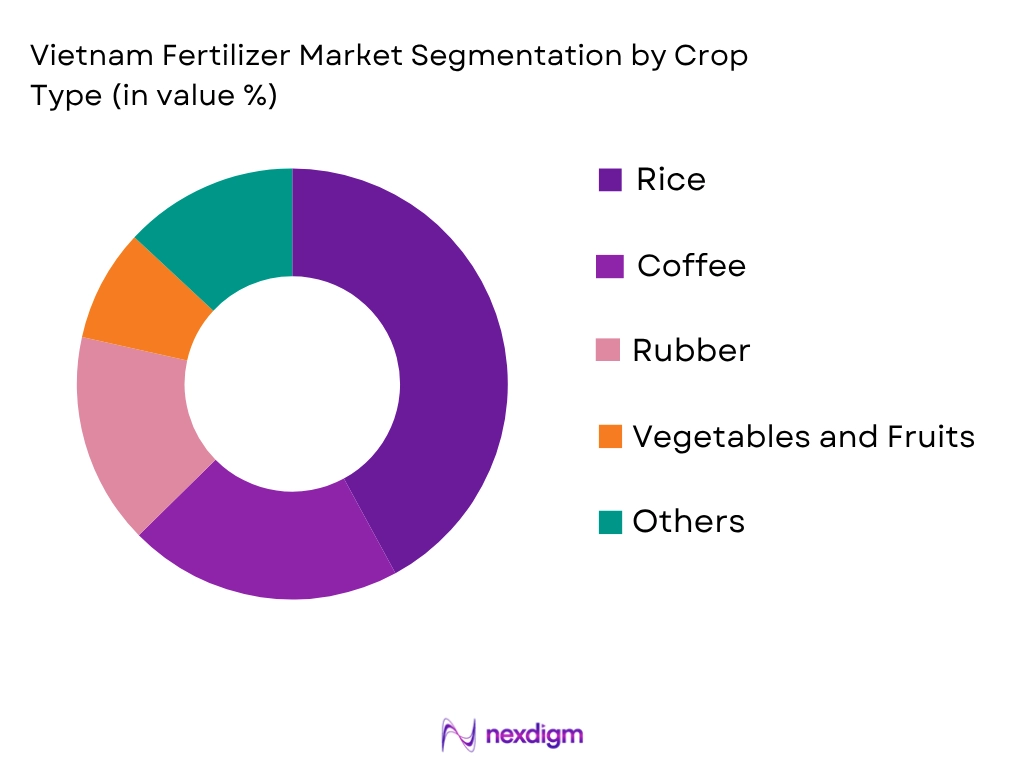
Rice represents the dominant crop segment within the Vietnam fertilizer market because it is the most extensively cultivated crop in the country, covering approximately 7.2 million hectares across the Red River Delta, the Mekong River Delta, and coastal agricultural regions. The crop requires significant applications of nitrogen, phosphate, potash, and micronutrient fertilizers across multiple growing cycles to sustain the productivity levels needed to support both national food security and Vietnam’s position as one of the world’s largest rice exporters. Smallholder rice farmers across the Mekong Delta depend heavily on fertilizer inputs to achieve commercially viable yields and maintain the quality standards required by export markets. Rising demand for high-quality rice varieties targeting premium international markets has further encouraged more precise and intensive nutrient management practices. Consequently, rice farming remains the single largest contributor to fertilizer consumption throughout Vietnam.
Competitive Landscape
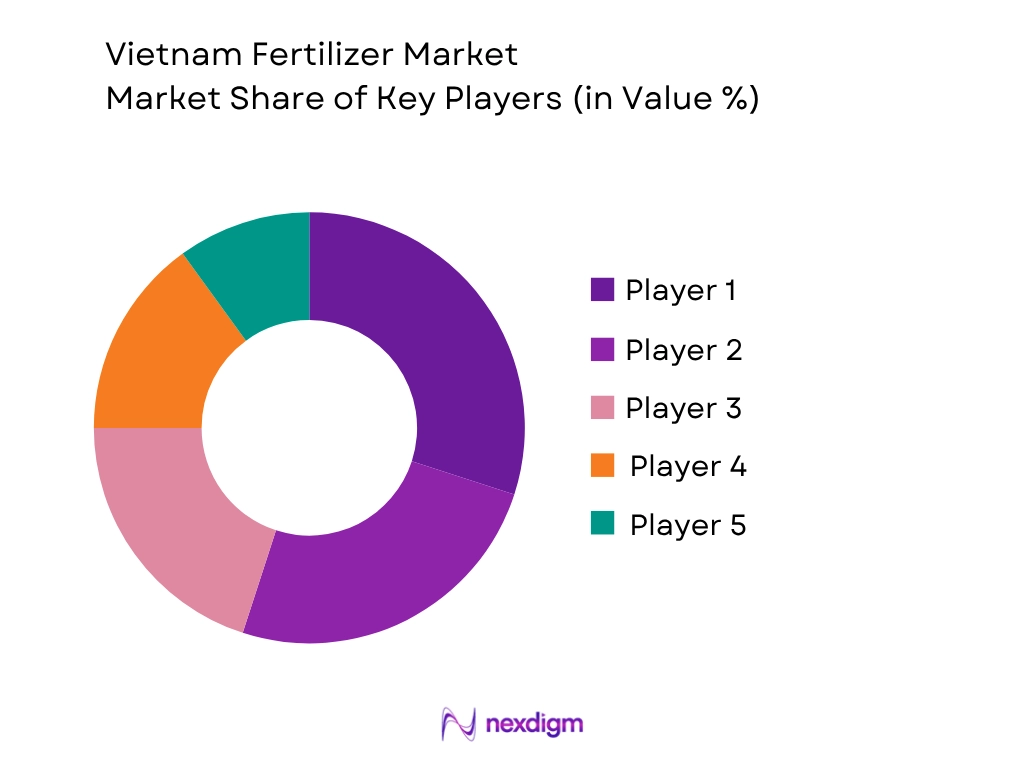
The Vietnam fertilizer market is characterized by the coexistence of state-owned enterprises, domestic private manufacturers, and multinational fertilizer companies competing across production, import distribution, and agricultural service activities. State-linked companies such as PVFCCo and PVCFC dominate the domestic nitrogen fertilizer supply, while private companies and multinationals compete in compound NPK, specialty, and imported fertilizer segments. Companies compete through distribution agent networks, agronomic support services, blending capabilities, import infrastructure, and crop-specific nutrient solutions. The proliferation of counterfeit and substandard fertilizer products has led to increased regulatory enforcement and quality certification requirements, further shaping competitive dynamics across the market.
| Company | Establishment Year | Headquarters | Product Portfolio | Production & Blending Facilities
|
Import Infrastructure | Distribution Reach | Specialty Fertilizer Portfolio | Agronomic Support Network |
| PVFCCo (Phu My) | 2003 | ~ | ~ | ~ | ~ | ~ | ~ | ~ |
| PVCFC (Ca Mau) | 2011 | ~ | ~ | ~ | ~ | ~ | ~ | ~ |
| Duc Giang Chemical Group | 1963 | ~ | ~ | ~ | ~ | ~ | ~ | ~ |
| Lam Thao Fertilizers | 1962 | ~ | ~ | ~ | ~ | ~ | ~ | ~ |
| Binh Dien Fertilizer | 1976 | ~ | ~ | ~ | ~ | ~ | ~ | ~ |
Vietnam Fertilizer Market Analysis
Growth Drivers
Expansion of Rice Cultivation and Export-Oriented Agricultural Production
The Vietnam fertilizer market continues to be driven by the sustained intensity of rice cultivation and the country’s expanding export-oriented agricultural sector. According to the Ministry of Agriculture and Rural Development (MARD), Vietnam’s total food crop output exceeded 43 million metric tons in 2024, with paddy rice production reaching approximately 43.5 million metric tons across an estimated 7.2 million hectares of cultivated land. Vietnam maintained its position as one of the world’s top three rice exporters, shipping approximately 8 million metric tons of rice in 2024, generating export revenues exceeding USD 5.5 billion according to the Vietnam Food Association. This export orientation requires farmers across the Mekong Delta and other major rice-growing regions to sustain high productivity through intensive fertilizer application programmes. Beyond rice, Vietnam is the world’s second-largest coffee producer, cultivating approximately 710,000 hectares primarily in the Central Highlands provinces of Dak Lak, Lam Dong, and Gia Lai, with coffee export revenues exceeding USD 5 billion in 2024. Coffee, rubber, cashew, and pepper plantations collectively consume substantial volumes of NPK compound fertilizers, micronutrients, and specialty foliar products. Vietnam’s GDP exceeded USD 430 billion in 2024 according to the World Bank, with agriculture contributing approximately 12% of national output, underscoring the sector’s ongoing importance and its structural demand for fertilizer inputs.
Rising Demand for High-Value Horticultural and Export Crop Production
The rapid expansion of high-value horticultural and export crop production is creating significant incremental fertilizer demand in Vietnam. According to MARD and the Vietnam Fruit and Vegetable Association (Vinafruit), Vietnam’s fruit and vegetable export revenues reached approximately USD 5.6 billion in 2024, driven by growing shipments of dragon fruit, durian, mango, longan, lychee, and fresh vegetables to China, the United States, South Korea, Japan, and the European Union. Durian alone emerged as the country’s largest single fruit export, with revenues exceeding USD 2.3 billion in 2024, driving intensive fertilizer use across expanding plantation areas in the Central Highlands and Southern provinces. These high-value crops require sophisticated nutrient management programmes incorporating compound NPK fertilizers, water-soluble fertilizers, calcium and boron supplements, and biological soil amendments. The Vietnam-EU Free Trade Agreement (EVFTA) and expanded trade relationships under RCEP are creating new market access opportunities that incentivize quality-focused production, driving demand for precision nutrition products. The growth of contract farming arrangements, agricultural cooperatives, and farmer linkage programmes with export processors is further professionalizing fertilizer use among commercial horticulture producers, increasing demand for premium specialty nutrient solutions across Vietnam’s rapidly modernizing agricultural sector.
Market Challenges
High Dependence on Imported Potash and Phosphate Raw Materials
A significant structural challenge facing the Vietnam fertilizer market is the country’s heavy dependence on imported potash and phosphate fertilizer materials. According to the General Department of Vietnam Customs and industry data from the Vietnam Fertilizer Association, Vietnam imports virtually all of its muriate of potash (MOP) and significant volumes of DAP, MAP, and phosphoric acid from international suppliers including Canada, Russia, Belarus, China, Morocco, and Saudi Arabia. Total fertilizer imports exceeded 4.5 million metric tons in 2024, with potash imports accounting for approximately 900,000 to 1 million metric tons annually. This dependence exposes Vietnamese farmers and importers to international commodity price volatility, currency fluctuations between the Vietnamese Dong and the US Dollar, and supply chain disruptions arising from geopolitical events. The global fertilizer price spike of 2021-2022, triggered by the Russia-Ukraine conflict and export restrictions by major producing countries, significantly increased input costs for Vietnamese farmers and squeezed agricultural profitability. While Vietnam possesses domestic apatite phosphate rock reserves in Lao Cai Province that support some superphosphate and fused magnesium phosphate production, the scale of domestic reserves is insufficient to meet the country’s total phosphate fertilizer requirements, reinforcing ongoing import dependency as a persistent market risk.
Proliferation of Counterfeit and Substandard Fertilizer Products
The proliferation of counterfeit, adulterated, and substandard fertilizer products represents a serious and persistent challenge within the Vietnam fertilizer market, undermining farmer confidence, reducing crop productivity, and damaging the reputation of legitimate manufacturers. According to MARD and the Plant Protection Department, inspections of fertilizer retail outlets and distribution points have consistently revealed significant proportions of products with incorrect declared nutrient contents, unauthorized additives, or falsified labeling. Estimates from industry associations suggest that counterfeit and substandard fertilizers may account for a substantial share of products circulating in certain rural retail channels, particularly in remote provinces with limited regulatory oversight. Smallholder farmers, who rely heavily on local retail agents and price-based purchasing decisions, are particularly vulnerable to counterfeit products that appear similar to legitimate branded fertilizers but deliver inferior agronomic performance. The Vietnamese Government has strengthened enforcement under the Law on Fertilizers 2019 and associated Decree 84/2019/ND-CP, introducing stricter registration, labeling, and quality certification requirements. However, enforcement capacity across a fragmented distribution network spanning thousands of retail agents and dealers across 63 provinces remains a significant operational challenge. Addressing counterfeit product proliferation requires sustained regulatory investment, industry collaboration, and farmer education programmes across Vietnam’s diverse agricultural regions.
Market Opportunities
Expansion of Specialty, Slow-Release, and Biofertilizer Products
The growing emphasis on sustainable agriculture, nutrient use efficiency, and compliance with international export market quality standards is creating strong opportunities for specialty fertilizer products in Vietnam. The country’s expanding high-value horticultural sector, covering more than 1.2 million hectares of fruits and vegetables, creates significant demand for water-soluble fertilizers, micronutrient blends, controlled-release NPK products, and fertigation solutions tailored to premium export crops. Slow-release and coated urea products are gaining traction in paddy rice cultivation as farmers seek to reduce the frequency of fertilizer applications and improve nitrogen use efficiency under Vietnam’s Sustainable Rice Platform (SRP) and the One Million Hectares of High-Quality, Low-Emission Rice programme. Biofertilizers incorporating beneficial microorganisms, organic matter, and biostimulants are receiving growing attention under MARD’s promotion of organic and biological farming inputs, supported by preferential treatment in government procurement and agricultural extension programmes. Additionally, the EVFTA and Japan-Vietnam EPA are creating export market incentives for reduced-chemical-input and organically certified agricultural products, driving demand for biological and organic fertilizer alternatives. These trends collectively position specialty and sustainable fertilizer categories for accelerated growth across Vietnam’s increasingly sophisticated and export-integrated agricultural sector.
Digital Agriculture Integration and Precision Nutrient Management
Vietnam’s rapidly increasing smartphone penetration, expanding rural internet connectivity, and growing adoption of digital agricultural platforms present significant opportunities for precision nutrient management and technology-enabled fertilizer services. According to the Ministry of Information and Communications, internet penetration in Vietnam exceeded 78% in 2024, with rural connectivity expanding rapidly under national digital transformation programmes. Digital platforms including agricultural advisory apps, e-commerce marketplaces for agricultural inputs, drone-based field monitoring services, and precision irrigation management tools are gaining adoption among progressive farmers and agricultural cooperatives. The Vietnam-based startup ecosystem and international technology companies are developing AI-powered soil analysis, crop monitoring, and fertilizer recommendation services that can guide more targeted nutrient applications, reducing input waste and improving profitability. Large fertilizer manufacturers including PVFCCo, PVCFC, and Binh Dien are investing in direct-to-farmer digital marketing and technical advisory services, reducing dependence on traditional retail agent distribution channels. Government digital agriculture initiatives under the National Digital Transformation Programme and the Ministry of Agriculture and Rural Development’s smart agriculture strategy are creating a supportive policy environment for technology-driven agricultural input services. These developments position digital agriculture and precision nutrition as high-growth opportunity segments within Vietnam’s evolving fertilizer market landscape.
Future Outlook
The Vietnam fertilizer market is expected to witness sustained growth over the forecast period due to expanding export-oriented agricultural production, increasing demand for crop quality improvements, rising adoption of precision farming technologies, and government initiatives promoting sustainable and efficient nutrient management. The One Million Hectares of High-Quality, Low-Emission Rice programme and the national organic agriculture development strategy are expected to gradually shift consumption patterns toward more efficient and environmentally compliant fertilizer products. Rising demand for specialty fertilizers, biological solutions, water-soluble products, and slow-release nutrient technologies will further diversify and develop the market. Additionally, continued investment in domestic fertilizer production capacity, digital agriculture integration, and strengthened regulatory enforcement against counterfeit products is likely to improve market quality and strengthen long-term growth prospects across Vietnam’s agricultural sector through 2035.
Major Players
- Petrovietnam Ca Mau Fertilizer Joint Stock Company (PVCFC)
- Petrovietnam Phu My Fertilizer Joint Stock Company (PVFCCo)
- Duc Giang Chemical Group
- Lam Thao Fertilizers and Chemicals
- Southern Fertilizer Company (Vinacam)
- Ha Bac Nitrogen Fertilizers and Chemicals
- Van Dien Fused Magnesium Phosphate
- Binh Dien Fertilizer Joint Stock Company
- Yara Vietnam
- Nutrien Vietnam
- ICL Vietnam
- Compo Expert Vietnam
- Haifa Group Vietnam
- EuroChem Vietnam
- Bayer CropScience Vietnam
Key Target Audience
- Fertilizer Manufacturers
- Agricultural Input Distributors and Retailers
- Commercial Farming Enterprises and Agricultural Cooperatives
- Agribusiness and Plantation Enterprises
- Investments and Venture Capitalist Firms
- Government and Regulatory Bodies (Ministry of Agriculture and Rural Development, Ministry of Industry and Trade, Plant Protection Department, Vietnam Fertilizer Association)
- Fertilizer Importers and Exporters
- Precision Agriculture Technology Providers
Research Methodology
Step 1: Identification of Key Variables
The initial phase involves constructing an ecosystem map encompassing all major stakeholders within the Vietnam Fertilizer Market. Extensive secondary research is conducted through industry publications, government databases, company annual reports, trade associations, and agricultural statistics. The objective is to identify critical variables influencing fertilizer demand, supply, pricing, imports, and crop production.
Step 2: Market Analysis and Construction
This phase focuses on gathering and analyzing historical information regarding fertilizer production, imports, nutrient consumption, crop acreage, and agricultural output. Market revenues are estimated through analysis of fertilizer volumes, average selling prices, and nutrient demand trends. Both supply-side and demand-side assessments are incorporated to develop comprehensive market estimates.
Step 3: Hypothesis Validation and Expert Consultation
Preliminary findings and market assumptions are validated through structured interviews with fertilizer manufacturers, distributors, agricultural cooperatives, agronomists, and industry specialists. These consultations provide valuable insights into purchasing patterns, nutrient application trends, production economics, and future market developments.
Step 4: Research Synthesis and Final Output
The final stage integrates findings obtained from primary and secondary research. Data triangulation techniques are applied to ensure consistency and reliability across all market estimates. The resulting report provides a comprehensive assessment of market structure, competitive dynamics, growth opportunities, and long-term industry outlook for the Vietnam Fertilizer Market.

- Executive Summary
- Research Methodology (Market Definitions and Assumptions, Abbreviations, Market Sizing Approach, Top-Down Analysis, Bottom-Up Analysis, Fertilizer Demand Assessment by Crop Area, Nutrient Consumption Analysis, Import-Export Assessment, Primary Industry Interviews, Data Triangulation, Forecasting Framework, Limitations and Future Conclusions)

- Definition and Scope
- Market Evolution and Industry Genesis
- Timeline of Major Industry Developments
- Vietnam Agricultural Production Ecosystem
- Fertilizer Industry Value Chain Analysis

- Growth Drivers (Expansion of Rice and Coffee Cultivation, Rising Yield Optimization Requirements, Increasing Adoption of Precision Agriculture, Government Support for Domestic Fertilizer Production, Growth in High-Value Export Agriculture, Rising Rural Income and Agricultural Investment)
- Market Challenges (High Dependence on Imported Potash and Phosphate, Volatility in Global Fertilizer Prices, Counterfeit and Low-Quality Fertilizer Proliferation, Environmental Compliance Pressures, Fragmented Smallholder Farming Structure)
- Market Opportunities (Expansion of Specialty and Slow-Release Fertilizer Products, Biofertilizer and Organic Fertilizer Development, Growth in High-Value Horticultural Crop Nutrition, Precision Nutrient Management Solutions, Digital Agricultural Platform Integration)
- Market Trends (Increased Use of Compound and Complex Fertilizers, Digital Agriculture Integration, Customized Nutrient Blends for Export Crops, Environmentally Compliant Crop Nutrition, Expansion of Biological Inputs and Biostimulants)
- Government Regulations (Law on Fertilizers 2019, Decree 84/2019/ND-CP on Fertilizer Management, National Target Programme for New Rural Development, Ministry of Agriculture and Rural Development (MARD) Quality Standards, Import and Trade Policies)
- Import Dependency Assessment (Potash Import Ratio, Phosphate Import Ratio, Nitrogen Import Ratio, Supplier Country Concentration)
- Raw Material Analysis (Natural Gas Availability, Phosphate Rock Supply, Potash Reserves, Sulfur Availability)
- Fertilizer Consumption Intensity Analysis (Kg per Hectare, Nutrient Use Efficiency, Crop-Wise Consumption, Regional Application Rates)
- Price Trend Analysis (Urea Prices, DAP Prices, MOP Prices, NPK Prices, SSP Prices)
- Supply-Demand Gap Analysis (Domestic Production Capacity, Installed Capacity Utilization, Import Requirements, Inventory Levels)
- SWOT Analysis
- Porter’s Five Forces Analysis
- PESTLE Analysis
- Stakeholder Ecosystem
- Competition Ecosystem

- By Market Value (2020-2025)
- By Production Volume (2020-2025)
- By Average Selling Price (2020-2025)

- By Nutrient Type (In Value %)
Nitrogen Fertilizers
Phosphate Fertilizers
Potash Fertilizers
Secondary Nutrient Fertilizers
Micronutrient Fertilizers
Specialty and Customized Fertilizers - By Application Method (In Value %)
Soil Application
Fertigation
Foliar Application
Seed Treatment
Precision Agriculture Application - By Crop Type (In Value %)
Rice
Coffee
Rubber
Vegetables and Fruits
Sugarcane
Maize
Cashew
Tea
Others - By Region (In Value %)
Red River Delta
Mekong River Delta
Central Highlands
North Central and Central Coastal Areas
Northeast and Northwest
Southeast - By Distribution Channel (In Value %)
Agricultural Cooperatives
Agricultural Retailers and Agents
Direct Sales by Manufacturers
Distributors and Wholesalers
Digital Agricultural Platforms

- Market Share Analysis of Major Players (By Value, By Volume, Nutrient Segment, Crop Segment, By Region)
- Market Concentration Analysis
- Cross Comparison Parameters (Product Portfolio Diversity, Annual Fertilizer Production Capacity, Blending Capacity, Import Terminal Infrastructure, Distribution Network Reach, Agronomic Technical Service Coverage, Specialty Fertilizer Portfolio Strength, Crop-Specific Nutrient Solution Capability)
- SWOT Analysis of Major Players
- Pricing Analysis by Product Type and Nutrient Grade
- Detailed Profiles of Major Companies
Petrovietnam Ca Mau Fertilizer Joint Stock Company (PVCFC)
Petrovietnam Phu My Fertilizer Joint Stock Company (PVFCCo)
Duc Giang Chemical Group
Lam Thao Fertilizers and Chemicals
Southern Fertilizer Company (Vinacam)
Ha Bac Nitrogen Fertilizers and Chemicals
Van Dien Fused Magnesium Phosphate
Binh Dien Fertilizer Joint Stock Company
Yara Vietnam
Nutrien Vietnam
ICL Vietnam
Compo Expert Vietnam
Haifa Group Vietnam
EuroChem Vietnam
Bayer CropScience Vietnam

- Crop Nutrient Consumption Assessment (Crop Area, Yield Targets, Nutrient Removal Rates, Fertilizer Intensity)
- Farm Size Analysis (Smallholder Farms, Medium Farms, Large Plantation Estates)
- Purchasing Power Analysis (Farm Income Levels, Credit Availability, Fertilizer Budget Allocation)
- Seasonal Demand Assessment (Winter-Spring Crop, Summer-Autumn Crop, Autumn-Winter Crop, Procurement Patterns)
- Farmer Purchasing Behavior (Brand Preference, Nutrient Preference, Price Sensitivity)
- Precision Agriculture Adoption Analysis (GPS-Based Application, Variable Rate Technology, Digital Farm Management)
- Sustainability Adoption Analysis (Carbon Reduction Practices, Soil Health Management, Sustainable Rice Platform)
- Pain Point Analysis (Input Costs, Counterfeit Product Risk, Logistics Challenges, Agronomic Support)
- Purchase Decision-Making Process

- By Market Value (2026-2035)
- By Production Volume (2026-2035)
- By Average Selling Price (2026-2035)


 Request a Sample
 Ask for Customization
 Get a Quote
 Enquire Now