

 Download PDF
Market Overview
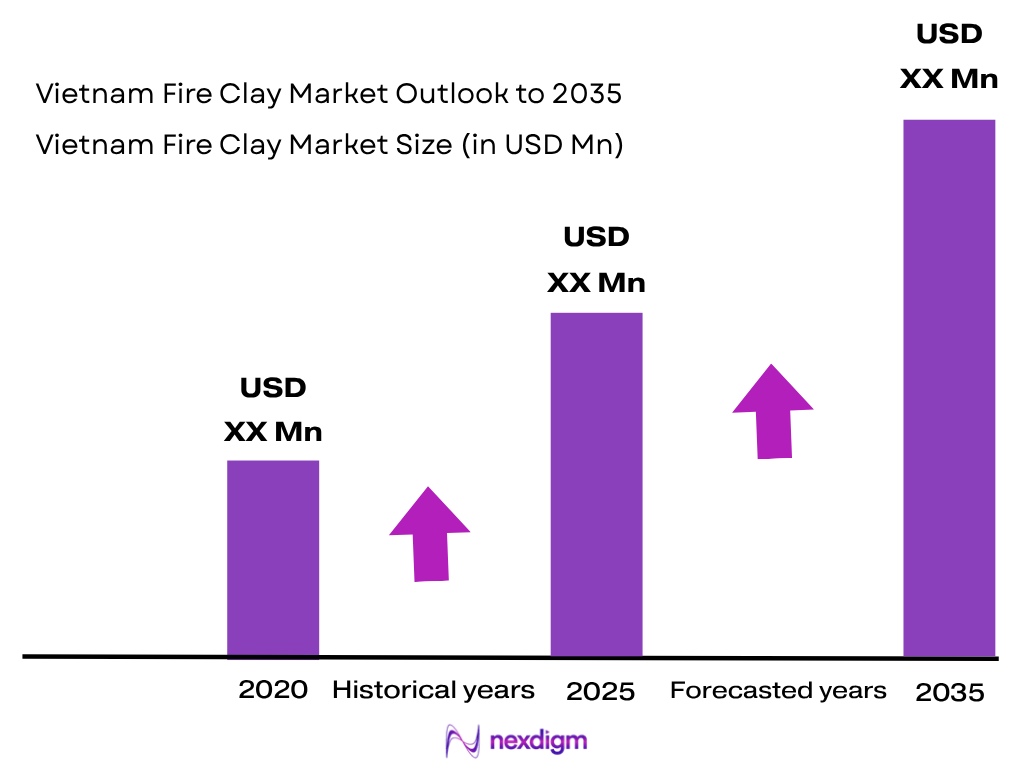
The Vietnam Fire Clay Market is estimated at USD ~XX million in 2024, compared with USD ~XX million in 2023, with the market supported primarily by refractory consumption in steel, cement, ceramics, glass and other high-temperature industrial applications. Vietnam’s industrial production environment provides an important downstream base: the Ministry of Industry and Trade reported that the country’s industrial production index increased 8.4% in 2024, while manufacturing and processing expanded by approximately 9.6%. Fire clay demand is consequently linked to furnace, kiln and refractory-material requirements across Vietnam’s expanding industrial ecosystem.
The Vietnam Fire Clay Market is concentrated around major industrial and manufacturing clusters rather than being evenly distributed across the country. Hanoi and the Red River Delta provide proximity to refractory manufacturers and industrial-furnace users, while Hai Phong and Quang Ninh benefit from ports, heavy industry and construction-material activity. Binh Duong, Dong Nai and Ba Ria–Vung Tau form another important southern industrial cluster with manufacturing and materials-processing activities. Viglacera, for example, operates extensive construction-material manufacturing infrastructure, while Novaref supplies refractory solutions to steel, cement, power and other industrial furnaces.
Market Segmentation
By Grade Type
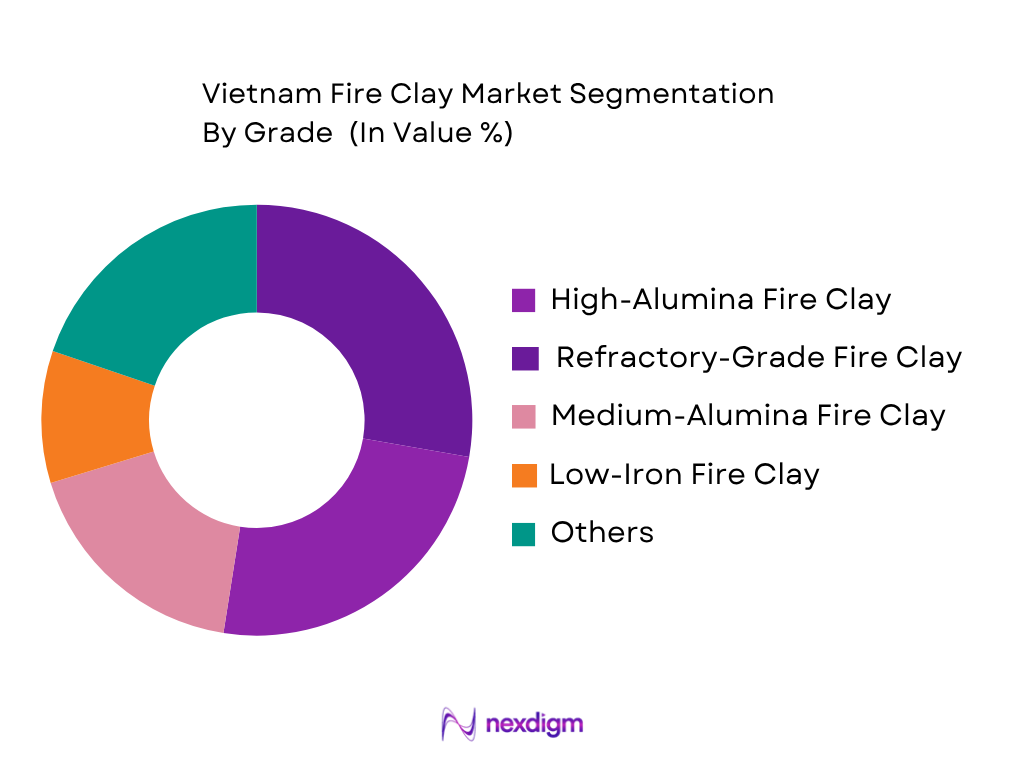
The Vietnam Fire Clay Market is segmented by grade type into refractory-grade fire clay, high-alumina fire clay, plastic fire clay, semi-plastic fire clay, non-plastic fire clay, low-iron fire clay, high-refractoriness fire clay, standard fire clay, blended fire clay and processed refractory-grade fire clay. Refractory-grade fire clay is expected to represent the dominant sub-segment because its chemical and thermal characteristics make it suitable for manufacturing products exposed to high temperatures, including furnace and kiln linings, refractory bricks and refractory mixes. Demand is closely connected with Vietnam’s steel and cement industries, where industrial furnaces require materials capable of maintaining structural integrity under thermal cycling. Novaref identifies iron and steel, cement kilns, power-plant boilers, waste-to-energy incinerators, aluminum furnaces and other industrial furnaces among its refractory applications. Its production infrastructure includes dedicated lines for refractory castables, gunning mixes, plastic and ramming mixes and other refractory products. The preference for consistent alumina content, controlled impurities and predictable refractory performance also makes processed and higher-quality fire clay relevant to industrial buyers seeking stable furnace operating conditions.
By End-Use Industry
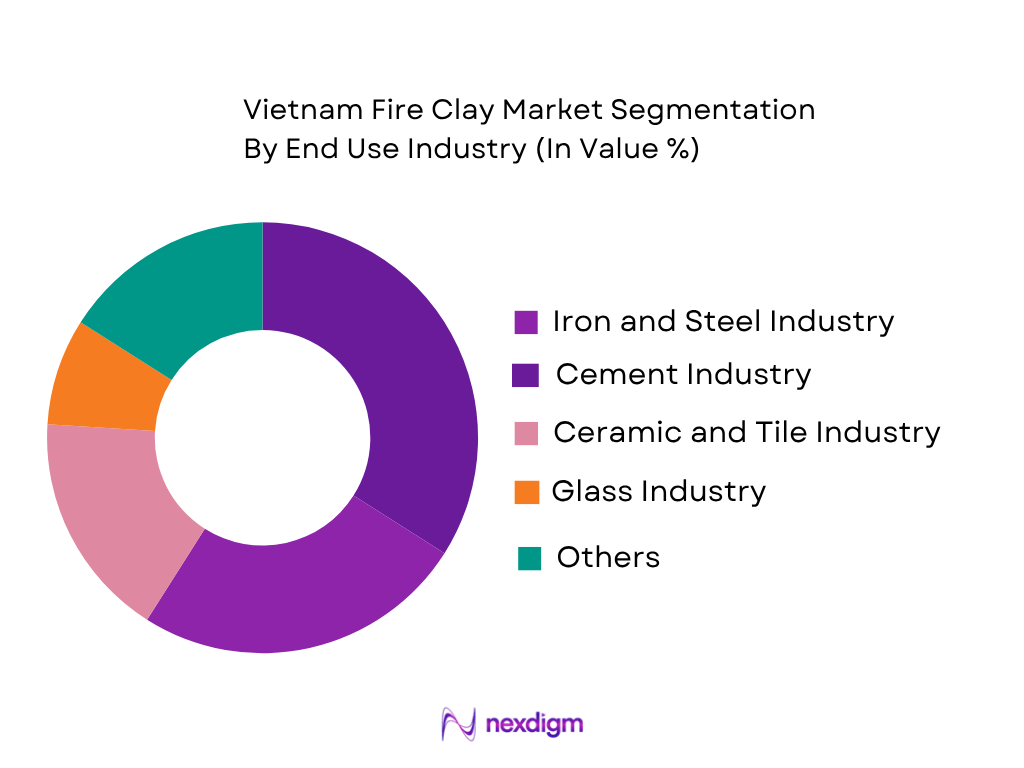
The Vietnam Fire Clay Market is segmented by end-use industry into iron and steel, cement, ceramics, glass, foundry, non-ferrous metallurgy, industrial furnaces, brick and tile manufacturing, chemical processing and other high-temperature industries. Iron and steel represents a major demand segment because refractory systems are essential across high-temperature metallurgical processes, including furnaces, ladles and associated thermal equipment. Vietnam’s broader industrial recovery strengthens this application base: manufacturing and processing recorded approximately 9.6% growth in 2024, while the Ministry of Industry and Trade identified metal production among the industrial sectors showing strong expansion during the year. Fire clay therefore enters the market through refractory manufacturers rather than only through direct raw-clay consumption. Novaref specifically supplies refractory solutions to iron and steel operations and cement kilns, while Vinaref provides refractory products for steelmaking, coke and pig-iron production and cement rotary kilns. This diversified furnace exposure creates recurring requirements for refractory raw materials with controlled physical and chemical properties. Cement and ceramic production provide additional demand because kilns require thermal-resistant linings and refractory components.
Competitive Landscape
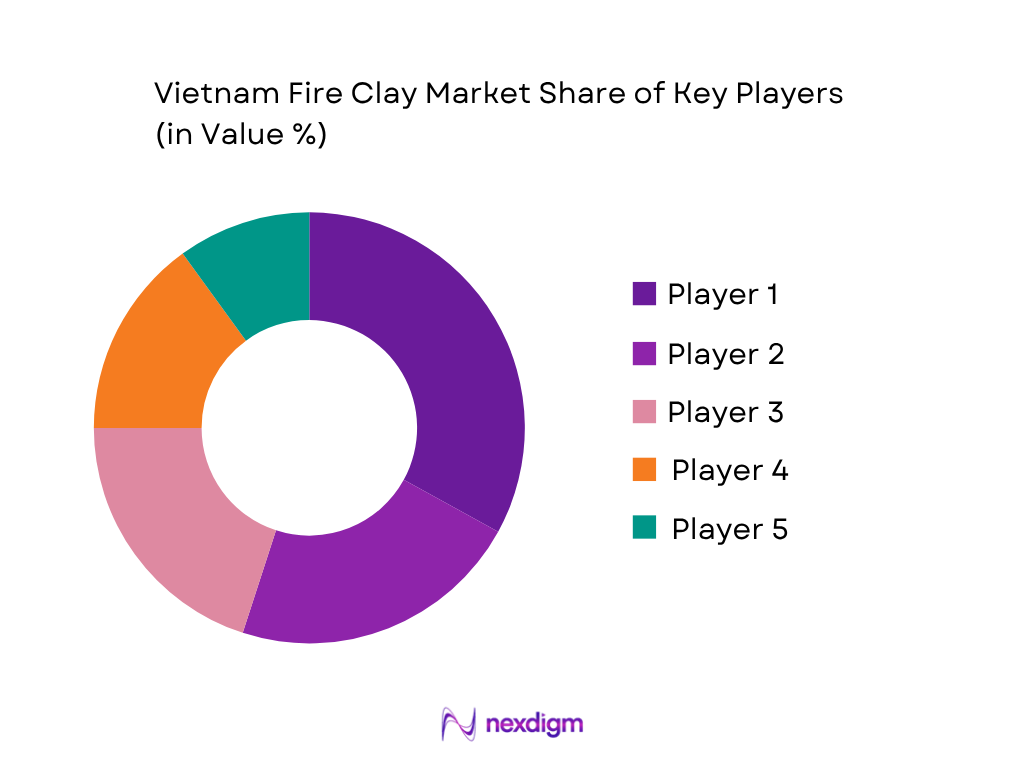
The Vietnam Fire Clay Market operates through a combination of domestic refractory manufacturers, construction-material producers, industrial furnace solution providers and international refractory groups. Competition is influenced by access to suitable raw materials, refractory formulation capability, furnace-specific technical expertise, manufacturing capacity and relationships with steel, cement, ceramic and other industrial customers. Novaref maintains dedicated refractory production facilities and supplies steel, cement and other furnace applications, while Vinaref provides specialized refractory products for steel, coke, pig iron and cement operations. Viglacera provides an important construction-material ecosystem with 31 industrial factories, including ceramic and fired-clay products.
| Major Player | Establishment Year | Headquarters | Fire Clay/Refractory Focus | Key Customer Industries | Product Capability | Manufacturing Presence | Market-Specific Strength |
| Novaref | ~2000s | Hanoi, Vietnam | ~ | ~ | ~ | ~ | ~ |
| Vinaref | ~2000s | Vietnam | ~ | ~ | ~ | ~ | ~ |
| Viglacera | 1974 | Hanoi, Vietnam | ~ | ~ | ~ | ~ | ~ |
| RHI Magnesita | 1834 | Vienna, Austria | ~ | ~ | ~ | ~ | ~ |
| Vesuvius | 1916 | London, UK | ~ | ~ | ~ | ~ | ~ |
Vietnam Fire Clay Market Analysis
Growth Drivers
Expansion of Steelmaking Capacity
Expansion of Vietnam’s steelmaking activity is a direct demand driver for the Fire Clay Market because steel production requires refractory linings, bricks, castables and furnace components capable of operating under extreme thermal conditions. Vietnam produced 22.0 million tonnes of crude steel in 2024, compared with 19.2 million tonnes in 2023, according to the World Steel Association. This additional production volume supports recurring consumption of refractory materials across blast furnaces, electric-arc furnaces, ladles, reheating furnaces and related equipment. Vietnam’s industrial environment also strengthened materially, with the General Statistics Office reporting 8.4% growth in the industrial production index in 2024, compared with 1.3% in 2023, while manufacturing and processing increased 9.6%, compared with 1.5% previously. Steelmaking therefore represents an important downstream application for fire-clay-derived refractory products, particularly where aluminosilicate formulations are suitable for furnace structures and auxiliary equipment. The country’s steel industry also benefits from increasing construction and manufacturing activity, creating interconnected demand for steel products and refractory maintenance. For fire-clay suppliers, the expansion of steel output supports opportunities for consistent-quality refractory raw materials, while refractory manufacturers increasingly require controlled alumina content, low impurity levels and predictable thermal performance. The combination of higher steel production and stronger industrial utilization strengthens the underlying consumption base for refractory-grade fire clay in Vietnam.
Growth of Cement and Clinker Production
Cement and clinker production provide a substantial downstream driver for the Vietnam Fire Clay Market because rotary kilns, preheaters, coolers and associated thermal-processing equipment require refractory materials capable of resisting high temperatures, abrasion and repeated thermal cycling. The Ministry of Construction reported that Vietnam’s cement and clinker consumption reached approximately 95 million tonnes in 2024, including approximately 65.3 million tonnes of domestic consumption and 29.7 million tonnes of exports. The country also has a large installed cement-manufacturing base, with production lines operating across multiple provinces and supporting sustained requirements for kiln maintenance materials. Fire clay is relevant primarily through refractory products manufactured from aluminosilicate raw materials rather than as a direct cement ingredient. Vietnam’s wider industrial activity reinforces this demand relationship: the General Statistics Office recorded 8.4% growth in industrial production in 2024, while the manufacturing and processing sector increased 9.6%. Cement plants therefore remain important consumers within the refractory ecosystem because kiln shutdowns and maintenance cycles require replacement of worn refractory components. The Ministry of Construction has also identified cement as a strategically important construction-material industry, linking its production and consumption with infrastructure and construction activity. Continued operation of the existing kiln base, together with requirements for refractory maintenance and thermal efficiency, creates recurring demand for suitable fire-clay grades and processed aluminosilicate refractory inputs.
Market Challenges
Limited Availability and Quality Variability of High-Grade Fire Clay
Limited availability of consistently high-grade fire clay can constrain the development of Vietnam’s domestic refractory raw-material supply chain. The challenge is particularly relevant because refractory manufacturers require predictable chemical and physical characteristics, including controlled alumina content, low iron and alkali impurities, suitable plasticity and stable firing behavior. Vietnam’s mining sector contracted 6.5% in 2024, according to the General Statistics Office, even as overall industrial production increased 8.4%. This divergence indicates that downstream industrial demand can expand while domestic extractive activity faces structural constraints. The country’s 2024 geological administration program also involved delineating national mineral-reserve areas, with the geological authority reporting confirmation from 19 of 26 provinces concerning delineated national mineral reserve areas. In addition, 8 areas containing dispersed and small-scale minerals were submitted for approval and publication during the year. These figures illustrate the continuing administrative and geological work required to identify and manage mineral resources. For fire clay, resource heterogeneity can result in differences in mineralogical composition between deposits, requiring additional beneficiation, blending or quality-control processes before material can meet refractory specifications. Producers therefore face challenges in securing dependable feedstock at consistent quality, while refractory manufacturers must qualify individual sources according to technical performance. This can increase supply-chain complexity and limit the ability of smaller domestic suppliers to serve demanding industrial refractory applications consistently.
Environmental Compliance and Mining-Permit Requirements
Environmental compliance and mining-permit requirements represent important challenges for Vietnam’s Fire Clay Market because commercial extraction requires regulatory control over geological resources, land use, environmental impacts and mine development. Vietnam introduced the Law on Geology and Minerals 2024, containing 12 chapters and 111 articles, establishing an updated legal framework for geological investigation, mineral management and exploitation. The regulatory framework emphasizes efficient resource utilization and environmental protection, which can increase the technical and administrative requirements associated with developing new clay resources. Vietnam’s geological authority also reported that mineral-reserve management activities involved 19 provinces confirming information relating to national mineral-reserve areas, while 8 dispersed and small-scale mineral areas were submitted for approval and publication during 2024. These activities demonstrate the extent of government involvement in identifying, classifying and managing mineral resources. For fire-clay producers, compliance requirements can influence exploration schedules, mine development, environmental approvals, land access and operating continuity. The challenge becomes more significant where deposits are relatively small or geographically concentrated because additional regulatory and environmental requirements can affect project feasibility. At the same time, downstream refractory manufacturers require reliable raw-material supply, creating pressure for miners to maintain continuity while meeting environmental standards. Consequently, regulatory compliance is not only a permitting issue but also an operational factor affecting the availability and scalability of domestic fire-clay production.
Market Opportunities
Domestic Refractory Raw-Material Development and Import Substitution
Development of domestic refractory-grade raw materials presents an opportunity for the Vietnam Fire Clay Market as industrial users continue to require dependable inputs for high-temperature applications. Vietnam’s manufacturing and processing sector expanded 9.6% in 2024, while total industrial production increased 8.4%, creating a broader industrial base for steel, cement, ceramics, glass and other furnace-dependent industries. Vietnam’s crude-steel production reached 22.0 million tonnes in 2024, while cement and clinker consumption reached approximately 95 million tonnes, illustrating the scale of downstream industries that depend on refractory systems. These industries create an opportunity for domestic producers to develop higher-quality fire clay capable of meeting refractory manufacturers’ specifications. The opportunity is particularly relevant for processed materials because beneficiation, classification, blending and calcination can improve consistency and enable lower-grade domestic resources to be converted into more technically suitable inputs. Vietnam’s geological administration has also continued systematic resource investigation, including 8 dispersed and small-scale mineral areas submitted for approval during 2024. Such resource-development activity can support greater identification and characterization of mineral deposits. For the domestic fire-clay industry, stronger integration between geological investigation, mining, mineral processing and refractory manufacturing could reduce supply-chain dependence on external sources and create a more integrated mine-to-refractory ecosystem. The opportunity therefore extends beyond raw-clay extraction toward value-added processing and specification-controlled refractory feedstock.
Calcined Fire Clay and Higher-Value Refractory Products
Expansion into calcined fire clay and higher-value refractory products provides an opportunity to move Vietnam’s fire-clay industry toward greater processing intensity and application-specific materials. Calcination can modify the physical characteristics of clay and produce a more controlled refractory raw material suitable for selected brick, castable and monolithic-refractory formulations. The opportunity is supported by Vietnam’s substantial downstream industrial base: the country produced 22.0 million tonnes of crude steel in 2024, while the construction-ceramics sector maintained designed capacity of 850 million m² of ceramic tiles and 26 million sanitary-ceramic products. The General Statistics Office also recorded 9.6% growth in manufacturing and processing during 2024. These industrial activities require thermal equipment operating under demanding temperature and wear conditions, creating a market environment in which refractory performance and raw-material consistency are increasingly important. Domestic producers can therefore target higher-value applications by controlling alumina content, particle-size distribution, moisture, impurity levels and calcination characteristics rather than supplying only unprocessed clay. The development of processed fire clay could also allow refractory manufacturers to formulate products for specific kiln and furnace requirements across steel, cement, ceramics and other industries. This creates an opportunity for greater vertical integration between mineral extraction, processing and refractory manufacturing while supporting more reliable domestic supply.
Future Outlook
Over the forecast period, the Vietnam Fire Clay Market is expected to develop alongside the country’s industrial manufacturing, steel, cement, ceramic and high-temperature processing ecosystem. Demand will increasingly depend on refractory performance requirements rather than raw clay availability alone. Higher-quality grades, controlled chemical composition, beneficiation and processed refractory inputs are expected to become more important for industrial buyers. Domestic refractory manufacturers can also strengthen their position through integrated raw-material procurement, formulation and furnace-service capabilities. Vietnam’s industrial base provides a significant underlying demand platform. Industrial production increased 8.4% in 2024, while manufacturing and processing increased approximately 9.6%. Government policy continues to emphasize industrial production, construction materials and the development of domestic manufacturing capabilities.
Major Players
- Novaref Refractory Development Joint Stock Company
- Vietnam Refractory Materials Co., Ltd. (Vinaref)
- Viglacera Corporation
- Hoa Phat Group
- RHI Magnesita
- Vesuvius
- Saint-Gobain Performance Ceramics & Refractories
- Calderys
- Krosaki Harima Corporation
- Shinagawa Refractories Co., Ltd.
- IFGL Refractories Limited
- HarbisonWalker International
- Morgan Advanced Materials
- Chosun Refractories
- Refra S.A.
Key Target Audience
- Steel manufacturers and metallurgical furnace operators
- Cement and clinker manufacturers
- Ceramic, tile and sanitaryware manufacturers
- Refractory manufacturers and industrial furnace solution providers
- Mining and mineral-processing companies
- Investments and venture capitalist firms
- Government and regulatory bodies (Ministry of Industry and Trade, Ministry of Construction, Ministry of Natural Resources and Environment)
- Industrial equipment and furnace manufacturers
Research Methodology
Step 1: Identification of Key Variables
The initial phase involves constructing a Vietnam Fire Clay Market ecosystem covering mineral suppliers, processors, refractory manufacturers, steel producers, cement plants, ceramic manufacturers and industrial-furnace operators. Secondary research is used to identify fire-clay applications, geological supply considerations, refractory-grade specifications, import dependencies and downstream industrial demand.
Step 2: Market Analysis and Construction
Historical market information is compiled through production, consumption, import-export, industrial-production and downstream-industry indicators. The analysis evaluates fire-clay demand according to grade, application and end-use industry while reconciling raw-material flows with refractory manufacturing and industrial furnace consumption.
Step 3: Hypothesis Validation and Expert Consultation
Market hypotheses are validated through discussions with refractory producers, raw-material suppliers, furnace operators, steel manufacturers, cement producers and ceramic manufacturers. Interviews focus on procurement specifications, grade preferences, application requirements, supplier selection, replacement cycles and the influence of imported refractory materials.
Step 4: Research Synthesis and Final Output
The final research stage integrates primary and secondary findings into a unified market model. Bottom-up demand estimates are cross-checked against industrial production indicators, company capabilities, import-export information and downstream consumption patterns to improve consistency across market size, segmentation and competitive analysis.

- Executive Summary
- Research Methodology (Market Definition and Scope, Fire Clay Classification Framework, Refractory-Grade Fire Clay Assessment, Geological Resource Mapping, Market Sizing Approach, Top-Down Analysis, Bottom-Up Analysis, Demand-Side Assessment, Supply-Side Assessment, Primary Industry Interviews, Import-Export Validation, Production and Consumption Reconciliation, Data Triangulation, Forecasting Framework, Market Limitations and Conclusions)

- Definition and Scope
- Fire Clay Geological Occurrence
- Fire Clay Industry Evolution
- Fire Clay Value Chain Analysis
- Fire Clay Supply Chain Analysis
- Vietnam Fire Clay Production Ecosystem

- Growth Drivers (Expansion of Steelmaking Capacity, Cement and Clinker Production, Industrial Furnace Deployment, Ceramic Manufacturing Growth, Domestic Refractory Consumption, Infrastructure-Linked Construction Materials, Growth of High-Temperature Processing Industries, Increasing Requirement for Refractory-Grade Raw Materials)
- Market Challenges (Limited High-Grade Fire Clay Availability, Geological Deposit Concentration, Quality Variability, Limited Resource Transparency, Processing Constraints, Environmental Compliance, Mining Permit Requirements, Transportation of Bulk Clay, Dependence on Imported Refractory Inputs, Competition from Alternative Refractory Minerals)
- Market Opportunities (Domestic Refractory Raw-Material Development, High-Alumina Fire Clay Exploration, Fire Clay Beneficiation, Calcined Fire Clay Production, Integrated Mine-to-Refractory Operations, Import Substitution, Advanced Fireclay Brick Manufacturing, Export-Oriented Refractory Products, Industrial Furnace Applications, Higher-Value Processed Clay Products)
- Market Trends (Higher-Performance Refractories, Low-Impurity Fire Clay Adoption, Refractory Material Localization, Furnace Efficiency Improvement, Advanced Kiln Technologies, Industrial Waste Heat Recovery, Refractory Recycling, Beneficiated Clay Utilization, Integrated Refractory Supply Chains)
- Government Regulations and Standards (Law on Minerals, Environmental Protection Law, Mining License Requirements, Environmental Impact Assessment, Land and Resource Management, Industrial Emission Requirements, Construction Material Standards, Refractory Product Standards, Occupational Safety Requirements, Import and Export Regulations)
- SWOT Analysis
- Porter’s Five Forces Analysis
- PESTLE Analysis
- Stakeholder Ecosystem
- Competition Ecosystem

- By Market Value (2020-2025)
- By Production Volume (2020-2025)
- By Consumption Volume (2020-2025)
- By Import Volume (2020-2025)
- By Export Volume (2020-2025)
- By Domestic Production (2020-2025)

- By Grade Type (In Volume %)
Refractory-Grade Fire Clay
High-Alumina Fire Clay
Plastic Fire Clay
Semi-Plastic Fire Clay
Non-Plastic Fire Clay
Low-Iron Fire Clay
High-Refractoriness Fire Clay
Standard Fire Clay
Blended and Processed Fire Clay - By End-Use Industry (In Volume %)
Iron and Steel Industry
Cement Industry
Ceramic Industry
Glass Industry
Foundry Industry
Non-Ferrous Metallurgy
Industrial Furnace Industry
Brick and Tile Manufacturing
Chemical Processing Industry
Other High-Temperature Industries - By Application (In Volume %)
Fireclay Bricks
Refractory Mortars
Refractory Castables
Furnace Linings
Kiln Linings
Boiler and Incinerator Linings
Foundry Refractories
Ceramic Kiln Components
Thermal Processing Equipment
Other Refractory Applications - By Processing Stage (In Volume %)
Raw Fire Clay
Screened Fire Clay
Crushed and Graded Fire Clay
Washed and Beneficiated Fire Clay
Calcined Fire Clay
Blended Refractory Clay
Processed Refractory-Grade Fire Clay - By Customer Type (In Volume %)
Integrated Steel Producers
Cement Manufacturers
Refractory Manufacturers
Ceramic Producers
Glass Manufacturers
Foundries
Industrial Furnace Operators
Construction Material Manufacturers
Trading and Distribution Companies
Other Industrial Buyers - By Region (In Volume %)
Northern Vietnam
Red River Delta
North Central Vietnam
Central Vietnam
South Central Coast
Southeastern Vietnam
Mekong Delta
Other Mining and Industrial Regions

- Market Share of Major Players (By Domestic Revenue, Fireclay Product Portfolio, Refractory Product Revenue, Production Capacity, Customer Industry Coverage, Domestic Manufacturing Presence, Regional Distribution, Export Activity)
- Cross Comparison Parameters (Fireclay Product Portfolio Breadth, Refractory-Grade Clay Processing Capability, Fireclay Brick Manufacturing Capability, High-Alumina Product Capability, Refractory Production Capacity, Steel Industry Application Coverage, Cement Kiln Application Coverage, Integrated Raw-Material Supply Capability)
- SWOT Analysis of Major Players
- Detailed Profiles of Major Companies
Hoa Phat Dung Quat Steel Joint Stock Company
Viet-Trung Refractory Material and Installation Electric Joint Stock Company
Vinaref Refractory Materials Co., Ltd.
RESOCO Refractory Solution Joint Stock Company
Novaref Refractory Development Joint Stock Company
Vietnam Oven Maintenance Joint Stock Company (VNKILNCARE)
Viglacera Corporation
RHI Magnesita
Vesuvius
Saint-Gobain Performance Ceramics & Refractories
Calderys
Krosaki Harima Corporation
Shinagawa Refractories Co., Ltd.
IFGL Refractories Limited
Horizon Refractories

- Refractory Manufacturers’ Procurement Behavior
- Steel and Metallurgical Industry Buyers
- Cement and Construction-Material Producers
- Ceramic and Tile Manufacturers
- Glass and Other High-Temperature Industries

- By Market Value (2026-2035)
- By Production Volume (2026-2035)
- By Consumption Volume (2026-2035)
- By Import Volume (2026-2035)
- By Export Volume (2026-2035)
- By Domestic Production (2026-2035)


 Request a Sample
 Ask for Customization
 Get a Quote
 Enquire Now