
 Download PDF
Market Overview
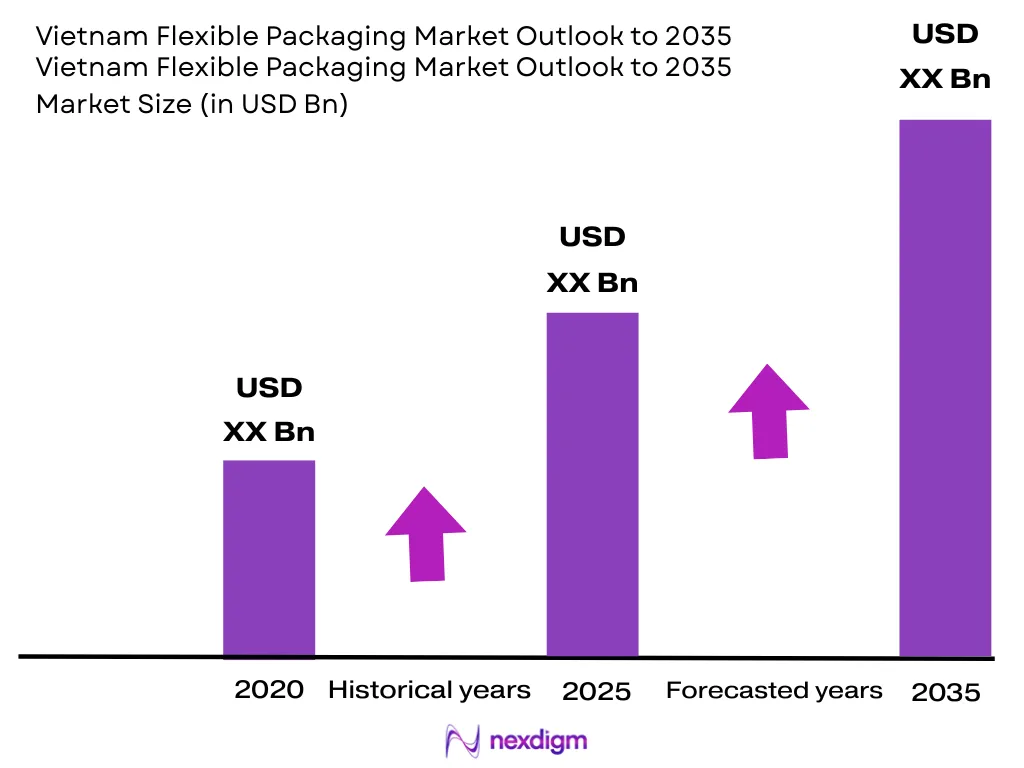
The Vietnam Flexible Packaging Market was valued at USD ~ Billion in 2024 and is anticipated to expand at a CAGR of ~% during 2026-2035. The market is primarily driven by Vietnam’s expanding food and beverage processing base, which recorded sales of approximately USD 79.3 billion in 2024, up 7.4% year-on-year, alongside rising seafood and aquaculture export volumes requiring high-barrier multilayer packaging. Industry estimates place the Vietnam flexible packaging market at approximately USD ~ Billion in 2025, growing toward approximately USD ~ billion by 2034. Export-oriented tax incentives, which lower converters’ effective tax rate to approximately 15%, continue to attract foreign direct investment, exemplified by South Korea’s SK Group committing approximately USD 1.25 billion in January 2025. Meanwhile, Vietnam’s Extended Producer Responsibility framework, effective since January 2024 under Decree No. 08/2022/ND-CP and further refined by Decree No. 05/2025/ND-CP, continues to accelerate converter investment in recyclable mono-material film structures.
Market Segmentation
By Material
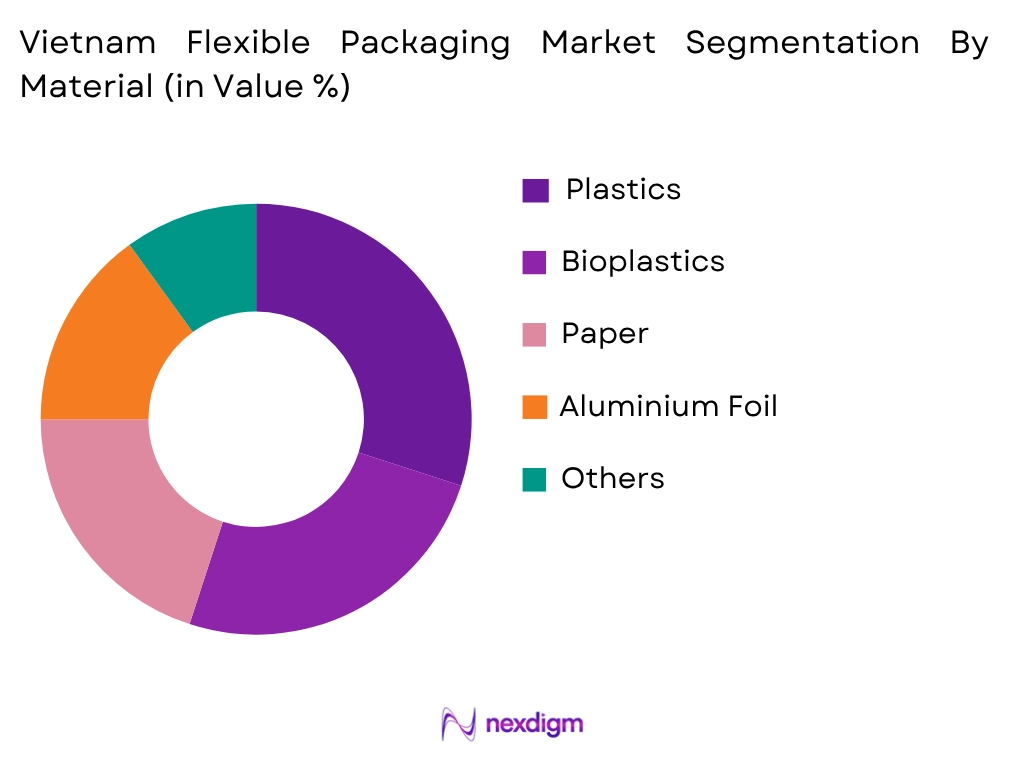
Plastic, primarily polyethylene and biaxially-oriented polypropylene (BOPP), dominates the Vietnam Flexible Packaging Market with approximately 68.72% share in 2025, favored for its excellent barrier protection, processing flexibility, and cost-effectiveness on existing blown-film production lines. Polyethylene remains the leading resin because it processes easily on existing equipment and can now integrate 20-30% post-consumer recycled content without compromising performance, while BOPP retains niche leadership in snack and confectionery webs requiring high gloss and stiffness. Bioplastics represent the fastest-growing material segment, expanding at approximately 7.85% CAGR, led by domestic producers including An Phat Holdings’ AnEco line and EuroPlas’s BiONext compounds, which are increasingly piloted for short-shelf-life dry products where barrier demands are moderate. EVOH-based multilayer structures, though representing a smaller tonnage share, continue to command disproportionate value in seafood and pet food export applications owing to their ultra-low oxygen permeability.
By Product Type
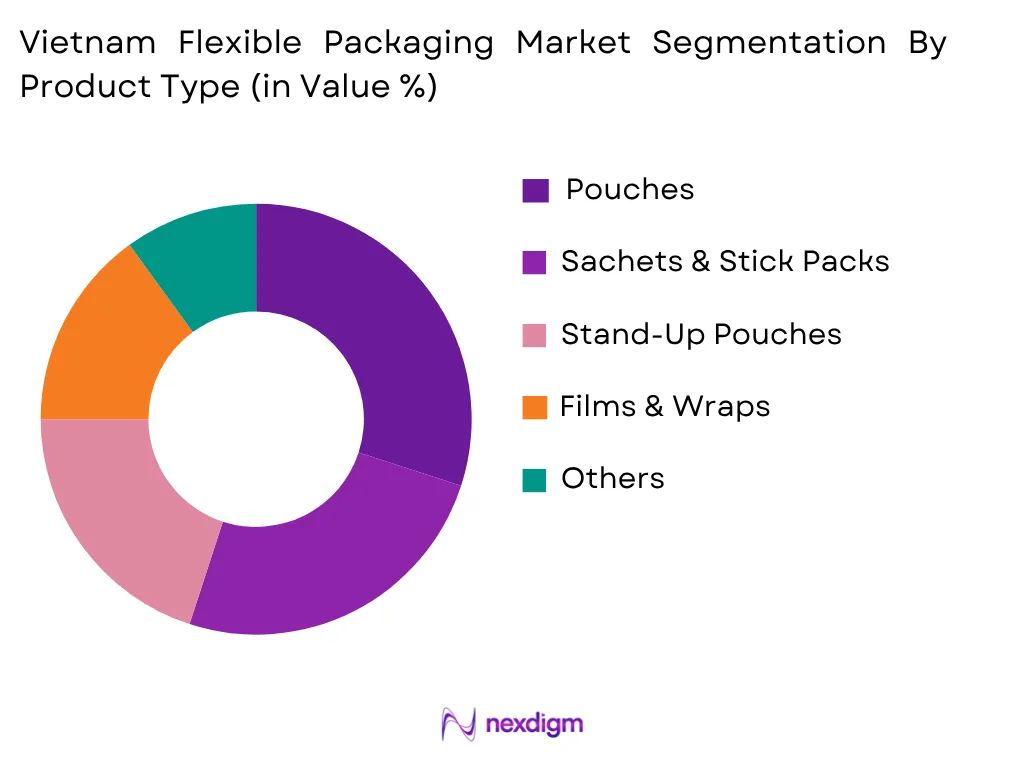
Wraps and overwraps represent the largest product-type segment, capturing approximately 44.20% of sales in 2025, reflecting their widespread use across Vietnam’s food processing and snack manufacturing sectors. Stand-up pouches represent the fastest-growing format, expanding at approximately 8.72% annually as consumer preferences shift toward portion control and on-the-go convenience. Vietnam’s key economic hubs, Ho Chi Minh City and Hanoi, continue to dominate demand given their high concentration of food processing, FMCG manufacturing, and modern retail activity. High-barrier multilayer films are gaining particular traction in processed meat and seafood export applications, with converters increasingly installing multilayer co-extruders that combine polyethylene with EVOH to achieve oxygen transmission rates below 0.1 cubic centimeters per square meter per day at 23 degrees Celsius, a specification increasingly demanded by international seafood and processed food buyers.
Competitive Landscape
The Vietnam Flexible Packaging Market remains moderately fragmented, with domestic converters competing alongside multinational packaging companies that have established local manufacturing operations to serve Vietnam’s export-oriented food processing base. Competition is primarily based on barrier technology performance, EPR-compliant mono-material design capability, export certification readiness, and manufacturing capacity. Domestic players such as An Phat Holdings have built strong positions through vertical integration into bioplastics production, while Tan Tien Packaging & Printing and other established local converters leverage proximity to Ho Chi Minh City’s dense food processing cluster for just-in-time delivery. Multinational converters including Amcor, Huhtamaki, and UFlex continue expanding local capacity to serve both Vietnam’s domestic FMCG sector and its growing base of export-oriented food and seafood processors, with collaboration intensifying across the value chain as resin suppliers co-develop tailored polyethylene grades with converters and brand owners engage in early-stage pack design to pre-qualify EPR-compliant structures.
| Company | Establishment Year | Headquarters | Primary Product Portfolio | Flexible Packaging Portfolio
|
Manufacturing Presence | Major End-Use Industries | Key Strategic Focus | Certifications & Compliance |
| An Phat Holdings | 2002 | ~ | ~ | ~ | ~ | ~ | ~ | ~ |
| Tan Tien Packaging & Printing JSC | 1996 | ~ | ~ | ~ | ~ | ~ | ~ | ~ |
| Amcor | 1860 | ~ | ~ | ~ | ~ | ~ | ~ | ~ |
| Huhtamaki | 1920 | ~ | ~ | ~ | ~ | ~ | ~ | ~ |
| UFlex Ltd. | 1985 | ~ | ~ | ~ | ~ | ~ | ~ | ~ |
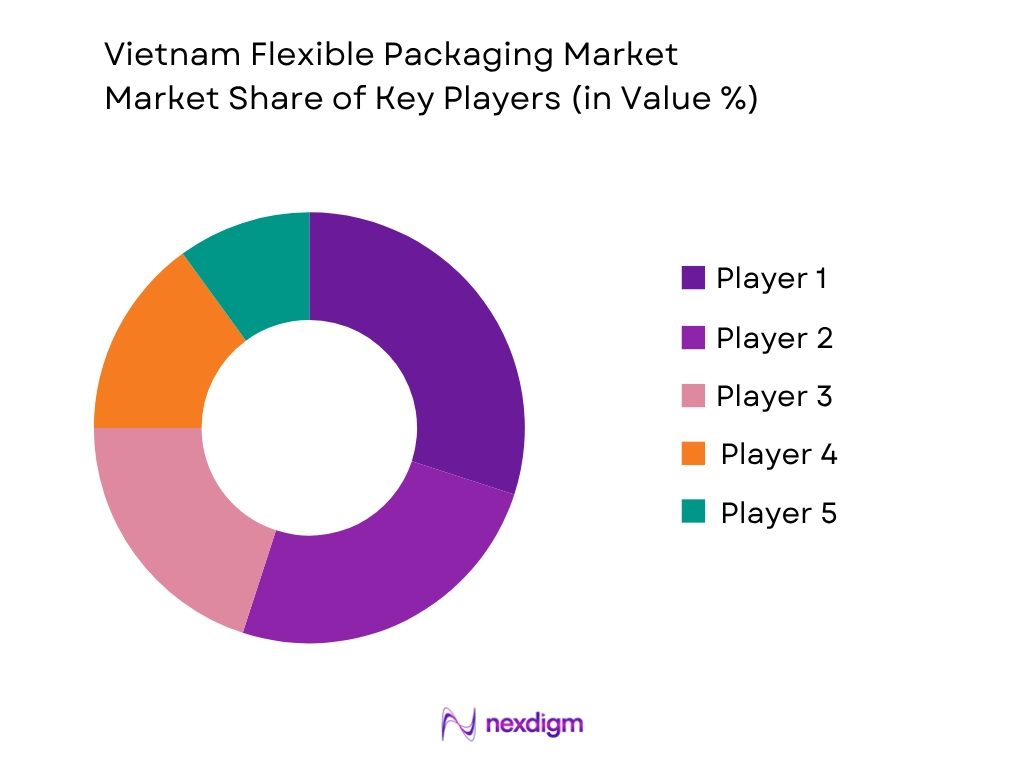
Vietnam Flexible Packaging Market Analysis
Growth Drivers
Robust Food & Beverage and Seafood Export Growth
Vietnam’s flexible packaging market is experiencing sustained growth due to the rapid expansion of the country’s food and beverage processing sector, which recorded sales of approximately USD 79.3 billion in 2024, up 7.4% from the prior year, solidifying its role as the single largest demand driver for flexible packaging in the country. Rising processed meat and seafood export volumes have encouraged converters to install multilayer co-extrusion lines combining polyethylene with EVOH to achieve oxygen transmission rates below 0.1 cubic centimeters per square meter per day, a specification increasingly required by international seafood and processed food buyers. Vietnam’s growing middle class, rapid urbanization, and rising disposable income continue to expand consumption of packaged food and beverage products, while services contributed approximately 43.44% of Vietnam’s GDP in the first quarter of 2025, reflecting the country’s rising retail sophistication and consumer packaged goods penetration. This combination of processing sector growth and export-oriented quality requirements continues to sustain strong underlying demand for flexible packaging formats across Vietnam’s food and beverage industry.
Favorable Export Tax Incentives and Rising Foreign Direct Investment
Vietnam’s export-oriented tax incentive regime, which lowers converters’ effective tax rate to approximately 15%, continues to attract substantial foreign direct investment into the country’s flexible packaging and broader manufacturing base. South Korea’s SK Group committed approximately USD 1.25 billion in January 2025, signaling continued confidence among major regional investors in Vietnam’s manufacturing ecosystem and its role in global supply chain diversification strategies. Vietnam’s positioning as an alternative manufacturing base amid ongoing supply chain diversification away from single-country concentration continues to attract packaging converters seeking to establish production capacity serving both domestic consumption and export markets. This favorable investment climate, combined with Vietnam’s competitive labor costs and strategic access to major shipping routes, continues to support capacity expansion across the country’s flexible packaging manufacturing base, positioning Vietnam as an increasingly important regional packaging hub within Southeast Asia.
Market Challenges
Resin Price Volatility and Fragmented Recycling Infrastructure
Vietnam’s flexible packaging converters continue to navigate significant resin price volatility, with polyolefin resin prices rising approximately 15-20% during 2024, compressing converter margins and prompting manufacturers to hedge input costs through multi-supplier contracts and experimentation with recycled or bio-based resin alternatives. Vietnam’s recycling infrastructure remains fragmented, with a substantial share of post-consumer plastic collection historically handled by an informal sector of waste pickers and small-scale recyclers rather than formal, traceable recycling operations capable of supplying food-grade recycled content at scale. This fragmentation limits the availability of consistent, verified post-consumer recycled feedstock for converters seeking to meet EPR recycled-content targets and retailer sustainability commitments. Smaller regional converters without long-term resin supply agreements or in-house recycling capability face particular difficulty managing margin volatility, creating a structural advantage for larger, vertically integrated players capable of securing more stable feedstock pricing.
Escalating EPR Compliance Complexity Amid Evolving Regulations
Vietnam’s Extended Producer Responsibility framework continues to evolve rapidly, creating ongoing compliance complexity for flexible packaging converters and brand owners. Decree No. 08/2022/ND-CP, effective since January 2024, established mandatory collection and recycling targets and reporting requirements for packaging producers and importers, while Decree No. 05/2025/ND-CP has since further refined targets, exemptions, and contribution formulas to strengthen compliance oversight. Decision 1316/QD-TTg establishes a national roadmap to reduce plastic waste that includes banning small non-biodegradable plastic bags beginning in 2026 and progressively phasing out most traditional single-use plastics by the early 2030s, requiring converters to continuously redesign product portfolios well ahead of each regulatory milestone. Major retailers such as AEON have set targets of 85% eco-friendly packaging by 2025, adding commercial pressure on top of regulatory requirements. This continuously evolving compliance landscape requires converters to maintain dedicated regulatory affairs capacity and to plan product redesign cycles around a moving set of regulatory deadlines rather than a single, stable compliance target.
Market Opportunities
Growth in Mono-Material and Bio-Based Packaging Innovation
Tightening EPR requirements and retailer sustainability commitments continue to create substantial opportunity for converters investing in mono-material and bio-based flexible packaging solutions. Low-barrier mono-material films already account for approximately 60.70% of Vietnam’s plastic packaging films market by revenue, prized specifically for their recyclability under EPR requirements. Domestic bioplastics producers, including An Phat Holdings’ AnEco line and EuroPlas’s BiONext compounds, are pioneering plant-based feedstock alternatives that meet EN 13432 compostability norms and can seal at lower temperatures, reducing per-pouch energy costs for converters. With major retailers such as AEON targeting 85% eco-friendly packaging by 2025, converters that can demonstrate credible mono-material recyclability or verified bio-based content are increasingly well positioned to capture premium contract positioning as Vietnam’s regulatory and commercial environment continues to reward sustainable packaging innovation ahead of competitors still reliant on conventional multilayer plastic structures.
Expansion of High-Barrier Multilayer Films for Export-Oriented Food Processing
Vietnam’s growing role as a major seafood, processed meat, and food export hub creates substantial opportunity for converters specializing in high-barrier multilayer film technology. High-barrier multilayer formats are expanding at approximately 6.55% CAGR, outpacing the broader plastic packaging films market, as seafood and processed food exporters require longer shelf life and superior oxygen barrier performance to meet international buyer specifications. In March 2025, Tetra Pak demonstrated its retortable Tetra Recart solutions at ProPak Vietnam, highlighting potential warehouse-space savings of approximately 30% and operating-cost reductions of approximately 60% relative to traditional metal or glass packaging formats. Converters investing in triple-bubble or machine direction orientation (MDO) film technology are increasingly able to supply thinner yet tougher laminates that align with both cost efficiency and sustainability targets, strengthening export competitiveness as global buyers increasingly specify downgauged but high-performance packaging structures for Vietnam-origin food and seafood products.
Future Outlook
The Vietnam Flexible Packaging Market is expected to witness robust expansion over the forecast period, supported by continued food and beverage sector growth, rising seafood and processed food export volumes, and sustained foreign direct investment into the country’s export-oriented manufacturing base. Continued investment in mono-material recyclable films, bio-based packaging solutions, and high-barrier multilayer technology will further shape competitive positioning across the industry as Vietnam’s EPR framework continues to tighten. The market is also likely to benefit from Vietnam’s growing position as a preferred Southeast Asian manufacturing and export hub, supported by favorable tax incentives and continued diversification of regional supply chains.
Major Players
- An Phat Holdings
- Tan Tien Packaging & Printing JSC
- Dong A Plastic Group
- Tin Thanh Packaging (Batico)
- Duy Tan Plastics
- Amcor
- Huhtamaki
- Constantia Flexibles
- UFlex Ltd.
- Toppan Inc.
- Dai Nippon Printing Co., Ltd. (DNP)
- Sonoco Products Company
- Mondi
- Berry Global
- EuroPlas
Key Target Audience
- Flexible Packaging Manufacturers
- Food & Beverage Processing Companies
- Seafood & Aquaculture Exporters
- Healthcare & Pharmaceutical Companies
- Personal Care & Cosmetics Manufacturers
- Investment and Venture Capitalist Firms
- Government and Regulatory Bodies (Ministry of Natural Resources and Environment (MONRE), Vietnam Environment Administration, Ministry of Industry and Trade)
- Raw Material Suppliers and Resin Producers
Research Methodology
Step 1: Identification of Key Variables
The research process begins with identifying the complete ecosystem of the Vietnam Flexible Packaging Market, including raw material suppliers, packaging converters, printing technology providers, brand owners, retailers, and regulatory authorities. Extensive secondary research is conducted using company annual reports, government publications, trade associations, customs statistics, industry journals, and proprietary databases to determine the variables influencing market demand, pricing, production, consumption, and technological developments.
Step 2: Market Analysis and Construction
Historical market information is collected and analyzed to estimate market size, production volumes, import-export activity, application-wise demand, and pricing trends. A combination of top-down and bottom-up approaches is used to estimate market revenues and validate segment-level performance. Consumption patterns across food processing, beverage, seafood export, and e-commerce packaging are evaluated to establish an accurate representation of the industry.
Step 3: Hypothesis Validation and Expert Consultation
The preliminary findings are validated through Computer-Assisted Telephone Interviews (CATIs) and structured discussions with flexible packaging converters, procurement managers, distributors, packaging engineers, regulatory experts, and senior executives operating within the Vietnamese packaging industry. These interviews help verify market assumptions, competitive developments, technology adoption trends, pricing dynamics, and future investment opportunities while refining the overall market estimates.
Step 4: Research Synthesis and Final Output
The final stage integrates insights obtained from primary interviews with quantitative information collected through secondary sources. Data triangulation techniques are applied to reconcile differences between supply-side and demand-side estimates, ensuring robust market forecasting. The report is then reviewed through multiple quality assurance checkpoints to deliver a comprehensive analysis covering market size, segmentation, competitive landscape, future outlook, and strategic recommendations for industry stakeholders.

- Executive Summary
- Research Methodology (Market Definitions and Assumptions, Abbreviations, Market Sizing Approach, Top-Down Analysis, Bottom-Up Analysis, Demand-Side Assessment, Supply-Side Assessment, Primary Industry Interviews, Secondary Research Validation, Data Triangulation, Forecasting Framework, Limitations and Future Conclusions)

- Definition and Scope
- Market Evolution and Industry Genesis
- Timeline of Major Industry Developments
- Flexible Packaging Industry Value Chain Analysis
- Supply Chain Analysis

- Growth Drivers (Robust Food & Beverage Sector Growth, Rising Seafood & Aquaculture Export Demand, Favorable Export Tax Incentives, Increasing FDI in Manufacturing Capacity, Growth of E-Commerce & Modern Retail, Expansion of Mono-Material Recyclable Films)
- Market Challenges (Resin Price Volatility, Fragmented Recycling Infrastructure, Escalating EPR Compliance Complexity, Informal Sector Recycling Competition, Currency and Input Cost Pressure, Technical Talent Scarcity)
- Market Opportunities (Growth in Mono-Material & Bio-Based Packaging, Expansion of High-Barrier Multilayer Films for Exports, Digital Printing Capacity Growth, Retailer-Driven Sustainability Partnerships, Regional Export Hub Positioning, Advanced Recycling Technology Investment)
- Market Trends (Shift Toward Mono-Material Recyclable PE Films, Growth in Stand-Up Pouch Adoption, Bioplastic Feedstock Expansion, Retailer Eco-Friendly Packaging Targets, Multilayer Co-Extrusion Investment, Downgauging & Lightweighting Initiatives)
- Government Regulations (Law on Environmental Protection 2020, Decree No. 08/2022/ND-CP EPR Requirements, Decree No. 05/2025/ND-CP Compliance Refinements, Decision 1316/QD-TTg Plastic Waste Roadmap, Vietnam Ecolabel Certification, Import Compliance)
- Import and Export Analysis (Trade Volume, Major Import Sources, Export Destinations, HS Code Analysis, Trade Balance)
- Raw Material Availability Analysis (Polyethylene & BOPP Resins, Recycled PE & PCR Feedstock, Kraft Paper & Pulp, Aluminum Foil Stock, Bio-Based Polymer Feedstocks)
- Technology Landscape (Multilayer Co-Extrusion Technologies, Flexographic & Digital Printing Systems, Barrier Coating Technologies, Triple-Bubble & MDO Film Technologies, Mechanical & Chemical Recycling Technologies)
- Sustainability Assessment (Post-Consumer Recycled Content Adoption, Mono-Material Recyclability, Vietnam Ecolabel Certification Coverage, Carbon Footprint Reduction, Circular Economy Partnerships)
- PESTLE Analysis
- SWOT Analysis
- Porter’s Five Forces Analysis
- Stakeholder Ecosystem
- Competition Ecosystem

- By Market Value (2020-2025)
- By Volume Consumption (2020-2025)
- By Average Selling Price (2020-2025)

- By Material Type (In Value %)
Plastic (Polyethylene & BOPP)
Paper-Based Laminates
Aluminum Foil
Bioplastics & Compostables
Multilayer Composite Films - By Product Type (In Value %)
Pouches & Stand-Up Pouches
Bags & Wraps
Films & Overwraps
Sachets & Stick Packs
Laminates & Rollstock
Shrink & Stretch Films - By Printing Technology (In Value %)
Flexography
Rotogravure
Digital Printing
Offset Printing
Others - By End User (In Value %)
Food Processing
Beverage
Seafood & Aquaculture Export
Healthcare & Pharmaceutical
Personal Care & Cosmetics
E-Commerce & Retail
Household & Home Care - By Region (In Value %)
Southeast Vietnam
Red River Delta
Mekong Delta
North Central & Central Coastal Vietnam
Northern Midlands & Mountain Areas

- Market Share of Major Players (By Value, Volume, Material Type, Application Industry, Product Category)
- Cross Comparison Parameters (Product Portfolio Breadth, Recycled-Content Capability, Barrier Technology Performance, Application Technical Support, Manufacturing Capacity, Regulatory Compliance & Certifications, Food & Beverage Customer Base, Innovation & New Product Launch Frequency)
- SWOT Analysis of Major Players
- Pricing Analysis by Product Category and SKU
- Production Capacity Analysis
- Manufacturing Footprint Analysis
- Distribution Network Analysis
- Innovation Benchmarking
- Detailed Profiles of Major Companies
An Phat Holdings
Tan Tien Packaging & Printing JSC
Dong A Plastic Group
Tin Thanh Packaging (Batico)
Duy Tan Plastics
Amcor
Huhtamaki
Constantia Flexibles
UFlex Ltd.
Toppan Inc.
Dai Nippon Printing Co., Ltd. (DNP)
Sonoco Products Company
Mondi
Berry Global
EuroPlas

- Consumption Pattern Analysis (Industrial Usage, Batch Size, Product Category Penetration, Seasonal Demand, Reformulation Activity)
- Purchasing Criteria (Barrier Performance, EPR Compliance, Cost Efficiency, Recyclability, Print Quality, Shelf Appeal)
- Procurement and Supplier Selection Analysis
- Recycled-Content Adoption Assessment
- Premium vs Conventional Packaging Demand
- Product Attribute Preference Analysis (Oxygen Transmission Rate, Moisture Barrier Performance, Seal Integrity, Print Definition, Recyclability, Shelf Life Extension)
- Sustainability & Regulatory Compliance Influence on Product Development
- Pain Point Analysis
- Decision-Making Process

- By Market Value (2026-2035)
- By Volume Consumption (2026-2035)
- By Average Selling Price (2026-2035)


 Request a Sample
 Ask for Customization
 Get a Quote
 Enquire Now