

 Download PDF
Market Overview
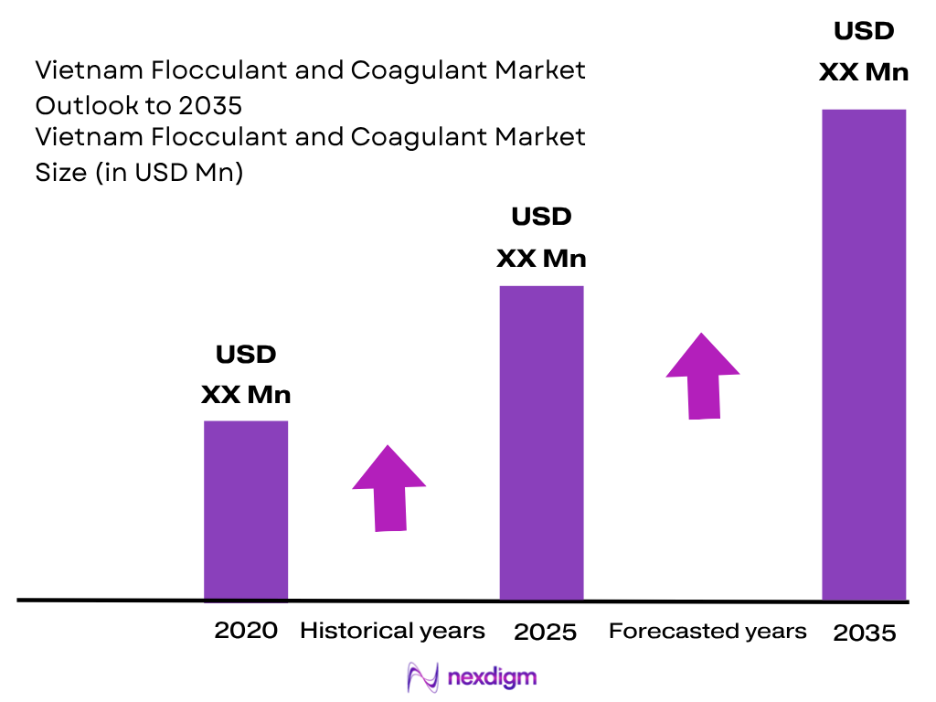
The Vietnam Flocculant and Coagulant Market is valued at ~USD X.X million, with demand closely connected to municipal water treatment, industrial wastewater management, sludge dewatering and process-water clarification. Vietnam’s economy generated USD 476.39 billion in GDP, while GDP growth reached 7.1 and manufacturing value added represented 24 of GDP. Manufacturing production also expanded by 9.8 in 2024, strengthening wastewater-treatment requirements across industrial facilities. Vietnam’s growing industrial base, environmental compliance requirements and expansion of water-treatment infrastructure therefore provide a structural demand base for coagulation and flocculation chemicals.
Demand for the Vietnam Flocculant and Coagulant Market is concentrated around Ho Chi Minh City, Hanoi, Binh Duong, Dong Nai, Hai Phong and Bac Ninh, reflecting the country’s major urban, manufacturing and industrial clusters. Vietnam recorded a population of 100,987,686, while manufacturing represented 24 of GDP. Manufacturing production increased 9.8 and foreign-investment commitments reached USD 38.2 billion, with manufacturing accounting for 67 of those commitments. These indicators support treatment-chemical demand around industrial parks, electronics manufacturing, textiles, food processing, municipal utilities and wastewater-treatment facilities.
Market Segmentation
By Product Type
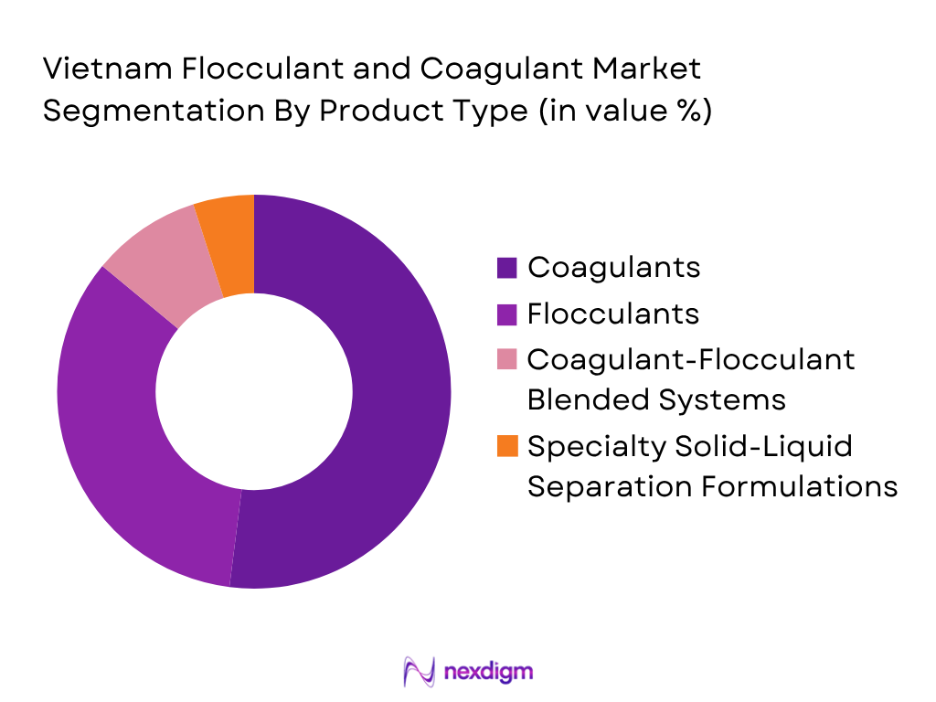
The Vietnam Flocculant and Coagulant Market is segmented by product type into coagulants, flocculants, coagulant-flocculant blended systems and specialty solid-liquid separation formulations. Coagulants represent the dominant sub-segment, supported by their extensive application in drinking-water clarification, municipal wastewater treatment and industrial effluent treatment. Polyaluminium chloride has become particularly important because it can be used across municipal and industrial clarification processes and is available through both domestic manufacturing and imported supply channels. Vietnam’s South Basic Chemicals Joint Stock Company manufactures PAC for civil water supply, industrial water supply, wastewater containing suspended solids and aquaculture applications. PAC is also listed for drinking-water treatment under NSF/ANSI/CAN 60 through a Vietnamese manufacturing facility. Flocculants remain essential for sludge dewatering, DAF, mining, paper retention and industrial wastewater treatment. The country’s expanding manufacturing base, where manufacturing production grew 9.8, creates additional demand for chemical treatment of industrial effluents. Consequently, the product mix is increasingly shaped by treatment efficiency, dosage optimization, sludge characteristics and the specific water chemistry encountered by municipal and industrial operators.
By Application Type
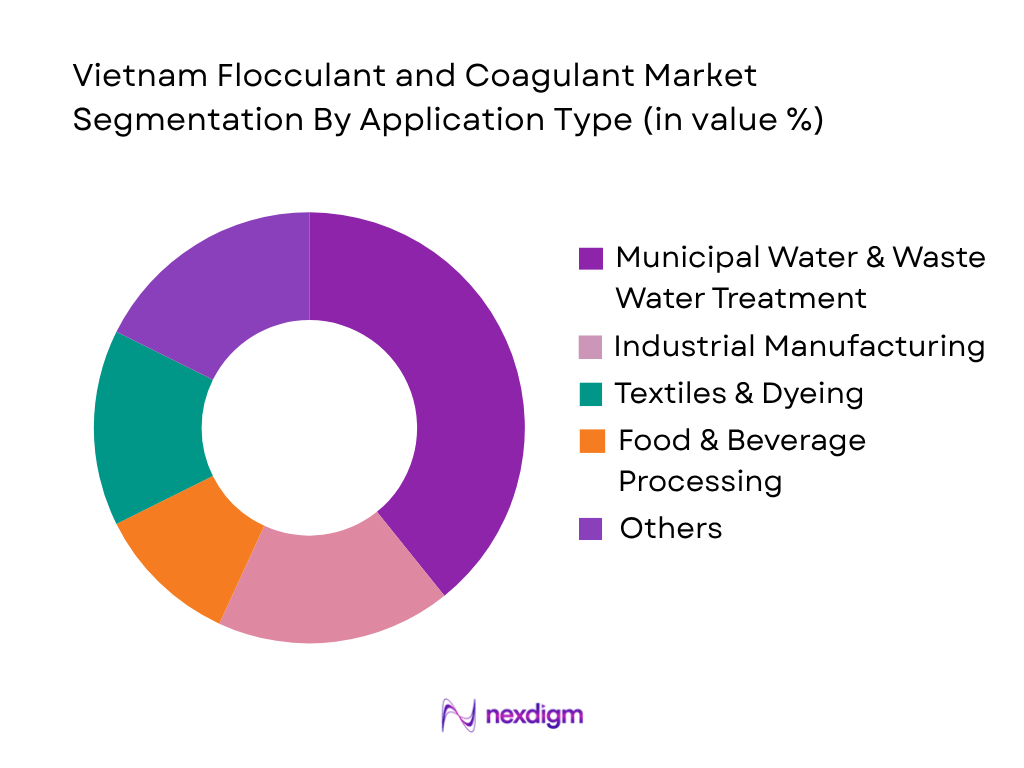
Vietnam Flocculant and Coagulant market is segmented by application into municipal water treatment, industrial wastewater treatment, mining and mineral processing, textile wastewater treatment, pulp and paper processing, food and beverage wastewater treatment, aquaculture treatment, chemical processing wastewater treatment, and oil and gas wastewater management. The industrial wastewater treatment segment dominates due to Vietnam’s rapid industrialization and increasing wastewater discharge from manufacturing facilities. Industrial parks, textile factories, food processing units, and chemical manufacturing facilities require effective coagulation and flocculation systems to meet environmental discharge regulations. Vietnam’s manufacturing sector has expanded significantly due to foreign direct investment inflows, increasing demand for chemical treatment solutions. Industrial wastewater operators increasingly use polymer flocculants and coagulants to improve suspended solids removal, sludge dewatering efficiency, and treatment performance. The growth of export-oriented industries such as textiles, seafood processing, and electronics manufacturing continues to support chemical consumption.
Competitive Landscape
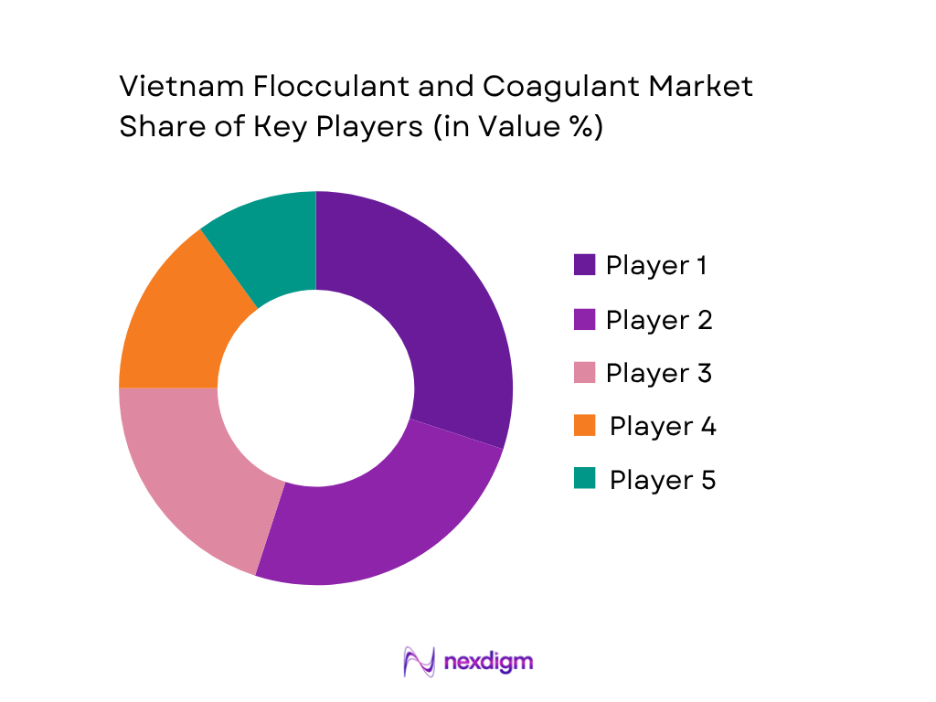
The Vietnam Flocculant and Coagulant Market includes international water-treatment chemical companies, specialty polymer manufacturers, inorganic-coagulant producers and local chemical suppliers. Competition is shaped by product chemistry, PAC availability, polyacrylamide formulation capability, technical support, local inventory, municipal tender participation and industrial customer relationships. Domestic suppliers provide PAC and other basic chemicals, while international participants contribute advanced polymers, treatment-process expertise and specialized application technologies. The market therefore combines local manufacturing and distribution capabilities with international water-treatment technologies.
| Company | Established | Headquarters | Core Product Portfolio | Municipal Water Treatment | Industrial Wastewater Treatment | Polymer / Flocculant Capability | Vietnam Supply & Distribution |
| SNF Group | 1978 | Andrézieux, France | ~ | ~ | ~ | ~ | ~ |
| Kemira Oyj | 1920 | Helsinki, Finland | ~ | ~ | ~ | ~ | ~ |
| Ecolab / Nalco Water | 1923 | St. Paul, Minnesota, US | ~ | ~ | ~ | ~ | ~ |
| Solenis | 1907 | Wilmington, Delaware, US | ~ | ~ | ~ | ~ | ~ |
| South Basic Chemicals JSC | 1976 | Ho Chi Minh City, Vietnam | ~ | ~ | ~ | ~ | ~ |
Vietnam Flocculant and Coagulant Market Analysis
Growth Drivers
Expansion of Manufacturing and Industrial Wastewater Treatment
Vietnam’s accelerating industrial base is creating a broader requirement for coagulation, flocculation, clarification and sludge-management chemicals across manufacturing facilities and industrial parks. Vietnam’s industrial production index increased from 1.3 in 2023 to 8.4 in 2024, while the manufacturing and processing sector recorded an index increase of 9.6. Manufacturing consumption also increased by 11.3, indicating stronger utilization of industrial production capacity and associated process-water requirements. The water supply, waste management and wastewater-treatment sector recorded an index increase of 10.7, demonstrating concurrent expansion of water and wastewater-service activity. Foreign investment further strengthens the industrial treatment base. Vietnam recorded 3,375 newly registered foreign-investment projects and total foreign-investment commitments of USD 38.23 billion in 2024, while the processing and manufacturing sector attracted USD 25.58 billion. The FDI sector generated exports of approximately USD 290.9 billion, reinforcing Vietnam’s role as a manufacturing and export platform. These industrial activities generate wastewater containing suspended solids, dyes, oils, organic matter and other contaminants requiring chemical clarification and separation. Consequently, PAC, ferric coagulants, alum and polymeric flocculants have expanding applications across industrial wastewater plants, centralized industrial-park treatment systems and process-water recycling facilities.
Growth of Municipal Water Infrastructure and Environmental Treatment Requirements
Expansion of urbanization, municipal infrastructure and environmental-management systems is supporting recurring demand for flocculants and coagulants in Vietnam’s drinking-water and wastewater-treatment facilities. Vietnam’s GDP reached approximately USD 476.3 billion in 2024, while the economy expanded from the previous year, reflecting stronger domestic activity and investment. The water supply, waste management and wastewater-treatment sector increased its industrial production index by 10.7 during 2024, alongside expansion in the broader industrial economy. Construction activity also increased, with construction value added rising by 7.87, supporting development of urban buildings, industrial facilities, utilities and associated wastewater infrastructure. Manufacturing consumption increased by 11.3, while industrial employment increased by 3.2, indicating greater activity across production facilities requiring water and wastewater services. Vietnam’s FDI ecosystem also recorded 42,002 valid foreign-investment projects cumulatively by the end of 2024, with approximately USD 322.5 billion in realized FDI capital, creating a substantial installed base of industrial facilities requiring environmental-management systems. Municipal and industrial treatment plants require coagulants to destabilize colloidal particles and flocculants to improve particle aggregation, sedimentation and sludge separation. Increasing wastewater-treatment activity therefore creates recurring chemical consumption across clarification, sludge conditioning and solids-removal processes.
Market Challenges
Dependence on Imported Specialty Chemical Inputs and Supply-Chain Exposure
Vietnam’s Flocculant and Coagulant Market faces supply-chain challenges because advanced treatment polymers and specialty chemical inputs are often dependent on international manufacturing and trade networks. The scale of Vietnam’s import-oriented industrial economy highlights this exposure: the FDI sector alone recorded approximately USD 241.6 billion in imports during 2024, while Vietnam’s total foreign-investment sector generated approximately USD 290.9 billion in exports. The country had 42,002 valid foreign-investment projects at the end of 2024, creating a large manufacturing ecosystem dependent on chemical, equipment and intermediate-material supply chains. Manufacturing and processing attracted USD 25.58 billion of foreign-investment capital, while total foreign-investment commitments reached USD 38.23 billion. For treatment-chemical suppliers, international sourcing can affect availability of polyacrylamide feedstocks, specialty polymers, organic coagulants and formulation additives. Imported materials can also create longer procurement cycles for industrial users operating continuous wastewater-treatment plants. This is particularly important because treatment interruptions can affect suspended-solids removal, sludge dewatering and compliance with wastewater discharge requirements. The challenge is compounded by the need to maintain different polymer charge types and molecular-weight characteristics for textile, food processing, electronics, chemical and municipal wastewater streams. Suppliers consequently need inventory planning, multiple sourcing channels and local formulation or warehousing capabilities to reduce supply interruptions.
Increasing Treatment Complexity and Technical Requirements Across Industrial Wastewater Streams
Increasing diversity in Vietnam’s manufacturing base creates a technical challenge because wastewater characteristics differ substantially across textiles, electronics, food processing, chemicals, paper, seafood and other industries. Vietnam’s manufacturing and processing industry recorded an industrial production increase of 9.6 in 2024, while specific manufacturing categories recorded strong expansion, including rubber and plastic products at 24.9, furniture at 23.8, motor vehicles at 21.1, textiles at 12.1, chemicals at 11.9, electrical equipment at 11.9, electronics and optical products at 8.3, and food processing at 7.4. Each production stream can generate wastewater with different suspended-solids concentrations, organic loads, dyes, oils, metals or process residues, making a single standardized chemical program unsuitable for every facility. Manufacturing consumption increased by 11.3, reinforcing the need for treatment systems to accommodate higher industrial activity. Meanwhile, the water supply, waste management and wastewater-treatment sector increased its industrial production index by 10.7, indicating growing activity within the treatment ecosystem itself. Chemical suppliers must therefore provide accurate jar testing, dosage optimization, polymer selection and application engineering. Poor chemical selection can increase sludge generation, reduce clarification efficiency or affect downstream filtration. This raises technical-service requirements and creates qualification barriers for suppliers attempting to enter specialized industrial applications.
Market Opportunities
Expansion of Industrial Water Recycling and High-Performance Treatment Chemicals
Vietnam’s expanding manufacturing economy creates opportunities for higher-performance coagulants and flocculants designed for industrial water recycling, wastewater clarification and sludge dewatering. Manufacturing and processing attracted USD 25.58 billion of foreign-investment capital in 2024, while total FDI commitments reached USD 38.23 billion. The manufacturing sector’s industrial production index increased by 9.6, and manufacturing consumption increased by 11.3, indicating greater industrial throughput and corresponding water-treatment requirements. Electronics and optical-products production increased by 8.3, chemical manufacturing increased by 11.9, and textile manufacturing increased by 12.1, creating multiple specialized wastewater-treatment applications. Industrial facilities seeking greater water efficiency can deploy improved coagulation and flocculation to enhance suspended-solids removal before membrane filtration, biological treatment or reuse. High-charge-density polymers, specialty PAC formulations, cationic flocculants and application-specific polymer blends can address different wastewater characteristics more efficiently than standardized products. The water supply, waste management and wastewater-treatment sector itself recorded an industrial production increase of 10.7, demonstrating a growing treatment-services ecosystem. This creates opportunities for suppliers that combine chemical products with dosage optimization, laboratory testing, automated dosing and process monitoring. Local technical centers and inventory facilities can further improve response times for industrial customers and reduce dependence on overseas technical support.
Increasing Demand from Electronics, Textiles, Food Processing and Export-Oriented Manufacturing
Vietnam’s continued integration into global manufacturing value chains creates opportunities for specialized flocculant and coagulant solutions serving electronics, textiles, food processing and other export-oriented industries. The country attracted USD 38.23 billion of total FDI commitments in 2024, with manufacturing and processing receiving USD 25.58 billion. The FDI sector generated approximately USD 290.9 billion in exports and imported approximately USD 241.6 billion of goods, demonstrating the scale of production linked to international supply chains. Vietnam’s industrial production data show particularly strong expansion in industries requiring different wastewater-treatment chemistries: textile production increased 12.1, chemical production increased 11.9, electrical-equipment production increased 11.9, food processing increased 7.4, and electronics, computers and optical products increased 8.3. These sectors create opportunities for application-specific treatment programs because their wastewater characteristics vary significantly. Textile facilities require treatment for dyes, suspended fibers and organic contaminants, while electronics facilities can generate wastewater containing fine particles and process chemicals. Food-processing facilities require removal of organic matter and suspended solids, while chemical plants can produce complex effluent streams. Suppliers can therefore expand through specialty polymers, high-efficiency inorganic coagulants, customized dosing programs and integrated sludge-dewatering solutions. The opportunity is strengthened by Vietnam’s continued industrial expansion and the increasing importance of environmental management within export-oriented manufacturing facilities.
Future Outlook
The Vietnam Flocculant and Coagulant Market is expected to benefit from continued industrialization, expansion of municipal wastewater infrastructure and rising requirements for industrial effluent treatment. Vietnam’s manufacturing production increased 9.8, while total investment growth reached 7.2, creating a broader industrial base requiring water and wastewater management.
Demand is expected to increasingly shift toward higher-performance PAC, polyacrylamide and specialty polymer formulations that improve clarification and sludge dewatering. Industrial water recycling, electronics manufacturing, textile wastewater treatment, seafood processing and industrial-park wastewater management are expected to create additional application opportunities.
Major Players
- SNF Group
- Kemira Oyj
- Ecolab / Nalco Water
- Solenis
- South Basic Chemicals Joint Stock Company
- Feralco Group
- GEO Specialty Chemicals
- USALCO LLC
- PVS Chemicals Inc.
- BASF Vietnam
- Kuraray Vietnam
- Veolia Water Technologies
- SUEZ Water Technologies & Solutions
- Kurita Water Industries
- Airedale Chemical
Key Target Audience
- Municipal Water Supply and Wastewater Treatment Operators
- Industrial Park Wastewater Treatment Operators
- Textile, Dyeing and Garment Manufacturers
- Food, Seafood Processing and Aquaculture Companies
- Electronics and Semiconductor Manufacturers
- Chemical, Mining and Manufacturing Companies
- Investments and Venture Capitalist Firms
- Government and Regulatory Bodies (Ministry of Natural Resources and Environment, Ministry of Construction, Ministry of Industry and Trade, Vietnam Environment Administration)
Research Methodology
Step 1: Identification of Key Variables
The initial phase involves constructing a Vietnam Flocculant and Coagulant Market ecosystem covering PAC manufacturers, inorganic chemical suppliers, polymer producers, importers, distributors, municipal utilities and industrial wastewater operators. Variables include product chemistry, active ingredients, physical form, application, dosage requirements, treatment process, customer type, domestic production and import dependency. Particular attention is given to municipal and industrial wastewater applications.
Step 2: Market Analysis and Construction
This phase involves compiling historical and current information across drinking-water treatment, municipal wastewater, industrial effluent, sludge dewatering and process-water applications. Product-level analysis covers PAC, alum, ferric salts, polyacrylamide, polyDADMAC and specialty polymers. Demand is constructed using end-use consumption, treatment infrastructure, industrial activity, production capacity, imports and distribution channels.
Step 3: Hypothesis Validation and Expert Consultation
Market hypotheses are validated through discussions with water-treatment chemical manufacturers, distributors, municipal treatment operators, industrial users, EPC contractors and application specialists. Interviews assess chemical-selection criteria, dosage practices, treatment efficiency, procurement cycles, customer preferences and substitution patterns. Expert inputs are used to validate product segmentation and competitive positioning.
Step 4: Research Synthesis and Final Output
The final phase integrates secondary research, company-level information, supply-side analysis and demand-side assessment. Market calculations are cross-checked against industrial production indicators, treatment infrastructure, trade flows and supplier capabilities. The final analysis provides market sizing, product segmentation, end-use assessment, competitive benchmarking and future-market projections for the Vietnam Flocculant and Coagulant Market.

- Executive Summary
- Research Methodology (Market Definition and Scope, Vietnam Flocculant and Coagulant Market Classification, Chemical Product Mapping, Coagulant and Flocculant Formulation Assessment, Active Ingredient Mapping, Treatment-Process Demand Assessment, Municipal and Industrial Water Treatment Assessment, Domestic Manufacturing Mapping, Import and Export Trade Analysis, Raw Material Supply Assessment, Demand-Side Assessment, Supply-Side Assessment, Top-Down Market Sizing, Bottom-Up Market Sizing, Primary Industry Interviews, Data Triangulation, Forecasting Framework, Market Share Validation, Limitations and Future Conclusions)

- Definition and Scope
- Vietnam Water Treatment Industry Evolution and Development of Municipal Water Infrastructure, Industrial Wastewater Treatment, Chemical Manufacturing and Water-Reuse Systems
- Flocculant and Coagulant Value Chain Analysis
- Flocculant and Coagulant Supply Chain Analysis
- Inorganic Chemical Manufacturers, Polymer Manufacturers, Water-Treatment Chemical Formulators, Importers, Distributors, Water Utilities, Wastewater Treatment Operators, Industrial Manufacturers, EPC Contractors and Treatment-System Integrators
- Coagulant Integration Across Drinking Water Treatment, Municipal Wastewater, Industrial Effluent, Aquaculture and Process-Water Clarification
- Flocculant Integration Across Sludge Dewatering, Industrial Wastewater, Mining, Pulp and Paper, Food Processing and Water-Reuse Applications

- Growth Drivers (Expansion of Industrial Parks and Manufacturing, Increasing Municipal Wastewater Treatment Capacity, Growth of Textile and Dyeing Production, Expansion of Food and Seafood Processing, Rising Water-Reuse Requirements, Development of Urban Water Infrastructure, Growth of Electronics Manufacturing, Increasing Industrial Environmental Compliance, Expansion of Sludge Dewatering Applications)
- Market Challenges (Dependence on Imported Polymer Feedstocks, Volatility in Chemical Raw Material Costs, Fragmented Distribution Networks, Quality Variation Across Local Suppliers, Limited Advanced Polymer Manufacturing Capacity, Wastewater Treatment Infrastructure Gaps, Technical Dosage Optimization Requirements, Regulatory Compliance Costs, Logistics and Chemical Storage Constraints)
- Market Opportunities (Advanced Polyacrylamide Formulations, High-Efficiency PAC and Ferric Coagulants, Industrial Water-Reuse Applications, Sludge Dewatering Optimization, Electronics and Semiconductor Wastewater Treatment, Textile Wastewater Treatment, Seafood Processing Effluent Treatment, Municipal Treatment-Plant Modernization, Local Production of Specialty Water-Treatment Polymers)
- Market Trends (Shift Toward High-Performance Polymers, Increasing PAC Adoption, Growth of Cationic Flocculants, Automated Chemical Dosing, Digital Water-Quality Monitoring, Industrial Water Recycling, Sludge Dewatering Optimization, Specialty Coagulant Formulations, Low-Residual Treatment Processes, Integrated Chemical and Water-Treatment Solutions)
- Government Regulations and Standards (Vietnam Law on Environmental Protection, National Technical Regulation on Industrial Wastewater, National Technical Regulation on Domestic Wastewater, National Technical Regulation on Surface Water Quality, Ministry of Natural Resources and Environment Discharge Requirements, Chemical Management Regulations, Industrial Wastewater Monitoring Requirements, Drinking Water Quality Requirements, Hazardous Chemical Handling Regulations, Environmental Impact Assessment Requirements)
- SWOT Analysis
- Porter’s Five Forces Analysis
- PESTLE Analysis
- Stakeholder Ecosystem
- Competition Ecosystem

- By Market Value (2020-2025)
- By Market Volume (2020-2025)
- By Coagulant Consumption Volume (2020-2025)
- By Flocculant Consumption Volume (2020-2025)
- By Domestic Production Volume (2020-2025)
- By Import Volume (2020-2025)
- By Export Volume (2020-2025)
- By Average Selling Price (2020-2025)

- By Coagulant Type (In Value %)
Polyaluminium Chloride
Aluminium Sulfate
Ferric Chloride
Ferric Sulfate
Ferrous Sulfate
Polyaluminium Ferric Chloride
Organic Coagulants
Other Inorganic Coagulants - By Flocculant Type (In Value %)
Cationic Flocculants
Anionic Flocculants
Non-Ionic Flocculants
Amphoteric Flocculants
Polyacrylamide Flocculants
PolyDADMAC Flocculants
Polyamine Flocculants
Other Specialty Flocculants - By Form (In Value %)
Liquid Coagulants
Liquid Flocculants
Powder Coagulants
Powder Flocculants
Emulsion Polymers
Granular Polymers - By Application Type (In Value %)
Drinking Water Treatment
Municipal Wastewater Treatment
Industrial Wastewater Treatment
Sludge Dewatering
Process Water Treatment
Water Reuse and Recycling
Aquaculture Water Treatment
Mining and Mineral Processing
Pulp and Paper Treatment
Food and Beverage Wastewater Treatment - By End-Use Industry (In Value %)
Municipal Water Utilities
Industrial Manufacturing
Textiles and Dyeing
Food and Beverage Processing
Seafood Processing and Aquaculture
Pulp and Paper
Mining and Mineral Processing
Chemical Manufacturing
Oil and Gas
Power Generation
Electronics and Semiconductor Manufacturing
Pharmaceutical Manufacturing - By Distribution Channel (In Value %)
Direct Industrial Sales
Authorized Chemical Distributors
Specialty Water-Treatment Distributors
Local Chemical Trading Companies
Municipal Procurement and Tenders
Industrial Procurement Channels
E-Commerce and Online Chemical Platforms
Water-Treatment EPC and System Integrator Networks - By Region (In Value %)
Ho Chi Minh City and Southern Vietnam
Binh Duong
Dong Nai
Hanoi and Northern Vietnam
Hai Phong
Bac Ninh
Da Nang and Central Vietnam
Other Vietnamese Regions

- Market Share of Major Players (By Vietnam Revenue, Coagulant Sales Volume, Flocculant Sales Volume, Product Portfolio, PAC Capacity, Polymer Portfolio, Domestic Manufacturing Capacity, Import Dependency, Industrial Customer Coverage, Municipal Customer Coverage, Distribution Network Coverage, Regional Presence, Technical-Service Capability)
- Cross Comparison Parameters (Flocculant and Coagulant Revenue, Coagulant Portfolio Breadth, Flocculant Polymer Portfolio Breadth, Local Manufacturing and Inventory Capacity, PAC Production Capability, Polyacrylamide Technology Coverage, Municipal and Industrial Application Coverage, Distribution Network Reach)
- SWOT Analysis of Major Players
- Competitive Positioning Matrix
- Polyacrylamide Chemistry and Polymer Performance Assessment
- Municipal Water Treatment Chemical Benchmarking
- Industrial Wastewater Treatment Chemical Benchmarking
- Detailed Profiles of Major Companies
SNF Vietnam
Kurita-GK Vietnam Co., Ltd.
Ecolab Vietnam / Nalco Water
Solenis Vietnam
Kemira Oyj
Veolia Water Technologies Vietnam
South Basic Chemicals Joint Stock Company
Viet Tri Chemical Joint Stock Company
Dong A Joint Stock Company
Chemtrade Logistics Inc.
BASF Vietnam Co., Ltd.
SUEZ Water Technologies & Solutions Vietnam
Kuraray Vietnam
Organo Corporation
HexaChem Vietnam

- Municipal Drinking Water Treatment Chemical Procurement Assessment
- Municipal Wastewater Treatment Chemical Requirement Analysis
- Industrial Park Wastewater Treatment Assessment
- Textile and Dyeing Wastewater Treatment Requirement Analysis
- Food and Seafood Processing Wastewater Chemical Assessment
- Aquaculture Water Treatment Requirement Analysis
- Pulp and Paper Retention and Wastewater Treatment Assessment
- Mining and Mineral Processing Flocculant Requirement Analysis
- Electronics Manufacturing Wastewater Treatment Assessment
- Sludge Dewatering Chemical Procurement Analysis
- EPC Contractor and Water-Treatment Integrator Procurement Assessment

- By Market Value (2026-2035)
- By Market Volume (2026-2035)
- By Coagulant Consumption Volume (2026-2035)
- By Flocculant Consumption Volume (2026-2035)
- By Domestic Production Volume (2026-2035)
- By Import Volume (2026-2035)
- By Export Volume (2026-2035)
- By Average Selling Price (2026-2035)


 Request a Sample
 Ask for Customization
 Get a Quote
 Enquire Now