

 Download PDF
Market Overview
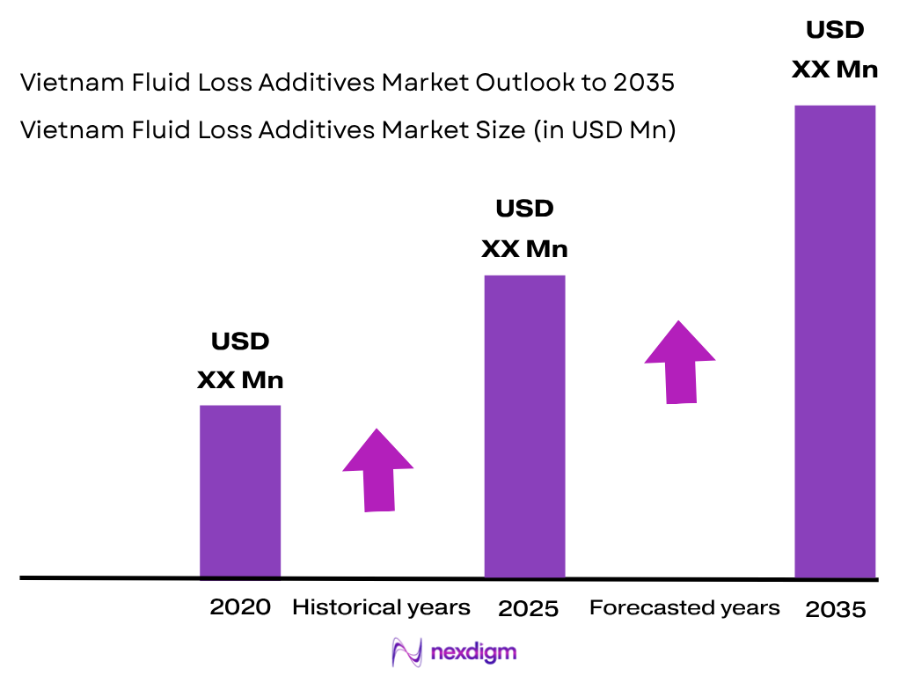
The Vietnam Fluid Loss Additives Market is estimated at ~USD XX million, with the 2024–2035 CAGR at ~XX%. Demand is closely linked to drilling-fluid consumption, well construction activity, formation-pressure management and the technical requirements of offshore and complex wells. Vietnam’s GDP increased from approximately USD 429.7 billion to USD 476.4 billion across the latest two reported observations, while PVEP recorded 1.41 million tonnes of oil equivalent in production during the first six months of the latest reported operating period, supporting continued upstream activity.
Vietnam’s offshore sedimentary basins are the principal demand centers for fluid-loss additives because upstream activity is concentrated around established offshore petroleum provinces and mature producing assets. PVEP identifies 8 major sedimentary basins and reports participation in 28 domestic oil and gas projects, including 13 producing projects, 5 development projects and 10 exploration projects. The Cửu Long, Nam Côn Sơn and Malay–Thổ Chu areas are particularly relevant because drilling and production operations require filtration control, wellbore stabilization and formation-protection technologies.
Market Segmentation
By Product Type
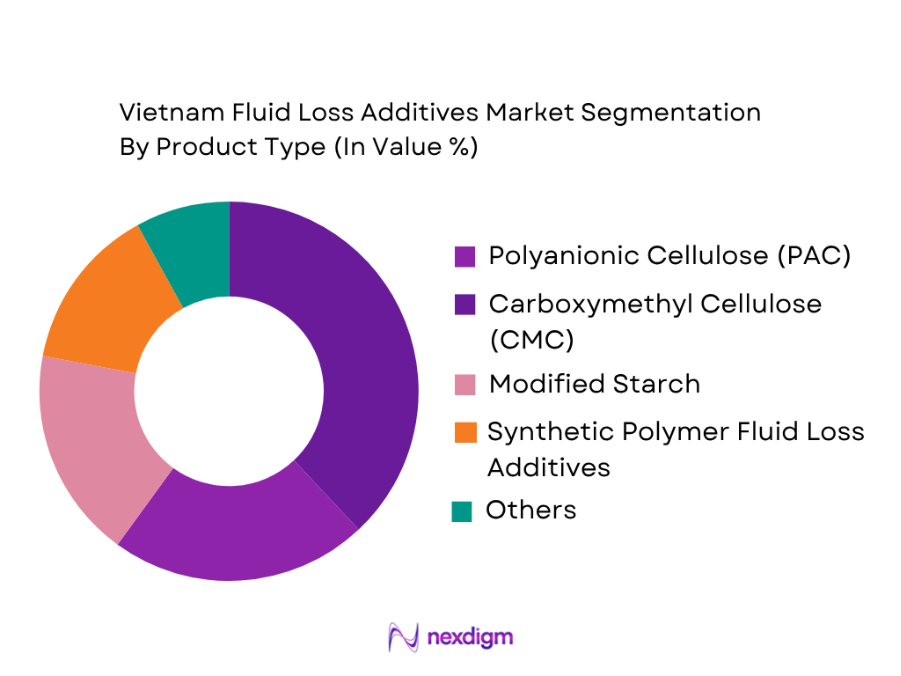
Vietnam Fluid Loss Additives Market is segmented by product type into polyanionic cellulose (PAC), carboxymethyl cellulose (CMC), modified starch, synthetic polymer fluid-loss additives and natural polymer-based additives. PAC is expected to represent the leading segment, at ~38%, because of its established application in water-based drilling-fluid systems and its ability to control filtration while maintaining desirable rheological characteristics. PAC grades can be selected according to temperature, salinity, fluid composition and filtration requirements, making them suitable for Vietnam’s offshore drilling environment. CMC remains important where viscosity modification and filtration control are required simultaneously, while modified starch provides an economical option for selected formulations. Synthetic polymers have greater relevance in technically demanding wells where conventional cellulose derivatives may face temperature or salinity limitations. The increasing complexity of offshore well sections also favors differentiated PAC grades with improved HTHP performance and compatibility with weighted mud systems. The segmentation therefore reflects both established consumption patterns and the technical progression toward higher-performance filtration-control products.
By Application
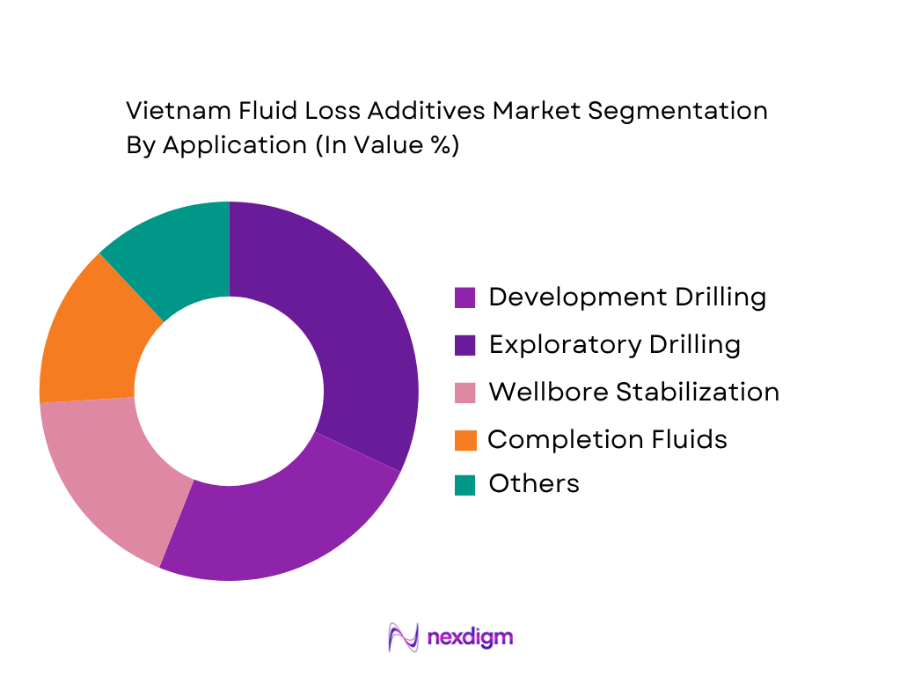
Vietnam Fluid Loss Additives Market is segmented by application into exploration drilling, development drilling, workover and completion fluids, wellbore stabilization and formation-damage control. Development drilling is expected to hold the largest share at ~32%, supported by the need to maintain production from existing fields and extend the productive life of established assets. Development wells generally require carefully controlled filtration characteristics because drilling-fluid losses can affect formation integrity, filter-cake quality and reservoir productivity. Exploration drilling remains a significant application because uncertainty in formation pressure, permeability and mineralogy increases the importance of filtration control during new-well construction. Workover and completion operations require specialized fluid systems designed to minimize formation impairment. Wellbore stabilization applications are particularly important in deviated and technically complex offshore wells, while formation-damage control is increasingly connected with reservoir-protection requirements. The application structure therefore captures both conventional drilling consumption and higher-value fluid-loss-control requirements associated with reservoir-sensitive operations.
Competitive Landscape
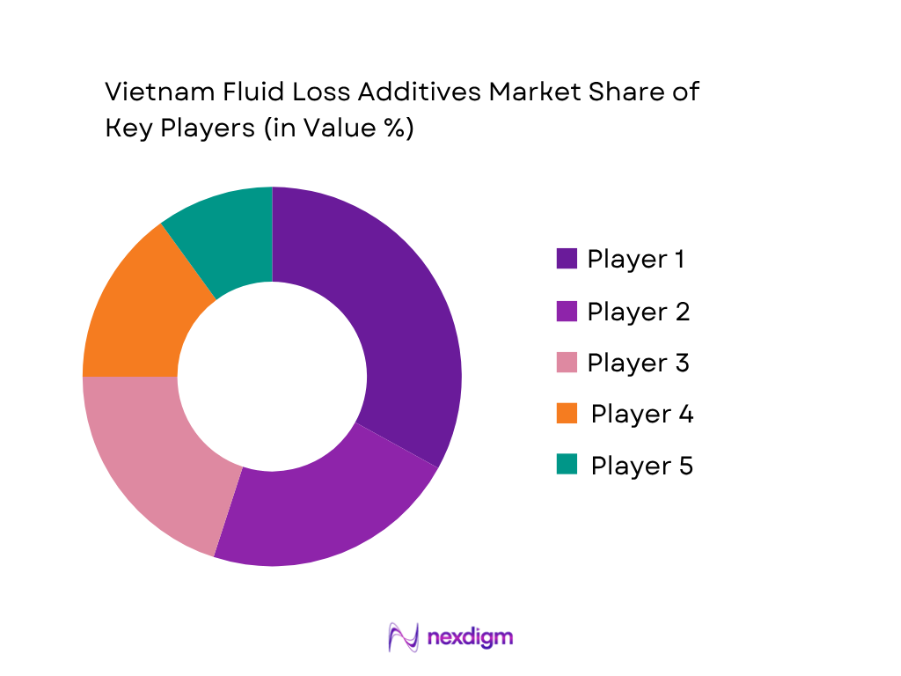
The Vietnam Fluid Loss Additives Market is characterized by participation from global oilfield-service companies, specialty chemical producers and drilling-fluid technology suppliers. Competitive strength depends less on commodity chemical availability alone and more on formulation expertise, offshore technical support, laboratory qualification, HPHT capability, operator relationships and integration with complete drilling-fluid systems. Companies with established drilling-fluid businesses can combine additive supply with mud engineering, laboratory testing and rig-site services, creating stronger customer relationships than standalone chemical suppliers.
| Company | Established | Headquarters | PAC/CMC Capability | HPHT Capability | Offshore Support | Drilling-Fluid Integration | Custom Formulation | Vietnam/Regional Support |
| SLB | 1926 | Houston, USA | ~ | ~ | ~ | ~ | ~ | ~ |
| Halliburton | 1919 | Houston, USA | ~ | ~ | ~ | ~ | ~ | ~ |
| Baker Hughes | 1907 | Houston, USA | ~ | ~ | ~ | ~ | ~ | ~ |
| Clariant | 1995 | Muttenz, Switzerland | ~ | ~ | ~ | ~ | ~ | ~ |
| Nouryon | 2018 | Amsterdam, Netherlands | ~ | ~ | ~ | ~ | ~ | ~ |
Vietnam Fluid Loss Additives Market Analysis
Growth Drivers
Offshore Exploration and Development, Deepwater Drilling
Vietnam’s offshore exploration and development activity provides a direct operating base for fluid-loss additives because drilling programs require filtration control, filter-cake management and wellbore stability under marine operating conditions. PVEP reported 3.05 million tonnes of oil equivalent of production in 2024, including 2.05 million tonnes of crude oil and 1 billion cubic meters of marketed gas, demonstrating the scale of upstream operations requiring continued well and reservoir management. In 2025, PVEP increased total production to 3.65 million tonnes of oil equivalent, while crude-oil production reached 2.54 million tonnes, and exploration added 10.5 million tonnes of oil-equivalent reserves, the highest reserve addition in 10 years. The broader economic environment also supports continued upstream investment: Vietnam’s GDP reached USD 476.39 billion in 2024, with real GDP growth of 7.1, according to the World Bank, while the IMF reported that the economy continued expanding by 7.5 in the first half of 2025. These indicators strengthen the industrial and investment backdrop for technically demanding drilling activity. For fluid-loss additives, the combination of mature-field production, reserve replacement and exploration creates demand for PAC, CMC, modified starch and synthetic polymer systems capable of controlling filtration in complex offshore wells.
Wellbore Stability, Water-Based Fluids and Drilling Optimization
Increasing requirements for wellbore stability and drilling-fluid performance are supporting the need for specialized fluid-loss additives in Vietnam. PVEP reported 1.71 million tonnes of oil equivalent of production in the first half of 2024 and 586 million cubic meters of marketed gas during the same period, indicating substantial continuing upstream operating activity. Its 2024 plan also targeted 3.6 million tonnes of oil equivalent of production and USD 716 million of investment in oil-and-gas projects, providing evidence of continued capital allocation toward upstream development. In 2025, PVEP invested approximately VND 18 trillion, while reserve additions reached 10.5 million tonnes of oil equivalent. These figures are relevant to fluid-loss additives because increasing drilling activity and field redevelopment require drilling fluids to control filtrate invasion, maintain filter-cake integrity and limit formation damage. Vietnam’s macroeconomic conditions reinforce this operating environment: the World Bank recorded GDP of USD 476.39 billion and GDP per capita of USD 4,717.3 in 2024, while the IMF reported 7.1 real GDP growth in 2024 and 6.9 year-on-year growth in the first quarter of 2025. As operators pursue efficient production and reservoir management, fluid-loss additives become increasingly important for maintaining drilling-fluid performance across changing formation and pressure conditions.
Market Challenges
Raw-Material Dependence, Polymer Variability and High-Salinity Compatibility
Raw-material dependence is a significant challenge for Vietnam’s fluid-loss additives market because advanced filtration-control formulations rely on specialized cellulose derivatives, polymers and chemical intermediates whose performance must remain consistent across different drilling-fluid environments. The technical challenge is particularly relevant offshore, where salinity, temperature and formation chemistry can materially influence polymer hydration and filtration behavior. PVEP’s 2024 operating plan targeted VND 20.6 trillion of total investment, including USD 716 million for petroleum projects, demonstrating the scale of capital deployed around upstream assets but also the importance of reliable chemical inputs for maintaining operational continuity. In 2025, PVEP’s exploration program added 10.5 million tonnes of oil equivalent of reserves, while total production reached 3.65 million tonnes of oil equivalent, increasing the importance of consistent drilling-fluid performance across exploration and development activities. Vietnam’s economy reached USD 476.39 billion in GDP in 2024 and recorded 3.6 consumer-price inflation, according to the World Bank, while the IMF reported 7.1 real GDP growth. For additive suppliers, these conditions create a requirement for dependable procurement, inventory planning and formulation qualification. Variability in PAC, CMC or synthetic-polymer quality can alter filtrate control, rheology interaction and filter-cake properties, increasing the technical burden on mud engineers and raising the importance of laboratory validation before offshore deployment.
HPHT Performance, Formation-Damage Risk and Offshore Logistics
Technical performance under high-temperature, high-pressure and high-salinity conditions remains a challenge because fluid-loss additives must control filtration without creating undesirable rheological changes or damaging productive formations. Vietnam’s offshore operating environment increases the importance of these requirements because drilling fluids must remain stable during transportation, mixing and circulation while maintaining filtration performance as downhole conditions change. PVEP reported that its 2024 production included 2.05 million tonnes of crude oil and 1 billion cubic meters of marketed gas, while the first half of 2024 generated 1.71 million tonnes of oil equivalent of production. In 2025, production increased to 3.65 million tonnes of oil equivalent, with average field uptime of 96.9, demonstrating the operational importance of reliable production systems. At the macro level, Vietnam recorded 7.1 real GDP growth in 2024 and GDP of USD 476.39 billion, while the IMF identified global trade uncertainty and financial conditions as continuing risks during 2025. These factors matter for chemical procurement because offshore additives must be available at the right location and time, while imported specialty polymers can face transportation, inventory and supply-chain constraints. Consequently, suppliers need robust qualification procedures, stable formulation performance, appropriate offshore inventory and application engineering to reduce filtration failures, formation damage and unplanned mud-system treatment.
Market Opportunities
High-Performance PAC and CMC, HPHT Polymers and Offshore Fluid-Loss Control
Vietnam’s ongoing upstream production and reserve-development activity creates opportunities for higher-performance fluid-loss additives rather than commodity filtration-control products alone. PVEP added 10.5 million tonnes of oil-equivalent reserves in 2025, the highest reserve addition reported by the company in 10 years, while production reached 3.65 million tonnes of oil equivalent and crude-oil production reached 2.54 million tonnes. These operating figures indicate an active exploration, appraisal and production environment in which drilling-fluid performance can directly affect well construction and reservoir protection. The opportunity is particularly relevant to PAC and CMC formulations engineered for improved temperature stability, salt tolerance and filtration control, alongside synthetic polymers designed for technically demanding wells. Vietnam’s economy provides a supportive industrial backdrop: the World Bank reports GDP of USD 476.39 billion in 2024, GDP per capita of USD 4,717.3, and real GDP growth of 7.1. The IMF also recorded 7.5 year-on-year economic growth during the first half of 2025. These conditions support continued industrial activity and investment capacity around energy infrastructure. Suppliers can therefore differentiate through application-specific grades, laboratory testing, customized mud packages and offshore technical support rather than competing only on standard additive supply.
Local Additive Blending, Digital Mud Monitoring and Reservoir Drill-In Solutions
Localized blending and technically customized fluid-loss packages present an opportunity to improve supply responsiveness while addressing the increasingly specialized requirements of Vietnam’s offshore drilling environment. PVEP’s 2024 investment plan allocated VND 20.6 trillion to investment, including USD 716 million for petroleum projects, while its 2025 investment was approximately VND 18 trillion. The upstream portfolio therefore provides a meaningful operating base for suppliers able to combine chemical availability with formulation support, laboratory testing and rig-site engineering. Digital mud monitoring can further improve additive utilization by linking filtration behavior, fluid properties and treatment decisions more closely to actual drilling conditions. Reservoir drill-in fluids and low-dosage synthetic polymers offer additional opportunities where formation protection and reduced chemical loading are important. The wider economic environment is also supportive: Vietnam recorded 7.1 real GDP growth in 2024, GDP of USD 476.39 billion, and a 6.6 current-account surplus relative to GDP, according to the IMF. Economic resilience and continued upstream investment can support greater adoption of technically differentiated oilfield chemicals. For suppliers, the opportunity is therefore to establish regional inventory, local blending capability, customized additive packages and digital fluid-management services around Vietnam’s offshore drilling ecosystem.
Future Outlook
The Vietnam Fluid Loss Additives Market is expected to develop alongside offshore exploration, field redevelopment, well intervention and increasingly sophisticated drilling-fluid requirements. Demand will increasingly favor additives capable of maintaining filtration control under elevated temperature, salinity and pressure conditions. Offshore operations are likely to remain the principal technology driver because of the technical complexity and formation-protection requirements associated with marine wells. Local supply partnerships, formulation customization and stronger rig-site technical support should become increasingly important competitive differentiators. PVEP’s ongoing exploration and development portfolio provides a continuing operational base for specialized drilling-fluid technologies.
Major Players
- SLB
- Halliburton
- Baker Hughes
- Clariant
- Nouryon
- BASF
- Elementis
- Ingevity
- Newpark Resources
- CES Energy Solutions
- Flotek Industries
- Kemira
- Ashland
- Dow
- Huntsman
Key Target Audience
- Oil & Gas Exploration and Production Companies
- Drilling and Well-Construction Contractors
- Drilling-Fluid Service Companies
- Oilfield Chemical Manufacturers and Suppliers
- Investments and Venture Capitalist Firms
- Government and Regulatory Bodies (Vietnam Oil and Gas Group, Ministry of Industry and Trade, Vietnam Administration of Seas and Islands)
- Offshore Engineering and Well-Completion Companies
- Industrial Chemical Distribution and Procurement Organizations
Research Methodology
Step 1: Identification of Key Variables
The initial phase establishes the Vietnam Fluid Loss Additives Market ecosystem by mapping oil and gas operators, drilling contractors, drilling-fluid service providers, additive manufacturers and chemical distributors. Key variables include well count, drilled meterage, drilling-fluid system, additive dosage, product type, operating environment and filtration-control requirements.
Step 2: Market Analysis and Construction
Historical market data is constructed through analysis of Vietnam’s exploration, development, offshore and workover activity. The assessment connects drilling activity with fluid-system requirements, additive consumption intensity, product specifications and procurement channels to develop the market’s value and volume framework.
Step 3: Hypothesis Validation and Expert Consultation
Market hypotheses are validated through consultations with drilling-fluid engineers, oilfield chemical suppliers, offshore drilling specialists and procurement professionals. Technical discussions focus on PAC and CMC usage, HPHT performance, salinity tolerance, formation-damage control and additive qualification requirements.
Step 4: Research Synthesis and Final Output
The final stage triangulates operator activity, supplier capabilities, drilling-fluid requirements and competitive positioning. Bottom-up additive-consumption calculations are reconciled with top-down industry indicators to establish the final market structure, segmentation, competitive assessment and forecast framework.

- Executive Summary
- Research Methodology (Market Definition and Scope, Fluid-Loss Additive Classification Framework, Market Sizing Architecture, Top-Down Market Assessment, Bottom-Up Market Reconstruction, Drilling Activity Mapping, Well-Count and Meterage Analysis, Additive Consumption Intensity Assessment, Operator and Mud-Service-Company Interviews, Supplier-Side Validation, Application-Level Demand Mapping, Data Triangulation, Historical Baseline Development, Forecasting Framework, Assumptions and Limitations)

- Definition and Scope
- Fluid Loss Additives Role in Drilling-Fluid Systems
- Vietnam Upstream Oil & Gas Industry Structure
- Vietnam Offshore Drilling Landscape
- Vietnam Onshore Drilling Landscape
- Drilling-Fluid Ecosystem and Additive Value Chain
- Fluid Loss Control Mechanism Across the Well Construction Cycle
- Drilling Fluid Supply Chain and Procurement Structure

- Growth Drivers (Offshore Exploration and Development, Deepwater Drilling, Wellbore Stability Requirements, Increasing Drilling Complexity, Development of Existing Oil Fields, Demand for Water-Based Drilling Fluids, Formation-Damage Prevention, Drilling-Fluid Performance Optimization)
- Market Challenges (Raw-Material Dependence, Polymer Performance Variability, High-Salinity Compatibility, HPHT Performance Requirements, Calcium Contamination, Offshore Logistics Complexity, Formation-Damage Risk, Additive Qualification Requirements, Environmental Compliance, Supply-Chain Reliability)
- Market Opportunities (High-Performance PAC and CMC, HPHT Fluid-Loss Polymers, Deepwater Fluid-Loss Control, Local Additive Blending, Environmentally Preferred Formulations, Customized Drilling-Fluid Packages, Reservoir Drill-In Fluids, Digital Mud Monitoring, Low-Dosage Synthetic Polymers, Offshore Fluid-Loss Optimization)
- Market Trends (Advanced PAC Formulations, High-Temperature Fluid-Loss Control, Customized Polymer Systems, Low-Dosage Additive Formulation, Environmentally Preferred Drilling Fluids, Digital Drilling-Fluid Monitoring, Offshore Well Optimization, Formation-Damage Mitigation)
- Regulatory and Environmental Framework (QCVN 36:2024/BTNMT Requirements for Offshore Drilling Fluids and Drill Cuttings, Permitted Drilling-Fluid Characteristics, Non-Aqueous Drilling-Fluid Requirements, Barite Mercury and Cadmium Limits, PAH Limits, Biodegradability Requirements, Sediment Toxicity Requirements, Drill-Cuttings Discharge Limits, Offshore Environmental Compliance) Văn Bản Chính Phủ
- Porter’s Five Forces Analysis
- PESTLE Analysis
- SWOT Analysis

- By Market Value (2020-2025)
- By Volume Consumption (2020-2025)
- By Average Selling Price (2020-2025)
- By Additive Consumption per Well (2020-2025)
- By Drilled Meter (2020-2025)
- By Product Type (2020-2025)

- By Product Type (In Value %)
Polyanionic Cellulose (PAC)
Carboxymethyl Cellulose (CMC)
Synthetic Polymer Fluid-Loss Additives
Natural Polymer-Based Fluid-Loss Additives - By Drilling Fluid System (In Value %)
Water-Based Drilling Fluids
Oil-Based Drilling Fluids
Synthetic-Based Drilling Fluids
Low-Solids Drilling Fluids
Reservoir Drill-In Fluids - By Application (In Value %)
Exploration Drilling
Development Drilling
Workover and Completion Fluids
Wellbore Stabilization
Formation-Damage Control - By Well Type (In Value %)
Vertical Wells
Directional Wells
Horizontal Wells
Extended-Reach Wells
Deepwater Wells - By Operating Environment (In Value %)
Onshore
Shallow Offshore
Deepwater Offshore
High-Temperature Wells
High-Salinity Formation Environments - By End User (In Value %)
National Oil & Gas Operators
International Oil & Gas Operators
Drilling Contractors
Drilling-Fluid Service Companies
Completion and Well-Intervention Contractors - By Additive Function (In Value %)
API Filtration Reduction
HTHP Filtration Control
Filter-Cake Formation
Wellbore Wall Stabilization
Formation Protection - By Procurement Channel (In Value %)
Direct Operator Procurement
Drilling-Fluid Service Contracts
Oilfield Chemical Distributors
Integrated Drilling-Service Procurement
Local Chemical Suppliers

- Market Share of Major Players (By Value, Volume, Product Type, Drilling Fluid System, Application, End User, Operating Environment)
- Cross Comparison Parameters (Product Portfolio Breadth, PAC/CMC Grade Coverage, HPHT Fluid-Loss Capability, Salt-Tolerance Capability, Offshore Supply Capability, Local Technical Support, Laboratory Testing Capability, Additive Customization Capability)
- SWOT Analysis of Major Players
- Detailed Profiles of Major Companies
Halliburton
SLB
Baker Hughes
Weatherford
Newpark Resources
CES Energy Solutions
Nouryon
Clariant
BASF
Ingevity
Elementis
Flotek Industries
Chevron Phillips Chemical
PetroVietnam Drilling & Well Services Corporation (PV Drilling)
Petrovietnam Exploration Production Corporation (PVEP)

- Oil & Gas Operator Demand
- Drilling Contractor Demand
- Drilling-Fluid Service Provider Demand
- Completion and Well-Intervention Demand
- Offshore Operations Assessment

- By Market Value (2026-2035)
- By Volume Consumption (2026-2035)
- By Average Selling Price (2026-2035)
- By Additive Consumption per Well (2026-2035)
- By Drilled Meter (2026-2035)
- By Product Type (2026-2035)


 Request a Sample
 Ask for Customization
 Get a Quote
 Enquire Now