

 Download PDF
Market Overview
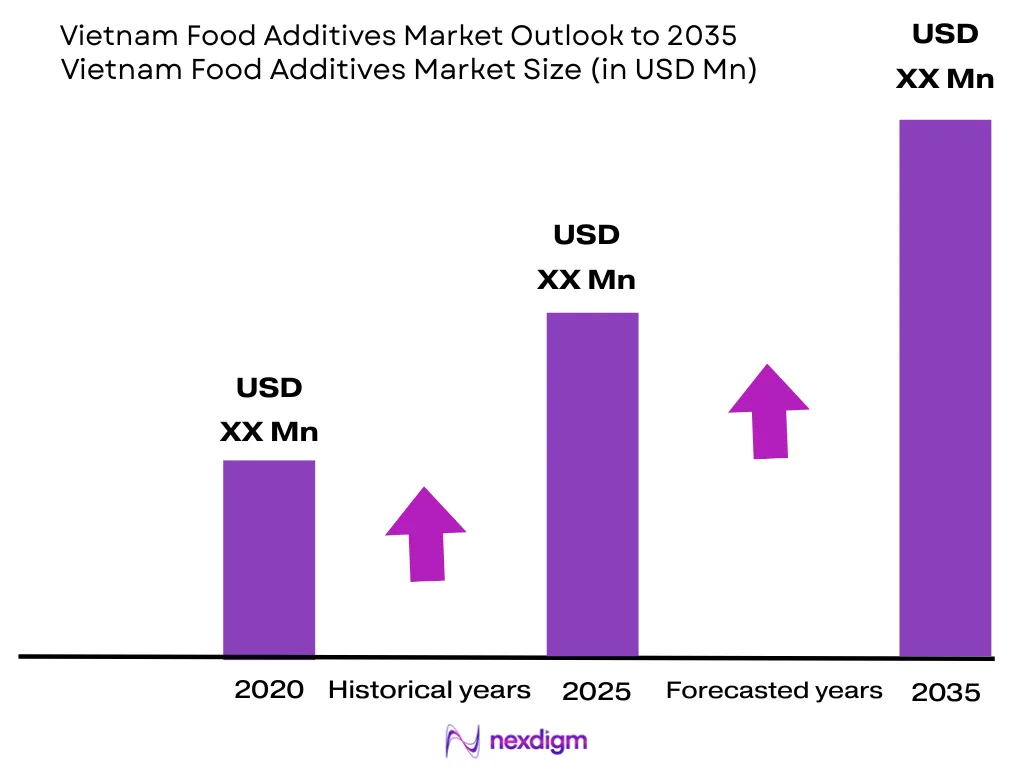
The Vietnam Food Additives Market is valued at USD ~ million, based on a five-year historical analysis, and is forecast to grow at % CAGR during the forecast period. Demand is driven by processed food, dairy drinks, RTD beverages, seafood processing, instant noodles, snacks, sauces and confectionery. Vietnam’s food processing industry reached USD 79.3 billion and grew 7.4% in 2024, while GDP reached about USD 476.3 billion, compared with 5.05% GDP growth in 2023. The Vietnam Food Additives Market is dominated by Ho Chi Minh City, Binh Duong, Dong Nai, Long An, Hanoi, Bac Ninh, Hung Yen, Hai Phong, Can Tho and the Mekong Delta. Southern clusters dominate because of beverage, dairy, seafood, packaged food and industrial-zone concentration, while Hanoi and northern provinces dominate FMCG, instant noodles and beverage manufacturing. PepsiCo’s additional USD 400 million Vietnam investment across Long An and Ha Nam reinforces the role of southern and northern processing corridors.
Market Segmentation
By Additive Type
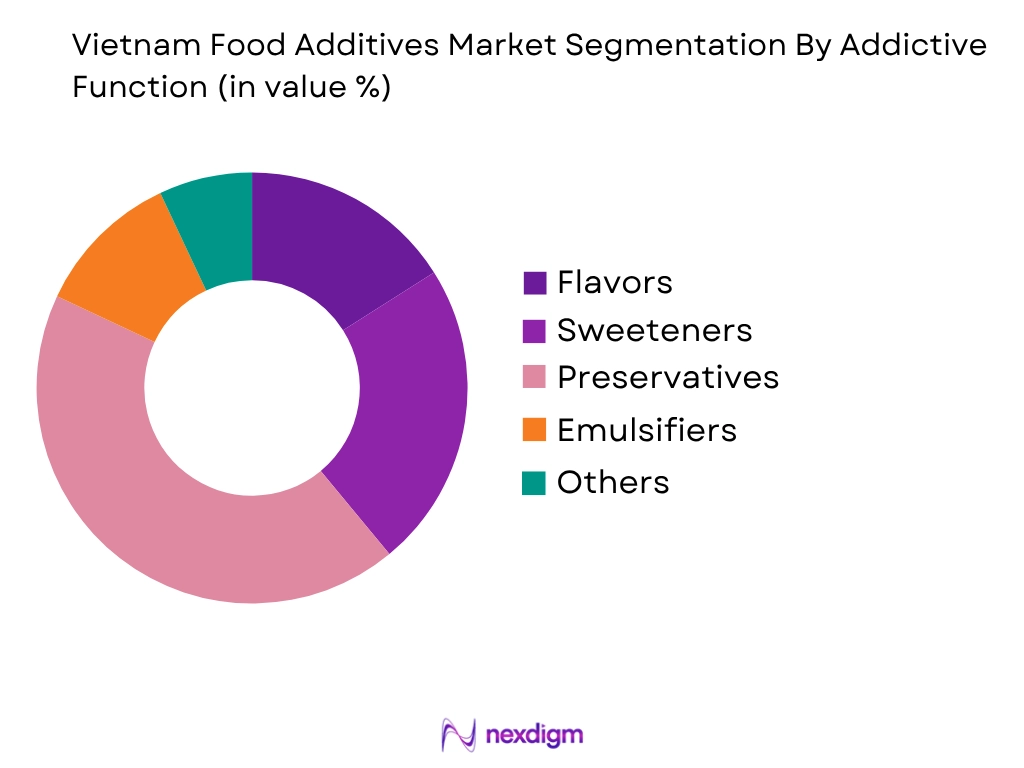
Vietnam Food Additives Market is segmented by additive type into preservatives, flavours, flavour enhancers, emulsifiers, stabilizers, sweeteners, colours, acidity regulators, antioxidants, hydrocolloids, enzymes and other functional additives. Recently, preservatives have a dominant market share in Vietnam under the additive type segmentation, due to their high relevance across seafood, sauces, instant noodles, bakery, dairy drinks, RTD beverages, meat products and ready-to-eat foods. Vietnam’s long north-south distribution geography, hot and humid climate, export-oriented seafood processing base and strong packaged food manufacturing activity increase the need for microbial control and shelf-life extension. Preservatives also support retailers, convenience stores and distributors by reducing spoilage risk across chilled, ambient and semi-processed products. Their dominance is reinforced by Vietnam’s regulatory framework, where permitted additives and maximum-use levels are listed under Ministry of Health rules, making compliant preservation systems central to organized food manufacturing.
By Application
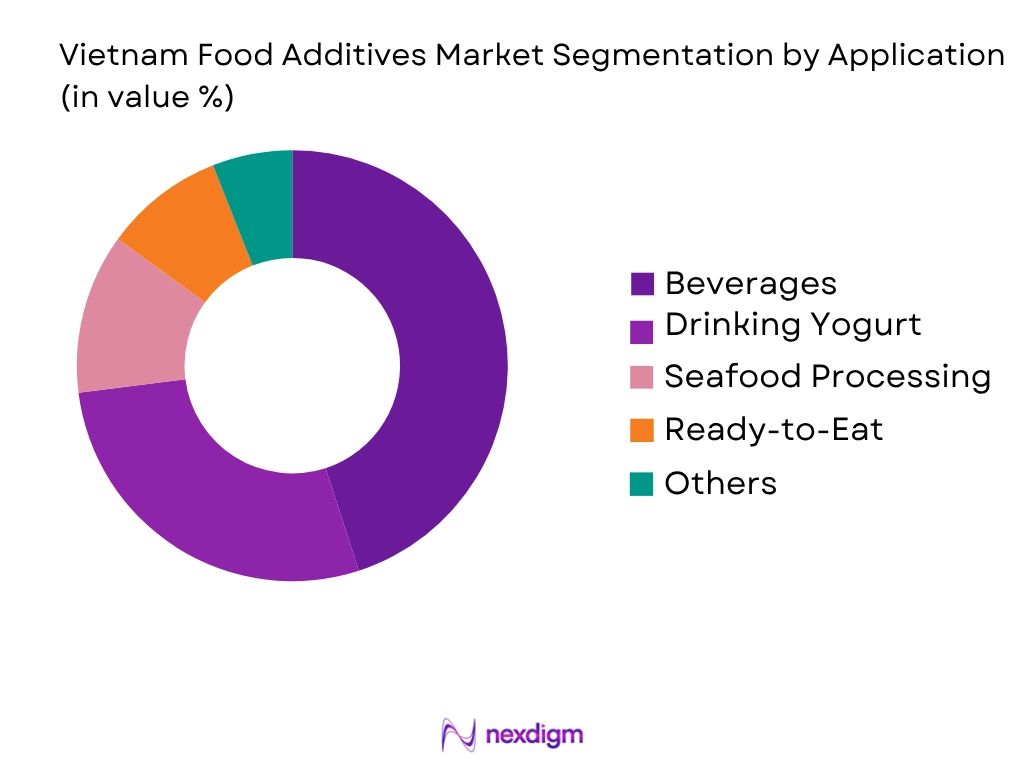
Vietnam Food Additives Market is segmented by application into beverages and RTD drinks, seafood processing, dairy and drinking yogurt, instant noodles, packaged snacks, sauces, condiments, fish sauce, bakery, confectionery, meat products, poultry products, ready-to-eat foods and ready-to-cook foods. Recently, beverages and RTD drinks have a dominant market share in Vietnam under the application segmentation because beverage manufacturing uses several additive systems simultaneously, including sweeteners, acidity regulators, preservatives, colours, clouding agents, flavours, stabilizers and antioxidants. Vietnam’s urban retail network, convenience stores, cafés, modern trade outlets and foodservice channels support frequent beverage product launches in tea drinks, carbonated beverages, energy drinks, coffee beverages, fruit drinks and functional drinks. Low-sugar and flavoured drink development increases demand for acid-sweetness balancing, colour stability and sensory standardization. Beverage plants also require consistent batch performance, regulatory documentation and scalable ingredient supply, making this category highly additive-intensive compared with simpler food applications.
Competitive Landscape
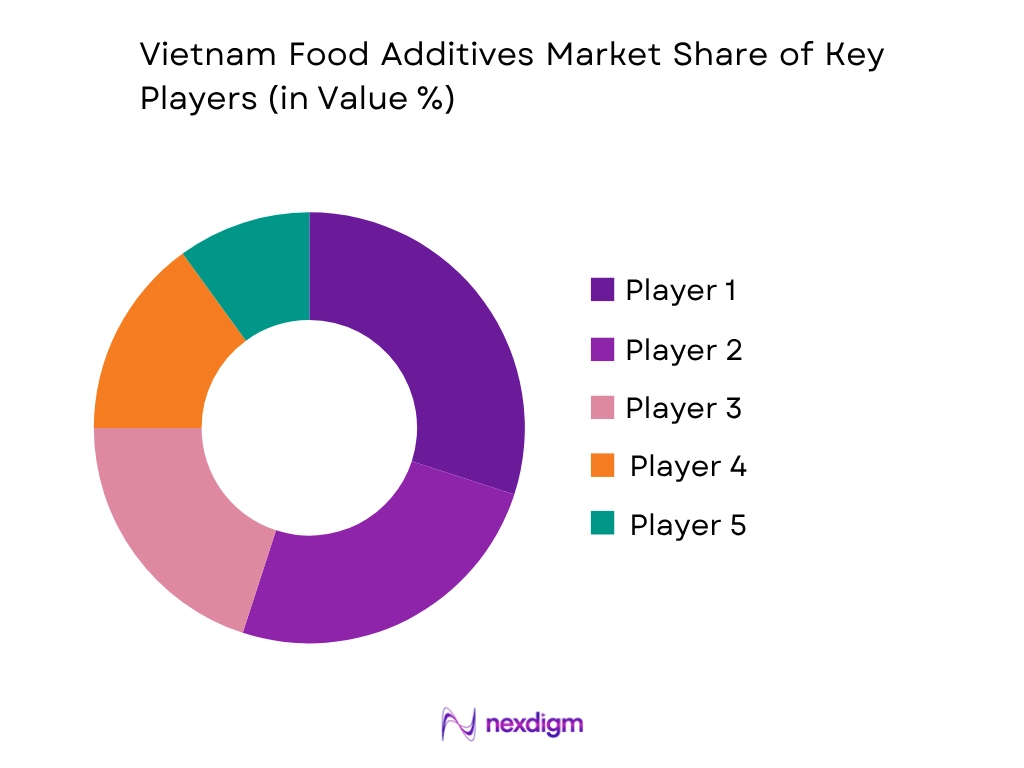
Vietnam Food Additives Market is served by a mix of global ingredient companies, Japanese and European flavour houses, local distributors, chemical traders, food ingredient blenders and domestic food chemical suppliers. The market is relatively fragmented at the distribution level, but technical capability is concentrated among players that provide application support, regulatory documents, imported ingredient portfolios and formulation assistance. Large beverage, dairy, seafood and instant noodle manufacturers prefer suppliers with Ministry of Health-compliant documentation, stable import supply, HACCP-compatible ingredients and category-specific formulation expertise.
| Company | Establishment Year | Headquarters | Core Additive Focus | Vietnam Market Role | Key Applications | Distribution Strength | Compliance Capability | Market-Specific Capability |
| Ajinomoto Vietnam | 1991 | Bien Hoa, Vietnam | ~ | ~ | ~ | ~ | ~ | ~ |
| Cargill Vietnam | 1995 | Minnesota, USA | ~ | ~ | ~ | ~ | ~ | ~ |
| Kerry Ingredients Vietnam | 1972 | Tralee, Ireland | ~ | ~ | ~ | ~ | ~ | ~ |
| DSM-Firmenich Vietnam | 2023 | Maastricht, Netherlands / Geneva, Switzerland | ~ | ~ | ~ | ~ | ~ | ~ |
| Brenntag Vietnam | 1874 | Essen, Germany | ~ | ~ | ~ | ~ | ~ | ~ |
Vietnam Food Additives Market Analysis
Growth Drivers
Expansion of food processing and packaged food manufacturing
Vietnam Food Additives Market is supported by the country’s expanding food processing base, where preservatives, stabilizers, emulsifiers, colours, sweeteners, acidity regulators, antioxidants, hydrocolloids and flavour enhancers are used in beverages, seafood, dairy drinks, instant noodles, sauces, bakery and snacks. USDA FAS reported that Vietnam’s food processing industry grew by 7.4 units per 100 units in 2024 to USD 79.3 billion, while the 2026 update reported the industry reaching USD 88 billion in 2025, growing 11 units per 100 units. The National Statistics Office reported Vietnam’s GDP growth at 7.09 units per 100 units in 2024, with average population at 101.3 million and labour force aged 15 and above at nearly 53.0 million. This supports additive demand because larger food manufacturing output requires longer shelf life, consistent sensory quality, microbial stability, colour retention and formulation standardisation across domestic retail, foodservice and export-oriented channels.
Urbanization, modern retail and beverage-led consumption
Vietnam Food Additives Market is driven by urbanizing consumption, because urban food systems rely more heavily on packaged beverages, dairy drinks, instant noodles, snacks, sauces, frozen foods and ready-to-eat meals that need additive-supported stability. The World Bank reported Vietnam’s urban population at 40.2 units per 100 units of total population in 2024, while the National Statistics Office estimated the country’s average population at 101.3 million in 2024. Vietnam’s macroeconomic base also expanded, with GDP growth at 7.09 units per 100 units in 2024 and the labour force aged 15 and older at nearly 53.0 million. These numbers are relevant to food additives because a larger urban working population increases demand for convenience foods, RTD beverages, packaged snacks and dairy beverages requiring preservatives, sweeteners, acidulants, stabilizers, emulsifiers, colours and flavour systems. Beverage and convenience-food manufacturers also need stable formulations for nationwide distribution across Ho Chi Minh City, Hanoi, Binh Duong, Dong Nai and Long An.
Market Challenges
Regulatory compliance and permitted-additive control
Vietnam Food Additives Market faces a major challenge from regulatory compliance because food additives are governed by permitted lists, use conditions and maximum-use levels rather than free formulation use. Circular 24/2019/TT-BYT, issued by Vietnam’s Ministry of Health, provides the list of food additives, rules for use and management, and responsibilities of manufacturers, sellers, importers and regulatory authorities. In 2024, the Ministry of Health issued Consolidated Document 09/VBHN-BYT, updating and consolidating the effective regulations on food additive management and use. This matters for Vietnam’s additive buyers because beverage makers, seafood processors, dairy companies, instant noodle producers, sauce manufacturers and bakery companies must verify whether each preservative, colour, sweetener, flavour enhancer, emulsifier, antioxidant or hydrocolloid is permitted for the relevant food category. Compliance affects product self-declaration, import documentation, label review, maximum-use validation, food safety inspection and export buyer audits. The challenge is market-specific because Vietnam has strong imported additive dependence and large export food sectors that require document-ready ingredients.
Imported ingredient dependence and technical formulation constraints
Vietnam Food Additives Market is constrained by import dependency and technical formulation complexity, especially for hydrocolloids, enzymes, natural colours, high-intensity sweeteners, specialty preservatives, acidulants and stabilizer systems. Vietnam’s economy is highly trade-linked: Reuters, citing official data, reported exports at USD 405.53 billion and imports at USD 380.76 billion in 2024, alongside GDP growth of 7.09 units per 100 units. USDA FAS also stated that ingredient demand remains strong as the food processing industry expanded to USD 79.3 billion in 2024 and reached USD 88 billion in 2025. For food additives, this creates operational risk because many processors depend on imported ingredients from China, ASEAN, Europe, Japan and the United States. A shortage or documentation delay can affect beverage stabilizers, seafood phosphates, dairy emulsifiers, snack antioxidants and bakery improvers. Technical reformulation is also difficult because replacing one additive can alter pH, viscosity, water activity, colour migration, mouthfeel, microbial stability or shelf life, requiring application trials before commercial production.
Market Opportunities
Export-oriented food processing and compliance-ready additive systems
Vietnam Food Additives Market has a strong opportunity in export-grade additive systems because the country has large seafood, processed food, beverage and packaged food export linkages requiring documented, compliant and application-specific ingredients. Reuters reported Vietnam’s total exports at USD 405.53 billion in 2024 and imports at USD 380.76 billion, indicating a highly internationalised manufacturing economy. USDA FAS reported that Vietnam’s food processing industry reached USD 79.3 billion in 2024 and USD 88 billion in 2025. This creates opportunity for additive suppliers offering HACCP-compatible, MOH-compliant and export-documentation-ready preservatives, stabilizers, phosphates, antioxidants, colours, flavour systems, sweeteners and hydrocolloids. Seafood processors need moisture-control and texture systems; beverage companies need acid-sweetness balancing and stabilizers; instant noodle manufacturers need flavour enhancers and anti-caking systems. The opportunity is current rather than speculative, because existing export-linked factories already require reliable documentation, certificates of analysis, traceability files, permitted-use confirmation and consistent batch quality to meet domestic inspection and overseas buyer requirements.
Application-specific clean-label and functional additive solutions
Vietnam Food Additives Market has an opportunity in clean-label and application-specific additive systems as food manufacturers shift from single ingredients to formulation solutions for beverages, dairy drinks, seafood, bakery, instant noodles, sauces and snacks. The National Statistics Office estimated Vietnam’s 2024 average population at 101.3 million, with nearly 53.0 million people in the labour force aged 15 and above, while the World Bank reported urban population at 40.2 units per 100 units of total population. These indicators support large-scale demand for packaged and convenience foods that must remain stable through hot and humid distribution conditions. USDA FAS reported food processing industry value at USD 79.3 billion in 2024, expanding to USD 88 billion in 2025, showing a broad current manufacturing base for additive innovation. Suppliers can target natural colours, plant-derived hydrocolloids, fermentation-derived preservatives, low-sugar sweetener blends, dairy stabilizer systems, seafood texture stabilizers and beverage emulsions. The opportunity is market-specific because Vietnamese processors require clean-label positioning without losing shelf life, pH control, texture, colour stability or cost-in-use performance.
Future Outlook
Over the forecast period, Vietnam Food Additives Market is expected to expand steadily, supported by food processing growth, beverage innovation, seafood exports, dairy consumption, instant noodle manufacturing, bakery development and modern retail expansion. Food additives will remain important for shelf-life extension, texture control, colour stability, flavour enhancement, pH control and export-grade product consistency. Beverages will remain one of the strongest application areas. Carbonated drinks, bottled teas, coffee beverages, fruit drinks, energy drinks and functional beverages require acidity regulators, sweeteners, colours, stabilizers, flavours and preservatives. Low-sugar product development will increase the need for sweetener systems, acidity balancing, flavour masking and stabilizer support.
Major Players
- Ajinomoto Vietnam
- Cargill Vietnam
- DSM-Firmenich Vietnam
- Kerry Ingredients Vietnam
- International Flavors & Fragrances Vietnam
- Givaudan Vietnam
- Symrise Vietnam
- Brenntag Vietnam
- IMCD Vietnam
- Azelis Vietnam
- DKSH Vietnam
- Roquette Vietnam
- Tate & Lyle Vietnam
- Vinh Nam Anh Food Chemical Company
- AIG Asia Ingredients Group
Key Target Audience
- Food additive manufacturers
- Food and beverage processing companies
- Seafood processors and export-oriented food manufacturers
- Dairy, beverage and RTD drink manufacturers
- Instant noodle, bakery and snack manufacturers
- Ingredient importers and specialty ingredient distributors
- Investments and venture capitalist firms
- Government and regulatory bodies
Research Methodology
Step 1: Identification of Key Variables
The initial phase involves constructing an ecosystem map covering additive manufacturers, importers, ingredient distributors, beverage companies, seafood processors, dairy manufacturers, instant noodle producers, bakery companies and application solution providers. This step uses desk research, regulatory documents, trade indicators and company information. The objective is to define the key variables influencing Vietnam Food Additives Market demand, including additive type, application, source, functionality, compliance type and distribution model.
Step 2: Market Analysis and Construction
In this phase, historical data is compiled across food processing activity, beverage production, seafood exports, ingredient imports, industrial-zone development and end-user procurement patterns. The top-down approach evaluates macro food processing indicators, while the bottom-up approach assesses additive usage across beverages, seafood, dairy, snacks, sauces, instant noodles and RTE foods. This supports value, volume and segment-level market modelling.
Step 3: Hypothesis Validation and Expert Consultation
Market hypotheses are validated through computer-assisted telephone interviews with additive suppliers, importers, distributors, food technologists, seafood processors, beverage formulators and procurement teams. These consultations help verify category dominance, supplier selection criteria, import dependency, MOH compliance requirements and clean-label reformulation trends. Expert inputs are used to refine segmentation and competitive positioning.
Step 4: Research Synthesis and Final Output
The final phase integrates regulatory review, secondary research, company benchmarking, trade indicators, distributor checks and expert consultations into a consolidated market model. Data triangulation is applied across manufacturer demand, import movement, application usage and food category requirements. The final output includes market size, segmentation, competitive landscape, future outlook and strategic recommendations for Vietnam Food Additives Market participants.

- Executive Summary
- Research Methodology (Market Definitions and Assumptions, Abbreviations, INS/E-Number Mapping, Vietnam Food Category Mapping, Circular 24/2019/TT-BYT Additive Classification, Import HS Code Mapping, Market Sizing Approach, Top-Down Analysis, Bottom-Up Analysis, Demand-Side Assessment, Supply-Side Assessment, Ingredient Import-Export Assessment, Food Processor Procurement Checks, Distributor and Trader Interviews, Primary Industry Interviews, Data Triangulation, Forecasting Framework, Limitations and Future Conclusions)

- Definition and Scope
- Market Evolution and Industry Genesis
- Timeline of Major Industry Developments
- Food Additives Regulatory Framework
- Role of Additives in Vietnam Food Processing and Beverage Manufacturing

- Growth Drivers (Expansion of Food Processing Industry, Rising Packaged Food Consumption, Urbanization and Modern Retail Penetration, Growth of Dairy and RTD Beverages, Expansion of Instant Noodle Manufacturing, Seafood Export Processing, Bakery and Confectionery Growth, Demand for Shelf-Life Extension)
- Market Challenges (MOH Compliance Complexity, Import Dependency for Specialty Additives, State Food Safety Inspection for Imported Additives, Clean-Label Reformulation Pressure, Quality Variation in Regional Distribution, Misuse of Non-Permitted Additives, Technical Formulation Barriers, Traceability and Documentation Gaps)
- Market Opportunities (Natural Colours and Natural Preservatives, Clean-Label Hydrocolloids, Low-Sugar Beverage Sweetener Systems, Seafood Processing Stabilizers, Dairy and Beverage Stabilizer Blends, Export-Grade Additive Systems, Fermentation-Derived Ingredients, Regional Food Processing Cluster Expansion)
- Market Trends (Shift from Synthetic to Natural Additives, Demand for Clean-Label Ingredient Lists, Growth of Low-Sugar Beverages, Increased Use of Stabilizers in Dairy Drinks, Enzyme-Based Processing Solutions, Customized Emulsifier and Stabilizer Systems, Colour Replacement in Snacks and Confectionery, Export-Oriented Compliance)
- SWOT Analysis
- Porter’s Five Forces Analysis
- PESTLE Analysis

- By Market Value (2020-2025)
- By Consumption Volume (2020-2025)
- By Import Value (2020-2025)

- By Additive Type (In Value %)
Preservatives
Emulsifiers
Stabilizers
Thickeners
Sweeteners
Colours - By Application (In Value %)
Beverages
Ready to Eat
Drinking Yogurt
Sea Food Processing
Plant-Based Additives - By Distribution Channel (In Value %)
Direct Sales to Food Processors
Ingredient Distributors
Chemical Traders
Importers
Online B2B Ingredient Platforms
Specialty Ingredient Solution Providers - By Region (In Value %)
Northern Vietnam
Central Vietnam
Southern Vietnam
Mekong Delta
Red River Delta
Southeast Vietnam
Central Highlands

- Market Share of Major Players (By Value, Volume, Additive Type, Application, End User, Region, Distribution Channel, Domestic vs Imported Portfolio)
- Cross Comparison Parameters (Application Lab Capability, MOH Documentation Strength, Additive Portfolio Breadth, Natural and Clean-Label Product Range, Import and Domestic Manufacturing Mix, Food Category-Specific Formulation Expertise, Distribution Reach Across Food Processing Clusters, Technical Support and Shelf-Life Testing Capability)
- SWOT Analysis of Major Players (Technical Strength, Product Breadth, Regulatory Capability, Customer Concentration, Import Exposure, Price Competitiveness, Distribution Network, Clean-Label Readiness)
- Detailed Profiles of Major Companies
Ajinomoto Vietnam
Cargill Vietnam
DSM-Firmenich Vietnam
Kerry Ingredients Vietnam
International Flavors & Fragrances Vietnam
Givaudan Vietnam
Symrise Vietnam
Brenntag Vietnam
IMCD Vietnam
Azelis Vietnam
DKSH Vietnam
Roquette Vietnam
Tate & Lyle Vietnam
Vinh Nam Anh Food Chemical Company
AIG Asia Ingredients Group

- Food and Beverage Manufacturer Analysis
- Dairy and Drinking Yogurt Processor Analysis
- Beverage Manufacturer Analysis
- Seafood Processor Analysis
- Instant Noodle and Snack Manufacturer Analysis

- By Market Value (2026-2035)
- By Consumption Volume (2026-2035)
- By Import Value (2026-2035)


 Request a Sample
 Ask for Customization
 Get a Quote
 Enquire Now