
 Download PDF
Market Overview
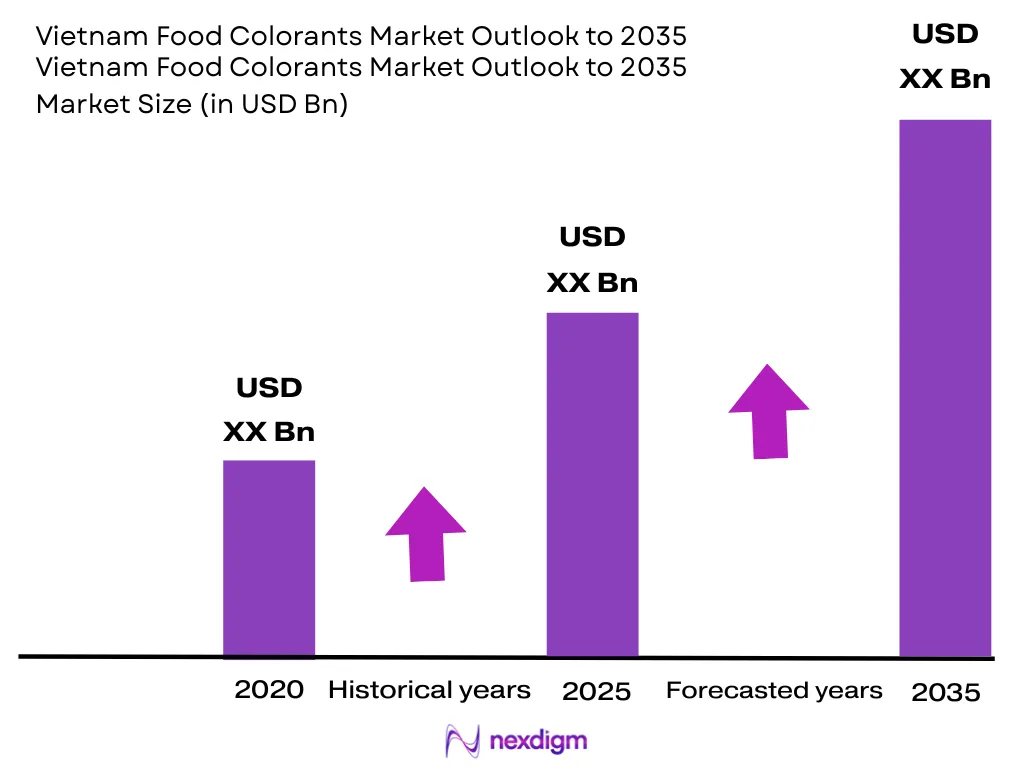
The Vietnam Food Colorants Market was valued at USD ~ Billion in 2024 and is anticipated to expand at a CAGR of ~% during 2026–2035. The market is primarily driven by the country’s rapidly expanding food processing and beverage manufacturing base, rising urban incomes, and a deep-rooted culinary tradition of using indigenous plant-based pigments in everyday Vietnamese cuisine. Vietnam’s overall food and beverage market was valued at close to USD 124.5 billion in 2024, supported by a population that reached 101.1 million as of the April 2024 mid-term population census and GDP growth of 6.1% in 2024. Continued expansion of modern retail, e-commerce grocery platforms, and a fast-growing foodservice sector, which is projected to more than double in value by 2033, continues to sustain rising demand for functional ingredients such as food colorants across bakery, beverage, dairy, and confectionery applications.
Market Segmentation
By Source Type
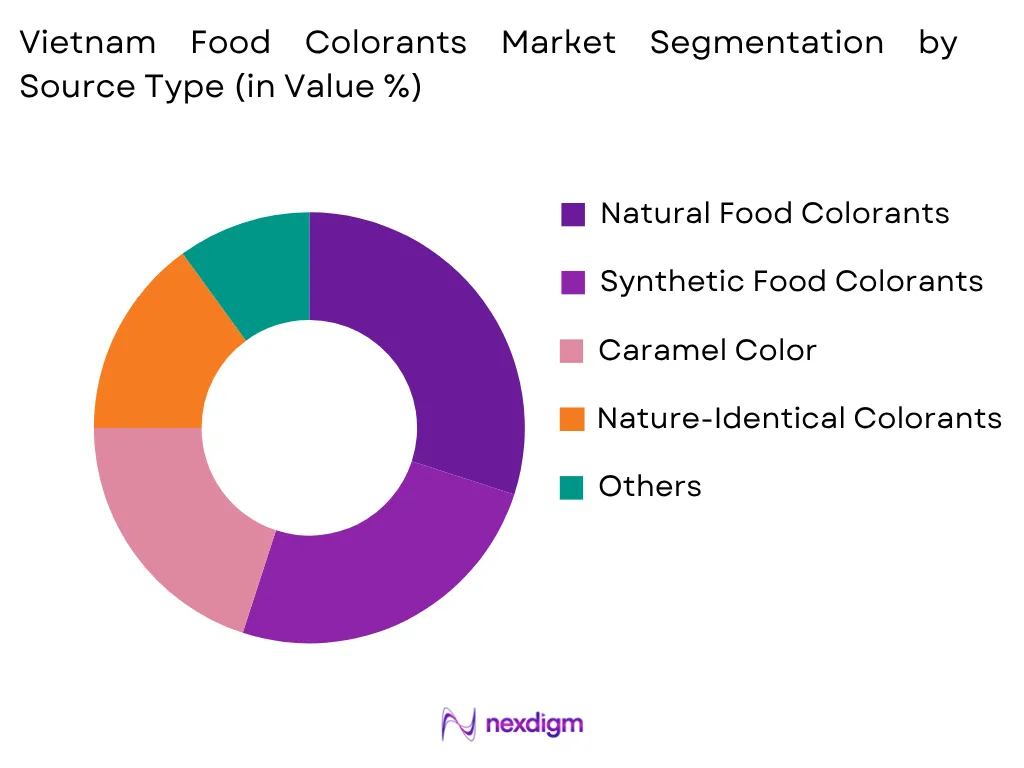
Natural Food Colorants hold a considerable and steadily growing share of the Vietnam Food Colorants Market, supported by the country’s long culinary tradition of using indigenous plant-based pigments such as gấc fruit, turmeric, pandan leaf, butterfly pea flower, and annatto seeds to color rice, desserts, and traditional dishes. Unlike many regional markets, Vietnam benefits from strong domestic agricultural availability of several key coloring crops across the Mekong Delta and Central Highlands, which supports local sourcing alongside imports of specialty pigments and concentrates. At the same time, Synthetic Food Colorants continue to command a substantial share of overall value given their lower cost, superior heat stability in tropical supply chains, and dominant use in mass-market packaged snacks, beverages, and instant noodles, particularly among price-sensitive consumer segments. Regulatory encouragement under the Ministry of Health’s Circular 24/2019/TT-BYT, together with rising clean-label awareness among urban consumers, continues to accelerate a gradual shift toward natural and nature-identical colorants across premium product categories.
By Application
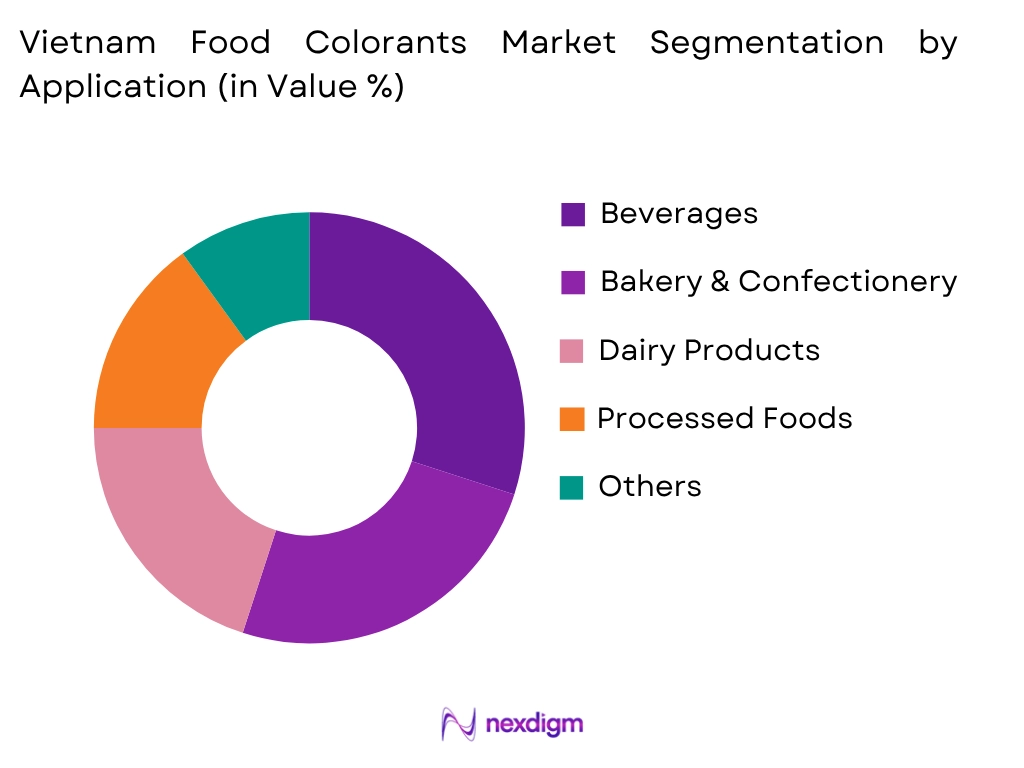
The Beverages segment accounts for a leading share of the Vietnam Food Colorants Market, driven by the country’s large and fast-growing consumption of soft drinks, ready-to-drink tea, coffee-based beverages, and functional drinks. Vietnam’s robust café culture and position as the world’s second-largest coffee exporter have encouraged manufacturers to expand color-enhanced beverage lines, from vibrant fruit teas to specialty iced coffee drinks, while an upcoming excise tax on high-sugar soft drinks, set to take effect in 2027, is prompting reformulation toward naturally colored, reduced-sugar alternatives. The rapid growth of quick-service restaurants, cloud kitchens, and delivery-first beverage brands across Ho Chi Minh City and Hanoi has further increased demand for vivid, stable colors that preserve visual appeal through delivery packaging. Meanwhile, the Bakery & Confectionery segment continues to grow steadily, supported by rising demand for premium baked goods and confectionery items sold through Vietnam’s rapidly expanding network of modern retail and convenience stores.
Competitive Landscape
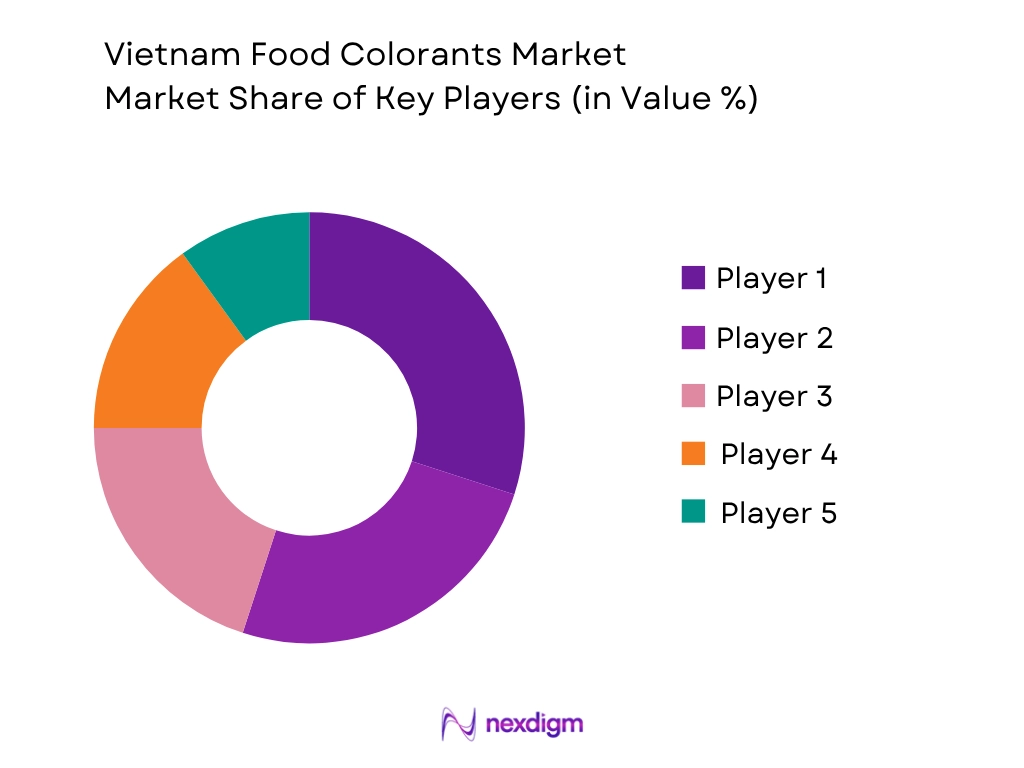
The Vietnam Food Colorants Market is moderately fragmented, comprising a mix of multinational ingredient suppliers, regional distributors operating through Thai, Singaporean, and Malaysian hubs, and a growing base of domestic natural extract producers. Multinational players increasingly value Vietnam not only as a consumption market but also as a manufacturing base, given its relatively competitive production costs and proximity to abundant natural raw materials such as annatto, turmeric, and gấc fruit; Roha Group, for instance, operates one of its global manufacturing centers in Vietnam, reflecting the country’s growing role as a regional production base for food colorant manufacturers alongside its traditional position as a demand market. Competitive dynamics are shaped by compliance with the Ministry of Health’s Circular 24/2019/TT-BYT and its 2023 amendment, technical support capabilities suited to high-temperature tropical supply chains, and the ability to balance cost-competitive synthetic portfolios with expanding natural and nature-identical offerings. Companies with in-country manufacturing or blending facilities hold a distinct advantage in serving Vietnam’s large and diverse base of food processors, which ranges from multinational beverage majors to fast-growing local snack and instant noodle producers.
| Company | Establishment Year | Headquarters | Primary Product Portfolio | Natural Color Portfolio
|
Manufacturing Presence | Major End-Use Industries | Key Strategic Focus | Certifications & Compliance |
| Roha Group | 1972 | ~ | ~ | ~ | ~ | ~ | ~ | ~ |
| Givaudan | 1895 | ~ | ~ | ~ | ~ | ~ | ~ | ~ |
| DSM-Firmenich | 2023 | ~ | ~ | ~ | ~ | ~ | ~ | ~ |
| Sensient Technologies | 1882 | ~ | ~ | ~ | ~ | ~ | ~ | ~ |
| Döhler | 1838 | ~ | ~ | ~ | ~ | ~ | ~ | ~ |
Vietnam Confectionary Market Analysis
Growth Drivers
Rapid Growth of Food Processing, Beverage, and Foodservice Industries
The Vietnam food colorants market is benefiting from the country’s broad-based expansion of food manufacturing, retail, and out-of-home consumption. Vietnam’s food and beverage market was valued at close to USD 124.5 billion in 2024 and is projected to reach USD 210.4 billion by 2032, supported by rising disposable incomes, rapid urbanization, and a population of 101.1 million as of the April 2024 mid-term census. GDP growth of 6.1% in 2024, together with a fast-expanding middle class, continues to sustain demand for packaged foods, dairy products, confectionery, and beverages in which food colorants play an essential role. Recent capital commitments illustrate the scale of this expansion: PepsiCo announced an investment of close to USD 400 million in two new beverage manufacturing plants in Long An and Ha Nam in March 2024, while TH Group committed close to USD 220 million to a new dairy farm and milk processing project in Nghe An. Vietnam’s foodservice market, projected to grow from USD 21.9 billion in 2024 to USD 54.3 billion by 2033, and international tourist arrivals of 17.6 million in 2024, are further widening the addressable market for coloring solutions across bakery, beverage, dairy, and confectionery applications.
Rich Domestic Availability of Natural Pigment-Yielding Crops
Unlike many regional food colorant markets that depend almost entirely on imported botanical feedstocks, Vietnam benefits from an unusually deep domestic supply of natural pigment-yielding crops rooted in its own culinary heritage. Turmeric, annatto, pandan leaf, butterfly pea flower, and gấc fruit, a traditional Vietnamese fruit prized for its intense red-orange pigment and used for centuries to color ceremonial dishes such as xôi gấc, are cultivated across the Mekong Delta and Central Highlands and increasingly commercialized as natural colorant feedstocks. Rising consumer preference for natural and clean-label additives, noted across recent industry surveys, is prompting local ingredient producers to launch new natural extract lines using advanced fermentation and extraction techniques, while global processors are also directing greater sourcing and blending activity through Vietnam to take advantage of this domestic raw material base. This combination of local agricultural abundance and improving processing capability continues to differentiate Vietnam’s natural colorant supply chain from that of import-dependent markets in the wider region.
Market Challenges
Persistent Price Sensitivity Sustaining Synthetic Colorant Demand
Despite growing clean-label awareness, cost remains the dominant purchasing criterion for a large share of Vietnamese consumers, which continues to entrench synthetic colorants in mass-market food and beverage production. Industry surveys indicate that while 74% of consumers express concern over ultra-processed foods, 47% still rank price as their primary purchase driver, and synthetic colorants delivered close to 52.15% of market revenue in 2025 owing to a 30–50% unit-cost advantage and more reliable performance under Vietnam’s high-temperature, humid supply chains. Natural pigments, by contrast, often show greater sensitivity to heat, light, and pH variation during transport and storage, requiring additional stabilization or encapsulation technology before they can substitute directly for synthetic dyes in mainstream applications. This cost and performance gap slows the pace at which manufacturers of value-priced snacks, instant noodles, and beverages are willing to reformulate toward natural alternatives.
Regulatory Compliance Complexity and Fragmented Smallholder Sourcing
Vietnam’s regulatory framework for food additives, governed by the Ministry of Health’s Circular 24/2019/TT-BYT and its 2023 amendment, Circular 17/2023/TT-BYT, requires manufacturers to submit detailed technical dossiers and self-declaration filings aligned with the Codex General Standard for Food Additives, a process that industry analysts note can be prohibitively costly for smaller or undercapitalized entrants. Imported food additives are also subject to Vietnamese-language labeling requirements under Decree 43/2017/ND-CP and import inspection under the Food Safety Law, adding administrative steps for foreign suppliers. On the supply side, many natural pigment feedstocks such as gấc fruit, turmeric, and annatto are sourced from a fragmented base of smallholder farms across the Mekong Delta and Central Highlands, resulting in variability in pigment concentration, harvest timing, and quality grading that can complicate efforts by manufacturers to maintain consistent color performance at scale.
Market Opportunities
Expansion of Vietnam as a Regional Colorant Manufacturing and Export Hub
Vietnam’s combination of competitive production costs, abundant natural raw materials, and preferential trade agreements is creating an opportunity for the country to grow beyond a consumption market into a regional manufacturing and export base for food colorants. Roha Group’s existing manufacturing facility in Vietnam illustrates this potential, and government support programs, including an estimated USD 150 million allocated in 2024 to strengthen food safety regulation and enforcement, alongside low-interest loans and technology-adoption grants for food-sector SMEs, are helping smaller domestic producers scale up quality and compliance capabilities. Trade agreements that lower tariffs on imported processing equipment and raw materials, combined with Vietnam’s proximity to major ASEAN distribution hubs in Thailand, Singapore, and Malaysia, position the country to capture a growing share of regional natural colorant production and export activity over the coming decade.
Reformulation Driven by Reduced-Sugar Policy and Indigenous Pigment Innovation
Vietnam’s forthcoming excise tax on sugary beverages, set to begin at 8% in 2027 and rise to 10% in 2028, is expected to accelerate reformulation of soft drinks and flavored beverages toward reduced-sugar and naturally colored alternatives, while milk, mineral water, and natural juices remain exempt. This regulatory shift, combined with rising demand for functional foods, projected to reach close to USD 3 billion by 2028, and plant-based products, forecast to grow at an 8.1% CAGR through 2033, is widening opportunities for ingredient developers to introduce visually distinctive natural colors. Vietnam’s own indigenous fruits and flowers, including gấc fruit, dragon fruit, and butterfly pea, offer a distinctive innovation pathway: their vivid natural pigments are increasingly being explored by beverage and confectionery manufacturers seeking authentic, locally rooted clean-label positioning that also resonates with export markets seeking novel natural colors.
Future Outlook
The Vietnam Food Colorants Market is expected to witness sustained expansion over the forecast period, supported by continued growth in food and beverage manufacturing, rising consumer preference for naturally derived and clean-label ingredients, and regulatory-driven reformulation of sugary beverages ahead of the 2027 excise tax. Growing investment in premium confectionery, functional beverages, and reduced-sugar drink categories, alongside Vietnam’s expanding foodservice and tourism sectors, will further accelerate demand for innovative coloring solutions. The market is also likely to benefit from Vietnam’s deepening role as a regional manufacturing and export base, as multinational and domestic ingredient suppliers alike invest in local processing capacity to serve both the domestic market and the wider ASEAN region.
Major Players
- Givaudan
- DSM-Firmenich
- Sensient Technologies
- Döhler
- Roha Group
- Oterra
- Chr. Hansen
- IFF (International Flavors & Fragrances)
- Naturex
- Kalsec
- ADM
- Kerry Group
- Symrise
- GNT Group
- DDW, The Color House
Key Target Audience
- Food Colorant Manufacturers
- Food & Beverage Processing Companies
- Bakery and Confectionery Manufacturers
- Dairy Product Manufacturers
- Nutraceutical and Functional Food Manufacturers
- Investment and Venture Capitalist Firms
- Government and Regulatory Bodies (Vietnam Food Administration – VFA, Ministry of Health – MOH, Ministry of Industry and Trade – MOIT, Ministry of Agriculture and Rural Development – MARD)
- Food Ingredient Distributors and Industrial Raw Material Suppliers
Research Methodology
Step 1: Identification of Key Variables
The research process begins with identifying the complete ecosystem of the Vietnam Food Colorants Market, including domestic and smallholder raw material growers, pigment distributors, ingredient blenders, food processors, retailers, and regulatory authorities. Extensive secondary research is conducted using company reports, government publications, trade associations, customs statistics, industry journals, and proprietary databases to determine the variables influencing market demand, pricing, production, consumption, and technological developments.
Step 2: Market Analysis and Construction
Historical market information is collected and analyzed to estimate market size, import volumes, application-wise demand, and pricing trends. A combination of top-down and bottom-up approaches is used to estimate market revenues and validate segment-level performance. Consumption patterns across bakery, dairy, beverages, confectionery, processed foods, and nutraceuticals are evaluated to establish an accurate representation of the industry.
Step 3: Hypothesis Validation and Expert Consultation
The preliminary findings are validated through Computer-Assisted Telephone Interviews (CATIs) and structured discussions with food ingredient distributors, procurement managers, food technologists, regulatory experts, and senior executives operating within the Vietnamese food industry. These interviews help verify market assumptions, competitive developments, technology adoption trends, pricing dynamics, and future investment opportunities while refining the overall market estimates.
Step 4: Research Synthesis and Final Output
The final stage integrates insights obtained from primary interviews with quantitative information collected through secondary sources. Data triangulation techniques are applied to reconcile differences between supply-side and demand-side estimates, ensuring robust market forecasting. The report is then reviewed through multiple quality assurance checkpoints to deliver a comprehensive analysis covering market size, segmentation, competitive landscape, future outlook, and strategic recommendations for industry stakeholders.

- Executive Summary
- Research Methodology (Market Definitions and Assumptions, Abbreviations, Market Sizing Approach, Top-Down Analysis, Bottom-Up Analysis, Demand-Side Assessment, Supply-Side Assessment, Primary Industry Interviews, Secondary Research Validation, Data Triangulation, Forecasting Framework, Limitations and Future Conclusions)

- Definition and Scope
- Market Evolution and Industry Genesis
- Timeline of Major Industry Developments
- Food Colorants Industry Value Chain Analysis
- Supply Chain Analysis

- Growth Drivers (Growing Clean Label Food Demand, Rising Consumption of Processed Foods, Expansion of Beverage Manufacturing, Increasing Demand for Natural Pigments, Premiumization of Food Products, Growth in Plant-Based Foods)
- Market Challenges (Persistent Price Sensitivity Favoring Synthetic Colors, Color Stability Issues in Tropical Supply Chains, Fragmented Smallholder Raw Material Sourcing, Regulatory Compliance and Registration Complexity, Limited Shelf Stability of Natural Pigments, Quality Inconsistency Across Suppliers)
- Market Opportunities (Localization of Colorant Manufacturing, Fermentation-Based Natural Pigments, Organic Food Expansion, Functional and Reduced-Sugar Beverage Innovation, Indigenous Fruit and Flower Pigment Innovation, Clean Label Reformulation Projects)
- Market Trends (Replacement of Synthetic Colors, Blue Butterfly Pea Adoption, Botanical Extract Innovation, Traceable and Export-Grade Pigment Sourcing, Heat-Stable Natural Color Development, Multi-Functional Ingredients)
- Government Regulations (MOH Food Additive Regulations (Circular 24/2019), Circular 17/2023 Amendments, Maximum Permitted Usage Levels, Vietnamese-Language Labeling Requirements, Self-Declaration Conformity Procedures, Food Safety Standards)
- Import and Export Analysis (Trade Volume, Major Import Sources, Export Destinations, HS Code Analysis, Trade Balance)
- Raw Material Availability Analysis (Gấc Fruit, Turmeric, Pandan Leaf, Butterfly Pea Flower, Annatto Seeds, Dragon Fruit Extracts)
- Technology Landscape (Extraction Technologies, Encapsulation Technologies, Spray Drying, Fermentation Technologies, Stability Enhancement Technologies)
- Sustainability Assessment (Domestic Renewable Raw Materials, Carbon Footprint Reduction, Smallholder Sourcing Initiatives, Waste Valorization, Eco-Friendly Processing)
- PESTLE Analysis
- SWOT Analysis
- Porter’s Five Forces Analysis
- Stakeholder Ecosystem
- Competition Ecosystem

- By Market Value (2020-2025)
- By Volume Consumption (2020-2025)
- By Average Selling Price (2020-2025)

- By Source Type (In Value %)
Natural Food Colorants
Synthetic Food Colorants
Nature-Identical Colorants
Caramel Color
Mineral-Based Colorants
Fermentation-Derived Colorants - By Application (In Value %)
Bakery & Confectionery
Beverages
Dairy Products
Processed Foods Snacks & Savory Products
Meat, Poultry & Seafood Products
Frozen Foods
Plant-Based Foods
Nutraceuticals & Functional Foods
Infant Nutrition - By Distribution Channel (In Value %)
Direct Sales to Food Manufacturers
Ingredient Distributors
Industrial Ingredient Suppliers
Online B2B Ingredient Platforms
Specialty Ingredient Suppliers - By End User (In Value %)
Food Processing Companies
Beverage Manufacturers
Bakery Manufacturers
Confectionery Manufacturers
Dairy Processors
Nutraceutical Manufacturers
Foodservice Manufacturers - By Region (In Value %)
Northern Vietnam
Southern Vietnam
Central Vietnam
Mekong Delta
Central Highlands

- Market Share of Major Players (By Value, Volume, Source Type, Application Industry, Product Category)
- Cross Comparison Parameters (Natural Colorant Portfolio Breadth, Synthetic Colorant Portfolio, Color Stability Performance, Application Technical Support Capability, Manufacturing Capacity, Regulatory Compliance & Certifications, Food & Beverage Customer Base, Innovation & New Product Launch Frequency)
- SWOT Analysis of Major Players
- Pricing Analysis by Product Category and SKU
- Production Capacity Analysis
- Manufacturing Footprint Analysis
- Distribution Network Analysis
- Innovation Benchmarking
- Detailed Profiles of Major Companies
Givaudan
DSM-Firmenich
Sensient Technologies
Döhler
Roha Group
Oterra
Chr. Hansen
IFF (International Flavors & Fragrances)
Naturex
Kalsec
ADM
Kerry Group
Symrise
GNT Group
DDW, The Color House

- Consumption Pattern Analysis (Industrial Usage, Batch Size, Product Category Penetration, Seasonal Demand, Reformulation Activity)
- Purchasing Criteria (Color Stability, Regulatory Compliance, Cost Efficiency, Heat Stability, Light Stability, Shelf Life)
- Procurement and Supplier Selection Analysis
- Clean Label Adoption Assessment
- Premium vs Conventional Product Demand
- Product Attribute Preference Analysis (Hue Consistency, Dispersion Performance, pH Stability, Solubility, Natural Origin, Label Friendliness)
- Consumer Health & Wellness Influence on Product Development
- Pain Point Analysis
- Decision-Making Process

- By Market Value (2026-2035)
- By Volume Consumption (2026-2035)
- By Average Selling Price (2026-2035)


 Request a Sample
 Ask for Customization
 Get a Quote
 Enquire Now