

 Download PDF
Market Overview
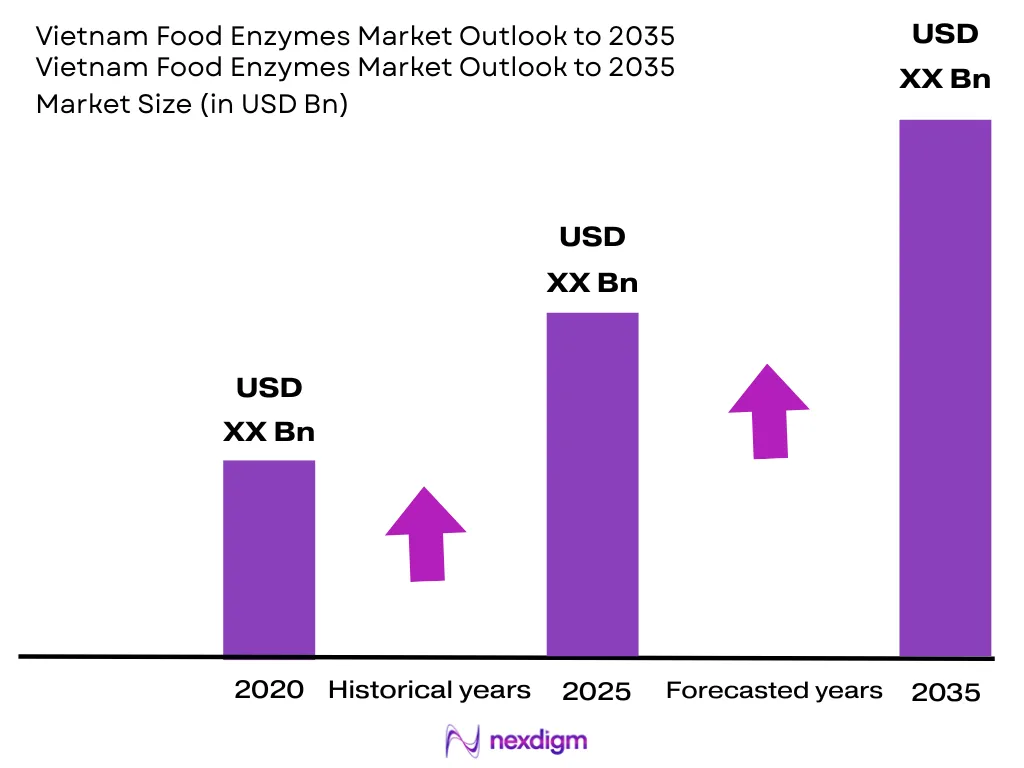
The Vietnam Food Enzymes Market was valued at USD ~ Million in 2024 and is anticipated to expand at a CAGR of ~% during 2026–2035. The market is primarily driven by the country’s expanding food processing industry, rising foreign direct investment in manufacturing, and a regulatory shift toward natural processing aids and away from certain synthetic additives. According to IMARC Group, the broader Vietnam enzymes market, spanning food and beverages, household care, bioenergy, pharmaceuticals, and feed applications, reached USD 56.0 million in 2024 and is projected to reach USD 95.0 million by 2033, growing at a CAGR of 6.05%. The Ministry of Industry and Trade values Vietnam’s food processing sector at approximately USD 20 billion, underscoring the scale of the underlying demand base for enzymatic processing aids across bakery, dairy, and beverage applications.
Market Segmentation
By Source
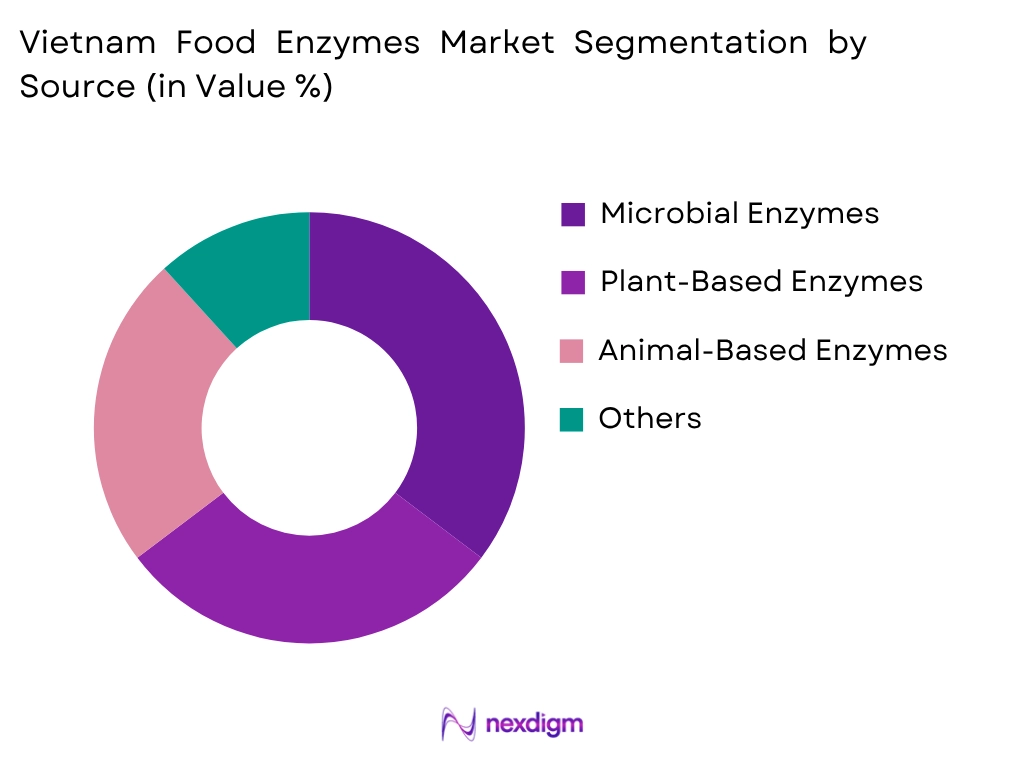
Among these, Microbial Enzymes hold the largest share of the Vietnam Food Enzymes Market, reflecting the broader Vietnam Industrial Enzymes Market where microorganism-derived enzymes are favoured for their consistency, scalability, and cost efficiency relative to plant- and animal-derived alternatives. Global producers such as Novonesis have continued launching new enzyme solutions for sustainable food processing in Vietnam, while DSM Nutritional Products Vietnam Ltd. and DuPont de Nemours, Inc. maintain established manufacturing and representative office presence to serve the country’s food and beverage manufacturing base. Vietnam’s National Strategy on Green Growth further supports adoption of microbial fermentation-based enzyme production, which optimises renewable resource use and reduces environmental impact relative to conventional chemical processing aids, reinforcing the segment’s dominance across bakery, dairy, and beverage applications.
By Application
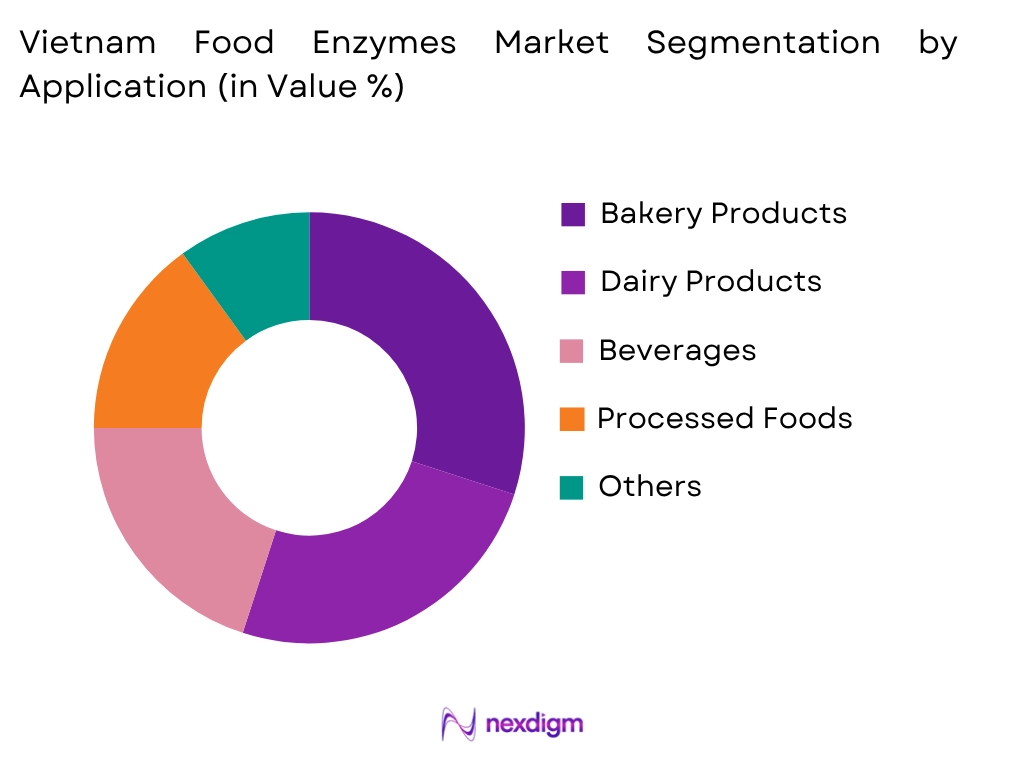
The Bakery and Dairy segments account for a substantial and growing share of the Vietnam Food Enzymes Market, reflecting a persistent gap in domestic bakery product shelf life and softness that creates significant opportunity for enzyme-based solutions extending freshness and improving crumb texture. The Dairy segment is further reinforced by Vietnam’s structural dairy deficit, with annual dairy imports exceeding USD 1.2 billion, continuing to drive demand for stabilisers such as carrageenan and pectin in fortified liquid milk products, alongside functional dairy lines increasingly incorporating enzyme-assisted cultures to meet protein and probiotic content requirements. The Beverages segment, encompassing beer, rice wine, and juice processing, also holds a meaningful share, supported by new Ministry of Health regulations introduced in 2023 that are driving the phase-out of certain azo dyes, creating a competitive advantage for enzyme and ingredient suppliers whose portfolios are already JECFA-approved.
Competitive Landscape
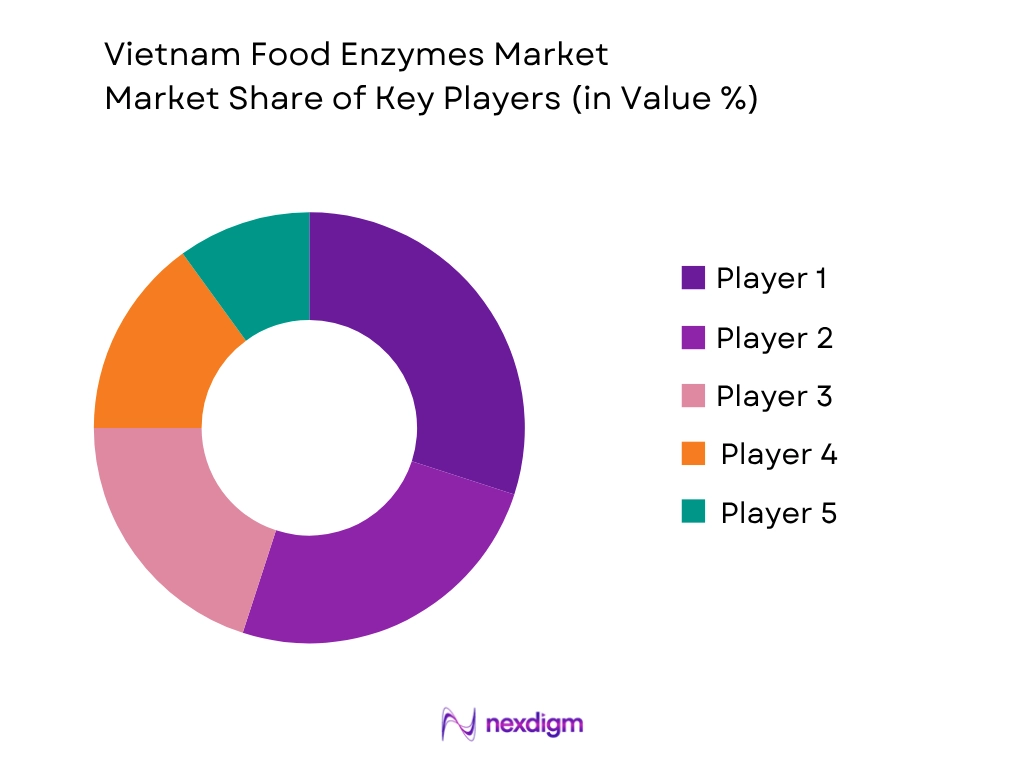
The Vietnam Food Enzymes Market remains fragmented, with global suppliers including Novonesis, DSM Nutritional Products Vietnam Ltd., DuPont de Nemours, Inc., and Amano Enzyme Asia Pacific Co., Ltd. operating through representative offices or regional production hubs and leveraging pre-approved, CODEX-aligned enzyme portfolios to fast-track local registrations. Domestic players such as Ho Chi Minh City-based Biozym Production and Services Co., Ltd. compete by distributing imported enzyme preparations alongside locally blended food additive solutions, serving both northern and southern regional markets through dedicated warehousing. Competition is primarily based on enzyme portfolio breadth, regulatory registration speed, distribution reach across Vietnam’s three regional markets, and the ability to support food manufacturers navigating the country’s evolving food safety and labelling requirements.
| Company | Establishment Year | Headquarters | Primary Product Portfolio | Enzyme Portfolio
|
Manufacturing Presence | Major End-Use Industries | Key Strategic Focus | Certifications & Compliance |
| Biozym Production and Services Co., Ltd. | 2017 | ~ | ~ | ~ | ~ | ~ | ~ | ~ |
| Amano Enzyme Asia Pacific Co., Ltd. | 1899 | ~ | ~ | ~ | ~ | ~ | ~ | ~ |
| DuPont de Nemours, Inc. | 1802 | ~ | ~ | ~ | ~ | ~ | ~ | ~ |
| Novonesis (Novozymes A/S) | 2000 | ~ | ~ | ~ | ~ | ~ | ~ | ~ |
| DSM Nutritional Products Vietnam Ltd. | 1902 | ~ | ~ | ~ | ~ | ~ | ~ | ~ |
Vietnam Food Enzymes Market Analysis
Growth Drivers
Rapid Expansion of Vietnam’s Food Processing Industry
The Vietnam food enzymes market is experiencing sustained growth due to the rapid expansion of the country’s food processing industry, supported by strong foreign direct investment inflows. In 2024, Vietnam’s processing and manufacturing sectors secured foreign direct investment worth USD 25.58 billion, according to Mordor Intelligence, reflecting continued international confidence in the country’s manufacturing base. The Ministry of Industry and Trade values Vietnam’s food processing sector at approximately USD 20 billion, creating substantial demand for enzymes in applications such as meat tenderisation, dairy processing, and bakery production. Enzyme usage within Vietnam’s food industry is projected to grow by 8% annually, according to Ken Research, driven by increasing consumer awareness regarding food quality and safety, reinforcing enzymes as an increasingly essential processing aid across the country’s expanding food manufacturing base.
Regulatory Shift Toward Natural Processing Aids and Clean Labelling
Regulatory change in Vietnam is a significant driver for enzyme adoption as manufacturers reformulate away from certain synthetic additives. New regulations introduced by the Ministry of Health in 2023 are driving the phase-out of certain azo dyes in the beverage industry, creating a competitive advantage for enzyme and ingredient suppliers whose portfolios have already been approved by JECFA. Separately, Circular 29/2023 mandates front-of-pack nutritional labelling starting in January 2026, which will make sugar and sodium content more visible to consumers and is expected to accelerate reformulation cycles among Vietnamese food manufacturers, according to Mordor Intelligence. In 2023, the Vietnamese government also implemented regulations to enhance the quality and safety of enzyme products, mandating that enzymes used in food and pharmaceuticals comply with international standards, fostering a more competitive and quality-assured environment for both domestic and international enzyme suppliers.
Market Challenges
High Dependence on Imported Enzymes
Vietnam’s food enzymes market remains heavily dependent on imported enzyme products, as global suppliers including Cargill, Ajinomoto, DSM-Firmenich, Kerry, Givaudan, ADM, and Tate & Lyle typically operate through representative offices or regional production hubs rather than full domestic manufacturing, according to Mordor Intelligence. This reliance exposes Vietnamese food and beverage manufacturers to global supply chain disruptions, currency fluctuations, and import registration delays. Domestic firms such as TTC AgriS, Quang Ngai Sugar Joint Stock Company, and LASUCO dominate sugar-derived sweeteners but have limited reach into higher-margin specialty enzyme and ingredient categories, leaving a structural gap that continues to be filled primarily by multinational suppliers and importing distributors such as Biozym.
Limited End-User Awareness and Cost Sensitivity
A lack of awareness and understanding of enzyme technology among food industry stakeholders, particularly in the dairy processing sector, poses a notable challenge to market growth in Vietnam, according to industry research. Many food producers may not fully comprehend the benefits and applications of enzyme-based solutions in enhancing product quality, efficiency, and profitability, resulting in reluctance to adopt enzymatic alternatives or underutilisation of available technologies. Cost sensitivity further compounds this challenge, as Vietnamese food producers often operate in highly competitive market environments with tight margins, making price competitiveness paramount and creating pressure for enzyme suppliers to demonstrate clear return on investment relative to conventional chemical processing aids.
Market Opportunities
Bakery Shelf-Life Extension and Dairy Deficit-Driven Demand
A persistent gap in domestic bakery product softness and shelf life presents a significant opportunity for the adoption of enzymes that can extend freshness and improve bread quality, according to Mordor Intelligence. Separately, Vietnam’s structural dairy deficit, with annual dairy imports exceeding USD 1.2 billion, continues to drive demand for enzyme-assisted stabilisers and functional dairy ingredients in fortified liquid milk products. As functional dairy product lines increasingly incorporate enzyme-modified cultures and vitamin premixes to meet rising protein and probiotic content requirements, enzyme suppliers with strong technical service capabilities are well positioned to capture this growing demand across Vietnam’s dairy processing sector.
JECFA-Aligned Product Registration Advantage
Vietnam’s 2023 regulatory shift away from certain synthetic azo dyes in the beverage industry creates a meaningful opportunity for enzyme and ingredient suppliers whose product portfolios are already approved by the Joint FAO/WHO Expert Committee on Food Additives (JECFA). Suppliers with pre-approved, CODEX-aligned enzyme portfolios can fast-track local registrations relative to competitors introducing novel formulations, according to Mordor Intelligence. Combined with continued strong foreign direct investment in Vietnam’s processing and manufacturing sectors, which totalled USD 25.58 billion in 2024, this regulatory environment favours established global enzyme suppliers and domestic distributors capable of rapidly aligning their portfolios with evolving Vietnamese food safety and labelling requirements, including the upcoming Circular 29/2023 nutritional labelling mandate effective January 2026.
Future Outlook
The Vietnam Food Enzymes Market is expected to witness steady expansion over the forecast period, supported by continued growth in food processing investment, sustained foreign direct investment inflows, and an evolving regulatory environment favouring natural processing aids and transparent nutritional labelling. Growing demand across bakery, dairy, and beverage applications, combined with Vietnam’s National Strategy on Green Growth encouraging sustainable enzyme production practices, will further accelerate market development. The market is also likely to benefit from Vietnam’s expanding role in regional food export supply chains, even as manufacturers and distributors continue to navigate import dependency, limited end-user awareness in certain segments, and a regulatory landscape that continues to evolve alongside international standards.
Major Players
- Novonesis (Novozymes A/S)
- DSM Nutritional Products Vietnam Ltd.
- Chr. Hansen A/S (Novonesis Group)
- DuPont de Nemours, Inc.
- Amano Enzyme Asia Pacific Co., Ltd.
- BASF SE
- Kerry Group plc
- IFF (International Flavors & Fragrances)
- Advanced Enzyme Technologies Ltd.
- Dyadic International Inc.
- Cargill, Incorporated
- Ajinomoto Vietnam
- Biozym Production and Services Co., Ltd.
- Viet Huong Flavor and Fragrance JSC
- TTC AgriS
Key Target Audience
- Food Enzyme Manufacturers
- Food & Beverage Processing Companies
- Bakery Manufacturers
- Dairy Product Manufacturers
- Beverage and Brewing Manufacturers
- Investment and Venture Capitalist Firms
- Government and Regulatory Bodies (Ministry of Health, Ministry of Industry and Trade, Ministry of Agriculture and Rural Development)
- Food Ingredient Distributors and Industrial Raw Material Suppliers
Research Methodology
Step 1: Identification of Key Variables
The research process begins with identifying the complete ecosystem of the Vietnam Food Enzymes Market, including raw material and fermentation feedstock suppliers, enzyme manufacturers, ingredient distributors, food processors, retailers, and regulatory authorities. Extensive secondary research is conducted using company annual reports, government publications, trade associations, customs statistics, industry journals, and proprietary databases to determine the variables influencing market demand, pricing, production, consumption, and technological developments.
Step 2: Market Analysis and Construction
Historical market information is collected and analysed to estimate market size, production volumes, import-export activity, application-wise demand, and pricing trends. A combination of top-down and bottom-up approaches is used to estimate market revenues and validate segment-level performance. Consumption patterns across bakery, dairy, beverages, confectionery, processed foods, and nutraceuticals are evaluated to establish an accurate representation of the industry.
Step 3: Hypothesis Validation and Expert Consultation
The preliminary findings are validated through Computer-Assisted Telephone Interviews (CATIs) and structured discussions with enzyme manufacturers, procurement managers, distributors, food technologists, regulatory experts, and senior executives operating within the Vietnamese food industry, spanning Ho Chi Minh City, Hanoi, and Da Nang. These interviews help verify market assumptions, competitive developments, technology adoption trends, pricing dynamics, and future investment opportunities while refining the overall market estimates.
Step 4: Research Synthesis and Final Output
The final stage integrates insights obtained from primary interviews with quantitative information collected through secondary sources. Data triangulation techniques are applied to reconcile differences between supply-side and demand-side estimates, ensuring robust market forecasting. The report is then reviewed through multiple quality assurance checkpoints to deliver a comprehensive analysis covering market size, segmentation, competitive landscape, future outlook, and strategic recommendations for industry stakeholders.

- Executive Summary
- Research Methodology (Market Definitions and Assumptions, Abbreviations, Market Sizing Approach, Top-Down Analysis, Bottom-Up Analysis, Demand-Side Assessment, Supply-Side Assessment, Primary Industry Interviews, Secondary Research Validation, Data Triangulation, Forecasting Framework, Limitations and Future Conclusions)

- Definition and Scope
- Market Evolution and Industry Genesis
- Timeline of Major Industry Developments
- Food Enzymes Industry Value Chain Analysis
- Supply Chain Analysis

- Growth Drivers (Growing Clean Label Food Demand, Rising Consumption of Processed Foods, Expansion of Food & Beverage Manufacturing, Regulatory Shift Away from Synthetic Additives, Growth of Dairy and Bakery Processing, Foreign Direct Investment in Food Processing)
- Market Challenges (High Dependence on Imported Enzymes, Limited End-User Awareness, Raw Material Price Volatility, Regulatory Compliance Complexity, High Production and Processing Costs, Competition from Chemical Alternatives)
- Market Opportunities (Bakery Shelf-Life Extension Solutions, Dairy Deficit-Driven Stabiliser Demand, JECFA-Aligned Product Registration, Functional Food Innovation, Export-Oriented Food Processing Growth, Clean Label Reformulation Projects)
- Market Trends (Phase-Out of Certain Azo Dyes in Beverages, Front-of-Pack Nutritional Labelling, Custom Enzyme Development, Growth of Local Food Manufacturing Investment, Enzymes for Sugar and Additive Reduction, Multi-Functional Enzyme Blends)
- Government Regulations (Ministry of Health Food Enzyme Regulations, Circular 29/2023 on Nutritional Labelling, Maximum Permitted Usage Levels, Novel Enzyme Approval Standards, Import Compliance, Food Safety Standards)
- Import and Export Analysis (Trade Volume, Major Import Sources, Export Destinations, HS Code Analysis, Trade Balance)
- Raw Material Availability Analysis (Fermentation Feedstocks, Rice and Cereal Substrates, Milk-Derived Substrates, Fruit Processing Substrates, Microbial Strains)
- Technology Landscape (Submerged Fermentation, Solid-State Fermentation, Enzyme Immobilisation, Protein Engineering, Encapsulation Technologies)
- Sustainability Assessment (National Strategy on Green Growth Alignment, Renewable Fermentation Feedstocks, Carbon Footprint Reduction, Waste Valorisation, Energy-Efficient Manufacturing)
- PESTLE Analysis
- SWOT Analysis
- Porter’s Five Forces Analysis
- Stakeholder Ecosystem
- Competition Ecosystem

- By Market Value (2020-2025)
- By Volume Consumption (2020-2025)
- By Average Selling Price (2020-2025)

- By Type (In Value %)
Carbohydrases
Proteases
Lipases
Phytases
Lactases
Pectinases - By Source (In Value %)
Microbial Enzymes
Plant-Based Enzymes
Animal-Based Enzymes - By Application (In Value %)
Bakery
Dairy
Beverages
Confectionery
Meat, Poultry and Seafood Products
Processed Foods
Nutraceuticals and Functional Foods - By Distribution Channel (In Value %)
Direct Sales to Food Manufacturers
Ingredient Distributors
Industrial Ingredient Suppliers
Online B2B Ingredient Platforms
Specialty Ingredient Suppliers - By Region (In Value %)
Southern Vietnam
Northern Vietnam
Central Vietnam

- Market Share of Major Players (By Value, Volume, Enzyme Type, Application Industry, Product Category)
- Cross Comparison Parameters (Enzyme Portfolio Breadth, Custom Enzyme Development Capability, Thermal and pH Stability Performance, Application Technical Support Capability, Manufacturing and Representative Office Presence, Regulatory Compliance & Certifications, Food & Beverage Customer Base, Innovation & New Product Launch Frequency)
- SWOT Analysis of Major Players
- Pricing Analysis by Product Category and SKU
- Production Capacity Analysis
- Manufacturing Footprint Analysis
- Distribution Network Analysis
- Innovation Benchmarking
- Detailed Profiles of Major Companies
Novonesis (Novozymes A/S)
DSM Nutritional Products Vietnam Ltd.
Chr. Hansen A/S (Novonesis Group)
DuPont de Nemours, Inc.
Amano Enzyme Asia Pacific Co., Ltd.
BASF SE
Kerry Group plc
IFF (International Flavors & Fragrances)
Advanced Enzyme Technologies Ltd.
Dyadic International Inc.
Cargill, Incorporated
Ajinomoto Vietnam
Biozym Production and Services Co., Ltd.
Viet Huong Flavor and Fragrance JSC
TTC AgriS

- Consumption Pattern Analysis (Industrial Usage, Batch Size, Product Category Penetration, Seasonal Demand, Reformulation Activity)
- Purchasing Criteria (Enzyme Activity Consistency, Regulatory Compliance, Cost Efficiency, Thermal Stability, pH Stability, Shelf Life)
- Procurement and Supplier Selection Analysis
- Clean Label Adoption Assessment
- Premium vs Conventional Product Demand
- Product Attribute Preference Analysis (Activity Consistency, Dosage Efficiency, Thermal Tolerance, Substrate Specificity, JECFA Alignment, Label Friendliness)
- Consumer Health & Wellness Influence on Product Development
- Pain Point Analysis
- Decision-Making Process

- By Market Value (2026-2035)
- By Volume Consumption (2026-2035)
- By Average Selling Price (2026-2035)


 Request a Sample
 Ask for Customization
 Get a Quote
 Enquire Now