
 Download PDF
Market Overview
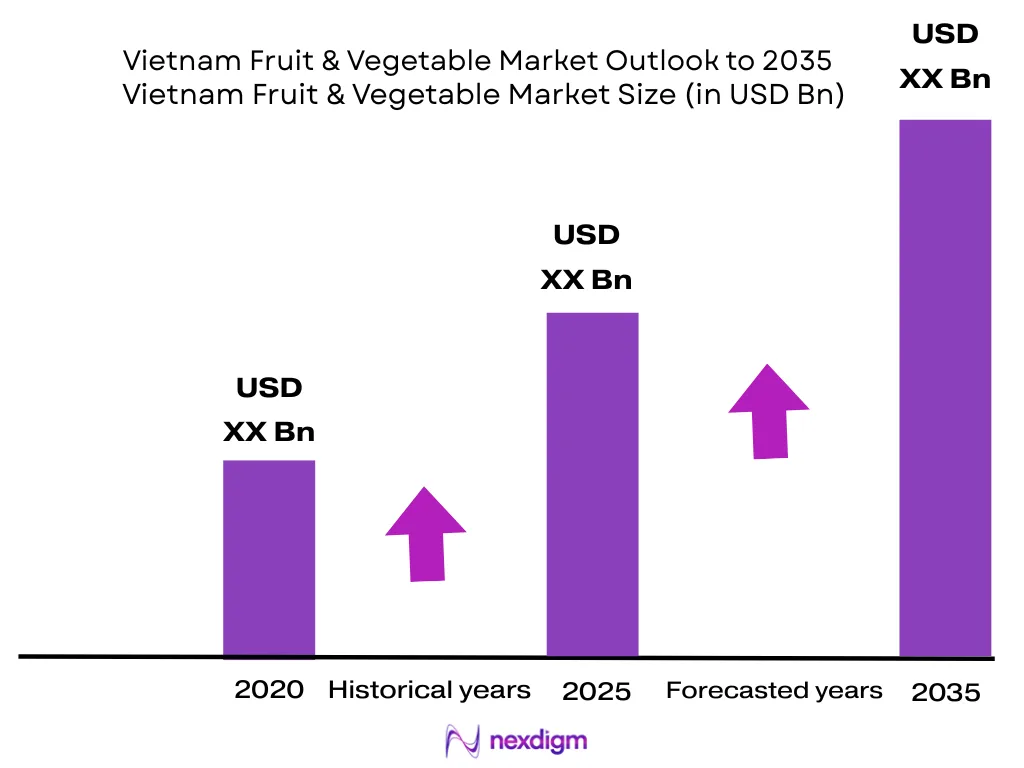
Vietnam Fruit & Vegetable Market is valued at USD ~ billion, based on a five-year historical analysis, and the market is forecast to grow at 5.20% CAGR across the 2026-2035 outlook period. Export demand is a major driver, with Vietnam’s fruit and vegetable exports moving from USD 5.6 billion to around USD 7.1-7.2 billion, supported by durian, dragon fruit, banana, mango, jackfruit, coconut and watermelon demand. Vietnam Fruit & Vegetable Market is dominated by the Mekong Delta, Southeast region, Central Highlands, Red River Delta and Ho Chi Minh City-Hanoi consumption corridors because these areas combine orchards, vegetable clusters, export packhouses, wholesale flow and modern retail demand. China dominates export demand because Vietnam’s fruit and vegetable exports rely heavily on official-quota protocols for durian, dragon fruit, banana and jackfruit; durian exports alone generated nearly USD 3.3 billion from total fruit and vegetable exports of about USD 7.15 billion.
Market Segmentation
By Product Type
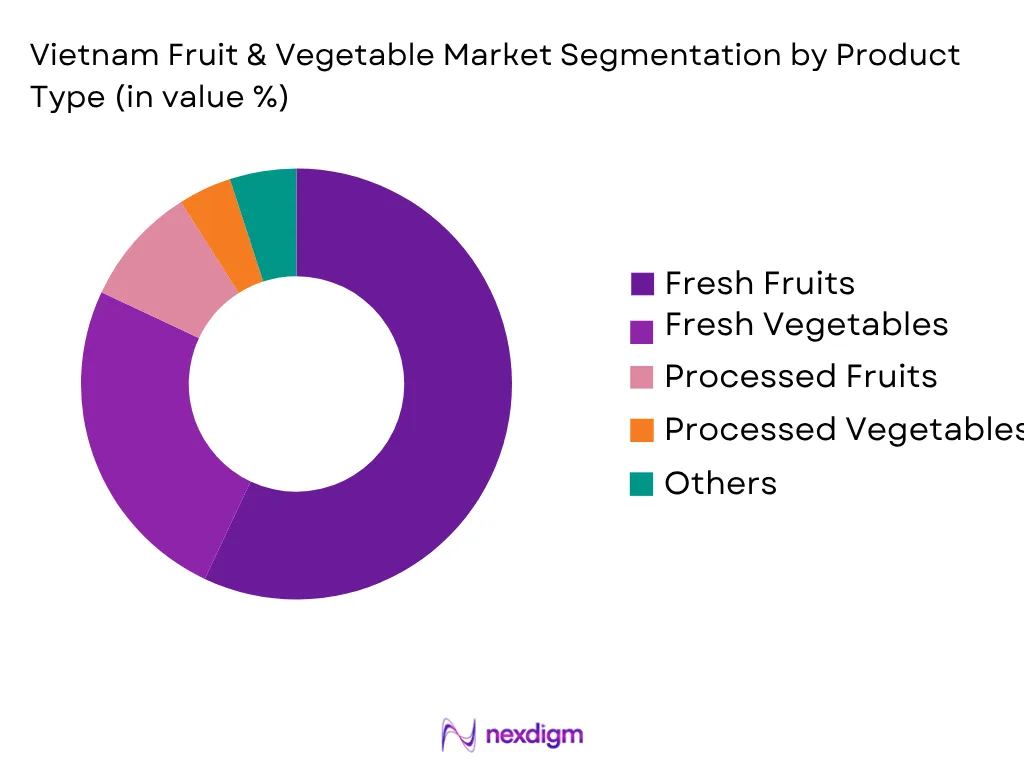
Vietnam Fruit & Vegetable Market is segmented by product type into fresh fruits, fresh vegetables, processed fruits, processed vegetables, and frozen, dried and value-added produce. Recently, fresh fruits have a dominant market share in Vietnam under the segmentation product type, it is due to the country’s strong export orientation and the rise of high-value tropical crops. Durian has become the most powerful category, followed by dragon fruit, banana, mango, jackfruit, coconut, watermelon, lychee, longan and pomelo. Fresh fruits benefit from China’s official import protocols, Vietnam’s expanding growing-area code system and strong production belts in the Mekong Delta, Central Highlands and Southeast region. Exporters also prefer fresh fruit because premium grades generate stronger returns than bulk vegetables, while processors use lower-grade fruit for frozen, dried and puree products.
By Distribution Channel
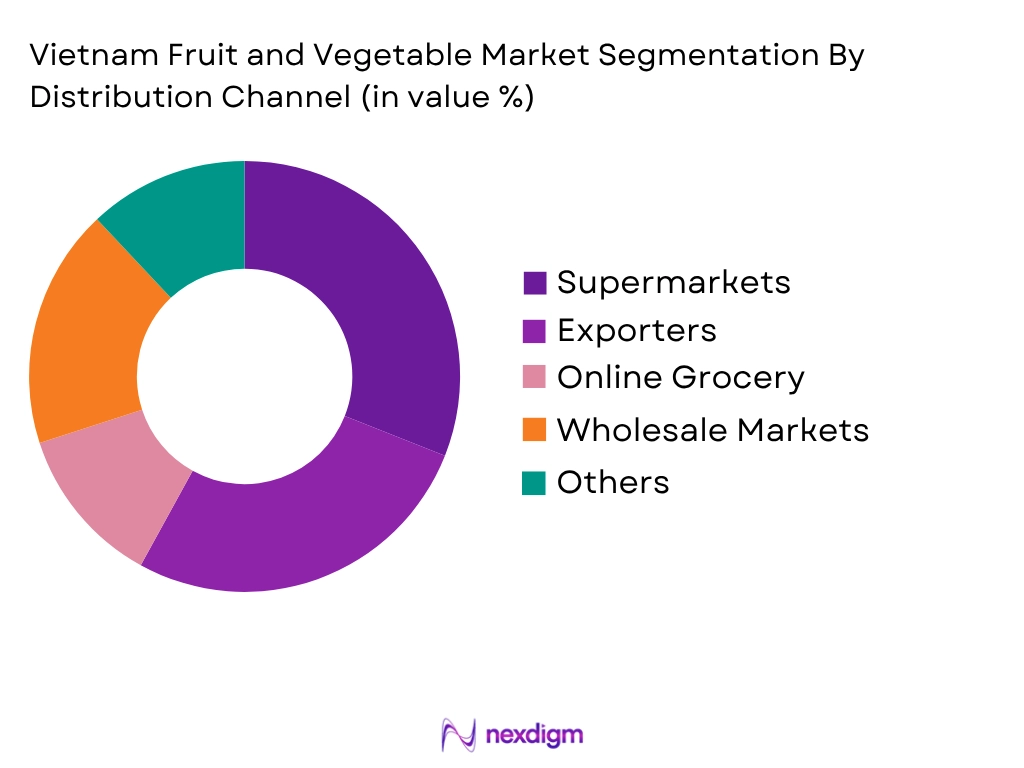
Vietnam Fruit & Vegetable Market is segmented by distribution channel into traditional wet markets and wholesale markets, exporters and export packhouses, supermarkets, hypermarkets and convenience stores, processors and frozen/dried produce manufacturers, and online grocery/foodservice/direct-to-consumer channels. Recently, traditional wet markets and wholesale markets have a dominant market share in Vietnam under the segmentation distribution channel, it is due to daily household buying habits, fragmented smallholder production, local collector networks and price-sensitive fresh food consumption. Wet markets remain central for leafy vegetables, herbs, water spinach, tomatoes, cucumber, banana, mango, watermelon and seasonal fruits. However, exporters and packhouses are gaining influence as durian, dragon fruit, banana, mango and pomelo increasingly require growing-area codes, packing facility codes, phytosanitary certificates and residue compliance for China, Japan, South Korea, the United States, Australia and the European Union.
Competitive Landscape
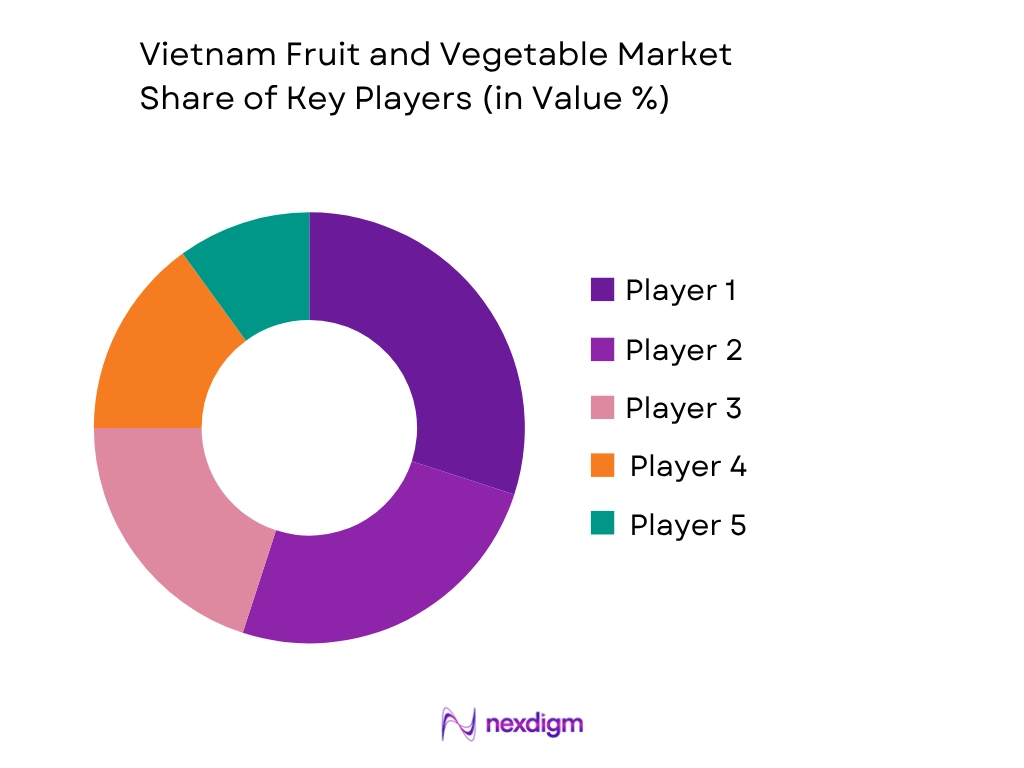
Vietnam Fruit & Vegetable Market is fragmented at farm and collector level but increasingly organized around export packhouses, frozen fruit processors, dried fruit manufacturers and VietGAP/GlobalG.A.P. compliant suppliers. Companies such as Lavifood, Nafoods Group, Doveco, Vinamit and Chánh Thu Fruit Import Export Group have strong influence because they operate across export-oriented fruit processing, certified sourcing, IQF/freezing, drying, purees, concentrates and fresh fruit packing. Competition is shaped by China protocol access, growing-area code control, residue compliance, processing capability and cold-chain execution.
| Company | Establishment Year | Headquarters | Key Categories | Business Model | Key Channel | Sourcing / Production Footprint | Market-Specific Capability | Competitive Advantage |
| Lavifood | 2014 | Tay Ninh | ~ | ~ | ~ | ~ | ~ | ~ |
| Nafoods Group | 1995 | Nghe An | ~ | ~ | ~ | ~ | ~ | ~ |
| Doveco | 1955 | Ninh Binh | ~ | ~ | ~ | ~ | ~ | ~ |
| Vinamit | 1988 | Binh Duong | ~ | ~ | ~ | ~ | ~ | ~ |
| Chánh Thu Fruit Import Export Group | 1990s | Ben Tre | ~ | ~ | ~ | ~ | ~ | ~ |
Vietnam Fruit & Vegetable Market Analysis
Growth Drivers
Export-Oriented Tropical Fruit Base Strengthens Sector Expansion
Vietnam Fruit & Vegetable Market is supported by a trade-oriented economy and a strong tropical fruit export basket. World Bank data records Vietnam’s GDP at USD 476.39 billion and GDP per capita at USD 4,717.3 in 2024, providing a macroeconomic base for investment in packhouses, logistics, processing and export compliance. Vietnam’s fruit and vegetable exports increased from USD 5.6 billion in 2023 to around USD 7.2 billion in 2024, driven by durian, dragon fruit, banana, jackfruit and mango shipments. The sector’s export footprint covers more than 80 countries and regions, with China, the United States, South Korea, Japan, Thailand, the Netherlands and Australia among key destinations. This supports higher use of growing area codes, packhouse codes, phytosanitary certification and export-grade sorting.
Durian, Banana, Mango, Jackfruit, Coconut and Grapefruit Drive Premium Crop Movement
Vietnam Fruit & Vegetable Market is driven by premium tropical fruit categories with strong external demand and increasing formal trade documentation. World Bank data shows Vietnam’s population at 101 million people in 2024, supporting domestic wet market, supermarket and e-commerce fruit consumption alongside export supply. VietnamPlus, citing Vietnam Customs, reported fruit and vegetable exports of USD 7.75 billion in the first 11 months of 2025 and a full-year figure estimated around USD 8.5 billion. Six key fruits—durian, banana, mango, jackfruit, coconut and grapefruit—were identified as the major growth products, while durian exports were estimated at more than USD 4 billion in 2025. This strengthens demand for orchards, collectors, cooperatives, exporters, packhouses, cold rooms and residue-testing systems.
Market Challenges
Export Concentration and Compliance Tightening Create Durian Supply Risk
Vietnam Fruit & Vegetable Market faces risk from strict import controls, especially in durian exports to China. World Bank data records Vietnam’s GDP per capita at USD 4,717.3 in 2024, but higher-income export growth depends on compliance-heavy crop systems rather than only production expansion. VietnamPlus reported that the General Administration of Customs of China added 829 growing area codes and 131 packing facility codes for Vietnamese durian in May 2025. However, durian exports to China reached only about USD 130 million, equal to 35,000 tonnes, in the first 4 months of 2025, compared with over USD 500 million in the same period of 2024. China’s requirement for test certificates on 100 parts of shipments increased documentation pressure and disrupted trading.
Weather, Flooding and Border-Linked Logistics Disrupt Perishable Produce Flow
Vietnam Fruit & Vegetable Market faces supply-chain risk from seasonal flooding, border handling and short shelf life across durian, dragon fruit, lychee, longan, mango and leafy vegetables. Vietnam’s macroeconomic base remains export-driven, with World Bank data showing GDP of USD 476.39 billion in 2024 and a trade-to-GDP ratio near 170 according to the World Bank country profile. VietnamPlus reported that fruit and vegetable shipments reached USD 701 million in November 2025, but the monthly value fell from October due to seasonal factors and recent flooding in farming areas. The same source recorded USD 7.75 billion in export turnover during the first 11 months of 2025. This creates pressure on cold storage, reefer movement, border queues, packhouse scheduling and harvest timing.
Market Opportunities
Growing Area Codes and Traceability Systems Support Higher-Quality Export Growth
Vietnam Fruit & Vegetable Market has a clear opportunity in traceability-led exports, because current compliance infrastructure is expanding for durian and other high-value fruits. World Bank data records Vietnam’s population at 101 million and GDP per capita at USD 4,717.3 in 2024, supporting domestic capability to scale formal agriculture supply chains. VietnamPlus reported that China approved 829 growing area codes and 131 packing facility codes for Vietnamese durian, while Vietnam had submitted dossiers for 1,604 durian growing areas and 314 packing facilities. VietnamPlus also reported a pilot durian traceability system from January 1 to June 30, 2026, covering production, purchasing, processing, packaging, transport and distribution. These current systems create room for QR-coded traceability, lab testing, packhouse audits and premium-market diversification.
Processed Fruit and Vegetable Products Create Scope Beyond Fresh Exports
Vietnam Fruit & Vegetable Market has an opportunity in processed formats because export growth is no longer limited to fresh fruit shipments. World Bank data records Vietnam’s GDP at USD 476.39 billion in 2024, providing a macroeconomic base for investment in IQF lines, drying, freezing, juice concentrates, purees and aseptic packaging. VietnamPlus reported that processed products, including canned and dried produce, were worth an estimated USD 1.65 billion in 2025. Fruit and vegetable exports rose from USD 3.34 billion in 2022 to USD 5.6 billion in 2023 and around USD 7.2 billion in 2024. This current trade base supports future expansion in frozen durian, IQF mango, passion fruit concentrate, dried jackfruit, coconut products, canned vegetables and export-ready processed fruit ingredients.
Future Outlook
Over the next five years, Vietnam Fruit & Vegetable Market is expected to expand through export formalization, durian-led growth, processing investment, modern retail penetration and rising demand for traceable tropical fruits. The market outlook is supported by the 2026-2035 forecast CAGR of 5.20%, with export-grade fruit and processed fruit products expected to remain the strongest growth engines. Fresh fruits will remain the leading category because Vietnam has clear advantages in durian, dragon fruit, banana, mango, pomelo, jackfruit, coconut, lychee and longan. Durian will continue to influence export value, particularly through China’s official-quota import system. Dragon fruit exporters will need to reposition through quality upgrading, residue control and diversified destinations after a period of weaker category momentum.
Processing will become more important as companies invest in IQF fruit, frozen durian, mango puree, passion fruit concentrate, dried jackfruit, coconut products, pineapple products and canned vegetables. These formats help absorb lower-grade produce, reduce seasonal gluts and increase access to industrial buyers in Japan, South Korea, the United States, the European Union and the Middle East. The market will remain exposed to China concentration risk, border congestion, smallholder fragmentation, cold-chain gaps, residue non-compliance and climate pressures in the Mekong Delta. Exporters will need stronger growing-area code management, packhouse audits, traceability records and phytosanitary controls. Domestic growth will be supported by supermarket chains, convenience stores, online grocery platforms and premium fruit gift boxes in Ho Chi Minh City, Hanoi, Da Nang and other urban centres.
Major Players
- Lavifood
- Nafoods Group
- Doveco
- Vinamit
- Ameii Vietnam
- Vina T&T Group
- Hoang Phat Fruit
- Chánh Thu Fruit Import Export Group
- GreenFeed / G Kitchen Produce Supply
- Ant Farm
- Organica
- Dalat GAP
- Vegetexco Vietnam
- An Giang Fruit-Vegetables & Foodstuff JSC
- THACO Agri
Key Target Audience
- Fruit growers and vegetable cooperatives
- Fresh fruit exporters and export packhouse operators
- Fruit processors, IQF manufacturers and dried fruit companies
- Supermarkets, convenience retailers and online grocery platforms
- Foodservice distributors and HoReCa procurement companies
- Cold-chain logistics, reefer transport and storage operators
- Investments and venture capitalist firms
- Government and regulatory bodies (Ministry of Agriculture and Environment, Plant Protection Department, Vietnam Customs, Ministry of Industry and Trade, Directorate for Standards Metrology and Quality, provincial Departments of Agriculture and Rural Development)
Research Methodology
Step 1: Identification of Key Variables
The initial phase involves constructing an ecosystem map encompassing all major stakeholders within the Vietnam Fruit & Vegetable Market. This includes growers, collectors, cooperatives, exporters, processors, packhouses, cold-chain providers, wet market traders, modern retailers and regulators. The objective is to identify variables such as crop type, export access, growing-area codes, processing capacity, certification, distribution flow and domestic consumption.
Step 2: Market Analysis and Construction
In this phase, historical data is compiled and analyzed for Vietnam Fruit & Vegetable Market revenue, exports, domestic retail movement, product mix and crop specialization. The analysis covers durian, dragon fruit, banana, mango, pomelo, jackfruit, lychee, longan, vegetables, frozen fruits and dried products. A top-down market valuation is combined with a bottom-up crop and channel model.
Step 3: Hypothesis Validation and Expert Consultation
Market hypotheses are validated through interviews with fruit exporters, cooperatives, packhouse managers, processors, modern retailers, cold-chain providers and foodservice distributors. These interviews provide insight into procurement practices, compliance constraints, export protocol risks, farmgate aggregation, grading systems and processing demand. The findings are used to refine market segmentation and competitive positioning.
Step 4: Research Synthesis and Final Output
The final phase integrates secondary research, trade data, company analysis and expert validation into a structured market report. The output includes market size, segmentation, competitive landscape, future outlook, target audience mapping and strategic recommendations. This ensures that Vietnam Fruit & Vegetable Market analysis reflects domestic demand, export dynamics and operational challenges.

- Executive Summary
- Research Methodology (Market Definitions and Assumptions, Product Classification, Fresh and Processed Produce Inclusion, Farm-Gate and Export Valuation, Domestic Retail and Wholesale Valuation, Ministry of Agriculture Data Review, Customs Export Mapping, Growing Area Code Validation, Bottom-Up Crop Output Modelling, Top-Down Consumption and Trade Model, Primary Interviews with Growers, Cooperatives, Exporters, Processors, Modern Retailers, Importers and Cold-Chain Operators, Limitations and Forecast Assumptions)

- Definition and Scope
- Market Genesis and Evolution
- Vietnam Fruit and Vegetable Production Landscape
- Domestic Consumption and Retail Fresh Produce Demand
- Role of Fruit and Vegetable Exports in Agriculture Trade

- Growth Drivers (Export Expansion, Durian Demand, China Market Access, Modern Retail Growth, Domestic Urban Consumption, Processing Capacity Expansion, VietGAP Adoption, Free Trade Agreements)
- Market Challenges (China Export Dependence, Border Congestion, Residue Compliance, Smallholder Fragmentation, Cold-Chain Gaps, Climate Risk, Fruit Quality Variability, Informal Procurement)
- Market Opportunities (Export Diversification, Premium Market Access, Packhouse Investment, Processing Expansion, Cold-Chain Development, Organic Produce, High-Quality Seedlings, Retail Brand Building)
- Trends (Official Export Formalization, Durian Boom, Dragon Fruit Quality Upgrade, Growing Area Code Management, Packaged Fresh Produce, Traceability, Premium Fruit Branding, Cold-Chain Digitization)
- SWOT Analysis
- Porter’s Five Forces

- By Value (2020-2025)
- By Volume (2020-2025)
- By Average Realization (2020-2025)

- By Product Category (In Value %)
Fresh Fruits
Fresh Vegetables
Processed Fruits
Processed Vegetables
Value-Added Produce - By Fruit Type (In Value %)
Durian
Dragon Fruit
Banana
Mango and Pomelo
Lychee, Longan and Tropical Fruits - By Distribution Channel (In Value %)
Traditional Wet Markets
Wholesale Markets
Supermarkets and Hypermarkets
Convenience Stores
Online Grocery - By Geography (In Value %)
Mekong Delta
Southeast Region
Central Highlands
Red River Delta
North Central Coast

- Market Share of Major Players (Value Share, Volume Share, Export Share, Processing Share, Retail Channel Share)
- Cross Comparison Parameters (Fruit and Vegetable Portfolio Depth, Growing Area Code and Farmer Network, Export Destination Coverage, Packhouse and Sorting Capacity, Processing and IQF/Freeze-Drying Capability, Cold-Chain and Border Logistics Reach, VietGAP/GlobalG.A.P./HACCP Certification Infrastructure, Modern Retail and E-Commerce Channel Penetration)
- SWOT Analysis of Major Players
- Pricing and SKU Benchmarking of Major Players
- Detailed Profiles of Major Companies
Lavifood
Nafoods Group
Doveco
Vinamit
Ameii Vietnam
Vina T&T Group
Hoang Phat Fruit
Chánh Thu Fruit Import Export Group
GreenFeed / G Kitchen Produce Supply
Ant Farm
Organica
Dalat GAP
Vegetexco Vietnam
Giang Fruit-Vegetables & Foodstuff JSC
THACO Agri

- Household Consumers
- Wet Market Traders and Wholesalers
- Supermarkets and Convenience Stores
- Online Grocery and E-Commerce Platforms
- Foodservice Operators

- By Value (2026-2035)
- By Volume (2026-2035)
- By Average Realization (2026-2035)


 Request a Sample
 Ask for Customization
 Get a Quote
 Enquire Now