
 Download PDF
Market Overview
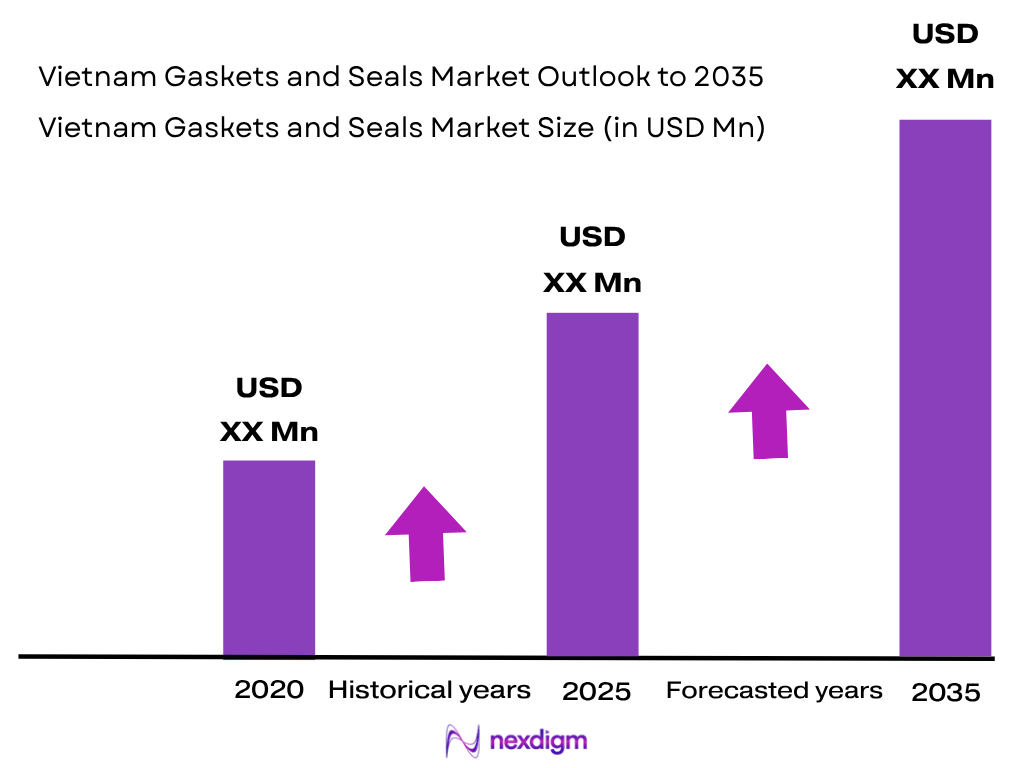
The Vietnam Gaskets and Seals Market is valued at approximately USD ~XX million, supported by refining, petrochemicals, automotive, electronics and industrial manufacturing. Manufacturing and processing attracted USD 23.50 billion of registered foreign investment in the preceding period and USD 25.58 billion in the latest period. Realized nationwide FDI simultaneously advanced from USD 23.18 billion to USD 25.35 billion, reinforcing machinery installation, factory maintenance and associated industrial sealing demand.
Ho Chi Minh City-Binh Duong-Dong Nai, Hanoi-Bac Ninh-Thai Nguyen, Hai Phong-Quang Ninh, Ba Ria-Vung Tau, Quang Ngai and Thanh Hoa dominate Vietnam’s sealing demand because these corridors concentrate electronics, automotive, machinery, refineries and processing plants. Registered manufacturing FDI moved from approximately USD 23.50 billion to USD 25.58 billion, while the latest refinery system produced 6.87 million tonnes of petroleum products during the first six months, supporting mechanical-seal, gasket, packing and rotating-equipment MRO requirements.
Market Segmentation
By Product Type
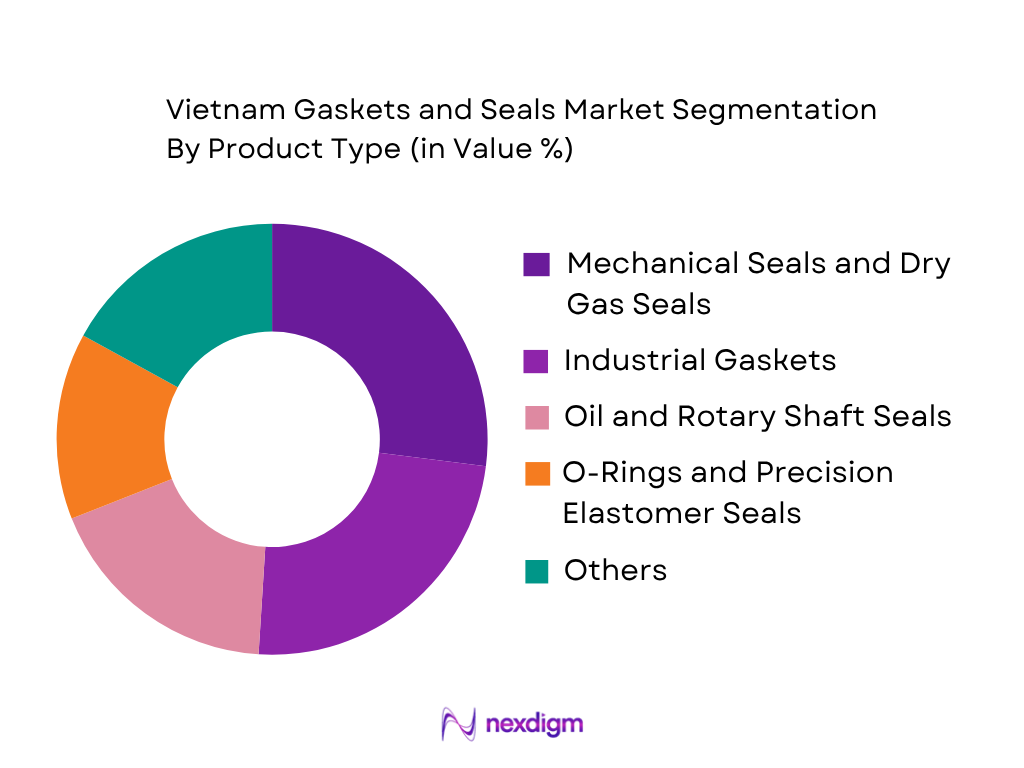
By Product Type: The Vietnam Gaskets and Seals Market is segmented into mechanical seals, industrial gaskets, oil and rotary shaft seals, O-rings and precision elastomer seals, hydraulic and pneumatic seals, and compression packing and specialty seals. Mechanical seals hold the dominant modeled market share because Vietnam’s refinery, petrochemical, chemical, water, power and general manufacturing industries operate large populations of pumps, compressors, agitators and other rotating equipment. Dung Quat and Nghi Son refineries alone produced 6.87 million tonnes of petroleum products during the first six months of the latest period. Dung Quat subsequently reported approximately 3.5 million tonnes of production during its first seven months. These process-intensive facilities require cartridge mechanical seals, component seals, seal-support systems and recurring repair services. Mechanical seals also carry higher unit value and greater engineering content than conventional commodity gaskets and O-rings, strengthening their contribution to market revenue.
By End-Use Industry
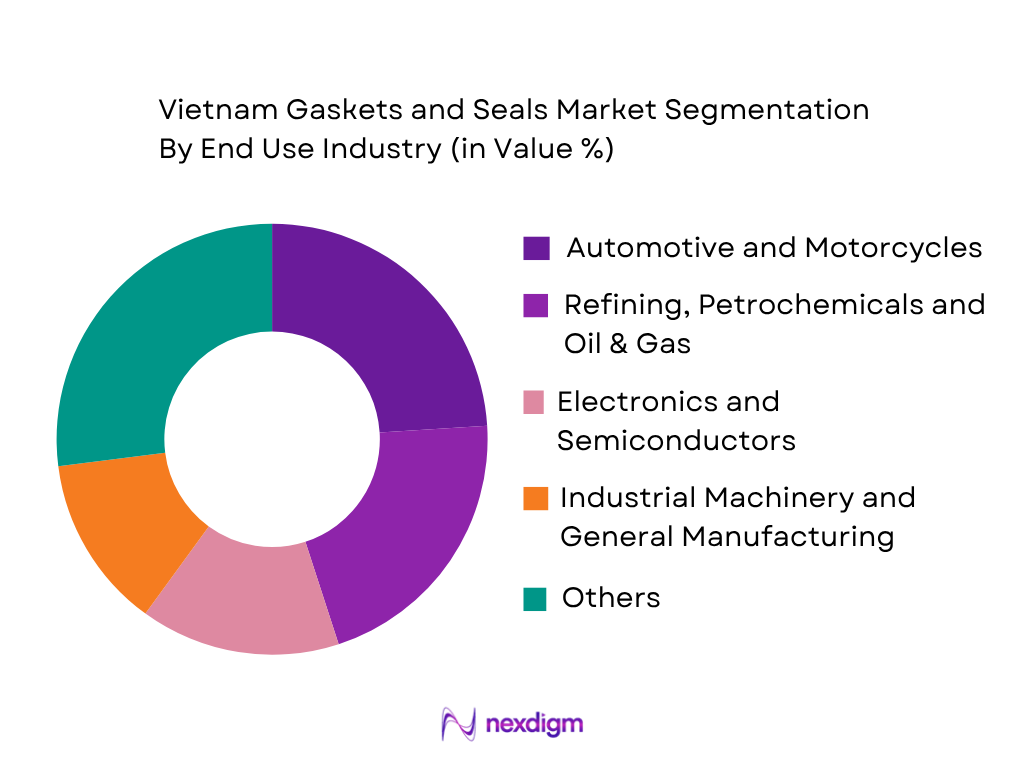
By End-Use Industry: The Vietnam Gaskets and Seals Market is segmented into automotive and motorcycles, refining and petrochemicals, electronics and semiconductors, industrial machinery, power generation, water and wastewater, chemicals, food processing, marine and other manufacturing. Automotive and motorcycle manufacturing represents the dominant modeled segment because Vietnam combines vehicle assembly with a large two-wheeler component ecosystem requiring oil seals, O-rings, engine gaskets, transmission seals, shock-absorber seals and custom moulded elastomers. The General Statistics Office reported that motor-vehicle manufacturing output expanded strongly in the latest period, while rubber and plastic product manufacturing also accelerated materially. The wider processing and manufacturing sector attracted USD 25.58 billion in registered FDI, supporting additional demand from foreign-invested automotive and component plants. Electrification further broadens sealing requirements into battery enclosures, cooling circuits, e-motors and thermal-management assemblies.
Competitive Landscape
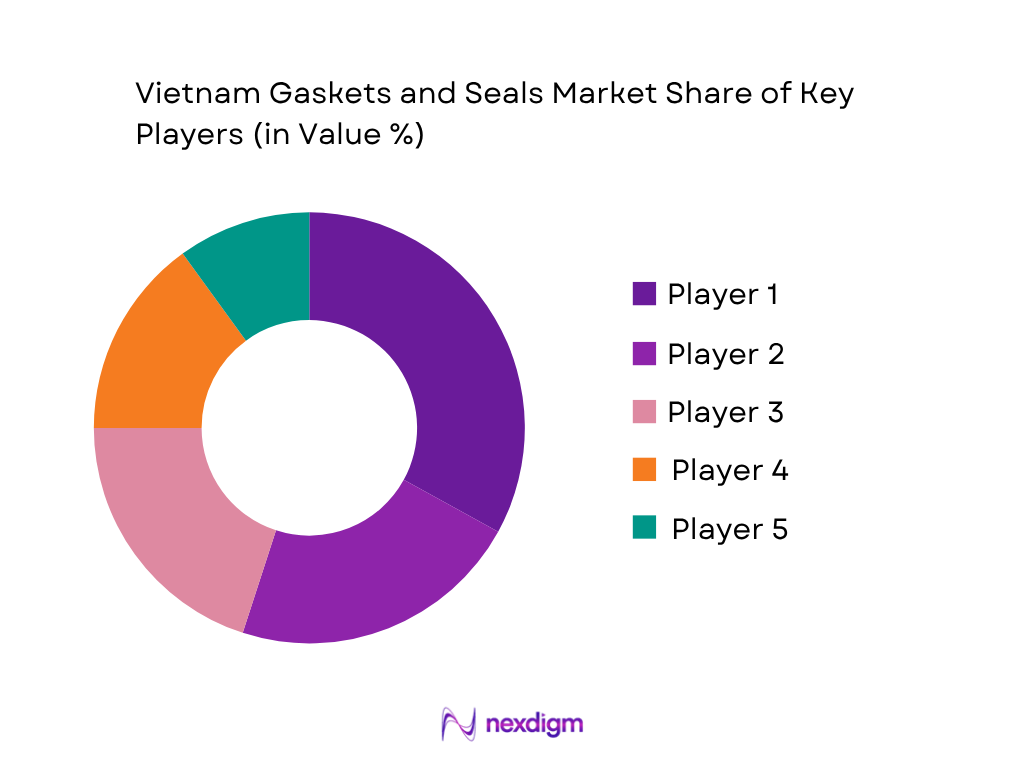
The Vietnam Gaskets and Seals Market combines international mechanical-seal specialists, Japanese industrial gasket and automotive sealing manufacturers, and bearing/sealing technology suppliers. EagleBurgmann has a particularly relevant position in process-industry sealing, while NOK benefits from automotive and precision elastomer expertise. NICHIAS spans industrial gaskets, fluoropolymer materials, automotive components and semiconductor applications. SKF participates through rotary sealing and rotating-equipment solutions. Competition increasingly depends on local inventory, OEM qualification, application engineering, specialty materials and rapid MRO response.
| Major Player | Establishment Year | Headquarters | Core Sealing Portfolio | Key Material Capability | Major Vietnam Applications | Manufacturing / Supply Capability | MRO & Technical Service | Advanced-Industry Capability |
| EagleBurgmann | 2004* | Wolfratshausen, Germany | ~ | ~ | ~ | ~ | ~ | ~ |
| NOK Corporation | 1939 | Tokyo, Japan | ~ | ~ | ~ | ~ | ~ | ~ |
| NICHIAS Corporation | 1896 | Tokyo, Japan | ~ | ~ | ~ | ~ | ~ | ~ |
| SKF | 1907 | Gothenburg, Sweden | ~ | ~ | ~ | ~ | ~ | ~ |
| Flowserve | 1997 | Texas, USA | ~ | ~ | ~ | ~ | ~ | ~ |
Vietnam Gaskets and Seals Market Analysis
Growth Drivers
Dung Quat-Nghi Son Refinery Base and Processing-Manufacturing Expansion
Vietnam’s refinery and manufacturing infrastructure creates recurring demand for mechanical seals, dry gas seals, spiral-wound gaskets, graphite products, packing and engineered elastomers. The Ministry of Industry and Trade reported that Dung Quat and Nghi Son produced 6.87 million tonnes of petroleum products during the first six months of 2024, while Dung Quat alone manufactured approximately 3.5 million tonnes during the first seven months. Pumps, compressors, valves, heat exchangers and process piping within these facilities require continuous sealing replacement, refurbishment and shutdown support. The broader industrial base is expanding simultaneously: the Ministry of Planning and Investment recorded USD 25.58 billion of foreign investment in processing and manufacturing during 2024, alongside 3,375 newly licensed foreign-invested projects across the economy. Vietnam also had 431 industrial and export-processing zones covering approximately 132,300 hectares by July 2024, including 301 operational zones, providing a geographically distributed installed base for hydraulic seals, pneumatic seals, O-rings and industrial gaskets. World Bank data place Vietnam’s 2024 GDP at USD 476.39 billion and GDP per capita at USD 4,717.3, demonstrating the industrial economic base supporting equipment investment and recurring sealing demand.
Electronics, Semiconductor and Advanced Manufacturing Development
Vietnam’s electronics-led manufacturing ecosystem is moving toward applications requiring more technically demanding sealing products, particularly FKM, FFKM, PTFE, vacuum-compatible O-rings and precision pneumatic seals. The government formally issued Decision 1018/QĐ-TTg on September 21, 2024, establishing a national semiconductor industry strategy encompassing design, fabrication, packaging and testing. This expands the addressable application base for seals used in vacuum pumps, deposition systems, chemical delivery, gas handling and clean manufacturing equipment. Supporting this transition, Vietnam recorded USD 38.23 billion of total registered foreign investment during 2024, including USD 19.7 billion across 3,375 newly registered projects and nearly USD 14 billion of additional capital across 1,539 existing projects. Processing and manufacturing alone received USD 25.58 billion, demonstrating the scale of capital flowing into equipment-intensive industrial operations. Vietnam’s industrial-zone network reached 431 established zones, with 301 operating, creating concentrated aftermarket demand for factory pumps, compressors, automation and utilities. World Bank data record USD 476.39 billion of GDP and USD 4,717.3 GDP per capita in 2024, providing macroeconomic support for continued industrial upgrading and higher-specification sealing adoption.
Market Challenges
Dependence on Imported Specialty Materials and Increasing Qualification Complexity
Vietnam’s transition from conventional manufacturing toward semiconductor, electronics and advanced process industries raises a major technical challenge for the domestic sealing ecosystem because applications increasingly require high-purity FFKM, specialty FKM, PTFE, engineered thermoplastics, silicon-carbide faces and other tightly controlled materials. The government’s Decision 1018/QĐ-TTg, issued September 21, 2024, formally establishes semiconductor development across design, fabrication, packaging and testing, exposing seal suppliers to more stringent requirements for contamination control, outgassing, plasma resistance, chemical compatibility and traceability. The scale of manufacturing investment amplifies this qualification requirement: processing and manufacturing attracted USD 25.58 billion of registered foreign investment during 2024, while 1,539 existing foreign-invested projects received nearly USD 14 billion of additional capital. Suppliers therefore need to satisfy increasingly sophisticated multinational OEM specifications rather than compete solely through standard catalogue products. Vietnam simultaneously had 301 operating industrial zones from 431 established zones by July 2024, creating a fragmented customer landscape requiring technical support across multiple manufacturing corridors. World Bank data put 2024 GDP at USD 476.39 billion and GDP per capita at USD 4,717.3. As the industrial economy becomes technologically more sophisticated, inadequate domestic availability of specialty compounds and seal-face materials can extend qualification and replacement lead times.
Legacy Process Equipment and Requirement for Specialized Mechanical-Seal MRO
Vietnam’s industrial sealing suppliers must support a heterogeneous installed base ranging from large refineries and petrochemical facilities to power plants, industrial parks, water systems and newly commissioned electronics factories. The Ministry of Industry and Trade reported 6.87 million tonnes of petroleum-product production from Dung Quat and Nghi Son during the first six months of 2024, while Dung Quat produced approximately 3.5 million tonnes during the first seven months. These facilities contain numerous pumps, compressors and process systems with different seal chambers, operating temperatures, pressures and materials, making replacement engineering more complex than standardized component distribution. Vietnam also had 301 operational industrial zones across approximately 89,900 hectares of industrial land within a national network of 431 established zones covering 132,300 hectares by July 2024. Mechanical-seal suppliers consequently need geographically distributed capabilities for face lapping, cartridge rebuilding, reverse engineering, failure analysis and emergency replacement. Water infrastructure adds another maintenance-intensive equipment base: a 2024 Binh Duong water-environment project covers more than 33,000 hectares and around 1.4 million residents, requiring substantial wastewater pumping and treatment infrastructure. World Bank data record Vietnam’s 2024 GDP at USD 476.39 billion, underscoring the scale of industrial assets requiring increasingly specialized MRO capabilities.
Market Opportunities
Semiconductor-Grade FFKM, Vacuum Sealing and Domestic Precision-Seal Localization
Vietnam’s semiconductor strategy creates a future-facing opportunity for suppliers capable of localizing high-purity FFKM O-rings, specialty FKM seals, PTFE components, vacuum seals and precision elastomer assemblies. Decision 1018/QĐ-TTg took effect on September 21, 2024, establishing a national framework for semiconductor design, fabrication, packaging and testing. Current industrial investment provides the manufacturing foundation for this transition: Vietnam recorded USD 38.23 billion of registered foreign investment in 2024, including USD 25.58 billion directed to processing and manufacturing, while 3,375 newly licensed projects attracted USD 19.7 billion. The country’s industrial infrastructure also included 431 established industrial and export-processing zones covering 132,300 hectares, of which 301 were operational, creating potential locations for electronics, component and supporting-material production. Localization would allow seal suppliers to serve vacuum equipment, ultra-pure gas systems, chemical delivery equipment and automated production machinery while reducing dependence on imported specialty components and improving emergency availability. World Bank data place Vietnam’s 2024 GDP at USD 476.39 billion and GDP per capita at USD 4,717.3. These current indicators support future expansion of technically differentiated sealing rather than purely commodity gasket and O-ring production.
Refinery Turnaround, Water-Pump Sealing and Industrial-Park MRO Services
Vietnam’s existing refinery, water and industrial infrastructure creates substantial future potential for locally stocked mechanical seals, turnaround services, CNC-machined emergency seals and predictive condition-monitoring solutions. Dung Quat and Nghi Son produced 6.87 million tonnes of petroleum products during the first six months of 2024, while Dung Quat alone produced approximately 3.5 million tonnes during the first seven months, providing a substantial installed base of process pumps, compressors, valves and flanged equipment requiring periodic servicing. Industrial-zone expansion broadens this opportunity: Vietnam had 431 established industrial and export-processing zones covering approximately 132,300 hectares, including 301 operational zones, by July 2024. Water infrastructure provides another equipment-intensive application. The Binh Duong Water Environment Improvement Project approved in 2024 involves USD 311 million of investment, including USD 231 million of World Bank financing, and covers more than 33,000 hectares with approximately 1.4 million residents. Separately, rural water and sanitation programs had delivered 285,259 new water-supply connections and connected 144,163 households to sustainable water systems by February 2024. These current assets create future demand for pump seals, packing, corrosion-resistant elastomers, rapid-response repair centres and predictive MRO services.
Future Outlook
The Vietnam Gaskets and Seals Market is forecast to expand at approximately ~XX% CAGR during 2026-2035. Growth will be supported by the continuing expansion of processing and manufacturing, refinery maintenance, automotive localization, electronics production, semiconductor development and industrial infrastructure. Demand is expected to migrate gradually from commodity sealing products toward engineered mechanical seals, precision elastomers, FKM/FFKM components, vacuum-compatible products and application-specific sealing assemblies.
Major Players
- EagleBurgmann Vietnam
- Flowserve Vietnam
- John Crane
- AESSEAL
- NOK Vietnam
- NICHIAS Vietnam
- VALQUA
- Trelleborg Sealing Solutions
- Freudenberg Sealing Technologies
- SKF Vietnam
- Garlock
- KLINGER
- Parker Hannifin
- A.W. Chesterton
- Sealtech Vietnam
Key Target Audience
- Gasket, Mechanical Seal and Precision Elastomer Manufacturers
- Automotive, Motorcycle and EV Manufacturers
- Refinery, Petrochemical, Chemical and Process Industry Operators
- Electronics and Semiconductor Manufacturers
- Pump, Compressor and Industrial Machinery Manufacturers
- Investments and Venture Capitalist Firms
- Government and Regulatory Bodies (Ministry of Industry and Trade, Ministry of Science and Technology, Ministry of Construction, Commission for Standards, Metrology and Quality of Vietnam)
- Industrial Distributors, EPC Contractors, MRO Providers and Strategic Investors
Research Methodology
Step 1: Identification of Key Variables
The initial phase involves developing a Vietnam-specific gasket and seal ecosystem covering mechanical-seal manufacturers, gasket fabricators, automotive sealing suppliers, elastomer processors, distributors, equipment OEMs and industrial users. Critical variables include refinery equipment, automotive production, electronics manufacturing, semiconductor investment, industrial FDI, power infrastructure and replacement cycles.
Step 2: Market Analysis and Construction
Historical market construction combines top-down industrial-demand analysis with bottom-up supplier assessment. Refinery throughput, manufacturing investment, equipment populations and end-use production are mapped against mechanical-seal installations, gasket consumption, automotive seal fitment, replacement frequency, import dependency and domestic manufacturing capability to construct market estimates.
Step 3: Hypothesis Validation and Expert Consultation
Market hypotheses are validated through computer-assisted telephone interviews with gasket manufacturers, mechanical-seal suppliers, automotive component producers, refinery maintenance personnel, industrial distributors, equipment manufacturers and MRO providers. Discussions examine material selection, OEM qualification, replacement cycles, local inventory, imported specialty seals, repair requirements and purchasing behaviour.
Step 4: Research Synthesis and Final Output
Primary findings are triangulated with Vietnam government industrial statistics, investment data, refinery operating information, company disclosures and trade indicators. Top-down demand calculations are reconciled against supplier-level and product-level bottom-up estimates to prevent duplication between OEM installation, aftermarket replacement, distributor sales and mechanical-seal repair activity.

- Executive Summary
- Research Methodology (Market Definition and Product Classification, Static versus Dynamic Seal Mapping, Mechanical Seal Installed-Base Assessment, Industrial Gasket Consumption Mapping, Automotive and Motorcycle Seal Demand, Refinery and Petrochemical Equipment Mapping, Electronics and Semiconductor Sealing Assessment, Power and Utility Equipment Mapping, Water Infrastructure Assessment, Domestic Manufacturing Analysis, Import-Export Assessment, OEM versus Aftermarket Demand, Top-Down Market Sizing, Bottom-Up Revenue Reconstruction, Primary Industry Interviews, Distributor Checks, Mechanical Seal Replacement-Cycle Assessment, Data Triangulation, Forecasting Framework, Research Limitations)

- Definition and Scope
- Vietnam Gaskets and Seals Industry Evolution
- Vietnam Gaskets and Seals Value Chain Analysis
- Vietnam Gaskets and Seals Supply Chain Analysis
- Domestic Manufacturing versus Imported Specialty Sealing Products

- Growth Drivers (Dung Quat and Nghi Son Refinery Rotating Equipment Base, Automotive and Motorcycle Manufacturing, Electronics Manufacturing Expansion, Semiconductor Industry Development, Processing and Manufacturing FDI, Power Generation Equipment Demand, Industrial Park Expansion, Water and Wastewater Infrastructure, Mechanical Seal Replacement Cycles, Chemical Processing Demand)
- Market Challenges (Imported FFKM and Specialty Fluoropolymer Dependence, Limited Domestic High-Performance Seal Manufacturing, Low-Cost Commodity Product Competition, Semiconductor Purity Qualification, Automotive OEM Qualification Requirements, Mechanical Seal Technician Availability, Raw Material Supply Volatility, Legacy Equipment Diversity, Long Industrial Approval Cycles, Dependence on Imported Seal-Face Materials)
- Market Opportunities (Refinery Turnaround Services, Dry Gas Seal Retrofits, Low-Emission Mechanical Seals, Semiconductor-Grade FFKM Seals, High-Purity Vacuum Sealing, EV Battery and Thermal Management Seals, LNG and Gas-Fired Power Seals, Offshore Wind Sealing, Water and Wastewater Pump Seals, Domestic Oil Seal and O-Ring Localization, CNC-Machined Emergency Seals, Electronics Equipment Sealing, Predictive Seal Condition Monitoring, Industrial Park MRO Service Expansion)
- Market Trends (Cartridge Mechanical Seal Adoption, Dry Gas Seal Deployment, Expanded PTFE Gaskets, High-Purity FFKM Adoption, Precision Oil Seal Localization, Automotive Electrification, Sensor-Enabled Seal Monitoring, Split Mechanical Seals, Vacuum-Compatible Elastomers, Semiconductor Cleanroom Packaging, Industrial MRO Digitalization)
- Government Regulations and Technical Standards (Vietnam Standards and Quality Requirements, Environmental Protection Regulations, Petroleum and Chemical Safety Requirements, Pressure Equipment Requirements, Automotive Quality Standards, API 682 Mechanical Seal Requirements, ASME Gasket Standards, Semiconductor Cleanliness Requirements, Industrial Wastewater Regulations)
- SWOT Analysis
- Porter’s Five Forces
- PESTLE Analysis Stakeholder
- Ecosystem Competition Ecosystem

- By Market Value (2020-2025)
- By Industrial Gasket Consumption Volume (2020-2025)
- By Mechanical Seal Consumption Volume (2020-2025)
- By Oil and Rotary Shaft Seal Consumption Volume (2020-2025)
- By O-Ring and Precision Elastomer Consumption Volume (2020-2025)

- By Product Type (in value %)
Spiral Wound Gaskets
Ring Type Joint Gaskets
Kammprofile Gaskets
Metal Jacketed Gaskets
Compressed Non-Asbestos Fibre Gaskets
Flexible Graphite Gaskets
PTFE and Expanded PTFE Gaskets
Rubber and Elastomeric Gaskets
Mechanical Seals
Cartridge Mechanical Seals
Dry Gas Seals
Metal Bellows Seals
Agitator and Mixer Seals - By Material Type (in value %)
HNBR
EPDM
FKM Fluoroelastomer
FFKM Perfluoroelastomer
Silicone
Fluorosilicone
Polyurethane
PTFEExpanded PTFE
PEEK and Engineered Thermoplastics
Flexible Graphite
Compressed Fibre
Carbon and Graphite Seal Faces - By Equipment Application (in value %)
Centrifugal Pumps
Positive Displacement Pumps
Compressors
Turbines
Valves and Actuators
Pipeline Flanges
Heat Exchangers
Pressure Vessels and Reactors
Mixers and Agitators
Industrial Gearboxes
Hydraulic Cylinders
Automotive Engines and Transmissions
Motorcycle Engines and Drivetrains
EV Battery and Thermal Management Systems
Electronics Production Equipment
Semiconductor Vacuum Equipment
Ultra-Pure Gas and Chemical Delivery Equipment
Water and Wastewater Pumps - By End-Use Industry (in value %)
Upstream Oil and Gas
Petroleum Refining
Petrochemicals and Chemicals
Automotive Passenger Vehicles
Commercial Vehicles
Motorcycles and Two-Wheelers
Electric Vehicles and Battery Manufacturing
Electronics and Electrical Equipment
Semiconductor Assembly and Testing
Semiconductor Fabrication and Advanced Packaging
Gas-Fired Power Generation
Hydropower
Renewable Energy
Water and Wastewater Treatment - By Demand Type (in value %)
OEM Equipment Installation
Automotive and Motorcycle OEM Fitment
Electronics Equipment OEM Demand
Routine Industrial MRO
Refinery and Petrochemical Turnarounds
Chemical Plant Shutdown Maintenance
Mechanical Seal Replacement
Mechanical Seal Repair and Refurbishment
Emergency Gasket Fabrication
Automotive Aftermarket Replacement
Water Utility MRO
Power Plant Maintenance
Reliability Upgrade and Retrofit Demand
Fugitive Emission Reduction Upgrades - By Sales Channel (in value %)
Direct Manufacturer Sales
Authorized Industrial Distributors
Gasket Fabricators and Converters
Mechanical Seal Service Centres
Pump and Compressor Service Providers
Equipment OEM Procurement
Automotive Tier Supplier Procurement
Electronics Manufacturing Procurement
EPC and Project Procurement
Plant MRO Procurement
Industrial Park Supplier Networks
Digital Industrial Procurement

- Market Share of Major Players (Vietnam Revenue, Product Category, End-Use Exposure, OEM Business, MRO Business, Domestic Manufacturing, Distribution Footprint)
- Cross Comparison Parameters (Vietnam Gaskets and Seals Revenue, Static-Dynamic-Automotive Sealing Portfolio Breadth, Refining-Electronics-Automotive-Semiconductor Application Coverage, Vietnam Manufacturing-Gasket Fabrication-Elastomer Moulding Capability, FFKM-PTFE-Graphite-Metallic Material Portfolio, Mechanical Seal Repair and Refurbishment Footprint, Vietnam Inventory-Distribution and Field-Service Network Coverage, API-OEM-Semiconductor Qualification and Application Engineering Capability)
- SWOT Analysis of Major Players (Product Technology, Vietnam Presence, Local Manufacturing, Material Capability, End-Use Exposure, MRO Infrastructure, Distribution Reach, Localization Strength)
- Detailed Profiles of Major Companies
EagleBurgmann Vietnam
Flowserve Vietnam
John Crane
AESSEAL
NOK Vietnam
NICHIAS Vietnam
VALQUA
Trelleborg Sealing Solutions
Freudenberg Sealing Technologies
SKF Vietnam
Garlock
KLINGER
Parker Hannifin
A.W. Chesterton
Sealtech Vietnam

- Refinery Procurement Assessment
- Automotive and Motorcycle OEM Procurement Assessment
- Electronics Manufacturer Requirement Assessment
- Semiconductor Customer Requirement Assessment
- Power Plant Customer Requirement Assessment
- Water Utility Procurement Assessment
- Customer Product Selection Criteria Assessment
- Customer Pain Point Analysis

- By Market Value (2026-2035)
- By Industrial Gasket Consumption Volume (2026-2035)
- By Mechanical Seal Consumption Volume (2026-2035)
- By Oil and Rotary Shaft Seal Consumption Volume (2026-2035)
- By O-Ring and Precision Elastomer Consumption Volume (2026-2035)


 Request a Sample
 Ask for Customization
 Get a Quote
 Enquire Now