

 Download PDF
Market Overview
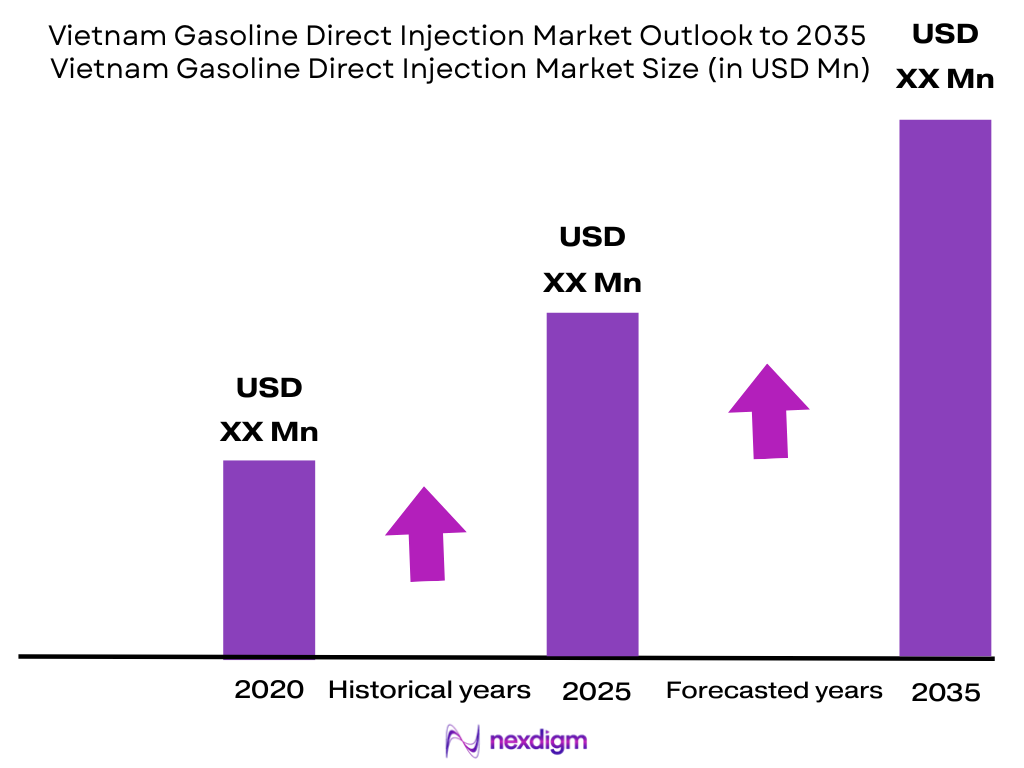
The Vietnam Gasoline Direct Injection Market is valued at approximately USD ~ million, retained as a placeholder because no authoritative public source separately publishes national GDI-system revenue. The automotive demand base strengthened from 301,989 vehicles to 340,142 vehicles across the two latest historical periods reported by VAMA, supporting demand for high-pressure injectors, pumps, fuel rails, pressure sensors and electronic controls across turbo-gasoline and hybrid powertrains. Hanoi, Hai Phong, Quang Nam–Chu Lai and Ho Chi Minh City–Southeast Vietnam form the principal demand and supply corridors because they combine vehicle assembly, industrial parks, parts distribution, ports and technical workforces. Vietnam’s sales structure shifted from 181,380 locally assembled and 120,609 imported vehicles to 172,730 locally assembled and 167,412 imported vehicles, making both domestic assembly clusters and import-distribution centres strategically important for GDI demand. DENSO also manufactures engine-related products in Hanoi.
Market Segmentation
By Component Type
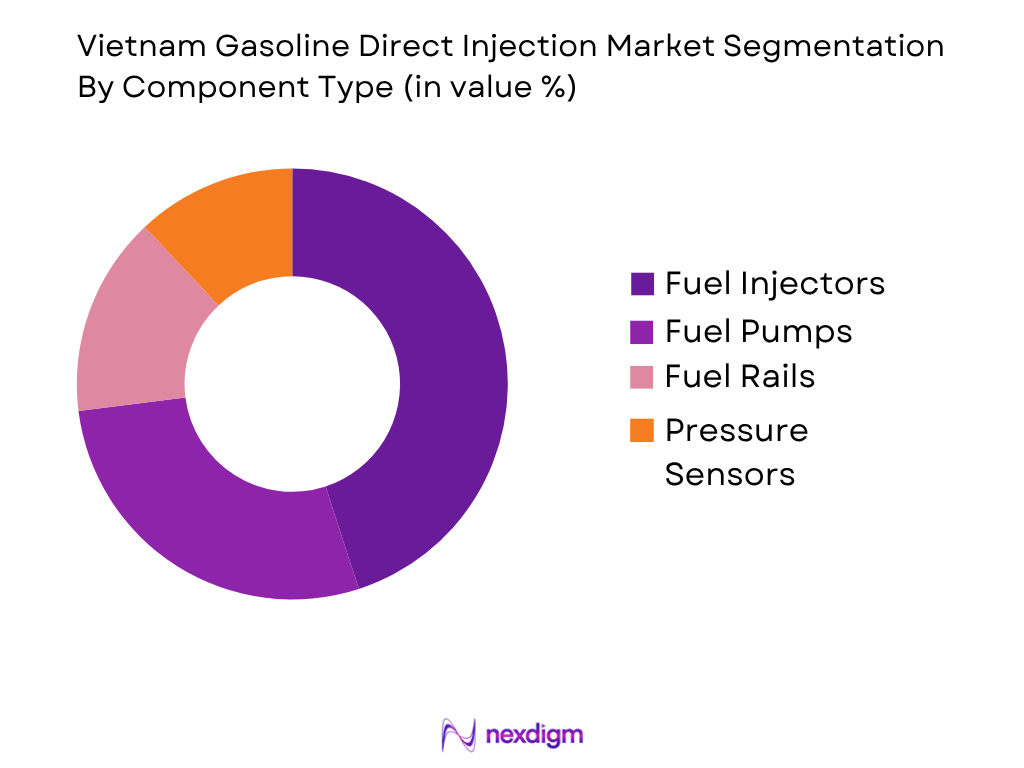
The Vietnam Gasoline Direct Injection Market is segmented into high-pressure fuel injectors, high-pressure fuel pumps, fuel rails, pressure sensors and control valves, and ECU/high-pressure supporting components. High-pressure fuel injectors hold the dominant share in the report model because every cylinder in a GDI engine requires an accurately controlled injector operating directly inside the combustion chamber. Injectors determine fuel quantity, spray targeting, atomisation and multiple-injection behaviour, placing them at the centre of combustion performance. Bosch’s current GDI architecture operates at pressures of up to 350 bar, while PHINIA offers injector systems reaching 400 bar and above 500 bar, demonstrating the increasing precision and technology content embedded in this component. Fuel pumps form the next-largest category because they create and regulate the high rail pressure required for direct injection.
By Powertrain Type
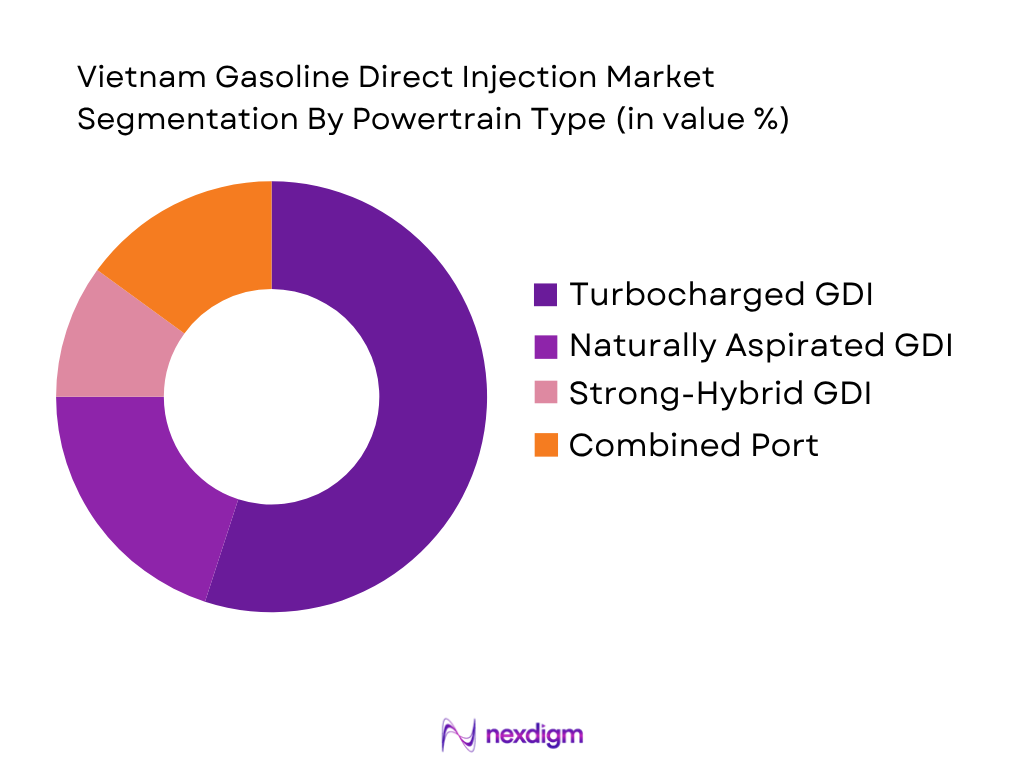
The Vietnam Gasoline Direct Injection Market is segmented into turbocharged GDI, naturally aspirated GDI, strong-hybrid GDI, mild-hybrid GDI and combined port/direct injection. Turbocharged GDI holds the dominant report-modelled position because Vietnam’s gasoline passenger-vehicle market increasingly includes compact SUVs, crossovers and premium models using smaller turbocharged engines to obtain high torque without increasing displacement. Direct injection supports this architecture by delivering fuel directly into the combustion chamber and enabling precise mixture formation at high pressure. Hybrid-GDI is also becoming strategically important as automakers expand gasoline-electric offerings. PHINIA has secured GDI fuel-system business specifically for hybrid and low-emission light-vehicle applications, illustrating the continuing role of direct injection within electrified combustion powertrains.
Competitive Landscape
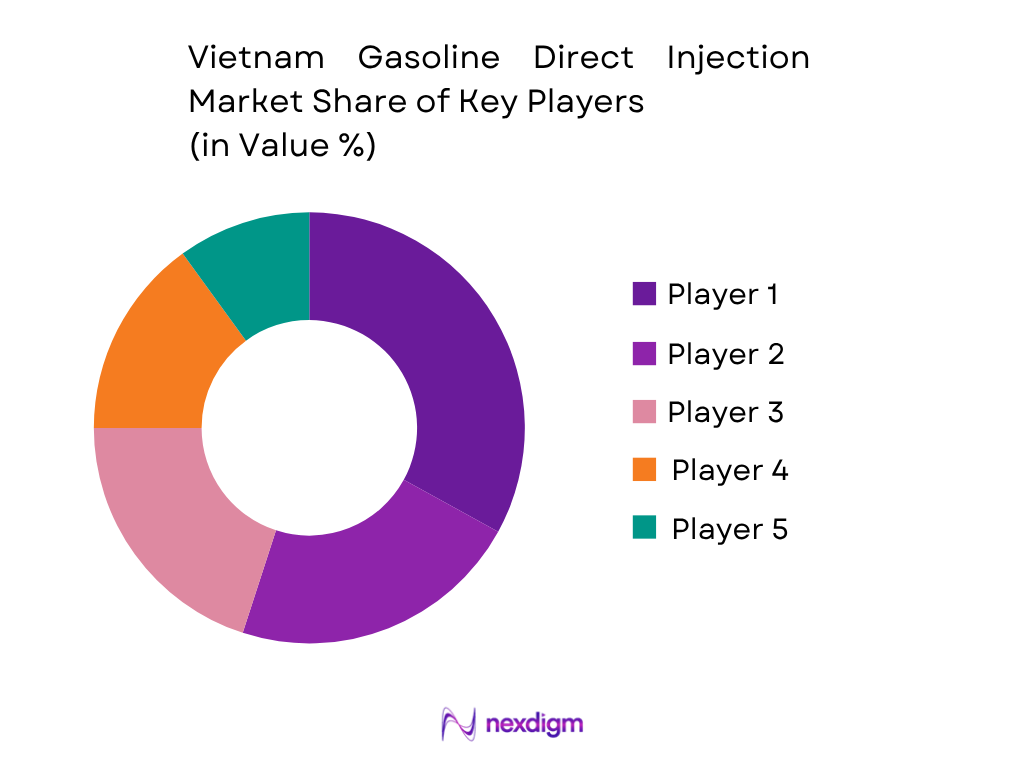
The Vietnam Gasoline Direct Injection Market is characterised by a limited group of technically advanced global fuel-system manufacturers because injector nozzle machining, pump pressure control, spray calibration and durability validation create substantial entry barriers. Bosch supports integrated GDI systems at up to 350 bar; PHINIA offers 350-bar and 500-plus-bar pumps and injectors exceeding 500 bar; Astemo produces direct-injection injectors and pumps reaching 50 MPa; Stanadyne has dedicated 350-bar GDI pump platforms; and DENSO combines global gasoline powertrain expertise with an established manufacturing presence in Vietnam.
| Major Player | Establishment | Headquarters | Injector Capability | High-Pressure Pump Capability | Pressure Positioning | Fuel Rail/System Integration | Alternative-Fuel Readiness | Vietnam / ASEAN Position |
| Robert Bosch GmbH | 1886 | Stuttgart, Germany | ~ | ~ | ~ | ~ | ~ | ~ |
| DENSO Corporation | 1949 | Kariya, Japan | ~ | ~ | ~ | ~ | ~ | ~ |
| PHINIA / Delphi | 2023 as PHINIA | Auburn Hills, USA | ~ | ~ | ~ | ~ | ~ | ~ |
| Astemo Ltd. | 2021 | Tokyo, Japan | ~ | ~ | ~ | ~ | ~ | ~ |
| Stanadyne | 1873 | Jacksonville, USA | ~ | ~ | ~ | ~ | ~ | ~ |
Vietnam Gasoline Direct Injection Market Analysis
Growth Drivers
Expansion of Passenger-Vehicle Demand and Turbo-Gasoline Applications
Vietnam’s expanding passenger-vehicle ecosystem is increasing the addressable base for gasoline direct injection systems, particularly in compact SUVs, crossovers, premium sedans and imported gasoline vehicles using turbocharged engines. Vietnam Automobile Manufacturers’ Association data show 301,989 vehicles were sold in 2023, while sales increased to approximately 340,142 vehicles in 2024. The structural mix also changed: locally assembled vehicle sales moved from 181,380 units to around 172,730 units, while completely built-up imports increased from approximately 120,609 units to 167,412 units. This rising imported-vehicle contribution matters for GDI because Japanese, Korean and European platforms increasingly use turbocharged gasoline engines and direct injection. Vietnam’s broader economic environment supports continued motorisation. World Bank data put national GDP at USD 476.39 billion in 2024, with GDP per capita at USD 4,717.3, while the IMF reports a national population of 103.077 million people for 2026. These fundamentals enlarge the potential pool of households capable of purchasing higher-specification passenger vehicles. From a GDI-system perspective, a turbocharged engine adds demand for high-pressure injectors, fuel pumps, rails, pressure sensors and injector-driver electronics. Contemporary Bosch direct-injection systems operate at up to 350 bar, indicating the precision-content embedded within modern gasoline platforms. Vietnam’s automotive market therefore does not merely provide a growing number of vehicles; it is shifting toward a more technologically intensive mix in which imported and locally assembled SUVs increasingly use smaller-displacement, higher-output gasoline engines. This creates a direct growth pathway for high-pressure fuel-system suppliers and increases opportunities for local distributors, Tier-1 suppliers and component manufacturers serving Vietnam’s gasoline powertrain ecosystem.
E10 Fuel Transition and Demand for More Advanced Gasoline Fuel Systems
Vietnam’s transition to E10 gasoline creates a second structural growth driver for the Gasoline Direct Injection Market because higher ethanol content raises the technical requirements placed on injectors, pumps, fuel rails, seals and pressure-control hardware. The Ministry of Industry and Trade issued Circular No. 50/2025/TT-BCT, establishing a nationwide E10 roadmap, and from June 1, 2026, unleaded gasoline distributed nationally must be blended into E10 for gasoline-engine applications. The ministry had already conducted pilot E10 programmes in Hanoi and Ho Chi Minh City from August 2025, giving the domestic fuel and automotive sectors an operational transition period before nationwide implementation. For GDI systems, ethanol compatibility affects corrosion resistance, elastomer selection, lubricity, high-pressure pump wear, injector deposits and calibration behaviour. These issues are especially relevant because modern systems operate at far higher pressures than traditional port injection. Bosch supports direct injection at up to 350 bar, while contemporary global GDI architectures extend considerably beyond that threshold. Vietnam’s macroeconomic base provides sufficient scale for OEMs and Tier-1 suppliers to justify adapting component specifications to local fuel policy: World Bank data place the economy at USD 476.39 billion in 2024, while the IMF reports a population exceeding 103 million people in 2026. The E10 transition also changes aftermarket requirements because service centres must diagnose fuel-system problems across an increasingly diverse vehicle parc containing imported turbocharged gasoline vehicles, locally assembled models and gasoline hybrids. As E10 becomes the nationwide standard, suppliers with ethanol-compatible injectors, pump seals, fuel rails and high-pressure lines will have a more defensible technical position. The opportunity extends beyond additional component volume: ethanol compatibility increases validation requirements and therefore raises the technological content of each GDI system supplied into Vietnam.
Market Challenges
Rising Battery-Electric Vehicle Substitution and Powertrain Diversification
The largest structural challenge for Vietnam’s Gasoline Direct Injection Market is the growing diversification of passenger-vehicle powertrains toward battery-electric and electrified propulsion, because a battery-electric vehicle eliminates the entire gasoline high-pressure fuel system. Unlike efficiency improvements within an internal-combustion engine, battery-electric substitution removes the injector, high-pressure pump, rail, pressure sensor and related gasoline-control hardware altogether. Vietnam’s automotive industry is already developing around electric mobility alongside conventional gasoline vehicles, while government industrial cooperation discussions increasingly include automotive manufacturing and advanced vehicle technologies. This creates investment uncertainty for suppliers considering new machining lines, injector assembly operations or high-pressure pump facilities. The challenge is amplified by Vietnam’s import structure. In 2024, approximately 167,412 completely built-up imported vehicles were sold through VAMA members, compared with around 172,730 locally assembled units, making imported powertrain technology a substantial influence on the domestic market. If overseas OEMs accelerate battery-electric vehicle allocation to Vietnam, local GDI demand can be affected without requiring major changes in domestic engine manufacturing. At the same time, the country remains large enough to sustain multiple technologies. World Bank data value Vietnam’s 2024 economy at USD 476.39 billion, while the IMF places the population at 103.077 million people in 2026. The implication is not immediate elimination of gasoline injection, but a more fragmented addressable market in which GDI suppliers must compete for fewer future combustion-platform nominations while also serving hybrids. Hybrid gasoline vehicles partially mitigate this risk because they retain injectors, pumps and rails, but they require more sophisticated engine restart and transient control. GDI suppliers therefore face a strategic requirement to shift away from reliance on conventional naturally aspirated gasoline engines and toward turbocharged, hybrid and combined port/direct-injection applications where advanced fuel systems remain relevant despite broader electrification.
Precision-Manufacturing Constraints and Dependence on Imported High-Pressure Components
Vietnam’s GDI market also faces a technical localisation challenge because high-pressure injectors and pumps require manufacturing capabilities substantially more demanding than those used for conventional mechanical automotive components. GDI injectors must repeatedly meter very small quantities of fuel directly into the combustion chamber while controlling spray targeting, response time and leakage under hundreds of bar of pressure. High-pressure pumps require similarly tight tolerances for plungers, valves, cam interfaces and sealing surfaces. These demands become more difficult as Vietnam transitions to E10 and as global injection pressures increase. Bosch’s commercial GDI architecture operates at up to 350 bar, creating strict requirements for machining accuracy, surface finishing, contamination control and end-of-line testing. Vietnam has a meaningful supporting-industry base, but government-linked trade information shows that domestic automotive manufacturing still relies heavily on imported components. Ministry of Industry and Trade-related information indicates that the country has approximately 30,000 mechanical enterprises, while policymakers are seeking significantly greater domestic production of engines, transmissions and automotive parts. Vehicle-market data reinforce the dependence on external supply chains: VAMA-member sales included approximately 167,412 imported vehicles in 2024, nearly matching locally assembled volumes. The E10 transition further raises the engineering threshold because the Ministry of Industry and Trade requires nationwide use from June 1, 2026, necessitating ethanol-compatible metallic surfaces, seals and calibration strategies. Vietnam’s macroeconomic scale—USD 476.39 billion GDP in 2024 and more than 103 million people in 2026—supports investment potential, but scale alone does not guarantee injector-grade manufacturing capability. Local suppliers need clean-room-style assembly processes, microscopic filtration control, spray imaging, flow calibration, high-pressure leak testing, pressure cycling and pump endurance equipment before they can qualify for global OEM programmes. Consequently, complex injectors, nozzle assemblies, electronic actuator components and pump internals may remain import dependent longer than simpler rails, pipes, housings and connectors.
Market Opportunities
Localisation of E10-Compatible Injectors, Fuel Rails and High-Pressure Pump Components
Vietnam’s move toward E10 creates a significant future localisation opportunity because nationwide ethanol-blended gasoline makes fuel compatibility a permanent specification for new gasoline platforms rather than an optional feature. Circular No. 50/2025/TT-BCT established the national roadmap, and E10 distribution became mandatory nationwide from June 1, 2026. Pilot implementation had already been conducted in Hanoi and Ho Chi Minh City from August 2025, allowing fuel distributors, OEMs and service networks to gain operating experience before full rollout. For local automotive suppliers, this creates demand for ethanol-resistant fuel rails, high-pressure lines, injector seals, pump housings, connectors and pressure-control hardware. Vietnam already possesses an industrial foundation that can be extended toward these components. Government-linked information identifies around 30,000 mechanical enterprises nationally, while the Ministry of Industry and Trade has highlighted the need to deepen production of engines, gearboxes and other strategic automotive components. The vehicle base is large enough to support localisation: approximately 340,142 vehicles were sold by VAMA members in 2024, including both local assembly and imported vehicles. World Bank data indicate USD 476.39 billion GDP in 2024, while the IMF reports a population of 103.077 million in 2026, creating a sizeable domestic manufacturing and consumption platform. The immediate opportunity is not necessarily complete localisation of injector needles and ultra-precision nozzles. Vietnam can first capture technically achievable areas such as rails, high-pressure pipes, pump housings, brackets, connectors, seals and selected machined parts, then progressively move toward higher-value assemblies. E10 increases the value of domestic validation laboratories as well, because suppliers need material-compatibility, leakage, pressure-cycle and long-term durability testing. Companies that establish local ethanol-testing and high-pressure validation capability can position themselves as preferred suppliers to both domestic assemblers and ASEAN automotive programmes.
Higher-Pressure GDI, Hybrid Integration and ASEAN Technology Partnerships
Vietnam has a future opportunity to move from basic imported gasoline fuel systems toward higher-pressure GDI and hybrid-compatible component manufacturing through partnerships with global automotive suppliers and neighbouring Asian manufacturing ecosystems. The Ministry of Industry and Trade has explicitly promoted deeper automotive cooperation with major industrial partners, including China and South Korea, while Vietnam’s participation in frameworks such as RCEP, CPTPP and EVFTA strengthens its integration into regional manufacturing networks. This matters for GDI because the technology is increasingly shifting toward higher injection pressure, greater electronic control and hybridised gasoline operation. Bosch systems currently operate at up to 350 bar, meaning future component programmes require advanced injectors, pumps, sensors and rails rather than conventional low-pressure fuel hardware. Vietnam’s manufacturing base provides an entry point: government-linked sources identify roughly 30,000 mechanical enterprises, and policymakers are encouraging deeper production of engines and drivetrain components instead of simple final assembly. Automotive demand also provides volume justification. VAMA-member sales rose from 301,989 vehicles in 2023 to approximately 340,142 vehicles in 2024, while imported vehicles reached around 167,412 units, exposing the market to a wide range of modern gasoline and hybrid technologies. Vietnam’s nationwide E10 requirement from June 1, 2026 adds another reason for technology transfer because future high-pressure systems must combine advanced injection performance with ethanol resistance. World Bank data showing USD 476.39 billion GDP in 2024 and IMF population data of 103.077 million people in 2026 reinforce the country’s potential as both a production base and final market. The strongest opportunity therefore lies in partnerships that localise selected precision processes—pump housing machining, rail production, high-pressure pipe forming, sensor integration, injector calibration and endurance testing—while global partners supply proprietary nozzle, actuator and control technologies. Such cooperation would allow Vietnam to capture more value per gasoline and hybrid vehicle even as the broader industry electrifies.
Future Outlook
The Vietnam Gasoline Direct Injection Market is forecast to expand at approximately ~ CAGR during 2026–2035, retained as a placeholder for the final market model. Future development will be shaped less by conventional gasoline-engine volume alone and increasingly by higher-pressure injection, turbocharged engines, gasoline hybrids, E10-compatible components and localisation of precision fuel-system parts.
Vietnam’s nationwide E10 gasoline transition materially changes fuel-system specifications. The Ministry of Industry and Trade states that nationwide E10 distribution commenced in 2026, meaning future injectors, rails, pumps, seals and high-pressure lines must increasingly be engineered around ethanol-containing gasoline.
Higher injection pressure will create another layer of value growth. Bosch currently supports systems up to 350 bar, Astemo pumps reach 50 MPa, and PHINIA offers GDI pumps and injectors exceeding 500 bar. The shift increases requirements for precision machining, rail-pressure stability, injector response and contamination management.
Hybridisation should provide a defensive growth channel against full electrification. Hybrid engines still require gasoline injection while adding demanding restart, transient-load and thermal-management requirements. Suppliers capable of serving turbo-hybrid and combined port/direct-injection architectures should therefore retain relevance even as Vietnam’s broader mobility market electrifies.
Major Players
- Robert Bosch GmbH / Bosch Vietnam
- DENSO Corporation / DENSO Vietnam
- PHINIA / Delphi
- Astemo Ltd.
- Marelli
- Stanadyne
- Aisan Industry Co., Ltd.
- Mikuni Corporation
- AUMOVIO
- TI Fluid Systems
- Standard Motor Products
- GB Remanufacturing
- Motorcar Parts of America
- Schaeffler Group
- AISIN Corporation
Key Target Audience
- Gasoline Direct Injection System Manufacturers
- Passenger Vehicle and Gasoline Engine OEMs
- High-Pressure Fuel Injector and Pump Manufacturers
- Automotive Tier-1 and Precision Component Manufacturers
- Turbocharged and Hybrid Powertrain Manufacturers
- Automotive Importers, Distributors and Aftermarket Companies
- Investments and Venture Capitalist Firms
- Government and Regulatory Bodies (Ministry of Industry and Trade, Ministry of Construction, Vietnam Register, Directorate for Standards, Metrology and Quality)
Research Methodology
Step 1: Identification of Key Variables
The research begins by mapping vehicle OEMs, assemblers, importers, gasoline-engine platforms, GDI suppliers, high-pressure injector manufacturers, pump companies, fuel-rail producers and aftermarket participants. Key variables include vehicle sales, CKD assembly, CBU imports, GDI fitment, turbocharging, engine displacement, injector count, injection pressure, hybridisation and E10 compatibility. Vehicle-market information is anchored to VAMA reporting, while fuel-policy inputs are obtained from Vietnam’s Ministry of Industry and Trade. Supplier technology specifications are benchmarked through primary corporate technical documentation rather than secondary market estimates.
Step 2: Market Analysis and Construction
The top-down model starts with Vietnam’s passenger-vehicle and light-vehicle base and identifies gasoline platforms using direct injection rather than conventional port injection. GDI vehicle volume is then translated into component demand using cylinders per engine, injectors per cylinder, pump fitment, rail content and pressure-management hardware.
The bottom-up model maps OEM platforms against supplier portfolios and technical specifications. Benchmark pressure points include Bosch’s 350-bar architecture, Astemo’s 50-MPa pump and PHINIA’s 500-plus-bar systems, providing boundaries for technology segmentation.
Step 3: Hypothesis Validation and Expert Consultation
Market hypotheses are validated through CATIs with vehicle assemblers, gasoline-engine engineers, automotive distributors, fuel-system Tier-1 suppliers, component importers and service workshops. Interviews assess GDI fitment by platform, supplier nomination, imported versus localised content, injection-pressure migration, E10 compatibility and component replacement patterns.
Technical discussions additionally evaluate injector deposits, pump wear, fuel cleanliness, pressure stability, calibration capability and workshop diagnostic requirements. These findings are used to reconcile calculated component volumes with the observed structure of Vietnam’s automotive supply chain.
Step 4: Research Synthesis and Final Output
The final stage triangulates VAMA vehicle data, government fuel-policy information, platform mapping, supplier technical documentation and primary interviews. Separate market models are prepared for turbo-GDI, naturally aspirated GDI, hybrid-GDI and combined port/direct-injection systems. Forecast scenarios incorporate passenger-vehicle demand, CKD versus CBU mix, turbocharged-engine penetration, hybrid adoption, E10 implementation, injection-pressure migration, local component manufacturing and battery-electric substitution. This provides both a vehicle-volume view and a component-content-per-vehicle view of the Vietnam Gasoline Direct Injection Market.

- Executive Summary
- Research Methodology (Market Definitions and Assumptions, GDI System Boundary, Abbreviations, Vehicle Platform Mapping, Gasoline Engine Family Mapping, GDI Fitment Assessment, Top-Down Market Sizing, Bottom-Up Component Consumption Model, Demand-Side Assessment, Supply-Side Assessment, Injectors per Engine Assessment, High-Pressure Pump Fitment, OEM Interviews, Tier-1 Supplier Interviews, Import-Export Assessment, Data Triangulation, Forecasting Framework, Limitations and Future Conclusions)

- Definition and Scope
- Evolution from Multi-Point Fuel Injection to Gasoline Direct Injection
- Evolution of Naturally Aspirated Gasoline Engines to Turbo-GDI Engines
- Vietnam Gasoline Powertrain Ecosystem
- GDI High-Pressure Fuel-System Architecture

- Growth Drivers (Rising Passenger Vehicle Ownership, Turbo-Gasoline Powertrains, SUV Demand, Engine Downsizing, Hybrid Adoption, E10 Adaptation, Local Assembly Expansion, Advanced Engine Technology)
- Market Challenges (Battery-Electric Substitution, Imported GDI Components, Precision Manufacturing, Injector Deposits, Pump Durability, E10 Adaptation, OEM Concentration, Diagnostic Complexity)
- Market Opportunities (High-Pressure GDI, E10 Systems, Hybrid-GDI, Localisation, Import Substitution, Precision Manufacturing, Aftermarket Services, Export Supply)
- Market Trends (Higher Injection Pressure, Multiple Injection, Dual Injection, Hybridisation, E10 Materials, Integrated Rails, Compact Pumps, Digital Diagnostics)
- SWOT Analysis
- Porter’s Five Forces Analysis
- PESTLE Analysis

- By Market Value (2020-2025)
- By GDI System Volume (2020-2025)
- By GDI-Equipped Vehicle Volume (2020-2025)

- By Component Type (In Value %)
High-Pressure Fuel Injectors
High-Pressure Fuel Pumps
Fuel Rails
Fuel Rail Pressure Sensors
Pressure Control and Volume Control Valves - By Vehicle Type (In Value %)
Hatchbacks
Sedans
Compact SUVs
Mid-Size SUVs
Large SUVs - By Powertrain Type (In Value %)
Naturally Aspirated GDI
Turbocharged GDI
Mild-Hybrid GDI
Strong-Hybrid GDI
Plug-In Hybrid GDI - By Region (In Value %)
Northern Vietnam
Red River Delta
Central Vietnam
Southeast Vietnam

- Market Share of Major Players by Value
- Cross Comparison Parameters (Maximum GDI Injection Pressure Capability, High-Pressure Injector Portfolio Breadth, High-Pressure Pump Pressure and Flow Range, Integrated Fuel Rail and Pressure-Sensor Capability, E10 Fuel Compatibility, Vietnam Manufacturing/Distribution Footprint, OEM Engine-Platform Coverage, Hybrid-GDI and Dual-Injection Capability)
- SWOT Analysis of Major Players
- Detailed Profiles of Major Companies
Robert Bosch GmbH / Bosch Vietnam
DENSO Corporation / DENSO Vietnam
PHINIA / Delphi
Astemo Ltd.
Marelli
Stanadyne
Aisan Industry Co., Ltd.
Mikuni Corporation
AUMOVIO
TI Fluid Systems
Standard Motor Products
GB Remanufacturing
Motorcar Parts of America
Schaeffler Group
AISIN Corporation

- Passenger Vehicle OEM Demand
- Turbo-Gasoline Engine Manufacturer Demand
- Hybrid Powertrain Manufacturer Demand
- Premium Vehicle Importer Demand
- Tier-1 Fuel-System Integrator Demand

- By Market Value (2026-2035)
- By GDI System Volume (2026-2035)
- By GDI-Equipped Vehicle Volume (2026-2035)


 Request a Sample
 Ask for Customization
 Get a Quote
 Enquire Now