

 Download PDF
Market Overview
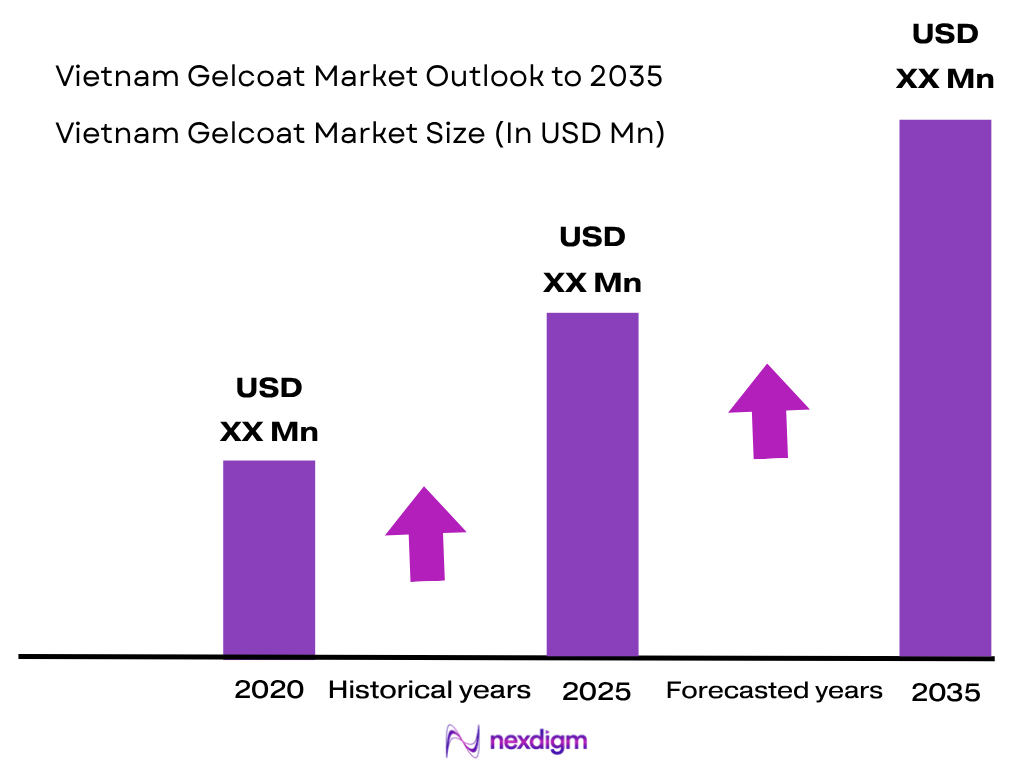
The Vietnam Gelcoat Market is valued at approximately USD ~XX million, based on historical demand across marine, construction, wind-energy, transportation and industrial FRP applications. Its expansion is supported by manufacturing recovery: national industrial-production performance moved from an index growth of 1.3 in the preceding period to 8.4 in the latest period, while manufacturing and processing moved from 1.5 to 9.6, strengthening the downstream environment for composite resins and gelcoat consumption.
Ho Chi Minh City–Binh Duong, Hai Phong–Quang Ninh and the southern coastal industrial corridor dominate the Vietnam Gelcoat Market because they concentrate resin distribution, FRP processing, ports, shipbuilding, industrial fabrication and marine activity. Renewable capacity increased from 21,169 MW to 21,447 MW, while total installed power capacity rose from 80,946 MW to 82,387 MW. Hai Phong handled approximately 106.5 million tonnes of seaport cargo in the latest reported period, reinforcing northern marine-material demand.
Market Segmentation
By Resin Chemistry
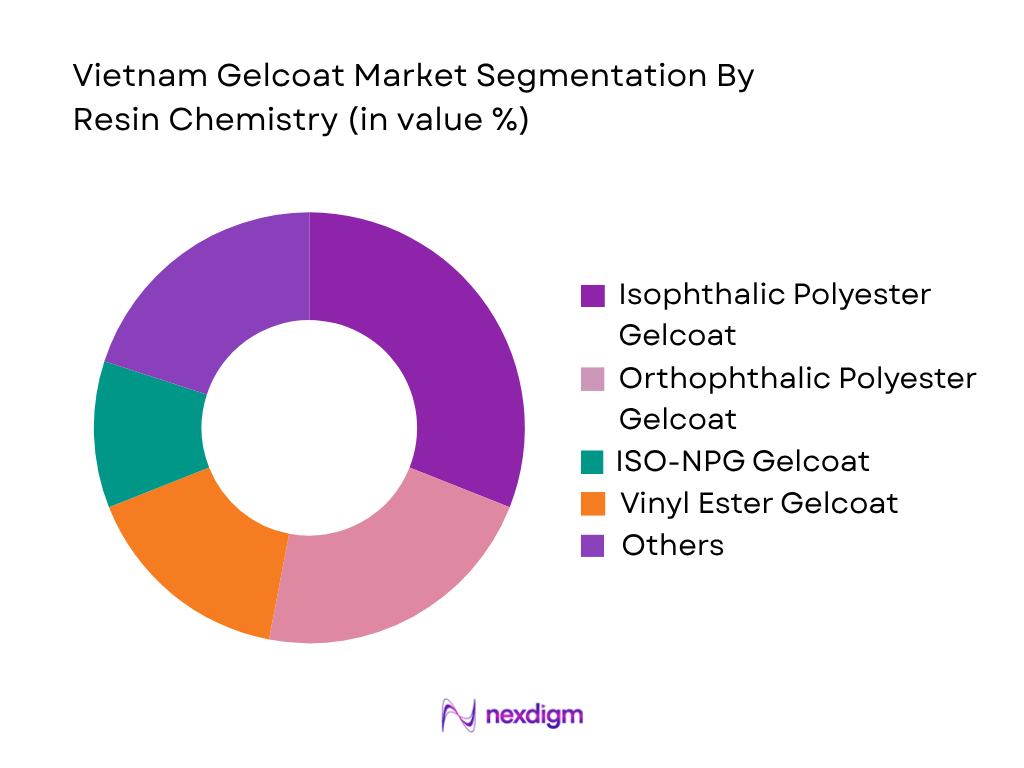
The Vietnam Gelcoat Market is segmented into orthophthalic polyester, isophthalic polyester, ISO-NPG, vinyl ester, epoxy, low-styrene, styrene-free and other specialty gelcoats. Isophthalic polyester gelcoat holds the dominant report-model share because Vietnam’s demand base remains heavily concentrated in marine FRP, tanks, construction components, sanitary products and general industrial composite fabrication, where water resistance, weatherability, surface gloss and compatibility with unsaturated polyester laminates are essential. Isophthalic systems provide a stronger durability profile than conventional orthophthalic chemistry while remaining applicable through the hand lay-up and spray-up techniques commonly used by regional fabricators. ISO-NPG gelcoats occupy the premium marine, swimming-pool and outdoor-surface segment because of superior hydrolysis and colour-retention characteristics. Vinyl ester systems are concentrated in corrosive industrial environments, tanks and pipes, while epoxy gelcoats serve specialised tooling and high-performance composite applications. International suppliers also increasingly offer low-styrene and styrene-free systems, widening the technology options available to Vietnamese processors.
By End-Use Industry
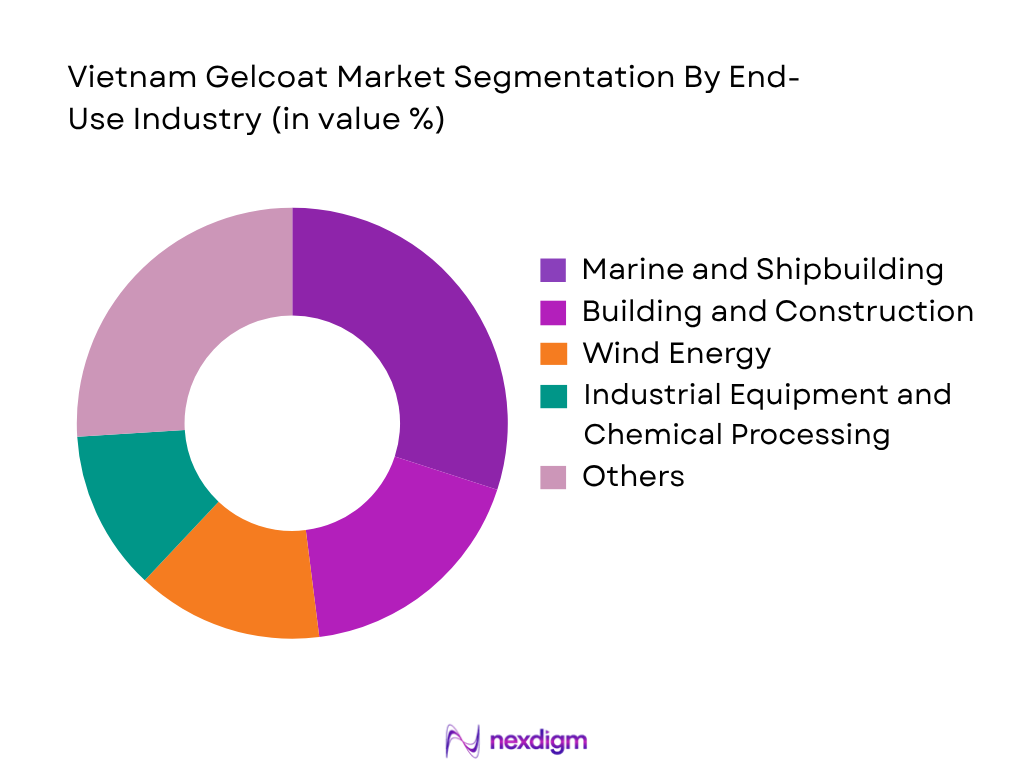
The Vietnam Gelcoat Market is segmented into marine and shipbuilding, wind energy, building and construction, transportation, industrial equipment, chemical processing, sanitaryware, swimming pools and other composite applications. Marine and shipbuilding represent the dominant report-model segment, supported by Vietnam’s long coastline, fishing-vessel ecosystem, shipyards, ports and expanding maritime logistics base. Gelcoat is extensively suited to boat hulls, decks, cabins, covers and FRP fittings because it delivers water resistance, UV protection, colour stability and repairable surface finishing. Vietnam’s fishery output reached 9.547 million tonnes, including 3.8254 million tonnes from capture fisheries, supporting a large coastal operating environment associated with fishing fleets and marine maintenance. Meanwhile, Hai Phong handled 106.5 million tonnes of seaport cargo, and Quang Ninh handled 149.54 million tonnes, reinforcing the concentration of marine activity in the north. Wind and construction follow as important demand areas for weather-resistant and corrosion-resistant composite surfaces.
Competitive Landscape
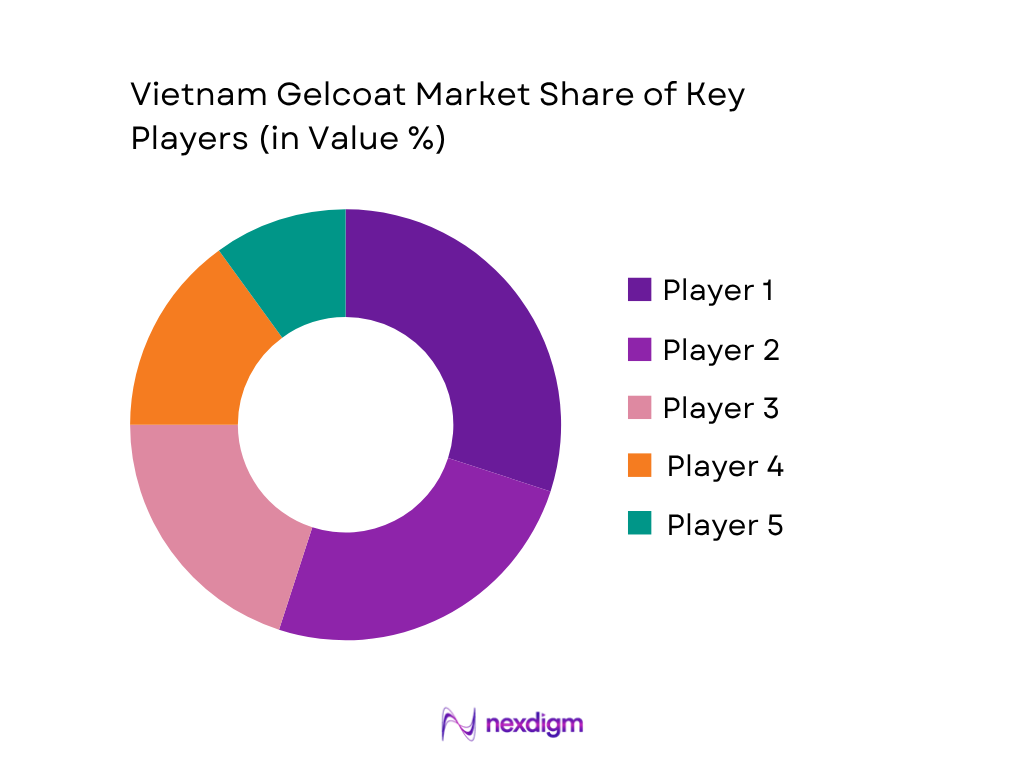
The Vietnam Gelcoat Market is fragmented across international gelcoat manufacturers, Asian composite-resin producers, Vietnamese distributors and local FRP material suppliers. Competition is based on resin chemistry, marine durability, ISO-NPG availability, corrosion resistance, colour matching, technical service and availability through local distribution. Scott Bader has an identified Vietnam composite distribution channel through Behn Meyer, Eternal Materials maintains a Vietnam office supplying unsaturated polyester resins, and Polynt supplies Southeast Asia through its Asia-Pacific gelcoat platform.
| Major Player | Established | Headquarters | Gelcoat / Resin Chemistry | Marine Capability | Wind & Industrial Capability | Low-Emission / Sustainability Capability | Vietnam / ASEAN Presence | Technical Support |
| Scott Bader | 1921 | Wollaston, United Kingdom | ~ | ~ | ~ | ~ | ~ | ~ |
| Polynt | 1955 | Scanzorosciate, Italy | ~ | ~ | ~ | ~ | ~ | ~ |
| Eternal Materials | 1964 | Kaohsiung, Taiwan | ~ | ~ | ~ | ~ | ~ | ~ |
| Swancor | 1992 | Nantou, Taiwan | ~ | ~ | ~ | ~ | ~ | ~ |
| allnex | 2013 | Frankfurt, Germany | ~ | ~ | ~ | ~ | ~ | ~ |
Vietnam Gelcoat Market Analysis
Growth Drivers
Expansion of Composite-Intensive Manufacturing and Industrial Investment
Vietnam’s expanding manufacturing base is a direct growth driver for the Vietnam Gelcoat Market, particularly for gelcoats used in FRP tanks, equipment covers, transportation components, architectural panels, sanitary products and corrosion-resistant industrial structures. Total social investment deployed in Vietnam reached VND 3,692.1 trillion in 2024, while realised foreign direct investment reached USD 25.35 billion. Manufacturing and processing alone absorbed USD 20.62 billion of realised foreign direct investment, demonstrating the scale of capital flowing into the industrial ecosystem where composite fabrication can expand. The country also had 42,002 valid foreign-invested projects with registered capital of USD 502.8 billion at the end of 2024, giving component and material suppliers a deep downstream customer base. For gelcoat manufacturers, this creates opportunities across chemical equipment, factory infrastructure, electrical enclosures, vehicle parts and engineered FRP products requiring corrosion protection, moulded surface quality and outdoor durability. The wider economic platform further supports industrial material consumption: World Bank data record Vietnam’s 2024 GDP at USD 476.39 billion, GDP per capita at USD 4,717.3, and population at 100,987,686. These manufacturing, investment and macroeconomic indicators collectively support sustained requirements for polyester, ISO-NPG, vinyl-ester and specialty gelcoat systems.
Large Marine, Fisheries and Port-Industrial Ecosystem
Vietnam’s extensive marine economy is another major growth driver for the Vietnam Gelcoat Market, because fishing vessels, leisure craft, workboats, GRP hulls, decks, cabins, covers and repair components require water-resistant and weather-resistant exterior surfaces. Vietnam recorded total fishery production of 9.547 million tonnes in 2024, comprising 5.7216 million tonnes of aquaculture output and 3.8254 million tonnes of capture fisheries. This operating base supports vessel construction, maintenance and replacement activity across coastal provinces. Marine logistics also operate at significant scale: Saigon Newport Corporation handled nearly 150 million tonnes of cargo in 2024, indicating high activity around southern port, vessel and logistics infrastructure. Investment continues to concentrate in coastal manufacturing locations; Hai Phong attracted USD 4.94 billion of registered foreign investment during 2024, while Ho Chi Minh City attracted more than USD 3.04 billion, strengthening demand around major industrial and maritime clusters. These conditions favour marine-grade isophthalic and ISO-NPG gelcoats offering hydrolysis resistance, UV stability, gloss retention and repairability. World Bank data place Vietnam’s 2024 GDP at USD 476.39 billion and population at 100,987,686, providing a substantial economic base for shipbuilding, fisheries, ports and associated composite-material consumption.
Vietnam Gelcoat Market Challenges
Dependence on Imported Resin, Polymer and Specialty Chemical Inputs
Dependence on imported feedstocks remains a structural challenge for the Vietnam Gelcoat Market, particularly for specialised polyester resin, vinyl-ester resin, styrene-related inputs, pigments, additives, catalysts and other composite-processing materials. Vietnam Customs recorded 5,398,481 tonnes of plastics imports during the first eight months of 2024, including 758,996 tonnes during August alone. Although the broader plastics category is larger than the gelcoat value chain, the scale illustrates Vietnam’s reliance on overseas polymer and petrochemical supply, which also affects composite material manufacturers sourcing specialty resins and additives. Vietnam’s industrial structure increases this exposure because gelcoat formulators and FRP processors need consistent resin viscosity, colour, catalyst response and chemical performance, leaving limited flexibility when an approved imported formulation or feedstock is disrupted. The country’s total merchandise imports reached a large industrial scale, while domestic manufacturing investment continues to expand demand for imported production inputs. For gelcoat suppliers, procurement interruptions can affect formulation schedules, colour availability and delivery reliability for marine and industrial customers. Vietnam’s 2024 economy recorded USD 476.39 billion in GDP, USD 4,717.3 in GDP per capita and 100,987,686 residents according to the World Bank, demonstrating that the challenge arises within a large, rapidly industrialising economy whose downstream material requirements can outpace local specialty chemical availability.
Composite Waste Management and Limited Circular Recovery Pathways
Waste management represents an increasingly important challenge for the Vietnam Gelcoat Market because conventional gelcoat is generally cross-linked with an underlying thermoset composite, making end-of-life recovery more difficult than remelting ordinary thermoplastics. Vietnam’s wider plastics circularity infrastructure illustrates the scale of the challenge confronting polymer-based industries. During 2024, PRO Vietnam and its partners collected and recycled more than 64,000 tonnes of post-consumer packaging, including PET bottles, HDPE packaging, PP packaging, flexible plastics and shrink films. A separate government-reported collaboration had collected and recycled more than 30,000 tonnes of plastic waste through 2024. These recovery volumes demonstrate active development of circular infrastructure, but most established collection streams focus on thermoplastics and packaging rather than glass-fibre-reinforced thermoset structures coated with polyester or vinyl-ester gelcoat. Boat hulls, tanks, construction panels and industrial FRP therefore require different dismantling, grinding, co-processing or material-recovery solutions. This raises lifecycle-management requirements for gelcoat suppliers serving environmentally sensitive customers and export manufacturers. At the macro level, World Bank figures show Vietnam supported a population of 100,987,686 and GDP of USD 476.39 billion in 2024, implying increasing industrial material throughput as manufacturing expands. Gelcoat producers consequently face pressure to improve durability, service life and compatibility with lower-waste composite manufacturing processes while downstream recycling infrastructure matures.
Market Opportunities
Wind-Energy Composite Surface Systems and Weather-Resistant Gelcoats
Vietnam’s renewable-energy buildout creates a forward opportunity for the Vietnam Gelcoat Market, particularly in gelcoats used on wind-turbine nacelles, spinner covers, composite housings, access covers and ancillary GRP structures exposed to ultraviolet radiation, rain, coastal salt and temperature cycling. Vietnam Electricity reported total installed power-system capacity of approximately 82,400 MW at the end of 2024, including 21,447 MW of wind and solar capacity. In addition, the Ministry of Industry and Trade’s power-planning review identified 123 onshore wind projects with 7,697.9 MW of capacity, creating a substantial pipeline around which composite manufacturing, maintenance and component localisation can develop. The market opportunity is strongest for ISO-NPG, low-styrene and specialty weather-resistant gelcoats capable of maintaining colour, surface integrity and adhesion under prolonged outdoor exposure. Suppliers can also target field repair, refurbishment and locally matched surface systems as the installed asset base expands. These opportunities should be distinguished from specialised blade leading-edge coatings, which frequently use different coating chemistries. Vietnam’s wider economic capacity strengthens the business case: World Bank data record 2024 GDP of USD 476.39 billion, GDP per capita of USD 4,717.3, and population of 100,987,686, providing an industrial base capable of supporting renewable-energy component localisation and technical composite supply chains.
Local Specialty Gelcoat Formulation, Colour Matching and Import Substitution
Local formulation and technical-service capability represents a significant future opportunity in the Vietnam Gelcoat Market because the country combines rapidly expanding industrial demand with continued dependence on imported polymer and specialty chemical inputs. Vietnam Customs recorded 5,398,481 tonnes of plastics imports in the first eight months of 2024, demonstrating the depth of imported polymer dependence across downstream manufacturing. At the same time, realised foreign direct investment reached USD 25.35 billion in 2024, of which USD 20.62 billion was deployed in manufacturing and processing. Foreign investors maintained 42,002 active projects with USD 502.8 billion in registered capital, creating an expanding population of industrial customers requiring local materials, shorter lead times and technical troubleshooting. For gelcoat suppliers, this opens opportunities for domestic tinting, custom colours, application-adjusted viscosity, marine-grade ISO-NPG systems, corrosion-resistant vinyl-ester gelcoats and low-emission formulations supplied with local catalyst and processing support. A local technical platform can also reduce dependence on importing every finished colour or specialist grade while retaining qualified resin technologies. World Bank macroeconomic data further support localisation: Vietnam generated USD 476.39 billion in GDP in 2024 with 100,987,686 residents. These conditions favour investment in blending, warehousing, quality control and application laboratories positioned close to Vietnamese FRP processors and shipbuilding clusters.
Future Outlook
The Vietnam Gelcoat Market is forecast to expand at approximately ~XX% CAGR during 2026–2035, supported by growth in marine composites, renewable-energy components, construction FRP, corrosion-resistant industrial equipment and higher-performance surface systems. Demand is expected to shift gradually toward ISO-NPG, vinyl-ester, low-styrene and specialised weather-resistant formulations as processors move beyond general-purpose orthophthalic systems.
Vietnam’s renewable-energy base provides an important future platform for composite-material demand. Installed renewable capacity increased from 21,169 MW to 21,447 MW, while revised power planning incorporated 123 wind projects representing 7,697.9 MW. Wind-related gelcoat demand is most relevant to nacelles, spinners, equipment covers and other GRP structures rather than necessarily turbine-blade leading-edge protection, which often uses specialised coating technologies.
Major Players
- allnex Vietnam
- Scott Bader
- Polynt Composites
- BÜFA Composite Systems
- AOC
- Swancor
- Eternal Materials
- Changzhou Huake Polymers
- INEOS Composites
- Sicomin
- Resoltech
- Behn Meyer Vietnam
- Gia Khang Technology
- ViChem
- Hoang Anh Composite Materials
Key Target Audience
- Gelcoat, Unsaturated Polyester Resin and Vinyl Ester Resin Manufacturers
- Marine, Shipbuilding, Boatbuilding and Vessel Repair Companies
- FRP and Composite Component Manufacturers
- Wind Energy and Renewable-Energy Component Manufacturers
- Construction, Sanitaryware and Industrial Composite Product Manufacturers
- Composite Material Importers, Distributors and Chemical Suppliers
- Investments and Venture Capitalist Firms
- Government and Regulatory Bodies (Ministry of Industry and Trade, Ministry of Construction, Ministry of Health, Ministry of Agriculture and Environment, Vietnam Electricity Authority)
Research Methodology
Step 1: Identification of Key Variables
The initial phase involves constructing an ecosystem map encompassing all major stakeholders within the Vietnam Gelcoat Market, including resin manufacturers, international gelcoat suppliers, importers, distributors, FRP fabricators, shipyards, boatbuilders, wind-component manufacturers and construction-composite processors. Secondary research identifies critical variables such as gelcoat chemistry, end-use demand, imports, domestic formulation, application process, coated surface area, styrene content and customer qualification requirements.
Step 2: Market Analysis and Construction
In this phase, historical demand is evaluated through both top-down and bottom-up approaches. Top-down analysis assesses marine activity, wind-energy deployment, construction output, transportation composites and industrial FRP manufacturing. Bottom-up analysis estimates gelcoat consumption using numbers of composite components, production volumes, coated surface area, film thickness, application loss, resin system, replacement frequency and manufacturer or distributor throughput to construct the overall market.
Step 3: Hypothesis Validation and Expert Consultation
Market hypotheses are subsequently validated through computer-assisted telephone interviews with gelcoat suppliers, polyester and vinyl-ester resin companies, distributors, boatbuilders, FRP moulders and industrial composite users. These discussions examine resin-chemistry preferences, gelcoat-to-laminate compatibility, spray versus brush application, colour matching, cure behaviour, surface defects, marine durability, import dependence, customer qualification and low-styrene adoption, allowing preliminary market assumptions to be refined.
Step 4: Research Synthesis and Final Output
The final phase triangulates findings from supply-side companies, downstream manufacturing indicators, trade information, marine activity and application-level demand. Bottom-up consumption calculations are compared with top-down industry indicators to reconcile market value, volume and segmentation. Product portfolios and local distribution structures are also benchmarked to develop a validated assessment of the Vietnam Gelcoat Market, competitive positioning, end-use opportunities and long-term strategic outlook.

- Executive Summary
- Research Methodology (Market Definition and Scope, Vietnam Gelcoat Market Classification, Gelcoat Consumption Assessment, Unsaturated Polyester and Vinyl Ester Resin Mapping, Marine Composite Demand Assessment, Wind Energy Composite Application Mapping, Construction and Infrastructure GRP Analysis, Transportation Composite Assessment, Domestic Resin Manufacturing Assessment, Import and Distribution Mapping, End-Use Industry Demand Assessment)

- Definition and Scope
- Vietnam Gelcoat Industry Evolution and Development of Marine, Wind Energy, GRP Fabrication and Composite Manufacturing Ecosystem
- Gelcoat Formulation, Composite Resin Manufacturing and FRP Processing Industry Structure
- Vietnam Gelcoat Value Chain Analysis
- Vietnam Gelcoat Supply Chain Analysis
- Resin Manufacturer, Gelcoat Formulator, Fiberglass Supplier, Composite Distributor, FRP Fabricator, OEM and Shipyard Ecosystem Analysis
- Gelcoat Manufacturing and Application Integration Assessment Across Marine, Wind Energy, Construction, Transportation, Sanitaryware and Industrial Composite Applications

- Growth Drivers (Expansion of Marine and Shipbuilding Activity, Development of Wind Energy Infrastructure, Growth of FRP Construction Applications, Expansion of Composite Manufacturing, Increasing Demand for Corrosion-Resistant Industrial Components, Growth of Leisure Craft Manufacturing, Demand for Weather-Resistant Composite Surfaces, Industrialisation of Composite Processing)
- Market Challenges (Dependence on Imported Specialty Resin Inputs, Styrene Workplace Exposure Management, Volatile Petrochemical Feedstock Availability, Inconsistent Surface Quality in Manual Processing, Limited High-Performance Gelcoat Formulation Capability, Skilled Composite Applicator Constraints, Competition from Conventional Coating Systems, Composite Waste Management Constraints)
- Market Opportunities (Marine-Grade ISO-NPG Gelcoat Expansion, Offshore and Onshore Wind Composite Surface Systems, Low-Styrene and Styrene-Free Gelcoat Adoption, Chemical-Resistant Industrial Gelcoats, Fire-Retardant Transportation Gelcoats, Construction FRP Surface Solutions, Automated Gelcoat Application, Gelcoat Repair and Refurbishment, Local Colour-Matching Capability)
- Market Trends (ISO-NPG Gelcoat Adoption, Lower-Styrene Formulations, High-Gloss Marine Finishes, UV-Resistant Surface Systems, Vinyl Ester Barrier Coats, Fire-Retardant Gelcoats, Vacuum-Infusion-Compatible Surface Systems, Custom Colour Matching, Automated Spray Application, Sustainable Resin Development)
- Regulatory and Standards Landscape (Vietnam Chemical Law Requirements, Ministry of Health Workplace Chemical Exposure Regulations, VOC and Hazardous Chemical Management, Environmental Protection Requirements, Fire Safety Requirements, Marine Classification Standards, Industrial Product Quality Requirements, Composite Waste and Hazardous Waste Management)
- SWOT Analysis
- Porter’s Five Forces Analysis
- PESTLE Analysis
- Stakeholder Ecosystem
- Competition Ecosystem

- By Market Value (2020-2025)
- By Gelcoat Consumption Volume (2020-2025)
- By Domestic Gelcoat Production Volume (2020-2025)
- By Polyester Gelcoat Consumption Volume (2020-2025)
- By Vinyl Ester Gelcoat Consumption Volume (2020-2025)
- By Marine-Grade Gelcoat Consumption Volume (2020-2025)
- By Imported Gelcoat and Composite Resin Volume (2020-2025)

- By Resin Chemistry (In Value %)
Orthophthalic Polyester Gelcoat
Isophthalic Polyester Gelcoat
Isophthalic-Neopentyl Glycol Gelcoat
Vinyl Ester Gelcoat
Epoxy Gelcoat
Low-Styrene Polyester Gelcoat
Styrene-Free Gelcoat
Bio-Based and Lower-Emission Gelcoat
Other Specialty Gelcoats - By Product Type (In Value %)
General-Purpose Gelcoat
Marine-Grade Gelcoat
UV and Weather-Resistant Gelcoat
Chemical-Resistant Gelcoat
Fire-Retardant Gelcoat
Tooling Gelcoat
Barrier Gelcoat
Clear Gelcoat
High-Gloss Decorative Gelcoat
Repair and Refurbishment Gelcoat - By Application Type (In Value %)
Boat Hulls and Decks
Fishing and Commercial Vessel Components
Yacht and Leisure Craft Components
Wind Turbine Nacelles and Composite Covers
Architectural and Construction Panels
FRP Roofing and Cladding Components
Baths, Basins and Sanitaryware
Swimming Pools and Water Features
FRP Tanks, Pipes and Process Equipment
Transportation Composite Components - By Processing Technology (In Value %)
Hand Lay-Up
Spray-Up
Resin Transfer Moulding
Light Resin Transfer Moulding
Vacuum Infusion
Compression Moulding
Closed-Mould Processing
Automated Gelcoat Application
Brush and Roller Application
Composite Repair Application - By End-Use Industry (In Value %)
Marine and Shipbuilding
Wind Energy
Building and Construction
Transportation and Automotive
Industrial Equipment
Chemical Processing
Sanitaryware and Bathroom Products
Swimming Pools and Leisure Products
Water and Wastewater Infrastructure
Electrical and Utility Equipment - By Distribution Channel (In Value %)
Direct Manufacturer-to-FRP Processor Supply
Authorized Composite Material Distributors
Marine Material Distributors
Industrial Chemical Distributors
OEM Contract Supply
Shipyard and Boatbuilder Procurement
Construction Composite Material Suppliers
Online and B2B Composite Material Distribution
Local Colour-Matching and Custom Gelcoat Supply

- Market Share of Major Players (By Revenue, Gelcoat Volume, Resin Chemistry, Product Portfolio, End-Use Industry, Application Method, Domestic Manufacturing Footprint, Distribution Channel)
- Cross Comparison Parameters (Vietnam Gelcoat Revenue, Marine-Grade and ISO-NPG Gelcoat Portfolio Breadth, Low-Styrene and Styrene-Free Gelcoat Capability, Vinyl Ester and Chemical-Resistant Gelcoat Capability, Colour-Matching and Surface-Finish Technology, Vietnam Manufacturing and Distribution Footprint, Marine Wind and Industrial Customer Exposure, Application Engineering and Technical Support Capability)
- SWOT Analysis of Major Players
- Competitive Positioning Matrix
- Gelcoat Chemistry and Product Portfolio Benchmarking
- Marine and Industrial Surface Performance Benchmarking
- Manufacturing and Application Technology Assessment
- Customer Industry and Vietnam Distribution Assessment
- Detailed Profiles of Major Companies
allnex Vietnam
Scott Bader
Polynt Composites
BÜFA Composite Systems
AOC
Swancor
Eternal Materials
Changzhou Huake Polymers
INEOS Composites
Sicomin
Resoltech
Behn Meyer Vietnam
Gia Khang Technology
ViChem
Hoang Anh Composite Materials

- Boatbuilder and Shipyard Gelcoat Procurement Assessment
- Fishing Vessel Manufacturer Gelcoat Requirement Analysis
- Yacht and Leisure Craft Surface-Finish Assessment
- Wind Energy Composite Manufacturer Gelcoat Requirement Analysis
- Construction FRP Manufacturer Surface-Coating Assessment
- Sanitaryware Producer Gelcoat Procurement Analysis
- FRP Tank and Pipe Manufacturer Chemical-Resistance Assessment
- Transportation Composite Manufacturer Gelcoat Requirement Analysis
- Industrial Composite Fabricator Procurement Assessment

- By Market Value (2026-2035)
- By Gelcoat Consumption Volume (2026-2035)
- By Domestic Gelcoat Production Volume (2026-2035)
- By Polyester Gelcoat Consumption Volume (2026-2035)
- By Vinyl Ester Gelcoat Consumption Volume (2026-2035)
- By Marine Gelcoat Consumption Volume (2026-2035)
- By Imported Gelcoat and Composite Resin Volume (2026-2035)


 Request a Sample
 Ask for Customization
 Get a Quote
 Enquire Now