
 Download PDF
Market Overview
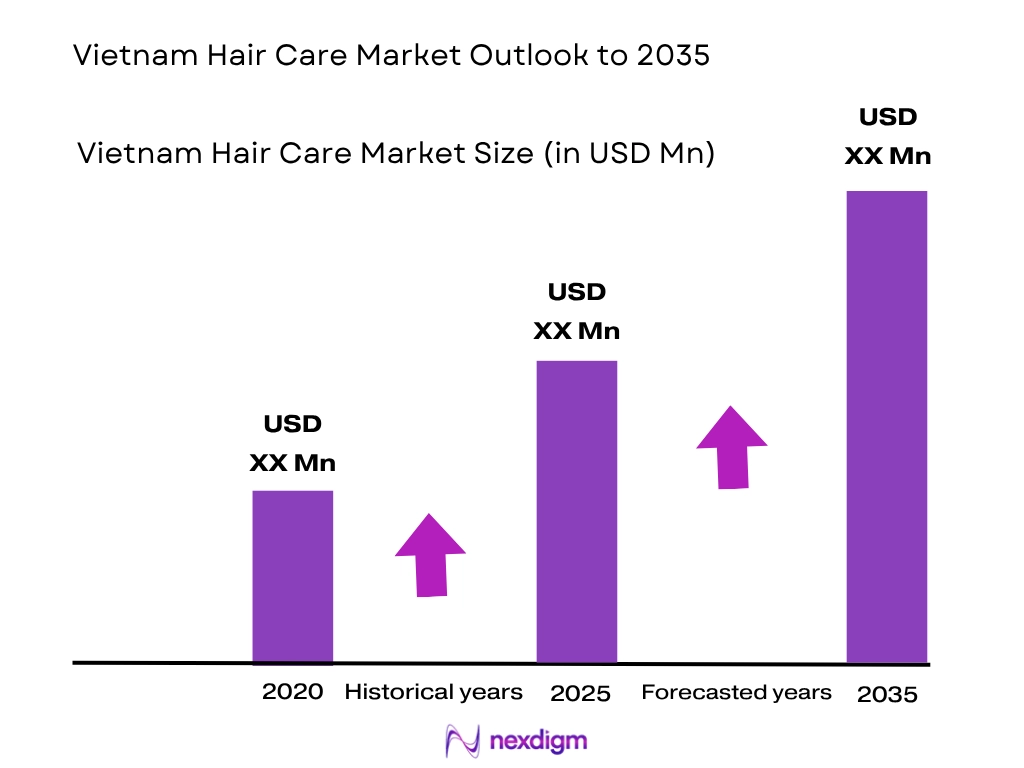
The Vietnam Hair Care Market is valued at USD ~ million, based on Nexdigm’s historical market sizing, and is forecasted to expand at a benchmark CAGR of 4.94% for 2026-2035. The market is driven by customised hair care, anti-dandruff demand, hair fall concerns, natural oils, aloe vera, organic extracts, and wider availability across supermarkets, convenience stores, retailers and online platforms.
Ho Chi Minh City and Hanoi dominate the Vietnam Hair Care Market because they concentrate affluent consumers, beauty salons, modern trade stores, pharmacy chains, e-commerce fulfilment, and brand launches. Vietnam’s GDP reached USD ~ billion, GDP per capita reached USD ~, retail sales of goods and services reached VND ~ quadrillion, and internet users reached 78.44 million, supporting frequent online and offline grooming purchases in these urban hubs.
Market Segmentation
By Product Type
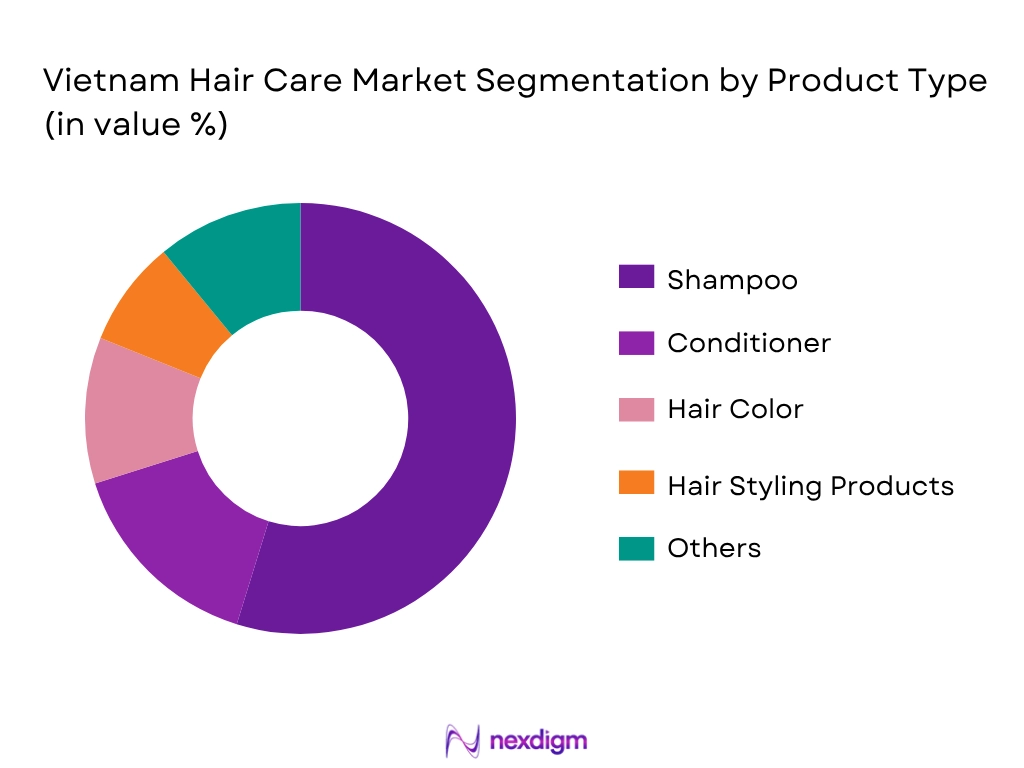
Vietnam Hair Care Market is segmented by product type into shampoo, conditioner, hair color, hair styling products, hair treatment/mask and others. Shampoo has a dominant market share in Vietnam under the product type segmentation due to its daily-use nature, high household penetration, tropical-climate-led frequent washing, and strong brand availability across sachets, small bottles and family packs. Anti-dandruff and cleansing claims are particularly important because consumers deal with oily scalp, humidity, pollution exposure and dry or itchy scalp concerns. The segment is also supported by leading mass brands such as Clear, Head & Shoulders, Sunsilk, Pantene and Dove, which maintain strong distribution in small grocers, supermarkets, health and beauty chains and e-commerce. Nexdigm also identifies shampoo among the core product segments of the Vietnam hair care market.
By Distribution Channel
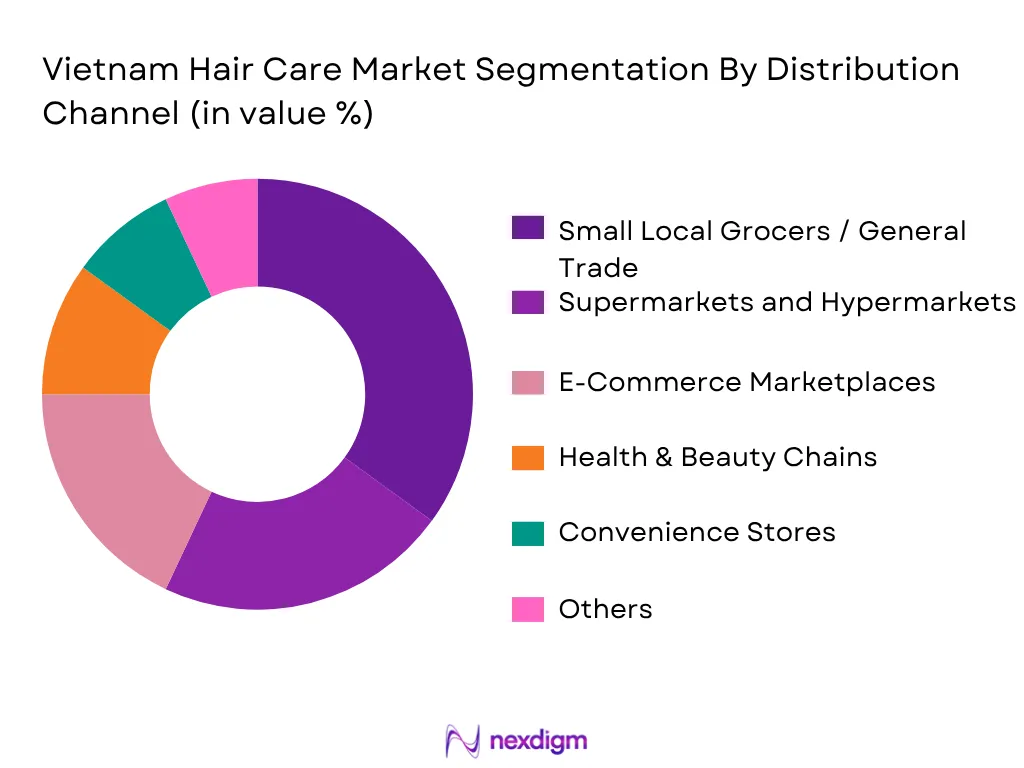
Vietnam Hair Care Market is segmented by distribution channel into small local grocers/general trade, supermarkets and hypermarkets, e-commerce marketplaces, specialty stores/health and beauty chains, convenience stores, pharmacies/drugstores, and salon and professional channels. Small local grocers dominate because hair care is still a high-frequency household purchase, and neighborhood outlets provide immediate access to mass shampoos, sachets and smaller packs near homes and workplaces. However, supermarkets and e-commerce are gaining share as consumers shift toward authentic brands, larger packs, bundled promotions and online discovery. Small local grocers have remained the leading hair care channel, while supermarkets and e-commerce gained share due to modern retail expansion, promotions, TikTok Shop activity and influencer-led selling.
Competitive Landscape
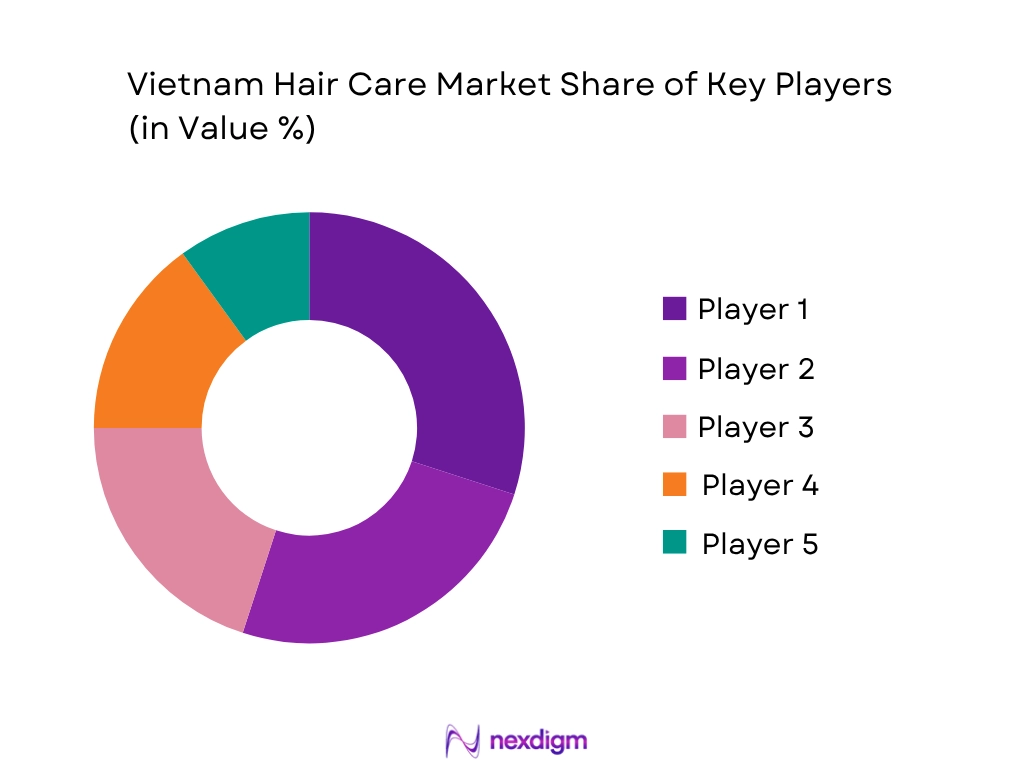
The Vietnam Hair Care Market is led by multinational FMCG companies and reinforced by premium Asian beauty brands, salon-professional players and local herbal manufacturers. P&G and Unilever brands hold a combined 58% share, while Japanese and Korean brands compete in premium hair care and local brands such as Sao Thai Duong and Cocoon compete through herbal, vegan and Vietnamese ingredient positioning. P&G Vietnam has operated in Vietnam since 1995 and has manufacturing facilities in Binh Duong with a general office in Ho Chi Minh City; L’Oréal Vietnam was established in mid-2007 and distributes 13 international brands; Sao Thai Duong was founded in 2000 and is positioned around Vietnamese herbal cosmetics.
| Company | Establishment Year | Headquarters | Vietnam Hair Care Brands | Core Hair Care Focus | Hero Hair Concern | Channel Strength | Price / Pack Positioning | Market-Specific Advantage |
| Unilever Vietnam | 1995 | Ho Chi Minh City | ~ | ~ | ~ | ~ | ~ | ~ |
| Procter & Gamble Vietnam | 1995 | Ho Chi Minh City / Binh Duong operations | ~ | ~ | ~ | ~ | ~ | ~ |
| L’Oréal Vietnam | 2007 | Ho Chi Minh City | ~ | ~ | ~ | ~ | ~ | ~ |
| Shiseido Vietnam | 2010s | Ho Chi Minh City | ~ | ~ | ~ | ~ | ~ | ~ |
| Sao Thai Duong | 2000 | Hanoi | ~ | ~ | ~ | ~ | ~ | ~ |
Vietnam Hair Care Market Analysis
Growth Drivers
Urban Beauty Routine
Vietnam’s urban beauty routine is strengthening hair care demand because grooming purchases are supported by a large consumer base, higher city-led consumption, and expanding formal retail access. Vietnam’s population reached 100,987,686 people, GDP reached USD 476.39 billion, and GDP per capita reached USD 4,717.3, creating a broad consumption base for recurring personal care categories such as shampoo, conditioner, hair treatment and scalp care. Urbanization is directly relevant to the hair care market because modern retail, pharmacy chains, salons, beauty stores and e-commerce delivery are concentrated in Hanoi, Ho Chi Minh City, Da Nang and surrounding urban provinces. World Bank-linked urban population data reported 40,592,000 urban residents, which gives brands a large addressable base for premium hair masks, anti-dandruff shampoos, salon-inspired treatments, men’s shampoo and herbal formulations. Consumer spending capacity is also supported by Vietnam’s retail environment: the National Statistics Office reported total retail sales of goods and consumer service revenue at VND 6,391.0 trillion, reflecting a large domestic consumption platform for fast-moving personal care goods. For hair care companies, this supports store expansion, supermarket listings, pharmacy-led scalp-care placement and online-offline promotions. The average income of employees reached VND 7.7 million per month, which supports repeat purchases of branded shampoos, larger family packs and higher-value conditioner or treatment add-ons. These indicators justify urban beauty routine as a growth driver because the category depends on frequent replenishment, convenient access, household penetration and visible brand trust. Hair care is therefore positioned as a routine-led consumer category rather than an occasional beauty purchase.
Daily Shampoo Usage
Daily shampoo usage is a core growth driver in the Vietnam Hair Care Market because the category is tied to household hygiene, climate-led cleansing needs, workplace grooming and repeated replenishment across mass and premium channels. Vietnam’s population base of 100,987,686 people provides a large national household pool for shampoo consumption, and population growth stood at 0.6 on the World Bank’s annual population growth indicator, supporting incremental consumer additions to daily-use FMCG categories. The relevance of daily shampoo is reinforced by the country’s labor and mobility base: the National Statistics Office reported that the labor force aged 15 and above reached 52.7 million people in the third quarter, indicating a large working population exposed to outdoor commuting, office grooming standards, helmet use, humidity and pollution-related scalp discomfort. Hair cleansing is also supported by national living infrastructure. World Bank data shows Vietnam’s access to electricity at 99.8 people per 100 people, enabling widespread use of modern retail, household appliances, lighting, e-commerce logistics and consumer product storage across urban and rural areas. Internet adoption is another demand enabler: World Bank data reports 84 internet users per 100 people, giving shampoo brands a strong discovery channel through product reviews, KOL content, marketplace search and brand-owned online stores. The shampoo segment benefits because it is the entry product in most hair care routines, while conditioners, masks, oils and serums are often purchased after a consumer establishes brand trust through shampoo. For Vietnam, daily washing behavior is especially relevant because humidity, traffic exposure and dense urban commuting make scalp freshness, fragrance, oil control and anti-dandruff claims important purchase triggers. The macro data supports a large, connected and working consumer base that can sustain high-frequency shampoo replenishment.
Market Challenges
Price Sensitivity
Price sensitivity remains a major challenge in the Vietnam Hair Care Market because hair care is a recurring household purchase and consumers compare brands, pack sizes and promotions across grocery stores, supermarkets and e-commerce platforms. The challenge is not weak consumption; rather, it is the pressure to keep products affordable while maintaining margins, brand equity and distribution depth. Vietnam’s GDP per capita reached USD 4,717.3, placing the market in a developing-consumer context where mass-market shampoo, sachets and small bottles remain essential for household affordability. Average employee income reached VND 7.7 million per month, which supports recurring personal care purchases but still requires brands to balance premium positioning with accessible pack formats and promotional bundles. Inflation also matters for hair care because households can delay conditioners, masks and styling products when food, transport and utilities take priority. World Bank data reports consumer price inflation at 3.6, while the IMF noted inflation around the State Bank of Vietnam’s 4 to 4.5 target range, indicating that purchasing power management remains important for daily-use consumer goods. Retail competition further intensifies this challenge. The National Statistics Office reported retail sales of goods and consumer service revenue of VND 6,391.0 trillion, showing a large retail system where hair care brands compete for shelf space, visibility, bundle promotions and retailer support. In this environment, shampoo brands must offer entry packs, refill formats, economy variants and differentiated claims such as anti-dandruff, herbal, keratin or scalp care without pushing consumers out of the acceptable household basket. Price sensitivity is therefore a structural market constraint because consumers may remain loyal to hair cleansing needs but switch brands quickly when promotions, pack sizes or online deals appear more attractive.
Counterfeit Risk
Counterfeit risk is a material challenge for the Vietnam Hair Care Market because hair care products are distributed through fragmented offline stores, marketplaces, social commerce pages, livestream sellers and cross-border platforms. This affects premium shampoos, salon products, scalp treatments, anti-dandruff products and imported Japanese or Korean hair care brands because consumers often rely on authenticity signals, ratings and seller reputation before purchase. The scale of digital access increases the monitoring burden: World Bank data records 84 internet users per 100 people, making online product discovery and seller proliferation central to beauty and personal care distribution. Vietnam’s total population reached 100,987,686 people, which means counterfeit exposure can affect a large consumer base when products move through uncontrolled digital or informal channels. Enforcement pressure has increased. Vietnam required foreign online retailers Temu and Shein to register with the government by the end of November, with authorities citing concerns around aggressive discounting and the potential sale of counterfeit products. The Ministry of Health and the Drug Administration of Vietnam have also pushed stricter cosmetic compliance, with the Drug Administration urging provincial and municipal health departments to enforce cosmetic regulations more tightly after inspections identified non-compliant cosmetics in the market. VietnamNet reported that the Drug Administration revoked 500 receipt numbers for imported cosmetics due to voluntary withdrawal requests and more than 100 receipt numbers due to violations or errors, showing that cosmetic compliance is an active operating risk for beauty and hair care companies. For legitimate hair care brands, this risk increases investment needs in official stores, QR authentication, distributor control, marketplace enforcement, approved labeling and consumer education. Counterfeit risk therefore weakens trust, affects premium conversion and creates regulatory exposure for importers, distributors and e-commerce sellers.
Opportunities
Scalp Care
Scalp care is a strong future opportunity in the Vietnam Hair Care Market because it shifts consumer spending from basic shampoo toward problem-solution routines covering dandruff, itchy scalp, oily scalp, hair fall, sensitivity and post-chemical treatment care. The opportunity is supported by a large urban and working consumer base. World Bank-linked data reports 40,592,000 urban residents, and Vietnam’s labor force aged 15 and above reached 52.7 million people in the third quarter, giving brands a large base of consumers exposed to commuting, helmet use, air pollution, humidity, salon treatments and regular grooming requirements. The macro backdrop also supports higher-value routines. GDP reached USD 476.39 billion, GDP per capita reached USD 4,717.3, and average employee income reached VND 7.7 million per month, enabling selected consumers in major cities to move from standard shampoo into anti-dandruff shampoos, scalp serums, exfoliating scalp treatments and hair fall control products. The digital infrastructure strengthens this opportunity because scalp care requires education, proof points and reviews. World Bank data records 84 internet users per 100 people, allowing brands to use dermatologist content, ingredient explainers, before-after routines, official marketplace stores and creator-led product demonstrations. Regulatory discipline will also favor compliant brands with credible claims. Vietnam’s cosmetic management framework is aligned with the Ministry of Health and Drug Administration of Vietnam oversight, and enforcement has focused on cosmetic notification, claims and non-compliant products. This creates a pathway for trusted scalp-care brands to differentiate from generic shampoos by emphasizing approved ingredients, official distribution and clear usage routines. Scalp care therefore represents a premiumization opportunity backed by urbanization, income growth, digital education and rising demand for functional personal care.
Men’s Grooming
Men’s grooming is an attractive opportunity in the Vietnam Hair Care Market because men’s shampoo, anti-dandruff, cooling, oil-control and fragrance-led hair care products can expand beyond basic household shampoo. The demographic base is large: World Bank data reports Vietnam’s population at 100,987,686 people, while male population accounted for 48.98 people per 100 people, giving hair care brands a substantial male consumer base for targeted products. Labor force data strengthens the opportunity because male grooming is closely linked to employment, commuting, helmets, workplace appearance and daily hygiene. Vietnam’s labor force aged 15 and over was 52.7 million people in the third quarter, while World Bank gender data reports male labor force participation at 77.3 people per 100 male working-age people for 2025, indicating a large active male consumer cohort with routine grooming needs. Digital adoption provides another route for men’s hair care brands to build awareness through sports, lifestyle, fragrance, confidence and scalp freshness positioning. World Bank data records 84 internet users per 100 people, supporting discovery across e-commerce search, short video platforms, official brand stores and livestream commerce. Income data also supports the move from shared household shampoo to male-specific products. The National Statistics Office reported average employee income of VND 7.7 million per month, while later data showed average employee income of VND 8.3 million per month in the nine-month period of 2025, indicating an improving income base for routine grooming categories. For hair care companies, the opportunity lies in dedicated men’s anti-dandruff shampoos, menthol cooling products, oil-control variants, 2-in-1 shampoo-conditioner formats, sport-fragrance variants and bundles with deodorant or body wash. Men’s grooming is therefore supported by demographics, employment, digital reach and increasing income rather than speculative future estimates.
Future Outlook
The Vietnam Hair Care Market is expected to grow steadily, supported by higher consumer spending on grooming, more advanced scalp-care routines, premium shampoo and conditioner adoption, and broader digital retail access. E-commerce and social commerce will remain important for discovery, especially through Shopee, Lazada, TikTok Shop, livestream selling and creator-led reviews. Premium Japanese, Korean and salon-inspired brands will compete with local herbal brands focused on natural Vietnamese ingredients. The future market will be shaped by anti-dandruff, hair fall, damage repair, scalp detox, herbal formulations, larger packs and salon-to-home treatment kits.
Major Players
- Unilever Vietnam
- Procter & Gamble Vietnam
- Marico / International Consumer Products
- Wipro Consumer Care Vietnam
- L’Oréal Vietnam
- Kao Vietnam
- Shiseido Vietnam
- Amorepacific Vietnam
- LG Household & Health Care Vietnam
- Rohto-Mentholatum Vietnam
- Sao Thai Duong
- Cocoon Vietnam
- Thorakao
- DKSH Vietnam
- Guardian / Watsons exclusive and private-label hair care assortments
Key Target Audience
- Hair care product manufacturers
- FMCG and personal care companies
- Salon professional product companies
- Beauty and health retail chains
- E-commerce marketplaces and social commerce platforms
- Importers, distributors and contract manufacturers
- Investments and venture capitalist firms
- Government and regulatory bodies (Ministry of Health, Drug Administration of Vietnam, Ministry of Industry and Trade, Directorate for Standards, Metrology and Quality)
Research Methodology
Step 1: Identification of Key Variables
The initial phase involves constructing an ecosystem map for the Vietnam Hair Care Market, covering manufacturers, importers, distributors, retailers, salons, pharmacies, e-commerce marketplaces and regulatory agencies. Desk research is used to identify market variables such as product type, price tier, pack size, channel mix, ingredient claims, hair concerns and brand positioning.
Step 2: Market Analysis and Construction
In this phase, historical market data is compiled and analyzed across shampoo, conditioner, hair color, styling, treatment and scalp care categories. The analysis evaluates retail value, channel penetration, SKU pricing, promotional intensity, product availability and the role of online marketplaces in generating incremental demand across urban and provincial markets.
Step 3: Hypothesis Validation and Expert Consultation
Market hypotheses are validated through computer-assisted telephone interviews with distributors, modern trade buyers, beauty chain category managers, salon owners, pharmacy retailers and e-commerce sellers. These discussions help refine assumptions around sell-out velocity, brand switching, price sensitivity, salon product adoption, promotional behavior and premium hair care penetration.
Step 4: Research Synthesis and Final Output
The final phase synthesizes secondary data, primary feedback, SKU benchmarking, channel checks and competitor profiling into a validated market model. Bottom-up analysis from product segments and distribution channels is reconciled with top-down market sizing to provide a structured view of the Vietnam Hair Care Market, competitive intensity and future opportunity zones.

- Executive Summary
- Research Methodology (Market Definitions and Assumptions, Abbreviations, Product Inclusion and Exclusion, Retail Value and Volume Sizing Logic, Top-Down Market Sizing, Bottom-Up SKU and Channel Build-Up, Primary Interviews with Distributors/Modern Trade/E-Commerce Sellers/Salon Operators, Consumer Validation, Price Basket Mapping, Brand Share Triangulation, Import-Local Manufacturing Split, Forecast Assumptions, Limitations and Future Conclusions)

- Definition and Scope
- Market Genesis and Evolution of Hair Care Consumption
- Timeline of Major Hair Care Brands and Category Expansion
- Business Cycle and Seasonality
- Supply Chain and Value Chain Analysis
- Route-to-Market Structure Across GT, MT, Pharmacy, Salon and E-Commerce
- Product Architecture Across Daily Wash, Anti-Dandruff, Hair Fall, Damage Repair, Herbal and Premium Care
- Consumer Hair-Washing Behaviour and Hair Concern Landscape
- Urban-Rural Adoption Gap in Advanced Hair Care Products
- Vietnam Hair Care Market Ecosystem Map

- Growth Drivers (Urban Beauty Routine, Daily Shampoo Usage, Anti-Dandruff Demand, Hair Fall Anxiety, Premium Asian Beauty Influence, E-Commerce Penetration, Social Commerce Discovery, Rising Disposable Income)
- Market Challenges (Price Sensitivity, Counterfeit Risk, Promotional Dependence, Rural Adoption Gap, Ingredient Claim Scrutiny, Import Notification Compliance, Channel Conflict, Margin Pressure)
- Opportunities (Scalp Care, Men’s Grooming, Gen Z Hair Color, Herbal Premiumization, Salon Retail, Refill Packs, Livestream Commerce, Dermatological Hair Care)
- Trends (Natural Ingredients, Premium Asian Brands, K-Beauty/J-Beauty Influence, Large Family Packs, Sachet Trials, Micellar Scalp Detox, Keratin Smooth, Dermatological Anti-Dandruff, Sustainable Packaging)
- Government Regulation (MOH, DAV, ASEAN Cosmetic Directive, Cosmetic Product Notification, PIF, Labeling, Claims Substantiation, Importer Responsibility, Post-Market Surveillance)
- SWOT Analysis (Mass Brand Strength, Premium White Space, Local Herbal Differentiation, E-Commerce Disruption, Price-Based Competition, Compliance Risk)
- Stakeholder Ecosystem (Brand Owners, Importers, Local Manufacturers, FMCG Distributors, Modern Trade Retailers, Pharmacies, Salons, Marketplaces, KOLs/KOCs, Regulators)
- Porter’s Five Forces (Supplier Power, Buyer Power, Competitive Rivalry, Threat of Substitutes, Threat of New Entrants; By Channel and Price Tier)
- PESTLE Analysis (Cosmetic Regulation, Disposable Income, Beauty Consciousness, Marketplace Technology, Ingredient Sustainability, Labeling Law)
- Pricing and Promotion Analysis (Sachet Pricing, Bottle Pricing, Combo Bundles, Flash Sales, Livestream Discounts, Retailer Margins, Price per ml/g)
- Import and Local Manufacturing Analysis (Imported Premium Brands, Local Herbal Manufacturing, Contract Manufacturing, Distributor-Led Imports, Parallel Trade Risk)
- Route-to-Market Analysis (GT Coverage, MT Listing, Pharmacy Placement, Salon Education, Marketplace Flagship, Social Commerce Affiliate Model)
- Consumer Decision Journey (Awareness, Hair Concern Diagnosis, Ingredient Search, Trial Pack, Review Validation, Bundle Purchase, Repeat Purchase)

- By Value (2020-2025)
- By Volume (2020-2025)
- By Average Selling Price (2020-2025)
- By Retail Value Versus Professional/Salon Value (2020-2025)
- By Offline Versus Online Sales Contribution (2020-2025)

- By Product Type (In Value%)
Shampoo
Conditioner
Hair Treatment/Mask
Hair Oil/Serum
Hair Colorant
Hair Styling Products
Scalp Care Products - By Hair Concern (In Value%)
Anti-Dandruff/Itchy Scalp
Hair Fall Control
Damage Repair
Smoothening/Frizz Control
Moisture and Dryness Care
Oil Control and Deep Clean
Color Protection
Scalp Detox and Sensitivity Care - By Ingredient/Claim (In Value%)
Herbal/Botanical
Keratin-Infused
Biotin/Protein-Based
Anti-Dandruff Actives
Silicone-Free/Sulfate-Free
Natural/Organic Positioning
Premium Asian Beauty Formulations
Dermatological/Medicated Positioning - By Consumer Group (In Value%)
Women
Men
Unisex/Family
Teen and Gen Z Consumers
Children/Kids
Salon Users
Urban Premium Consumers
Price-Sensitive Mass Consumers - By Price Tier (In Value%)
Economy Sachet and Small Pack
Mass-Market Bottle
Masstige
Premium
Salon Professional
Dermocosmetic/Medicated - By Distribution Channel (In Value%)
General Trade/Grocery Stores
Supermarkets and Hypermarkets
Health and Beauty Chains
Pharmacies/Drugstores
Salon and Professional Channel
E-Commerce Marketplaces
Social Commerce and Livestream Commerce
Brand-Owned Online Stores - By Region (In Value%)
Northern Vietnam
Southern Vietnam
Central Vietnam
Hanoi
Ho Chi Minh City
Tier-2 and Tier-3 Urban Provinces
Rural Vietnam - By Packaging Format (In Value%)
Sachets
Small Bottles
Mid-Size Bottles
Large Family Packs
Pump Bottles
Tubes
Jars/Tubs
Refill Packs - By Purchase Occasion (In Value%)
Daily Hair Wash
Anti-Dandruff Treatment
Post-Color/Post-Chemical Treatment
Salon Maintenance
Gifting/Beauty Sets
Travel and Trial Purchase
Promotional Basket Purchase - By Sales Model (In Value%)
Distributor-Led FMCG Sales
Direct Modern Trade Sales
Marketplace Flagship Store
Cross-Border E-Commerce
Salon Distributor Sales
Pharmacy-Led Dermocosmetic Sales

- Market Share of Major Players (Retail Value Share, Volume Share, Shampoo Share, Conditioner Share, Anti-Dandruff Share, Men’s Hair Care Share, E-Commerce Share)
- Market Share by Product Type (Shampoo, Conditioner, Treatment, Oil/Serum, Colorant, Styling, Scalp Care)
- Market Share by Price Tier (Economy, Mass, Masstige, Premium, Salon Professional, Dermocosmetic)
- Market Share by Channel (General Trade, Modern Trade, Health and Beauty Chain, Pharmacy, Salon, Marketplace, Social Commerce)
- Cross Comparison Parameters (Company Overview, Parent Company, Brand Portfolio, Hero SKUs, Hair Concern Focus, Ingredient/Claim Focus, Price Tier, Price per ml/g, Pack-Size Architecture, Sachet Availability, E-Commerce Flagship Presence, Offline Distribution Reach, Salon/Professional Channel Presence, Health and Beauty Chain Presence, Regulatory/Notification Readiness, Promotional Intensity, KOL/KOC Strategy, Livestream Commerce Activity, Strengths, Weaknesses, Recent Developments, Unique Value Proposition)
- SWOT Analysis of Major Players (Unilever, P&G, Marico, Wipro Consumer Care, L’Oréal, Kao, Shiseido, LG H&H, Amorepacific, Rohto, Sao Thai Duong, Cocoon, Thorakao, DKSH, Local Herbal Challengers)
- Pricing Analysis Basis SKUs for Major Players (Sachet, 150ml–200ml, 300ml–370ml, 500ml–650ml, 850ml–900ml, Conditioner Tube, Hair Mask Jar, Serum/Oil Bottle, Combo Pack)
- Product Basket and SKU Benchmarking (Anti-Dandruff Shampoo, Smoothening Shampoo, Hair Fall Shampoo, Keratin Conditioner, Damage Repair Mask, Herbal Shampoo, Men’s Cooling Shampoo, Scalp Treatment Serum)
- Distribution Benchmarking (GT Numeric Distribution, MT Listing Depth, Guardian/Watsons Presence, Pharmacy Placement, Salon Distributor Network, Marketplace Official Store, TikTok Affiliate Network)
- Marketing and Digital Visibility Benchmarking (KOL Activation, KOC Reviews, Livestream Frequency, Search Ranking, Ratings and Reviews, Bundle Strategy, Voucher Strategy)
- Detailed Profiles of Major Companies
Unilever Vietnam
Procter & Gamble Vietnam
Marico/International Consumer Products
Wipro Consumer Care Vietnam
L’Oréal Vietnam
Kao Vietnam
Shiseido Vietnam
Amorepacific Vietnam
LG Household & Health Care Vietnam
Rohto-Mentholatum Vietnam
Sao Thai Duong
Cocoon Vietnam
Thorakao
DKSH Vietnam
Guardian/Watsons Private and Exclusive Hair Care Assortment

- Market Demand and Utilization (Wash Frequency, Conditioner Usage, Treatment Frequency, Family Pack Consumption, Salon Maintenance Usage)
- Purchasing Power and Budget Allocation (Monthly Hair Care Spend, Price per Bottle, Promo Sensitivity, Premium Upgrade Readiness)
- Needs, Desires and Pain Point Analysis (Dandruff, Hair Fall, Oily Scalp, Dry Ends, Heat Damage, Chemical Damage, Frizz, Sensitive Scalp)
- Decision-Making Process (Brand Trust, Efficacy Claim, Ingredient Preference, Price, KOL Review, Platform Rating, Salon Recommendation)
- Consumer Cohort Analysis (Gen Z, Millennial Women, Male Grooming Buyers, Family Household Buyers, Salon-Treated Hair Consumers, Rural Mass Consumers)
- Channel Preference Analysis (Grocery Convenience, Supermarket Stock-Up, Guardian/Watsons Discovery, Pharmacy Trust, Shopee/Lazada Value, TikTok Shop Influence)
- Brand Switching and Loyalty Analysis (Promotion-Led Switching, Anti-Dandruff Loyalty, Herbal Trial, Premium Retention, Bundle Repurchase)

- By Value (2026-2035)
- By Volume (2026-2035)
- By Average Selling Price (2026-2035)
- By Retail Versus Professional/Salon Value (2026-2035)
- By Offline Versus Online Sales Contribution (2026-2035)


 Request a Sample
 Ask for Customization
 Get a Quote
 Enquire Now