

 Download PDF
Market Overview
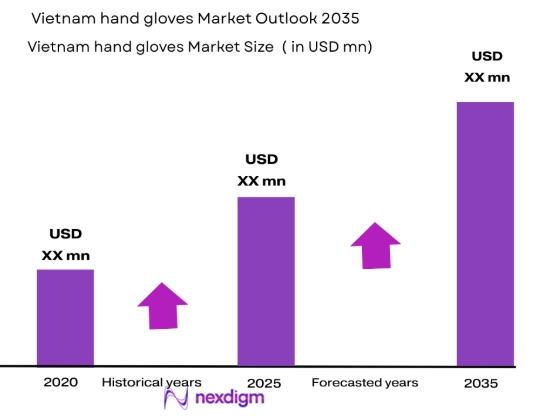
The Vietnam hand gloves market is valued at approximately USD ~ million in 2024, based on aggregated industrial safety equipment and medical consumables data from international trade statistics and Vietnam’s manufacturing output reports. The market is driven by strong healthcare utilization, industrial expansion, and export-oriented production. Increasing hospital visits, industrial labor force exceeding 17 million, and rising hygiene standards further contribute to sustained glove consumption across end-use industries.
Vietnam’s hand gloves market is concentrated in southern and northern industrial hubs such as Ho Chi Minh City, Binh Duong, Dong Nai, Hanoi, and Hai Phong due to dense manufacturing clusters and export processing zones. These regions host large-scale electronics, textile, and food processing factories that require continuous use of protective gloves. Additionally, Vietnam’s integration into global supply chains, supported by trade agreements like CPTPP and EVFTA, strengthens export-driven glove manufacturing, while proximity to major rubber-producing countries ensures stable raw material sourcing for glove production.
Market Segmentation
By Product Type
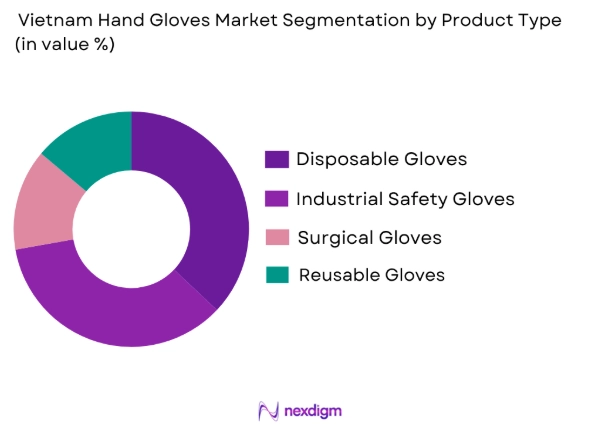
Vietnam hand gloves market is segmented by product type into disposable gloves, reusable gloves, surgical gloves, and industrial safety gloves. Disposable gloves dominate the market due to their widespread usage in healthcare, food processing, and export-oriented manufacturing industries. Hospitals, diagnostic labs, and food handling facilities require single-use gloves for hygiene compliance, especially with increasing infection control standards. Vietnam’s healthcare system includes over 13,000 public and private health facilities, creating continuous demand for disposable gloves. Additionally, export industries such as seafood processing and electronics manufacturing require contamination-free environments, further strengthening disposable glove consumption. The growing awareness of hygiene practices among industrial workers and regulatory compliance for food safety also reinforces the dominance of disposable gloves over reusable alternatives.
By End User
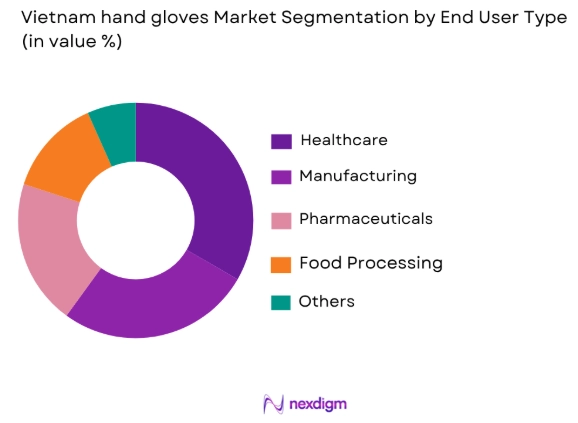
Vietnam hand gloves market is segmented by end user into healthcare, manufacturing, food processing, pharmaceuticals, and others. Manufacturing dominates the market due to Vietnam’s strong industrial base and export-driven economy. The country hosts over 400 industrial parks and more than 37,000 manufacturing enterprises, requiring gloves for worker safety and compliance with occupational standards. Industries such as electronics assembly, textiles, footwear, and automotive components demand gloves for protection against chemicals, cuts, and contamination. Additionally, Vietnam’s position as a global manufacturing hub increases glove consumption in export-oriented industries. While healthcare remains a significant segment due to hospital demand, manufacturing leads due to continuous industrial operations and workforce safety requirements across multiple sectors.
Competitive Landscape
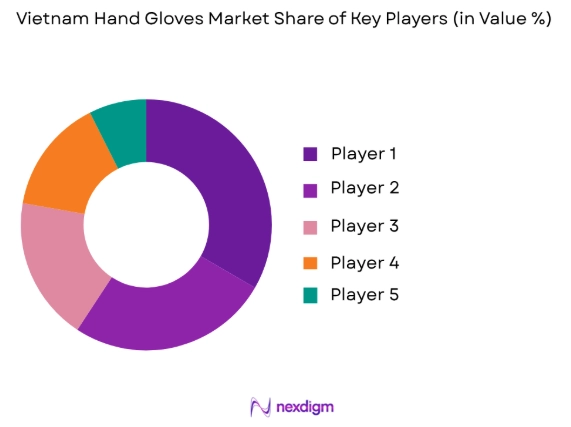
The Vietnam hand gloves market is moderately competitive, with a mix of domestic manufacturers and international suppliers. Local companies leverage cost-effective production and proximity to raw materials, while global players bring advanced technology and strong export networks. The presence of foreign direct investment in Vietnam’s manufacturing sector further intensifies competition, as multinational companies establish production facilities or sourcing partnerships in the country.
| Company | Establishment Year | Headquarters | Product Focus | Production Capacity | Distribution Network | Key End Users | Export Presence | Competitive Advantage |
| Top Glove Vietnam | 1991 | Malaysia | ~ | ~ | ~ | ~ | ~ | ~ |
| VRG Khai Hoan | 2009 | Vietnam | ~ | ~ | ~ | ~ | ~ | ~ |
| Nam Viet Gloves | 2015 | Vietnam | ~ | ~ | ~ | ~ | ~ | ~ |
| Ansell Vietnam | 1893 | Australia | ~ | ~ | ~ | ~ | ~ | ~ |
| Sri Trang Vietnam | 1987 | Thailand | ~ | ~ | ~ | ~ | ~ | ~ |
Vietnam Hand Gloves Market Analysis
Growth Drivers
Rising Healthcare Infrastructure and Medical Consumables Demand
Vietnam hand gloves demand is supported by the healthcare network’s recurring need for surgical, examination, and hygiene consumables. WHO states Vietnam has 47 central public hospitals, 419 provincial public hospitals, 684 district public hospitals, and 182 private hospitals, creating steady glove use across inpatient, outpatient, emergency, and diagnostic settings. World Bank reports Vietnam’s GDP at USD 476.39 billion and GDP per capita at USD 4,717.3, indicating broader healthcare affordability and institutional procurement capacity. World Bank health data also reports current health expenditure per capita at USD 188.9, supporting medical consumables demand.
Expansion of Industrial Manufacturing and Export-Oriented Production
Vietnam hand gloves demand is strongly linked to manufacturing, food processing, electronics, garments, footwear, rubber products, and export logistics, where workers need disposable and industrial safety gloves. Vietnam’s merchandise exports reached USD 405.53 billion, imports reached USD 380.76 billion, and trade surplus reached USD 24.77 billion, showing the scale of goods movement requiring factory safety and contamination-control practices. World Bank reports Vietnam’s GDP at USD 476.39 billion, while GSO-cited data shows implemented FDI reached USD 25.35 billion, supporting industrial production zones and export manufacturing.
Market Challenges
Volatility in Latex and Nitrile Raw Material Supply
Vietnam hand gloves producers face raw material risk because latex-based gloves depend on natural rubber availability, while nitrile gloves depend on synthetic rubber inputs. Vietnam exported 2 million tonnes of rubber worth USD 3.4 billion, while rubber export volume declined by 6, showing supply movement pressure despite higher value realization. Vietnam also exported 414,317 tonnes of rubber in Q1, generating more than USD 607 million, according to the General Department of Customs. For glove manufacturers, this creates procurement uncertainty when rubber is diverted to export markets and industrial buyers require stable glove availability.
Dependence on Export Demand and International Buyers
Vietnam hand gloves market is exposed to international demand because the country’s industrial ecosystem is heavily export-oriented. Vietnam’s exports reached USD 405.53 billion and imports reached USD 380.76 billion, while the United States alone imported USD 136.5 billion of Vietnamese goods, showing reliance on external buyers. This matters for glove demand because factories serving electronics, apparel, seafood, furniture, and rubber-product exports use gloves for hygiene, handling, and worker protection. Any disruption in global orders affects production shifts, labor deployment, and procurement of industrial consumables such as gloves.
Opportunities
Expansion of Glove Exports
Vietnam hand gloves exporters have room to expand because the country already operates inside a large export economy with established customs, port, and industrial-zone infrastructure. World Bank-linked trade data reports merchandise exports of USD 405.935 billion, while GSO-cited data reports import-export turnover of USD 786.3 billion, indicating strong cross-border logistics capacity. For glove producers, this supports future shipments to healthcare, food processing, cleaning, and industrial safety buyers abroad. Vietnam’s rubber export base also supports downstream glove manufacturing, with rubber exports reaching 2 million tonnes and USD 3.4 billion.
Increasing Demand for Nitrile and Non-Latex Gloves
Vietnam hand gloves market has an opportunity in nitrile and non-latex gloves because healthcare, electronics, laboratories, food processing, and chemical users require alternatives to latex for allergy reduction, chemical resistance, and clean handling. World Bank WITS data shows exporters shipped 2,537,610 kg of surgical gloves from Thailand to Vietnam, 890,022 kg from Malaysia, and 81,886 kg from China, confirming import dependence in medical glove supply. Vietnam’s GDP reached USD 476.39 billion and GDP per capita reached USD 4,717.3, supporting consumption of higher-specification protective products across institutional and industrial users.
Future Outlook
Over the next five years, the Vietnam hand gloves market is expected to witness steady growth driven by industrial expansion, rising healthcare demand, and increasing hygiene awareness. The country’s strong manufacturing base, supported by export growth and foreign investment, will continue to drive demand for industrial safety gloves. Additionally, the expansion of healthcare infrastructure and food processing industries will sustain demand for disposable gloves.Vietnam’s strategic location and participation in global trade agreements will enhance export opportunities for glove manufacturers. Increasing adoption of nitrile and non-latex gloves, along with advancements in glove manufacturing technology, will further support market growth. The shift toward higher safety standards and compliance in workplaces will also contribute to long-term demand across industries.
Major Players
- Top Glove
- VRG Khai Hoan Corporation
- Nam Viet Gloves
- Viet Glove Corporation
- Merufa Joint Stock Company
- Showa Gloves
- Sri Trang Gloves
- Intco Medical
- Hartalega
- Supermax
- Kossan
- Ansell
- Kimberly-Clark
- Blue Sail Medical
- Dipped Products
Key Target Audience
- Healthcare providers and hospital procurement departments
- Manufacturing and industrial companies
- Food processing and export companies
- Pharmaceutical manufacturers
- Retail and wholesale distributors
- Investments and venture capitalist firms
- Government and regulatory bodies
- Occupational safety and compliance organizations
Research Methodology
Step 1: Identification of Key Variables
The initial phase involves mapping stakeholders in the Vietnam hand gloves market including manufacturers, distributors, healthcare providers, and industrial users. Secondary data sources such as government publications, trade statistics, and industry databases are used to identify critical variables influencing demand and supply dynamics.
Step 2: Market Analysis and Construction
Historical data is analyzed to understand consumption patterns, industrial output, and healthcare utilization. The study evaluates glove usage across sectors, production trends, and trade flows to construct a comprehensive market model.
Step 3: Hypothesis Validation and Expert Consultation
Industry experts, including manufacturers, distributors, and procurement managers, are consulted to validate assumptions. These interactions provide insights into operational challenges, pricing strategies, and demand trends.
Step 4: Research Synthesis and Final Output
The final phase integrates primary and secondary research findings to deliver a validated market assessment. Data triangulation ensures accuracy and reliability of market estimates and forecasts.

- Executive Summary
- Research Methodology (Market Definitions and Assumptions, Abbreviations, Market Sizing Approach, Consolidated Research Approach, Understanding Market Potential Through In-Depth Industry Interviews, Primary Research Approach, Limitations and Future Conclusions)

- Definition and Scope
- Market Dynamics Overview
- Market Genesis
- Major Players and Market Timeline
- Business Cycle and Trends
- Supply Chain and Value Chain Analysis

- Growth Drivers
Rising Healthcare Infrastructure and Medical Consumables Demand
Expansion of Industrial Manufacturing and Export-Oriented Production
Increasing Focus on Workplace Safety and Hygiene
Growth of Food Processing and Pharmaceutical Industries - Market Challenges
High Competition and Price Sensitivity
Volatility in Latex and Nitrile Raw Material Supply
Regulatory and Quality Compliance Barriers
Dependence on Export Demand and International Buyers - Opportunities
Expansion of Glove Exports
Increasing Demand for Nitrile and Non-Latex Gloves
Growth in Domestic Healthcare Consumption
Adoption of Sustainable and Biodegradable Gloves
- Key Trends
Shift toward nitrile and synthetic gloves
Rising demand for disposable single use gloves
Growth in industrial safety glove applications
Increasing focus on eco friendly gloves
Innovation in high durability glove products - Government Regulations
- SWOT Analysis
- Porter’s Five Forces

- By Value, 2020–2025
- By Volume, 2020–2025
- By Average Price, 2020–2025

- By Product (In Value %)
Disposable Gloves
Reusable Gloves
Surgical Gloves
Industrial Safety Gloves
- By End User (In Value %)
Manufacturing
Healthcare
Food Processing
Pharmaceuticals
Others - By Material (In Value %)
Latex
Nitrile
Vinyl
Neoprene
Polyethylene - By Application (In Value %)
Healthcare
Industrial Manufacturing
Food Processing
Household and Cleaning
Pharmaceutical and Laboratory Use - By Distribution Channel (In Value %)
Direct Sales
Distributors and Wholesalers
Retail Stores
Online Channels - By Region (In Value %)
Northern Vietnam
Central Vietnam
Southern Vietnam
Mekong Delta

- Market Share of Major Players by Value/Volume
- Market Share of Major Players by Product Type
- Cross Comparison Parameters(Company Overview, Business Strategies, Recent Developments, Strength, Weakness, Organizational Structure, Revenues, Revenues by Product Type, Number of Touchpoints, Distribution Channels, Number of Dealers and Distributors, Margins, Production Plant, Capacity, Unique Value Offering and Others)
- SWOT Analysis of Major Players
- Pricing Analysis Based on Product Categories for Major Players
- Detailed Profiles of Major Companies
Top Glove
VRG Khai Hoan Corporation
Nam Viet Gloves
Viet Glove Corporation
Merufa Joint Stock Company
Showa Gloves
Sri Trang Gloves
Intco Medical
Hartalega
Supermax
Kossan
Ansell
Kimberly-Clark
Blue Sail Medical
Dipped Products

- Market Demand and Utilization
- Purchasing Power and Budget Allocations
- Regulatory and Compliance Requirements
- Needs, Desires, and Pain Point Analysis
- Decision-Making Process

- By Value, 2026–2035
- By Volume, 2026–2035
- By Average Price, 2026–2035


 Request a Sample
 Ask for Customization
 Get a Quote
 Enquire Now