

 Download PDF
Market Overview
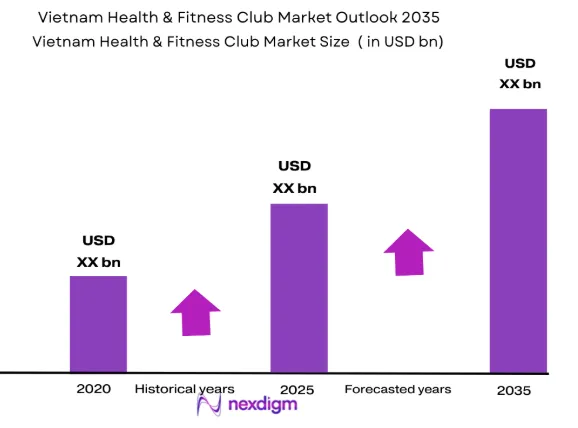
The Vietnam Health & Fitness Club Market is assessed through the broader fitness industry, which was publicly reported at USD ~ billion in a recent historical assessment, supported by rising club penetration, gym and studio expansion, higher wellness spending, and wider use of digital fitness applications. Demand is being driven by urban consumers seeking structured exercise, personal training, group classes, weight management, and lifestyle-oriented wellness services.
Ho Chi Minh City and Hanoi dominate the Vietnam Health & Fitness Club Market because they combine large urban populations, higher income concentration, expatriate communities, dense commercial real estate, and stronger adoption of premium fitness memberships. Da Nang, Hai Phong, and Can Tho are developing secondary markets, supported by tourism, residential development, and growing middle-class demand. Public sources also identify Hanoi and Ho Chi Minh City as the leading demand centers for health and fitness services.
Market Segmentation
By Club Type
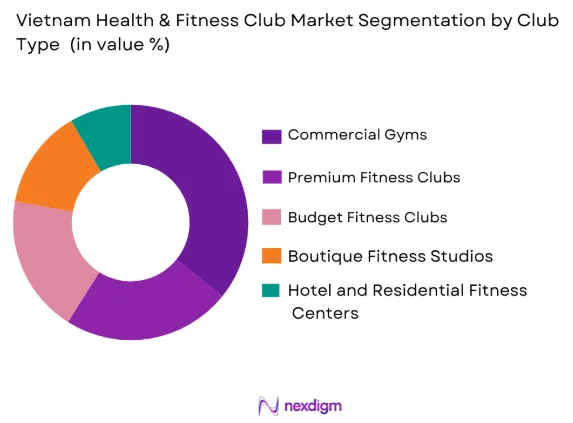
Vietnam Health & Fitness Club Market is segmented by club type into commercial gyms, premium fitness clubs, budget fitness clubs, boutique fitness studios, hotel and residential fitness centers, and corporate fitness centers. Recently, commercial gyms have a dominant market share due to their broader affordability, wider outlet availability, flexible membership options, and appeal to both first-time and regular fitness users. Commercial gyms also benefit from standard equipment-based formats, which allow operators to serve large member bases without relying heavily on specialist programming. Their ability to combine strength training, cardio, personal training, and basic group classes makes them attractive to urban consumers seeking convenience. Premium clubs remain influential in Ho Chi Minh City and Hanoi, while boutique studios are gaining traction among younger consumers interested in yoga, Pilates, boxing, HIIT, and community-led fitness experiences.
By Revenue Stream
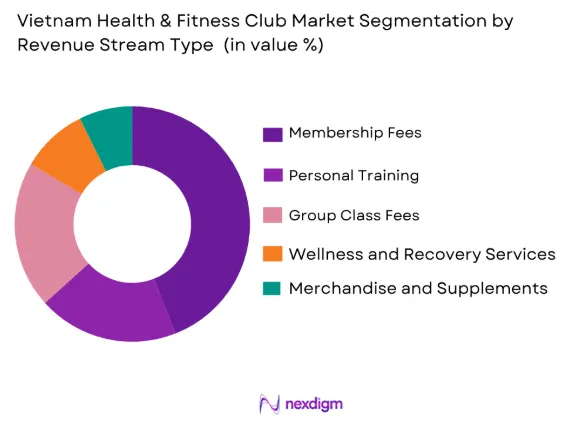
Vietnam Health & Fitness Club Market is segmented by revenue stream into membership fees, personal training fees, group class fees, wellness and recovery services, merchandise and supplements, and corporate wellness programs. Recently, membership fees have a dominant market share because recurring subscription income remains the core commercial model for most clubs, especially organized chains and multi-location operators. Monthly, quarterly, and annual memberships create predictable cash flow, support facility investment, and allow clubs to spread fixed costs across a large customer base. Personal training is growing quickly, particularly among premium members and consumers focused on weight loss or body transformation, but it remains an add-on rather than the base revenue source. Group classes strengthen retention, while wellness services and corporate programs are still developing as operators reposition from gym-only facilities toward broader lifestyle and preventive-health platforms.
Competitive Landscape
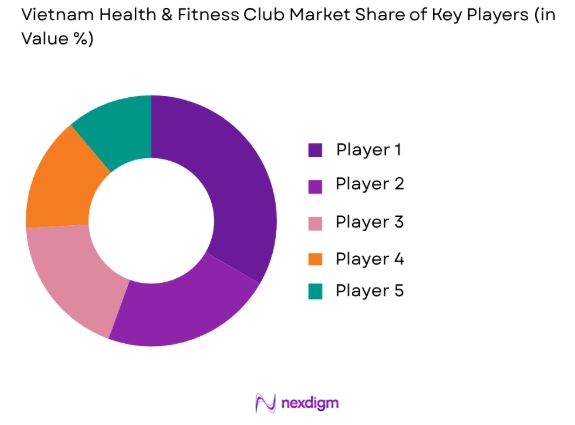
The Vietnam Health & Fitness Club Market remains fragmented overall, but organized fitness services are more concentrated around leading brands with strong urban visibility, premium facilities, trainer networks, and multi-format offerings. California Fitness & Yoga Centers, Elite Fitness, Fit24, Citigym, and UFC Gym Vietnam are among the visible organized players, while local independent gyms continue to compete on price and proximity. Public industry references identify California Fitness & Yoga Centers, Elite Fitness, and Fit24 as key organized fitness operators in Vietnam.
| Company Name | Establishment Year | Headquarters | Technology Focus | Market Reach | Key Products | Revenue | Club Network / Positioning |
| California Fitness & Yoga Centers | 2007 | Ho Chi Minh City, Vietnam | ~ | ~ | ~ | ~ | ~ |
| Elite Fitness | 2010 | Hanoi, Vietnam | ~ | ~ | ~ | ~ | ~ |
| Fit24 | 2012 | Ho Chi Minh City, Vietnam | ~ | ~ | ~ | ~ | ~ |
| Citigym | 2018 | Ho Chi Minh City, Vietnam | ~ | ~ | ~ | ~ | ~ |
| UFC Gym Vietnam | 2017 | Ho Chi Minh City, Vietnam | ~ | ~ | ~ | ~ | ~ |
Vietnam Health & Fitness Club Market Analysis
Growth Drivers
Rising Health and Fitness Awareness Among Urban Consumers
Rising health and fitness awareness among urban consumers is a major growth driver for the Vietnam Health & Fitness Club Market. Consumers in Ho Chi Minh City, Hanoi, Da Nang, and other urban centers are increasingly adopting gym memberships, yoga classes, strength training, and wellness routines as part of daily lifestyle management. Growing concerns around obesity, stress, sedentary office work, and preventive healthcare are encouraging individuals to join structured fitness facilities. Social media, fitness influencers, and corporate wellness campaigns are also shaping consumer behavior. This trend supports demand for commercial gyms, boutique studios, personal training services, and hybrid fitness memberships.
Expansion of Premium and Budget Fitness Chains
Expansion of premium and budget fitness chains is supporting wider access to the Vietnam Health & Fitness Club Market. Premium clubs attract urban professionals and high-income consumers through modern equipment, personal trainers, group classes, spa facilities, and lifestyle-focused services. At the same time, budget gyms are expanding access for students, young workers, and price-sensitive consumers seeking affordable fitness options. This dual-format growth allows operators to serve different income groups and city locations. Chain-based operators also benefit from stronger branding, standardized service quality, digital membership systems, and multi-location convenience, helping organized fitness services gain visibility across Vietnam.
Market Challenges
High Rental and Operating Costs in Urban Areas
High rental and operating costs in urban areas remain a key challenge for the Vietnam Health & Fitness Club Market. Fitness clubs require large spaces, modern equipment, air conditioning, changing rooms, showers, trainers, cleaning staff, front-desk teams, and continuous maintenance. Prime locations in Ho Chi Minh City and Hanoi offer strong customer access but also involve high lease expenses. These costs increase pressure on operators to maintain high membership volumes and strong renewal rates. Smaller gyms face difficulty matching premium facilities, while larger chains must balance facility quality with profitability, especially when consumers remain sensitive to membership pricing.
Competition from Home Workouts and Digital Fitness Platforms
Competition from home workouts and digital fitness platforms is creating pressure on the Vietnam Health & Fitness Club Market. Many consumers now access workout videos, fitness apps, livestream classes, wearable-linked programs, and social media training content from home. These alternatives are convenient, low-cost, and flexible for users with busy schedules or limited budgets. Beginner-level cardio, yoga, stretching, bodyweight training, and general wellness routines can often be performed without visiting a gym. This reduces the urgency to maintain physical club memberships. Fitness clubs must therefore differentiate through trainer supervision, advanced equipment, community experience, progress tracking, and specialized in-person programs.
Opportunities
Expansion into Tier-2 and Tier-3 Cities
Expansion into tier-2 and tier-3 cities presents a strong opportunity for the Vietnam Health & Fitness Club Market. While Ho Chi Minh City and Hanoi remain the leading fitness hubs, cities such as Da Nang, Hai Phong, Can Tho, Nha Trang, and Binh Duong are witnessing rising urbanization, residential development, tourism activity, and middle-class consumption. These markets are less saturated than major metropolitan areas, allowing operators to build early brand loyalty. Smaller club formats, mid-range gyms, residential fitness centers, and compact boutique studios can suit local demand. This expansion can widen membership access and support long-term organized fitness growth.
Integration of Wearables, Fitness Apps, and Digital Platforms
Integration of wearables, fitness apps, and digital platforms offers a major opportunity for the Vietnam Health & Fitness Club Market. Clubs can use digital tools for class booking, attendance tracking, workout planning, payment management, nutrition guidance, and trainer-member communication. Wearables and fitness apps can help members monitor calories, heart rate, steps, sleep, and progress, making fitness outcomes more measurable. Hybrid models combining in-club training with online coaching can improve engagement beyond the gym floor. For operators, digital platforms support retention, personalization, corporate wellness reporting, and targeted promotions, helping clubs compete more effectively with home fitness alternatives.
Future Outlook
The Vietnam Health & Fitness Club Market is expected to progress from an urban gym-led industry into a broader wellness and lifestyle services market.Growth will likely be supported by rising disposable income, urban housing development, corporate wellness adoption, and consumer interest in preventive health.Technology will become more important through app-based memberships, digital coaching, wearable integration, and data-led retention programs.Regulatory and public-policy support for physical activity should strengthen the long-term demand environment, while operators will need to manage rental costs, trainer quality, and churn.
Major Players
- California Fitness & Yoga Centers
- Elite Fitness
- Fit24
- Citigym
- City Gym
- Star Fitness
- Diamond Fitness Center
- NShape Fitness
- GetFit Gym & Yoga
- LIVWELL
- 25 FIT
- UFC Gym Vietnam
- Yoga Plus
- HD Fitness Center
- Curves Vietnam
Key Target Audience
- Health and fitness club operators
- Gym and boutique studio owners
- Investments and venture capitalist firms
- Government and regulatory bodies
- Real estate developers and mall operators
- Fitness equipment manufacturers and distributors
- Corporate wellness program buyers
- Healthcare, insurance, and wellness service providers
Research Methodology
Step 1: Identification of Key Variables
- The study begins by identifying market variables such as club type, membership model, revenue stream, pricing, city-level demand, target consumer group, and operator format.
- Public data, company information, industry publications, government policy references, and macroeconomic indicators are reviewed to define the market boundary.
- Variables are screened for relevance to commercial gyms, premium clubs, boutique studios, and wellness-oriented fitness services.
Step 2: Market Analysis and Construction
- Market construction is conducted through top-down and bottom-up logic, combining published industry values, urban demand indicators, operator presence, and service revenue assumptions.
- Club-level revenue behavior is assessed through membership fees, personal training, group classes, wellness services, and corporate programs.
- Segmentation is developed by comparing demand concentration, consumer affordability, format penetration, and channel maturity across Vietnam’s leading cities.
Step 3: Hypothesis Validation and Expert Consultation
- Preliminary findings are validated through comparison with public market references, company positioning, industry commentary, and observed competitive activity.
- Where company-level revenue or exact segment values are not publicly disclosed, findings are treated as directional market intelligence rather than audited financial disclosure.
- Expert consultation would typically include club managers, equipment suppliers, trainers, landlords, wellness brands, and corporate wellness buyers.
Step 4: Research Synthesis and Final Output
- The final output integrates market size, competitive structure, segmentation, drivers, challenges, opportunities, and future outlook into a structured executive report.
- Findings are checked for consistency across macroeconomic context, city-level demand, operator strategy, and service-format evolution.
- The report is designed to support investors, operators, suppliers, real estate stakeholders, and policy bodies evaluating the Vietnam Health & Fitness Club Market.

- Executive Summary
- Research Methodology (Definitions and Assumptions, Abbreviations, Market Sizing Approach, Consolidated Research Approach, Understanding Market Potential Through In-Depth Industry Interviews, Primary Research Approach, Limitations and Future Conclusions)

- Definition and Scope
- Market Dynamics Overview
- Market Genesis
- Major Players and Market Timeline
- Business Cycle and Trends
- Supply Chain and Value Chain Analysis

- Growth Drivers
Rising Health and Fitness Awareness Among Urban Consumers
Growth of Middle-Class Population and Disposable Income
Expansion of Premium and Budget Fitness Chains
Increasing Demand for Personal Training and Group Fitness Classes
Rising Adoption of Digital Fitness and Hybrid Membership Models
Growth of Corporate Wellness Programs
- Market Challenges
High Rental and Operating Costs in Urban Areas
Low Fitness Club Penetration Compared to Developed Markets
Price Sensitivity Among Consumers
High Member Churn and Retention Challenges
Competition from Home Workouts and Digital Fitness Platforms
Shortage of Certified Fitness Trainers - Opportunities
Expansion into Tier-2 and Tier-3 Cities
Growth of Boutique Fitness Studios
Rising Demand for Women-focused Fitness Centers
Integration of Wearables, Fitness Apps, and Digital Platforms
Increasing Demand for Wellness, Recovery, and Lifestyle Services
Growth in Corporate and Community Fitness Programs - Key Trends
Shift Toward Premium and Experience-based Fitness Clubs
Growth of Boutique Studios for Yoga, Pilates, Boxing, and HIIT
Rising Popularity of Personal Training
Increasing Use of Mobile Apps for Membership and Workout Tracking
Hybrid Fitness Models Combining Offline and Online Training
Growing Focus on Wellness, Nutrition, and Recovery Services - Government Regulations
Licensing and Business Registration Requirements
Health and Safety Regulations
Labor and Trainer Certification Guidelines
Consumer Protection and Membership Contract Regulations
Fire Safety and Facility Compliance Standards
Taxation and Foreign Investment Regulations - SWOT Analysis
- Porter’s Five Forces Analysis

- By Value, 2020–2025
- By Number of Clubs, 2020–2025
- By Number of Members, 2020–2025
- By Average Membership Fee, 2020–2025

- By Club Type (In Value %)
Commercial Gyms
Premium Fitness Clubs
Budget Fitness Clubs
Boutique Fitness Studios
Hotel and Residential Fitness Centers
Corporate Fitness Centers - By Service Type (In Value %)
Gym and Strength Training
Cardio and Functional Training
Group Fitness Classes
Personal Training
Yoga and Pilates
Dance and Aerobics
Wellness, Spa, and Recovery Services - By Membership Type (In Value %)
Monthly Memberships
Quarterly Memberships
Annual Memberships
Pay-per-Session Memberships
Corporate Memberships
Family Memberships - By Consumer Age Group (In Value %)
Below 18 Years
18–25 Years
26–35 Years
36–45 Years
46–60 Years
Above 60 Years - By Gender (In Value %)
Male
Female - By Revenue Stream (In Value %)
Membership Fees
Personal Training Fees
Group Class Fees
Merchandise and Supplements
Wellness and Spa Services
Corporate Wellness Programs
- By Distribution Channel (In Value %)
Offline Club Enrollment
Online Membership Platforms
Mobile Applications
Corporate Tie-ups
Third-party Fitness Aggregators
- By Region (In Value %)
Ho Chi Minh City
Hanoi
Da Nang
Hai Phong
Can Tho
Rest of Vietnam

- Market Share of Major Players by Value
- Market Share of Major Players by Number of Clubs
- Market Share of Major Players by Membership Base
- Market Share of Major Players by Club Type
- Comparison Parameter (Company Overview, Business Strategies
Recent Developments, Strengths, Weaknesses, Organizational Structure, Revenue, Revenue by Service Type, Number of Clubs, Number of Members, Membership Pricing, Distribution Channels, Trainer Network, Margins, Geographic Presence, Value , Digital Platform Presence, Corporate Partnerships, Others) - Detailed Profiles of Major Companies
California Fitness & Yoga Centers
Elite Fitness
Fit24
Citigym
City Gym
Star Fitness
Diamond Fitness Center
NShape Fitness
GetFit Gym & Yoga
LIVWELL
25 FIT
UFC Gym Vietnam
Yoga Plus
HD Fitness Center
Curves Vietnam

- Market Demand and Utilization
- Consumer Spending Power and Budget Allocation
- Fitness Goals and Lifestyle Preferences
- Regulatory and Safety Expectations
- Needs, Desires, and Pain Point Analysis
- Decision-Making Process

- By Value, 2026–2035
- By Number of Clubs, 2026–2035
- By Number of Members, 2026–2035
- By Average Membership Fee, 2026–2035


 Request a Sample
 Ask for Customization
 Get a Quote
 Enquire Now