
 Download PDF
Market Overview
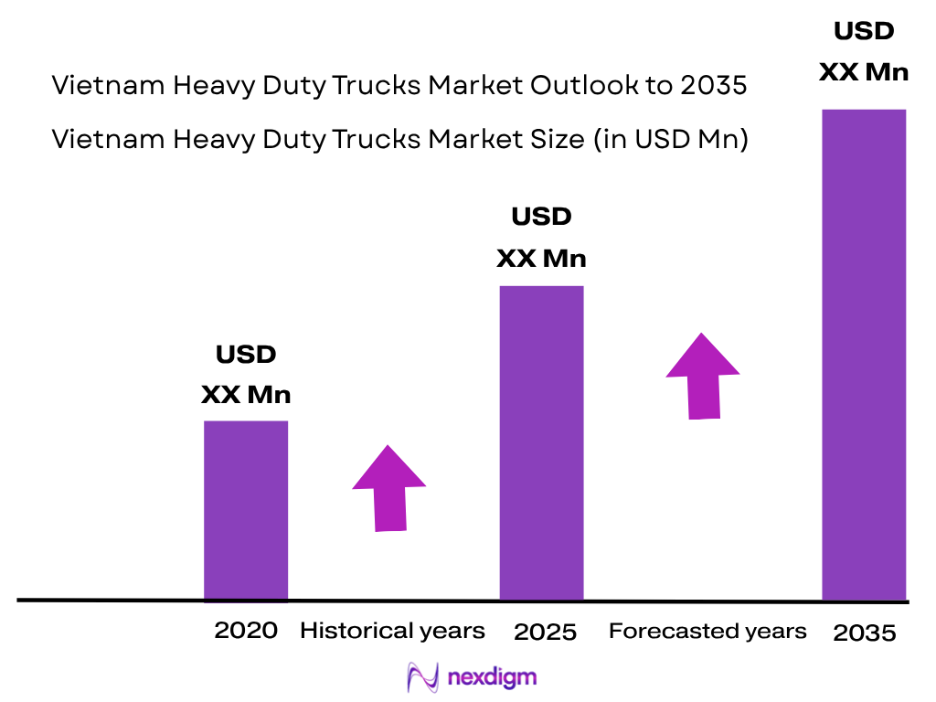
The Vietnam Heavy Duty Trucks Market is supported by expanding freight movement, industrial production, construction activity and cross-border logistics. Official statistics report 2,670.6 million tonnes of freight transported and 545.1 billion tonne-kilometres of freight traffic in the latest annual dataset, while the preceding annual observation was approximately 2,343 million tonnes. Vietnam’s GDP reached USD 476.3 billion, with industry and construction expanding 8.24%, reinforcing demand for high-payload transportation assets.
The market is concentrated around Ho Chi Minh City, Hanoi, Hai Phong, Binh Duong, Dong Nai, Ba Ria–Vung Tau, Bac Ninh and Quang Ninh, reflecting the concentration of manufacturing, ports, industrial parks and logistics corridors. Hanoi recorded road-freight activity of 1,569.4 million tonnes within its broader transport ecosystem, while national merchandise trade reached USD 786.29 billion in the latest annual dataset. Industrial manufacturing also recorded 9.83% value-added growth, strengthening heavy-truck requirements around production and export corridors.
Market Segmentation
By Truck Class
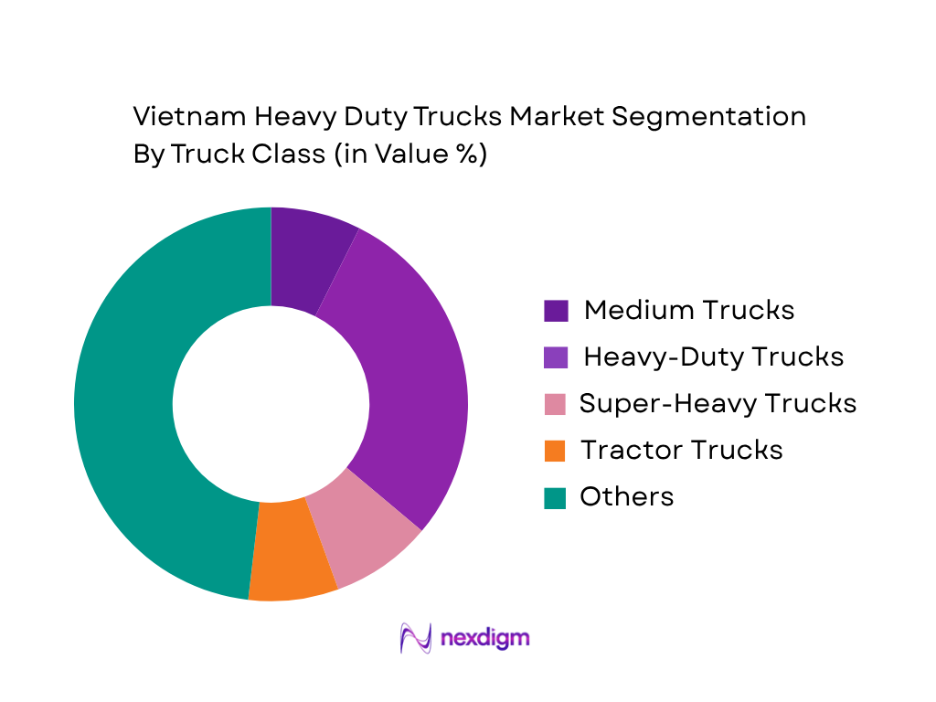
Vietnam’s heavy-duty truck market is segmented into medium trucks, heavy-duty trucks, super-heavy trucks, tractor trucks and other specialized heavy-haul configurations. Within the addressable heavy-duty market, heavy-duty and tractor configurations represent the key demand centers because they are suited to long-distance freight, container movement, construction materials, steel, cement and industrial cargo. VAMA defines heavy-duty trucks as vehicles above 24,000 kg and below 45,000 kg GVW, while super-heavy trucks begin at 45,000 kg GVW. Its commercial-vehicle reporting also separates trucks by small, light, medium and heavy-duty categories. (Vama) The dominance of heavy-duty and tractor configurations is linked to Vietnam’s rapidly expanding freight requirement. National freight transport reached 2,670.6 million tonnes, while freight traffic reached 545.1 billion tonne-kilometres, indicating substantial demand for vehicles capable of moving larger payloads over longer distances. Export-oriented manufacturing further increases demand for tractor heads and container-haulage equipment. VAMA’s annual reporting shows that THACO Truck recorded 15,996 vehicle sales across its reported truck activity, compared with 14,535 in the preceding annual period, illustrating the importance of truck-oriented OEM operations in Vietnam.
By End-Use Application
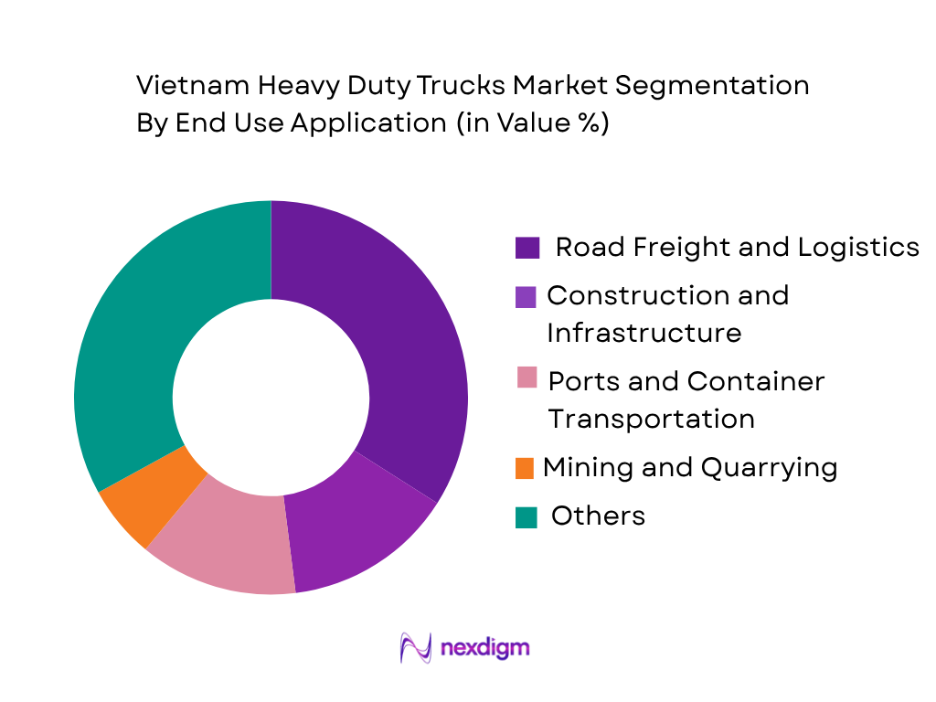
The Vietnam Heavy Duty Trucks Market is segmented into road freight and logistics, construction and infrastructure, ports and container transportation, mining and quarrying, cement and building materials, steel and metals, agriculture and agro-processing, fuel distribution, cold-chain logistics, waste management and specialized heavy haulage. Road freight and logistics represents the dominant application because heavy trucks provide the principal road-based connection between factories, warehouses, ports, border gates and domestic consumption centers. The underlying freight environment strongly supports this position. National freight transport reached 2,670.6 million tonnes, while freight traffic reached 545.1 billion tonne-kilometres. Merchandise imports and exports together reached USD 786.29 billion, creating substantial requirements for container drayage, industrial distribution and interprovincial movement. Manufacturing also expanded strongly, with the processing and manufacturing sector increasing 9.83%, while production of motor vehicles increased 21.1%. These conditions support demand for tractor heads, high-payload rigid trucks and specialized logistics configurations.
Competitive Landscape
The Vietnam Heavy Duty Trucks Market comprises domestic assemblers, Japanese commercial-vehicle manufacturers, Korean OEMs and Chinese heavy-truck brands. THACO, Hino, Isuzu, Hyundai and Mitsubishi Fuso are among the important competitive participants, while Sinotruk/Howo, Foton, Shacman, Dongfeng and other Chinese manufacturers strengthen competition in heavy-haul, tractor and specialized truck applications. THACO’s platform is particularly significant because it manufactures and distributes multiple truck brands and has domestic assembly capabilities.
| Company | Establishment | Headquarters | Heavy-Duty Portfolio | Local Manufacturing / Assembly | Key Configurations | Service Network | Fleet Technology / Differentiator | Market Positioning |
| THACO AUTO / THACO Truck | 1997 | Chu Lai, Vietnam | ~ | ~ | ~ | ~ | ~ | ~ |
| Hino Motors Vietnam | 1996 | Hanoi, Vietnam | ~ | ~ | ~ | ~ | ~ | ~ |
| Isuzu Vietnam | 1995 | Ho Chi Minh City, Vietnam | ~ | ~ | ~ | ~ | ~ | ~ |
| Hyundai Thành Công | 2007 | Ninh Binh, Vietnam | ~ | ~ | ~ | ~ | ~ | ~ |
| Mitsubishi Fuso / THACO AUTO | 2017 Vietnam cooperation | Vietnam operations via THACO | ~ | ~ | ~ | ~ | ~ | ~ |
Vietnam Heavy Duty Trucks Market Analysis
Growth Drivers
Expansion of Road Freight, E-Commerce-Linked Distribution, Port Throughput Growth and Manufacturing FDI
Vietnam’s heavy-duty truck demand is closely tied to the scale and geographic dispersion of freight-intensive economic activity. National goods transport reached 2,670.6 million tonnes, while freight traffic reached 545.1 billion tonne-kilometres, creating a substantial operating base for tractor trucks, heavy rigid trucks and specialized freight vehicles. Vietnam’s total goods import and export turnover reached USD 786.29 billion, with the trade balance recording a USD 24.77 billion surplus. E-commerce provides an additional logistics requirement: the Ministry of Industry and Trade reported domestic e-commerce exceeding USD 25 billion, compared with USD 20.5 billion in B2C e-commerce turnover in the preceding year. Manufacturing-related demand is particularly important because foreign investors committed USD 25.58 billion to Vietnam’s processing and manufacturing sector, representing the largest FDI destination among economic sectors. Realized FDI reached USD 25.35 billion, including USD 20.62 billion in processing and manufacturing. This combination of factory output, export logistics, containerized trade and increasingly distributed fulfillment networks supports demand for high-payload trucks capable of repeated interprovincial and factory-to-port movements. The concentration of manufacturing investment around major industrial corridors also increases requirements for tractor heads, container chassis combinations and heavy-duty vehicles serving industrial parks, ports and logistics hubs.
Construction and Infrastructure Investment, Industrial Corridor Development, Cross-Border Trade, Fleet Replacement and Logistics Modernization
Vietnam’s infrastructure and industrial expansion creates multiple heavy-truck demand pools beyond conventional road freight. Government expenditure reached approximately VND 1,830.8 trillion, including VND 529.1 trillion in development investment expenditure, supporting construction-related economic activity and infrastructure deployment. The industrial and construction sector expanded by 8.24%, while processing and manufacturing value added increased 9.83%, strengthening requirements for bulk-material transportation, machinery movement, steel distribution and factory logistics. Vietnam also recorded total merchandise trade of USD 786.29 billion, while China alone supplied USD 144.3 billion of imports and the United States received USD 119.6 billion of Vietnamese exports. These flows require extensive inland transportation between ports, border crossings, industrial parks, distribution centers and production facilities. The FDI ecosystem reinforces this structural requirement: Vietnam had 42,002 valid FDI projects with registered capital of approximately USD 502.8 billion, of which accumulated realized FDI reached USD 322.5 billion. Processing and manufacturing represented more than USD 308.76 billion of accumulated registered FDI. Such investment creates sustained cargo-generation points and encourages logistics operators to replace aging vehicles with higher-capacity, more reliable equipment. Heavy-duty trucks therefore benefit not only from additional freight volumes but also from the modernization of fleets serving industrial corridors, construction projects, ports and cross-border trade routes.
Market Challenges
High Vehicle Acquisition Cost, Financing Availability, Diesel-Fuel Exposure, Road Infrastructure Constraints and Payload Regulations
Heavy-duty truck operators in Vietnam face a particularly demanding capital and operating environment because vehicle economics depend on high utilization, financing availability, fuel consumption and compliance with axle and payload requirements. Vietnam’s annual consumer price index increased 3.63%, while transportation-related service imports reached USD 14.6 billion, indicating the broader scale of logistics expenditure within the economy. Fuel exposure remains structurally important because diesel-powered heavy trucks account for the dominant portion of long-haul commercial operations, while Vietnam imported substantial quantities of petroleum products; customs data recorded 3.29 million tonnes of diesel oil in cumulative imports in the referenced 2024 dataset. Infrastructure constraints can also reduce productive utilization when heavy vehicles encounter congestion, bridge limitations, urban access restrictions or road sections unsuitable for high-GVW configurations. At the same time, operators must comply with vehicle-weight, axle-load and road-safety requirements, limiting the ability to compensate for high operating expenses simply by increasing payload. Financing is another important consideration because tractor heads and specialized heavy vehicles represent capital-intensive assets whose economics depend on utilization and replacement timing. For smaller and fragmented operators, access to commercial-vehicle loans and leasing can materially influence purchasing decisions. Consequently, OEMs must compete not only on vehicle specifications but also on warranty, financing partnerships, fuel efficiency, service availability, residual value and uptime.
Driver Shortages, Maintenance Costs, Imported Component Dependency and Fragmented Fleet Ownership
Vietnam’s heavy-duty truck ecosystem remains exposed to operational fragmentation because freight transportation involves numerous fleet operators, logistics companies and owner-operators with different vehicle utilization patterns, maintenance practices and replacement cycles. The scale of transportation activity is substantial, with 2,670.6 million tonnes of freight transported and 545.1 billion tonne-kilometres of freight traffic, increasing the requirement for qualified drivers, mechanics and service technicians capable of maintaining high-utilization vehicles. Imported-input exposure is another challenge: Vietnam’s total imports reached a level that contributed to overall merchandise trade of USD 786.29 billion, while production-material imports alone reached USD 356.43 billion. China was Vietnam’s largest import market, supplying USD 144.3 billion of goods, demonstrating the importance of international supply chains for industrial inputs. Heavy-truck manufacturers consequently remain exposed to international availability of engines, transmissions, electronic systems, braking components, tires and other components. Maintenance requirements are also more demanding for vehicles operating continuously on long-haul, construction and heavy-haul routes, where downtime directly affects fleet productivity. Fragmented ownership can make preventive maintenance and fleet-standardization programs more difficult, particularly where operators run small numbers of vehicles across mixed brands. These conditions create pressure for OEMs to strengthen parts availability, workshop coverage, technician training, roadside assistance and telematics-enabled maintenance. The competitive advantage increasingly extends beyond the initial vehicle sale toward lifecycle support and measurable uptime.
Market Opportunities
Fleet Modernization, Fuel-Efficient Powertrains, LNG and Alternative-Fuel Trucks, Battery-Electric Heavy Trucks and Connected Fleet Management
Vietnam’s expanding industrial and logistics base creates an opportunity for OEMs to move fleet purchasing toward more efficient, connected and lower-emission heavy vehicles. Manufacturing attracted USD 25.58 billion of FDI inflows, while realized FDI in Vietnam reached USD 25.35 billion, including USD 20.62 billion in processing and manufacturing. These investments create concentrated freight corridors where fleet operators can justify higher-specification vehicles through utilization, fuel efficiency and uptime improvements. Vietnam’s road-freight ecosystem already handles 545.1 billion tonne-kilometres, making fuel consumption a significant operating variable for long-distance fleets. Alternative-fuel technologies can initially target predictable logistics routes, industrial parks, ports and large fleet operators where fueling infrastructure can be centralized. Battery-electric heavy trucks similarly have an opportunity in shorter, repeatable routes where charging can be integrated into depot operations. Connected fleet management represents another commercially relevant opportunity: telematics can link vehicle location, fuel consumption, driver behavior, maintenance intervals, utilization and route performance, allowing fleet owners to optimize assets rather than simply purchase additional units. The country’s digital economy also provides supporting infrastructure, with e-commerce exceeding USD 25 billion and accounting for approximately two-thirds of Vietnam’s digital-economy value, according to the Ministry of Industry and Trade. The combination of concentrated industrial freight, digital logistics and large-scale transportation activity provides a strong foundation for progressively smarter heavy-truck fleets.
Autonomous Driving Technologies, Port Electrification, Specialized Heavy-Haul Vehicles and Local Component Manufacturing
Vietnam’s industrial investment profile creates an increasingly attractive environment for specialized heavy-duty vehicles, port-oriented equipment, advanced driver technologies and localized component production. The country had 42,002 valid FDI projects with approximately USD 502.8 billion in registered capital, while processing and manufacturing accounted for more than USD 308.76 billion of accumulated registered investment. New investment is increasingly directed toward higher-value manufacturing, including semiconductor, battery, photovoltaic-cell, component and electronics projects. These developments can generate demand for specialized tractor units, low-bed heavy haulers, tankers, temperature-controlled vehicles and other purpose-built configurations rather than only standardized cargo trucks. Port and industrial fleets are also suitable environments for controlled-route automation because vehicle paths, loading points and operating hours can be standardized. Port electrification creates a further pathway for electric tractors and terminal vehicles where charging can be concentrated within defined operating zones. Local component manufacturing can reduce exposure to international supply chains while creating opportunities for domestic suppliers of chassis components, body structures, electronics, battery systems and fleet-management equipment. Vietnam’s merchandise trade reached USD 786.29 billion, while transportation-service exports reached USD 6.52 billion, demonstrating the scale of logistics activity surrounding the goods economy. With industrial corridors expanding and manufacturing becoming more technologically sophisticated, specialized heavy-haul equipment and localized components can capture value beyond conventional truck assembly.
Future Outlook
The Vietnam Heavy Duty Trucks Market is expected to benefit from sustained freight growth, manufacturing expansion, port connectivity and infrastructure development. The country’s merchandise trade ecosystem, expanding industrial base and increasing road-freight activity should support replacement and incremental fleet demand. Heavy-duty tractor heads are likely to remain important for containerized and long-distance freight, while specialized configurations should benefit from construction, cement, steel and industrial projects. Electrification and alternative-fuel adoption will develop progressively, initially focusing on controlled routes and fleet applications where charging or refueling infrastructure can be concentrated.
Major Players
- THACO AUTO / THACO Truck
- Hino Motors Vietnam
- Isuzu Vietnam
- Hyundai Thành Công Việt Nam
- Mitsubishi Fuso Truck and Bus Vietnam
- Sinotruk / HOWO
- Foton Motor Vietnam
- Shacman Vietnam
- Dongfeng Vietnam
- JAC Motors Vietnam
- FAW Trucks Vietnam
- VEAM Motor
- Vinamotor
- TMT Motors
- Daewoo Trucks Vietnam
Key Target Audience
- Heavy-duty truck OEMs and commercial-vehicle manufacturers
- Truck assemblers and CKD/SKD manufacturing companies
- Logistics and road-freight fleet operators
- Port, container-haulage and intermodal transportation companies
- Construction, cement, steel, mining and infrastructure fleet owners
- Investments and venture capitalist firms
- Government and regulatory bodies (Ministry of Construction, Vietnam Register, Ministry of Industry and Trade, Ministry of Finance)
- Commercial-vehicle financing, leasing, insurance and fleet-management companies
Research Methodology
Step 1: Identification of Key Variables
The research begins with an ecosystem map covering heavy-truck OEMs, assemblers, dealers, fleet operators, logistics companies, ports, construction contractors, component suppliers and financing providers. Vehicle classes are standardized using GVW, payload, axle configuration, body type and tractor-head definitions. Secondary databases are used to establish the baseline market structure.
Step 2: Market Analysis and Construction
Historical vehicle sales, registrations, imports, domestic assembly and fleet additions are reconciled to construct the market database. VAMA commercial-vehicle statistics, government transport data and trade statistics are assessed alongside OEM-level information. Freight tonnes, tonne-kilometres, industrial production and construction activity are incorporated as demand-side indicators.
Step 3: Hypothesis Validation and Expert Consultation
Market hypotheses are validated through interviews with OEM executives, commercial-vehicle dealers, fleet operators, logistics companies, body builders, financing institutions and aftermarket specialists. Discussions focus on replacement cycles, payload preferences, route utilization, financing, fuel economy, service requirements and purchasing criteria. These inputs are used to test bottom-up vehicle-unit assumptions.
Step 4: Research Synthesis and Final Output
The final model reconciles OEM sales, registration trends, import data, fleet requirements and freight activity. Segment-level estimates are constructed by truck class, powertrain, configuration and end-use application. Competitive benchmarking then evaluates product coverage, assembly footprint, service infrastructure, technology, fleet economics and market positioning.

- Executive Summary
- Research Methodology (Market Definition and Heavy-Duty Truck Classification, Gross Vehicle Mass Thresholds, Payload-Based Classification, Tractor-Head Inclusion Criteria, Special-Purpose Vehicle Treatment, Top-Down Market Sizing, Bottom-Up Vehicle-Unit Reconstruction, OEM and Dealer Validation, Fleet-Demand Assessment, Registration and Sales Data Reconciliation, Import-Export Validation, Primary Industry Interviews, Data Triangulation, Forecasting Framework, Scenario Analysis, Assumptions and Limitations)

- Definition and Scope
- Vietnam Heavy Duty Truck Industry Evolution
- Heavy Duty Truck Industry Ecosystem
- Heavy Duty Truck Value Chain Analysis
- Commercial Vehicle Sales and Registration Ecosystem

- Growth Drivers (Expansion of Road Freight, E-Commerce-Linked Distribution, Port Throughput Growth, Manufacturing FDI, Construction and Infrastructure Investment, Industrial Corridor Development, Cross-Border Trade, Fleet Replacement and Logistics Modernization)
- Market Challenges (High Vehicle Acquisition Cost, Financing Availability, Diesel-Fuel Exposure, Road Infrastructure Constraints, Payload and Axle Regulations, Driver Shortages, Maintenance Costs, Imported Component Dependency and Fragmented Fleet Ownership)
- Market Opportunities (Fleet Modernization, Fuel-Efficient Powertrains, LNG and Alternative-Fuel Trucks, Battery-Electric Heavy Trucks, Connected Fleet Management, Autonomous Driving Technologies, Port Electrification, Specialized Heavy-Haul Vehicles and Local Component Manufacturing)
- Market Trends (Euro 5 Adoption, Fuel-Efficiency Optimization, Fleet Telematics, Automated Manual Transmissions, Advanced Driver Assistance Systems, Electrification, Connected Trucks, Predictive Maintenance, Lightweight Chassis and Higher Payload Configurations)
- Government and Regulatory Framework (Vietnam Road Traffic Law, Ministry of Transport Requirements, Vehicle Type Approval, Technical Safety Standards, Emission Standards, Vehicle Registration, Axle-Load Regulations, Driver Licensing and Roadworthiness Requirements)
- Porter’s Five Forces Analysis
- PESTLE Analysis
- SWOT Analysis

- By Market Value (2020-2025)
- By Vehicle Units Sold (2020-2025)
- By Average Selling Price (2020-2025)
- By Truck Payload and GVW Class (2020-2025)
- By Powertrain (2020-2025)
- By Body Configuration (2020-2025)
- By End-Use Industry (2020-2025)

- By Gross Vehicle Mass / Payload Class (In Volume %)
Medium-Duty Trucks
Heavy-Duty Trucks
Super-Heavy Trucks
Tractor Heads
Heavy Rigid Trucks
Multi-Axle Heavy Trucks
Special-Purpose Heavy Trucks - By Powertrain (In Volume %)
Diesel Heavy Duty Trucks
Compressed Natural Gas Trucks
Liquefied Natural Gas Trucks
Battery Electric Heavy Trucks
Hybrid Heavy Trucks
Alternative-Fuel Heavy Trucks - By Truck Configuration (In Volume %)
4×2
6×2
6×4
8×4
8×6
10×4 - By Body Type / Application Configuration (In Volume %)
Tractor Heads
Dump Trucks
Cargo Trucks
Concrete Mixer Trucks
Tanker Trucks
Refrigerated Trucks
Flatbed Trucks
Container Carriers
Crane Trucks
Garbage and Waste Trucks
Other Specialized Trucks - By End-Use Industry (In Volume %)
Road Freight and Logistics
Construction and Infrastructure
Mining and Quarrying
Cement and Building Materials
Steel and Metal
Agriculture and Agro-Processing
Ports and Container Transportation
Oil, Gas and Fuel Distribution
Food and Cold Chain
Waste Management and Municipal Services
Specialized Heavy Haulage - By Ownership / Fleet Type (In Volume %)
Large Logistics Fleets
Dedicated Industrial Fleets
Construction Fleets
Port and Container Fleets
Small and Medium Fleet Operators
Owner-Operators
Government and Municipal Fleets
Rental and Contract-Hire Fleets

- Market Share of Major Players (By Vehicle Units, Market Value, GVW Class, Tractor Heads, Body Type, Powertrain, End-Use Industry and Distribution Channel)
- Cross Comparison Parameters (Heavy-Duty GVW & Payload Coverage, Tractor Head & Long-Haul Portfolio, Powertrain & Fuel-Efficiency Performance, Local Assembly & Manufacturing Footprint, Commercial Vehicle Product Breadth, Dealer, Workshop & Spare-Parts Reach)
- SWOT Analysis of Major Players
- Detailed Profiles of Major Companies
THACO AUTO / THACO TRUCK
Hyundai Thành Công Việt Nam
Hino Motors Vietnam
Isuzu Vietnam
VEAM Motor
Mitsubishi Fuso Truck and Bus Vietnam
Vinamotor
Dongfeng Vietnam
Sinotruk / HOWO
Foton Vietnam
Jac Motors Vietnam
TMT Motors
Daewoo Trucks Vietnam
Shacman Vietnam
FAW Trucks Vietnam

- Logistics Fleet Analysis
- Construction Fleet Analysis
- Port and Container Fleet Analysis
- Mining and Quarrying Fleet Analysis
- Manufacturing Fleet Analysis
- Agriculture and Agro-Processing Fleet Analysis
- Fuel and Tanker Fleet Analysis
- Cold-Chain Fleet Analysis

- By Market Value (2026-2035)
- By Vehicle Units Sold (2026-2035)
- By Average Selling Price (2026-2035)
- By Truck Payload and GVW Class (2026-2035)
- By Powertrain (2026-2035)
- By Body Configuration (2026-2035)
- By End-Use Industry (2026-2035)


 Request a Sample
 Ask for Customization
 Get a Quote
 Enquire Now