
 Download PDF
Market Overview
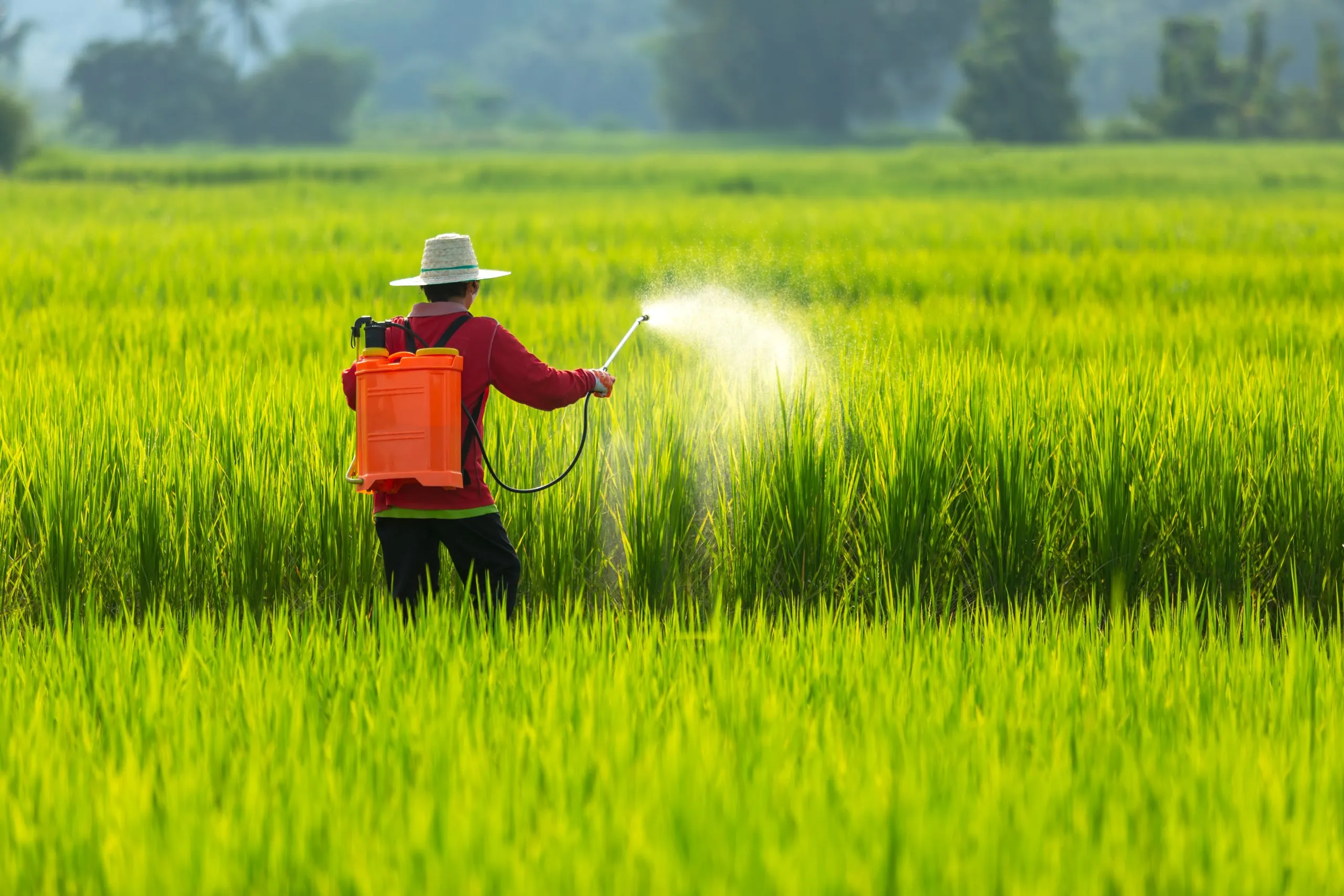
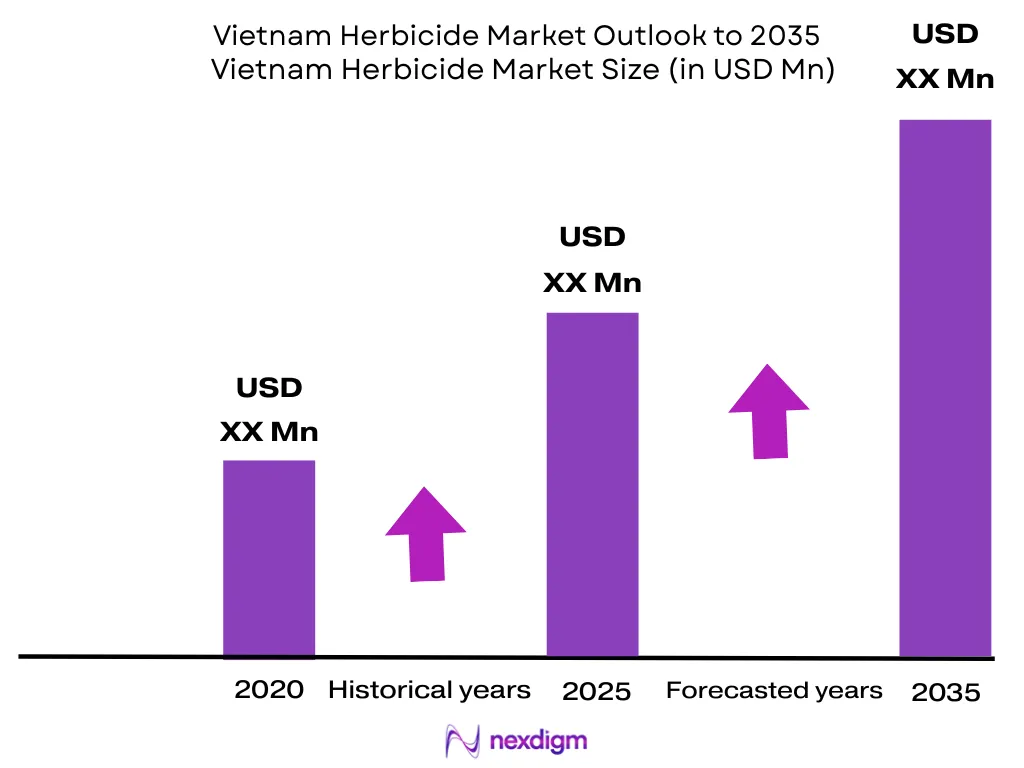
The Vietnam Herbicide Market is valued at USD ~ million, based on historical herbicide category analysis, and is forecast to grow at 5.00% CAGR during 2026-2035. The market is driven by rice, coffee, rubber and fruit cultivation where labour-saving weed control is critical. Rice exports reached 8.3 million metric tons in the previous cycle and over 9 million tonnes in the latest cycle, reinforcing demand for crop-protection inputs. Mekong Delta, Red River Delta, Central Highlands and Ho Chi Minh City-linked distribution corridors dominate the Vietnam Herbicide Market. Mekong Delta leads due to multi-season rice cultivation; Central Highlands is important for coffee and pepper; Southeast Vietnam supports rubber, fruit and industrial crops. Vietnam’s rice export volume reached 9 million tonnes and value reached USD 5.7 billion, while coffee and rubber exports were estimated at USD 5.4 billion and USD 3.2 billion, supporting herbicide demand in these crop belts.
Market Segmentation
By Crop Type
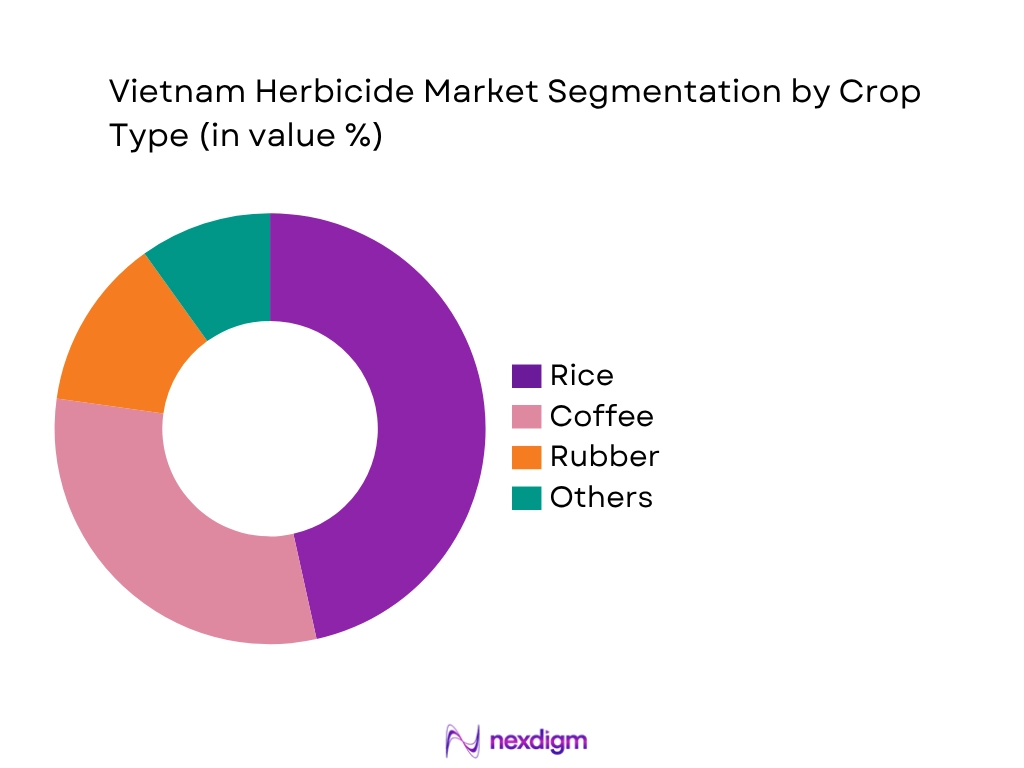
Vietnam Herbicide Market is segmented by crop type into rice, coffee, rubber, fruits & vegetables, maize, cassava & other upland crops, and pepper, cashew & other plantation crops. Rice has a dominant market share under this segmentation due to the intensity of paddy cultivation in the Mekong Delta and Red River Delta. Rice requires repeated weed-control intervention across pre-emergence and post-emergence stages, especially in direct-seeded rice systems where grasses, sedges and broadleaf weeds compete early with the crop. Herbicides such as pretilachlor, butachlor, bispyribac sodium, cyhalofop-butyl and 2,4-D-linked broadleaf solutions remain central to paddy weed management. Rice’s dominance is further strengthened by Vietnam’s export-oriented rice economy, where stable yields, harvest quality and timely field operations are commercially important for farmers, cooperatives and exporters.
By Herbicide Type
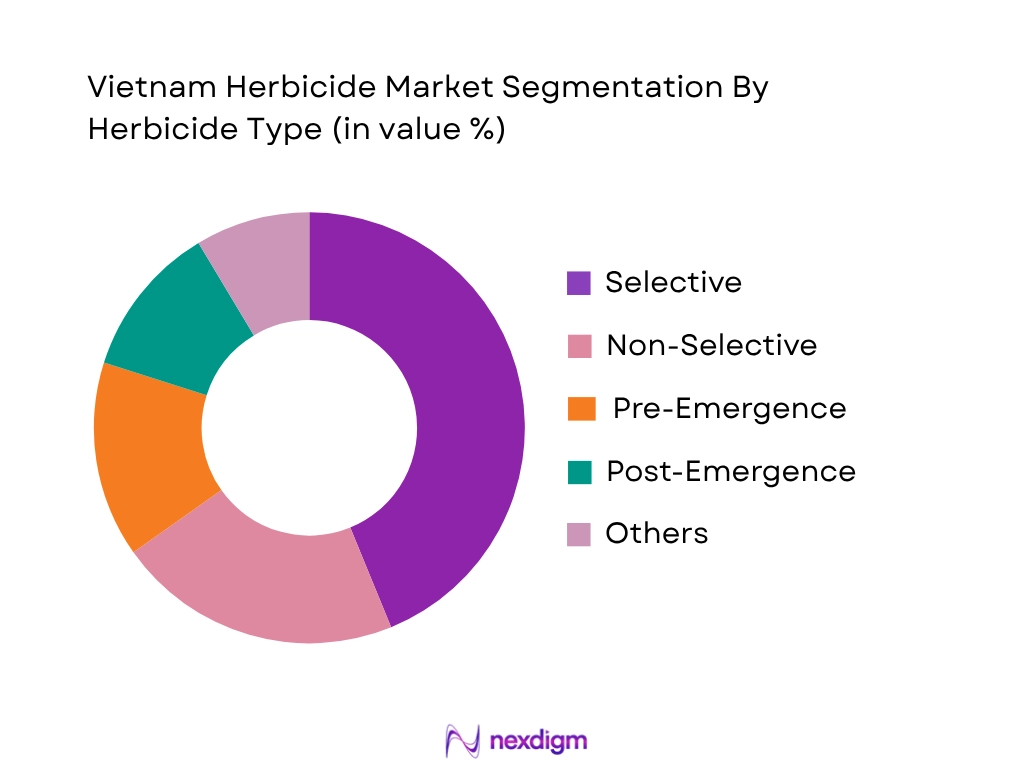
Vietnam Herbicide Market is segmented by herbicide type into selective herbicides, non-selective herbicides, pre-emergence herbicides, post-emergence herbicides, and bio-based & other herbicides. Selective herbicides hold the dominant market share because Vietnam’s herbicide demand is crop-specific and concentrated in rice, maize, vegetables and plantation crops where crop safety is a critical purchase factor. Paddy herbicides are particularly important because farmers require products that control grasses and sedges without damaging rice seedlings. The removal of glyphosate from Vietnam’s permitted-use list has also reduced reliance on broad non-selective weed-control programs and increased the importance of registered alternatives, crop-safe formulations and directed application. Selective herbicides also benefit from stronger dealer recommendations because they are easier to position around crop stage, weed spectrum, water depth and label-based use.
Competitive Landscape
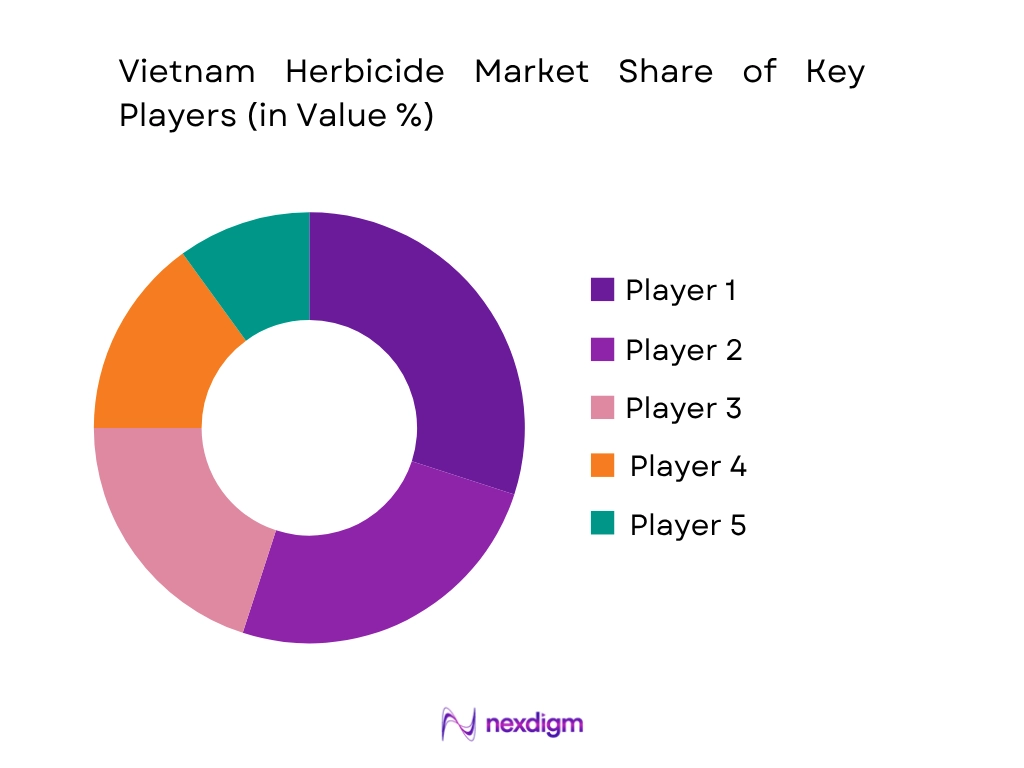
The Vietnam Herbicide Market includes domestic crop-protection companies, import-driven agrochemical distributors and multinational suppliers. Domestic players such as Loc Troi Group, Vietnam Fumigation Joint Stock Company and HAI Agrochem are strong in local distribution and farmer connectivity, while multinational companies such as Syngenta, Bayer, BASF, FMC and UPL compete through molecule access, stewardship, product quality and crop-specific agronomy. Glyphosate’s regulatory removal has also intensified competition around substitute non-selective chemistry, paddy herbicides and plantation weed-control programs.
| Company | Establishment Year | Headquarters | Key Herbicide Focus | Crop Focus | Distribution Strength | Registration / Portfolio Depth | Strategic Advantage | Market Positioning |
| Loc Troi Group JSC | 1993 | An Giang, Vietnam | ~ | ~ | ~ | ~ | ~ | ~ |
| Vietnam Fumigation JSC | 1960 | Ho Chi Minh City, Vietnam | ~ | ~ | ~ | ~ | ~ | ~ |
| HAI Agrochem JSC | 1986 | Ho Chi Minh City, Vietnam | ~ | ~ | ~ | ~ | ~ | ~ |
| Syngenta Vietnam | 2000 | Ho Chi Minh City, Vietnam | ~ | ~ | ~ | ~ | ~ | ~ |
| Bayer Vietnam | 1994 | Ho Chi Minh City, Vietnam | ~ | ~ | ~ | ~ | ~ | ~ |
Vietnam Herbicide Market Analysis
Growth Drivers
Rice Cultivation Intensity Supports Repeated Herbicide Use
Vietnam Herbicide Market is supported by the country’s large rice-growing base, where paddy systems require pre-emergence and post-emergence weed control to protect early crop establishment. In the winter-spring rice crop, Vietnam cultivated 2,953.6 thousand hectares of spring paddy, according to the National Statistics Office of Vietnam. Rice exports reached 9 million tonnes and USD 5.7 billion, based on Ministry of Agriculture and Rural Development statistics reported by VietnamPlus. The World Bank places Vietnam’s population at 100,987,686 and GDP at USD 476.39 billion, showing the macro base behind food production and input consumption. For herbicide suppliers, rice remains the most important demand anchor because the Mekong Delta and Red River Delta rely on fast weed suppression, water-layer herbicide management, granular paddy formulations and selective molecules such as pretilachlor, butachlor, bispyribac sodium and cyhalofop-butyl.
Plantation and Export Crop Systems Create Demand for Directed Weed Control
Vietnam Herbicide Market is also driven by plantation crops such as coffee and rubber, where inter-row weeds, orchard-floor growth and plantation undergrowth create recurring demand for directed herbicide application. Vietnam’s coffee exports exceeded USD 5 billion in the 2023-2024 crop year, with about 1.46 million tons exported, according to Vietnam Law Magazine citing Vietnam Coffee-Cocoa Association data. The 2024-2025 coffee crop year reached over 1.5 million tons and more than USD 8.4 billion, while coffee cultivation area reached 731,900 hectares, according to the Ministry of Agriculture and Environment. Rubber exports reached about 2 million tonnes and USD 3.4 billion, based on General Department of Customs figures cited by the Ministry of Industry and Trade-linked trade portal. The World Bank reports Vietnam’s GDP per capita at USD 4,717.3, supporting higher input intensity across export-linked agriculture. These crop systems favour non-selective alternatives, glufosinate-based programs, directed spray practices and safer weed-control solutions for perennial crops.
Market Challenges
Climate Shocks Disrupt Herbicide Application Windows and Crop Planning
Vietnam Herbicide Market faces climate-related disruption because herbicide performance depends on water level, rainfall timing, soil moisture and crop-stage precision. Typhoon Yagi caused severe disruption to northern Vietnam’s agriculture, with government-linked estimates reporting 190,000 hectares of rice fields inundated and 48,000 hectares of cash crops affected. A UNDP multi-sector assessment reported 286,647 hectares of rice losses and 63,352 hectares of other crop losses linked to the same disaster period. This directly affects herbicide demand because delayed sowing, washed-off pre-emergence products, damaged seedlings and replanting cycles change molecule selection and dealer inventory movement. The World Bank records Vietnam’s GDP at USD 476.39 billion and population at 100,987,686, showing that climate shocks affect a large macroeconomic and food-system base. For suppliers, regional inventory planning must account for flood-prone paddy areas, typhoon exposure, application failure risk and emergency shifts from scheduled weed-control programs to crop recovery.
Rural Fragmentation and Stewardship Gaps Increase Application Risk
Vietnam Herbicide Market faces a structural challenge from fragmented rural application practices, because weed-control outcomes depend on correct dose, spray timing, nozzle use, water volume and crop-stage identification. The World Bank estimates Vietnam’s rural population at 60,395,686 people and total population at 100,987,686, indicating a large, dispersed rural user base for crop-protection inputs. Vietnam’s agricultural land was reported at 122,910 sq. km, according to World Bank-linked data, creating a broad geography for herbicide distribution, training and compliance monitoring. The challenge is market-specific because herbicide misuse can cause paddy phytotoxicity, spray drift in orchards, poor weed knockdown, residue concerns and dealer-level product switching. IMF notes Vietnam’s economy recovered with strong external demand and resilient investment, but broader structural reforms remain important to sustain productivity. For herbicide companies, growth requires more than product supply; it requires label education, farmer demonstrations, cooperative-level training, safe-use instructions and retailer discipline.
Market Opportunities
Rice Value-Chain Modernisation Creates Scope for Crop-Specific Herbicide Programs
Vietnam Herbicide Market has a strong opportunity in rice-specific herbicide programs because Vietnam’s rice economy is large, export-oriented and concentrated in repeat-cropping regions. Rice exports reached 9 million tonnes and USD 5.7 billion, with Ministry of Agriculture and Rural Development data showing record export volume and value. Spring paddy cultivation reached 2,953.6 thousand hectares, according to the National Statistics Office of Vietnam. In 2025, the winter-spring rice crop covered 2,970.9 thousand hectares, adding 17.0 thousand hectares compared with the previous winter-spring crop, based on the National Statistics Office. The World Bank reports Vietnam’s GDP at USD 476.39 billion and GDP per capita at USD 4,717.3, supporting higher commercial input usage in organised crop systems. This creates room for paddy herbicide kits, granular formulations, pre-emergence and early post-emergence sequences, cooperative procurement, drone-compatible labels and dealer advisory tools focused on grasses, sedges and broadleaf weed complexes.
Export-Crop Compliance Creates Space for Safer and Traceable Weed-Control Solutions
Vietnam Herbicide Market has an opportunity in export-crop stewardship because coffee, rubber, fruit and rice buyers increasingly require traceable input use, safer field practices and residue-conscious production. Coffee exports in the 2024-2025 crop year reached more than USD 8.4 billion and over 1.5 million tons, while the coffee cultivation area reached 731,900 hectares, according to the Ministry of Agriculture and Environment. Fruit and vegetable exports earned USD 3.83 billion in the first seven months of 2024, according to the Government News portal. Rubber exports reached about 2 million tonnes and USD 3.4 billion, based on customs data cited by the Ministry of Industry and Trade-linked trade portal. The World Bank records Vietnam’s GDP per capita at USD 4,717.3 and population at 100,987,686, supporting the scale of organised farming and export-linked consumption. This supports opportunities for glyphosate-free positioning, QR-coded packaging, cooperative training, directed-spray protocols, low-residue formulations and plantation-specific herbicide programs.
Future Outlook
The Vietnam Herbicide Market is expected to grow steadily as farmers continue replacing manual weeding with chemical and mechanised weed-control solutions. Growth will be supported by rice intensification, plantation crop maintenance, drone spraying, rising labour pressure and greater demand for crop-safe formulations. The market’s future will be shaped by regulatory tightening, glyphosate-free product strategies, residue-sensitive export crops and higher adoption of registered selective herbicides. Rice will remain the anchor crop for herbicide consumption because Mekong Delta and Red River Delta production systems require timely weed management. Companies with paddy-specific products, granule formulations, pre-emergence and early post-emergence programs, and farmer advisory strength are expected to maintain stronger channel relevance. Selective herbicides will benefit from crop-safety requirements, especially in rice, maize, vegetables and fruit crops. Plantation crops will create a separate growth pathway for herbicide suppliers. Coffee, rubber, pepper, cashew and fruit orchards require inter-row and directed weed-control products that can reduce labour dependence without damaging perennial crops. The Central Highlands and Southeast Vietnam will remain important for companies offering non-selective alternatives, safer directed-spray options and stewardship training for estate and smallholder users. Regulation will remain one of the defining factors in the market. Vietnam’s removal of glyphosate from permitted use shows that active ingredient risk, farmer safety and environmental considerations are central to future portfolio decisions. Suppliers with compliance-ready labels, traceable packaging, low-residue positioning and strong distributor training will be better placed than companies dependent only on low-cost generic formulations.
Major Players
- Loc Troi Group Joint Stock Company
- Vietnam Fumigation Joint Stock Company
- HAI Agrochem Joint Stock Company
- Sai Gon Plant Protection Joint Stock Company
- Vietnam Pesticide Joint Stock Company
- Can Tho Pesticide Joint Stock Company
- Central Plant Protection Joint Stock Company No. 1
- Hop Tri Investment Joint Stock Company
- An Nong Group
- Phu Nong Company Limited
- Bayer Vietnam
- Syngenta Vietnam
- BASF Vietnam
- FMC Vietnam
- UPL Vietnam
Key Target Audience
- Herbicide manufacturers
- Crop protection chemical formulators
- Agrochemical importers and distributors
- Plantation crop companies
- Rice cooperatives and integrated rice value-chain operators
- Investments and venture capitalist firms
- Government and regulatory bodies — Ministry of Agriculture and Rural Development, Plant Protection Department, Vietnam Chemicals Agency
- Drone spraying service providers and agri-mechanisation companies
Research Methodology
Step 1: Identification of Key Variables
The initial phase involves constructing an ecosystem map of the Vietnam Herbicide Market, including active ingredient suppliers, formulation companies, importers, distributors, rice cooperatives, plantation estates and spray-service operators. Key variables include treated crop area, molecule type, formulation format, application timing, crop intensity, registration status and regional weed pressure.
Step 2: Market Analysis and Construction
In this phase, historical market data is compiled from herbicide category sources, pesticide market references, crop production statistics, import flows and company-level portfolio mapping. Market construction uses a top-down crop protection allocation and bottom-up build-up across rice, coffee, rubber, fruits, vegetables, maize, cassava and plantation crops.
Step 3: Hypothesis Validation and Expert Consultation
Market hypotheses are validated through structured interviews with domestic formulators, multinational crop-science companies, provincial distributors, agrochemical retailers, cooperative procurement teams and plantation managers. These consultations help verify crop-wise herbicide intensity, dominant molecule groups, channel structure, glyphosate replacement trends and demand seasonality across Vietnam’s agricultural regions.
Step 4: Research Synthesis and Final Output
The final phase integrates secondary research, field-level inputs and bottom-up modelling to produce a validated view of the Vietnam Herbicide Market. Segment shares are refined through triangulation of crop acreage, herbicide application frequency, channel feedback, regulatory constraints, formulation type, active ingredient availability and regional sales patterns.

- Executive Summary
- Research Methodology (Market Definitions and Assumptions, Active Ingredient Mapping, Crop-Wise Treated Acreage, Herbicide Dose Per Hectare, Import-Export Triangulation, MARD Registration Screening, Dealer Channel Validation, Farmer-Level Usage Checks, Primary Interviews, Bottom-Up Formulation Sales Build-Up, Top-Down Crop Protection Allocation, Forecast Assumptions, Limitations and Future Conclusions)

- Definition and Scope
- Market Genesis
- Evolution of Herbicide Adoption
- Business Cycle
- Supply Chain and Value Chain Analysis

- Growth Drivers (Rice Production Intensity, Plantation Crop Maintenance, Labour Shortage, Mechanised Spraying, Drone Application, Crop Export Quality Requirements, Dealer Advisory Penetration)
- Market Challenges (Glyphosate Ban Impact, Paraquat and 2,4-D Scrutiny, Counterfeit Products, Farmer Misapplication, Spray Drift, Smallholder Fragmentation, Technical Import Dependence, Climate Volatility)
- Opportunities (Glyphosate Alternatives, Rice-Specific Herbicide Programs, Plantation Directed Spray Solutions, Bio-Based Weed Control, Drone-Compatible Formulations, Cooperative Procurement, Export Crop Stewardship)
- Market Trends (Selective Herbicide Premiumisation, Glyphosate-Free Positioning, Ready-Mix Uptake, Granular Paddy Herbicides, Digital Agronomy, QR-Enabled Packaging, IPM-Aligned Advisory)
- SWOT Analysis
- Porter’s Five Forces

- By Value (2020-2025)
- By Volume (2020-2025)
- By Average Realisation (2020-2025)

- By Herbicide Type (In Value %)
Selective Herbicides
Non-Selective Herbicides
Residual Herbicides
Contact Herbicides - By Crop Type (In Value %)
Rice
Coffee
Rubber
Pepper and Cashew
Maize and Cassava - By Sales Channel (In Value %)
Company Distributor
Provincial Wholesaler
Commune-Level Agrochemical Retailer
Cooperative Procurement
Rice Value-Chain Program - By Region (In Value %)
Mekong River Delta
Red River Delta
Central Highlands
Southeast Region
North Central Coast

- Market Share of Major Players on the Basis of Value and Volume (Domestic Formulators, Multinational Brands, Generic Importers, Paddy Herbicide Leaders, Plantation Herbicide Suppliers)
- Cross Comparison Parameters (Herbicide Active Ingredient Portfolio, MARD Registration Breadth, Rice Herbicide Strength, Plantation Crop Herbicide Strength, Glyphosate Replacement Portfolio, Formulation Capability, Provincial Distributor Network, Dealer Credit and Farmer Advisory Reach)
- SWOT Analysis of Major Players
- Detailed Profiles of Major Companies
Loc Troi Group Joint Stock Company
Vietnam Fumigation Joint Stock Company
HAI Agrochem Joint Stock Company
Sai Gon Plant Protection Joint Stock Company
Vietnam Pesticide Joint Stock Company
Can Tho Pesticide Joint Stock Company
Central Plant Protection Joint Stock Company No. 1
Hop Tri Investment Joint Stock Company
An Nong Group
Phu Nong Company Limited
Bayer Vietnam
Syngenta Vietnam
BASF Vietnam
FMC Vietnam
UPL Vietnam

- Market Demand and Utilisation
- Purchasing Power and Budget Allocation
- Regulatory and Compliance Requirements
- Needs, Desires and Pain Point Analysis
- Decision-Making Process

- By Value (2026-2035)
- By Volume (2026-2035)
- By Average Realisation (2026-2035)


 Request a Sample
 Ask for Customization
 Get a Quote
 Enquire Now