
 Download PDF
Market Overview
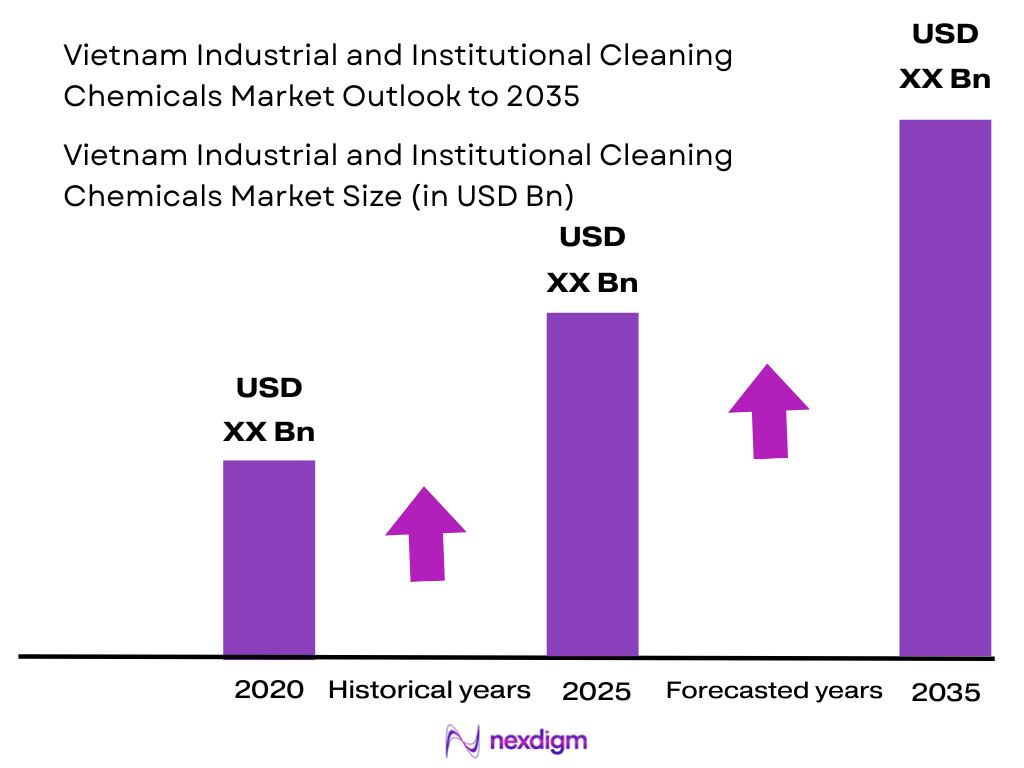
The Vietnam Industrial and Institutional Cleaning Chemicals Market is valued at ~USD XX million, supported by expanding manufacturing, food processing, healthcare, hospitality and commercial activity. Vietnam’s GDP reached USD 476.3 billion, while GDP growth was 7.09. Industrial production increased 8.4, with manufacturing and processing rising 9.6, creating a larger base of factories, production facilities and equipment requiring routine cleaning and sanitation. Water supply, waste management and wastewater treatment also increased 10.7, reinforcing demand for professional hygiene and cleaning solutions.
Demand is concentrated around Ho Chi Minh City, Hanoi, Binh Duong, Dong Nai, Hai Phong and Bac Ninh, where manufacturing, logistics, food processing, healthcare, hospitality and commercial facilities are heavily clustered. Vietnam’s manufacturing and processing activity increased 9.6, while transport and warehousing increased 10.82. International visitor arrivals reached nearly 17.6 million, supporting hotel, restaurant and institutional cleaning requirements. Vietnam also recorded USD 786.29 billion in merchandise trade, strengthening demand from factories, warehouses, ports and logistics facilities.
Market Segmentation
By Product Type
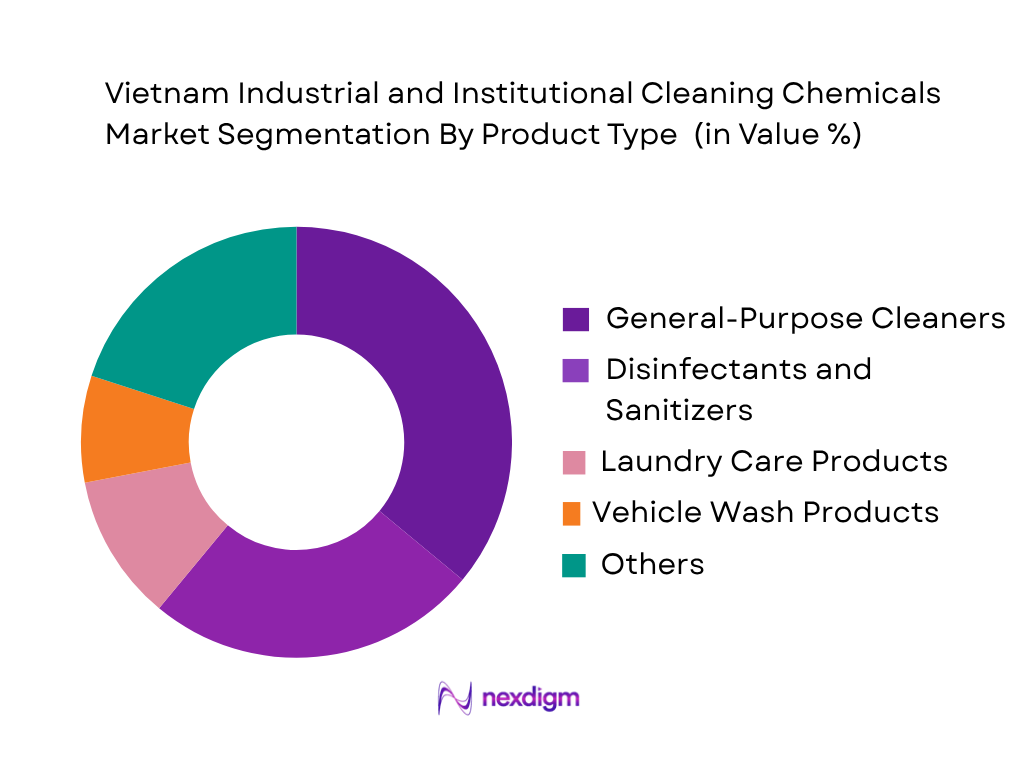
The Vietnam Industrial and Institutional Cleaning Chemicals Market is segmented by product type into general-purpose cleaners, disinfectants and sanitizers, degreasers, floor-care chemicals, toilet and restroom cleaners, glass and surface cleaners, laundry chemicals, warewashing chemicals, specialty cleaners and other professional cleaning chemicals. General-purpose cleaners are expected to represent the dominant segment because they address a broad range of routine applications across factories, offices, hotels, hospitals, restaurants, warehouses and commercial properties. Their applicability to floors, walls, work surfaces and general facility maintenance creates recurring consumption across multiple customer categories. The scale of Vietnam’s industrial ecosystem reinforces this demand, with industrial production increasing 8.4 and manufacturing and processing increasing 9.6. General-purpose formulations also benefit from straightforward application, compatibility with routine cleaning programs and widespread distributor availability. However, higher-value specialty categories such as disinfectants, CIP chemicals, degreasers and food-contact sanitation products remain important where customers require application-specific performance. The diversity of end users means product selection is increasingly differentiated according to cleaning intensity, surface type, contamination profile and sanitation protocol rather than relying solely on generic chemical formulations.
By End-Use Industry
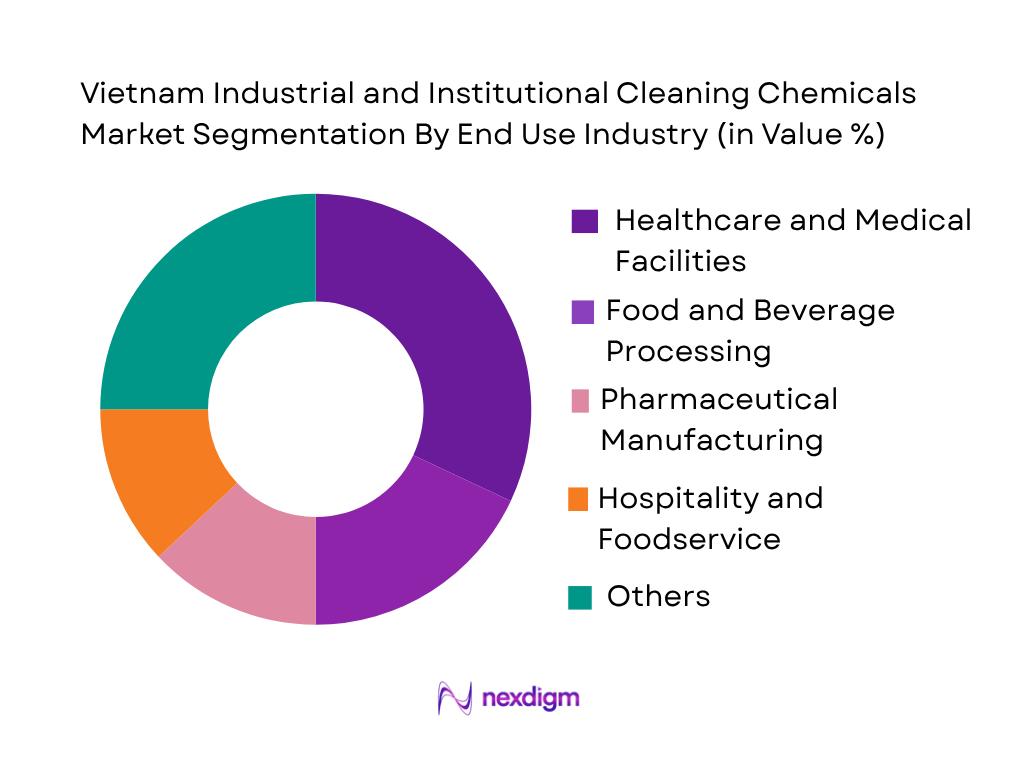
The market is segmented by end-use industry into manufacturing and industrial facilities, food and beverage processing, healthcare, hospitality and foodservice, commercial and office buildings, retail and shopping facilities, transportation and logistics, education and institutional facilities, and other end users. Manufacturing and industrial facilities constitute the dominant end-use segment because factories require continuous cleaning of production floors, machinery, equipment, workspaces, storage areas and sanitation-sensitive environments. Vietnam’s industrial production index increased 8.4, while manufacturing and processing increased 9.6, demonstrating the expansion of the underlying industrial customer base. Industrial consumption also benefits from Vietnam’s strong export-oriented manufacturing ecosystem, with merchandise trade reaching USD 786.29 billion. Food and beverage processing represents another significant application because production facilities require repeated cleaning and sanitation of equipment, surfaces and processing areas. Healthcare, hospitality and foodservice similarly require specialized disinfectants, surface cleaners, laundry chemicals and restroom products. The breadth of industrial activity therefore creates demand for both high-volume routine chemicals and specialized formulations designed for particular contaminants, equipment and sanitation protocols.
Competitive Landscape
The Vietnam Industrial and Institutional Cleaning Chemicals Market includes multinational chemical suppliers, specialized hygiene companies, professional cleaning-product manufacturers and domestic distributors. Competition is shaped by product breadth, formulation technology, technical support, distribution coverage, application expertise and the ability to supply large industrial and institutional accounts. Major international suppliers compete alongside regional and local players, while facility-management companies and chemical distributors also influence purchasing decisions.
| Company | Establishment Year | Headquarters | Product Portfolio | Key I&I Applications | Distribution Capability | Technical Support | Formulation Focus |
| Diversey | 1923 | Fort Mill, USA | ~ | ~ | ~ | ~ | ~ |
| Ecolab | 1923 | St. Paul, USA | ~ | ~ | ~ | ~ | ~ |
| Kersia | 1946 | Dinan, France | ~ | ~ | ~ | ~ | ~ |
| 3M | 1902 | St. Paul, USA | ~ | ~ | ~ | ~ | ~ |
| SC Johnson Professional | 1886 | Racine, USA | ~ | ~ | ~ | ~ | ~ |
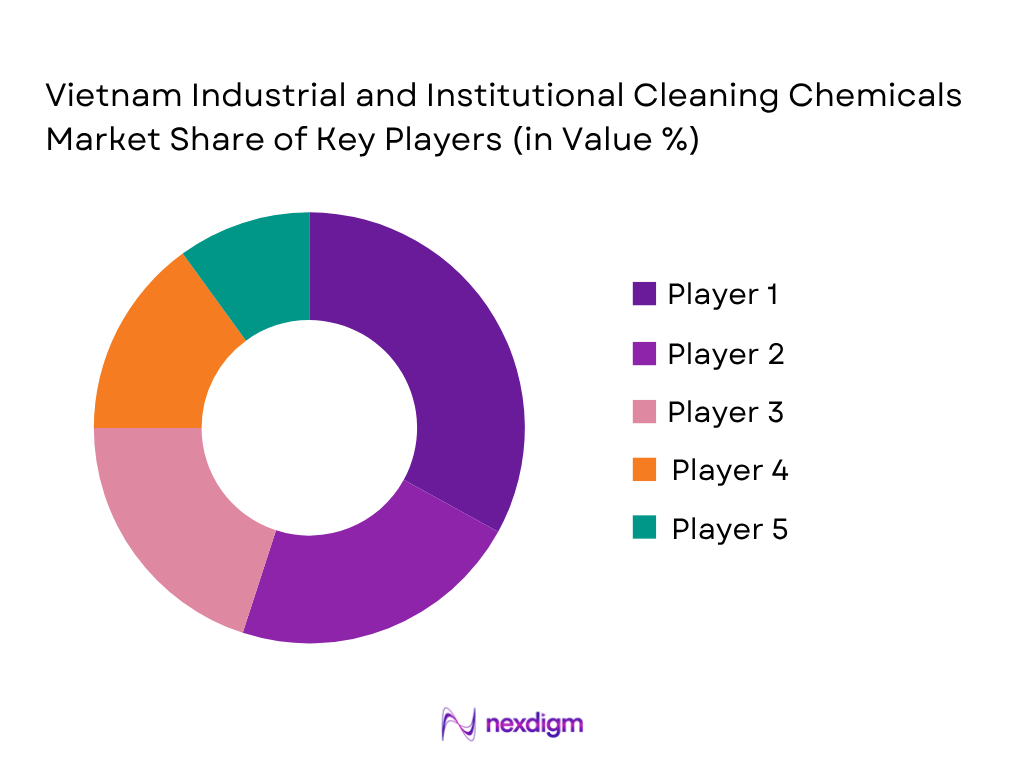
Vietnam Industrial and Institutional Cleaning Chemicals Market Analysis
Market Growth Drivers
Manufacturing Expansion
Vietnam Industrial and Institutional Cleaning Chemicals Market is strongly supported by the expansion of manufacturing and processing facilities, where recurring requirements include equipment cleaning, floor sanitation, degreasing, surface disinfection, production-line hygiene and maintenance cleaning. Vietnam’s industrial production index increased 8.4 in 2024, compared with 1.3 in 2023, while manufacturing and processing increased 9.6, compared with 1.5 in 2023. Manufacturing consumption also increased 11.3 during the year, indicating stronger utilization of industrial production capacity. The chemical industry itself recorded particularly strong activity, with production of chemicals and chemical products increasing 16.9 during the first nine months. This combination expands the addressable base for industrial detergents, degreasers, disinfectants, specialty cleaners and process-cleaning chemicals. Export-oriented manufacturing further strengthens recurring demand because factories supplying electronics, machinery, textiles, footwear, plastics, metals and other products require controlled workplace and production-area hygiene. Vietnam’s merchandise exports reached USD 405.53 billion, while imports reached approximately USD 380.76 billion, creating extensive manufacturing and logistics activity that requires professional cleaning solutions across factories, warehouses and associated facilities.
Food and Beverage Processing Growth
Food and beverage processing creates intensive and recurring consumption of professional cleaning and sanitation chemicals because production equipment, food-contact surfaces, floors, drains, storage areas and processing lines require frequent cleaning. Vietnam’s food-processing industrial production increased 7.8 during the first nine months of 2024, while total fisheries production reached 9.547 million tonnes, including 5.7216 million tonnes of aquaculture output. These volumes support substantial requirements for detergents, alkaline and acidic cleaners, degreasers, disinfectants, sanitizers and cleaning-in-place chemicals across seafood, meat, dairy, beverage and packaged-food facilities. Vietnam’s accommodation and foodservice sector also expanded, with accommodation and catering services increasing 9.31 in the first quarter of 2025, reinforcing downstream demand for kitchen sanitation, warewashing, floor care and restroom products. International tourism adds another demand layer: Vietnam received nearly 17.6 million international visitors in 2024, supporting hotels, restaurants and foodservice establishments. The combination of high-throughput food production, seafood processing, hospitality and commercial food preparation makes sanitation a recurring operational requirement rather than an occasional cleaning activity. Suppliers offering application-specific formulations, controlled dosing and food-contact-compatible sanitation programs therefore have opportunities to deepen penetration among professional users.
Market Challenges
Imported Specialty Chemical Dependency
Vietnam Industrial and Institutional Cleaning Chemicals Market faces supply-chain exposure where specialized surfactants, solvents, disinfectant actives, enzymes, specialty additives and formulation inputs may depend on international sourcing. This creates vulnerability to shipping disruptions, exchange-rate movements, geopolitical events and fluctuations in international chemical availability. Vietnam’s merchandise trade reached USD 786.29 billion in 2024, while total exports reached USD 405.53 billion and imports reached approximately USD 380.76 billion, illustrating the country’s highly interconnected external supply base. Manufacturing and processing increased 9.6 in 2024, while the chemicals and chemical-products sector recorded 16.9 growth during the first nine months, increasing the importance of dependable chemical-input availability. For professional cleaning suppliers, disruptions in specialty ingredients can affect formulation consistency, lead times and the ability to maintain uninterrupted supply contracts with industrial customers. Buyers serving food processing, healthcare, electronics and other sensitive applications may require specific chemical grades and performance characteristics that cannot always be substituted quickly. Consequently, suppliers face pressure to maintain inventory buffers, diversify sourcing channels and develop locally adaptable formulations without compromising cleaning performance or regulatory requirements.
Wastewater Discharge Constraints
Wastewater management represents a significant operational challenge because industrial and institutional cleaning chemicals ultimately interact with wastewater streams generated by factories, food-processing plants, hotels, hospitals and commercial facilities. Vietnam’s water supply, sewerage, waste-management and wastewater-treatment activities increased 9.43 in 2024, while the industrial production index for water supply, waste management and wastewater treatment increased 10.7. These figures demonstrate increasing activity around environmental infrastructure and wastewater management, raising the importance of chemical selection and discharge control. Industrial customers using detergents, disinfectants, degreasers and specialty cleaners must increasingly consider chemical loading, residues, compatibility with wastewater-treatment systems and downstream environmental requirements. Food-processing facilities can generate particularly intensive wastewater streams containing organic matter, fats, oils and cleaning chemicals, while manufacturing plants may generate more complex effluents. Consequently, suppliers cannot compete solely on cleaning performance; they increasingly need formulations compatible with wastewater-treatment processes and controlled dosing practices. This creates additional technical requirements for product development, customer training and application monitoring. The challenge is particularly relevant for large facilities seeking to reduce chemical consumption while maintaining required hygiene standards and avoiding treatment-system disruption.
Market Opportunities
Green Cleaning Chemistry
The Vietnam Industrial and Institutional Cleaning Chemicals Market presents an opportunity for green cleaning chemistry as industrial and institutional customers increasingly seek formulations that combine effective cleaning with lower environmental impact. Vietnam’s water supply, sewerage, waste-management and wastewater-treatment activities increased 9.43 in 2024, while the industrial production index for the broader water supply, waste management and wastewater-treatment segment increased 10.7. This creates a stronger operating context for products designed around lower chemical loading, improved biodegradability, controlled discharge and efficient water use. Opportunities extend across bio-based surfactants, biodegradable detergents, enzymatic cleaners, low-residue disinfectants and concentrated formulations. Food processors, hotels, hospitals and multinational manufacturing facilities can be particularly relevant users because their cleaning programs involve repeated chemical and water consumption. Vietnam’s manufacturing and processing sector increased 9.6 in 2024, expanding the potential customer base for industrial formulations that can reduce cleaning inputs while maintaining process hygiene. Concentrated products and automated dosing can further support this transition by controlling chemical application and minimizing overuse. Suppliers able to combine environmental characteristics with measurable cleaning performance can therefore differentiate themselves from conventional commodity formulations and develop longer-term relationships with industrial and institutional buyers.
Automated Chemical Dosing and Precision Industrial Cleaning
Automated dosing, smart dispensing and precision-cleaning systems offer a significant opportunity because Vietnam’s expanding industrial base creates demand for more consistent, measurable and efficient chemical application. Manufacturing and processing increased 9.6 in 2024, while the industrial production index increased 8.4. At the same time, manufacturing consumption increased 11.3, indicating greater throughput and stronger operational requirements across production facilities. Automated dispensing can help factories, food processors, hotels, hospitals and professional cleaning contractors standardize dilution, reduce chemical overuse and maintain repeatable cleaning outcomes. The opportunity is particularly relevant to food-processing and manufacturing facilities where cleaning frequency, chemical concentration and equipment compatibility directly affect production hygiene. Vietnam’s export activity also provides a supporting demand environment, with electronics, computers and components generating USD 72.6 billion of exports and machinery, equipment and spare parts generating USD 52.3 billion. Such export-oriented facilities often operate standardized production systems and require controlled workplace practices. Smart dispensing therefore creates opportunities beyond selling chemicals alone, allowing suppliers to provide integrated chemical-plus-equipment solutions involving dosing hardware, application monitoring, cleaning protocols and technical service. This can increase customer retention while creating a pathway toward higher-value professional cleaning programs.
Future Outlook
The Vietnam Industrial and Institutional Cleaning Chemicals Market is expected to maintain its expansion as manufacturing capacity, food processing, healthcare infrastructure, hospitality activity and commercial facilities continue developing. Industrial production growth, increasing sanitation requirements and greater adoption of professional facility-management practices should sustain recurring chemical consumption. Demand is also likely to shift toward concentrated formulations, specialized disinfectants, automated dosing systems, low-residue products and environmentally preferable chemistries. The expansion of wastewater-treatment infrastructure should further encourage products designed around controlled chemical discharge and efficient water use. Vietnam’s industrial and service ecosystem therefore provides multiple avenues for product upgrading and application-specific innovation.
Major Players
- Ecolab
- Diversey
- Kersia
- 3M
- SC Johnson Professional
- Reckitt
- P&G Professional
- CloroxPro
- Spartan Chemical Company
- Zep
- GOJO Industries
- Christeyns
- Sealed Air
- Kimberly-Clark Professional
- Nilfisk
Key Target Audience
- Industrial manufacturing companies and factory operators
- Food and beverage processing companies
- Hospitals and healthcare facility operators
- Hotels, resorts, restaurants and foodservice operators
- Facility-management and professional cleaning service providers
- Commercial property owners, retailers and shopping-center operators
- Investments and venture capitalist firms
- Government and regulatory bodies (Ministry of Industry and Trade, Ministry of Health, Ministry of Natural Resources and Environment, Directorate for Standards, Metrology and Quality)
Research Methodology
Step 1: Identification of Key Variables
The initial phase establishes the Vietnam Industrial and Institutional Cleaning Chemicals Market ecosystem, covering chemical manufacturers, distributors, facility-management companies and major consuming industries. Variables include product categories, application intensity, end-user requirements, procurement structures, formulation characteristics and channel dynamics. Secondary data are used to identify industrial, healthcare, food-processing and hospitality indicators influencing chemical consumption.
Step 2: Market Analysis and Construction
Historical market information is compiled across product categories and end-use industries to construct the market baseline. Manufacturing output, food-processing activity, healthcare infrastructure, hospitality activity and commercial development are assessed alongside cleaning-chemical application requirements. Bottom-up calculations are developed from consumption intensity, facility activity, chemical utilization patterns and supplier-level information.
Step 3: Hypothesis Validation and Expert Consultation
Market hypotheses are validated through discussions with industry participants across chemical manufacturing, distribution, facility management, food processing, healthcare and hospitality. Interviews focus on purchasing behavior, formulation preferences, application requirements, supplier selection, product substitution and evolving sanitation standards. Findings are cross-checked against available industry and government information.
Step 4: Research Synthesis and Final Output
The final analysis integrates demand-side and supply-side findings into a consolidated market model. Segment-level estimates are reconciled with industrial activity, application intensity and supplier information to identify the principal demand centers and competitive dynamics. The resulting framework supports segmentation analysis, competitive assessment and the long-term market outlook.

- Executive Summary
- Research Methodology (Market Definition and Scope, Product Inclusion and Exclusion Criteria, Value-Chain Mapping, Top-Down Market Assessment, Bottom-Up Market Assessment, Volume-to-Value Conversion, Demand-Side Analysis, Supply-Side Analysis, End-User Validation, Distributor Validation, Primary Interviews, Secondary Data Validation, Data Triangulation, Forecasting Framework, Scenario Analysis, Market Assumptions and Limitations)

- Definition and Scope
- Market Ecosystem and Industry Structure
- Evolution of Professional Cleaning Chemistry in Vietnam
- Industrial and Institutional Cleaning Chemicals Value Chain
- Professional Cleaning Services Ecosystem

- Growth Drivers (Manufacturing Expansion, Food and Beverage Processing Growth, Healthcare Hygiene Requirements, Hospitality Development, Facility Management Outsourcing, Industrial Cleaning Intensity, Commercial Real Estate Development, Institutional Sanitation)
- Market Challenges (Imported Specialty Chemical Dependency, Raw Material Supply Exposure, Chemical Compliance Requirements, Wastewater Discharge Constraints, Worker Safety Requirements, Fragmented Distribution, Product Quality Variability, Skilled Cleaning Workforce Availability)
- Market Opportunities (Green Cleaning Chemistry, Bio-Based Surfactants, Enzymatic Cleaners, Concentrated Formulations, Low-VOC Chemistry, Water-Efficient Cleaning, Automated Chemical Dosing, Smart Dispensing, Sustainable Packaging, Precision Industrial Cleaning)
- Market Trends (Concentrated Chemistry, Sustainable Formulations, Enzyme-Based Cleaning, Low-Residual Disinfection, Automated Dosing, Chemical Dispensing Systems, Water Reduction, Refill Models, Bio-Based Ingredients, Digital Facility Management)
- Government Regulations and Compliance Framework (Chemical Management, Chemical Safety, Hazardous Chemical Storage, Hazardous Waste Management, Environmental Protection, Wastewater Discharge, Occupational Safety, Food Hygiene, Healthcare Infection Control, Product Registration and Labeling)
- SWOT Analysis
- Porter’s Five Forces Analysis
- PESTLE Analysis

- By Market Value (2020-2025)
- By Volume Consumption (2020-2025)
- By Product Category (2020-2025)
- By Chemistry Type (2020-2025)
- By Formulation Type (2020-2025)
- By Application (2020-2025)
- By End-Use Industry (2020-2025)

- By Product Type (In Value %)
General-Purpose Cleaner
Disinfectants and Sanitizers
Floor Care Chemicals
Kitchen and Food-Service Cleaners
Laundry Chemicals
Warewashing Chemicals
Industrial Degreasers
Glass and Surface Cleaners
Carpet and Upholstery Cleaners
Restroom and Washroom Cleaners
Specialty and Precision Cleaners - By Chemistry Type (In Value %)
Surfactant-Based Formulations
Acid-Based Formulations
Alkaline Formulations
Solvent-Based Formulations
Enzyme-Based Formulations
Biocide and Antimicrobial Formulations
Chelating-Agent-Based Formulations
Bio-Based Cleaning Chemistry - By Formulation Type (In Value %)
Ready-to-Use Liquids
Concentrated Liquids
Powders
Gels
Foams
Tablets and Solid Doses
Wipes and Pre-Moistened Formats - By End-Use Industry (In Value %)
Healthcare and Hospitals
Food and Beverage Processing
Pharmaceutical Manufacturing
Hospitality and Foodservice
Industrial and Manufacturing Facilities
Commercial Offices and Business Parks
Retail and Shopping Facilities
Transportation and Logistics
Educational and Institutional Facilities
Government and Public Facilities - By Cleaning Application (In Value %)
Hard-Surface Cleaning
Floor Cleaning and Maintenance
Equipment and Machinery Cleaning
Clean-in-Place Cleaning
Manual Dishwashing
Automatic Warewashing
Industrial Degreasing
Parts and Component Cleaning
Laundry and Textile Cleaning
Restroom Sanitation
High-Touch Surface Disinfection
Precision Equipment Cleaning - By Facility Type (In Value %)
Hospitals and Clinics
Food Processing Plants
Pharmaceutical Facilities
Hotels and Resorts
Restaurants and Commercial Kitchens
Factories and Manufacturing Plants
Shopping Malls and Retail Complexes
Office Buildings and Business Parks
Airports and Transportation Facilities
Schools and Institutional Campuses
Government Facilities

- Market Share Analysis of Major Players (By Value, Product Category, Chemistry Type, End-Use Industry, Application, Customer Type, Distribution Channel)
- Cross Comparison Parameters (Product Portfolio Breadth, Professional Cleaning SKU Coverage, Domestic Manufacturing Footprint, Specialty Chemistry Capability, Sustainable Chemistry Portfolio, Automated Dosing Capability, Distribution Network Reach, Facility Management Customer Coverage)
- SWOT Analysis of Major Players
- Detailed Profiles of Major Companies
Ecolab Inc.
Diversey
Unilever
Reckitt
The Procter & Gamble Company
3M
SC Johnson Professional
The Clorox Company
Zep Inc.
Spartan Chemical Company
Betco Corporation
Kimberly-Clark Professional
Kärcher
LIXCO
NETCO

- Institutional and Industrial Cleaning Consumption Behavior
- End-User Purchase Frequency and Chemical Consumption Intensity
- Industrial Buyer Preferences
- Healthcare and Institutional Hygiene Requirements
- Food Processing and Foodservice Cleaning Behavior
- Hospitality and Commercial-Facility Consumption
- Purchasing Criteria and Decision-Making Process

- By Market Value (2026-2035)
- By Volume Consumption (2026-2035)
- By Product Category (2026-2035)
- By Chemistry Type (2026-2035)
- By Formulation Type (2026-2035)
- By Application (2026-2035)
- By End-Use Industry (2026-2035)


 Request a Sample
 Ask for Customization
 Get a Quote
 Enquire Now