
 Download PDF
Market Overview
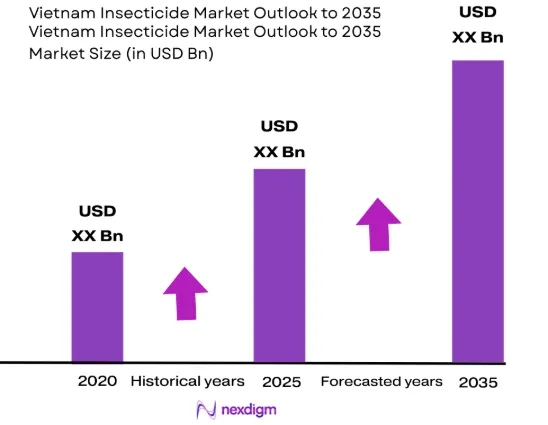
The Vietnam Insecticide Market is valued at approximately USD ~ billion, forming a major component of the country’s crop protection industry. Vietnam’s agricultural sector generated approximately USD ~ billion in output, while agricultural exports exceeded USD ~ billion. Rice cultivation covered more than 7.1 million hectares, coffee plantations exceeded 700,000 hectares, and fruit production continued expanding across export-oriented regions. The market is driven by increasing pest pressure in rice, coffee, fruits, vegetables, and pepper cultivation, coupled with growing adoption of modern crop protection technologies and integrated pest management practices. Export-oriented agriculture and stricter residue compliance standards further support demand for insecticide products across the country.
Market Segmentation
By Product Category
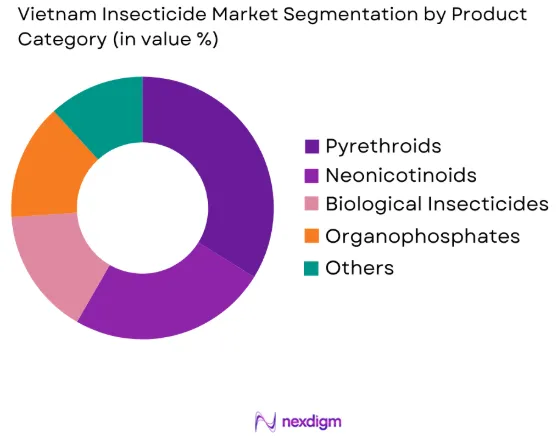
Vietnam Insecticide Market is segmented by product category into pyrethroids, neonicotinoids, biological insecticides, organophosphates, and others. Recently, pyrethroids have held the dominant market share because they are extensively used across rice, coffee, vegetables, fruits, and pepper cultivation. Vietnamese farmers rely on pyrethroid formulations for controlling brown planthoppers, stem borers, leaf folders, aphids, and other economically significant pests. Their broad-spectrum efficacy, rapid knockdown effect, affordability, and widespread availability through agrochemical dealer networks contribute to their leadership position. Rice farmers in the Mekong Delta and Red River Delta extensively utilize pyrethroids due to recurring pest outbreaks. Additionally, these products are frequently incorporated into integrated pest management programs because of their operational flexibility. Although biological insecticides are gaining momentum due to sustainability initiatives and export compliance requirements, pyrethroids continue to dominate owing to their proven effectiveness and strong farmer familiarity across Vietnam’s major agricultural regions.
By Crop Type
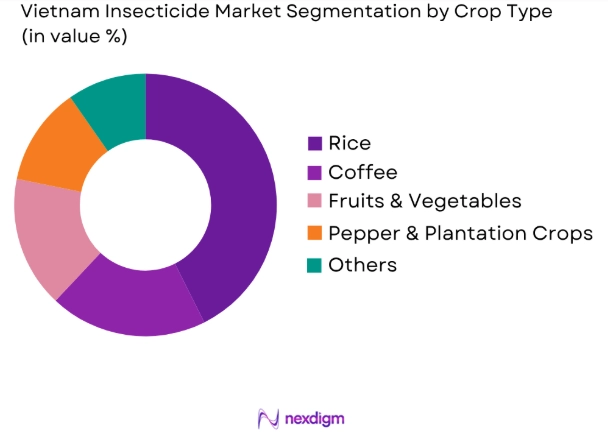
Vietnam Insecticide Market is segmented by crop type into rice, coffee, fruits and vegetables, pepper and plantation crops, and others. Recently, rice has held the dominant market share because Vietnam remains one of the world’s largest rice-producing and exporting countries. Rice cultivation occupies more than seven million hectares and faces continuous threats from brown planthoppers, stem borers, rice leaf folders, and other insect pests capable of causing substantial yield losses. Farmers in the Mekong Delta and Red River Delta regularly apply insecticides to maintain crop productivity and meet export quality requirements. Government initiatives promoting food security and rice export competitiveness further encourage investment in crop protection solutions. Additionally, rice is cultivated across multiple growing seasons annually, resulting in repeated insecticide applications. This combination of extensive cultivated acreage, pest pressure, and export-oriented production supports rice’s dominant position within Vietnam’s insecticide market.
Competitive Landscape
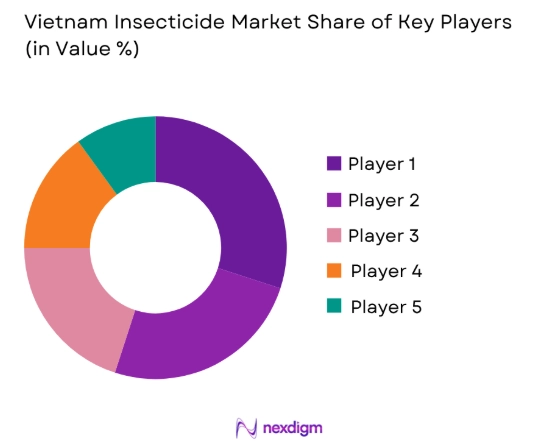
The Vietnam Insecticide Market is moderately consolidated, with multinational agrochemical companies competing alongside domestic crop protection manufacturers and distributors. Market competition is influenced by product registrations, dealer network strength, active ingredient portfolios, biological crop protection offerings, and crop-specific solutions for rice, coffee, fruits, and vegetables. International players maintain strong positions through innovation and research capabilities, while domestic companies leverage local distribution and farmer relationships.
| Company | Establishment Year | Headquarters | Active Ingredient Portfolio | Biological Portfolio | Distribution Network | Rice Crop Focus | Coffee Crop Focus | Competitive Position |
| Syngenta Vietnam | 2000 | ~ | ~ | ~ | ~ | ~ | ~ | ~ |
| Bayer Vietnam Crop Science | 1863 | ~ | ~ | ~ | ~ | ~ | ~ | ~ |
| BASF Vietnam | 1865 | ~ | ~ | ~ | ~ | ~ | ~ | ~ |
| Corteva Agriscience Vietnam | 2019 | ~ | ~ | ~ | ~ | ~ | ~ | ~ |
| Loc Troi Group | 1993 | ~ | ~ | ~ | ~ | ~ | ~ | ~ |
Vietnam Insecticide Market
Growth Drivers
Expansion of Agricultural Production
Vietnam’s pesticide market is strongly supported by the scale and export orientation of its agricultural sector. According to the Ministry of Agriculture and Rural Development (MARD), Vietnam’s agricultural, forestry, and fishery exports reached USD 62.4 billion, while the sector generated a record USD 18.6 billion trade surplus. Rice cultivation covered approximately 7.112 million hectares, producing 43.7 million tonnes of rice, while coffee cultivation reached 716.6 thousand hectares. Fruit and vegetable production exceeded 13.5 million tonnes, creating substantial demand for crop protection products against insects, diseases, and weeds. Growing export requirements for rice, coffee, pepper, fruits, and vegetables are increasing the need for effective pesticide management to protect yields and maintain export quality standards. These agricultural production levels continue to create a large addressable market for pesticide manufacturers and distributors operating across Vietnam.
Rising Pest Pressure and Food Security Requirements
Increasing pest incidence across major crops is driving pesticide demand throughout Vietnam. Rice remains the dominant crop, accounting for approximately 82% of the country’s arable land, while national rice output exceeds 43 million tonnes. Coffee plantations in the Central Highlands cover more than 700,000 hectares, creating significant exposure to insect infestations and crop diseases. Climate variability has intensified pest risks, with reports indicating that nearly 350,000 hectares of rice and crops experienced damage from adverse climatic events. Additionally, agricultural exports continue expanding, with rice exports exceeding 9 million tonnes and generating more than USD 5 billion in export earnings. Protecting these strategic crops from pest-related losses remains a priority for both farmers and policymakers, supporting consistent pesticide consumption across the country’s agricultural regions.
Market Challenges
Tightening Pesticide Residue and Export Compliance Requirements
Vietnam’s growing dependence on agricultural exports creates significant challenges for pesticide suppliers and farmers. Agricultural exports reached USD 62.4 billion, while fruit and vegetable exports alone generated billions of dollars in foreign exchange earnings. Export markets such as China, the European Union, Japan, and the United States increasingly enforce strict Maximum Residue Limits (MRLs), requiring careful pesticide selection and application. Vietnam exported more than 9 million tonnes of rice, while coffee exports generated substantial revenues, making compliance critical for maintaining market access. Farmers and distributors must continuously adapt to evolving regulatory requirements and approved active ingredient lists. Failure to comply with international residue standards can result in shipment rejections, financial losses, and reduced competitiveness, creating operational challenges across Vietnam’s pesticide value chain.
Dependence on Imported Active Ingredients and Supply Chain Vulnerability
Vietnam’s pesticide industry remains heavily dependent on imported technical-grade active ingredients and formulated products, exposing the market to global supply chain disruptions. The country’s agriculture sector supports over 7 million hectares of rice cultivation, 716.6 thousand hectares of coffee plantations, and rapidly expanding fruit and vegetable production exceeding 13.5 million tonnes. These large crop areas require a continuous supply of crop protection products throughout the year. Any disruption in international logistics, geopolitical tensions, container shortages, or regulatory restrictions can impact product availability. Furthermore, climate-related agricultural pressures, including crop damage affecting 350,000 hectares, increase demand volatility and inventory management complexity. These supply-side dependencies remain a major challenge for pesticide manufacturers, importers, distributors, and agricultural cooperatives operating in Vietnam.
Market Opportunities
Growth of Biological and Sustainable Crop Protection Solutions
Vietnam’s transition toward sustainable agriculture is creating opportunities for biological pesticides and environmentally friendly crop protection products. Agricultural exports reached USD 62.4 billion, supported by increasing adoption of international production standards and green agriculture initiatives. The government’s agricultural development strategy maintains approximately 3.56 million hectares of rice farmland under long-term food security planning while encouraging sustainable production systems. Fruit and vegetable exports continue expanding, with export revenues reaching billions of dollars annually, increasing pressure to comply with residue standards in international markets. Biological pesticides offer farmers a pathway to improve export compliance while reducing environmental impact. As exporters focus on premium international markets and sustainable farming certifications, biological crop protection solutions are expected to gain stronger adoption across rice, coffee, fruits, vegetables, and plantation crops.
Digital Agriculture and Precision Application Technologies
The modernization of Vietnam’s agricultural sector creates opportunities for precision pesticide application technologies, digital farming platforms, and drone-assisted spraying solutions. Rice cultivation exceeds 7.1 million hectares, coffee plantations cover over 700 thousand hectares, and agricultural exports generate more than USD 62 billion in annual revenue. Large-scale production systems increasingly require efficient resource utilization and optimized crop protection strategies. Digital pest monitoring, remote sensing, GPS-guided spraying systems, and drone applications can help farmers improve application accuracy while reducing wastage. Furthermore, Vietnam’s economy recorded growth of 6.82 during the first three quarters, supporting investments in agricultural modernization and technology adoption. As commercial farms, cooperatives, and export-oriented producers pursue higher productivity and sustainability, precision agriculture technologies present significant growth opportunities within the pesticide ecosystem.
Future Outlook
The Vietnam Insecticide Market is expected to grow steadily through the forecast period, supported by rising agricultural exports, increasing pest pressure, modernization of farming practices, and stronger adoption of integrated pest management programs. Export-oriented crops such as rice, coffee, fruits, vegetables, and pepper will continue to require advanced crop protection solutions to meet international quality standards. Biological insecticides are expected to gain increasing adoption as Vietnam strengthens sustainable agriculture initiatives and residue-compliance requirements for export markets. Manufacturers are likely to expand investments in environmentally friendly formulations and integrated pest management solutions. Drone-assisted spraying, precision agriculture technologies, AI-enabled pest monitoring systems, and digital farm advisory platforms are expected to transform insecticide application practices. Farmers are increasingly seeking productivity-enhancing technologies that reduce input waste while improving pest-control efficiency. Vietnam’s expanding role in global agricultural exports is expected to create sustained demand for effective insecticide solutions capable of protecting crop yields while meeting evolving sustainability and food safety requirements.
Major Players
- Syngenta Vietnam
- Bayer Vietnam Crop Science
- BASF Vietnam
- Corteva Agriscience Vietnam
- FMC Vietnam
- UPL Vietnam
- ADAMA Vietnam
- Sumitomo Chemical Vietnam
- Nong Duoc Hai (HAI Agrochem)
- Loc Troi Group
- An Giang Plant Protection Joint Stock Company
- Vietnam Fumigation Joint Stock Company (VFC)
- VIPESCO (Vietnam Pesticide Joint Stock Company)
- Nufarm Vietnam
- East-West Seed Crop Protection Vietnam
Key Target Audience
- Agrochemical Manufacturers
- Biological Crop Protection Companies
- Agricultural Cooperatives
- Rice Producer Associations
- Coffee Plantation Operators
- Agrochemical Distributors and Dealer Networks
- Investments and Venture Capitalist Firms
- Government and Regulatory Bodies
Research Methodology
Step 1: Identification of Key Variables
The initial phase involves constructing an ecosystem map encompassing all major stakeholders within the Vietnam Insecticide Market. This includes agrochemical manufacturers, distributors, importers, farmer cooperatives, plantation operators, exporters, agronomists, and regulatory agencies. Extensive secondary research is conducted to identify variables affecting insecticide demand, crop protection expenditure, pest incidence, and technology adoption.
Step 2: Market Analysis and Construction
In this phase, historical data relating to crop acreage, insecticide consumption, active ingredient demand, agricultural exports, pest outbreaks, and regional crop production are compiled and analyzed. Market sizing is performed through top-down and bottom-up approaches to ensure accurate validation of market estimates.
Step 3: Hypothesis Validation and Expert Consultation
Market hypotheses are validated through computer-assisted telephone interviews with agrochemical companies, distributors, rice farmers, coffee plantation operators, horticulture growers, and agricultural cooperatives. These consultations provide insights into purchasing behavior, product preferences, resistance management strategies, and biological insecticide adoption.
Step 4: Research Synthesis and Final Output
The final phase integrates primary and secondary research findings to validate market estimates, segmentation, competitive positioning, growth drivers, challenges, and opportunities. Direct engagement with industry stakeholders ensures a comprehensive and accurate assessment of the Vietnam Insecticide Market.

- Executive Summary
- Research Methodology (Market definitions and assumptions, abbreviations, Vietnam insecticide taxonomy, active ingredient classification, crop protection scope, MARD pesticide registration framework, plant protection regulations, market sizing approach, top-down and bottom-up triangulation, distributor validation, agro-dealer interviews, farmer consultations, treated acreage assessment, pest incidence mapping, crop protection expenditure analysis, import-export trade assessment, limitations and future conclusions)

- Definition and Scope
- Overview Genesis
- Timeline of Major Players
- Business Cycle
- Supply Chain and Value Chain Analysis

- Growth Drivers (Rice production intensity, export-oriented agriculture, increasing pest pressure, coffee plantation protection, horticulture expansion, food security requirements, biological insecticide adoption, modernization of crop protection practices)
- Market Challenges (Counterfeit agrochemicals, pesticide residue compliance, resistance development, fragmented distribution networks, climate variability, regulatory changes, farmer awareness gaps, dependency on imported active ingredients)
- Opportunities (Biological crop protection expansion, drone spraying adoption, integrated pest management implementation, precision agriculture technologies, export crop quality management, sustainable farming initiatives, digital agriculture platforms, residue-compliant crop protection solutions)
- Market Trends (Biological insecticide adoption, drone-assisted pesticide application, digital pest monitoring, reduced-residue crop protection, AI-enabled farm advisory platforms, sustainable agriculture practices, integrated pest management expansion, smart farming technologies)
- Government Regulation (MARD pesticide registration, Plant Protection Department regulations, pesticide residue standards, export crop compliance requirements, agrochemical import controls, environmental safety assessments, integrated pest management programs, sustainable agriculture policies)
- SWOT Analysis
- Stakeholder Ecosystem
- Porter’s Five Forces
- Competition Ecosystem

- By Market Value (2020-2025)
- By Volume Consumption (2020-2025)
- By Active Ingredient Consumption (2020-2025)

- By Product Category (In Value %)
Pyrethroids
Neonicotinoids
Biological Insecticides
Organophosphates
Others - By Crop Type (In Value %)
Rice
Coffee
Fruits and Vegetables
Pepper and Plantation Crops
Others - By Application Method (In Value %)
Foliar Spray
Seed Treatment
Soil Treatment
Drone-Based Application
Others - By Pest Type (In Value %)
Brown Planthoppers
Stem Borers
Fruit Flies
Thrips and Aphids Others - By Distribution Channel (In Value %)
Agrochemical Dealers and Retailers
Agricultural Cooperatives
Direct Company Sales
Provincial Distribution Networks
Digital Agri-Input Platforms - By Region (In Value %)
Mekong Delta
Red River Delta
Central Highlands
Southeast Vietnam
North Central and Coastal Vietnam

- Market Share of Major Players (Market value, volume sales, active ingredient portfolio, treated acreage coverage, rice crop penetration, biological product portfolio, dealer network reach, regional footprint)
- Cross Comparison Parameters (Registered active ingredients, rice and coffee crop penetration, biological insecticide portfolio, dealer and distributor network strength, manufacturing and formulation capabilities, R&D investment in crop protection, export-compliant product portfolio, digital agriculture integration capability)
- SWOT Analysis of Major Players
- Pricing Analysis Basis SKUs (Imidacloprid formulations, Lambda-cyhalothrin formulations, Chlorpyrifos alternatives, Emamectin Benzoate products, Biological insecticides, Brown planthopper control products, Stem borer control products, Fruit fly control products, Coffee pest management products, Seed treatment insecticides)
- Detailed Profiles of Major Companies
Syngenta Vietnam
Bayer Vietnam Crop Science
BASF Vietnam
Corteva Agriscience Vietnam
FMC Vietnam
UPL Vietnam
ADAMA Vietnam
Sumitomo Chemical Vietnam
Nong Duoc Hai (HAI Agrochem)
Loc Troi Group
An Giang Plant Protection JSC
VFC Corporation (Vietnam Fumigation JSC)
Vietnam Pesticide Joint Stock Company (VIPESCO)
Nufarm Vietnam
East-West Seed Crop Protection Vietnam

- Rice Farmer Analysis
- Coffee Plantation Operator Analysis
- Fruit and Vegetable Grower Analysis
- Pepper and Plantation Crop Producer Analysis
- Agricultural Cooperative Analysis
- Commercial Agribusiness Analysis

- By Market Value (2026-2035)
- By Volume Consumption (2026-2035)
- By Active Ingredient Consumption (2026-2035)


 Request a Sample
 Ask for Customization
 Get a Quote
 Enquire Now