
 Download PDF
Market Overview
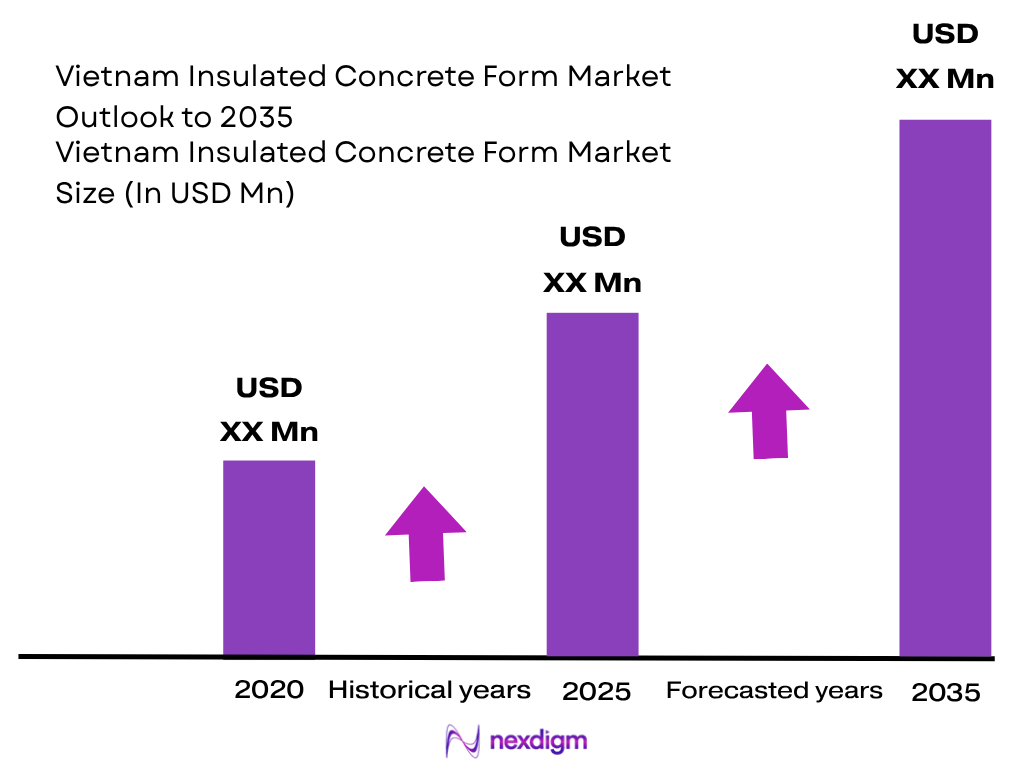
The Vietnam Insulated Concrete Form Market is valued at approximately USD ~XX million, based on historical demand for insulated reinforced-concrete wall systems. The addressable green-building base expanded from 396 certified buildings in the preceding annual base to 559 buildings covering more than 13.6 million m² in the latest annual count. An additional 163 green buildings entered certification during the latest period, strengthening demand for high-performance envelopes, thermal insulation and permanent-formwork technologies.
Ho Chi Minh City, Hanoi, Binh Duong, Bac Ninh and Hai Phong constitute the strongest potential demand clusters for Vietnam ICF because they combine dense development pipelines, industrial construction and the largest concentrations of certified green buildings. Ho Chi Minh City’s completed residential floor area increased from 1.703 million m² in the preceding period to 3.041 million m² in the latest period. These cities also concentrate developers, contractors, ready-mix concrete infrastructure, EPS supply and sophisticated building-envelope specifications.
Market Segmentation
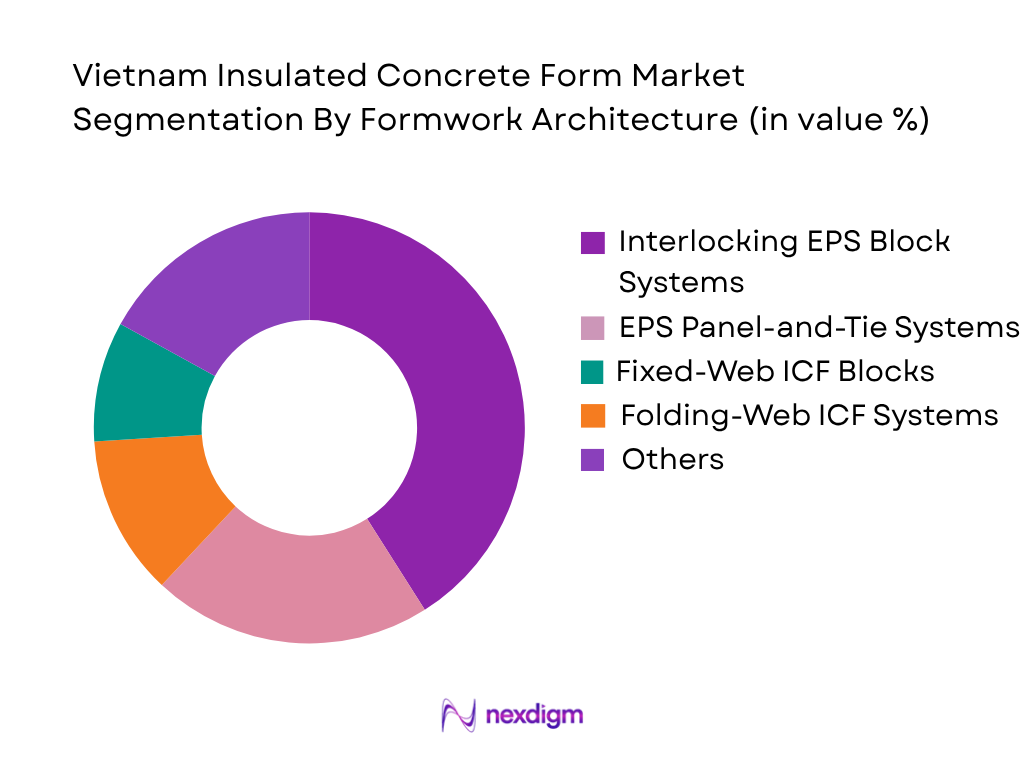
By Formwork Architecture
The Vietnam Insulated Concrete Form Market is segmented into interlocking EPS block systems, EPS panel-and-tie systems, fixed-web ICF blocks, folding-web systems, variable-width panel systems, wood-cement permanent formwork and hybrid insulated formwork. Interlocking EPS block systems hold the dominant report-model share because EPS blocks combine permanent insulation, concrete formwork and repetitive modular installation within one wall assembly. The system is compatible with Vietnam’s familiarity with reinforced-concrete construction while reducing dependence on conventional removable wall formwork. EPS also permits factory-moulded corners, straight blocks and specialty units, facilitating villas, low-rise residential buildings, hotels and selected commercial structures. Vietnam already possesses an established EPS and polymer-processing manufacturing base, providing a technical foundation for future localisation of ICF moulding. Permanent EPS forms additionally support thermal continuity across the concrete wall, an increasingly relevant consideration as green-building certification and energy-efficiency requirements gain importance. Panel-and-tie systems remain significant where contractors require adjustable wall widths, while wood-cement systems occupy a smaller sustainability-oriented niche.
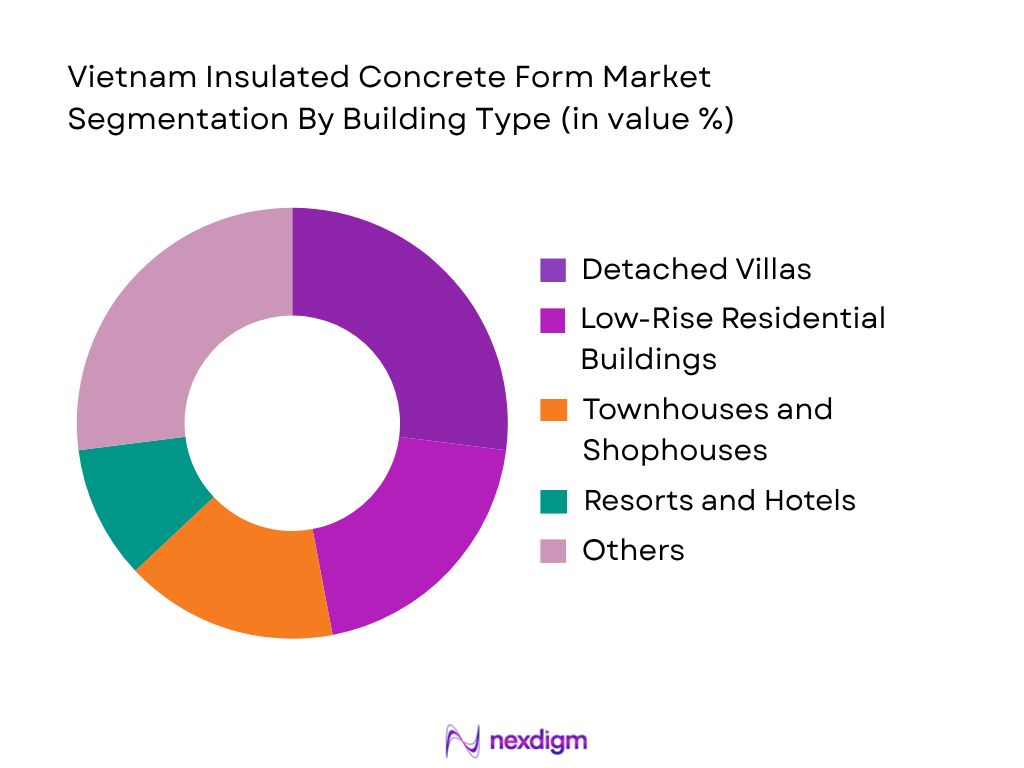
By Building Type
The Vietnam Insulated Concrete Form Market is segmented into detached villas, townhouses and shophouses, low-rise residential buildings, apartments and multi-family housing, social housing, resorts and hotels, commercial buildings, industrial facilities and institutional construction. Detached villas and low-rise residential projects represent the dominant report-model application base, reflecting the suitability of ICF for projects where individual developers can select alternative structural-wall technologies. These buildings benefit from monolithic reinforced-concrete walls, integrated insulation, acoustic separation and flexible openings without requiring the repetitive structural systems typically specified for large towers. Vietnam’s broader housing pipeline reinforces the opportunity: the Ministry of Construction recorded 79 newly licensed commercial housing projects containing about 38,345 units and 69 completed projects containing approximately 23,041 units during the latest annual reporting period. Social housing also provides a future standardisation opportunity because repetitive wall layouts and large unit volumes can support industrialised ICF installation, although conventional reinforced concrete, masonry and precast solutions presently remain deeply established.
Competitive Landscape
The Vietnam Insulated Concrete Form Market remains fragmented and technically developing, rather than being controlled by a large domestic ICF manufacturing oligopoly. Competition involves international ICF technology providers, EPS-based building-system companies, imported permanent-formwork solutions and Vietnam-based construction-material suppliers. Terraco has a particularly relevant local position because it established production in Vietnam and maintains a Ho Chi Minh City presence while supporting EPS-based building-envelope and ICF finishing applications. Global ICF specialists provide important technology benchmarks for block geometry, core flexibility, installation systems, thermal performance and technical training.
| Major Player | Established | Headquarters | Formwork Architecture | Insulation Technology | Concrete-Core Flexibility | Residential / Commercial Capability | Vietnam / Asia Supply Position | Technical Support Capability |
| Terraco | 1980 | International Group / Vietnam operations in Ho Chi Minh City | ~ | ~ | ~ | ~ | ~ | ~ |
| Nudura | 2001 | Beachwood, Ohio, USA | ~ | ~ | ~ | ~ | ~ | ~ |
| Amvic Building System | 1997 | Toronto, Canada | ~ | ~ | ~ | ~ | ~ | ~ |
| Fox Blocks | 2005 | Omaha, Nebraska, USA | ~ | ~ | ~ | ~ | ~ | ~ |
| BEWI | 1980 | Frøya, Norway | ~ | ~ | ~ | ~ | ~ | ~ |
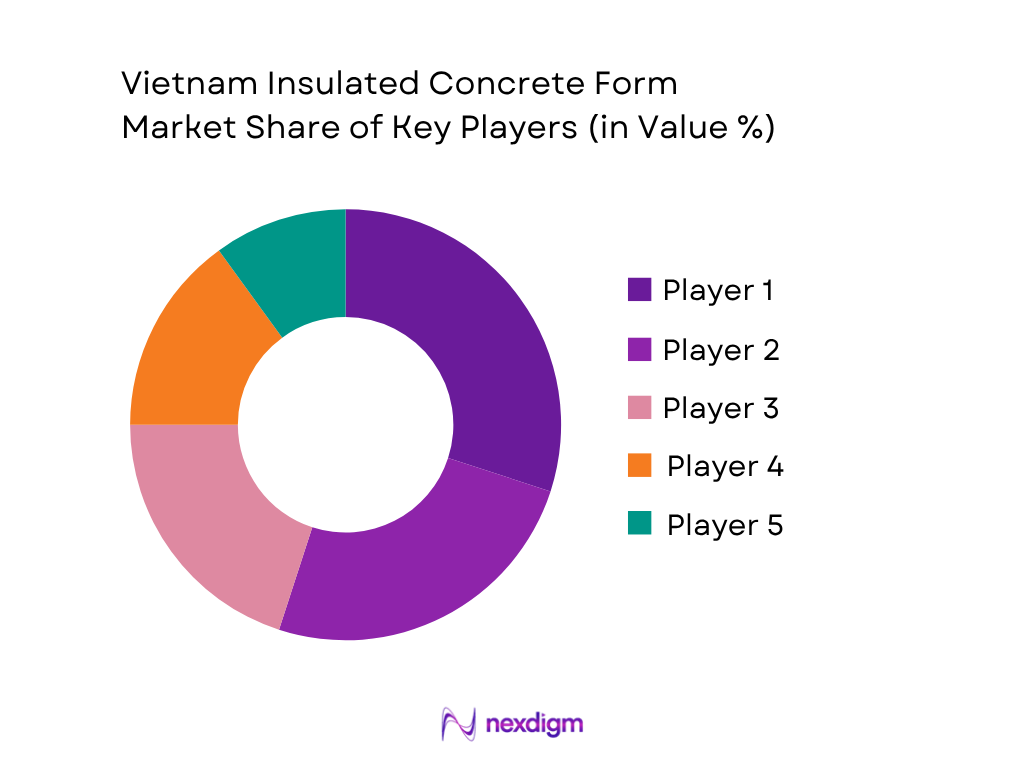
Vietnam Insulated Concrete Form Market Analysis
Growth Drivers
Expanding Residential and Social Housing Construction Pipeline
Vietnam’s expanding housing pipeline is a direct growth driver for the Vietnam Insulated Concrete Form Market because ICF systems are most relevant where developers require repetitive structural walls, integrated insulation, faster enclosure, and reduced reliance on removable formwork. The Ministry of Construction reported 79 newly licensed commercial housing projects representing 38,345 dwellings in 2024, alongside 69 completed projects representing 23,041 dwellings. At year-end, 937 commercial housing projects with about 403,349 dwellings were under construction, creating a substantial addressable base for alternative wall systems in villas, townhouses, low-rise housing, and selected apartment projects. Social housing adds another channel: 28 projects with 20,284 units were completed and 23 projects with 25,399 units were licensed and started during 2024. This construction depth supports contractor learning, mould standardisation, domestic EPS fabrication, reinforcement integration, and ready-mix concrete coordination. World Bank data place Vietnam’s 2024 GDP at USD 476.39 billion and GDP per capita at USD 4,717.3, providing the macroeconomic scale required to sustain building-system modernisation and higher-performance construction adoption.
Green Building Expansion and Energy-Efficient Envelope Demand
Vietnam’s accelerating green-building ecosystem is strengthening the case for the Vietnam Insulated Concrete Form Market because ICF combines continuous insulation, reinforced concrete structure, thermal mass, and reduced thermal bridging within one permanent wall system. The Ministry of Construction reported 559 certified green buildings covering more than 13.6 million square metres of floor area at the end of 2024. Hanoi alone accounted for more than 2.16 million square metres of certified green-building floor area, second only to Ho Chi Minh City, concentrating high-performance specifications in the country’s largest construction markets. By the third quarter of 2025, Vietnam had surpassed 600 certified green buildings with nearly 17 million square metres of floor area. In 2026, selected construction-material groups became subject to energy-labelling requirements, reinforcing demand for products that affect building energy performance. These developments create specification opportunities for insulated permanent formwork across residential, hospitality, commercial, and institutional buildings. World Bank data place Vietnam’s 2024 GDP at USD 476.39 billion and GDP per capita at USD 4,717.3, supporting continued investment in technically advanced building envelopes and energy-efficient construction materials.
Market Challenges
Entrenched Conventional Concrete and Masonry Construction Ecosystem
The strongest challenge for the Vietnam Insulated Concrete Form Market is competition from entrenched conventional concrete, masonry, and alternative wall systems operating at considerable scale across the national construction sector. The Ministry of Construction reported 937 commercial housing projects with about 403,349 dwellings under construction at the end of 2024, while 69 projects containing about 23,041 dwellings were completed during the year. These projects are generally supported by established contractor, reinforcement, brick, block, ready-mix concrete, and removable-formwork supply chains, meaning ICF must replace familiar specifications rather than enter an unserved construction category. Vietnam also consumed approximately 65.3 million tonnes of cement domestically in 2024, while combined cement and clinker consumption reached about 95 million tonnes, demonstrating the depth of traditional concrete-material infrastructure. This scale benefits techniques already supported by local crews, engineering practices, procurement processes, and construction detailing. World Bank data place Vietnam’s 2024 GDP at USD 476.39 billion and GDP per capita at USD 4,717.3. ICF suppliers therefore require strong local engineering, training, reference projects, and standardized detailing before wider substitution of established wall systems can occur.
Limited Specialized Installation Capability and Technical Standardisation
Limited specialised installation capability and incomplete technical standardisation create another challenge for the Vietnam Insulated Concrete Form Market. ICF walls require accurate block alignment, temporary bracing, reinforcement placement, service penetrations, opening detailing, controlled concrete lift sequencing, and appropriate pumping practices, making site execution more dependent on system-specific training than conventional masonry. Vietnam had 17.4 million employed people in industry and construction during 2024, according to the General Statistics Office, but ICF remains a niche construction technique within that much larger labour pool and does not benefit from comparable installer familiarity. The Ministry of Construction also highlighted in 2026 that domestic standards for green construction materials were not yet fully unified, while technology investment, testing, and certification continued to create barriers for innovative materials. These conditions increase the importance of structural calculations, fire documentation, tropical-moisture detailing, technical supervision, and approved installer development. World Bank data place Vietnam’s 2024 GDP at USD 476.39 billion and GDP per capita at USD 4,717.3. Developing dedicated contractor networks is therefore necessary to reduce installation risk and strengthen developer confidence in ICF systems.
Market Opportunities
Social Housing as a Platform for Standardized ICF Deployment
Social and affordable housing provides a significant future opportunity for the Vietnam Insulated Concrete Form Market because repetitive unit layouts can support standardized block dimensions, recurring reinforcement details, repeatable concrete pours, and faster wall-cycle learning across large developments. The Ministry of Construction reported 645 social housing projects covering 581,218 dwellings under implementation at the end of 2024. Within this pipeline, 96 projects representing 57,652 dwellings had been completed, 135 projects representing 115,630 dwellings had commenced construction, and 414 projects representing 407,936 dwellings had received investment approval. Momentum continued during 2025, when the national programme expanded to 692 projects covering 633,559 dwellings, including 146 completed projects with 102,387 dwellings and 124 started projects with 112,952 dwellings. This scale creates a practical route for ICF suppliers to localize moulds, establish standardized house types, train repeat installation teams, and integrate domestic concrete and reinforcement supply. World Bank data place Vietnam’s 2024 GDP at USD 476.39 billion and GDP per capita at USD 4,717.3, supporting the industrial capacity needed for wider housing-system localization.
Green Urban and High-Performance Building Envelope Applications
Green urban, commercial, hospitality, and industrial development creates another future opportunity for the Vietnam Insulated Concrete Form Market because ICF can combine structural strength and continuous insulation within one wall assembly for projects seeking better building-energy performance. Vietnam recorded 559 certified green buildings with more than 13.6 million square metres of floor area at the end of 2024, while Hanoi alone represented more than 2.16 million square metres. By the third quarter of 2025, the national portfolio exceeded 600 green buildings with nearly 17 million square metres of certified floor area, expanding the pool of projects where thermal-envelope requirements can influence wall-system selection. In 2026, energy labelling became mandatory for selected construction-material groups, further strengthening the policy direction toward measurable material efficiency. These current indicators create opportunities for locally adapted EPS, graphite-EPS, reinforced-concrete-core, waterproofed, and rendered ICF assemblies tailored to Vietnam’s climate. World Bank data place Vietnam’s 2024 GDP at USD 476.39 billion and GDP per capita at USD 4,717.3. This supports future localisation through domestic moulding, engineering partnerships, distribution networks, and integrated high-performance wall packages.
Future Outlook
The Vietnam Insulated Concrete Form Market is forecast to grow at approximately ~XX% CAGR during 2026–2035, supported by green-building expansion, higher-performance building envelopes, housing development and gradual construction industrialisation. The strongest opportunity is expected to come from projects where developers value insulation, structural continuity and accelerated wall construction simultaneously rather than treating thermal insulation as a separate finishing layer.
Vietnam’s green-building ecosystem provides an increasingly important specification environment. The country finished the latest reporting period with 559 certified green buildings and more than 13.6 million m² of certified floor area, after adding 163 certified projects during the period. The Ministry of Construction has subsequently reported the national portfolio moving beyond 600 green buildings with nearly 17 million m² of floor area, indicating continuing adoption of higher-performance design and construction practices.
Residential development should remain the largest potential ICF application pool. Commercial housing recorded 79 newly licensed projects representing approximately 38,345 dwellings, while another 69 projects representing about 23,041 dwellings reached completion in the latest full-year Ministry of Construction dataset. Social housing provides another potential route to industrialised permanent formwork: 28 social-housing projects containing 20,284 units were completed in the same reporting period, while projects representing 25,399 units were licensed and commenced.
Major Players
- Nudura
- Amvic Building System
- Fox Blocks
- BuildBlock Building Systems
- Quad-Lock Building Systems
- BEWI
- SuperForm Products
- Element ICF
- IntegraSpec
- Logix ICF – Legacy ICF Brand / System Benchmark
- Zolo Formwork / ZPLASTK
- ICF Systems / Stronghold ICF
- Velox Building Systems
- Durisol / Woodcrete ICF Systems
- Terraco Vietnam
Key Target Audience
- Insulated Concrete Form Manufacturers and EPS Formwork Producers
- Residential Developers and Housebuilders
- Resort, Hotel and Hospitality Developers
- Industrial and Logistics Property Developers
- Building Material, EPS, Ready-Mix Concrete and Reinforcement Manufacturers
- Architects, Structural Engineering Practices and Building-System Specifiers
- Investments and Venture Capitalist Firms
- Government and Regulatory Bodies (Ministry of Construction, Vietnam Institute for Building Science and Technology, Institute for Building Materials, Provincial Departments of Construction and Vietnam Standards and Quality Institute)
Research Methodology
Step 1: Identification of Key Variables
The initial phase involves constructing a comprehensive ecosystem map for the Vietnam Insulated Concrete Form Market, covering EPS resin suppliers, foam moulders, proprietary ICF manufacturers, polymer-tie producers, reinforcement suppliers, ready-mix concrete companies, distributors, architects, structural engineers, installers, contractors and property developers. The principal variables include installed ICF wall area, block consumption, EPS density, concrete-core dimensions, reinforcement configuration, domestic production capability, imported system penetration, application type, thermal performance and distribution structure.
Step 2: Market Analysis and Construction
Historical market assessment is undertaken through integrated top-down and bottom-up modelling. The top-down approach evaluates Vietnam’s residential construction pipeline, green-building floor area, social housing, villas, resorts, commercial projects and industrial buildings to define the addressable structural-wall market. The bottom-up approach calculates potential ICF consumption using block dimensions, wall area per project, concrete-core configuration, EPS volume, supplier activity and project-level installation patterns. Both models are reconciled before final market construction.
Step 3: Hypothesis Validation and Expert Consultation
Market hypotheses are validated through computer-assisted telephone interviews and direct discussions with EPS processors, construction-material distributors, developers, structural engineers, architects, ready-mix concrete suppliers and contractors. Primary discussions examine actual awareness of ICF, preferred wall technologies, reinforcement practices, concrete-placement constraints, fire documentation, tropical-climate performance, acceptable block configurations, installation requirements and substitution against fired-clay brick, AAC blocks, precast concrete and conventional reinforced-concrete wall construction.
Step 4: Research Synthesis and Final Output
The final phase integrates primary intelligence with construction statistics, green-building data, building regulations, supplier product specifications and project-level modelling. Bottom-up ICF wall-area calculations are cross-validated with top-down building activity to avoid overstatement of this emerging construction technology. Competitive benchmarking then evaluates system architecture, EPS insulation configuration, concrete-core flexibility, structural engineering support, thermal and fire performance, localisation potential, Vietnam distribution capability and installer training to produce the final Vietnam Insulated Concrete Form Market outlook.

- Executive Summary
- Research Methodology (Market Definition and Scope, Vietnam Insulated Concrete Form Market Classification, ICF Wall System Demand Assessment, EPS Formwork Consumption Mapping, Reinforced Concrete Core Assessment, Domestic EPS Manufacturing Capacity Mapping, Imported ICF System Assessment, Residential and Non-Residential Construction Demand Analysis, Green Building Project Mapping, Thermal Insulation Requirement Assessment, Application-Level Demand Assessment, Installer and Contractor Ecosystem Mapping, Primary Industry Interviews, Top-Down Market Sizing, Bottom-Up ICF Wall Area and Company Revenue Assessment, Trade Flow Analysis, Data Triangulation, Pricing Assessment, Forecasting Framework)

- Definition and Scope
- Vietnam Insulated Concrete Form Industry Evolution and Development of EPS Permanent Formwork, Reinforced Concrete Wall and Energy-Efficient Building Ecosystem
- ICF Block, EPS Panel, Polymer Tie, Reinforcement and Concrete-Core Industry Structure
- Vietnam Insulated Concrete Form Value Chain Analysis
- Vietnam Insulated Concrete Form Supply Chain Analysis
- EPS Resin Supplier, EPS Moulder, ICF System Manufacturer, Polymer Tie Supplier, Reinforcement Supplier, Ready-Mix Concrete Producer, Distributor, Structural Engineer, Contractor, Developer and Building Owner Ecosystem Analysis
- Insulated Concrete Form Integration Across Villas, Low-Rise Housing, Resorts, Hotels, Commercial Buildings, Industrial Facilities, Basements and Green Buildings

- Growth Drivers (Expansion of Residential and Villa Construction, Green Building Development, Growing Thermal-Envelope Requirements, Reinforced Concrete Construction Familiarity, Expansion of Resorts and Hospitality Assets, Industrial and Logistics Construction, Faster Wall Construction Requirements, Reduced Wet-Trade Dependence, Greater Demand for Thermal and Acoustic Comfort)
- Market Challenges (Limited ICF Contractor Familiarity, Low Architect and Developer Awareness, Competition from Brick Masonry and AAC, Dependence on Imported Proprietary ICF Systems, EPS Fire-Performance Perception, Concrete Pour Quality Control, Formwork Bracing Requirements, Lack of Standardized Local ICF Specifications, Installer Training Requirements, Project-Specific Structural Engineering)
- Market Opportunities (Domestic ICF Block Manufacturing, Graphite EPS Permanent Formwork, Low-Energy Villa Construction, Resort and Hospitality Projects, Social Housing Applications, Green Industrial Buildings, High-Performance Residential Envelopes, Flood-Resilient Concrete Housing, Imported System Localization, Integrated Wall-and-Foundation Packages)
- Market Trends (Green Construction Materials, High-Performance EPS Adoption, Permanent Formwork Systems, Reinforced Monolithic Wall Construction, Prefabrication Integration, Lower Thermal Transmittance, Reduced Thermal Bridging, Construction Waste Reduction, Digital Structural Design, Integrated Waterproofing and Finishing Systems)
- Regulatory and Standards Landscape (QCVN Energy-Efficient Building Requirements, Vietnam Building Code Requirements, Fire Safety Regulations, Structural Concrete Standards, EPS Material Standards, TCVN Thermal Insulation Standards, Green Building Certification, Energy Labelling of Construction Materials, Construction Material Conformity Requirements, Environmental and Waste Management Requirements)
- SWOT Analysis
- Porter’s Five Forces Analysis
- PESTLE Analysis
- Stakeholder Ecosystem
- Competition Ecosystem

- By Market Value (2020-2025)
- By ICF Wall Area Installed (2020-2025)
- By ICF Block and Panel Consumption Volume (2020-2025)
- By EPS-Based ICF Consumption Volume (2020-2025)
- By Reinforced Concrete Core Volume Used in ICF Construction (2020-2025)
- By Residential ICF Wall Area (2020-2025)
- By Non-Residential ICF Wall Area (2020-2025)
- By Domestic ICF Production Volume (2020-2025)
- By Imported ICF System Volume (2020-2025)
- By Average Selling Price (2020-2025)

- By Formwork Architecture (In Value %)
Interlocking EPS Block Systems
EPS Panel-and-Tie Systems
Folding-Web ICF Systems
Fixed-Web ICF Blocks
Variable-Width Panel Systems
Wood-Cement Permanent Formwork Systems
Hybrid Insulated Concrete Form Systems
Specialty High-Insulation ICF Systems - By Insulation Material (In Value %)
Standard Expanded Polystyrene
Graphite-Enhanced Expanded Polystyrene
High-Density Expanded Polystyrene
Recycled-Content Expanded Polystyrene
XPS-Integrated Formwork Systems
Cement-Bonded Wood-Fibre Formwork
EPS-PIR Hybrid Systems
Other Composite Insulated Formwork Materials - By Concrete Core Configuration (In Value %)
100-125 mm Concrete Core
126-150 mm Concrete Core
151-200 mm Concrete Core
201-250 mm Concrete Core
Above 250 mm Concrete Core
Variable-Width Concrete Core Systems
Reinforced High-Load Concrete Core Systems - By Application Type (In Value %)
External Load-Bearing Walls
Internal Structural Walls
Basement Walls
Retaining Walls
Foundations
Swimming Pool Structures
Lift and Stair Cores
Industrial Building Walls
Resort and Hospitality Structures
Other Reinforced Concrete Applications - By Building Type (In Value %)
Detached Villas
Townhouses and Shophouses
Low-Rise Residential Buildings
Apartments and Multi-Family Housing
Social and Affordable Housing
Resorts and Hotels
Commercial and Mixed-Use Buildings
Educational and Healthcare Buildings
Industrial and Logistics Buildings
Public and Institutional Buildings - By Thermal Performance Category (In Value %)
Standard Insulated ICF Systems
Enhanced Thermal Performance ICF
Low-Energy Building ICF
High-Airtightness ICF Systems
Low-Thermal-Bridge Wall Systems
Green-Building-Oriented ICF Systems
High-Performance Building Envelope Systems - By Construction Method (In Value %)
Manual ICF Block Stacking
Panel-and-Tie Assembly
Pump-Filled Concrete ICF Construction
Crane-Assisted ICF Construction
Preassembled ICF Wall Sections
Integrated Reinforcement ICF Construction
Hybrid ICF-Prefabricated Construction - By Distribution Channel (In Value %)
Direct Manufacturer Supply
Authorized ICF Distributor
Construction Material Distributor
Contractor-Led Procurement
Developer Direct Procurement
EPC and Main Contractor Procurement
Imported Project-Based Supply
Design-Supply-Install Packages - By Geographic Region (In Value %)
Ho Chi Minh City and Southern Key Economic Region
Hanoi and Northern Key Economic Region
Binh Duong-Dong Nai Industrial Corridor
Hai Phong-Quang Ninh Corridor
Da Nang and Central Coast
Resort and Tourism Provinces
Emerging Provincial Urban Markets

- Market Share of Major Players (By Vietnam Revenue, ICF Wall Area, Formwork Architecture, EPS Configuration, Concrete Core Width, Application Type, Distribution Channel, Vietnam Project Exposure)
- Cross Comparison Parameters (Vietnam ICF Revenue, ICF Block and Panel Architecture Breadth, EPS Insulation and Thermal Performance Capability, Concrete Core Width and Structural Configuration Flexibility, Fire Thermal and Acoustic Performance Capability, Vietnam Distribution and Project Supply Footprint, Residential Industrial and Hospitality Application Coverage, Structural Design Installer Training and On-Site Technical Support Capability)
- SWOT Analysis of Major Players
- Competitive Positioning Matrix
- ICF Block and Panel Portfolio Benchmarking
- Pricing and ICF System Category Benchmarking
- Concrete Core and Structural Flexibility Assessment
- Thermal, Fire and Acoustic Performance Benchmarking
- Vietnam Distribution and Localization Assessment
- Detailed Profiles of Major Companies
Nudura
Amvic Building System
Fox Blocks
BuildBlock Building Systems
Quad-Lock Building Systems
BEWI
SuperForm Products
Element ICF
IntegraSpec
Logix ICF
Zolo Formwork / ZPLASTK
ICF Systems / Stronghold ICF
Velox Building Systems
Durisol / Woodcrete ICF Systems
Terraco Vietnam

- Residential Developer ICF Procurement Assessment
- Individual Villa and Luxury Homebuilder Requirement Analysis
- Resort and Hotel Developer ICF Application Assessment
- Industrial Developer Insulated Concrete Wall Requirement Analysis
- Social and Affordable Housing Developer ICF Assessment
- Architect and Design Consultant ICF Specification Analysis
- Structural Engineer Concrete Core and Reinforcement Assessment
- Main Contractor and Installer ICF Procurement Analysis
- Commercial Developer Building Envelope Assessment
- Green Building Developer ICF Adoption Analysis

- By Market Value (2026-2035)
- By ICF Wall Area Installed (2026-2035)
- By ICF Block and Panel Consumption Volume (2026-2035)
- By EPS-Based ICF Consumption Volume (2026-2035)
- By Residential ICF Wall Area (2026-2035)
- By Reinforced Concrete Core Volume Used in ICF Construction (2026-2035)
- By Non-Residential ICF Wall Area (2026-2035)
- By Domestic ICF Production Volume (2026-2035)
- By Imported ICF System Volume (2026-2035)
- By Average Selling Price (2026-2035)


 Request a Sample
 Ask for Customization
 Get a Quote
 Enquire Now