
 Download PDF
Market Overview
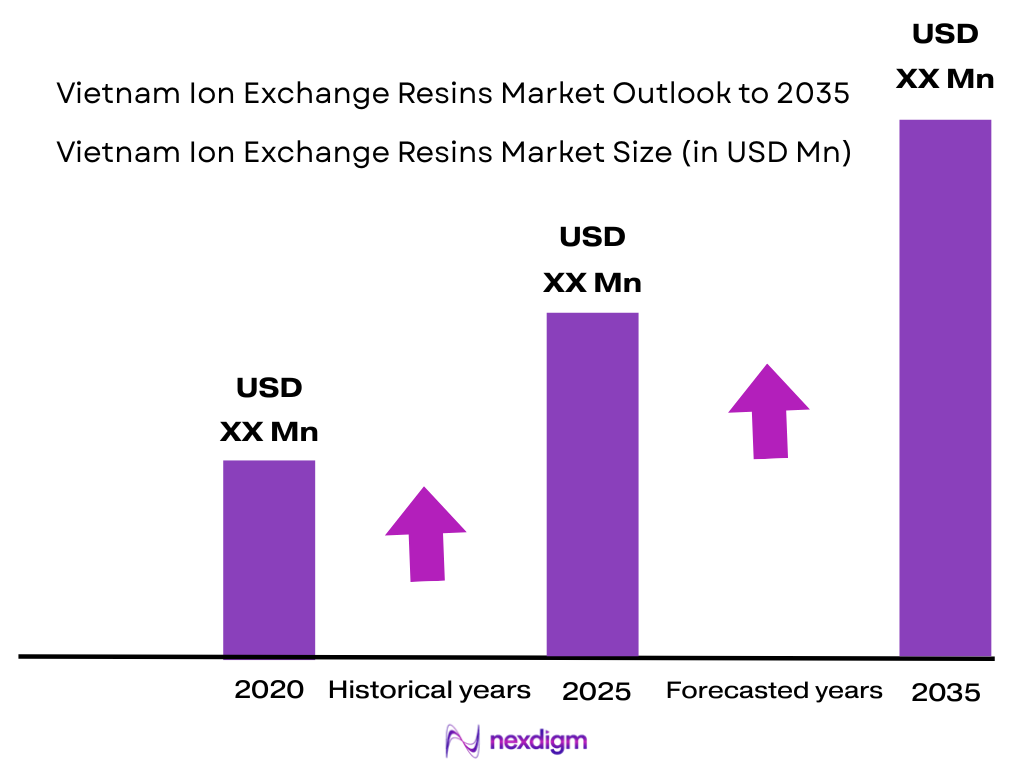
The Vietnam Ion Exchange Resins Market is valued at approximately USD ~XX million, supported by demand from industrial water treatment, demineralization, water softening, ultrapure-water production and wastewater recycling. Vietnam’s industrial base expanded from about 400 industrial parks covering over 128,000 hectares to more than 420 established parks, materially increasing process-water infrastructure requirements. Electronics, power, pharmaceuticals, chemicals and food processing are important demand generators because their operations require controlled ionic purity and reliable boiler or process-water treatment.
Southern and Northern Vietnam constitute the principal consumption centers. Dong Nai has 31 operational industrial parks, while Ho Chi Minh City, Binh Duong and surrounding provinces contain dense manufacturing, food-processing and chemical clusters. Hanoi, Bac Ninh and Hai Phong dominate northern demand because of electronics, semiconductor-related manufacturing and industrial investment. The Red River Delta attracted 487 newly licensed industrial-zone projects, including 390 FDI projects, reinforcing demand for ultrapure water, demineralization, boiler-water treatment and industrial wastewater purification systems.
Market Segmentation
By Resin Type
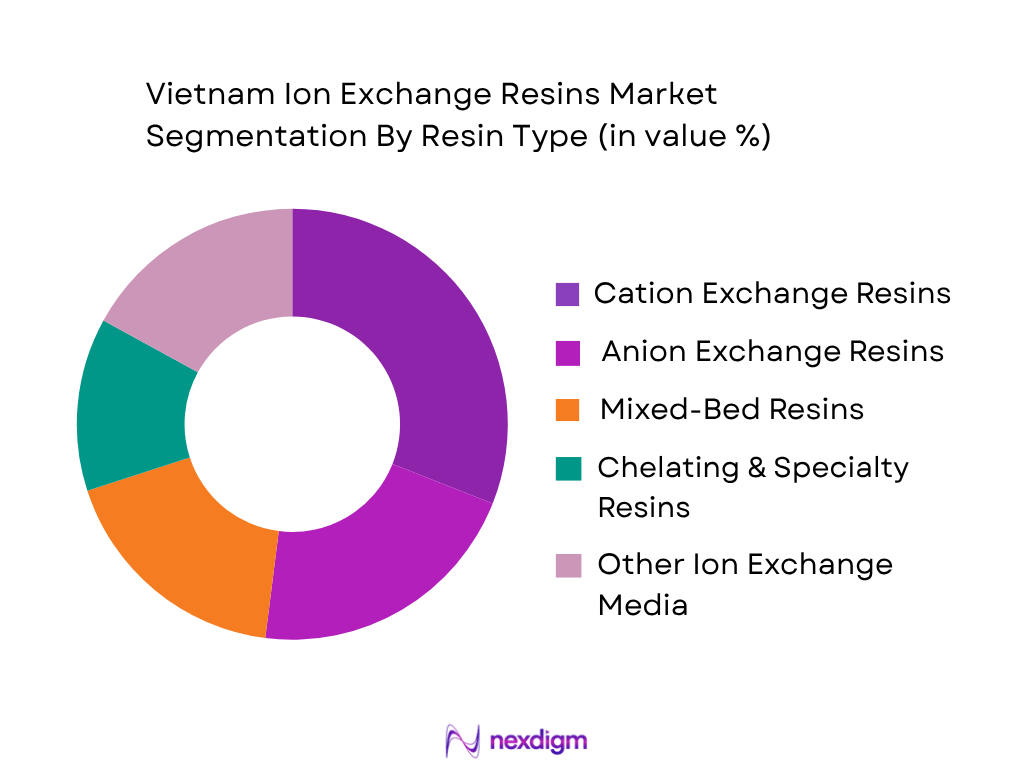
The Vietnam Ion Exchange Resins Market is segmented by resin type into cation exchange resins, anion exchange resins, mixed-bed resins, chelating and specialty resins, and other ion exchange media. Cation exchange resins hold the dominant position because water softening and demineralization represent fundamental treatment stages across manufacturing facilities, boilers, utility systems and commercial water-treatment installations. Strong-acid cation resins are particularly relevant for removing calcium, magnesium and other dissolved cations from industrial feedwater. Their established operating procedures, regenerability and broad compatibility with conventional treatment plants reinforce adoption. Growing industrial parks also create recurring replacement demand from installed softeners and demineralization units. Anion resins remain critical for complete demineralization, while mixed-bed and specialty products command greater technical importance in electronics, pharmaceutical and ultrapure-water applications where low conductivity and stringent ionic contamination control are required.
By End-User Industry
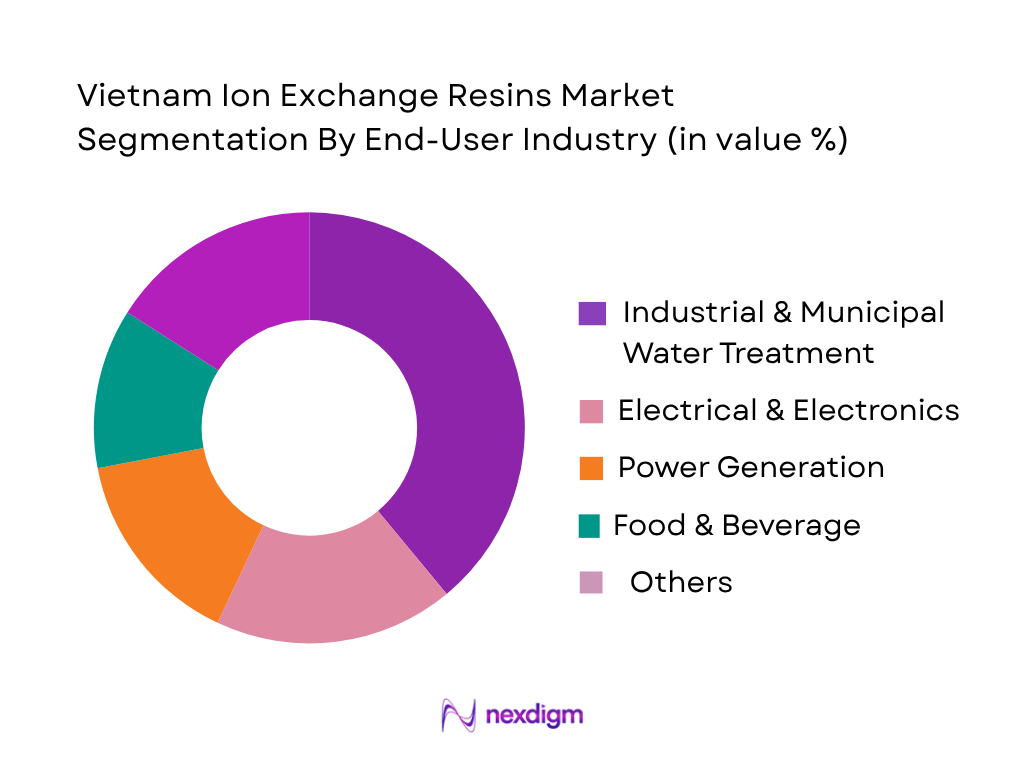
The Vietnam Ion Exchange Resins Market is segmented by end-user industry into industrial and municipal water treatment, electrical and electronics, power generation, food and beverage, pharmaceuticals and biotechnology, and other industries. Industrial and municipal water treatment represents the dominant segment because ion exchange remains widely deployed for softening, dealkalization, demineralization, contaminant removal and polishing. Vietnam’s expanding industrial-park infrastructure supports centralized and factory-level water-treatment installations, while tightening environmental requirements are increasing attention to wastewater management and reuse. Electronics manufacturing is increasingly important because semiconductor and component plants require ultrapure water with exceptionally low ionic contamination. Power plants require resins for boiler-feed demineralization and condensate polishing, while pharmaceutical and food processors require purified process water and specialized separation media. More than 400 industrial zones nationwide create a large installed base supporting recurring resin regeneration and replacement demand.
Competitive Landscape
The Vietnam Ion Exchange Resins Market features global specialty-chemical manufacturers and Asian resin suppliers competing through product performance, application expertise, distributor coverage, technical service and pricing. Premium suppliers have stronger positions in ultrapure water, semiconductor, pharmaceutical and condensate-polishing applications, where qualification requirements are stringent. Asian suppliers compete effectively in conventional softening and industrial demineralization, where purchase price and availability are important. Product reliability, local inventory, regeneration performance and technical troubleshooting increasingly influence supplier selection.
| Major Player | Establishment Year | Headquarters | Principal Resin Brand | Resin Portfolio | Ultrapure-Water Capability | Key Vietnam Applications | Specialty Resin Capability | Food/Pharma Capability | Competitive Positioning |
| DuPont de Nemours, Inc. | 1802 | Wilmington, USA | ~ | ~ | ~ | ~ | ~ | ~ | ~ |
| LANXESS AG | 2004 | Cologne, Germany | ~ | ~ | ~ | ~ | ~ | ~ | ~ |
| Mitsubishi Chemical Group | 1933 | Tokyo, Japan | ~ | ~ | ~ | ~ | ~ | ~ | ~ |
| Ecolab / Purolite | 1923* | Saint Paul, USA | ~ | ~ | ~ | ~ | ~ | ~ | ~ |
| Thermax Limited | 1966 | Pune, India | ~ | ~ | ~ | ~ | ~ |
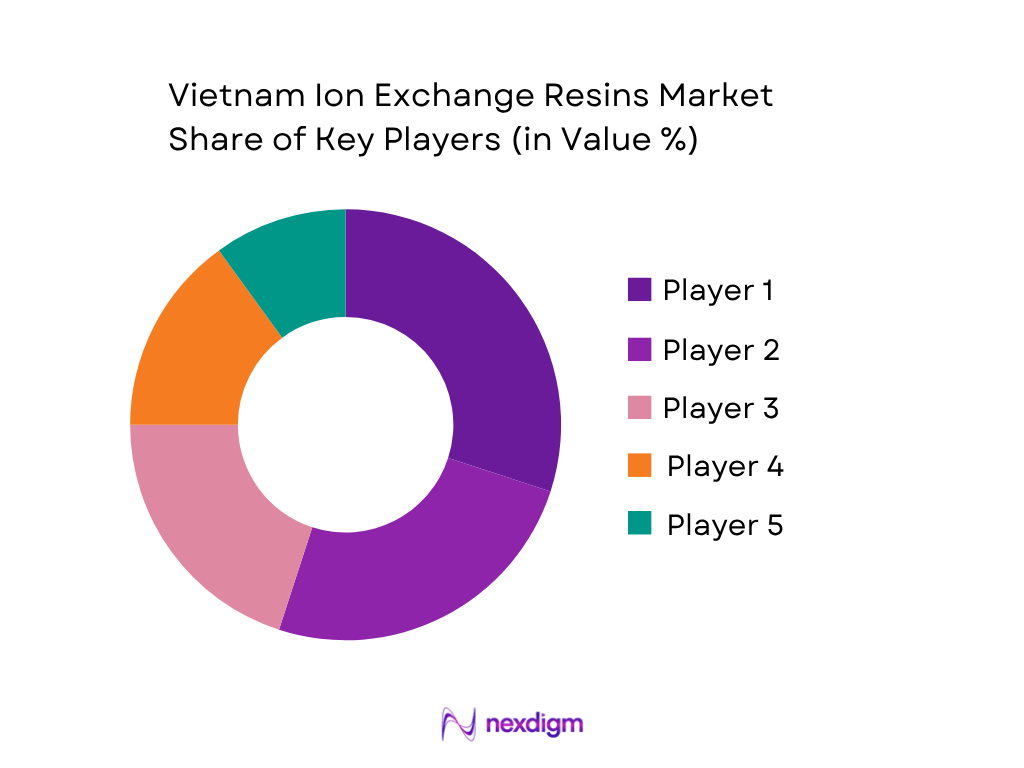
Vietnam Ion Exchange Resins Market Analysis
Growth Drivers
Expansion of Industrial Manufacturing and Water-Intensive Production
Vietnam’s expanding manufacturing base is strengthening structural demand for ion exchange resins used in industrial water softening, boiler-feed demineralization, process-water purification, condensate polishing and wastewater treatment. The World Bank records Vietnam’s economic output at USD 476.39 billion in 2024, with GDP per capita reaching USD 4,717.3, indicating a considerably larger industrial and consumption base supporting manufacturing infrastructure. More directly relevant to ion exchange consumption, Vietnam’s Ministry of Planning and Investment reported 3,375 newly licensed foreign-invested projects in 2024, while processing and manufacturing attracted USD 25.58 billion of foreign investment. By the end of the same period, the country had 42,002 valid foreign-invested projects, with accumulated registered foreign investment of approximately USD 502.8 billion. Processing and manufacturing alone accounted for more than USD 308.76 billion of accumulated registered investment, demonstrating the depth of industrial capacity requiring industrial utilities and water-treatment systems. Vietnam’s industrial-zone network further reinforces this demand base. Ministry of Planning and Investment data recorded 431 industrial and export-processing zones covering approximately 132,300 hectares, including around 89,900 hectares of industrial land, with 301 parks already operational as of July 2024.
Electronics, Semiconductor and High-Purity Water Manufacturing Expansion
Vietnam’s increasingly electronics-intensive manufacturing profile is an important growth driver for high-performance ion exchange resins because semiconductor, electronic-component and precision-manufacturing operations require extremely low concentrations of dissolved ionic contaminants. Vietnam Customs recorded exports of USD 44.90 billion in computers, electrical products, spare parts and components during only the first eight months of 2024, alongside USD 37.15 billion in telephones, mobile phones and related parts during the same period. National Statistics Office data also showed that production of electronic products, computers and optical products expanded materially during 2024, while production of electrical equipment also recorded strong industrial activity. The Ministry of Planning and Investment specifically identified semiconductors, photovoltaic cells, silicon bars, electronic products, components and other high-value manufacturing as major recipients of investment during 2024. This industrial profile is highly relevant for ion exchange resin suppliers because electronics manufacturing requires water-treatment trains substantially more sophisticated than standard municipal or commercial softening systems.
Market Challenges
High Import Dependence and Exposure to International Supply Chains
The Vietnam Ion Exchange Resins Market remains structurally exposed to imported specialty materials because the country has a much stronger downstream industrial manufacturing base than domestic production base for globally qualified ion exchange resin technologies. This creates dependence on overseas manufacturers for cation, anion, mixed-bed, chelating and ultrapure-water grades, particularly where electronics, pharmaceutical, food-processing or power-sector applications demand established product certifications and performance histories. Vietnam’s broader trade dependence illustrates the scale of this exposure. IMF data placed Vietnam’s 2024 GDP at approximately USD 468.5 billion in its Article IV framework, while goods exports and imports represented exceptionally large flows relative to domestic output. Vietnam Customs reported USD 44.90 billion of computers and electrical-product exports and USD 37.15 billion of telephone-related exports during the first eight months of 2024 alone, demonstrating how deeply local factories are connected to cross-border supply chains.
Competition from Membrane Technologies and Increasing Treatment-System Complexity
Ion exchange resins face a technical challenge from the wider adoption of reverse osmosis, nanofiltration and electrodeionization within Vietnam’s industrial water-treatment infrastructure. The issue is not complete displacement of ion exchange technology but reduced resin loading in applications where membrane systems perform the bulk of dissolved-solids removal before final polishing. Vietnam’s industrial development is making treatment systems more sophisticated because modern electronics, pharmaceutical, power and export-oriented manufacturing plants increasingly design water systems around multiple treatment stages rather than conventional standalone demineralizers. Government industrial statistics highlight the scale of this underlying customer base: Vietnam had 431 industrial and export-processing zones covering about 132,300 hectares, with 301 operational zones and approximately 89,900 hectares of industrial land as of July 2024. A subsequent Ministry of Planning and Investment update reported 436 industrial parks, more than 300 operating sites and over 4.16 million direct workers.
Market Opportunities
Ultrapure Water and Semiconductor-Grade Resin Opportunity
Vietnam’s expanding semiconductor and electronics manufacturing ecosystem creates a significant forward opportunity for suppliers of ultrapure-water ion exchange resins, particularly mixed-bed, low-TOC, low-ionic-leakage and uniform-particle-size grades. Current industrial indicators demonstrate the scale of the addressable manufacturing base without requiring future assumptions. Vietnam Customs recorded USD 44.90 billion of exports of computers, electrical products, spare parts and components during the first eight months of 2024, while telephone and mobile-phone exports reached USD 37.15 billion over the same interval. Ministry of Planning and Investment reporting also identified major investment projects during 2024 in semiconductors, batteries, photovoltaic cells, silicon bars, electronic components and high-value-added manufacturing. Foreign-investment inflows remained substantial, with 3,375 newly licensed projects and 1,539 projects receiving additional capital during 2024. Processing and manufacturing attracted USD 25.58 billion of foreign investment, confirming that industrial production remains the principal destination for incoming capital. The opportunity for resin suppliers arises from the water-quality intensity of these industries. Semiconductor and advanced electronics facilities require highly controlled process water for wafer rinsing, cleaning, chemical preparation and manufacturing operations; even very small ionic contamination can affect process yield and product quality. Consequently, ultrapure-water treatment trains use ion exchange as a polishing and safeguard technology even when reverse osmosis and electrodeionization perform upstream purification.
Industrial Wastewater Reuse and Specialty Ion Removal Opportunity
Increasing industrial concentration and tightening environmental-management requirements create a forward opportunity for ion exchange resins in wastewater polishing, selective contaminant removal, water reuse and resource recovery. Vietnam’s industrial footprint provides a substantial current base for these applications. Ministry of Planning and Investment data recorded 431 industrial and export-processing zones occupying around 132,300 hectares, including 301 operating zones and approximately 89,900 hectares of industrial land as of July 2024. A separate government update counted 436 industrial parks, more than 300 operational parks and over 4.16 million direct employees, illustrating the scale of wastewater-generating industrial activity. The industrial parks collectively contribute more than half of national export turnover according to the Ministry, making their water and environmental performance strategically important to Vietnam’s export-oriented economy. Current regulations require centralized wastewater-treatment systems in relevant dedicated production areas to operate continuously according to approved technological processes, maintain treatment performance and provide automatic monitoring where stipulated. This regulatory environment creates an addressable role for ion exchange beyond conventional boiler-water applications. Chelating and selective resins can remove nickel, copper, chromium and other metal ions from industrial effluents, while cation and anion resins can provide final polishing for reuse streams after membrane treatment.
Future Outlook
The Vietnam Ion Exchange Resins Market is forecast to expand at a CAGR of approximately ~XX% during the forecast period, supported by industrial manufacturing growth, water-quality compliance requirements and increasing adoption of advanced purification systems. The market is expected to move progressively toward higher-value mixed-bed, uniform-particle-size, low-leachable and selective resins. Electronics and semiconductor-linked investment should strengthen demand for ultrapure-water polishing, while wastewater recycling will widen the opportunity for selective contaminant removal and resource recovery.Industrial parks will remain an important underlying demand platform. Vietnam has progressed from roughly 400 industrial parks to more than 440 established facilities, with more than 300 operating, illustrating continued expansion of the manufacturing footprint. Eco-industrial-park development is also encouraging resource efficiency, wastewater reduction and industrial symbiosis. These trends favor hybrid treatment trains combining reverse osmosis, ion exchange and electrodeionization rather than eliminating ion exchange altogether.
Electronics represents a particularly attractive future demand pool. High-purity resin suppliers can benefit from increasing requirements for ultrapure rinse and process water in electronics, semiconductor, photovoltaic and precision manufacturing facilities. Products with low total-organic-carbon release, controlled particle-size distribution and very low ionic leakage will command a premium relative to commodity softening resins. Mitsubishi Chemical and LANXESS explicitly position specialized ion exchange products for semiconductor ultrapure-water production, demonstrating the technology requirements likely to become increasingly relevant to Vietnam.
Major Players
- DuPont de Nemours, Inc. – AmberLite™
- Ecolab Inc. / Purolite – Purolite™
- LANXESS AG – Lewatit™
- Mitsubishi Chemical Group Corporation – DIAION™
- Samyang Corporation – TRILITE™
- Thermax Limited – Tulsion™
- Ion Exchange (India) Limited – INDION™
- Sunresin New Materials Co., Ltd.
- ResinTech, Inc.
- Jacobi Carbons Group / Jacobi Resins
- Jiangsu Suqing Water Treatment Engineering Group
- Anhui Sanxing Resin Technology Co., Ltd.
- Pure Resin Co., Ltd.
- Zhejiang Zhengguang Industrial Co., Ltd.
- Hebi Higer Chemical Co., Ltd.
Key Target Audience
- Ion Exchange Resin Manufacturers and Specialty Separation Media Producers
- Industrial Water Treatment EPC Companies and System Integrators
- Industrial Parks, Export Processing Zones and Water-Intensive Manufacturing Companies
- Electronics, Semiconductor, Power, Pharmaceutical, Food & Beverage and Chemical Manufacturers
- Ion Exchange Resin Importers, Authorized Distributors and Industrial Chemical Suppliers
- Water Utilities, Industrial Wastewater Treatment Operators and Water-Reuse Solution Providers
- Investments and Venture Capitalist Firms
- Government and Regulatory Bodies (Ministry of Industry and Trade; Ministry of Agriculture and Environment; Ministry of Science and Technology; Vietnam Environment Agency and relevant provincial industrial-zone authorities)
Research Methodology
Step 1: Identification of Key Variables
The initial phase involves mapping the complete Vietnam Ion Exchange Resins Market ecosystem, including resin manufacturers, importers, authorized distributors, EPC contractors, water-treatment system integrators and industrial users. Secondary research identifies critical variables including resin consumption, installed bed volume, replacement cycles, product grade, application, import dependence, average selling price and end-user demand.
Step 2: Market Analysis and Construction
Historical demand is reconstructed using a combination of top-down and bottom-up approaches. The top-down model evaluates industrial output, industrial-park expansion, relevant manufacturing sectors, water-treatment infrastructure and trade patterns, while the bottom-up model assesses resin volumes consumed by major applications, installed treatment systems, resin loading requirements, replacement frequencies and supplier-level sales.
Step 3: Hypothesis Validation and Expert Consultation
Market hypotheses are validated through computer-assisted telephone interviews and structured discussions with ion exchange resin suppliers, distributors, water-treatment EPC contractors, procurement managers and industrial water-treatment professionals. Interviews examine actual resin selection practices, purchasing volumes, replacement intervals, application requirements, supplier positioning, price differences and the adoption of alternative technologies such as reverse osmosis and electrodeionization.
Step 4: Research Synthesis and Final Output
Primary findings are triangulated against trade statistics, company documentation, regulatory information, industrial investment indicators and application-level demand calculations. Market size and segmentation are reconciled using top-down and bottom-up models. Forecast assumptions incorporate industrial capacity additions, electronics investment, wastewater-reuse adoption, resin replacement demand, changes in treatment technology and expected movement from commodity toward specialty resin grades.

- Executive Summary
- Research Methodology (Market Definition and Scope, Ion Exchange Resin Classification, Market Boundary Assessment, Abbreviations, Market Sizing Methodology, Top-Down Market Estimation, Bottom-Up Market Validation, Demand-Side Assessment, Supply-Side Assessment, Import-Based Market Reconstruction, Distributor Sales Assessment, Installed Resin Bed Assessment, Resin Replacement Cycle Analysis, End-User Consumption Assessment, Industrial Water Treatment Project Mapping, Primary Interviews with Resin Manufacturers, Importers, Distributors, Water Treatment EPC Companies and Industrial End Users, Trade Data Analysis, Price Benchmarking, Data Triangulation, Market Forecasting Framework, Scenario Modeling, Assumptions and Limitations)

- Definition and Scope
- Evolution of Vietnam Ion Exchange Resins Industry
- Ion Exchange Resin Industry Genesis and Market Development
- Vietnam Ion Exchange Resins Industry Ecosystem Analysis
- Ion Exchange Resin Importer–Distributor–EPC–End User Ecosystem
- High-Purity and Ultrapure Water Treatment Ecosystem

- Growth Drivers (Expansion of Electronics and Semiconductor Manufacturing, Increasing Ultrapure Water Requirements, Growth of Industrial Parks, Rising Industrial Water Treatment Investment, Expansion of Power and Boiler Water Treatment Demand, Increasing Food and Beverage Processing Capacity, Pharmaceutical Manufacturing Expansion, Tightening Wastewater Discharge Requirements, Industrial Water Reuse Adoption, Replacement Demand from Existing Ion Exchange Installations)
- Market Challenges (High Dependence on Imported Resins, Foreign Exchange Exposure, Resin Price Volatility, Competition from Reverse Osmosis and Electrodeionization, Resin Fouling from Organic and Iron Contaminants, Regeneration Chemical Cost, Disposal of Spent Regenerants, Technical Skill Requirements, Counterfeit and Low-Grade Resin Supply, Long Qualification Cycles for Semiconductor and Pharmaceutical Applications)
- Market Opportunities (Ultrapure Water Resins for Semiconductor Manufacturing, Electronics Grade Mixed Bed Resins, Industrial Wastewater Recycling, Heavy Metal Selective Resins, High-Purity Pharmaceutical Resins, Food and Sweetener Purification Resins, Condensate Polishing Resins, Resin Replacement Services, Regeneration Optimization Solutions, High-Capacity Uniform Particle Size Resins, Industrial Park Centralized Water Treatment, Specialty Chelating Resin Applications)
- Market Trends (Shift from Commodity to High-Performance Resins, Adoption of Uniform Particle Size Resins, RO–Ion Exchange Hybridization, Growth of Mixed Bed Polishing, Increasing Demand for Low-Leachable Resins, High-Purity Resin Qualification, Longer Resin Life Optimization, Reduced Chemical Regeneration Consumption, Resin Performance Monitoring, Application-Specific Resin Selection, Local Distributor Technical Service Expansion)
- Technology Landscape
- Ion Exchange Performance Benchmarking
- Regeneration Economics Analysis
- SWOT Analysis of Major Players
- Porter’s Five Forces Analysis
- PESTLE Analysis

- By Market Value (2020-2025)
- By Consumption Volume (2020-2025)
- By Average Selling Price (2020-2025)
- By Import Value (2020-2025)
- By Import Volume (2020-2025)
- By Installed Resin Bed Volume (2020-2025)
- By Fresh Resin Consumption versus Replacement Resin Demand (2020-2025)

- By Resin Type
Strong Acid Cation Resins
Weak Acid Cation Resins
Strong Base Anion Resins – Type I
Strong Base Anion Resins – Type II
Weak Base Anion Resins
Mixed Bed Resins
Chelating Resins
Selective Ion Exchange Resins
Adsorbent and Specialty Separation Resins
Ultrapure Water Grade Resins
Food and Pharmaceutical Grade Resins
Condensate Polishing Resins - By Polymer Matrix
Styrene-Divinylbenzene Resins
Acrylic Resins
Polystyrenic Resins
Macroporous Resins
Gel-Type Resins
Specialty Polymeric Matrices - By Ionic Form
Hydrogen Form
Sodium Form
Hydroxide Form
Chloride Form
Free-Base Form
Mixed Ionic Form
Application-Specific Ionic Forms - By Application
Water Softening
Demineralization and Deionization
Condensate Polishing
Ultrapure Water Production
Boiler Feedwater Treatment
Process Water Purification
Drinking and Municipal Water Treatment
Wastewater Treatment and Water Reuse
Heavy Metal Removal
Nitrate and Selective Contaminant Removal
Sugar and Sweetener Deashing
Food and Beverage Purification
Pharmaceutical Purification and Separation
Chemical Processing and Catalysis
Metal Recovery and Hydrometallurgy - By Supply Source
China
South Korea
Japan
India
Germany
United States
Other European Markets
Other Asia-Pacific Markets
Domestic and Locally Repacked Supply - By Geography
Northern Vietnam
Red River Delta Industrial Corridor
Hanoi and Surrounding Industrial Provinces
Hai Phong–Quang Ninh Industrial CorridorCentral Vietnam
Da Nang and Central Industrial Corridor
Southern Vietnam
Ho Chi Minh City Industrial Cluster
Binh Duong–Dong Nai Manufacturing Corridor
Ba Ria–Vung Tau Petrochemical and Industrial Cluster
Mekong Delta

- Market Share Analysis of Major Players
- Cross Comparison Parameters (Product Portfolio Breadth, Ion Exchange Capacity and Resin Performance Range, Ultrapure Water and Semiconductor Grade Capability, Vietnam Distributor and Inventory Coverage, Industrial Application Coverage, Resin Qualification and Technical Support Capability, Price Positioning and Total Cost of Ownership, Regeneration Efficiency and Expected Resin Service Life)
- Competitive Benchmarking Analysis (Product Innovation Capability, Pricing Strategy, Vietnam Market Presence, Supply Chain Efficiency, Customer Base Strength, Product Grade Coverage, Application-Specific Resin Capability, Distribution and Technical Service Strength)
- SWOT Analysis of Major Players
- Pricing Analysis (Cation Resin Pricing, Anion Resin Pricing, Mixed-Bed Resin Pricing, Chelating Resin Pricing, Ultrapure Water Grade Premium, Country-of-Origin Price Differential, Distributor Margin, Bulk Procurement Pricing)
- Detailed Profile of Major Companies
DuPont de Nemours, Inc. – AmberLite™
Ecolab Inc. / Purolite – Purolite™
LANXESS AG – Lewatit™
Mitsubishi Chemical Group Corporation – DIAION™
Samyang Corporation – TRILITE™
Thermax Limited – Tulsion™
Ion Exchange (India) Limited – INDION™
Sunresin New Materials Co., Ltd.
ResinTech, Inc.
Jacobi Carbons Group / Jacobi Resins
Jiangsu Suqing Water Treatment Engineering Group
Anhui Sanxing Resin Technology Co., Ltd.
Pure Resin Co., Ltd.
Zhejiang Zhengguang Industrial Co., Ltd.
Hebi Higer Chemical Co., Ltd.

- Procurement Behavior Analysis
- Buyer Preference Assessment
- Import Dependency and Sourcing Analysis
- Pricing Sensitivity Analysis
- Vietnam Ion Exchange Resins Supply-Demand Analysis
- Domestic Resin Availability and Distribution Assessment
- Import Dependency Analysis
- Domestic Consumption Assessment

- By Market Value (2026-2035)
- By Consumption Volume (2026-2035)
- By Average Selling Price (2026-2035)
- By Import Value (2026-2035)
- By Import Volume (2026-2035)
- By Installed Resin Bed Volume (2026-2035)
- By Fresh Resin Consumption versus Replacement Resin Demand (2026-2035)


 Request a Sample
 Ask for Customization
 Get a Quote
 Enquire Now