

 Download PDF
Market Overview
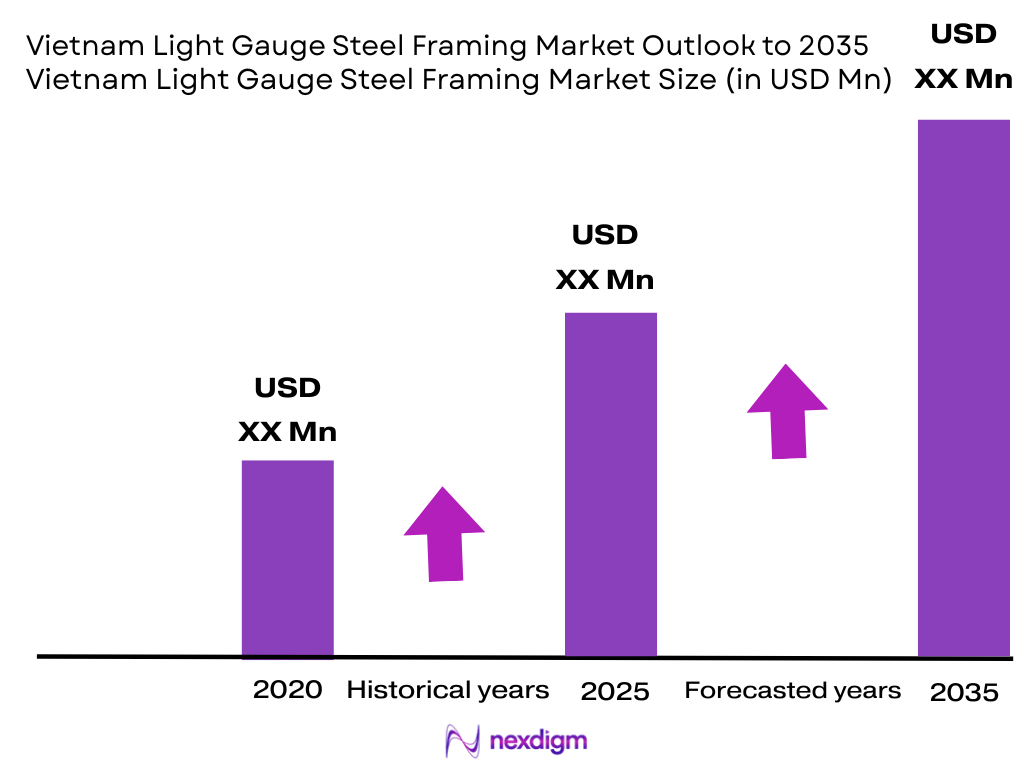
The Vietnam Light Gauge Steel Framing Market is valued at approximately USD ~ million, with the preceding comparable market value at approximately USD ~ million. The underlying demand environment is supported by Vietnam’s construction sector, which recorded 7.87% growth, while processing and manufacturing attracted USD 25.58 billion of registered foreign investment. Light-gauge systems benefit from industrial construction, prefabrication, factory-built components, and demand for faster project execution. Ho Chi Minh City, Hanoi and the southern industrial belt encompassing Binh Duong, Dong Nai and Ba Ria–Vung Tau represent important demand centres for light gauge steel framing. Ho Chi Minh City had USD 59 billion of accumulated registered FDI and Binh Duong USD 42.48 billion, while Hanoi approached USD 42.34 billion. Their concentration of industrial facilities, commercial projects, warehouses, residential development and foreign-invested manufacturing supports adoption of prefabricated steel construction. The Vietnam Light Gauge Steel Framing Market is projected to expand at a CAGR of ~ during 2026–2035, supported by industrial development, prefabricated construction, coated-steel availability, modular building adoption and requirements for shorter construction schedules.
Market Segmentation
By Structural Type
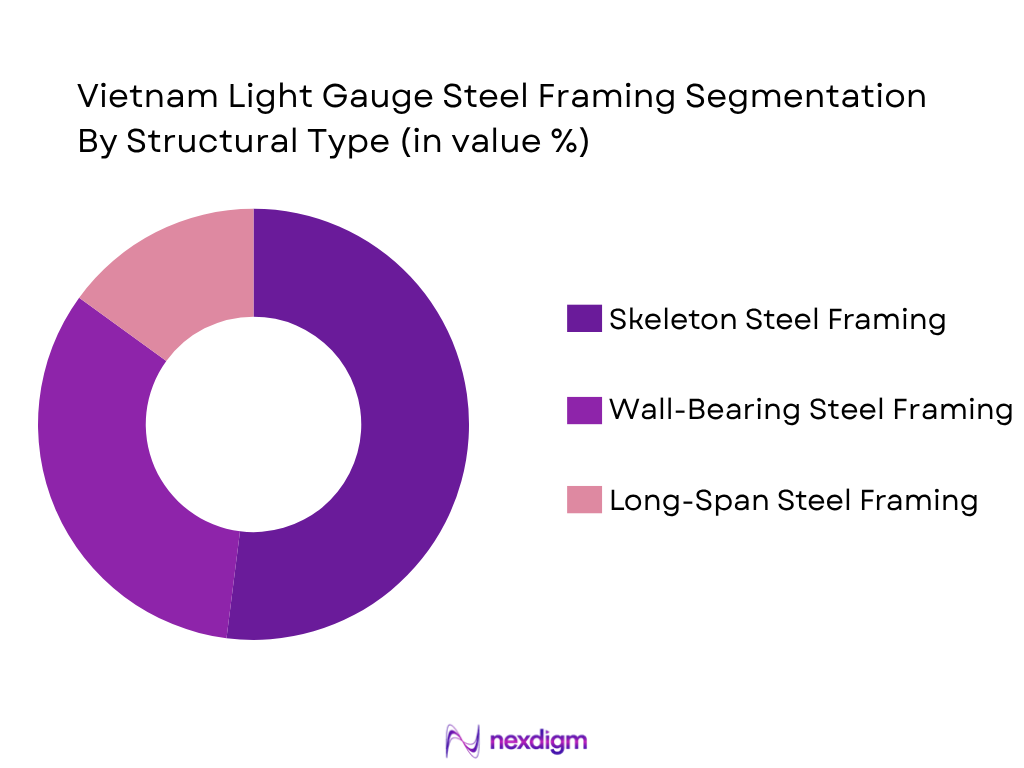
Vietnam Light Gauge Steel Framing Market is segmented by structural type into skeleton steel framing, wall-bearing steel framing and long-span steel framing. Skeleton steel framing holds the dominant market position within this segmentation. Its advantage arises from its flexibility across industrial facilities, warehouses, commercial buildings, modular structures and multi-storey applications where designers require efficient load transfer and adaptable internal layouts. Cold-formed C- and Z-sections can be factory engineered and subsequently assembled at construction sites, supporting shorter erection schedules and standardized quality. Vietnam’s growing manufacturing ecosystem further strengthens demand because industrial investors increasingly require scalable factory, warehouse and auxiliary-building solutions. The country’s processing and manufacturing industry attracted USD 25.58 billion in registered foreign investment, providing a substantial downstream construction pipeline. Vietnam-based suppliers already offer cold-formed steel systems across industrial and commercial applications, supporting wider contractor familiarity with lightweight engineered framing.
By End Use
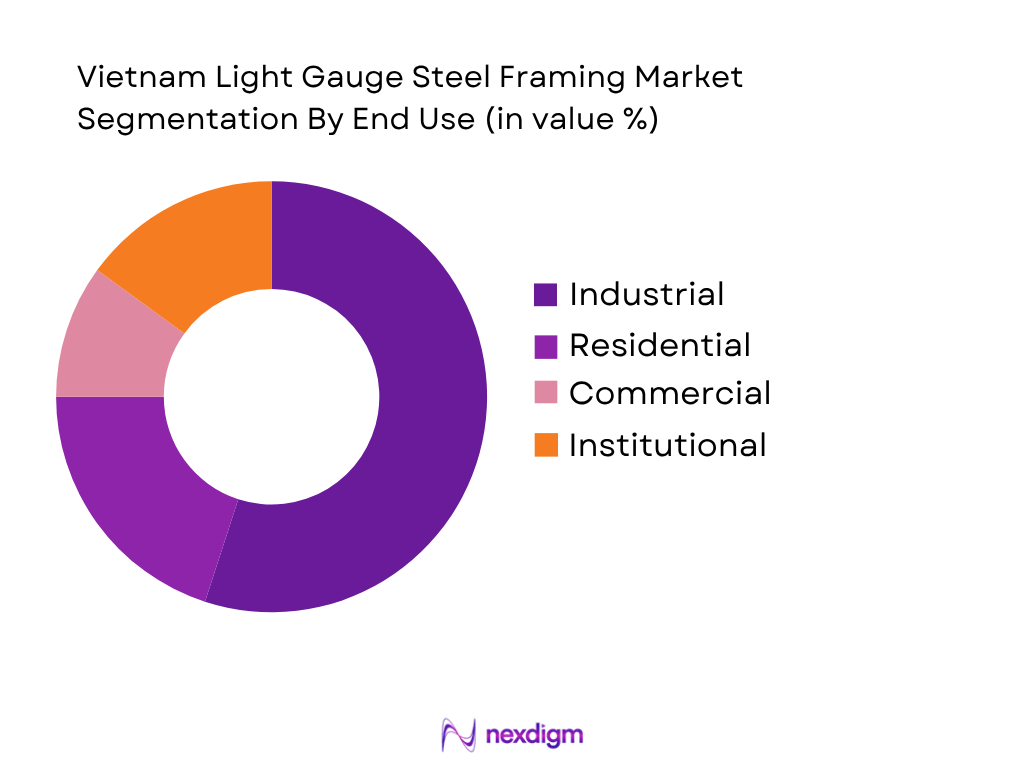
Vietnam Light Gauge Steel Framing Market is segmented by end use into residential, commercial, industrial, institutional and other applications. Industrial construction represents the dominant sub-segment because Vietnam has developed into a major regional manufacturing base requiring factories, workshops, warehouses, logistics buildings and supporting facilities. Light gauge and cold-formed steel systems fit this environment because structural members can be manufactured before delivery and assembled rapidly at the project location. Vietnam recorded 3,375 newly licensed FDI projects and USD 25.35 billion of realized foreign investment, reinforcing the construction pipeline associated with manufacturing expansion. Existing Vietnamese applications demonstrate the technology’s industrial relevance: NS BlueScope Lysaght’s Ranbuild system is positioned for light-industrial, commercial and multipurpose buildings, while its Kizuna Industrial Parks project involved 31 serviced factories. This installed ecosystem strengthens acceptance among developers, EPC contractors and industrial-park operators.
Competitive Landscape
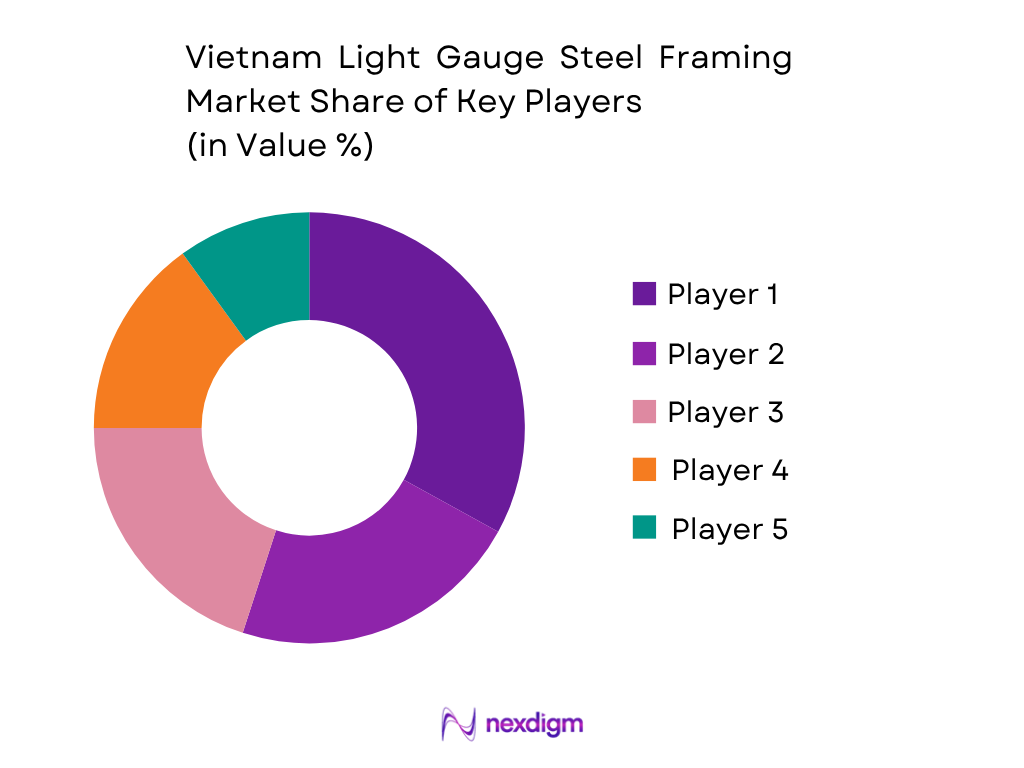
The Vietnam Light Gauge Steel Framing Market combines domestic steel fabricators, building-system suppliers, roll-forming companies and international engineered-steel specialists. Competition increasingly revolves around galvanized-steel specifications, cold-forming capability, structural engineering, BIM-enabled detailing, corrosion protection, prefabrication and installation support. NS BlueScope has an established Vietnamese manufacturing footprint, while Zamil Steel supplies pre-engineered structures incorporating cold-formed secondary members. Local fabrication capabilities are also developing around automated roll-forming equipment and modular construction.
| Major Player | Establishment | Headquarters | LGSF/Steel Building Offering | Core Steel System | Engineering Capability | Target Applications | Coating/Material Capability | Vietnam Positioning |
| NS BlueScope Lysaght Vietnam | 1993 in Vietnam | Ho Chi Minh City, Vietnam operations | ~ | ~ | ~ | ~ | ~ | ~ |
| Zamil Steel Vietnam | 1990s Vietnam presence | Hanoi-area Vietnam operations | ~ | ~ | ~ | ~ | ~ | ~ |
| PEB Steel | 1990s | Vietnam/Regional operations | ~ | ~ | ~ | ~ | ~ | ~ |
| Kirby Building Systems | 1970s | Kuwait / Regional operations | ~ | ~ | ~ | ~ | ~ | ~ |
| Viet Son Mechanical | Vietnam-based | Vietnam | ~ | ~ | ~ | ~ | ~ | ~ |
Vietnam Light Gauge Steel Framing Market Analysis
Growth Drivers
Rapid Urbanization and Expansion of Urban Construction
Vietnam’s accelerating urban development is strengthening the case for light gauge steel framing in apartments, low-rise housing, commercial buildings, schools and mixed-use developments because developers increasingly require construction systems that shorten site schedules and reduce structural weight. The Ministry of Construction reported that Vietnam’s urbanization rate reached about 44.3% in 2024, while the country’s construction and industrial sector expanded strongly alongside urban infrastructure development. Official national data show Vietnam’s GDP reached approximately USD 476.39 billion in 2024, with GDP per capita at USD 4,717.3, while industry and construction recorded 8.24% growth. The scale of urban building activity is also becoming more compatible with prefabricated structural technologies: the Ministry of Construction reported more than 600 certified green buildings covering nearly 17 million square metres by the third quarter of 2025. Light gauge steel framing is relevant to this transition because factory-cut studs, tracks, joists and trusses can be designed for repeatable dimensions, lower structural dead loads and dry construction, making the system suitable for increasingly standardized urban projects. Housing demand is adding another construction pipeline. By the first half of 2025, 146 social-housing projects containing 103,717 units had been completed and 124 projects were under construction, according to the Ministry of Construction. For LGSF suppliers, this combination of urbanization, housing delivery, green-building activity and sustained construction-sector expansion supports broader adoption among developers seeking industrialized building methods rather than conventional site-intensive construction.
Manufacturing Expansion, FDI and Industrial Building Construction
Vietnam’s continued industrialization is another direct growth driver for light gauge steel framing because manufacturing investment requires factories, worker accommodation, warehouses, logistics buildings, offices, ancillary buildings and rapid industrial-park expansion. Foreign Investment Agency data show that total registered foreign investment reached USD 10.98 billion in the first quarter of 2025, including 850 newly licensed projects and USD 5.16 billion of additional capital committed to existing projects. Manufacturing and processing attracted more than USD 6.7 billion of total registered investment during the period, while new manufacturing projects alone received USD 2.62 billion. The physical construction requirements generated by these investments are particularly relevant for LGSF because industrial projects often favour predictable construction schedules, factory prefabrication, modular offices and lightweight non-load-bearing wall systems that can be installed alongside conventional steel structures. Vietnam’s industrial development is supported by a sizeable macroeconomic platform: World Bank data place national GDP at USD 476.39 billion in 2024, while the IMF records a population of approximately 103.08 million people in 2026, providing both an industrial workforce and a large domestic demand base. Industrial investment is geographically concentrated in locations such as Bac Ninh, Ho Chi Minh City and Hanoi, identified by the Foreign Investment Agency among the leading investment destinations because of developed infrastructure and skilled labour availability. These clusters create an addressable pipeline for LGSF applications including factory partitions, mezzanine-associated framing, accommodation blocks, administrative buildings and modular utility structures, making manufacturing-led construction an increasingly important demand source for the Vietnam Light Gauge Steel Framing Market.
Market Challenges
Capital Intensity of Prefabrication and Limited Scale of Specialized LGSF Production
The Vietnam Light Gauge Steel Framing Market faces a scale-development challenge because establishing a competitive LGSF supply chain requires more than access to steel. Producers need computerized roll-forming lines, engineering software, coil-processing capability, punching and cutting systems, galvanized-steel quality control, connector production and coordinated design-to-fabrication processes. These requirements are difficult to justify when conventional masonry, reinforced concrete and site-fabricated steel remain deeply embedded across Vietnam’s construction sector. The challenge is significant because the construction economy itself is large and rapidly expanding: industry and construction recorded 8.24% growth in 2024, while the construction sector moved into 2026 after another strong period of infrastructure and housing activity. Producers therefore have to install automated capacity while simultaneously educating contractors, designers and developers about an unfamiliar framing method. Vietnam also has a broad mechanical-industry base, but converting general metalworking capacity into structural cold-formed steel production requires tighter dimensional tolerances, traceable coils, structural calculations and specialized joining systems. The scale issue becomes particularly important when project pipelines fluctuate between residential, industrial and institutional applications, because LGSF economics improve when standardized sections are produced repeatedly rather than as small custom orders. At the same time, Vietnam’s economy is large enough to attract substantial competition for industrial capital: GDP stood at approximately USD 476.39 billion in 2024, and foreign investors committed USD 10.98 billion in the first quarter of 2025 across numerous sectors. Consequently, LGSF manufacturers must compete with other industrial investments for machinery, engineering talent and factory space before the domestic market reaches consistently high standardized volumes.
Engineering, Fire, Corrosion and Extreme-Weather Performance Requirements
Technical performance requirements create another significant challenge because Vietnam’s tropical climate and exposure to severe storms require light gauge steel framing to be engineered for wind uplift, moisture, corrosion, connection integrity, cladding interaction and fire performance rather than treated as a simple substitute for masonry. The scale of the resilience issue became evident during Typhoon Yagi in 2024. Government reporting recorded damage to at least 168,000 houses, while another 73,248 houses were submerged; later reporting placed the number of houses, schools and public buildings with roofs damaged at approximately 230,000. World Bank analysis assessed the wider economic damage from the event at approximately USD 3.2 billion, demonstrating how wind, flooding and infrastructure disruption can affect the built environment. For LGSF, these conditions make structural detailing critical: wall tracks, roof trusses, hold-downs, sheathing, screw connections and foundations must collectively transfer lateral and uplift loads, while zinc-coated steel and detailing around moisture pathways must protect against corrosion. Fire-resistance design is also important because thin cold-formed steel rapidly loses strength when exposed to high temperatures unless protected by tested board assemblies, insulation and appropriate compartmentation. The technical burden is growing as Vietnam develops more certified sustainable buildings; the Ministry of Construction reported more than 600 green buildings covering nearly 17 million square metres by late 2025. To participate effectively in this higher-specification market, suppliers need structural engineers, BIM capability, certified material systems, installation training and documented testing. Inadequate detailing by inexperienced contractors could therefore restrain adoption even where the underlying structural system is technically suitable.
Market Opportunities
Automated Prefabrication, BIM Integration and Modular Construction
Technological modernization presents a major opportunity for Vietnam’s Light Gauge Steel Framing Market because LGSF can connect digital design directly with automated fabrication. Building information modelling can convert structural layouts into machine-readable production files, allowing roll-forming equipment to produce labelled studs, tracks, joists and truss members with holes and connection points prepared before delivery to the site. Vietnam already has a strong policy backdrop for smarter construction. The Ministry of Construction reported that the country had developed more than 600 green buildings with nearly 17 million square metres of floor area by the third quarter of 2025, reflecting increasing demand for more controlled and resource-efficient building processes. The broader construction economy provides a substantial platform for automation: industry and construction expanded by 8.24% in 2024, while Vietnam’s GDP reached approximately USD 476.39 billion. Digitally fabricated LGSF can support this expanding construction pipeline because repetitive residential units, worker accommodation, hotels, classrooms, clinics and industrial offices can be converted into standardized component families and assembled with relatively limited wet trades. The opportunity becomes stronger as the government promotes smart and sustainable urban development; by 2025, the Ministry of Construction was implementing the national smart-urban programme established for the 2018–2025 period with a longer-term development vision. Manufacturers that combine structural design, BIM coordination, automated roll forming and installation services can therefore move beyond selling steel profiles and offer complete engineered framing packages. This enables greater quality consistency while creating demand for local software integration, connection engineering, fire-rated wall systems, prefabricated panels and modular building assemblies.
Social Housing, Industrial Facilities and International Technology Partnerships
Vietnam’s combination of large housing requirements and continued foreign industrial investment creates an opportunity for LGSF suppliers to target repeatable, rapidly delivered building categories rather than relying only on conventional individual housing. The Ministry of Construction reported 696 social-housing projects completed or under implementation by late 2025, representing around 640,000 apartments, while 102,633 social-housing units were completed during 2025. In the first four months of 2026 alone, 40 social-housing projects were launched, indicating a continuing project pipeline. These large, repetitive developments create potential applications for LGSF in internal walls, façades, roof structures, low-rise blocks, community buildings and modular auxiliary facilities where factory fabrication can support standardized layouts. Industrial construction provides another opportunity. Foreign Investment Agency data show manufacturing and processing attracted more than USD 6.7 billion of registered FDI in the first quarter of 2025, while Vietnam received USD 10.98 billion of total registered foreign investment across 850 new projects during the period. This investment can generate demand for industrial offices, worker accommodation, clean-area partitions, warehouses and supporting buildings suitable for lightweight framing. International partnerships can accelerate the opportunity by transferring cold-formed steel design expertise, roll-forming technology, fire-rated assemblies and modular construction systems. Vietnam’s investment agencies continue to promote cooperation with Japan, China and other industrial partners in infrastructure, manufacturing and green transition, giving local LGSF firms potential channels to acquire equipment and engineering know-how. With a national population of about 103.08 million people in 2026, the combination of housing need, factory expansion and technology transfer provides a sizeable platform for wider adoption of engineered light-gauge steel construction.
Future Outlook
Over the outlook period, Vietnam’s Light Gauge Steel Framing Market is expected to benefit from the intersection of urban housing requirements, manufacturing investment, industrial-park development and increasing acceptance of prefabricated construction. The strongest opportunity is likely to emerge where developers need standardized buildings completed under tighter schedules with reduced wet trades.
Social housing is particularly relevant. The national programme targets more than one million apartments, while recent government reporting shows continuing acceleration in social-housing project implementation. In addition, Vietnam delivered more than 102,000 social-housing units during the latest completed annual period, indicating that repeatable housing construction has become an increasingly significant policy objective.
Industrial buildings represent a parallel growth avenue. Vietnam continues to promote eco-industrial parks, circular manufacturing and foreign-invested production facilities. These developments favor construction solutions offering factory-controlled component manufacturing, predictable erection schedules and potential material recovery. Light-gauge systems can therefore complement conventional pre-engineered steel buildings by serving internal structures, mezzanine systems, offices, worker accommodation and smaller modular buildings within industrial developments.
Technology will be an important competitive differentiator. Automated roll forming links digital structural design with factory production, while BIM-compatible systems can improve material utilization and reduce dimensional errors. FRAMECAD’s model combines engineering software, roll-forming machinery and production management, illustrating how the competitive focus is shifting from selling steel profiles toward supplying integrated construction systems.
Major Players
- NS BlueScope Lysaght Vietnam
- PEB Steel
- Zamil Steel Vietnam
- Kirby Building Systems
- ATAD Steel Structure Corporation
- BMB Steel
- WorldSteel Group
- QH Plus Corporation
- Viet Son Mechanical
- Dai Dung Metallic Manufacture Construction and Trade Corporation
- Hoa Phat Group
- Hoa Sen Group
- Nam Kim Steel
- Vina One Steel
- SeAH Steel Vina
Key Target Audience
- Light Gauge Steel Framing Manufacturers
- Cold-Formed Steel Profile Manufacturers
- Prefabricated and Modular Building Developers
- Industrial Park and Logistics Infrastructure Developers
- Real Estate Developers and EPC Contractors
- Coated Steel and Galvanized Steel Suppliers
- Investments and Venture Capitalist Firms
- Government and Regulatory Bodies (Ministry of Construction, Ministry of Industry and Trade, Ministry of Finance, National Standards Committee)
Research Methodology
Step 1: Identification of Key Variables
The initial phase constructs the Vietnam Light Gauge Steel Framing Market ecosystem covering galvanized-coil suppliers, cold-formed profile manufacturers, framing-system providers, fabricators, EPC contractors, architects, developers and end users. Key variables include steel consumption, framing intensity per square metre, building type, structural configuration, coating specification, domestic production, imports and construction pipeline.
Step 2: Market Analysis and Construction
Historical market demand is constructed through a combined top-down and bottom-up methodology. The top-down approach evaluates construction activity, industrial investment and addressable building floor area, while the bottom-up model examines supplier output, project installations, tonnes of cold-formed sections consumed and average steel intensity across different framing systems.
Step 3: Hypothesis Validation and Expert Consultation
Market hypotheses are validated through CATIs and structured discussions with steel-frame manufacturers, architects, structural engineers, roll-forming companies, developers, EPC contractors and procurement executives. Interviews test assumptions concerning structural-type adoption, galvanized-steel specifications, competitive positioning, project conversion rates and adoption barriers compared with reinforced concrete and conventional structural steel.
Step 4: Research Synthesis and Final Output
The final stage triangulates supplier-side data with construction demand and project-level consumption. Particular attention is given to skeleton framing, wall-bearing systems, long-span structures, wall systems, roof systems and industrial applications. Cross-checking domestic production, imports, construction activity and company-level information produces the final historical assessment and forecast framework through 2035.

- Executive Summary
- Research Methodology (Market Definitions and Assumptions, LGSF Market Boundary, Cold-Formed Steel Classification, Top-Down Market Sizing, Bottom-Up Frame Consumption Analysis, Steel Tonnage Assessment, Building Floor Area Assessment, Project Pipeline Mapping, Residential Demand Assessment, Industrial Demand Assessment, Prefabrication Demand Assessment, Supplier Interviews, Contractor Interviews, Architect and Structural Engineer Interviews, Data Triangulation, Forecasting Framework, Limitations and Future Conclusions)

- Definition and Scope
- Evolution of Cold-Formed Steel Construction in Vietnam
- Transition from Conventional Masonry and Reinforced Concrete to Lightweight Framing
- Evolution of Prefabricated and Modular Construction
- Light Gauge Steel Framing Industry Genesis

- Growth Drivers (Urban Residential Construction, Industrial Park Development, Faster Construction, Reduced Structural Weight, Prefabrication, Labour Productivity, Steel Supply, Sustainable Construction)
- Market Challenges (Installer Skills, Design Knowledge, Fire Perception, Corrosion Protection, Steel Price Exposure, Contractor Familiarity, Local Standards, Traditional Construction Preference)
- Market Opportunities (Affordable Housing, Modular Construction, Industrial Parks, Hotel Construction, Rooftop Extensions, Export Manufacturing, Automated Production, Green Buildings)
- Market Trends (Digital Design, BIM Integration, Automated Roll Forming, Higher-Strength Steel, Panelisation, Modular Construction, DfMA, Low-Waste Construction)
- SWOT Analysis
- Porter’s Five Forces
- PESTLE Analysis

- By Market Value (2020-2025)
- By Steel Consumption Volume (2020-2025)
- By LGSF Profile Volume (2020-2025)
- By Building Floor Area Installed

- By Frame Type (In Value %)
Load-Bearing Light Gauge Steel Framing
Non-Load-Bearing Light Gauge Steel Framing
Wall Framing Systems
Floor Framing Systems
Roof Framing Systems - By Structural Type (In Value %)
Skeleton Steel Framing
Wall-Bearing Steel Framing
Long-Span Steel Framing - By End Use (In Value %)
Industrial
Residential
Commercial
Institutional - By Building Type (In Value %)
Single-Family Housing
Villas and Townhouses
Low-Rise Residential Buildings
Mid-Rise Residential Buildings
Worker Accommodation - By Geographic Region (In Value %)
Northern Vietnam
Red River Delta
Hanoi Metropolitan Area
Central Vietnam

- Cross Comparison Parameters (LGSF Profile Thickness and Steel Grade Range, Roll-Forming and CNC Manufacturing Capability, Structural Design and BIM Integration Capability, Load-Bearing and Non-Load-Bearing System Portfolio, Coating and Corrosion-Resistance Specification, Prefabricated Panel and Modular Integration Capability, Vietnam Manufacturing and Installation Footprint, Residential–Commercial–Industrial Project Coverage)
- SWOT Analysis of Major Players
- Detailed Profiles of Major Companies
NS BlueScope Lysaght Vietnam
Viet Son Mechanical
VIS Steel
SEICO Group
AM Industries Vietnam.
BMB Steel
PEB Steel
Zamil Steel Buildings Vietnam
Kirby Southeast Asia
ATAD Steel Structure Corporation
Nam Trung Construction
Dai Dung Metallic Manufacture Construction and Trade Corporation
Thuan Phat Steel Structure Building & Investment
FRAMECAD
Howick Ltd.

- Residential Developers
- Industrial Developers
- Warehouse and Logistics Developers
- Hotel and Resort Developers
- Commercial Property Developers

- By Market Value (2026-2035)
- By Steel Consumption Volume (2026-2035)
- By Installed Floor Area (2026-2035)


 Request a Sample
 Ask for Customization
 Get a Quote
 Enquire Now