
 Download PDF
Market Overview
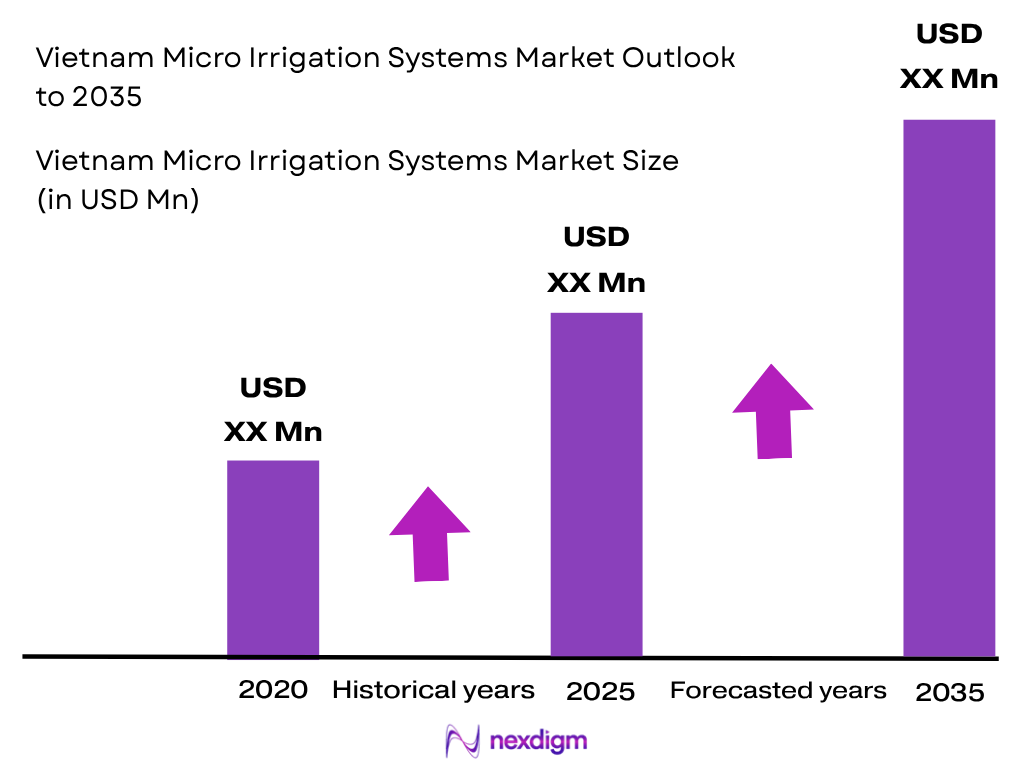
The Vietnam Micro Irrigation Systems Market is valued at approximately USD ~X billion in 2024, supported by increasing demand for efficient agricultural water management, modernization of farming practices, and expansion of high-value crop cultivation. Vietnam’s agriculture sector remains a significant contributor to the economy, with the World Bank reporting that agriculture, forestry, and fisheries continued to support rural employment and export-oriented production. The market growth is driven by rising adoption of drip irrigation, sprinkler systems, and fertigation technologies among fruit growers, coffee plantations, vegetable producers, and greenhouse operators seeking improved productivity and resource efficiency.
The Vietnam Micro Irrigation Systems Market is concentrated in regions such as the Mekong Delta, Central Highlands, Southeast Region, and Red River Delta due to their agricultural importance and demand for efficient irrigation solutions. The Central Highlands represents a major adoption area because of extensive coffee cultivation, while the Mekong Delta requires advanced irrigation management for fruit crops and agricultural production under changing water conditions. Provinces including Lam Dong, Dak Lak, Dong Nai, and An Giang demonstrate higher demand due to commercial farming activities, greenhouse cultivation, and export-oriented agriculture requiring consistent water application.
Market Segmentation
By Irrigation System Type
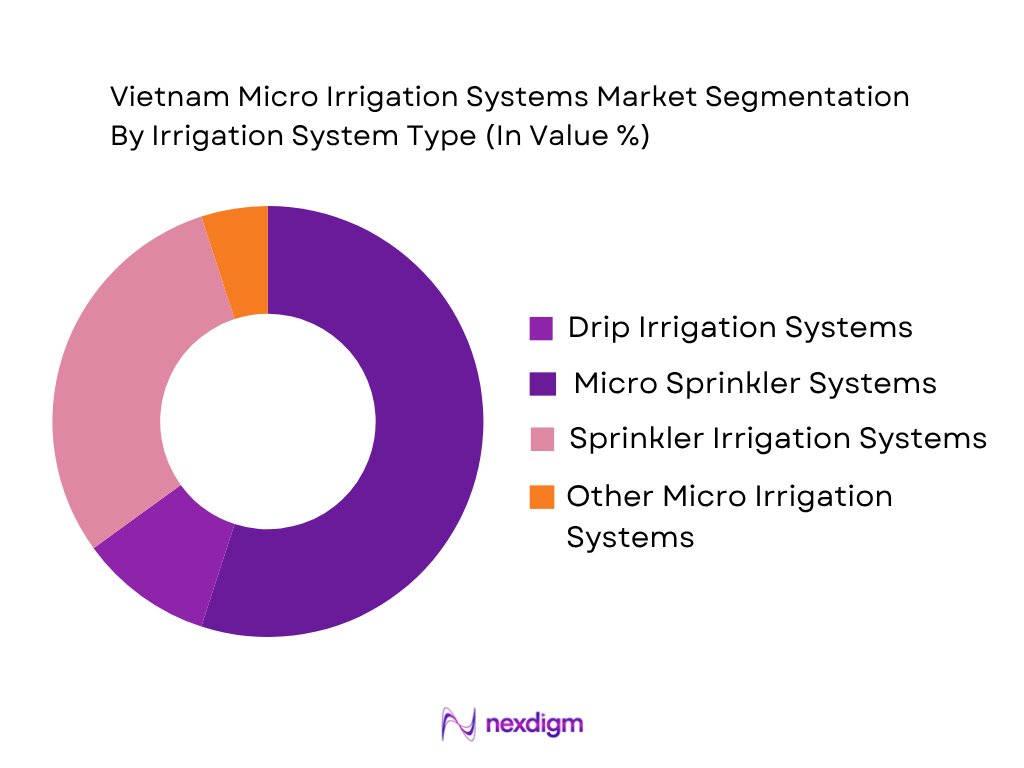
Vietnam Micro Irrigation Systems Market is segmented by irrigation system type into drip irrigation systems, sprinkler irrigation systems, micro sprinkler systems, and other specialized irrigation solutions. Drip irrigation systems hold the dominant market share due to their suitability for high-value crops, plantations, and water-sensitive agricultural applications. Vietnam’s expanding coffee, fruit, and vegetable cultivation sectors require precise water distribution to improve productivity and maintain crop quality. Drip irrigation enables controlled water delivery directly to plant roots, reducing unnecessary water usage and supporting fertigation practices. The technology is increasingly adopted by commercial farms, greenhouse operators, and export-oriented agricultural producers. Regions such as the Central Highlands and Mekong Delta are major demand centers due to their dependence on efficient irrigation methods for coffee, dragon fruit, durian, mango, and vegetable cultivation. The increasing focus on sustainable farming practices and agricultural modernization has further strengthened demand for drip irrigation systems.
By Application Area
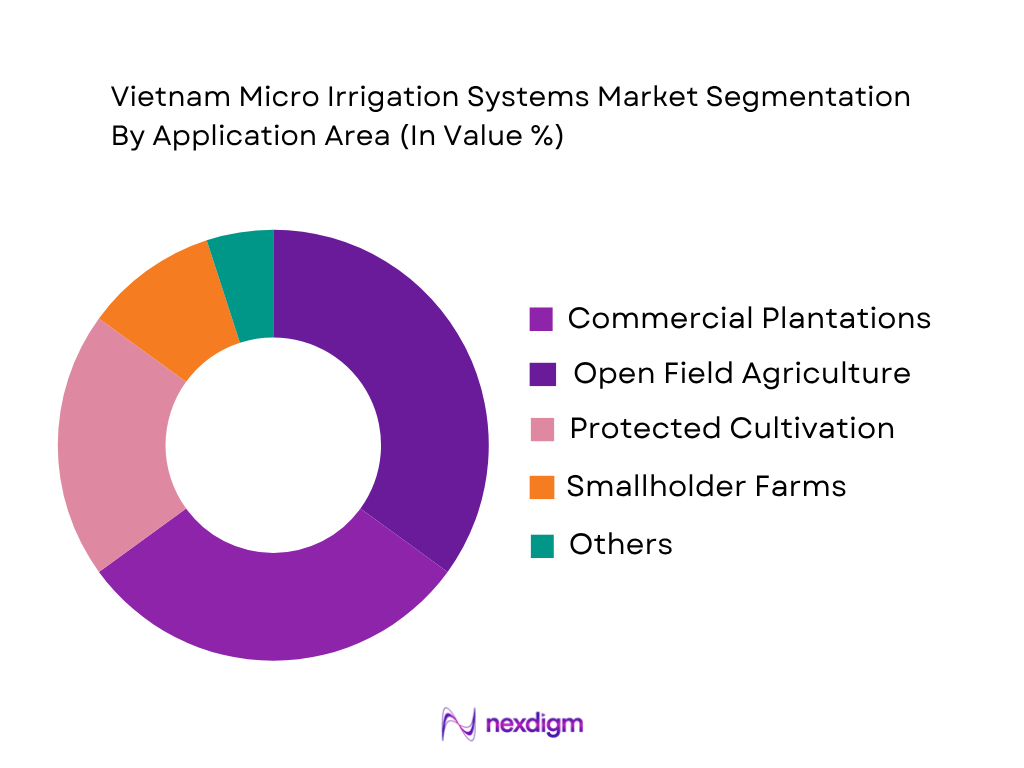
Vietnam Micro Irrigation Systems Market is segmented by application area into commercial plantations, open field agriculture, protected cultivation, smallholder farms, and landscaping applications. Commercial plantations account for the leading market share due to large-scale adoption among coffee, fruit, and industrial crop producers. Plantation owners require reliable irrigation systems to manage extensive cultivated areas and improve production efficiency. The Central Highlands coffee-producing regions have increased adoption of irrigation technologies due to seasonal rainfall variations and productivity requirements. Protected cultivation is also gaining importance as greenhouse and controlled farming practices expand for vegetables and flowers. Commercial agricultural enterprises generally have greater access to advanced irrigation technologies, including automated controllers, filtration systems, and fertigation equipment. Government agricultural modernization programs and increasing focus on export-quality agricultural production are encouraging broader adoption of micro irrigation solutions among different farming segments.
Competitive Landscape
The Vietnam Micro Irrigation Systems Market consists of international irrigation technology providers, domestic agricultural equipment manufacturers, and specialized irrigation solution companies supplying drip systems, sprinklers, fertigation equipment, and automated irrigation solutions. Competition is influenced by technology capabilities, agricultural application coverage, distribution strength, project execution expertise, and ability to provide customized solutions for coffee plantations, fruit orchards, vegetable farms, and greenhouse cultivation. Companies are increasingly focusing on precision agriculture solutions, automation, and water-efficient irrigation technologies to address Vietnam’s changing agricultural requirements.
| Company | Establishment Year | Headquarters | Key Product Portfolio | Irrigation Technology Focus | Crop Application Coverage | Distribution Network | Smart Irrigation Capability | Market Presence |
| Netafim Vietnam | 1965 | Israel / Vietnam Operations | ~ | ~ | ~ | ~ | ~ | ~ |
| Jain Irrigation Systems Ltd. | 1986 | Maharashtra, India | ~ | ~ | ~ | ~ | ~ | ~ |
| Rivulis Vietnam | 1966 | Israel | ~ | ~ | ~ | ~ | ~ | ~ |
| Binh Minh Plastic Joint Stock Company | 1977 | Ho Chi Minh City, Vietnam | ~ | ~ | ~ | ~ | ~ | ~ |
| Rain Bird Corporation | 1933 | California, USA | ~ | ~ | ~ | ~ | ~ | ~ |
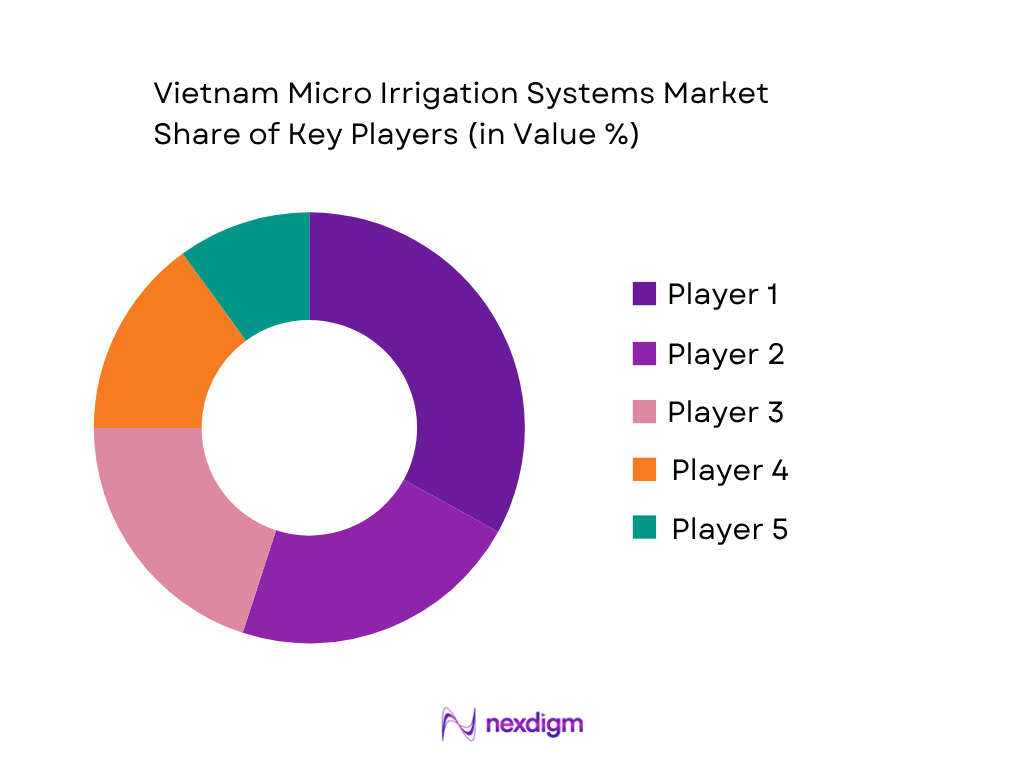
Vietnam Micro Irrigation Systems Market Analysis
Growth Drivers
Increasing Agricultural Water Management Requirements
The Vietnam Micro Irrigation Systems Market is supported by rising requirements for efficient agricultural water management due to increasing pressure on freshwater resources and changing farming conditions. Agriculture remains a critical sector in Vietnam, with the World Bank reporting that agriculture, forestry, and fisheries continue to contribute significantly to rural livelihoods and economic activity. Vietnam has more than 27 million hectares of agricultural land, creating substantial demand for irrigation infrastructure across farming regions. The Mekong Delta and Central Highlands face increasing challenges related to water availability, salinity intrusion, and irregular rainfall patterns, encouraging farmers to adopt drip irrigation and sprinkler technologies. According to Vietnam’s Ministry of Agriculture and Rural Development, climate adaptation and sustainable agricultural production have become key priorities, particularly for water-intensive crops. Micro irrigation systems help farmers optimize water usage, improve fertilizer application efficiency, and maintain crop productivity during variable climatic conditions. The increasing adoption of efficient irrigation technologies among coffee plantations, fruit orchards, and vegetable producers is strengthening market demand. Commercial farms are increasingly investing in irrigation modernization to improve resource management and support sustainable agricultural production.
Expansion of Coffee and Fruit Cultivation
The expansion of coffee and fruit cultivation is a major growth driver for the Vietnam Micro Irrigation Systems Market as commercial crop producers require reliable irrigation systems for maintaining productivity and quality. Vietnam is one of the world’s leading coffee producers, with the Ministry of Agriculture and Rural Development reporting coffee cultivation covering more than 700,000 hectares, primarily concentrated in the Central Highlands. Coffee production requires efficient water management, particularly during dry seasons, increasing demand for drip irrigation and sprinkler systems. Fruit cultivation has also expanded significantly, with Vietnam producing major export-oriented crops including dragon fruit, durian, mango, and banana. Government agricultural development programs have encouraged diversification toward high-value crops, creating demand for precision irrigation technologies. The General Statistics Office of Vietnam reported continued agricultural production activity supported by crop diversification and export agriculture. Micro irrigation systems enable fruit growers to maintain consistent moisture levels, improve crop quality, and reduce water losses. The expansion of commercial orchards and export-focused farming enterprises is encouraging greater adoption of advanced irrigation solutions across major agricultural regions.
Market Challenges
High Installation Costs
High installation costs remain a significant challenge for the Vietnam Micro Irrigation Systems Market, particularly among smallholder farmers operating with limited financial resources. Micro irrigation systems require investment in drip lines, sprinkler equipment, pumps, filtration units, controllers, and professional installation services, creating affordability barriers for smaller agricultural producers. Vietnam’s agricultural sector continues to have a large number of small-scale farming households, which limits their ability to independently finance advanced irrigation infrastructure. According to the General Statistics Office of Vietnam, millions of rural households remain engaged in agricultural activities, with many operating relatively small production areas. The initial investment requirement becomes more challenging for farmers cultivating traditional crops where immediate financial returns may be limited. Access to agricultural financing and technical support varies across regions, affecting adoption rates. Commercial farms and export-oriented agricultural enterprises generally have higher adoption because they possess greater financial capacity and require productivity improvements. Expanding financing programs, cooperative-based irrigation models, and affordable irrigation solutions remain important factors for increasing adoption among smaller farming communities.
Limited Awareness Among Smallholder Farmers
Limited awareness among smallholder farmers regarding micro irrigation technologies continues to restrict market development in several agricultural regions of Vietnam. Many farmers remain dependent on traditional irrigation practices due to limited knowledge about drip irrigation, sprinkler systems, fertigation methods, and automated water management technologies. According to Vietnam’s Ministry of Agriculture and Rural Development, agricultural modernization requires increased technology adoption and improved technical knowledge among farming communities. Smallholder farmers often face difficulties understanding irrigation system design, crop-specific water requirements, filtration management, and maintenance procedures. The fragmented structure of agricultural land ownership creates additional challenges because individual farmers may lack resources to invest in advanced irrigation solutions. Regional differences in agricultural extension services also influence adoption, with commercially developed farming regions showing higher technology penetration compared with remote agricultural areas. Increasing farmer training programs, strengthening agricultural cooperatives, and improving access to local irrigation specialists can support wider adoption. Enhanced awareness regarding productivity improvement, water conservation benefits, and long-term operational advantages will remain important for expanding the Vietnam Micro Irrigation Systems Market.
Market Opportunities
Expansion of Smart Irrigation Solutions
The expansion of smart irrigation solutions creates significant opportunities for the Vietnam Micro Irrigation Systems Market as agricultural producers increasingly adopt digital technologies to improve water management efficiency. IoT-based sensors, automated irrigation controllers, remote monitoring platforms, and data-driven irrigation management systems are gaining attention among commercial farms and technology-focused agricultural enterprises. Vietnam’s digital transformation initiatives have increased technology adoption across economic sectors, supported by improvements in connectivity infrastructure. The Ministry of Information and Communications has reported continued expansion of digital infrastructure, creating a foundation for connected agricultural solutions. Smart irrigation technologies enable farmers to monitor soil moisture, weather conditions, and crop requirements in real time, improving irrigation accuracy and reducing resource wastage. Commercial coffee plantations, fruit orchards, and greenhouse operators are increasingly exploring automated irrigation systems to improve operational efficiency. The integration of micro irrigation with digital agriculture platforms provides opportunities for manufacturers to offer advanced solutions combining hardware, software, and analytics. As Vietnam moves toward sustainable agricultural production, smart irrigation technologies are expected to become increasingly important for improving farm productivity and resource utilization.
Precision Fertigation Growth
The growth of precision fertigation systems represents an important opportunity for the Vietnam Micro Irrigation Systems Market as farmers increasingly seek methods to improve nutrient efficiency and crop productivity. Fertigation combines irrigation and fertilizer application through controlled delivery systems, allowing farmers to provide nutrients directly to plant roots while minimizing losses. Vietnam’s agriculture sector has increasingly focused on improving productivity and sustainability through modern farming practices. The Ministry of Agriculture and Rural Development has promoted agricultural restructuring programs emphasizing higher-value crops, improved resource efficiency, and advanced cultivation methods. High-value crops including coffee, dragon fruit, vegetables, and greenhouse-grown produce benefit significantly from fertigation technologies because they require precise nutrient management throughout cultivation cycles. The expansion of export-oriented agriculture has increased demand for technologies that support consistent crop quality and production standards. Protected cultivation systems, including greenhouses and controlled farming environments, also require precise irrigation and nutrient management, creating additional opportunities for fertigation solutions. The combination of micro irrigation, automation, and precision nutrient delivery provides manufacturers with opportunities to develop integrated agricultural solutions supporting sustainable farming practices across Vietnam.
Future Outlook
The Vietnam Micro Irrigation Systems Market is expected to experience sustained development due to increasing agricultural modernization, rising demand for efficient water management, and expansion of high-value crop cultivation. The adoption of drip irrigation, sprinkler systems, and precision fertigation technologies is expected to increase among commercial farms and export-oriented agricultural producers. Government initiatives supporting sustainable agriculture and climate adaptation are likely to encourage investment in water-efficient farming solutions. The integration of IoT-based monitoring systems, automation technologies, and digital agriculture platforms is expected to create additional opportunities for irrigation technology providers. Growing greenhouse cultivation and increasing focus on agricultural productivity improvement will further support market expansion.
Major Players
- Netafim Vietnam
- Jain Irrigation Systems Ltd.
- Rivulis Vietnam
- Binh Minh Plastic Joint Stock Company
- Rain Bird Corporation
- Hunter Industries
- The Toro Company
- Valmont Industries
- Khang Thinh Irrigation Technology Company
- Dai Thanh Plastic Company
- Hiep Thanh Irrigation Equipment Company
- Supreme Industries Limited
- Mahindra EPC Irrigation Limited
- Automat Industries Pvt. Ltd.
- Premier Irrigation Adritec Pvt. Ltd.
Key Target Audience
- Micro irrigation system manufacturers and irrigation equipment suppliers
- Agricultural equipment companies and precision farming technology providers
- Coffee plantation operators and commercial agricultural producers
- Fruit cultivation enterprises and export-oriented farming companies
- Greenhouse and protected cultivation solution providers
- Investments and venture capitalist firms focused on agricultural technology, climate solutions, and sustainable farming
- Government and regulatory bodies (Ministry of Agriculture and Rural Development, Vietnam Directorate of Water Resources, Provincial Departments of Agriculture and Rural Development)
- Fertigation equipment suppliers and agricultural input companies
Research Methodology
Step 1: Identification of Key Variables
The initial phase involves developing a comprehensive ecosystem map covering irrigation manufacturers, agricultural producers, government agencies, technology providers, distributors, and farming communities operating within the Vietnam Micro Irrigation Systems Market. This stage includes extensive secondary research to identify critical variables such as irrigation adoption patterns, crop-based demand, regional deployment, technology advancement, and regulatory factors.
Step 2: Market Analysis and Construction
In this phase, historical and current market information is analyzed to evaluate irrigation system deployment, agricultural application patterns, supply chain structure, and demand dynamics. The assessment covers drip irrigation, sprinkler systems, fertigation technologies, component suppliers, and adoption across major agricultural regions including the Mekong Delta and Central Highlands.
Step 3: Hypothesis Validation and Expert Consultation
Market assumptions are validated through discussions with irrigation manufacturers, agricultural solution providers, distributors, plantation operators, and industry stakeholders. These consultations provide insights into installation practices, technology preferences, farmer adoption barriers, operational challenges, and emerging opportunities within the Vietnam Micro Irrigation Systems Market.
Step 4: Research Synthesis and Final Output
The final stage combines primary and secondary research findings to develop a validated market assessment. Industry interactions are used to verify irrigation technology adoption, competitive positioning, application trends, and future opportunities. The collected information is synthesized into a structured analysis of market dynamics, segmentation, and growth prospects.

- Executive Summary
- Research Methodology (Market Definition and Scope, Vietnam Micro Irrigation Systems Market Classification, Irrigation Technology Mapping, Drip Irrigation System Assessment, Sprinkler Irrigation System Evaluation, Micro Sprinkler Technology Analysis, Fertigation System Assessment, Irrigation Component Mapping, Water Management Technology Evaluation, Precision Agriculture Integration Assessment, Agricultural Application Mapping, Crop-Based Demand Analysis, Top-Down Market Assessment, Bottom-Up Market Assessment, Supply-Side Analysis, Demand-Side Analysis, Primary Industry Interviews, Data Triangulation, Forecasting Framework, Research Limitations and Future Conclusions)

- Definition and Scope
- Vietnam Micro Irrigation Systems Industry Evolution
- Micro Irrigation Systems Value Chain Analysis
- Micro Irrigation Systems Supply Chain Analysis

- Growth Drivers (Increasing Agricultural Water Management Requirements, Expansion of Coffee and Fruit Cultivation, Rising Demand for Precision Agriculture, Government Support for Agricultural Modernization, Increasing Adoption of Water Efficient Farming, Expansion of Greenhouse Agriculture, Growth of High-Value Crop Production, Climate Variability Impact on Farming, Rising Export-Oriented Agriculture, Increasing Farm Productivity Requirements)
- Market Challenges (High Installation Costs, Limited Awareness Among Smallholder Farmers, Dependence on Imported Irrigation Components, Maintenance Requirements, Lack of Technical Expertise, Fragmented Agricultural Land Holdings, Limited Access to Financing, Water Quality and Filtration Challenges, Regional Differences in Adoption, Competition from Traditional Irrigation Practices)
- Market Opportunities (Expansion of Smart Irrigation Solutions, IoT-Based Farm Monitoring Systems, AI-Enabled Irrigation Management, Solar-Powered Irrigation Adoption, Precision Fertigation Growth, Expansion of Protected Cultivation, Low-Cost Irrigation Solutions for Small Farmers, Digital Agriculture Integration, Sustainable Farming Development, Government Water Conservation Initiatives)
- Market Trends (Automation in Irrigation Management, Adoption of Sensor-Based Irrigation Systems, Growth of Precision Agriculture, Expansion of Drip Irrigation in Fruit Cultivation, Increasing Fertigation Adoption, Sustainable Water Management Practices, Solar Irrigation Integration, Smart Farming Platform Development, Digital Monitoring Adoption, Customized Irrigation Solutions)
- Government Regulations and Agricultural Policies (Ministry of Agriculture and Rural Development Irrigation Programs, National Agricultural Restructuring Plan, Water Resources Law, Climate Change Adaptation Programs, Agricultural Modernization Policies, Mekong Delta Sustainable Development Programs, Environmental Protection Regulations, Water Resource Management Standards, Rural Development Initiatives)
- SWOT Analysis
- Porter’s Five Forces Analysis
- PESTLE Analysis
- Stakeholder Ecosystem
- Competition Ecosystem

- By Market Value (2020-2025)
- By Installed Irrigation Area (2020-2025)
- By Irrigation System Volume Consumption (2020-2025)
- By Drip Irrigation System Deployment (2020-2025)
- By Sprinkler Irrigation System Deployment (2020-2025)
- By Fertigation System Adoption (2020-2025)

- By Irrigation System Type (In Value %)
Drip Irrigation Systems
Surface Drip Irrigation
Subsurface Drip Irrigation
Pressure Compensating Drip Irrigation
Sprinkler Irrigation Systems
Center Pivot Irrigation Systems
Micro Sprinkler Systems
Fogging and Mist Irrigation Systems
Other Specialized Irrigation Systems - By Crop Type (In Value %)
Coffee Cultivation
Fruit Crops
Durian
Mango
Banana
Vegetable Crops
Flower and Ornamental Crops
Rice and Field Crops
Other Commercial Crops - By Application Area (In Value %)
Open Field Agriculture
Protected Cultivation
Greenhouse Farming
Commercial Plantations
Smallholder Farms
Large Agricultural Enterprises
Landscape Irrigation
Research and Demonstration Farms - By Component Type (In Value %)
Drip Pipes and Emitters
Sprinkler Heads and Nozzles
Filters and Filtration Systems
Pumps and Pressure Control Equipment
Valves and Controllers
Fertigation Equipment
Sensors and Monitoring Devices
Automation and Control Systems - By Distribution Channel (In Value %)
Agricultural Equipment Dealers
Irrigation Solution Providers
Direct Farm Procurement
Government Agricultural Programs
Cooperatives and Farmer Groups
Online Agricultural Platforms
Specialized Farming Technology Distributors - By Region (In Value %)
Mekong Delta
Central Highlands
Southeast Region
Red River Delta
North Central Coast
South Central Coast
Northern Midlands and Mountain Areas

- Market Share of Major Players (By Vietnam Revenue, Irrigation Product Portfolio, Drip Irrigation Coverage, Sprinkler System Capability, Agricultural Crop Coverage, Distribution Network Reach, Government Project Participation, Farmer Support Programs, Smart Irrigation Technology Adoption, Manufacturing Capability, Imported Component Dependency, Regional Presence)
- Cross Comparison Parameters (Drip Irrigation Technology Capability, Sprinkler System Portfolio, Fertigation Solution Capability, Agricultural Crop Application Coverage, Irrigation Automation Capability, Distribution Network Strength, After-Sales Service Coverage, Precision Farming Integration Capability)
- SWOT Analysis of Major Players
- Detailed Profiles of Major Companies
Netafim Vietnam
Jain Irrigation Systems Limited
Rivulis Vietnam
Binh Minh Plastic Joint Stock Company
TTC Agricultural Products Joint Stock Company
Supreme Industries Limited
Khang Thinh Irrigation Technology Company
Hiep Thanh Irrigation Equipment Company
Dai Thanh Plastic Company
Vinachem Agricultural Solutions
Hunter Industries
Rain Bird Corporation
Toro Company
Valmont Industries
Mahindra EPC Irrigation Limited

- Farmer Irrigation Adoption Assessment
- Smallholder Farmer Technology Awareness Analysis
- Commercial Farm Irrigation Requirement Assessment
- Coffee Plantation Irrigation Management Analysis
- Greenhouse Irrigation Requirement Analysis
- Vegetable Producer Irrigation Practices Assessment
- Export Agriculture Irrigation Demand Analysis
- Government Irrigation Program Assessment

- By Market Value (2026-2035)
- By Installed Irrigation Area (2026-2035)
- By Irrigation System Volume Consumption (2026-2035)
- By Drip Irrigation Deployment (2026-2035)
- By Sprinkler Irrigation Deployment (2026-2035)
- By Fertigation System Adoption (2026-2035)


 Request a Sample
 Ask for Customization
 Get a Quote
 Enquire Now