

 Download PDF
Market Overview
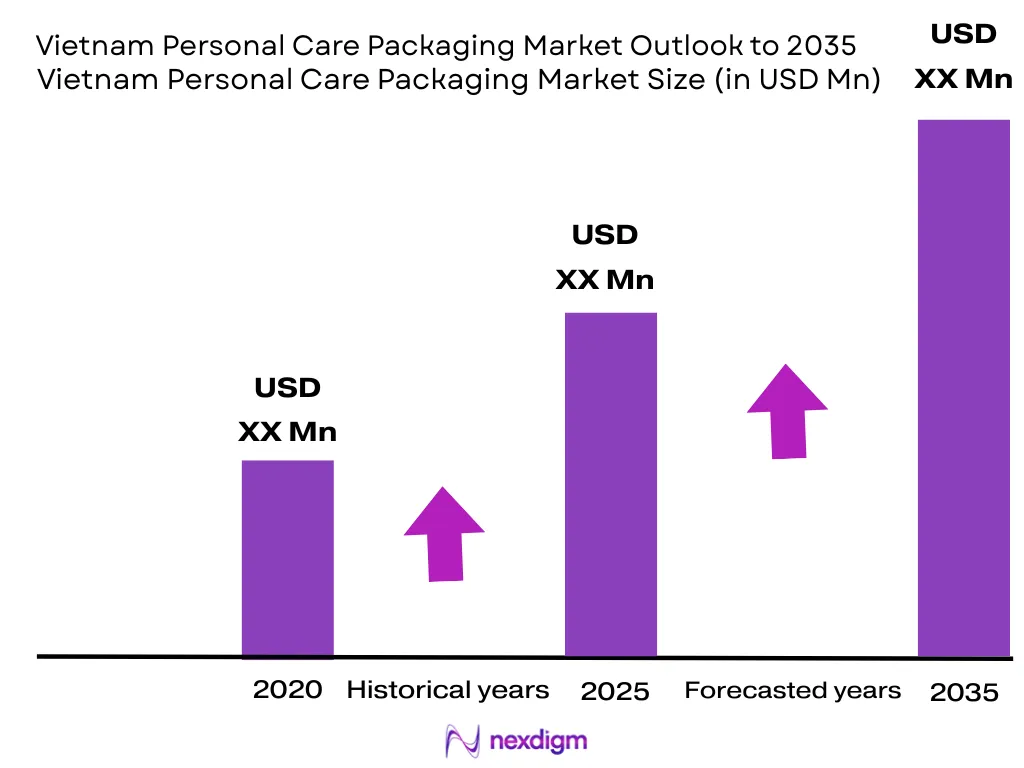
The Vietnam personal care packaging market increased from approximately USD ~ million in the historical base period to USD ~ million in the latest period, supported by a personal care products industry valued at about USD 2,560 million in the latest available commercial assessment. Demand is driven by skincare, haircare, bath products, fragrances, and cosmetics requiring pumps, bottles, tubes, jars, closures, sachets, and secondary cartons. E-commerce, pharmacy distribution, premiumization, and product differentiation are increasing packaging consumption. Ho Chi Minh City and Hanoi dominate personal care packaging demand because they contain Vietnam’s largest concentrations of consumers, beauty retailers, importers, brand offices, contract manufacturers, logistics operators, and modern trade outlets. The broader cosmetics market moved from approximately USD 1.57 billion to USD 1.68 billion across the two latest published annual observations. Ho Chi Minh City leads commercial launches and distribution, while Hanoi benefits from high purchasing power, institutional concentration, and strong access to northern manufacturing clusters.
Market Segmentation
By Packaging Material
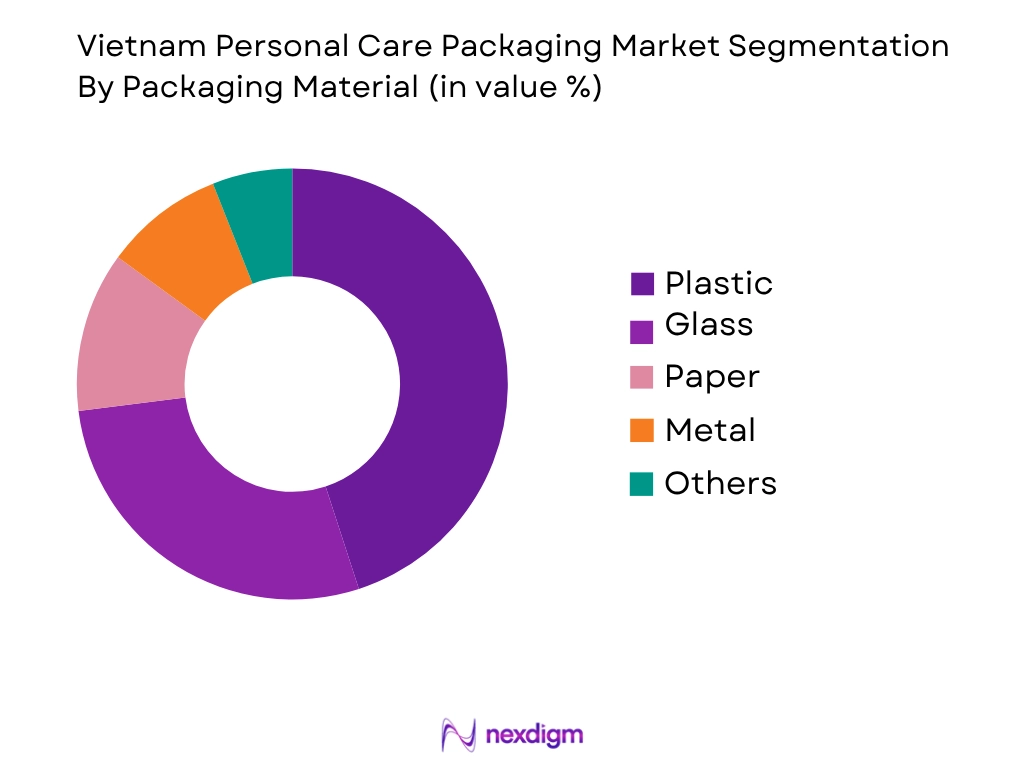
Plastic packaging holds the dominant market share under the material segmentation because it offers an advantageous combination of low unit cost, light weight, break resistance, design flexibility, and compatibility with high-volume personal care production. PET, polyethylene, polypropylene, and multilayer structures can be converted into bottles, jars, tubes, sachets, caps, and dispensing components for almost every product category. Plastic packaging also reduces transportation weight and supports convenient formats such as pumps, flip-top closures, travel packs, and refill pouches. Its established converting infrastructure and ability to accommodate decorative labeling make it particularly suitable for mass-market skincare, shampoos, body washes, and hygiene products. Nevertheless, regulatory pressure and consumer concerns about plastic waste are encouraging lightweight structures, mono-material designs, recycled content, refill systems, and paper-based alternatives. Suppliers capable of maintaining barrier protection while reducing virgin polymer use are therefore likely to secure stronger relationships with multinational and domestic brands.
By Product Format
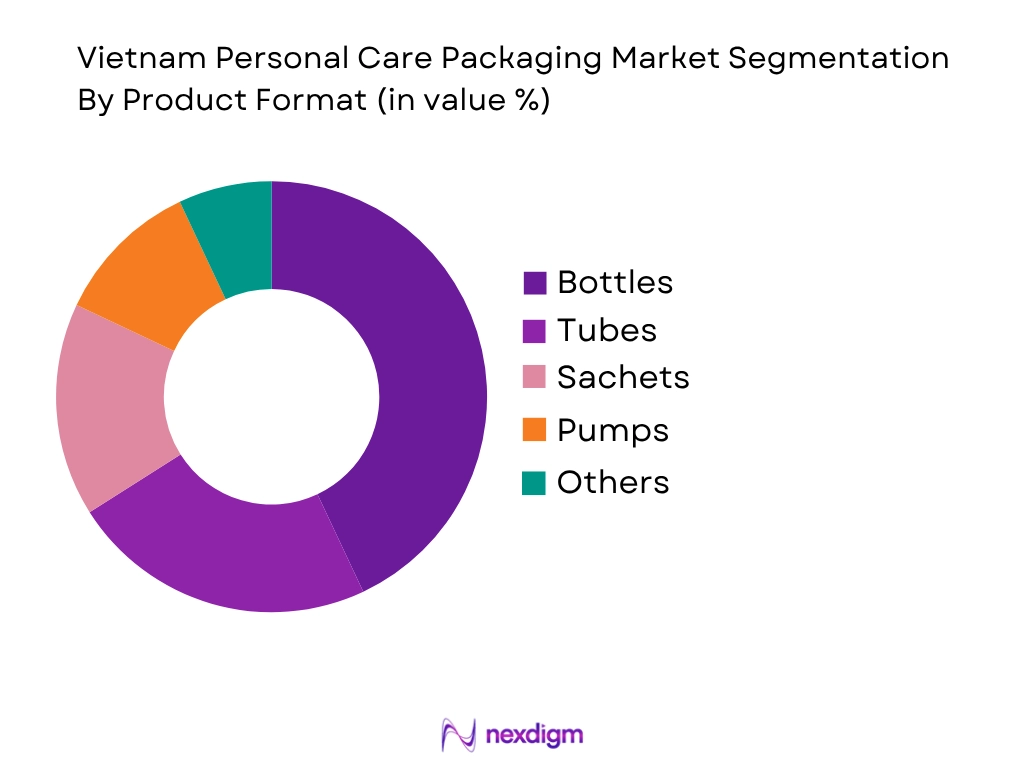
Bottles command the dominant share of the product-format segment because they are used across shampoo, conditioner, body wash, liquid soap, lotion, toner, facial cleanser, hair treatment, and men’s grooming categories. Bottles can accommodate products with different viscosities and can be combined with caps, pumps, sprays, droppers, and treatment dispensers. They also provide a broad printable and labelable surface, enabling brands to communicate ingredients, benefits, instructions, regulatory information, and premium positioning. Their suitability for both small trial packs and family-sized products makes them valuable across convenience stores, supermarkets, pharmacies, specialist beauty chains, and e-commerce. Demand is also reinforced by the popularity of Korean and Japanese skincare routines, which involve multiple liquid or semi-liquid products. Future bottle development will increasingly emphasize recycled PET, lightweight neck designs, removable dispensing components, refill compatibility, and standardized materials that improve collection and recycling outcomes.
Competitive Landscape
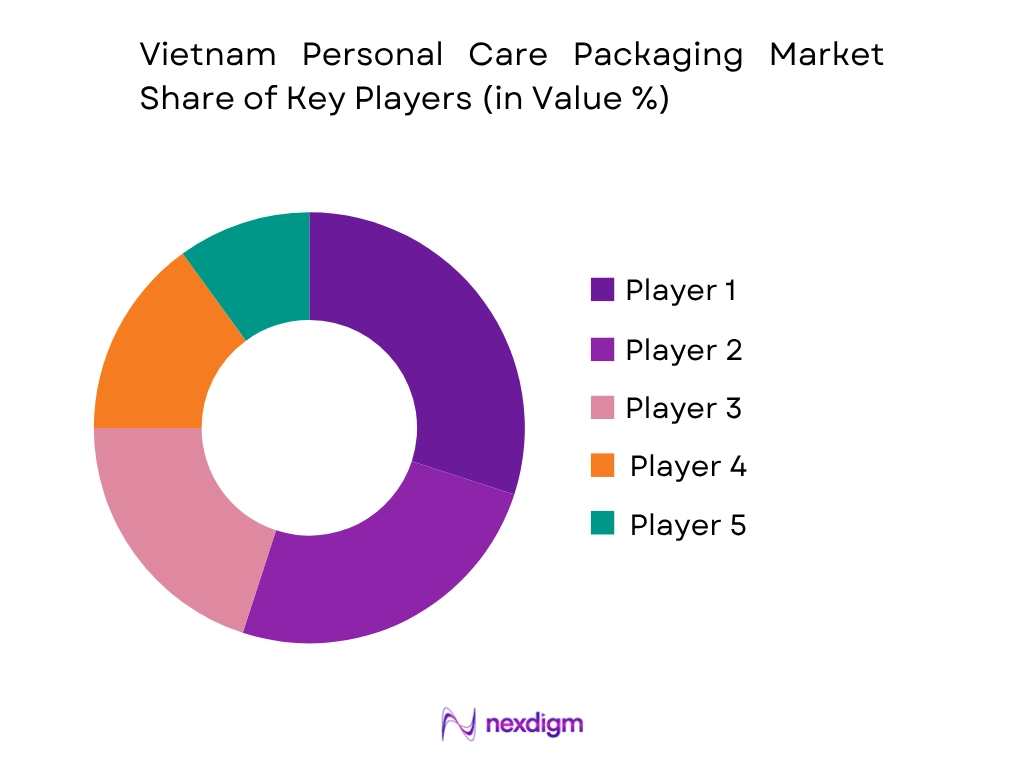
The Vietnam personal care packaging market is moderately fragmented, comprising international packaging groups, regional suppliers, local plastic converters, glass manufacturers, flexible-packaging producers, and specialized cosmetic-container companies. Large participants compete through scale, technical expertise, multinational customer relationships, and advanced dispensing solutions. Domestic suppliers compete through shorter lead times, competitive production costs, customization, and lower minimum order quantities. The presence of numerous cosmetic-packaging suppliers indicates an active but diversified domestic supply base.
| Company | Established | Headquarters | Core packaging formats | Principal materials | Personal care applications | Vietnam/ regional presence | Sustainability capability | Competitive strength |
| Amcor plc | 1860 | Zurich, Switzerland | ~ | ~ | ~ | ~ | ~ | ~ |
| AptarGroup, Inc. | 1992 | Crystal Lake, United States | ~ | ~ | ~ | ~ | ~ | ~ |
| Berry Global Group | 1967 | Evansville, United States | ~ | ~ | ~ | ~ | ~ | ~ |
| ALPLA Group | 1955 | Hard, Austria | ~ | ~ | ~ | ~ | ~ | ~ |
| Quadpack Industries | 2003 | Barcelona, Spain | ~ | ~ | ~ | ~ | ~ | ~ |
Vietnam Personal Care Packaging Market Analysis
Growth Drivers
Expanding Consumer Economy and Omnichannel Personal Care Distribution
Vietnam’s expanding consumer economy is increasing demand for bottles, tubes, jars, sachets, pumps, droppers and cartons used across skin care, hair care, bath products, oral care and grooming. The World Bank recorded national GDP at USD 476.39 billion and GDP per capita at USD 4,717.3 in 2024. Vietnam’s National Statistics Office reported total retail sales of consumer goods and services of nearly VND 6.4 quadrillion during the same period. These indicators support higher throughput across supermarkets, pharmacies, health-and-beauty stores, traditional retailers and online channels. Personal-care packaging demand is particularly concentrated in Ho Chi Minh City, Hanoi, Binh Duong and Dong Nai, where brand owners, contract manufacturers, plastics converters and fulfilment operations are clustered. E-commerce sales reached USD 25 billion in 2024, increasing the need for lockable pumps, tighter closures, abrasion-resistant labels and secondary packs suitable for motorbike and parcel delivery. Packaging suppliers serving this demand must accommodate both mass-market shampoo bottles and sachets and premium serum droppers, airless dispensers and decorated cartons. This dual demand supports converters capable of high-volume moulding, short-run decoration and rapid packaging changes.
Cosmetics Manufacturing Formalization and ASEAN-Aligned Regulation
Vietnam’s ASEAN-aligned cosmetics framework is strengthening demand for controlled packaging specifications, compliant labels and traceable production records. Cosmetic products placed on the market must follow notification, labelling and product-information requirements derived from the ASEAN Cosmetic Directive. Vietnam’s Drug Administration also maintains guidance covering cosmetic claims and sunscreen labelling, requiring companies to align package text with permitted product functions and warnings. The regulatory environment matters commercially because Vietnam recorded GDP growth of 7.1 units for every 100 units in 2024 and generated approximately VND 6.4 quadrillion in retail sales, supporting continuous product launches by domestic, Korean, Japanese and multinational brands. Each launch can involve multiple bottle sizes, shades, fragrances and promotional cartons, increasing the risk of artwork inconsistency. Packaging suppliers offering electronic artwork approval, batch coding, ingredient-list control, Vietnamese supplementary labels and tamper-evident formats therefore provide greater value than suppliers offering undecorated containers alone. Compliance also supports demand for contract filling and turnkey packaging services because smaller brands may lack internal teams for notification, formula documentation, label review and production control. The result is a broader commercial role for packaging companies in product commercialization, not merely component conversion.
Market Challenges
Multilayer Packaging Recovery and EPR Compliance Complexity
Vietnam’s personal-care sector uses multilayer sachets and pouches because they provide low unit weight, strong seals and barriers against moisture, oxygen and fragrance loss. These structures are commercially useful for shampoo, conditioner, facial cleanser and sample products, but they are difficult to collect and recycle when polyester, polyethylene, aluminium and adhesives are combined. Vietnam’s extended producer responsibility framework makes producers and importers responsible for packaging after consumption and links compliance to lifecycle management. Updated EPR provisions issued in 2026 further clarified the legal framework for producer and importer obligations. The technical problem is that replacing a multilayer sachet with a mono-material structure can reduce puncture resistance, seal integrity or formula protection. Packaging companies must conduct migration, seal-strength, heat-resistance and transport testing before changing films. Vietnam’s e-commerce sector handled USD 25 billion in transactions in 2024, while total retail sales reached nearly VND 6.4 quadrillion, meaning weak packages can create leakage and returns across a large distribution system. Brands must also maintain packaging-weight and material records, select recycling or financial-contribution pathways and verify compliance evidence. These requirements favour converters capable of material redesign, data reporting and recycler coordination, while increasing the burden on smaller brands and importers.
Imported Premium Components and Qualification Requirements
Vietnam has a developed plastics-conversion and flexible-packaging base, but premium airless pumps, fragrance sprayers, metallized collars, elastomer seals and specialized decoration systems can still depend on regional or overseas supply. Import dependence creates lead-time, exchange-rate and minimum-order risks for skin-care, fragrance and dermocosmetic brands. The challenge is amplified by the diversity of formulas placed in these packages. Alcohol, essential oils, surfactants, botanical extracts and active ingredients can interact with resins, seals, adhesives and inks, producing stress cracking, odour transfer, evaporation, discoloration or pump failure. A replacement component therefore cannot be adopted only because its dimensions appear equivalent. It must undergo priming tests, dose-consistency checks, closure-torque measurement, temperature cycling and accelerated aging. Vietnam’s GDP reached USD 476.39 billion in 2024, while e-commerce reached USD 25 billion, increasing the scale and speed at which packaging failures can affect inventories and consumer complaints. Custom moulds and decorated components also create working-capital pressure because they may become obsolete when brands alter claims, pack sizes or visual identities. Local suppliers with internal tooling, multiple component sources and documented change-control processes are better positioned to reduce these risks than distributors dependent on a single imported system.
Market Opportunities
Refill Systems and Mono-Material Flexible Packaging
Refill pouches, reusable bottles and simplified-material dispensers represent a strong future opportunity for Vietnam’s personal-care-packaging industry. At-home refills are suitable for shampoo, conditioner, hand wash, body care and selected skin-care products because consumers can retain a durable pump bottle and replace only the product-containing pack. This reduces rigid-material consumption and shipping weight without requiring retailers to install cleaning and bulk-dispensing infrastructure. Current economic indicators provide a substantial demand base: retail sales reached nearly VND 6.4 quadrillion, e-commerce reached USD 25 billion, and GDP reached USD 476.39 billion in 2024. These conditions support subscription refills and repeat online purchases. Vietnam’s EPR framework also strengthens the commercial case for packaging that uses less material, contains recycled resin or is easier to recycle. The most viable formats will include polyethylene-based refill films, detachable pumps, reduced-component closures and cartridges compatible with reusable outer packs. However, suppliers must prove seal integrity, puncture resistance, shelf stability and filling-line compatibility. Packaging companies can create additional value by offering material declarations, lifecycle calculations, leak testing and recycling guidance. This shifts competition from low-cost film conversion toward integrated circular-packaging development for domestic and export-oriented personal-care brands.
Digital Decoration and E-Commerce-Ready Packaging
Digital printing, smart labels and delivery-tested primary packaging create a future growth opportunity as Vietnamese personal-care brands expand through marketplaces, social commerce and direct-to-consumer channels. Vietnam’s e-commerce market reached USD 25 billion in 2024, while national retail sales approached VND 6.4 quadrillion. Digital decoration allows converters to produce smaller batches, regional-language variants, influencer editions and multiple fragrances without manufacturing separate printing plates for each design. This is particularly useful for emerging skin-care, botanical, fragrance and men’s-grooming brands that test products online before entering national retail. QR codes can provide usage instructions, authenticity verification, ingredient information, recycling guidance and direct reordering. Packaging performance must also reflect Vietnam’s delivery environment, where products may be transported by motorbike in heat, rain and mixed delivery bags. Lockable pumps, induction seals, reinforced caps and abrasion-resistant labels can reduce leakage and complaints. Slim refill pouches and travel-size formats can lower fulfilment weight and support subscription bundles. Suppliers combining stock bottles, digital labels, contract filling, coding and fulfilment can shorten launch cycles and reduce the capital required for custom tooling. This service model allows converters to earn revenue through speed, compliance and data management rather than competing only on container production.
Future Outlook
The Vietnam personal care packaging market is expected to expand steadily through 2035 as urban consumers adopt more complex skincare and grooming routines. Greater online beauty purchasing, rising product launches, pharmacy expansion, and the entry of international brands will broaden packaging requirements. Growth will increasingly favor suppliers offering recyclable materials, convenient dispensing systems, premium decoration, and flexible production volumes. Market development will nevertheless be influenced by resin prices, recycling infrastructure, packaging regulation, and imported component dependence. Transition toward recyclable mono-material packaging Brands will simplify multilayer structures and reduce material combinations that complicate recycling. Refill pouches and reusable bottles will gain attention in shampoos, body washes, liquid soaps, and selected skincare products. Premium dispensing solutions: Airless pumps, fine-mist sprays, droppers, and controlled-dosage systems will expand alongside serums and treatment products. Growth of e-commerce-ready packaging: Leak resistance, tamper evidence, compact design, and protection against parcel-handling damage will become standard purchasing criteria. Beauty brands will seek Vietnamese or regional suppliers to shorten lead times, reduce freight exposure, and support smaller production runs. Recycled PET and other post-consumer polymers will become more relevant where supply quality and food- or cosmetic-contact requirements can be verified.
Major Players
- Amcor plc
- AptarGroup, Inc.
- Berry Global Group, Inc.
- ALPLA Group
- Quadpack Industries
- Albéa Group
- Silgan Holdings Inc.
- Gerresheimer AG
- HCP Packaging
- Yonwoo Co., Ltd.
- SGD Pharma
- O-I Glass, Inc.
- Tetra Pak
- SCG Packaging Public Company Limited
- Hong Dong Plastic Company
Key Target Audience
- Personal care and cosmetics manufacturers
- Cosmetic packaging manufacturers and converters
- Packaging raw-material and resin suppliers
- Pumps, closures and dispensing-system manufacturers
- Importers, distributors and contract-packaging companies
- Retail, pharmacy and e-commerce operators
- Investments and venture capitalist firms
- Government and regulatory bodies (Ministry of Industry and Trade; Ministry of Health; Drug Administration of Vietnam; Ministry of Agriculture and Environment; Vietnam Competition Commission; Directorate for Standards, Metrology and Quality)
Research Methodology
Step 1: Identification of Key Variables
The initial phase involves constructing a market ecosystem covering personal care brands, packaging converters, raw-material suppliers, component manufacturers, distributors, retailers, recyclers, and regulators. Secondary research is used to identify variables such as packaging consumption, product launches, material usage, imports, domestic production, average selling prices, dispensing formats, and sustainability requirements.
Step 2: Market Analysis and Construction
Historical market information is compiled and organized by packaging material, format, personal care application, distribution channel, and supplier category. A bottom-up model evaluates packaging volumes consumed by major personal care categories and applies validated price ranges. The results are cross-checked against company revenues, trade activity, production capacities, customer demand, and broader personal care market performance.
Step 3: Hypothesis Validation and Expert Consultation
Preliminary assumptions are validated through computer-assisted telephone interviews and structured discussions with packaging manufacturers, cosmetic brands, distributors, mold developers, procurement professionals, and material suppliers. These consultations test assumptions concerning utilization rates, average order sizes, pricing, imported-component dependence, product substitution, sustainability adoption, and the relative importance of different packaging formats.
Step 4: Research Synthesis and Final Output
The final phase reconciles top-down and bottom-up findings and examines inconsistencies between company disclosures, trade data, channel observations, and expert feedback. Segment values are normalized to prevent double counting of components and finished packages. The completed output includes market size, growth outlook, segmentation, competitive assessment, market drivers, risks, company profiles, and scenario-based forecasts.

- Executive Summary
- Research Methodology (Market Definitions and Assumptions, Personal Care Packaging Taxonomy, Abbreviations, Market Sizing Approach, Top-Down Personal Care Product Consumption Analysis, Bottom-Up Packaging Supplier Aggregation, Packaging Units per Finished Product, Demand-Side Assessment, Supply-Side Capacity Mapping, Import–Export Reconciliation, Retail Channel Assessment, Primary Industry Interviews, Data Triangulation, Forecasting Framework, Scenario Analysis, Limitations and Future Conclusions)

- Definition and Scope
- Personal Care Packaging Market Evolution and Industry Genesis
- Timeline of Major Packaging and Regulatory Developments
- Personal Care Packaging Business Cycle
- Packaging Demand Linkage with Cosmetics, Toiletries and Fragrance Manufacturing
- ASEAN Cosmetics Regulatory Integration
- Domestic Personal Care Manufacturing and Imported Finished-Product Ecosystem

- Growth Drivers (Rising Urban Personal Care Consumption, Expansion of Modern Retail, Growth of E-Commerce and Social Commerce, Young Consumer Demographics, Korean and Japanese Beauty Influence, Domestic Cosmetics Manufacturing, Tourism and Hospitality Demand, Premium Skin-Care Adoption and Export-Oriented Production)
- Market Challenges (Virgin Resin Volatility, Multilayer Packaging Recovery, Imported Premium Pump Dependence, High Custom Tooling Costs, Short Product-Launch Cycles, Formula Compatibility Failures, Counterfeit Packaging, E-Commerce Leakage and EPR Compliance Complexity)
- Market Opportunities (Airless Dispensing, Refillable Skin-Care Packaging, Mono-Material Sachets, Recycled Resin Packaging, Digital Decoration, Smart Authentication Labels, Travel-Size Packaging, Waterless Products, Contract Packaging and ASEAN Export Packaging)
- Market Trends (Minimalist Korean-Style Packaging, Clinical Skin-Care Aesthetics, Premium Droppers, Refill Pouches, PCR Resin, Paper-Based Secondary Packaging, Botanical Design Language, Gender-Neutral Formats, Social-Commerce Packs and Omnichannel Packaging)
- SWOT Analysis
- Porter’s Five Forces Analysis
- PESTLE Analysis

- By Market Value (2020-2025)
- By Packaging Units (2020-2025)
- By Packaging Material Consumption (2020-2025)

- By Packaging Product Type (In Value %)
Bottles
Jars
Plastic Tubes
Laminated Tubes
Sachets
Pouches
Stand-Up Refill Pouches - By Packaging Material (In Value %)
Polyethylene Terephthalate
Recycled Polyethylene Terephthalate
High-Density Polyethylene
Low-Density Polyethylene
Polypropylene
Post-Consumer Recycled Polyolefins
Polyvinyl Chloride - By Sales and Distribution Channel (In Value %)
Traditional General Trade
Wet Markets and Independent Retailers
Supermarkets and Hypermarkets
Convenience Stores
Pharmacies and Drugstores
Health and Beauty Retailers - By Geographic Market (In Value %)
Northern Vietnam
Central Vietnam
Southern Vietnam
Red River Delta
Southeast Vietnam
Mekong River Delta

- Market Share of Major Players
- Cross Comparison Parameters (Personal Care Packaging Portfolio Breadth, Dispensing-System and Closure Technology, Vietnam Manufacturing Footprint, Sustainable Material and PCR Capability, Custom Moulding and Decoration Capability, Sachet and Refill-Pouch Capability, E-Commerce and Export Packaging Performance, Vietnamese Personal Care Brand Customer Coverage)
- SWOT Analysis of Major Players
- Detailed Profiles of Major Companies
Duy Tan Plastics Manufacturing Corporation
SCG Packaging
ALPLA Vietnam
Amcor Vietnam
Huhtamaki Vietnam
Oji Interpack Vietnam
Ngoc Nghia Industry
Tan Tien Plastic Packaging
Rengo Packaging Vietnam
Dai Dong Tien Corporation
Bach Tung Plastic
Hong Dong Plastic
NBT Plastic
Green Packaging Company
Dynaplast Packaging Vietnam

- Packaging Attribute Preference Assessment
- Convenience and Dispensing Preference
- Premium versus Functional Packaging Preference
- Refillable Packaging Acceptance
- Recycled-Content Packaging Perception
- Glass versus Plastic Preference
- Sachet versus Bottle Preference

- By Market Value (2026-2035)
- By Packaging Units (2026-2035)
- By Packaging Material Consumption (2026-2035)


 Request a Sample
 Ask for Customization
 Get a Quote
 Enquire Now