

 Download PDF
Market Overview
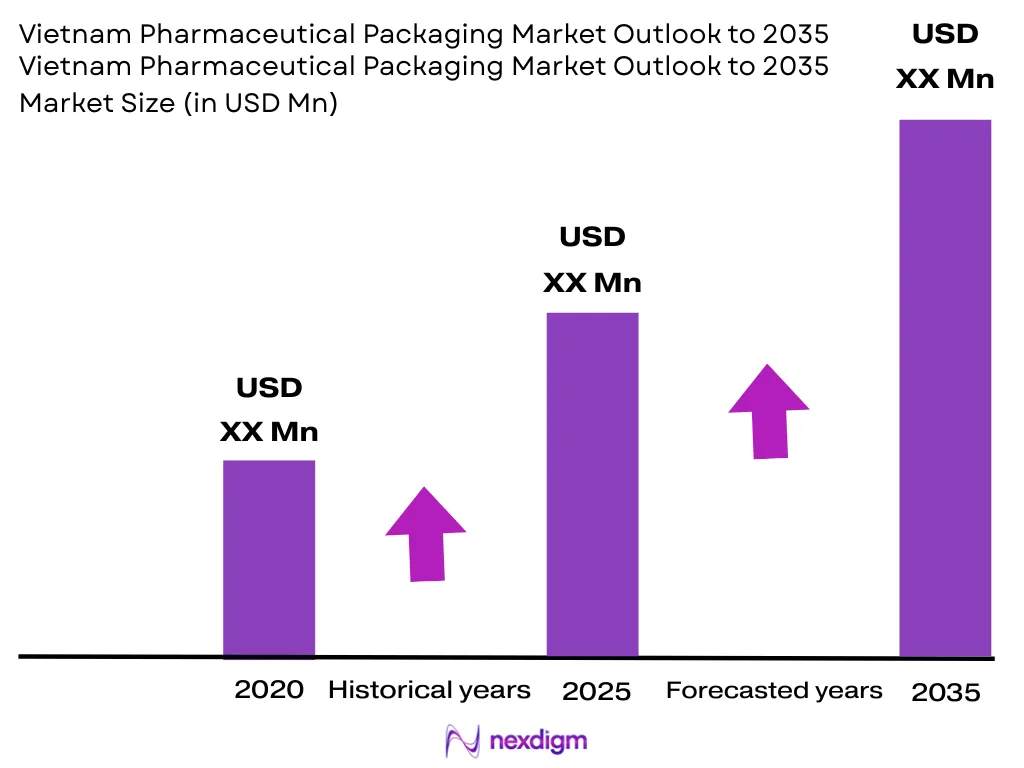
The Vietnam Pharmaceutical Packaging Market was valued at USD ~ Million in 2024 and is anticipated to expand at a CAGR of ~ % during 2026–2035. The market is primarily driven by localization of pharmaceutical manufacturing under industrial policy incentives, rising chronic disease and ageing population burden, and continued growth of generic drug production. According to Fortune Business Insights, the Vietnam pharmaceuticals market was worth USD ~ billion in 2024 and is estimated to reach USD ~ billion by 2032, growing at a CAGR of 9.33 percent, directly sustaining demand for compliant packaging across the country’s manufacturing base. According to Mordor Intelligence, Vietnam’s healthcare packaging segment is expected to grow at a 10.05 percent CAGR as the country localizes pharmaceutical production under industrial policy incentives, with tamper-evident folding cartons featuring braille embossing and moisture-barrier liners becoming increasingly standard across oral drugs, injectables, and traditional medicine applications.
Market Segmentation
By Material
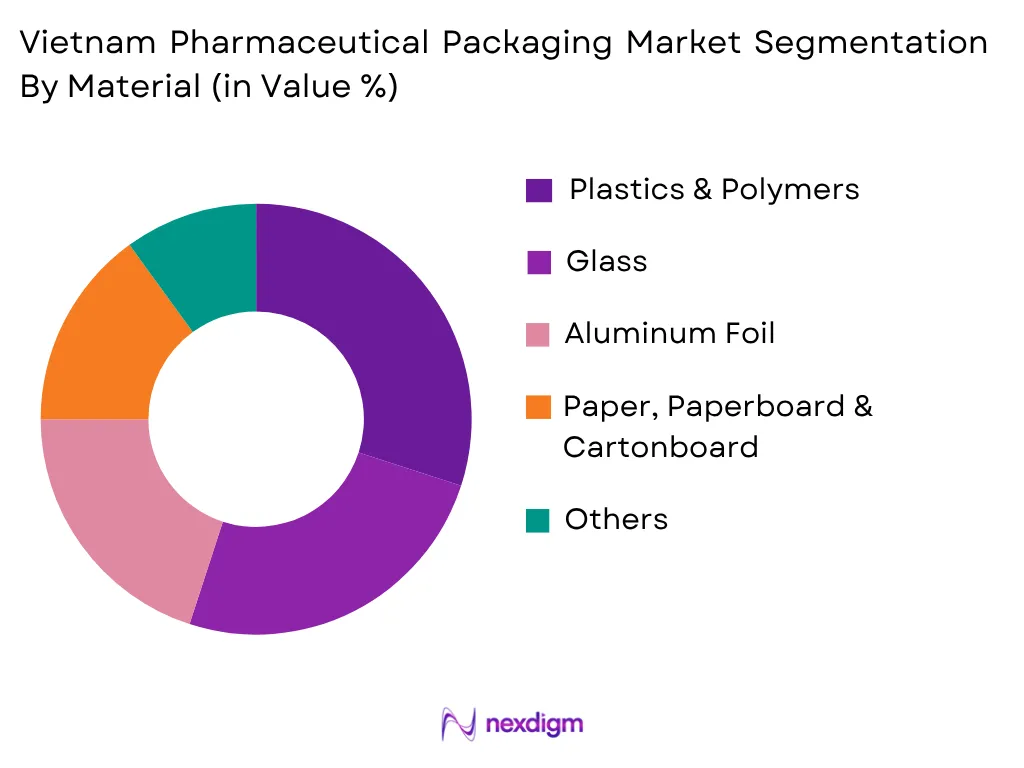
Among these, Plastics & Polymers hold a significant share of the Vietnam Pharmaceutical Packaging Market, supported by widespread use across bottles, blister packs, and strip packaging for oral solid dosage forms produced by the country’s expanding generics manufacturing base. Huhtamaki Oyj commenced production of sustainable flexible packaging solutions made from paper, polypropylene, and polyethylene in the Vietnamese market in April 2023, reflecting continued multinational investment in localized, sustainable packaging capacity. At the same time, Paper, Paperboard & Cartonboard is emerging as one of the fastest-growing material segments, with cartonboard recording an 11.13 percent CAGR through 2031 according to Mordor Intelligence, propelled by rising pharmaceutical labeling needs and retail-ready display requirements. Glass remains essential for injectable and vaccine packaging formats, with demand increasingly supported by Vietnam’s push to localize biologics and vaccine manufacturing capacity under government industrial policy.
By Application
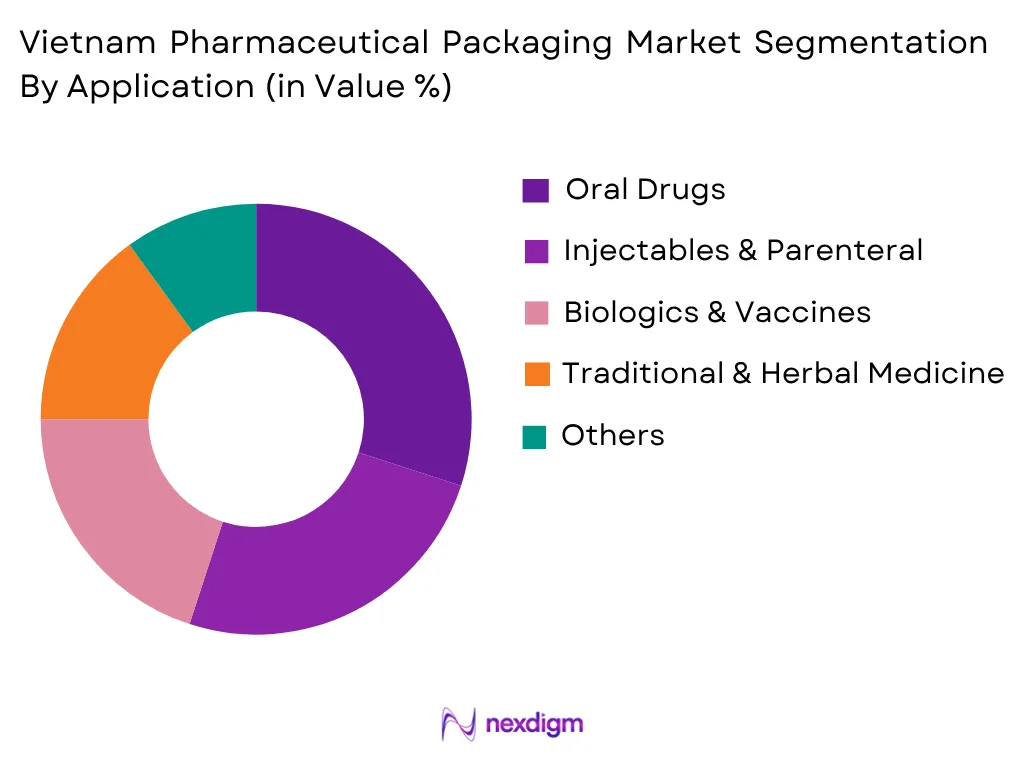
The Oral Drugs segment holds the largest share, reflecting Vietnam’s pharmaceutical market structure in which nonprescription products comprise approximately 70 percent of total sales, with branded and unbranded generics comprising the majority of the remaining share, according to SG Analytics. This consumption pattern sustains high-volume demand for bottles, blister packs, and strip packaging across the country’s extensive domestic generics manufacturing base. Meanwhile, Injectables & Parenteral and Biologics & Vaccines packaging is expanding rapidly as Vietnam continues localizing pharmaceutical production under industrial policy incentives, with healthcare packaging overall forecast to grow at a 10.05 percent CAGR. Traditional and herbal medicine packaging also represents a distinctive and significant application category in Vietnam, requiring specialized cartons and sachets that reflect the country’s deep-rooted traditional medicine practices alongside modern pharmaceutical manufacturing.
Competitive Landscape
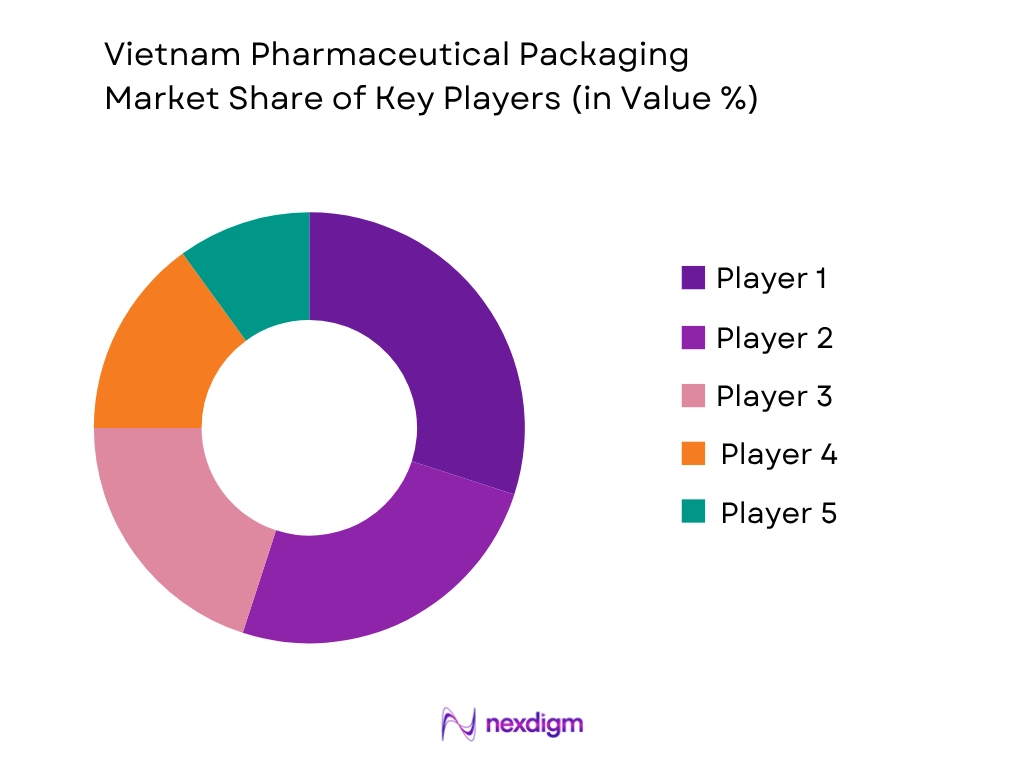
The Vietnam Pharmaceutical Packaging Market is moderately fragmented, with multinational packaging companies, regional Southeast Asian manufacturers, and domestic Vietnamese converters competing across plastic, glass, and paperboard formats. Competition is primarily based on cost efficiency, regulatory compliance with DAV labeling requirements, and the ability to serve both domestic pharmaceutical manufacturers and export-oriented producers. Southeast Vietnam, particularly Ho Chi Minh City, Binh Duong, and Dong Nai, remains the dominant manufacturing hub, benefiting from concentrated pharmaceutical and packaging converting capacity along with port access for imported raw materials. Companies are increasingly investing in sustainable flexible packaging production and tamper-evident carton technologies, exemplified by Huhtamaki’s April 2023 launch of sustainable flexible packaging production in Vietnam, to differentiate their portfolios and align with Vietnam’s evolving industrial policy incentives supporting localized pharmaceutical manufacturing.
| Company | Establishment Year | Headquarters | Primary Product Portfolio | Pharmaceutical Packaging Portfolio
|
Manufacturing Presence | Major End-Use Industries | Key Strategic Focus | Certifications & Compliance |
| Huhtamaki Oyj | 1920 | ~ | ~ | ~ | ~ | ~ | ~ | ~ |
| Tetra Pak Vietnam | 1994 | ~ | ~ | ~ | ~ | ~ | ~ | ~ |
| Amcor plc | 1860 | ~ | ~ | ~ | ~ | ~ | ~ | ~ |
| SCG Packaging | 1913 | ~ | ~ | ~ | ~ | ~ | ~ | ~ |
| Duy Tan Plastics | 1987 | ~ | ~ | ~ | ~ | ~ | ~ | ~ |
Vietnam Pharmaceutical Packaging Market Analysis
Growth Drivers
Localization of Pharmaceutical Manufacturing and Rising Healthcare Burden
Vietnam’s pharmaceutical packaging market is experiencing sustained growth due to government-driven localization of pharmaceutical manufacturing and rising healthcare demand. According to IMARC Group, the Vietnam pharmaceuticals market was valued at USD 7,983.8 million in 2025 and is expected to reach USD 14,649.8 million by 2034, driven by growing collaboration between pharmaceutical companies, an increasing geriatric population, and the high burden of chronic diseases, with cardiovascular diseases alone causing over 100,000 deaths and affecting approximately 1.6 million people in Vietnam. Local companies benefit from government support to produce cost-effective generics, reducing reliance on imports and improving supply chain resilience, according to IMARC. Foreign direct investment and partnerships with multinational pharmaceutical firms continue to bring advanced manufacturing technologies and quality standards to the market, sustaining consistent demand for compliant, high-performance packaging across the country’s expanding pharmaceutical manufacturing base.
Expansion of E-Pharmacies and Regulatory Streamlining
The rapid expansion of e-pharmacies and retail pharmacy chains continues to strengthen distribution channels and drive packaging demand across Vietnam. Vietnam’s regulatory environment is also becoming increasingly favorable, with streamlined approval processes and incentives for domestic manufacturing supporting continued market growth, according to IMARC Group. The Pharmaceutical Law amendment, Law No. 44/2024, took effect on July 1, 2025, updating Vietnam’s core legal framework governing drug and packaging registration alongside the implementing Decree 163/2025/ND-CP, reflecting continued regulatory modernization aligned with ASEAN and ICH standards. In July 2025, the UK’s Medicines and Healthcare products Regulatory Agency signed an agreement under a new trade strategy for industry-specific deals with Vietnam, simplifying the registration process for new medicines and vaccines and reflecting growing international regulatory cooperation that supports continued expansion of Vietnam’s pharmaceutical packaging industry.
Market Challenges
Lengthy Drug Registration Timelines and Regulatory Compliance Complexity
Despite steady demand growth, the Vietnam pharmaceutical packaging market remains constrained by lengthy drug registration processes that delay market entry for new drugs and discourage investment from global pharmaceutical companies. According to a November 2024 National Assembly session cited by Fortune Business Insights, only 9.0 percent of new medicines have been introduced in Vietnam over the past decade, far lower than other Asia Pacific countries, limiting patient access to new treatments and constraining growth in packaging formats associated with innovative therapies. The Drug Administration of Vietnam (DAV) requires drug registration dossiers, sample labels, and package inserts to be submitted in Vietnamese and to comply with mandatory standardized labeling templates, with inconsistencies in Vietnamese translations or formatting frequently causing delays. GMP inspection scheduling for foreign manufacturing facilities can also significantly extend approval timelines, creating compliance complexity for packaging manufacturers and pharmaceutical companies serving the Vietnamese market.
Limited Domestic Innovation Capacity and Raw Material Import Dependency
Vietnam’s pharmaceutical packaging market faces structural challenges from limited domestic innovator drug access and continued dependency on imported specialty packaging materials. According to SG Analytics, originator products comprise less than 4 percent of Vietnam’s pharmaceutical market share, placing the country below ASEAN counterparts such as Thailand and Singapore regarding access to innovative medicines, which in turn limits demand for advanced, high-value packaging formats associated with novel biologics and specialty therapies. Most domestic pharmaceutical suppliers lack sufficient resources such as R&D infrastructure, manufacturing capacity, and capital to fully exploit the market, according to SG Analytics, extending to the packaging sector where specialty barrier films, borosilicate glass, and advanced closures often must be imported. This raw material import dependency exposes packaging manufacturers to currency fluctuations and global supply chain disruptions, increasing cost volatility for companies operating within Vietnam’s pharmaceutical packaging industry.
Market Opportunities
Rising Investment in Sustainable and Compliance-Focused Packaging
Vietnam’s regulatory modernization and growing sustainability focus create significant opportunities for investment in compliance-focused and sustainable pharmaceutical packaging. Huhtamaki Oyj’s April 2023 launch of sustainable flexible packaging production made from paper, polypropylene, and polyethylene in Vietnam illustrates the commercial viability of localizing environmentally responsible packaging manufacturing. Vietnam’s healthcare packaging segment is forecast to grow at a 10.05 percent CAGR as the country localizes pharmaceutical production under industrial policy incentives, with tamper-evident folding cartons featuring braille embossing and moisture-barrier liners becoming increasingly standard. As Vietnam continues implementing its Pharmaceutical Law amendment and streamlining registration processes, manufacturers investing early in compliant, sustainable packaging formats are positioned to capture growing demand from both domestic and export-oriented pharmaceutical manufacturers.
Expansion of Biologics Localization and ASEAN Export Manufacturing
Vietnam’s growing foreign direct investment in pharmaceutical production and ASEAN regulatory harmonization create substantial long-term opportunities for packaging manufacturers serving biologics and vaccine localization efforts. Multinational pharmaceutical companies continue to expand their footprints in Vietnam through strategic initiatives such as collaborations and clinical trials, according to Fortune Business Insights, with companies such as Takeda serving as a committed healthcare partner in Vietnam for more than ten years. Vietnam’s adoption of the ASEAN ACTD/ACTR harmonized dossier format creates favorable conditions for pharmaceutical and packaging companies to streamline regulatory submissions across multiple Southeast Asian markets simultaneously. As Vietnam continues strengthening domestic biologics and vaccine manufacturing capacity, companies offering advanced glass vial, cartridge, and cold-chain-compatible packaging technologies are well positioned to capture growing demand across both domestic and regional export markets.
Future Outlook
The Vietnam Pharmaceutical Packaging Market is expected to witness sustained expansion over the forecast period, supported by continued localization of pharmaceutical manufacturing, expanding e-pharmacy and retail distribution channels, and increasing regulatory modernization under the 2025 Pharmaceutical Law amendment. Continued investment in tamper-evident cartons, sustainable flexible packaging, and biologics packaging capacity will further accelerate innovation across the industry. The market is also likely to benefit from Vietnam’s growing role as a regional pharmaceutical manufacturing hub, enabling greater integration between domestic converters and international pharmaceutical companies seeking compliant, cost-competitive packaging solutions.
Major Players
- Huhtamaki Oyj
- Tetra Pak Vietnam
- Amcor plc
- SCG Packaging
- Duy Tan Plastics
- Gerresheimer AG
- Schott AG
- AptarGroup, Inc.
- West Pharmaceutical Services, Inc.
- Berry Global Group, Inc.
- CCL Industries Inc.
- Nipro Corporation
- Becton, Dickinson and Company
- WestRock Company
- SGD Pharma
Key Target Audience
- Pharmaceutical Packaging Manufacturers
- Pharmaceutical and Biopharmaceutical Companies
- Contract Packaging Organizations (CPOs)
- Hospitals, Clinics and Traditional Medicine Manufacturers
- Retail and E-Pharmacy Distribution Networks
- Investment and Venture Capitalist Firms
- Government and Regulatory Bodies (Drug Administration of Vietnam (DAV), Ministry of Health (MOH), Ministry of Industry and Trade (MOIT))
- Packaging Material Suppliers and Industrial Raw Material Distributors
Research Methodology
Step 1: Identification of Key Variables
The research process begins with identifying the complete ecosystem of the Vietnam Pharmaceutical Packaging Market, including raw material and resin suppliers, packaging converters and manufacturers, pharmaceutical and biopharmaceutical companies, contract packaging organizations, distributors, and regulatory authorities. Extensive secondary research is conducted using company annual reports, government publications, trade associations, customs statistics, industry journals, and proprietary databases to determine the variables influencing market demand, pricing, production, consumption, and technological developments.
Step 2: Market Analysis and Construction
Historical market information is collected and analyzed to estimate market size, production volumes, import-export activity, application-wise demand, and pricing trends. A combination of top-down and bottom-up approaches is used to estimate market revenues and validate segment-level performance. Consumption patterns across oral drugs, injectables, traditional medicine, and biologics are evaluated to establish an accurate representation of the industry.
Step 3: Hypothesis Validation and Expert Consultation
The preliminary findings are validated through Computer-Assisted Telephone Interviews (CATIs) and structured discussions with pharmaceutical packaging manufacturers, procurement managers, regulatory affairs experts, quality assurance professionals, and senior executives operating within the Vietnamese pharmaceutical packaging industry. These interviews help verify market assumptions, competitive developments, technology adoption trends, pricing dynamics, and future investment opportunities while refining the overall market estimates.
Step 4: Research Synthesis and Final Output
The final stage integrates insights obtained from primary interviews with quantitative information collected through secondary sources. Data triangulation techniques are applied to reconcile differences between supply-side and demand-side estimates, ensuring robust market forecasting. The report is then reviewed through multiple quality assurance checkpoints to deliver a comprehensive analysis covering market size, segmentation, competitive landscape, future outlook, and strategic recommendations for industry stakeholders.

- Executive Summary
- Research Methodology (Market Definitions and Assumptions, Abbreviations, Market Sizing Approach, Top-Down Analysis, Bottom-Up Analysis, Demand-Side Assessment, Supply-Side Assessment, Primary Industry Interviews, Secondary Research Validation, Data Triangulation, Forecasting Framework, Limitations and Future Conclusions)

- Definition and Scope
- Market Evolution and Industry Genesis
- Timeline of Major Industry Developments
- Pharmaceutical Packaging Industry Value Chain Analysis
- Supply Chain Analysis

- Growth Drivers (Localization of Pharmaceutical Manufacturing Under Industrial Policy Incentives, Rising Chronic Disease and Ageing Population Burden, Growth of Generic Drug Manufacturing, Expansion of E-Pharmacies and Retail Pharmacy Chains, Increasing Foreign Direct Investment in Pharmaceutical Production, Rising Government Healthcare Spending)
- Market Challenges (Lengthy Drug Registration and Approval Timelines, Regulatory Compliance Complexity Under DAV Requirements, Volatility in Imported Resin and Glass Raw Material Prices, Mandatory Vietnamese-Language Labeling Compliance, Limited Domestic Innovator Drug Access, Fragmented Domestic Packaging Industry Structure)
- Market Opportunities (Investment in Domestic Pharmaceutical Manufacturing Capacity, Growth in Tamper-Evident and Compliance-Focused Cartons, Expansion of Sustainable Flexible Packaging Production, Localization of Vaccine and Biologics Packaging, ASEAN Regulatory Harmonization-Driven Export Growth, Smart and Traceable Packaging Technologies)
- Market Trends (Shift Toward Tamper-Evident Folding Cartons with Braille Embossing, Rising Adoption of Moisture-Barrier Liners, Growth in Cartonboard for Pharmaceutical Labeling, Localization of Sustainable Flexible Packaging Production, Streamlined Drug Registration Under the 2025 Pharmaceutical Law Amendment, Industry Consolidation Through Investment)
- Government Regulations (Drug Administration of Vietnam (DAV) Requirements, Law on Pharmacy (Law No. 105/2016/QH13, as Amended by Law No. 44/2024), Decree 163/2025/ND-CP Implementation Guidelines, Mandatory Vietnamese-Language Labeling and Packaging Rules, WHO-GMP and ASEAN ACTD/ACTR Harmonization Standards, Circular 12/2025/TT-BYT Registration Requirements)
- Import and Export Analysis (Trade Volume, Major Import Sources, Export Destinations, HS Code Analysis, Trade Balance)
- Raw Material Availability Analysis (Pharmaceutical-Grade Resins, Borosilicate Glass, Virgin and Recycled Paperboard, Aluminium Foil, Elastomeric Closures)
- Technology Landscape (Tamper-Evident Carton Technology, Blister and Strip Packaging Systems, Moisture-Barrier Film Extrusion, Vial and Ampoule Manufacturing, Smart and Traceable Packaging)
- Sustainability Assessment (Recyclability and Post-Consumer Recycled Content, Sustainable Flexible Packaging Localization, Carbon Footprint Reduction, Cartonboard Substitution for Plastics, Circular Economy Integration)
- PESTLE Analysis
- SWOT Analysis
- Porter’s Five Forces Analysis
- Stakeholder Ecosystem
- Competition Ecosystem

- By Market Value (2020-2025)
- By Volume Consumption (2020-2025)
- By Average Selling Price (2020-2025)

- By Material (In Value %)
Plastics & Polymers
Glass
Paper, Paperboard & Cartonboard
Aluminium Foil
Other Materials - By Product Type (In Value %)
Bottles
Blister Packs
Strip Packaging
Vials & Ampoules
Folding Cartons
Pouches & Sachets - By Application (In Value %)
Oral Drugs
Injectables & Parenteral
Traditional & Herbal Medicine
Biologics & Vaccines
Topical Formulations - By End Use (In Value %)
Pharmaceutical Manufacturers
Contract Packaging Organizations (CPOs)
Hospitals & Clinics
Retail & E-Pharmacies - By Region (In Value %)
Southeast Vietnam (Ho Chi Minh City, Binh Duong, Dong Nai)
Red River Delta (Hanoi, Hai Phong)
Mekong Delta
Central Vietnam
Rest of Vietnam

- Market Share of Major Players (By Value, Volume, Material Type, Application Industry, Product Category)
- Cross Comparison Parameters (Material Portfolio Breadth, Sterile & Aseptic Packaging Capability, Drug Delivery Device Portfolio, Application Technical Support Capability, Manufacturing Capacity, Regulatory Compliance & Certifications, Pharmaceutical Customer Base, Innovation & New Product Launch Frequency)
- SWOT Analysis of Major Players
- Pricing Analysis by Product Category and SKU
- Production Capacity Analysis
- Manufacturing Footprint Analysis
- Distribution Network Analysis
- Innovation Benchmarking
- Detailed Profiles of Major Companies
Huhtamaki Oyj
Tetra Pak Vietnam
Amcor plc
SCG Packaging
Duy Tan Plastics
Gerresheimer AG
Schott AG
AptarGroup, Inc.
West Pharmaceutical Services, Inc.
Berry Global Group, Inc.
CCL Industries Inc.
Nipro Corporation
Becton, Dickinson and Company
WestRock Company
SGD Pharma

- Consumption Pattern Analysis (Industrial Usage, Batch Size, Product Category Penetration, Seasonal Demand, Reformulation Activity)
- Purchasing Criteria (Barrier Performance, Regulatory Compliance, Sterility Assurance, Cost Efficiency, Tamper-Evidence, Vietnamese-Language Labeling Compliance)
- Procurement and Supplier Selection Analysis
- Sustainable Packaging Adoption Assessment
- Premium vs Conventional Packaging Demand
- Product Attribute Preference Analysis (Barrier Properties, Extractables & Leachables Profile, Tamper-Evidence, Child-Resistance, Recyclability, Print and Labeling Compliance)
- Patient Safety and Registration Compliance Influence on Packaging Design
- Pain Point Analysis
- Decision-Making Process

- By Market Value (2026-2035)
- By Volume Consumption (2026-2035)
- By Average Selling Price (2026-2035)


 Request a Sample
 Ask for Customization
 Get a Quote
 Enquire Now