
 Download PDF
Market Overview
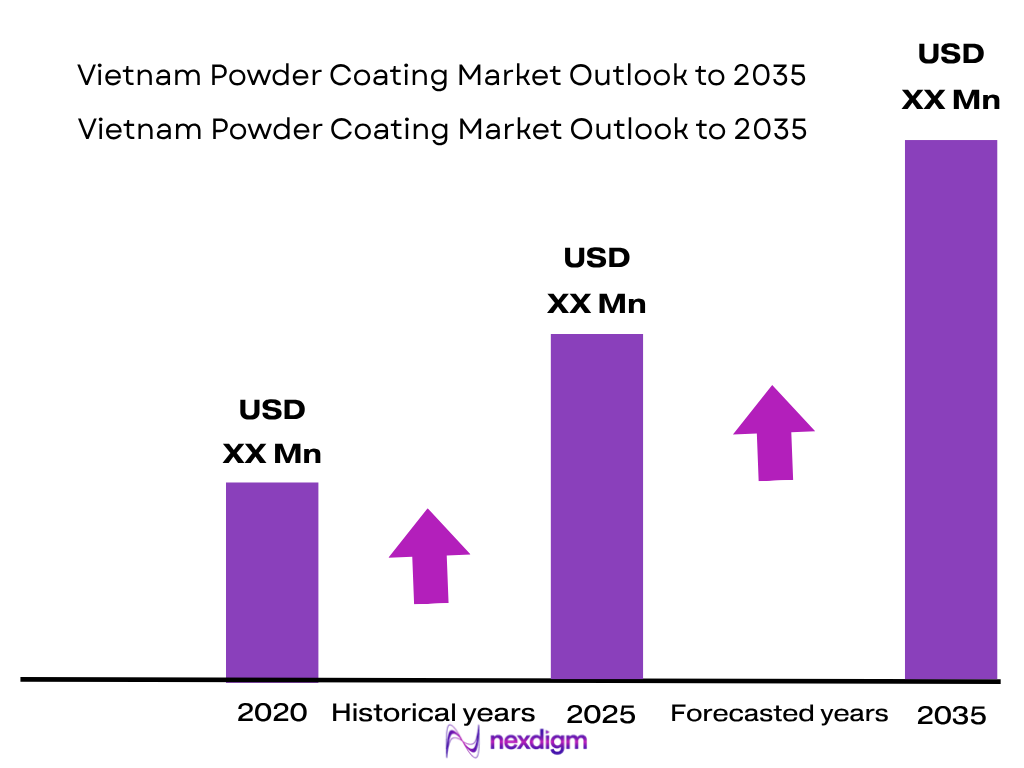
The Vietnam Powder Coating Market is valued at approximately USD ~X million, compared with approximately USD ~X million in the preceding annual period. Demand is supported by the country’s expanding manufacturing platform: industrial production moved from a comparatively weak 1.3 index-growth reading to 8.4, while manufacturing and processing advanced from 1.5 to 9.6. Electronics, furniture, vehicles, electrical equipment and fabricated-metal applications are consequently creating a broader substrate base for powder coating.
Dominant Manufacturing Locations: Ho Chi Minh City, Binh Duong, Dong Nai, Hanoi, Bac Ninh, Hai Phong and Hung Yen are important centres of the Vietnam Powder Coating Market because they concentrate foreign-invested manufacturing, electronics, aluminium fabrication, furniture, automotive components and industrial parks. Vietnam closed the latest annual period with 42,002 active FDI projects and approximately USD 502.8 billion in registered foreign investment. Ho Chi Minh City, Binh Duong and Hanoi alone had accumulated approximately USD 59.0 billion, USD 42.48 billion and USD 42.34 billion, respectively.
Market Segmentation
By Resin Type
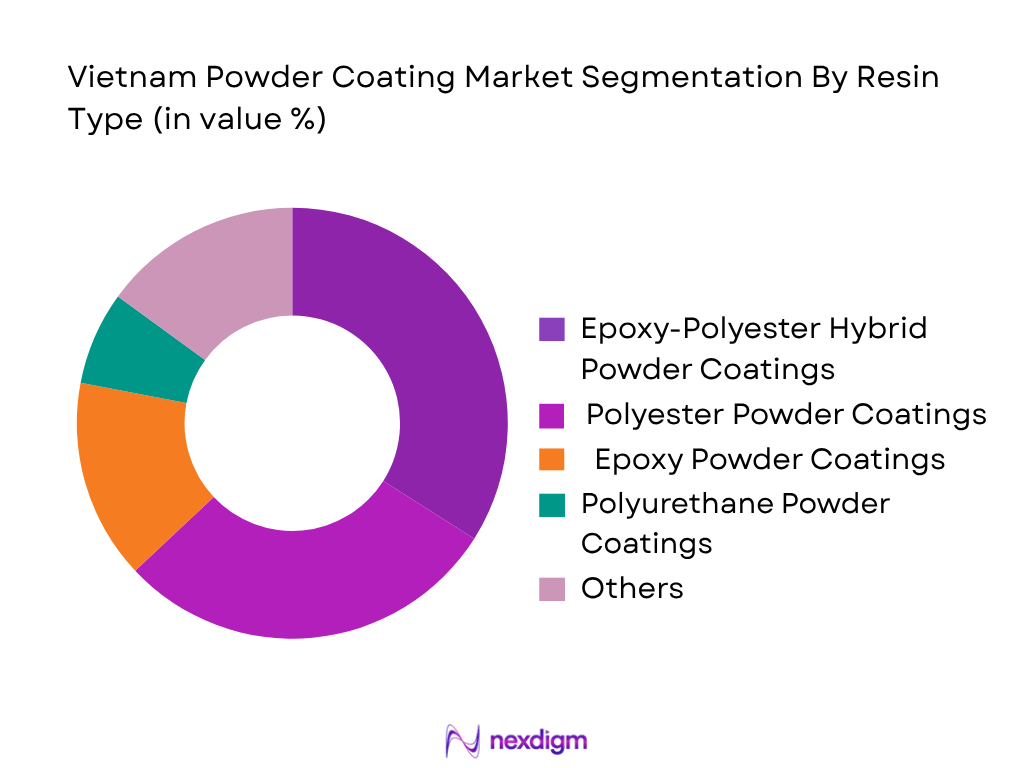
The Vietnam Powder Coating Market is segmented into polyester, epoxy-polyester hybrid, epoxy, polyurethane, acrylic, thermoplastic and other specialty resin systems. Epoxy-polyester hybrid powder coatings hold the dominant position because Vietnam has a large concentration of indoor metal products, appliances, office furniture, shelving, electrical enclosures and manufactured components where balanced appearance, mechanical performance and corrosion resistance are required without the exterior-weathering specifications associated with premium polyester systems. Industry assessments specifically identify epoxy-polyester as the leading resin segment in Vietnam. This position is reinforced by manufacturing output: furniture production recorded particularly strong expansion, while electrical-equipment manufacturing and chemical production also increased substantially. Hybrid powders are well suited to high-volume industrial coating lines because they offer smooth appearance, broad colour flexibility and dependable cure performance on steel components. Polyester remains particularly important in architectural aluminium and outdoor applications, while pure epoxy systems serve primers, electrical insulation and chemically demanding components. As Vietnamese manufacturing shifts toward export-grade products and exterior applications, super-durable polyester is gaining strategic importance, but hybrid chemistry remains central to the country’s current industrial coating mix.
By End-Use Industry
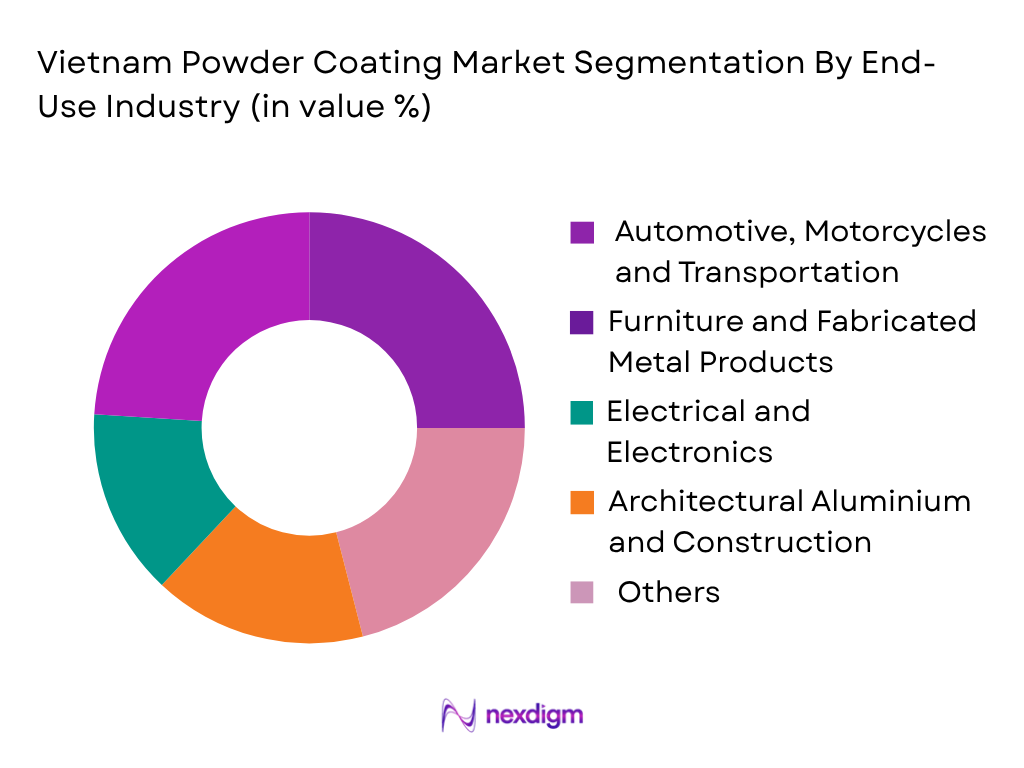
The Vietnam Powder Coating Market is segmented into automotive and motorcycles, furniture and fabricated metal products, electrical and electronics, appliances, architectural aluminium and construction, general industrial manufacturing and other applications. Automotive and transportation-related applications represent a leading demand segment, supported by motorcycles, passenger vehicles, commercial vehicles, bicycle production and a large auto-component ecosystem. Public market assessments identify automotive as a leading Vietnamese powder-coating application because coated components require abrasion resistance, corrosion protection and durable appearance. Industrial data reinforce this positioning: motor-vehicle manufacturing recorded particularly strong expansion, while transportation equipment exports reached USD 15.1 billion in the latest reported period. Powder coatings are used on wheels, frames, stands, brackets, springs, seating structures, underbody components and increasingly on EV-related metal parts. Furniture is another substantial demand centre, supported by USD 16.3 billion of wood and wood-product exports and rapid growth in furniture production. Electronics and appliance manufacturers create additional demand for metal housings, cabinets, racks and electrical enclosures, making the overall Vietnamese market highly diversified across export-oriented manufacturing industries.
Competitive Landscape
The Vietnam Powder Coating Market combines multinational coating groups with established Vietnamese manufacturers and regional Asian suppliers. Competition centres on resin technology, colour consistency, batch flexibility, local production, OEM qualification, architectural durability and technical support. Domestic manufacturers compete strongly in general industrial, furniture, electrical-equipment and standard colour applications, while multinational suppliers maintain strong positions in architectural, corrosion-resistant, premium exterior and specification-driven products. Local application support is important because coating quality depends on pretreatment, electrostatic settings, oven profile and powder recovery as much as powder formulation itself.
| Company | Establishment Year | Headquarters | Major Powder Technologies | Key Vietnam End Uses | Local Manufacturing / Supply | Custom Colour Capability | Specialty / Functional Portfolio | Technical Support |
| AkzoNobel / Interpon | 1792 | Amsterdam, Netherlands | ~ | ~ | ~ | ~ | ~ | ~ |
| Jotun | 1926 | Sandefjord, Norway | ~ | ~ | ~ | ~ | ~ | ~ |
| VEFCO Powder Coatings | 1994 | Vietnam | ~ | ~ | ~ | ~ | ~ | ~ |
| MAX Powder Coatings Vietnam | — | Vietnam | ~ | ~ | ~ | ~ | ~ | ~ |
| Protech-Oxyplast / Dai Phu | — | International / Vietnam | ~ | ~ | ~ | ~ | ~ |
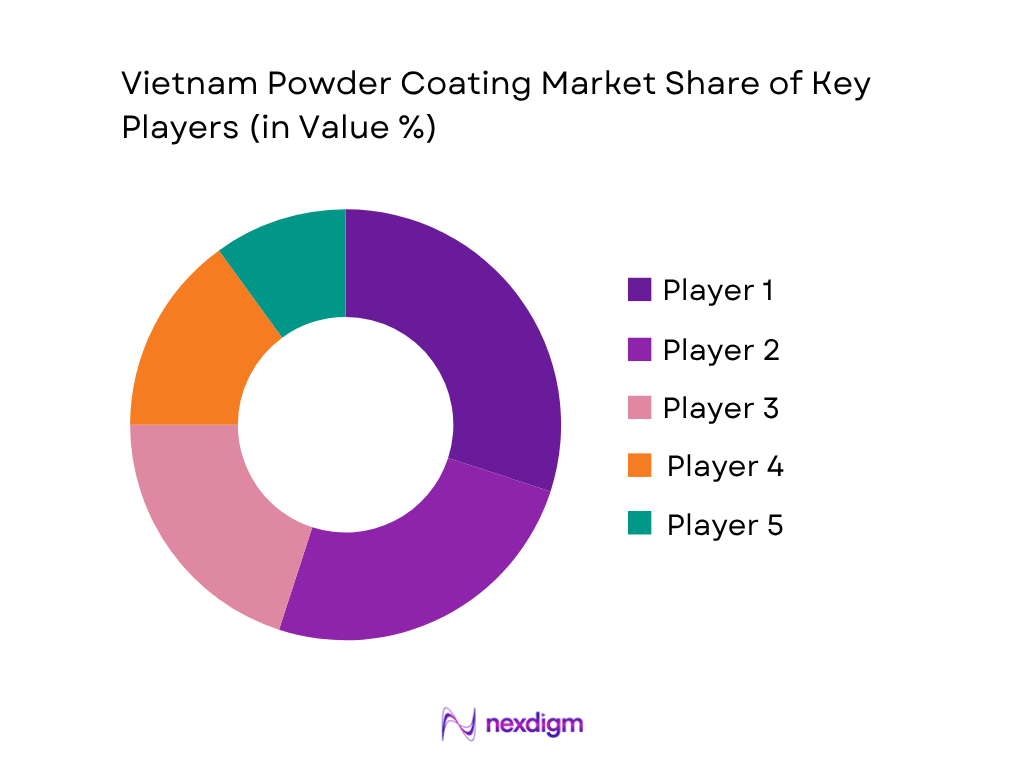
Vietnam Powder Coating Market Analysis
Growth Drivers
Electronics, Machinery and Export Manufacturing Expansion
Vietnam’s export-oriented electronics and machinery manufacturing base is generating substantial demand for epoxy, hybrid, polyester and functional powder coatings used on metal cabinets, equipment frames, server enclosures, electrical housings, appliance panels and fabricated components. The National Statistics Office of Vietnam recorded USD 72.6 billion of computer, electronics and component exports in 2024, alongside USD 53.9 billion of phones and components and USD 52.3 billion of machinery, equipment and spare-part exports. Combined electronics imports reached USD 107.1 billion, reflecting the enormous flow of components through domestic assembly plants. Total merchandise exports reached USD 405.53 billion, while foreign-invested enterprises generated USD 290.94 billion of exports. The Foreign Investment Agency recorded USD 25.58 billion of newly registered and adjusted foreign capital directed to processing and manufacturing, reinforcing investment in production facilities requiring metal-finishing processes. Powder coating benefits because automated electronics and equipment factories require uniform film thickness, abrasion resistance, electrical protection and repeatable colour consistency across high-volume production runs. Vietnam’s macroeconomic base also supports industrial demand: World Bank data place 2024 GDP at USD 476.39 billion, GDP per capita at USD 4,717.3, and population at 100,987,686. These production and trade volumes provide a broad substrate base for powder suppliers serving electronics, machinery and electrical-equipment manufacturers.
Furniture, Automotive and Metal-Product Production Strengthens Coating Consumption
Vietnam’s furniture, automotive and fabricated-metal industries provide a second major demand engine for powder coatings because these sectors process large quantities of steel, aluminium and other metal components requiring corrosion protection and durable decorative finishes. Official trade data recorded USD 16.3 billion of wood and wood-product exports during 2024 and USD 15.1 billion of transportation-equipment and component exports. Domestic automobile production reached approximately 388,500 vehicles, creating demand for powder-coated wheels, springs, brackets, chassis parts, seat structures and underbody components. Vietnam also transported approximately 2,670.6 million tonnes of freight, reflecting the scale of commercial and industrial activity requiring equipment, storage systems and fabricated infrastructure. The country’s industrial-park ecosystem reinforces this demand concentration: government information recorded 436 industrial parks, with more than 300 operating facilities providing employment to over 4.16 million workers. These industrial zones host furniture factories, metal processors, automotive suppliers and machinery manufacturers that commonly use conveyorized or batch powder-coating lines. Powder coatings suit these applications because they provide impact resistance, surface uniformity and corrosion protection across furniture frames, shelving, cabinets and transport components. World Bank data record Vietnam’s 2024 GDP at USD 476.39 billion, GDP per capita at USD 4,717.3, and population at 100,987,686, supporting a large manufacturing and domestic-consumption environment for coated metal products.
Market Challenges
Dependence on Imported Resins, Pigments and Industrial Raw Materials
Vietnamese powder-coating manufacturers remain exposed to imported industrial inputs because polyester and epoxy resins, titanium dioxide, specialty pigments, crosslinkers, additives and various substrate materials are integrated into international chemical and materials supply chains. The National Statistics Office recorded USD 380.76 billion of merchandise imports during 2024, of which production-related materials and equipment accounted for USD 356.43 billion. Imports of plastics reached USD 11.8 billion, while iron and steel imports reached USD 12.6 billion and machinery, equipment and spare parts reached USD 48.9 billion. Electronics and component imports added another USD 107.1 billion, illustrating the overall dependence of Vietnamese manufacturing on internationally sourced inputs. For powder producers, disruption in imported polyester resin, epoxy resin, pigments or curing agents can constrain formulation availability and complicate colour or performance consistency. Export-oriented customers typically require repeatable gloss, texture, film thickness and chemical performance, limiting the ability to substitute unqualified raw materials quickly. The scale of Vietnam’s economy intensifies procurement requirements: World Bank data record USD 476.39 billion of GDP, USD 4,717.3 of GDP per capita and 100,987,686 residents in 2024. Powder manufacturers seeking greater supply security therefore need broader supplier qualification, local inventory and progressive localization of resin and additive sourcing.
Thermal Curing Creates High Industrial Electricity Requirements
Powder coating requires electricity and thermal energy across extrusion, grinding, compressed-air systems, pretreatment, electrostatic spraying, ventilation and curing ovens, making energy management an important operational challenge for Vietnamese manufacturers and applicators. Vietnam Electricity recorded total power sales of 276,029 million kWh in 2024, with industrial customers alone consuming 142,416 million kWh, compared with 129,223 million kWh in the preceding annual period. Administrative and residential customers consumed another 97,110 million kWh, while commercial and hospitality users consumed 14,976 million kWh. The Ministry of Industry and Trade adjusted national electricity supply planning to approximately 310.6 billion kWh of generation and imports to accommodate rising power requirements. Conventional thermoset powder-coating systems require components to reach defined metal temperatures for sufficient time to achieve complete crosslinking. Large steel frames, furniture parts and industrial equipment increase oven thermal loads, while continuous conveyor operations require dependable energy supply throughout production shifts. Inefficient line loading or unnecessary over-curing therefore reduces productivity and increases energy consumption per coated component. World Bank data place Vietnam’s 2024 GDP at USD 476.39 billion, GDP per capita at USD 4,717.3, and population at 100,987,686. These industrial electricity volumes strengthen the business case for low-bake powders, faster-curing formulations, heat recovery, optimized oven profiles and improved transfer efficiency across Vietnamese coating facilities.
Market Opportunities
Electric Vehicle Manufacturing Opens Functional Powder Coating Applications
Vietnam’s rapidly developing electric-vehicle manufacturing ecosystem creates future opportunities for dielectric, corrosion-resistant, thermally stable and mechanically durable powder coatings used on battery enclosures, busbars, motor components, charging equipment and electrical housings. Domestic automobile production reached approximately 388,500 vehicles during 2024, demonstrating an established vehicle manufacturing base capable of supporting specialized coating processes. VinFast separately delivered more than 87,000 electric vehicles within Vietnam during the year, while its global electric-vehicle deliveries reached 97,399 units and electric-scooter deliveries reached 70,977 units. These current production and delivery volumes create an installed industrial platform rather than relying on future vehicle forecasts. EV components require coating properties beyond decorative appearance: electrical insulation, uniform edge coverage, corrosion resistance and controlled film build become increasingly important around battery and power-electronics assemblies. Vietnam’s wider transport-equipment ecosystem is also substantial, with USD 15.1 billion of transportation-equipment and component exports recorded during 2024. Manufacturers of powder coatings can use this existing base to develop epoxy insulation powders, high-performance polyester systems and custom functional products qualified specifically for electric drivetrains and battery hardware. World Bank data record Vietnam’s 2024 GDP at USD 476.39 billion, GDP per capita at USD 4,717.3, and population at 100,987,686, providing a sizeable economic foundation for continued localization of advanced automotive manufacturing and related surface-finishing technologies.
Industrial Parks and FDI Manufacturing Create Scope for Specialty Powder Localization
Vietnam’s expanding industrial-park and foreign-investment ecosystem provides a strong platform for future localization of low-bake, super-durable, corrosion-resistant and export-grade powder coatings. Government data recorded 436 industrial parks, with more than 300 operational parks supporting over 4.16 million direct jobs. Foreign investors committed approximately USD 38.23 billion during 2024 through new projects, additional capital and equity transactions, while processing and manufacturing attracted approximately USD 25.58 billion. A total of 3,375 new foreign-investment projects were licensed with approximately USD 19.7 billion in registered capital, and 1,539 existing projects received approximately USD 14.0 billion of additional investment. This industrial expansion supports future powder demand because newly established electronics, appliance, furniture, machinery, automotive and metal-processing plants frequently require automated finishing capacity and global-quality surface specifications. Domestic powder producers can respond by localizing specialty chemistries that are otherwise sourced through regional supply chains, reducing lead times for bespoke colours and OEM qualification batches. Industrial-park concentration also makes technical service, powder recovery optimization and rapid delivery easier to scale geographically. World Bank data place Vietnam’s 2024 GDP at USD 476.39 billion, GDP per capita at USD 4,717.3, and population at 100,987,686. These current investment and manufacturing indicators support future expansion of locally produced premium powder systems for Vietnam’s export-oriented factories.
Future Outlook
The Vietnam Powder Coating Market is expected to expand at approximately ~X% CAGR during 2026-2035, supported by continued industrialisation, export-oriented manufacturing, foreign direct investment and the transition toward more efficient surface-finishing technologies. Electronics, appliances, furniture, automotive components and architectural aluminium will remain major demand pillars, while specialty functional coatings should increase their contribution. Vietnam’s production model is particularly favourable for powder coatings because many of the country’s fastest-expanding industries process large quantities of metal components. Industrial production recorded strong gains across rubber and plastics, furniture, motor vehicles, chemicals, electrical equipment and electronics, all of which require protective or decorative surface finishing.
Low-bake and fast-cure technologies are expected to receive greater attention as manufacturers seek higher conveyor speeds and lower thermal loads. This is relevant for export-focused factories operating large coating lines where oven utilisation directly affects production capacity. Architectural products should increasingly move toward super-durable polyester and corrosion-resistant systems. Vietnam’s tropical humidity, intense UV exposure and long coastline create demanding weathering conditions for aluminium profiles, windows, doors, façades and steel structures. Jotun already supplies super-durable architectural products and corrosion-resistant powder primers in Vietnam, including systems tested against ISO 12944 requirements.
Major Players
- AkzoNobel Powder Coatings Vietnam / Interpon
- Jotun Vietnam
- Protech-Oxyplast / Dai Phu
- MAX Powder Coatings Vietnam
- Ti Gia Co., Ltd.
- VEFCO Powder Coatings
- Evertimes New Materials / DETECH
- Dong Tai Powder Coating Vietnam
- Kinh Thien Technology Materials
- Victory Powder Coatings
- Gia Phu Powder Coating
- TIGER Coatings
- Axalta Coating Systems
- PPG Industries
- Pulver Kimya
Key Target Audience
- Powder Coating Manufacturers and Resin Formulators
- Electronics, Electrical Equipment and Home-Appliance Manufacturers
- Furniture, Metal Furniture and Export Manufacturing Companies
- Automotive, Motorcycle and Auto-Component Manufacturers
- Architectural Aluminium Extruders, Fabricators and Construction Material Companies
- Powder Coating Applicators and Industrial Metal Finishers
- Investments and Venture Capitalist Firms
- Government and Regulatory Bodies (Ministry of Industry and Trade, Ministry of Finance, Ministry of Agriculture and Environment, Foreign Investment Agency, National Statistics Office of Vietnam, Vietnam Chemicals Agency)
Research Methodology
Step 1: Identification of Key Variables
The initial stage involves constructing an ecosystem map covering powder manufacturers, resin and pigment suppliers, distributors, application-equipment companies, contract coaters, metal fabricators, foreign-invested OEMs and export manufacturers. Variables include powder consumption, resin chemistry, domestic production, imported supply, coated surface area, film thickness, transfer efficiency, curing temperature, substrate type and end-use intensity.
Step 2: Market Analysis and Construction
Historical information for the Vietnam Powder Coating Market is analysed through top-down and bottom-up approaches. The bottom-up framework evaluates powder-manufacturer production, imports, distributor supply and applicator consumption, while the top-down framework maps powder demand against electronics output, furniture manufacturing, vehicle production, construction activity, appliances and fabricated-metal exports.
Step 3: Hypothesis Validation and Expert Consultation
Market hypotheses are validated through structured interviews and CATIs with powder manufacturers, raw-material suppliers, distributors, application-equipment providers, contract coaters, aluminium fabricators and industrial OEMs. Discussions evaluate resin preferences, curing schedules, custom-colour demand, transfer efficiency, domestic versus imported powder use, technical failures and customer qualification requirements.
Step 4: Research Synthesis and Final Output
The final phase triangulates primary research with government industrial-production data, trade statistics, foreign-investment information, company disclosures and technical documentation. Market values and volumes are reconciled across resin type, application, end-use sector and geography. Forecast assumptions incorporate FDI manufacturing expansion, electronics and furniture production, automotive development, architectural demand, localization and low-bake technology adoption.

- Executive Summary
- Research Methodology (Market Definition and Scope, Vietnam Powder Coating Taxonomy, Thermoset and Thermoplastic Powder Coating Classification, Resin Chemistry Mapping, Substrate Assessment, Powder Particle Size Assessment, Curing Technology Assessment, Application Equipment Mapping, End-Use Application Mapping, Raw Material Assessment, Sustainable Powder Coating Technology Evaluation, Market Sizing Framework)

- Definition and Scope
- Vietnam Powder Coating Industry Evolution and Powder Application Technology
- Development
- Powder Coating Manufacturing and Extrusion Process
- Powder Coating Value Chain Analysis
- Vietnam Powder Coating Supply Chain Analysis
- Resin, Pigment, Additive and Crosslinker Ecosystem Analysis
- Vietnam Powder Coating Import Dependency and Domestic Manufacturing Assessment
- OEM Powder Coating Application Architecture and Specialty Coating Solution Framework

- Growth Drivers (Expansion of Electronics and Appliance Manufacturing, Growth of Furniture and Metal Product Exports, Increasing Automotive and Motorcycle Component Production, Rising Architectural Aluminium Demand, Expansion of Industrial Parks, Export-Oriented Manufacturing Growth, Replacement of Liquid Coatings, Increasing Automated Powder Application)
- Market Challenges (Imported Resin and Pigment Dependency, Raw Material Availability, Energy-Intensive Curing Requirements, Fragmented Applicator Quality, Colour Consistency Requirements, Pretreatment Wastewater Management, Skilled Technical Labour Requirements, Competitive Imported Powder Supply)
- Market Opportunities (Low-Bake Powder Coatings, Super-Durable Architectural Powders, EV Electrical Insulation Powders, Premium Export Furniture Finishes, Electronics-Grade Functional Powders, Anti-Corrosion Powder Systems, Domestic Specialty Powder Localization, High-Recovery Automated Powder Application)
- Market Trends (Fine-Texture Powder Finishes, Matt and Ultra-Matt Powders, Low-Temperature Cure Systems, Rapid Colour Matching, Super-Durable Polyester Adoption, Automated Powder Recovery, Functional Electrical Powders, Lower-Carbon Powder Coating Formulations)
- Regulatory and Standards Landscape (Vietnam Law on Chemicals Requirements, Chemical Inventory and Declaration Requirements, Occupational Health and Powder Handling Requirements, Fire and Explosion Safety Requirements, Environmental Protection and Wastewater Compliance Requirements, Industrial Park Environmental Requirements, RoHS and REACH Export Customer Requirements, Hazardous Waste Management Requirements)
- SWOT Analysis
- Porter’s Five Forces Analysis
- PESTLE Analysis
- Stakeholder Ecosystem
- Competition Ecosystem

- By Market Value (2020-2025)
- By Powder Coating Consumption Volume (2020-2025)
- By Coated Surface Area (2020-2025)
- By Domestic Production Volume (2020-2025)
- By Import Volume (2020-2025)
- By Export Volume (2020-2025)
- By Average Powder Consumption per Square Metre (2020-2025)
- By Thermoset Powder Coating Consumption (2020-2025)
- By Thermoplastic Powder Coating Consumption (2020-2025)

- By Resin Type (In Value %)
Polyester Powder Coatings
Epoxy Powder Coatings
Epoxy-Polyester Hybrid Powder Coatings
Polyurethane Powder Coatings
Acrylic Powder Coatings
Polyamide Powder Coatings
Polyethylene Powder Coatings
PVC Powder Coatings
Fluoropolymer Powder Coatings
Other Specialty Resin Systems - By Powder Coating Technology (In Value %)
Thermoset Powder Coatings
Thermoplastic Powder Coatings
Low-Bake Powder Coatings
Fast-Cure Powder Coatings
UV-Curable Powder Coatings
Heat-Sensitive Substrate Powder Coatings
Dual-Layer and Primer-Topcoat Powder Systems - By Substrate Type (In Value %)
Aluminium
Mild Steel
Galvanised Steel
Stainless Steel
Cast Iron
Zinc-Coated Substrates
Magnesium and Light Alloys
MDF and Engineered Wood
Heat-Sensitive Composite Substrates - By End-Use Industry (In Value %)
Architectural Aluminium and Building Materials
Furniture and Wood-Metal Products
Electrical and Electronics
Home Appliances and Consumer Durables
Automotive and Auto Components
Motorcycles and Two-Wheeler Components
General Industrial Manufacturing
Fabricated Metal Products
Machinery and Industrial Equipment
Renewable Energy Equipment
Electrical Cabinets and Switchgear
HVAC and Refrigeration
Medical Equipment
Retail Fixtures and Shelving
Marine and Infrastructure Components - By Distribution Channel (In Value %)
Direct Manufacturer-to-OEM Sales
Direct Sales to Powder Applicators
Specialist Powder Coating Distributors
Industrial Coatings Distributors
Architectural Specification Channels
Contract Coater Supply Channels
Automotive and Electronics Tier Supplier Channels
Equipment and Powder Solution Distributors
Online and Digital Ordering Channels - By Region (In Value %)
Northern Vietnam
Hanoi
Bac Ninh
Bac Giang
Hai Phong
Hai Duong
Hung Yen
Vinh Phuc
Thai Nguyen
Central Vietnam
Da Nang
Quang Nam
Thanh Hoa
Southern Vietnam
Ho Chi Minh City
Binh Duong
Dong Nai
Long An
Ba Ria-Vung Tau
Tay Ninh

- Market Share of Major Players (By Revenue, Volume, Resin Type, Powder Coating Technology, Substrate Type, End-Use Industry, Market Type, Distribution Channel)
- Cross Comparison Parameters (Resin Chemistry Breadth, Vietnam Powder Manufacturing Capacity, Northern and Southern Vietnam Supply Footprint, Custom Colour and Small-Batch Capability, Low-Bake and Energy-Efficient Technology Portfolio, Architectural and Export-Grade Powder Capability, OEM Technical Support and Application Engineering, Specialty Functional and Sustainable Powder Portfolio)
- SWOT Analysis of Major Players
- Competitive Positioning Matrix
- Product and Technology Portfolio Benchmarking
- Pricing and Distribution Network Benchmarking
- Market Entry Strategy Assessment
- Detailed Profiles of Major Companies
AkzoNobel Powder Coatings Vietnam / Interpon
Jotun Vietnam
Protech-Oxyplast / Dai Phu
MAX Powder Coatings Vietnam
Ti Gia Co., Ltd.
VEFCO Powder Coatings
Evertimes New Materials / DETECH
Dong Tai Powder Coating Vietnam
Kinh Thien Technology Materials
Victory Powder Coatings
Gia Phu Powder Coating
TIGER Coatings
Axalta Coating Systems
PPG Industries
Pulver Kimya

- Buyer Segmentation
- OEM Procurement Behaviour
- Powder Applicator Procurement Behaviour
- Supplier Selection Criteria
- Buyer Pain Points
- Technology Adoption Assessment
- Replacement and Recoat Behaviour

- By Market Value (2026-2035)
- By Powder Coating Consumption Volume (2026-2035)
- By Coated Surface Area (2026-2035)
- By Domestic Production Volume (2026-2035)
- By Import Volume (2026-2035)
- By Export Volume (2026-2035)
- By Average Powder Consumption per Square Metre (2026-2035)
- By Thermoset Powder Coating Consumption (2026-2035)
- By Thermoplastic Powder Coating Consumption (2026-2035)


 Request a Sample
 Ask for Customization
 Get a Quote
 Enquire Now