
 Download PDF
Market Overview
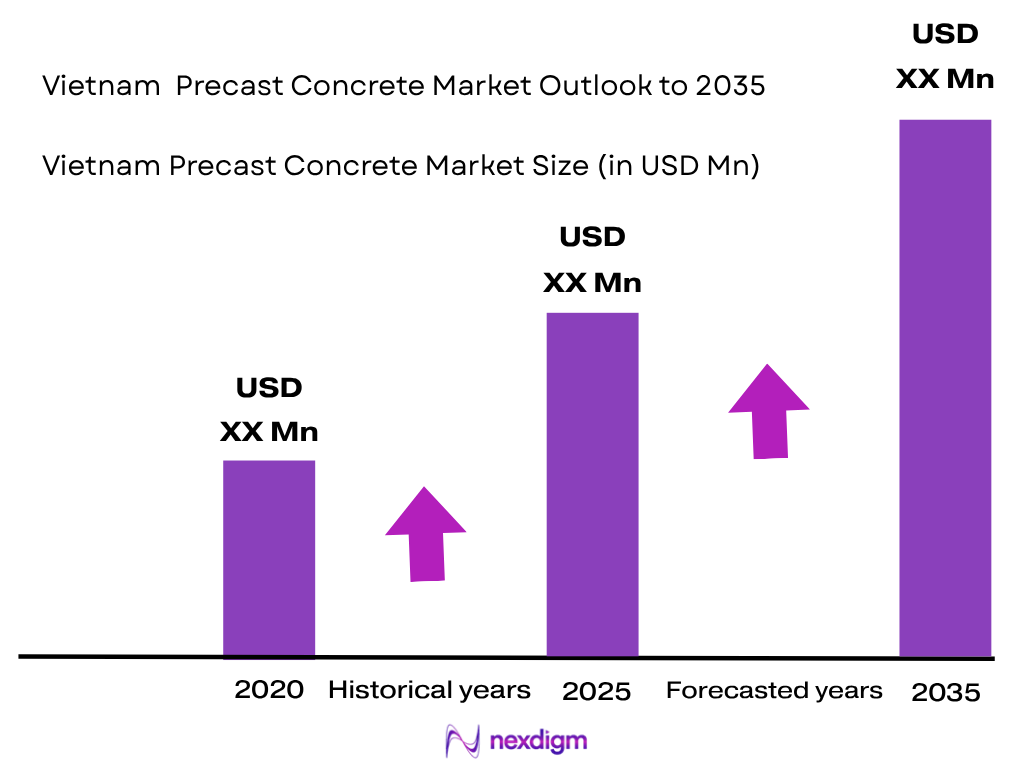
The Vietnam Precast Concrete Market is valued at approximately USD ~ billion, compared with approximately USD ~ billion in the preceding period, based on historical market assessment. Demand is supported by transport infrastructure, industrial construction, urban development and factory investment. Vietnam recorded USD 25.58 billion of registered foreign investment in manufacturing and processing and USD 6.31 billion in real estate, strengthening construction demand for piles, structural members and factory-produced concrete systems.
Hanoi, Ho Chi Minh City, Bac Ninh, Hai Phong, Binh Duong and the surrounding industrial corridors form important precast demand centers because of industrial parks, infrastructure projects and high-density construction. Bac Ninh attracted USD 5.12 billion of registered FDI and Hai Phong USD 4.94 billion, while Ho Chi Minh City attracted more than USD 3.04 billion. Bac Ninh also had 16 approved industrial parks covering 6,397.68 hectares, reinforcing demand for precast foundations and industrial structural components.
Market Segmentation
By Product Type
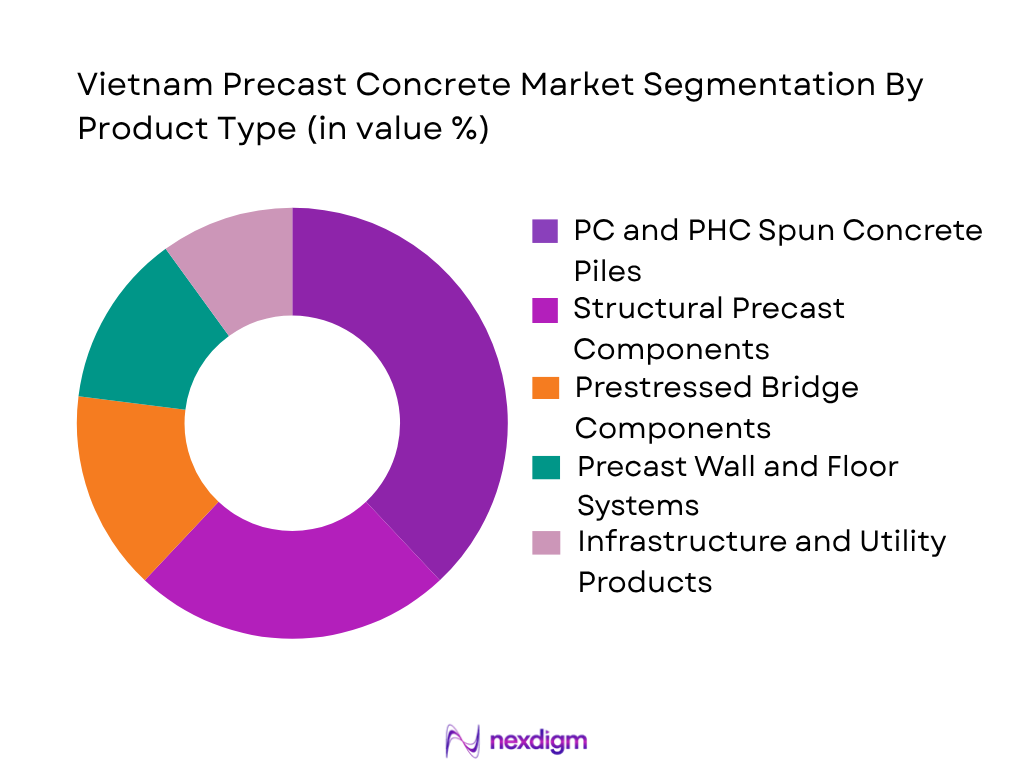
The Vietnam Precast Concrete Market is segmented by product type into PC and PHC spun concrete piles, structural precast components, prestressed bridge components, precast wall and floor systems, and infrastructure and utility products. Recently, PC and PHC spun concrete piles have held a dominant market position because Vietnam’s industrial, residential, port and infrastructure projects frequently require engineered deep-foundation solutions. Their standardized factory manufacturing, high compressive performance and compatibility with pile-driving, pile-pressing and pre-boring methods support broad project adoption. Vietnam has also developed substantial domestic manufacturing expertise in this category. Phan Vu has manufactured pre-tensioned spun concrete piles since 1996, while 620 Chau Thoi operates a pipe-pile line capable of producing 500 D300-D600 piles per day. These capabilities support large-volume foundation projects and reinforce the importance of precast piles in industrial parks, factories, warehouses, ports, high-rise developments and transportation infrastructure.
By Application
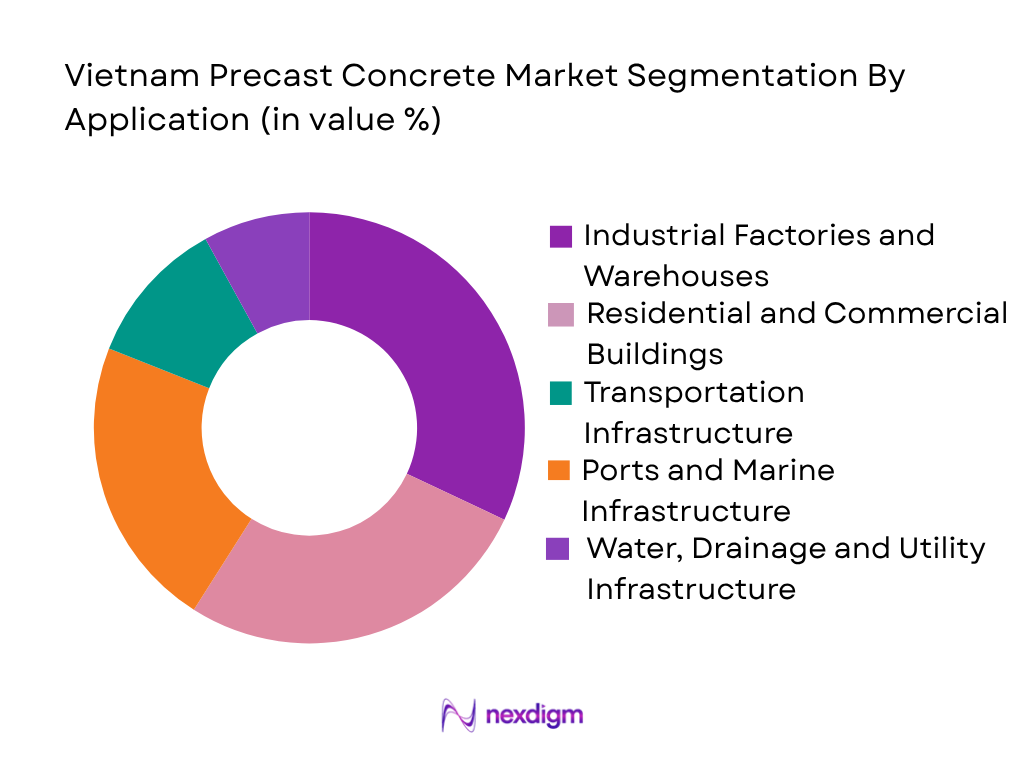
The Vietnam Precast Concrete Market is segmented by application into industrial factories and warehouses, residential and commercial buildings, transportation infrastructure, ports and marine projects, and water, drainage and utility infrastructure. Recently, industrial factories and warehouses have maintained a dominant position because Vietnam continues to receive substantial manufacturing investment requiring foundations, columns, beams, floors and standardized structural systems. Registered foreign investment in processing and manufacturing reached USD 25.58 billion, while realized foreign investment across Vietnam reached USD 25.35 billion. The country approved 3,375 new foreign-invested projects, creating an extensive pipeline of manufacturing and associated construction activity. Precast systems are particularly applicable to industrial projects because repeated structural grids, controlled factory production and off-site fabrication can support standardized construction programs. Bac Ninh, Hai Phong, Binh Duong and other manufacturing centers therefore represent important demand clusters for PHC piles, columns, beams, prestressed components and industrial precast systems.
Competitive Landscape
The Vietnam Precast Concrete Market includes specialized pile manufacturers, integrated precast producers and construction companies with in-house prefabrication capabilities. Competition increasingly centers on PC/PHC pile capacity, prestressing technology, product diversity, plant location, engineering integration and installation capabilities. Phan Vu has operated in spun prestressed piles since 1996; Xuan Mai has a precast lineage dating to 1983; and Chau Au Nam operates 5 factories and more than 40 prestressed reinforced-concrete production lines, illustrating the depth of domestic manufacturing capabilities.
| Company | Establishment Year | Headquarters | Core Precast Specialization | PC/PHC Pile Capability | Structural Precast Capability | Prestressing Capability | Infrastructure Exposure | Installation/Construction Capability |
| Phan Vu Group | 1996 | Ho Chi Minh City | ~ | ~ | ~ | ~ | ~ | ~ |
| FECON Corporation | 2004 | Hanoi | ~ | ~ | ~ | ~ | ~ | ~ |
| Xuan Mai Corp | 1983 | Hanoi | ~ | ~ | ~ | ~ | ~ | ~ |
| Chau Au Nam Precast Concrete JSC – AMACCAO | 2014 | Hanoi | ~ | ~ | ~ | ~ | ~ | ~ |
| 620 Chau Thoi Concrete JSC | 2004 | Vinh Long | ~ | ~ | ~ | ~ | ~ | ~ |
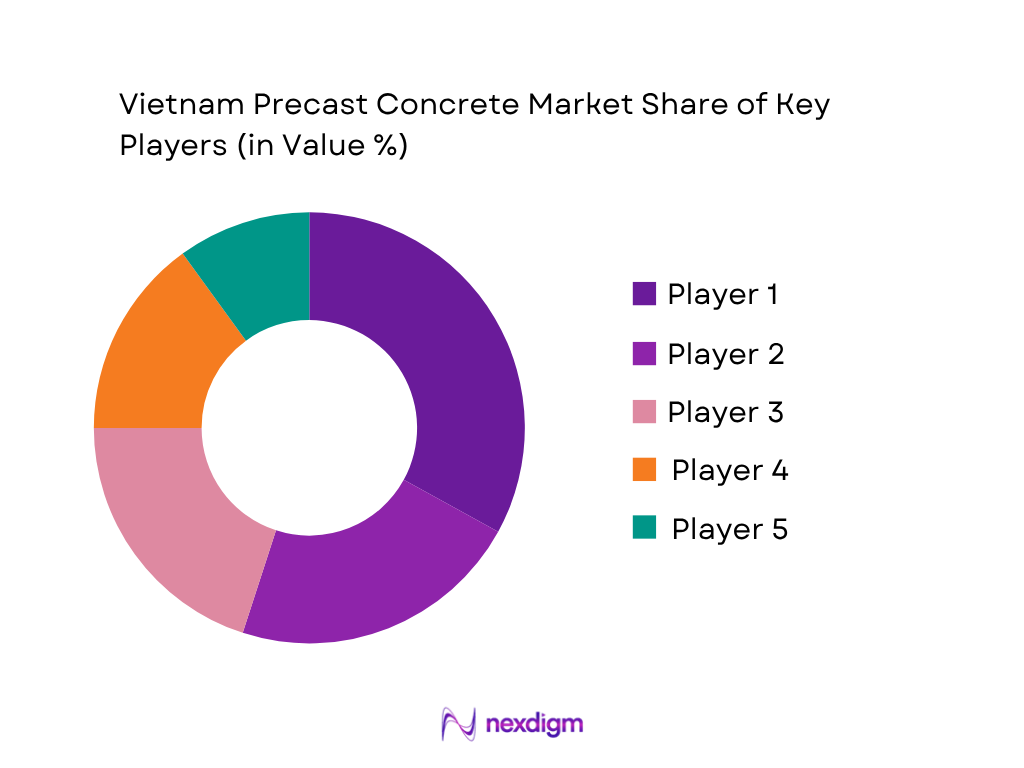
Vietnam Precast Concrete Market Analysis
Growth Drivers
Accelerating Transport Infrastructure Construction Supporting Structural and Prestressed Precast Demand
Vietnam’s expanding transport infrastructure program is increasing demand for precast bridge girders, prestressed beams, PHC piles, culverts, retaining structures, barriers and tunnel segments. Vietnam had approximately 2,021 km of expressways in operation during 2024, while major North–South Expressway components and connecting corridors remained under construction. Infrastructure activity is occurring within a strong construction environment, with the industry and construction sector expanding 8.24% in 2024, while economy-wide fixed-asset accumulation increased 7.20%. The wider economy generated approximately USD 459.5 billion of GDP in 2024, providing a substantial macroeconomic base for public and private capital formation. Precast concrete is particularly applicable to expressways, bridges and urban transport because repetitive components can be manufactured under controlled plant conditions, while foundation piles and prestressed structural members can be delivered according to construction sequencing. Continued execution of highways, bridges, metro infrastructure and interregional transport corridors therefore directly expands the addressable project pipeline for Vietnamese manufacturers capable of producing high-strength PHC piles, prestressed girders, tunnel segments and specialized infrastructure components. Greater infrastructure execution also encourages investment in prestressing facilities, automated production systems and heavy-component erection capabilities.
Manufacturing FDI and Industrial Construction Expanding Demand for Precast Foundations and Structural Systems
Vietnam’s manufacturing investment pipeline is strengthening demand for PHC piles, structural columns, beams, wall systems and other factory-produced concrete components used in industrial facilities. Vietnam recorded USD 38.23 billion of total registered foreign investment in 2024, including USD 25.58 billion directed toward processing and manufacturing. The country approved 3,375 new foreign-invested projects with registered capital of USD 19.7 billion, while 1,539 existing projects received an additional USD 14 billion. Actual foreign-investment disbursement reached USD 25.35 billion, indicating substantial conversion of investment commitments into operating projects and physical assets. This industrial investment occurred alongside approximately USD 459.5 billion of national GDP. Industrial projects are particularly relevant for precast manufacturers because factories, logistics facilities and supporting infrastructure frequently require repetitive foundations and structural grids. PHC piles address deep-foundation requirements, while standardized columns, beams, floors and wall systems can support industrial construction schedules. Consequently, continuing manufacturing investment creates a broad project base for integrated Vietnamese precast suppliers serving industrial parks, manufacturing complexes, warehouses and export-oriented production clusters, particularly around major northern and southern industrial corridors.
Market Challenges
Heavy Component Transportation and Installation Constraints Limiting Efficient Geographic Coverage
Transportation remains a structural challenge for Vietnam’s precast concrete industry because PHC piles, bridge girders, wall panels, tunnel segments and structural members are heavy, dimensionally constrained products requiring specialized vehicles, lifting systems and carefully sequenced site delivery. The challenge becomes more significant as construction spreads across Vietnam’s industrial and infrastructure network. The country recorded 3,375 newly licensed foreign-invested projects in 2024, while another 1,539 projects registered additional capital, demonstrating the large number of investment locations that suppliers may need to serve. Manufacturing and processing alone attracted USD 25.58 billion of registered foreign investment, supporting construction activity across northern and southern industrial clusters rather than a single concentrated location. At the macroeconomic level, Vietnam generated approximately USD 459.5 billion of GDP, while GDP per capita reached approximately USD 4,536, reflecting the scale of economic activity supported by national logistics and infrastructure systems. For precast producers, these conditions create a location-sensitive operating model. Plants must balance manufacturing scale against feasible delivery radii, while oversized components require suitable road access, specialized trailers, cranes, staging areas and erection coordination. Transportation capability therefore remains critical to plant location decisions and competitive access to industrial and infrastructure projects.
Uneven Construction Execution and Project Bottlenecks Affecting Precast Capacity Planning
Vietnamese precast manufacturers face capacity-planning challenges when approved construction pipelines convert into actual site activity at uneven rates. Social housing provides a construction-specific example. Approximately 619 social-housing projects representing 561,816 apartments had entered implementation by August 2024, yet only 8 projects were completed during the first six months against a national objective of approximately 130,000 apartments for the year. Subsequent full-year information showed 28 completed projects with 20,284 apartments, 23 licensed or commenced projects with 25,399 apartments, and 113 projects approved in principle representing 142,450 apartments. This illustrates the substantial difference that can arise between approved pipelines and construction-ready demand for piles and structural components. Meanwhile, Vietnam’s broader industry and construction sector recorded strong expansion, and the national economy generated approximately USD 459.5 billion of GDP in 2024. For precast suppliers, delayed land procedures, permitting, design finalization or site readiness can shift production schedules even when underlying construction demand remains substantial. Manufacturers must therefore manage molds, prestressing beds, raw materials, finished inventory, transport resources and plant labor against project pipelines whose physical execution can progress unevenly.
Market Opportunities
Industrial Park and Manufacturing Expansion Creating Future Opportunities for Integrated Precast Systems
Vietnam’s existing foreign-investment base creates a strong foundation for future expansion of industrial precast applications. At the end of 2024, the country contained 42,002 valid foreign-invested projects with total registered capital of USD 502.8 billion, while cumulative realized foreign investment reached approximately USD 322.5 billion. During the year, processing and manufacturing attracted another USD 25.58 billion, and realized foreign investment reached USD 25.35 billion. These current indicators support future demand for factory foundations, logistics buildings, warehouses, utility structures and standardized structural systems as existing manufacturers expand and new projects progress into construction. The macroeconomic platform is also substantial, with Vietnam generating approximately USD 459.5 billion of GDP and GDP per capita reaching approximately USD 4,536 in 2024. For the precast concrete industry, this creates opportunities beyond supplying standalone piles. Producers can increasingly offer PHC foundation systems alongside columns, beams, slabs, wall panels and infrastructure components, capturing more of the industrial construction package. Manufacturers with integrated design, production, transportation, piling and erection capabilities are particularly positioned to address repeatable industrial structures while serving manufacturing corridors around Hanoi, Hai Phong, Bac Ninh, Ho Chi Minh City, Dong Nai and other major industrial locations.
Social Housing and Urban Construction Creating Expansion Potential for Standardized Precast Building Systems
Vietnam’s housing-development pipeline provides a future opportunity for precast wall panels, floor slabs, staircases, structural frames, foundation piles and modular concrete systems. Current government information shows that 655 social-housing projects covering 593,428 apartments had entered implementation since 2021. Within 2024, 28 projects totaling 20,284 apartments were completed, another 23 projects covering 25,399 apartments received construction licenses or commenced work, and 113 projects representing 142,450 apartments received investment-policy approval. Land allocation further supports potential construction activity, with approximately 1,064 hectares in Dong Nai, 666 hectares in Quang Ninh, 408 hectares in Binh Duong, and 336 hectares in Hai Phong allocated for social-housing development. These current figures provide a tangible construction pipeline without relying on future statistical forecasts. At the macroeconomic level, Vietnam generated approximately USD 459.5 billion of GDP and recorded GDP per capita of approximately USD 4,536 in 2024. Large residential programs create opportunities for precast concrete because repeated apartment configurations can support standardized molds, factory production and repetitive installation. This provides manufacturers with opportunities to expand from foundation piles into wall panels, slabs, stairs and integrated structural building systems.
Future Outlook
The Vietnam Precast Concrete Market is forecast to expand at a ~% CAGR during 2026-2035, supported by infrastructure construction, industrial development, urbanization and greater utilization of off-site construction. Future demand is expected to broaden from traditional PC and PHC piles toward integrated structural precast systems, bridge girders, tunnel segments, hollow-core components and specialized infrastructure products. Manufacturing automation, high-strength concrete and integrated design-production-installation capabilities are expected to become increasingly important competitive differentiators.
Industrial construction represents an important long-term opportunity. Vietnam had 42,002 valid foreign-invested projects with registered capital totaling USD 502.8 billion at the end of 2024, while cumulative registered foreign investment in processing and manufacturing exceeded USD 308.76 billion. This established industrial base supports continuing requirements for factory expansion, logistics facilities, foundations and supporting infrastructure.
Major Players
- Phan Vu Group
- FECON Corporation
- Xuan Mai Corp
- Xuan Mai Concrete Co., Ltd.
- Chau Au Nam Precast Concrete JSC – AMACCAO
- VINA-PSMC Precast Concrete
- 620 Chau Thoi Concrete JSC
- Vinaconex Corporation
- Song Da Corporation
- Hoa Binh Construction Group
- Coteccons Construction JSC
- Delta Group
- Ricons Construction Investment JSC
- Newtecons Investment Construction JSC
- Hawee Precast Concrete JSC
Key Target Audience
- Precast and Prestressed Concrete Manufacturers
- PC and PHC Concrete Pile Manufacturers
- EPC and Infrastructure Construction Companies
- Real Estate and Industrial Park Developers
- Cement, Reinforcing Steel and Prestressing Steel Suppliers
- Investments and Venture Capitalist Firms
- Transportation, Port and Utility Infrastructure Developers
- Government and Regulatory Bodies (Ministry of Construction, Ministry of Finance, Ministry of Science and Technology, Directorate for Roads of Vietnam, Vietnam Standards and Quality Institute)
Research Methodology
Step 1: Identification of Key Variables
The initial phase involves constructing an ecosystem map covering stakeholders across the Vietnam Precast Concrete Market, including raw-material suppliers, precast plants, prestressing facilities, EPC contractors, piling companies and project developers. Secondary research is used to identify critical variables such as production capacity, product mix, plant geography, infrastructure demand, industrial construction activity, utilization and installation capabilities.
Step 2: Market Analysis and Construction
Historical information for the Vietnam Precast Concrete Market is analyzed through both top-down and bottom-up frameworks. The assessment incorporates production capabilities, domestic consumption, project pipelines, infrastructure construction and industrial development. Manufacturer-level analysis of PC/PHC piles, structural components, prestressed products and infrastructure precast is combined with demand-side construction indicators to construct the market framework.
Step 3: Hypothesis Validation and Expert Consultation
Market hypotheses are validated through computer-assisted telephone interviews with precast manufacturers, EPC contractors, foundation specialists, structural engineers, developers and procurement professionals. Discussions focus on production utilization, product demand, procurement patterns, manufacturing technologies, regional competition and project requirements. These industry inputs are used to test assumptions developed through secondary research and reconcile supply-side and demand-side findings.
Step 4: Research Synthesis and Final Output
The final stage integrates manufacturer information, construction indicators, infrastructure pipelines and primary industry insights into a consolidated Vietnam Precast Concrete Market model. Bottom-up manufacturer assessments are triangulated against top-down construction and investment indicators. Findings are subsequently reviewed for consistency across product types, applications and geographic clusters before developing the historical assessment, competitive landscape and forecast outlook.

- Executive Summary
- Research Methodology (Market Definitions and Assumptions, Vietnam Precast Concrete Market Classification, Precast and Prestressed Concrete Scope, PC and PHC Product Mapping, Structural Component Mapping, Infrastructure Precast Mapping, Building Precast Mapping, Precast Pile Assessment, Spun Pile Assessment, Prestressed Component Assessment, Hollow-Core Component Assessment, Tunnel Segment Assessment, Bridge Girder Assessment, Drainage Product Assessment, Manufacturing Plant Mapping, Installed Production Capacity Assessment, Capacity Utilization Assessment, Domestic Cement and Reinforcing Steel Supply Assessment, Top-Down Market Sizing, Bottom-Up Manufacturer Assessment, Demand-Side Assessment, Supply-Side Assessment, Primary Interviews with Manufacturers, Contractors and Developers, Construction Project Pipeline Assessment, Public Infrastructure Investment Assessment, Industrial Park and FDI Project Assessment, Import-Export Assessment, Data Triangulation, Forecasting Framework)

- Definition and Scope
- Vietnam Precast Concrete Industry Evolution and Development of Reinforced Precast Concrete, Prestressed Concrete, PC Piles, PHC Spun Piles, Square Piles, Sheet Piles, Structural Frames, Hollow-Core Slabs, Wall Panels, Bridge Girders, Tunnel Segments, Drainage Components, Utility Structures and Modular Precast Systems
- Precast Concrete Industry Value Chain Analysis
- Precast Concrete Supply Chain Analysis
- Cement Producers, Aggregate Suppliers, Reinforcing Steel Suppliers, Prestressing Steel Suppliers, Admixture Suppliers, Mold and Formwork Suppliers, Precast Manufacturing Plants, Prestressing Facilities, Engineering and Design Companies, Heavy Transport Operators, Piling Contractors, Erection Contractors, EPC Contractors, Property Developers, Industrial Park Developers, Transport Infrastructure Authorities, Municipal Infrastructure Agencies

- Growth Drivers (Expressway and Transport Infrastructure Construction, Metro and Urban Rail Development, Industrial Park Expansion, Foreign Direct Investment in Manufacturing, High-Rise Residential Development, Port and Logistics Infrastructure Investment, Faster Construction Schedule Requirements, Off-Site Construction Adoption)
- Market Challenges (Heavy Precast Transportation Constraints, Limited Economic Delivery Radius, Cement and Reinforcing Steel Input Volatility, Prestressing Steel Dependence, High Initial Plant Investment, Specialized Mold Requirements, Heavy-Lifting and Erection Constraints, Skilled Prestressing Workforce Requirements)
- Market Opportunities (PC and PHC Pile Demand, Metro Tunnel Lining Segments, Expressway Bridge Girders, Industrial Factory Structural Frames, Data Center Construction, Port and Marine Precast Components, Flood-Control Structures, Precast Drainage Systems, Modular Concrete Buildings, Low-Carbon Precast Products, Export of Precast Components to Southeast Asian Markets)
- Market Trends (High-Strength PHC Piles, Prestressed Structural Systems, Full-Precast Industrial Buildings, Hollow-Core Floor Systems, Precast Tunnel Segments, Super-T Bridge Girders, BIM-to-Fabrication Integration, Automated Rebar Processing, Factory-Based Quality Control, High-Performance Concrete)
- Government Regulations and Standards (TCVN Requirements for Precast Prestressed Concrete Products, TCVN Requirements for Precast Concrete Execution and Acceptance, TCVN Requirements for Pretensioned Spun Concrete Piles, TCVN Structural Concrete Requirements, Precast Strength Testing Requirements, Construction Quality Management Regulations)
- SWOT Analysis
- Porter’s Five Forces Analysis
- PESTLE Analysis
- Stakeholder Ecosystem
- Precast Concrete Production and Construction Ecosystem

- By Market Value (2020-2025)
- By Precast Concrete Production Volume (2020-2025)
- By Precast and Prestressed Concrete Production Volume (2020-2025)
- By PC and PHC Pile Production Volume (2020-2025)
- By Structural Precast Production Volume (2020-2025)
- By Infrastructure Precast Production Volume (2020-2025)
- By Building Precast Production Volume (2020-2025)
- By Precast Concrete Consumption Volume (2020-2025)
- By Domestic Sales Volume (2020-2025)
- By Export Volume (2020-2025)
- By Installed Precast Production Capacity (2020-2025)
- By Manufacturing Capacity Utilization (2020-2025)

- By Product Type (In Value %)
PC and PHC Spun Concrete Piles
Reinforced Concrete Square Piles
Prestressed Sheet Piles
Columns and Beams
Prestressed Bridge Girders and Super-T Girders
Hollow-Core Slabs
Precast Floor Slabs
Precast Wall Panels
Precast Staircases
Tunnel Lining Segments
Concrete Pipes and Culverts
Manholes and Utility Structures
Retaining and Revetment Components
Custom Infrastructure Precast Components - By Construction System (In Value %)
Reinforced Precast Concrete Systems
Prestressed Precast Concrete Systems
Pre-Tensioned Concrete Systems
Structural Frame Precast Systems
Precast Foundation Systems
Precast Building Envelope Systems
Hybrid Precast and Cast-in-Place Systems
Modular and Prefabricated Concrete Systems - By Application (In Value %)
Residential Buildings
Commercial Buildings
Industrial Factories and Warehouses
Industrial Parks
High-Rise Buildings
Bridges and Expressways
Urban Rail and Metro Infrastructure
Ports and Marine Infrastructure
Power and Energy Projects
Water and Wastewater Infrastructure
Drainage and Flood-Control Infrastructure
Utility and Underground Infrastructure - By Customer Type (In Value %)
EPC and General Contractors
Foundation and Piling Contractors
Real Estate Developers
Industrial Park Developers
Infrastructure Contractors
Government and Public Infrastructure Authorities
Manufacturing and Industrial Project Owners
Utility and Municipal Infrastructure Operators - By Manufacturing Technology (In Value %)
Conventional Wet-Cast Precast
Centrifugal Spun Concrete
Pre-Tensioned Prestressed Concrete
High-Strength Prestressed Concrete
Extrusion-Based Hollow-Core Production
Automated Precast Production
Segmental Precast Manufacturing
High-Performance Concrete Precast - By Region (In Value %)
Northern Vietnam
Red River Delta
Central Vietnam
Southeast Vietnam
Ho Chi Minh City Metropolitan Area
Mekong Delta

- Market Share of Major Players (By Vietnam Revenue, Precast Production Capacity, PC and PHC Pile Capacity, Structural Precast Capacity, Prestressed Concrete Capacity, Number of Manufacturing Plants, Product Portfolio, Geographic Plant Coverage, Infrastructure Project Exposure, Industrial Project Exposure, Installation Capability, Export Capability)
- Cross Comparison Parameters (Annual Precast Production Capacity, PC and PHC Pile Manufacturing Capability, Structural and Prestressed Product Breadth, Manufacturing Plant and Geographic Coverage, Maximum Prestressing and High-Strength Concrete Capability, Heavy Transport and On-Site Installation Capability, TCVN and International Standard Compliance, Infrastructure and Industrial Project Execution Portfolio)
- SWOT Analysis of Major Players
- Competitive Positioning Matrix
- Major Companies
Phan Vu Group
FECON Corporation
Xuan Mai Corp
Xuan Mai Concrete
Chau Au Nam Precast Concrete – AMACCAO
VINA-PSMC Precast Concrete
620 Chau Thoi Concrete JSC
Vinaconex Corporation
Song Da Corporation
Hoa Binh Construction Group
Coteccons Construction JSC
Delta Group
Ricons Construction Investment JSC
Newtecons Investment Construction JSC
Hawee Precast Concrete JSC

- EPC Contractor Procurement Assessment
- Real Estate Developer Requirement Assessment
- Industrial Park Developer Assessment
- Foundation Contractor Requirement Assessment
- Transport Infrastructure Contractor Assessment
- Metro and Urban Rail Precast Requirement Assessment
- Port and Marine Infrastructure Requirement Assessment
- Precast Performance Requirement Assessment

- By Market Value (2026-2035)
- By Precast Concrete Production Volume (2026-2035)
- By PC and PHC Pile Production Volume (2026-2035)
- By Structural Precast Production Volume (2026-2035)
- By Prestressed Concrete Production Volume (2026-2035)
- By Infrastructure Precast Production Volume (2026-2035)
- By Industrial Building Precast Demand (2026-2035)
- By Bridge and Expressway Precast Demand (2026-2035)
- By Metro and Urban Rail Precast Demand (2026-2035)
- By Port and Marine Precast Demand (2026-2035)
- By Water, Drainage and Flood-Control Precast Demand (2026-2035)
- By Hollow-Core and Wall Panel Demand (2026-2035)
- By Installed Manufacturing Capacity (2026-2035)
- By Export Volume (2026-2035)


 Request a Sample
 Ask for Customization
 Get a Quote
 Enquire Now
