
 Download PDF
Market Overview
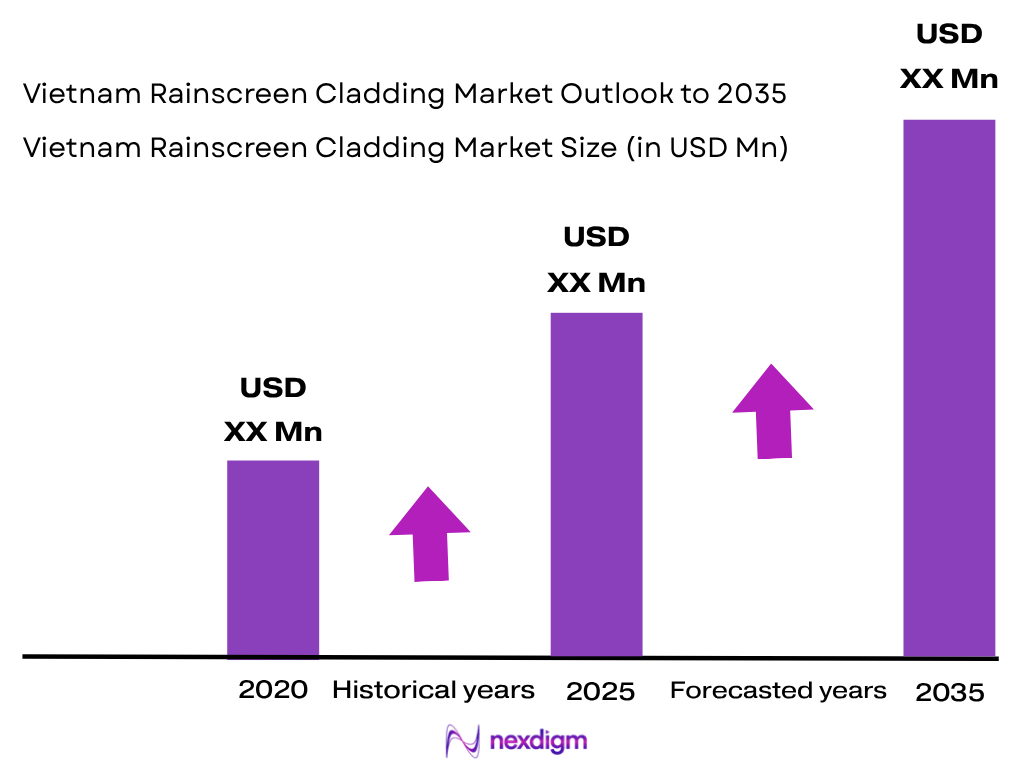
The Vietnam Rainscreen Cladding Market is valued at approximately ~USD XX million, supported by construction, foreign investment and green-building activity. Registered foreign investment increased from USD 36.6 billion in the preceding annual period to USD 38.23 billion in the latest period, including USD 6.31 billion directed toward real estate. Processing and manufacturing attracted another USD 25.58 billion, reinforcing demand for commercial, industrial and institutional building envelopes.
Ho Chi Minh City and Hanoi dominate Vietnam Rainscreen Cladding Market demand because they concentrate high-rise apartments, offices, malls, hotels and green-certified buildings, while Binh Duong, Bac Ninh and Hai Phong add industrial demand. Vietnam’s certified green-building stock expanded to 559 buildings covering 13,579,588 square metres, including 163 newly certified projects in the latest annual period. Ho Chi Minh City alone recorded approximately 3.4 million square metres of certified green floor space.
Market Segmentation
By Material Type
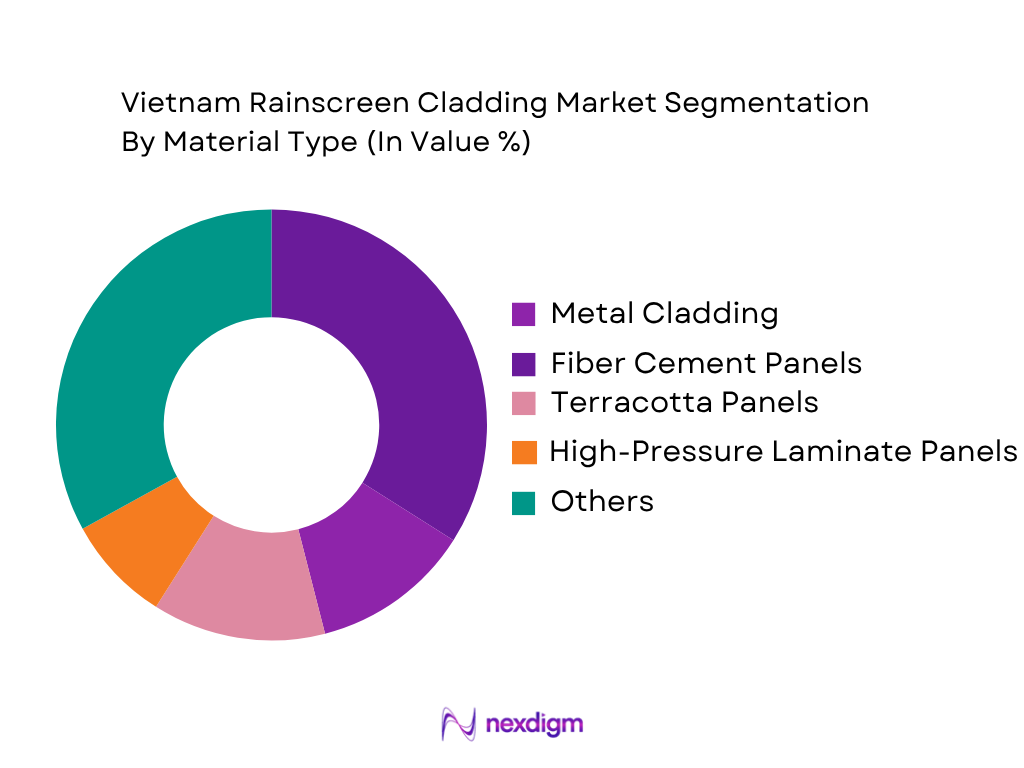
By Material Type: The Vietnam Rainscreen Cladding Market is segmented into aluminium composite panels, fire-rated ACP, solid aluminium panels, terracotta panels, fiber cement, HPL, natural stone, ceramic and porcelain, steel and zinc, GFRC/GRC and other architectural materials. Aluminium composite panels represent the dominant modeled sub-segment because Vietnam already has established domestic ACP production, fabrication capacity and nationwide distribution. Vietdung Aluminium’s ALCOREST portfolio includes standard and fireproof aluminium composite panels and is supported by more than 100 authorized distributors, three manufacturing facilities across northern and southern Vietnam, and over two decades of operating experience. ACP is widely applicable across offices, residential towers, retail façades and mixed-use developments because it combines low structural weight, rapid cassette fabrication, large-format appearance and broad coating options. The segment is also evolving toward improved fire-performance products as high-rise building owners and architects place greater scrutiny on core composition and exterior-wall fire behaviour.
By Building Type
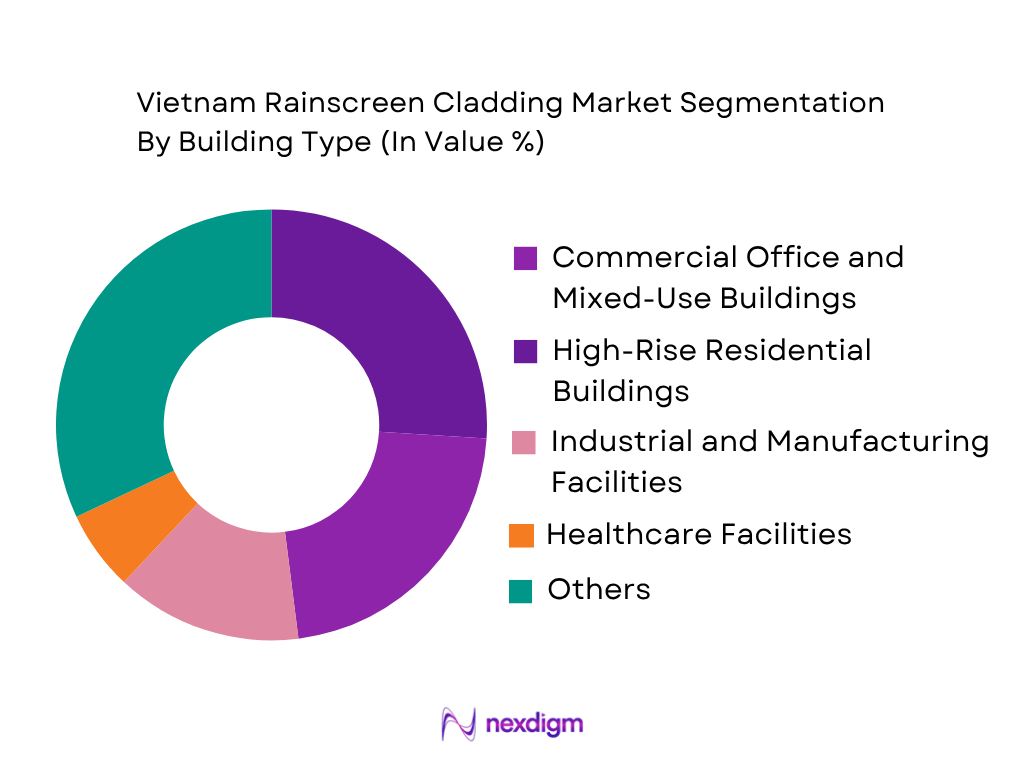
The Vietnam Rainscreen Cladding Market is segmented into commercial offices, high-rise residential buildings, mixed-use developments, shopping centres, hotels and resorts, hospitals, educational buildings, industrial facilities, electronics plants, data centres and transportation infrastructure. Commercial office and mixed-use buildings hold the dominant modeled position because these projects require extensive façade area, strong architectural differentiation and durable external envelopes capable of performing in hot-humid, high-rainfall conditions. Green-building growth further strengthens this segment. Vietnam has 559 certified green buildings covering 13.6 million square metres, with Ho Chi Minh City leading the country at approximately 3.4 million square metres of certified green floor area. Modern commercial projects increasingly combine higher-performance cladding, insulation and weather-protection layers to reduce cooling loads and improve durability. Vietnam’s energy-efficient building regulation, QCVN 09:2017/BXD, also applies to qualifying building projects and reinforces the importance of envelope performance in commercial construction.
Competitive Landscape
The Vietnam Rainscreen Cladding Market combines domestic aluminium and façade-material manufacturers with international fiber-cement, composite-panel, insulation and premium architectural cladding suppliers. Local competitors benefit from domestic fabrication and distribution, while international brands compete through fire performance, façade engineering, specification support and sustainability credentials. Competitive success increasingly depends on the ability to provide complete façade solutions rather than standalone decorative panels.
| Major Player | Establishment Year | Headquarters | Primary Rainscreen Offering | Manufacturing / Supply Presence | Fire-Performance Capability | Distribution / Project Reach | Technical Support | Key Application Strength |
| Vietdung Aluminium / ALCOREST | 2001 | Hanoi, Vietnam | ~ | ~ | ~ | ~ | ~ | ~ |
| SHERA Vietnam | 1974 group origin | Ho Chi Minh City presence | ~ | ~ | ~ | ~ | ~ | ~ |
| 3A Composites / ALUCOBOND | 1969 brand origin | Singen, Germany | ~ | ~ | ~ | ~ | ~ | ~ |
| FunderMax | 1890 | St. Veit/Glan, Austria | ~ | ~ | ~ | ~ | ~ | ~ |
| Etex / EQUITONE | 1905 | Zaventem, Belgium | ~ | ~ | ~ | ~ | ~ | ~ |
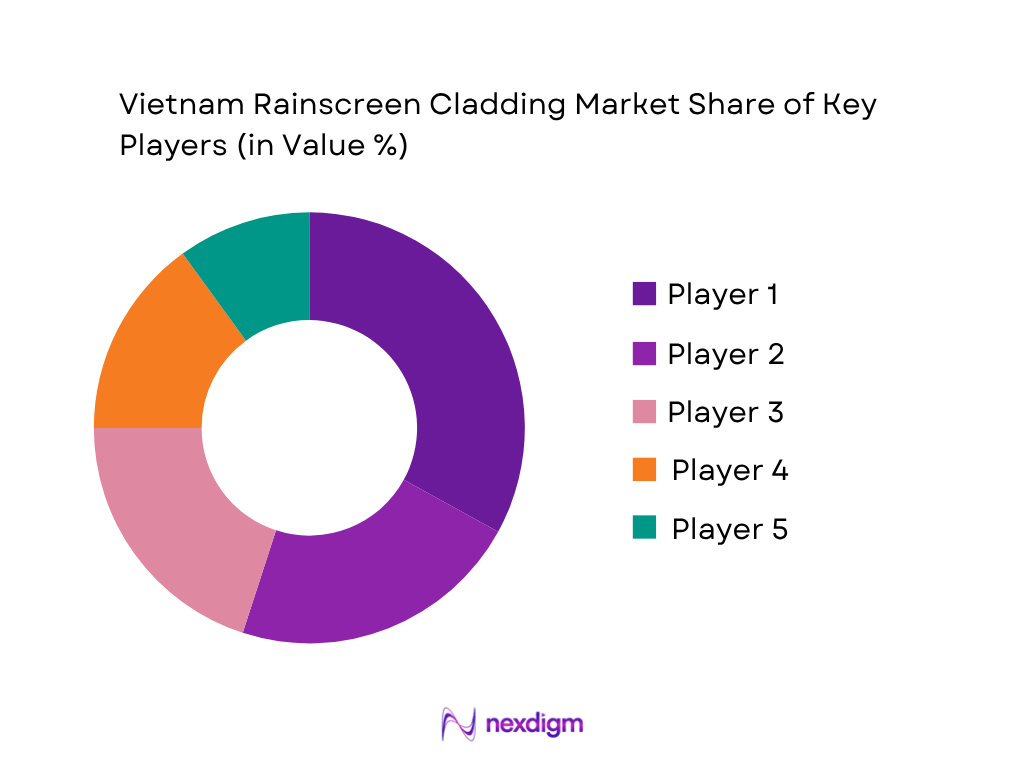
Vietnam Rainscreen Cladding Market Analysis
Growth Drivers
Industrial and Electronics Manufacturing Construction Expanding Façade Demand
Vietnam’s industrial and electronics manufacturing expansion is creating a larger addressable base for rainscreen cladding across factories, technology campuses, clean-production facilities and supporting commercial buildings. The Ministry of Planning and Investment recorded USD 38.23 billion of registered foreign investment in 2024, including USD 25.58 billion directed to processing and manufacturing. Vietnam also had 42,002 active foreign-invested projects with USD 502.8 billion of cumulative registered capital, while realized FDI reached USD 25.35 billion. The country’s industrial infrastructure already extends to 422 industrial zones across 61 provinces and cities, providing concentrated construction demand for lightweight, durable and low-maintenance façade systems. Manufacturing-oriented projects in Bac Ninh, Hai Phong, Binh Duong and Dong Nai are particularly relevant for aluminium composite panels, solid aluminium, fiber cement and ventilated metal façades because industrial facilities require weather resistance, rapid installation and maintainable envelope assemblies. Vietnam’s wider macroeconomic environment also supports construction investment: World Bank data place 2024 GDP at USD 476.39 billion, GDP per capita at USD 4,717.3, and population at 100,987,686. These fundamentals support continued specification of engineered façade systems across industrial and associated commercial developments.
Green Building Development and Energy-Efficient Envelope Adoption
Vietnam’s expanding green-building base is supporting demand for ventilated rainscreen façades that combine exterior finishes with drainage cavities, insulation, solar protection and improved moisture management. The Ministry of Construction reported 559 certified green buildings covering more than 13.6 million square metres of floor area at the end of 2024. Hanoi alone accounted for more than 2.16 million square metres, while Ho Chi Minh City remained the country’s largest concentration of certified green floor space. The construction sector itself recorded strong activity, with national statistics showing construction value added rising substantially in 2024 alongside the wider industrial economy. Housing data provide another indication of envelope demand: Vietnam had 101,112,656 residents in April 2024, average housing floor area reached 26.6 square metres per person, and 22.9 million households lived in dwellings constructed from 2000 onward. This expanding and relatively modern building stock provides a sizable base for future high-performance façade specifications and refurbishment. World Bank data place national GDP at USD 476.39 billion and GDP per capita at USD 4,717.3 in 2024. These conditions favor terracotta, fiber cement, aluminium and other rainscreen systems capable of improving façade durability and building-envelope performance.
Market Challenges
Fire-Safety Compliance and Higher Technical Requirements for Exterior Walls
Fire-safety compliance is becoming a significant technical challenge for Vietnam’s rainscreen cladding industry because high-rise exterior walls must be evaluated beyond panel appearance and basic weather protection. The Ministry of Public Security reported 1,975 fire and explosion incidents nationwide during the first six months of 2024, including 817 incidents involving houses or combined residential-production premises. Authorities had established 48,815 community fire-safety groups and 57,085 public firefighting points, illustrating the scale of national fire-prevention efforts. In December 2024 alone, Vietnam recorded 343 fires, causing 9 deaths and 4 injuries. For rainscreen suppliers, this environment increases the importance of cladding-core composition, non-combustible materials, insulation choice, cavity detailing and fire-barrier continuity. Fire-rated ACP, solid aluminium, terracotta and fiber cement can address parts of this requirement, but system performance still depends on correct installation and documented compatibility among components. Vietnam’s economic scale magnifies the relevance of these requirements: World Bank data show GDP of USD 476.39 billion, GDP per capita of USD 4,717.3, and more than 100.98 million residents in 2024. As high-rise and mixed-use construction expands, façade suppliers face increasing pressure to demonstrate reliable fire-performance documentation and disciplined installation practices.
Typhoon Exposure, Wind Loads and Weather-Resistance Engineering
Vietnam’s exposure to severe tropical weather creates substantial design and installation challenges for rainscreen façades, particularly in northern and coastal markets where high winds, wind-driven rain and salt exposure can test panel fixings, substructures and drainage cavities. Typhoon Yagi demonstrated the scale of this exposure in 2024. Government statistics recorded approximately 234,700 damaged or destroyed homes, around 1,500 damaged schools, 726 dike incidents and nearly 310,000 urban trees broken or uprooted. Preliminary property losses exceeded VND 50 trillion, while the storm caused 329 deaths or missing persons and around 1,929 injuries as of the official September assessment. Earlier reports also recorded 3,279 damaged houses soon after landfall, together with widespread roof, commercial-property and infrastructure damage. Such conditions are directly relevant to rainscreen engineering because panels, brackets, anchors and rails must transfer high wind suction loads while preventing water penetration and avoiding corrosion. Coastal markets such as Hai Phong, Quang Ninh and Da Nang require particularly robust systems. World Bank data place Vietnam’s 2024 GDP at USD 476.39 billion, highlighting the economic value of building assets exposed to extreme weather and the need for resilient façade specifications.
Market Opportunities
Fireproof and Non-Combustible Rainscreen Systems
Current fire-safety conditions create a strong future opportunity for suppliers of higher-performance exterior-wall systems, particularly fire-rated ACP, solid aluminium, terracotta, fiber cement and mineral-based assemblies. Vietnam recorded 1,975 fire and explosion incidents during the first six months of 2024, including 817 incidents in residential or combined residential-commercial premises. Authorities also maintained 48,815 community fire-safety groups and 57,085 public firefighting points, indicating significant policy and enforcement attention. In December 2024 alone, another 343 fires were recorded nationally. These current conditions provide a clear commercial rationale for developers and architects to place greater emphasis on façade combustibility, panel cores, insulation materials and cavity fire management when specifying future high-rise residential, office, hotel and institutional projects. The opportunity is reinforced by Vietnam’s growing urban and construction base: the country had 101,112,656 people in April 2024 and average housing floor area reached 26.6 square metres per person. World Bank data record national GDP at USD 476.39 billion and GDP per capita at USD 4,717.3. Suppliers able to provide documented, system-level fire performance rather than merely decorative panels should therefore have a stronger position in future façade procurement.
Green Building Retrofits and Industrial Rainscreen Systems
Vietnam’s existing green-building and industrial-development base provides a strong platform for future growth in ventilated façades, prefabricated rainscreen panels and locally manufactured substructures. The Ministry of Construction reported 559 certified green buildings covering more than 13.6 million square metres of floor area at the end of 2024, with Hanoi alone contributing over 2.16 million square metres and Ho Chi Minh City maintaining the largest certified footprint. Industrial demand is equally significant: Vietnam operates 422 industrial zones across 61 provinces and cities, while processing and manufacturing attracted USD 25.58 billion in registered foreign investment during 2024. Realized foreign investment across the economy reached USD 25.35 billion, and the country had 42,002 active FDI projects with registered capital totaling USD 502.8 billion. These current indicators create opportunities for locally fabricated aluminium rails, brackets, solid aluminium panels, fiber cement façades and prefabricated cassette systems serving factories, technology campuses, logistics buildings and green-certified commercial assets. Vietnam’s 2024 GDP of USD 476.39 billion and population of 100,987,686 further support sustained building investment. Suppliers combining domestic fabrication, tested attachment systems and energy-efficient façade engineering are positioned to benefit as developers seek faster installation and reduced dependence on imported components.
Future Outlook
The Vietnam Rainscreen Cladding Market is forecast to expand at approximately ~X.X% CAGR during 2026–2035, supported by continued high-rise development, industrial investment, green buildings, hospitality construction and modernization of exterior-wall systems. Demand is expected to migrate gradually from decorative direct-fixed cladding toward more engineered façade assemblies incorporating drainage cavities, ventilation, fire-safe materials, insulation and higher-performance attachment systems. Green-building activity will be one of the strongest structural catalysts. Vietnam has reached 559 certified green buildings covering approximately 13.6 million square metres, and 163 buildings obtained green certification during the latest annual period. The country has therefore already exceeded earlier official green-building targets, creating a larger installed base of projects where façade performance, energy efficiency and material durability are central design considerations.
Major Players
- Vietdung Aluminium JSC / ALCOREST
- Trieu Chen Co., Ltd.
- Austrong Vietnam
- BM Windows
- New Era Livingdeco / Terracon
- Gom Dat Viet / Vietnamese Ceramics Joint Stock Company
- SHERA Vietnam Company Limited
- ROCKWOOL Vietnam Co., Ltd.
- 3A Composites / ALUCOBOND Vietnam
- Facade Solutions Co., Ltd.
- Eurowindow Joint Stock Company
- Austdoor Group
- Ricons Construction Investment JSC
- FunderMax
- Etex / EQUITONE
Key Target Audience
- Rainscreen Cladding and Architectural Panel Manufacturers
- Aluminium Composite Panel and Solid Aluminium Manufacturers
- Façade Contractors, Fabricators and System Integrators
- Property Developers and Commercial Real Estate Owners
- Industrial Park and Manufacturing Facility Developers
- General Contractors and Construction Companies
- Investments and Venture Capitalist Firms
- Government and Regulatory Bodies (Ministry of Construction, Ministry of Industry and Trade, Vietnam Institute for Building Science and Technology, Provincial Departments of Construction, Fire Prevention and Fighting Authorities)
Research Methodology
Step 1: Identification of Key Variables
The initial phase involves constructing an ecosystem map of the Vietnam Rainscreen Cladding Market covering panel manufacturers, aluminium suppliers, terracotta companies, fiber-cement suppliers, façade contractors, architects, developers and distributors. Secondary research identifies key variables including installed façade area, material penetration, building type, fire requirements, weather exposure, green-building adoption, regional construction activity and domestic manufacturing capability.
Step 2: Market Analysis and Construction
Historical demand is assessed using top-down and bottom-up analysis. Top-down modelling evaluates construction activity, foreign investment, green-building development, industrial expansion and high-rise construction, while bottom-up modelling converts representative building floor areas into addressable façade surfaces. Material consumption, system configuration, substructure requirements and project-level cladding penetration are then mapped by application and region.
Step 3: Hypothesis Validation and Expert Consultation
Market hypotheses are validated through CATI interviews and direct engagement with façade manufacturers, distributors, contractors, developers and architects. Interviews examine ACP penetration, adoption of fire-rated panels, terracotta and fiber-cement use, substructure selection, regional product preferences, installation practices, imported-material dependency and project procurement structures.
Step 4: Research Synthesis and Final Output
The final phase triangulates government statistics, building regulations, company disclosures, construction data and primary interviews. Supplier-level information is reconciled with façade-area calculations and top-down construction indicators. The final market model assesses material shares, building applications, regional demand, competitive positioning, fire-safe cladding penetration, domestic manufacturing and future retrofit and new-build opportunities.

- Executive Summary
- Research Methodology (Market Definitions and Assumptions, Vietnam Rainscreen Cladding Market Classification, Building-Envelope Scope, Ventilated Facade Mapping, Pressure-Equalized Rainscreen Assessment, Open-Joint Rainscreen Assessment, Closed-Joint Rainscreen Assessment, Aluminium Composite Panel Assessment, Fire-Rated ACP Assessment, Solid Aluminium Panel Assessment, Terracotta Panel Assessment, Fiber Cement Panel Assessment, HPL Assessment, Natural Stone Assessment, Ceramic Cladding Assessment, Substructure and Bracket Assessment, Fastener and Anchor Assessment, Insulation Assessment, Air and Water Barrier Assessment, Fire Performance Assessment, Wind-Load Assessment, Typhoon Exposure Assessment, Thermal Performance Assessment, Moisture Management Assessment, Energy-Efficient Building Compliance Assessment, Green Building Assessment, Supply-Side Assessment, Demand-Side Assessment, Top-Down Market Sizing, Bottom-Up Market Sizing, Primary Industry Interviews, Construction Pipeline Assessment, Installed-Base Mapping, Data Triangulation, Forecasting Framework)

- Definition and Scope
- Vietnam Building-Envelope Industry Evolution and Development of Ventilated Rainscreen Facades, Aluminium Composite Panel Cladding, Fireproof Composite Panels, Solid Aluminium Facades, Terracotta Panels, Fiber Cement Facades, HPL Cladding, Natural Stone Rainscreens, Ceramic Facades, Dry-Clad Systems, Insulated Exterior Walls, High-Rise Facade Systems, Prefabricated Facade Assemblies, Green Building Facades, Thermally Optimized Building Envelopes
- Rainscreen Cladding Value Chain Analysis
- Rainscreen Cladding Supply Chain Analysis

- Growth Drivers (High-Rise Residential Development, Commercial Building Expansion, Industrial and Electronics Manufacturing Construction, Hotel and Resort Development, Green Building Adoption, Ventilated Facade Demand, Energy-Efficient Building Envelopes, Airport and Infrastructure Development, Domestic ACP Manufacturing, Premium Architectural Facades)
- Market Challenges (Fire-Safety Compliance, Low-Cost Conventional ACP Competition, Skilled Facade Installer Availability, Substructure Engineering Complexity, Imported Premium Material Dependence, Typhoon and Wind-Load Requirements, Coastal Corrosion Exposure, Inconsistent Installation Quality, Water-Ingress Risk, Fragmented Contractor Ecosystem)
- Market Opportunities (Fireproof and Higher Fire-Performance ACP, Terracotta Rainscreens, Fiber Cement Ventilated Facades, Solid Aluminium Cladding, Existing-Building Recladding, Data Centre Building Envelopes, Electronics Factory Facades, Green Building Retrofits, Prefabricated Facade Systems, Local Substructure Manufacturing)
- Market Trends (Fire-Rated ACP Adoption, Terracotta Facade Growth, Solid Aluminium Panels, Fiber Cement Cladding, Large-Format Panels, Concealed-Fix Systems, PVDF and FEVE Coatings, Thermally Optimized Substructures, BIM-Based Facade Engineering, Prefabricated Panels, Sustainable Materials, Low-Maintenance Facades)
- Government Regulations and Standards (Vietnam National Building Technical Regulations, QCVN Fire Safety Requirements, Energy-Efficient Building Requirements, QCVN Civil Building Energy Requirements, Fire Resistance Testing Standards, Structural Wind-Load Requirements, Construction Material Standards, Green Building Compliance, LOTUS Certification, EDGE Certification, LEED Certification)
- SWOT Analysis
- Porter’s Five Forces Analysis
- PESTLE Analysis

- By Market Value (2020-2025)
- By Installed Rainscreen Cladding Area (2020-2025)
- By ACP and Composite Panel Installation Area (2020-2025)
- By Solid Aluminium Cladding Installation Area (2020-2025)
- By Terracotta Rainscreen Installation Area (2020-2025)
- By Fiber Cement Rainscreen Installation Area (2020-2025)

- By Material Type (In Value %)
Aluminium Composite Panels
Fire-Rated Aluminium Composite Panels
Solid Aluminium Panels
Terracotta Panels
Fiber Cement Panels
High-Pressure Laminate Panels
Natural Stone Panels
Ceramic and Porcelain Panels
Steel and Zinc Cladding
GFRC and GRC Panels
Engineered Composite Panels
Wood and Wood-Look Panels
Other Architectural Rainscreen Materials - By Rainscreen System Type (In Value %)
Open-Joint Ventilated Rainscreen Systems
Closed-Joint Rainscreen Systems
Drained and Back-Ventilated Systems
Pressure-Equalized Rainscreen Systems
Cassette and Tray Panel Systems
Large-Format Panel Systems
Concealed-Fix Systems
Exposed-Fix Systems
Clip-and-Rail Systems
Prefabricated Rainscreen Assemblies - By Application (In Value %)
New Building Construction
Facade Replacement and Recladding
Energy-Efficiency Upgrades
Fire-Safety Facade Remediation
Architectural Facade Modernization
Moisture and Water-Ingress Remediation
Thermal Insulation Upgrades
High-Rise Facade Upgrades
Institutional Building Renovation
Green Building Facade Upgrades - By Fixing Method (In Value %)
Visible Rivet Fixing
Visible Screw Fixing
Concealed Mechanical Fixing
Clip-and-Rail Systems
Cassette Hook-On Systems
Undercut Anchor Systems
Interlocking Panel Systems
Hybrid Mechanical Fixing Systems - By Substructure Type (In Value %)
Aluminium Substructures
Galvanized Steel Substructures
Stainless-Steel Substructures
Hybrid Aluminium-Steel Systems
Thermally Broken Bracket Systems
Continuous Rail Systems
Intermittent Clip Systems - By Procurement Route (In Value %)
Direct Manufacturer-to-Project
Authorized Distributor
Facade Contractor Procurement
General Contractor Procurement
Architect-Specified Procurement
Facade Consultant-Specified Procurement
Design-and-Build Facade Packages
Public-Sector Procurement - By Region (In Value %)
Ho Chi Minh City
Hanoi
Binh Duong
Dong Nai
Hai Phong
Bac Ninh
Da Nang
Ba Ria-Vung Tau
Quang Ninh
Long An
Other Northern Vietnam
Other Central Vietnam
Other Southern Vietnam

- Market Share of Major Players (By Vietnam Revenue, Installed Area, ACP and Composite Panel Volume, Terracotta Project Portfolio, Fiber Cement Portfolio, Solid Aluminium Capability, Fireproof Product Portfolio, High-Rise Project Presence, Industrial Project Presence, Regional Reach, Distributor Network, Manufacturing Capacity, Facade Engineering Support, Warranty Capability)
- Cross Comparison Parameters (Rainscreen Cladding Material Portfolio Breadth, Fireproof and Non-Combustible Product Capability, Domestic Manufacturing and Fabrication Capacity, Typhoon and High-Wind Engineering Capability, Green Building and Energy-Efficiency Compatibility, Vietnam-Wide Distributor and Facade Contractor Network, Commercial-Industrial Project Reference Base, Warranty and Technical After-Sales Support)
- SWOT Analysis of Major Players (Manufacturing Scale, Fire Certification, Distribution Reach, Product Breadth, Project References, Technical Support, Sustainability, Innovation)
- Detailed Profiles of Major Companies
Vietdung Aluminium JSC / ALCOREST
Trieu Chen Co., Ltd.
Austrong Vietnam
BM Windows
New Era Livingdeco / Terracon
Gom Dat Viet / Vietnamese Ceramics Joint Stock Company
SHERA Vietnam Company Limited
ROCKWOOL Vietnam Co., Ltd.
3A Composites / ALUCOBOND Vietnam
Facade Solutions Co., Ltd.
Eurowindow Joint Stock Company
Austdoor Group
Ricons Construction Investment JSC
FunderMax
Etex / EQUITONE

- Real Estate Developer Requirement Assessment
- Architect Material Preference Assessment
- Facade Consultant Specification Assessment
- General Contractor Procurement Assessment
- Facade Contractor Product Preference Assessment
- Industrial Developer Requirement Assessment
- Hotel and Resort Developer Requirement Assessment
- Data Centre Client Requirement Assessment
- Government Procurement Assessment
- Fire-Rating Decision Factors
- Weather-Resistance Decision Factors
- Warranty Requirement Assessment
- Local Stock Availability Assessment
- Approved-Equivalent and Brand Substitution Assessment

- By Market Value (2026-2035)
- By Installed Rainscreen Cladding Area (2026-2035)
- By ACP and Composite Panel Installation Area (2026-2035)
- By Solid Aluminium Cladding Installation Area (2026-2035)
- By Terracotta Rainscreen Installation Area (2026-2035)
- By Fiber Cement Rainscreen Installation Area (2026-2035)


 Request a Sample
 Ask for Customization
 Get a Quote
 Enquire Now