
 Download PDF
Market Overview
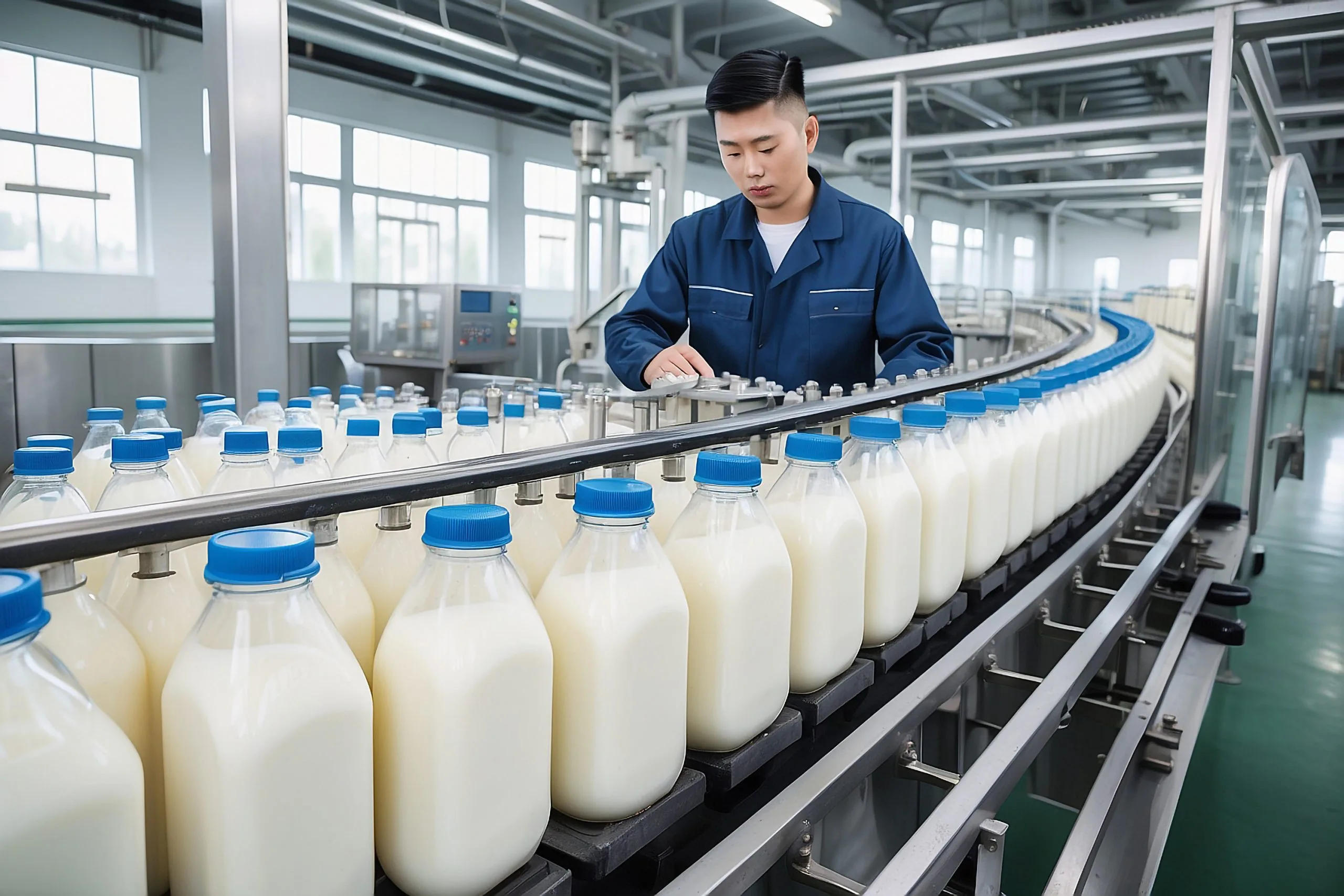
The Vietnam Reconstituted Milk Market is positioned within the country’s dairy products market, valued at USD ~ billion, with reconstituted milk demand linked to imported milk powder, UHT drinking milk, recombined dairy, school milk and fortified nutrition beverages. Vietnam’s food processing industry reached USD ~ billion, while U.S. dairy exports to Vietnam reached USD 146 million in the previous comparable base, supporting powder-based dairy formulation and liquid milk substitution.
Ho Chi Minh City, Hanoi, Binh Duong, Dong Nai, Nghe An, Lam Dong and Moc Chau dominate the Vietnam Reconstituted Milk Market because they combine urban dairy demand, modern retail, foodservice density, dairy processing plants, school milk programs and farm-linked supply. Ho Chi Minh City and Hanoi lead consumption through supermarkets, convenience stores and e-commerce, while Nghe An, Lam Dong and Moc Chau support domestic raw milk integration and processor-led traceability.
Market Segmentation
By Source
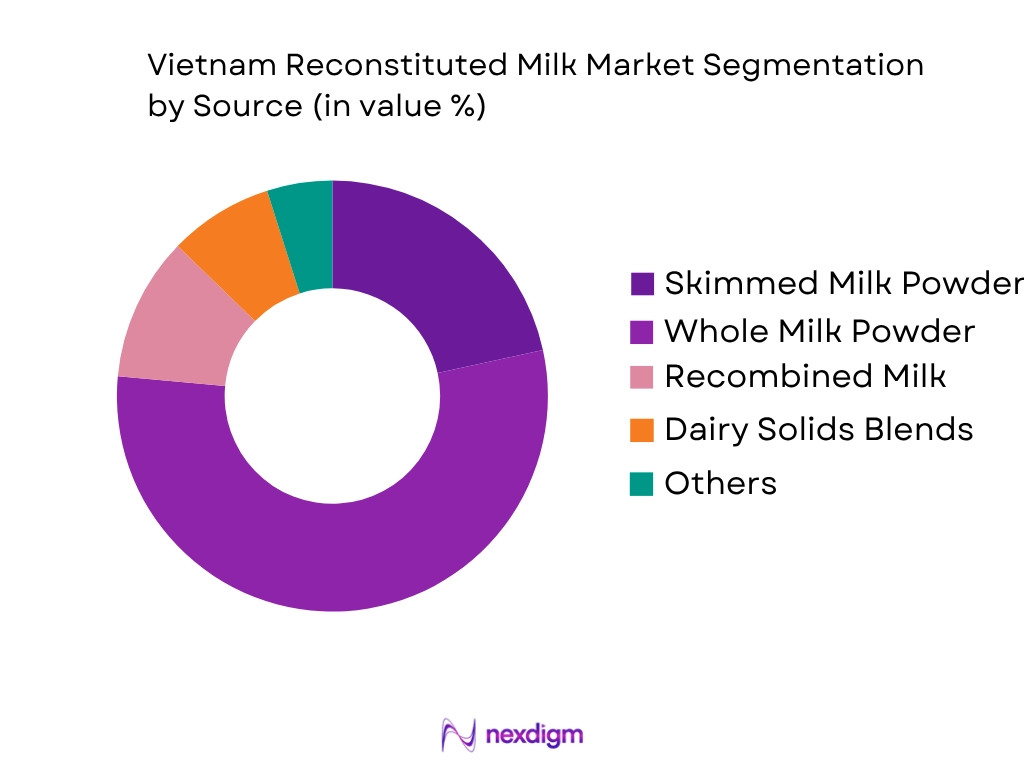
Vietnam Reconstituted Milk Market is segmented by source into whole milk powder based reconstituted milk, skim milk powder based reconstituted milk, recombined milk with butterfat or cream, whey and lactose dairy solids blends, and milk protein concentrate based reconstituted milk. Whole milk powder based reconstituted milk holds the dominant market share because Vietnam’s dairy consumption is strongly linked to UHT drinking milk, family nutrition, children’s milk and full-mouthfeel dairy beverages. Whole milk powder gives processors a fat-containing base that can be rehydrated into shelf-stable milk, fortified milk, flavored milk and nutrition beverages. It is also useful in a market where domestic fresh milk supply remains below processing demand. Major dairy processors use imported whole milk powder to balance supply, maintain sensory consistency and serve modern retail, traditional trade and school-linked consumption channels.
By Application
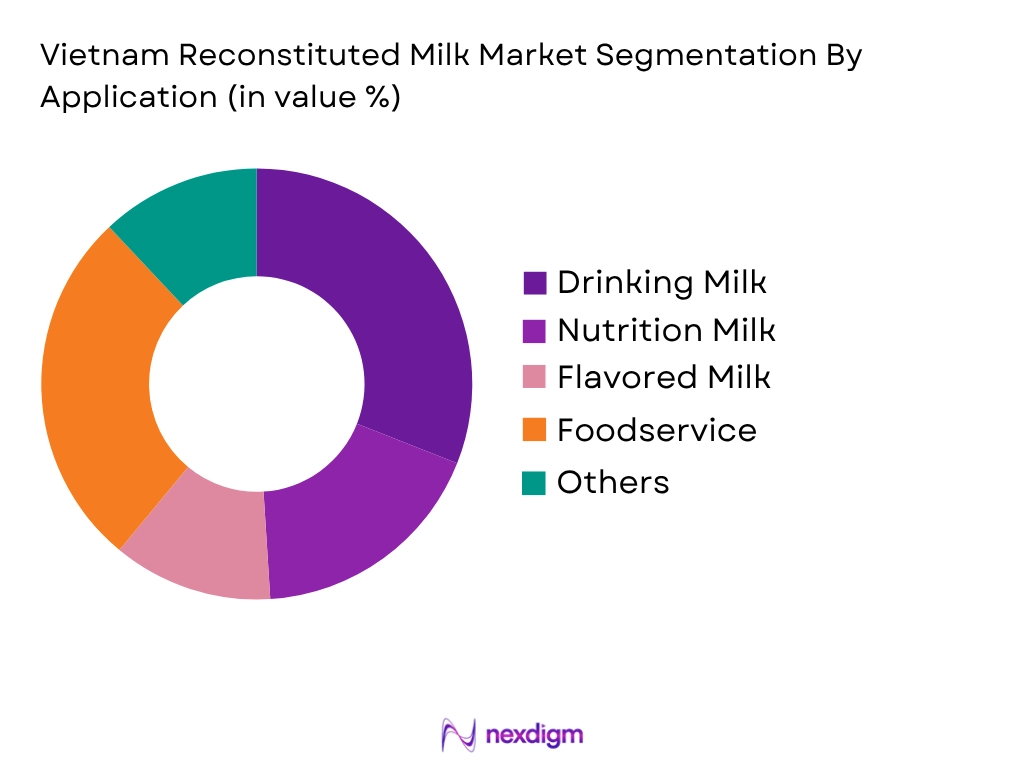
Vietnam Reconstituted Milk Market is segmented by application into UHT and shelf-stable drinking milk, children’s and family nutrition milk, dairy beverages and flavored milk, foodservice and bubble tea or coffee chains, food and beverage processing, and school milk and institutional procurement. UHT and shelf-stable drinking milk dominates the market because Vietnamese households are familiar with aseptic cartons, ambient storage and long-life dairy formats. Reconstituted milk is commercially important because imported powder can be blended, rehydrated, standardized and sterilized into UHT packs for supermarkets, convenience stores, schools and traditional retail outlets. The segment is also supported by Vietnam’s geography and uneven cold-chain depth outside large urban centers. Processors benefit from UHT formats because they reduce wastage, improve route-to-market flexibility and support national distribution of dairy products with consistent fat, protein and nutrition profiles.
Competitive Landscape
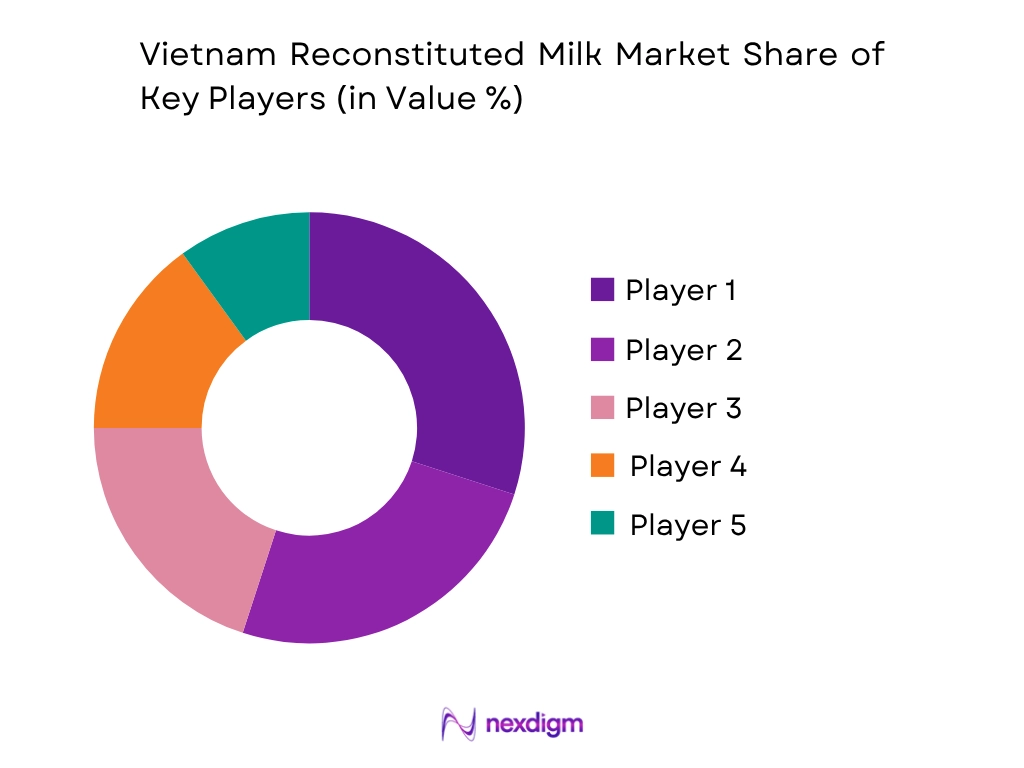
The Vietnam Reconstituted Milk Market is led by a small group of domestic dairy champions, multinational nutrition companies and ingredient-linked dairy suppliers. Vinamilk, TH true MILK, Moc Chau Milk, Nutifood and FrieslandCampina Vietnam are central players because they combine UHT milk, milk powder, children’s nutrition, school milk, modern retail distribution and brand trust. Competition is shaped by imported milk powder sourcing, domestic farm integration, UHT processing, fortified product portfolios, school milk exposure, convenience-store reach and e-commerce nutrition sales.
| Company | Establishment Year | Headquarters | Imported Powder Access | Domestic Farm Integration | UHT / Aseptic Capability | Children’s Nutrition Portfolio | Retail and Convenience Reach | Strategic Positioning |
| Vinamilk | 1976 | Ho Chi Minh City, Vietnam | ~ | ~ | ~ | ~ | ~ | ~ |
| TH true MILK | 2009 | Nghe An, Vietnam | ~ | ~ | ~ | ~ | ~ | ~ |
| Moc Chau Milk | 1958 | Son La, Vietnam | ~ | ~ | ~ | ~ | ~ | ~ |
| Nutifood | 2000 | Ho Chi Minh City, Vietnam | ~ | ~ | ~ | ~ | ~ | ~ |
| FrieslandCampina Vietnam / Dutch Lady | 1995 | Binh Duong, Vietnam | ~ | ~ | ~ | ~ | ~ | ~ |
Vietnam Reconstituted Milk Market Analysis
Growth Drivers
Imported Milk Powder Base Supports Reconstituted Milk Production
Vietnam Reconstituted Milk Market is supported by imported dairy ingredients because local dairy processors use milk powders, cream, sweet whey, lactose, butter and cheese for recombined milk, UHT milk, nutrition beverages and bakery-linked dairy products. USDA FAS reported Vietnam dairy-product imports of USD ~ billion in 2024, while local production was described as growing but still inadequate to meet demand. The same source identifies New Zealand, the EU, Australia and the United States as key suppliers of dairy ingredients, including milk powder. World Bank data shows Vietnam had 100,987,686 people and GDP of USD 476.39 billion in 2024, supporting a large dairy-processing and packaged-food consumption base.
Domestic Fresh Milk and Powder Output Support UHT and Nutrition Dairy
Vietnam Reconstituted Milk Market is driven by rising domestic dairy processing, where fresh milk and powdered milk are used together to supply UHT milk, children’s milk, flavored milk, yogurt drinks and fortified beverages. USDA FAS, using GSO/MPI and ministry sources, reported fresh milk production of 2,054 million liters and powdered milk production of 145 thousand tons in 2024. These volumes support powder rehydration and blending when fresh milk availability cannot fully match liquid dairy demand. Vietnam’s macro base also supports dairy demand: World Bank reported GDP per capita of USD 4,717.3 and population of 100,987,686 in 2024, strengthening household, school and urban retail consumption.
Market Challenges
Import Dependence Creates Supply and Formulation Risk
Vietnam Reconstituted Milk Market faces a structural challenge because many local dairy processors rely on imported milk powders and dairy solids for reconstituted and recombined products. USDA FAS reported that Vietnam’s dairy-product imports reached USD 1.2 billion in 2024, and noted that local dairy production remains inadequate to meet demand. The report also states that processors rely on imported milk powders, cream, sweet whey, lactose, butter and cheese. This creates risk for UHT milk, nutrition milk, school milk and foodservice dairy bases when supply conditions change. The exposure matters because Vietnam serves a large consumer base of 100,987,686 people, according to World Bank 2024 data.
Food Safety and Cold-Chain Requirements Increase Operating Complexity
Vietnam Reconstituted Milk Market faces operating complexity because powder-based dairy needs controlled storage, hygienic blending, traceability, UHT processing and safe distribution. USDA FAS states that food safety and quality assurance require investment in supply chain, cold chain, transportation and storage. This is directly relevant for milk powder, whey, lactose and reconstituted liquid milk because humidity, improper storage and inconsistent handling can affect solubility, taste and safety. The same source reports fresh milk production of 2,054 million liters and powdered milk production of 145 thousand tons in 2024, indicating substantial dairy handling needs. World Bank data shows Vietnam’s GDP per capita at USD 4,717.3, raising consumer expectations for safe packaged dairy.
Market Opportunities
UHT and Shelf-Stable Milk Can Expand Through Modern Retail
Vietnam Reconstituted Milk Market has an opportunity in UHT and shelf-stable milk because reconstituted inputs can be processed into aseptic cartons for supermarkets, convenience stores, schools and traditional retail. USDA FAS reported Vietnam food retail sales of USD 71.8 billion in 2024 and total retail of goods at USD 200.9 billion, while large retailers such as WinMart, AEON, Lotte, Central Retail, MM Mega Market and Saigon Co.op are listed among key retail chains. These channels are suitable for UHT milk, fortified milk and powder-derived family dairy products. World Bank data shows Vietnam’s population at 100,987,686, supporting nationwide demand for shelf-stable dairy formats.
Foodservice, Cafés and Nutrition Processing Create B2B Growth Potential
Vietnam Reconstituted Milk Market has an opportunity in B2B dairy bases for cafés, milk tea chains, bakeries, nutrition products and institutional foodservice. USDA FAS reported food and accommodation service sales of USD 30 billion in 2024 and noted strong development of canteens in industrial zones. The same report states that confectionery and nutrition product manufacturers are showing increasing demand for milk powder, whey and colostrum, including premium nutritional foods for children and the elderly. This supports reconstituted milk formulations for beverages, bakery fillings, desserts and fortified drinks. World Bank reported Vietnam GDP of USD 476.39 billion in 2024, supporting broader processed-food demand.
Future Outlook
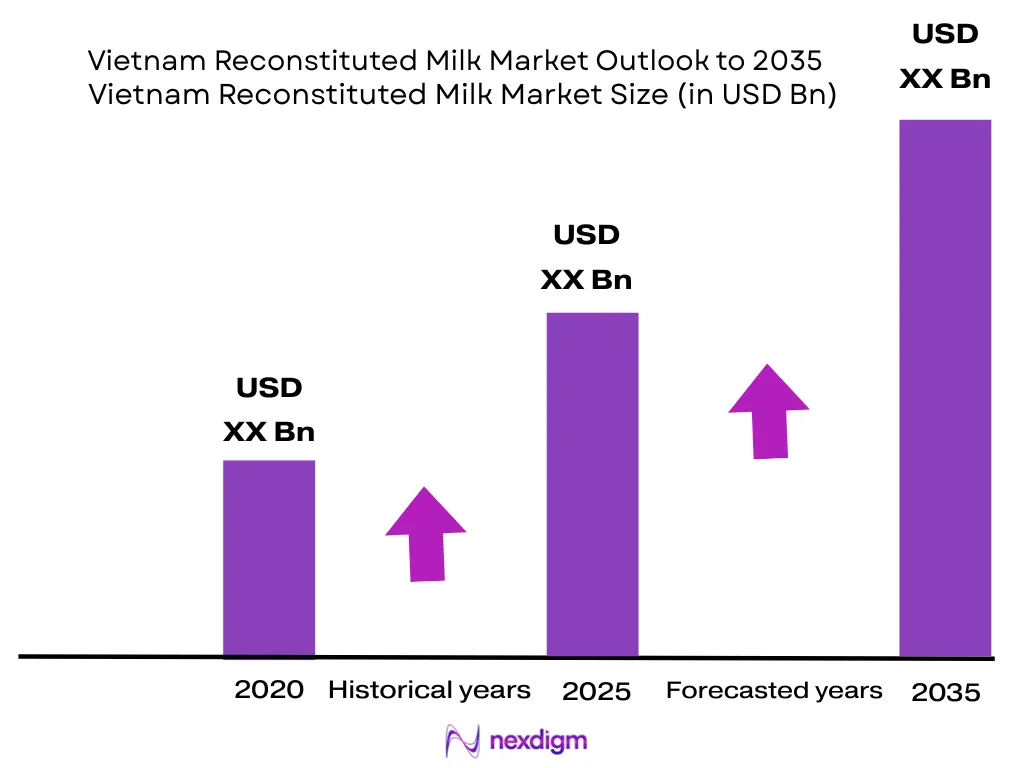
The Vietnam Reconstituted Milk Market is expected to expand with a forecast benchmark CAGR of 8.4% during 2026–2035, supported by Asia Pacific reconstituted milk growth, Vietnam’s dependence on imported dairy ingredients, UHT milk penetration, children’s nutrition demand and domestic dairy strategy. The market will remain closely linked to whole milk powder, skim milk powder, whey, lactose, butterfat and milk protein concentrates because domestic fresh milk supply does not fully cover processor demand. Over the next decade, Vietnam’s processors are expected to invest in imported powder blending, domestic farm integration, UHT sterilization, aseptic packaging, fortified milk, school milk, functional dairy and e-commerce nutrition packs. Ho Chi Minh City and Hanoi will remain primary demand centers, while Nghe An, Moc Chau and Lam Dong will become more important for domestic milk supply and traceability claims. Growth will be strongest in UHT milk, children’s fortified milk, senior nutrition drinks, foodservice milk bases and school-oriented dairy formats.
Major Players
- Vinamilk
- TH true MILK
- Moc Chau Milk
- Nutifood
- Dutch Lady Vietnam / FrieslandCampina Vietnam
- Nestlé Vietnam
- Abbott Vietnam
- Mead Johnson Vietnam
- VitaDairy
- Dalatmilk
- Nutricare
- IDP Dairy / Love’in Farm
- Fonterra Brands Vietnam
- Lothamilk
- Ba Vì Milk
Key Target Audience
- Dairy processors and UHT milk manufacturers
- Milk powder importers and dairy ingredient suppliers
- Children’s nutrition and fortified dairy companies
- Food and beverage processing companies
- Supermarket, convenience-store and e-commerce retail chains
- Foodservice, café, bakery and bubble tea procurement teams
- Investments and venture capitalist firms
- Government and regulatory bodies (Ministry of Health, Ministry of Agriculture and Environment, Ministry of Industry and Trade, Vietnam Food Administration, General Department of Vietnam Customs)
Research Methodology
Step 1: Identification of Key Variables
The initial phase involves mapping Vietnam’s reconstituted milk ecosystem, including dairy farms, powder importers, UHT processors, nutrition companies, retailers, foodservice distributors and schools. Key variables include imported powder availability, domestic fresh milk supply, UHT capacity, school milk demand, fortified milk demand and regional consumption corridors.
Step 2: Market Analysis and Construction
This phase compiles historical and current data on dairy imports, processed food output, UHT milk penetration, dairy product consumption, company portfolios and distribution channels. Market construction uses top-down dairy demand assessment and bottom-up modelling through processor output, powder-to-liquid conversion, product mix and channel-level demand.
Step 3: Hypothesis Validation and Expert Consultation
Market hypotheses are validated through structured interviews with dairy processors, powder importers, ingredient distributors, foodservice buyers, retail category managers, school milk stakeholders and packaging suppliers. These discussions help refine assumptions on source mix, reconstitution use cases, import reliance, UHT demand and nutrition-led dairy consumption.
Step 4: Research Synthesis and Final Output
The final phase integrates public statistics, trade data, company benchmarking, primary validation and segment-level triangulation. The final output is checked against Vietnam dairy imports, processed food activity, UHT category behavior, competitor product portfolios and regulatory requirements to create a commercially usable assessment of the Vietnam Reconstituted Milk Market.

- Executive Summary
- Research Methodology (Market definitions and assumptions, reconstituted milk classification, recombined milk scope, milk powder-to-liquid conversion, whole milk powder and skim milk powder inclusion, UHT milk inclusion logic, liquid milk equivalent calculation, domestic versus imported powder split, bottom-up processor validation, top-down dairy balance sheet approach, primary interviews with dairy processors and distributors, retail audit, school milk procurement checks, foodservice validation, import-export triangulation, limitations and forecast framework)

- Definition and Scope
- Market Genesis and Evolution
- Role of Reconstituted Milk in Vietnam’s Dairy Industry
- Business Cycle and Seasonality
- Supply Chain and Value Chain Analysis

- Growth Drivers (Milk powder import availability, UHT milk adoption, child nutrition demand, urban retail growth, foodservice expansion, domestic dairy strategy, school milk demand)
- Market Challenges (Import dependence, exchange-rate exposure, domestic fresh milk deficit, regulatory labeling, counterfeit risk, consumer trust, imported brand competition)
- Opportunities (Domestic milk substitution, fortified UHT milk, school milk, elderly nutrition, foodservice dairy base, private label, imported ingredient localization)
- Trends (Premium nutrition milk, farm-to-pack branding, UHT multipacks, fortified dairy, imported powder blending, e-commerce milk powder, sustainability in dairy farms)
- SWOT Analysis
- PESTLE Analysis
- Porter’s Five Forces

- By Value (2020-2025)
- By Volume (2020-2025)
- By Average Realization Price (2020-2025)

- By Product Type (In Value %)
Whole Reconstituted Milk
Skimmed Reconstituted Milk
Recombined Milk
Fortified Reconstituted Milk
Lactose-Free Reconstituted Milk - By Distribution Channel (In Value %)
Supermarkets and Hypermarkets
Convenience Stores
Traditional Grocery and Wet Market-Linked Retail
E-Commerce and Social Commerce
School and Institutional Supply - By End User (In Value %)
Households
Children and Students
Dairy Processors
Food and Beverage Manufacturers
Cafés, Bubble Tea Chains and HoReCa
- By Region (In Value %)
Southern Vietnam
Northern Vietnam
Central Vietnam
Mekong Delta
Red River Delta

- Market Share of Major Players (Value share, volume share, liquid milk-equivalent share, powder-equivalent share, UHT-linked share)
- Cross Comparison Parameters (Imported milk powder sourcing model, domestic dairy farm integration, UHT and aseptic processing capability, school milk contract exposure, fortified and children’s nutrition portfolio, modern trade and convenience-store reach, e-commerce milk powder presence, foodservice and bubble-tea channel strength)
- SWOT Analysis of Major Players
- SKU and Price Benchmarking
- Detailed Profiles of Major Companies
Vinamilk
TH true MIL
Moc Chau Milk
Nutifood
Dutch Lady Vietnam / FrieslandCampina Vietnam
Nestlé Vietnam
Abbott Vietnam
Mead Johnson Vietnam
VitaDair
Dalatmilk
Nutricare
IDP Dairy / Love’in Farm
Fonterra Brands Vietnam
Lothamilk
Ba Vì Milk

- Household Consumer Analysis
- Children and Student Consumer Analysis
- Dairy Processor Analysis
- Foodservice Operator Analysis
- Food Manufacturer Analysis
- Institutional Buyer Analysis

- By Value (2026-2035)
- By Volume (2026-2035)
- By Average Realization Price (2026-2035)


 Request a Sample
 Ask for Customization
 Get a Quote
 Enquire Now