

 Download PDF
Market Overview
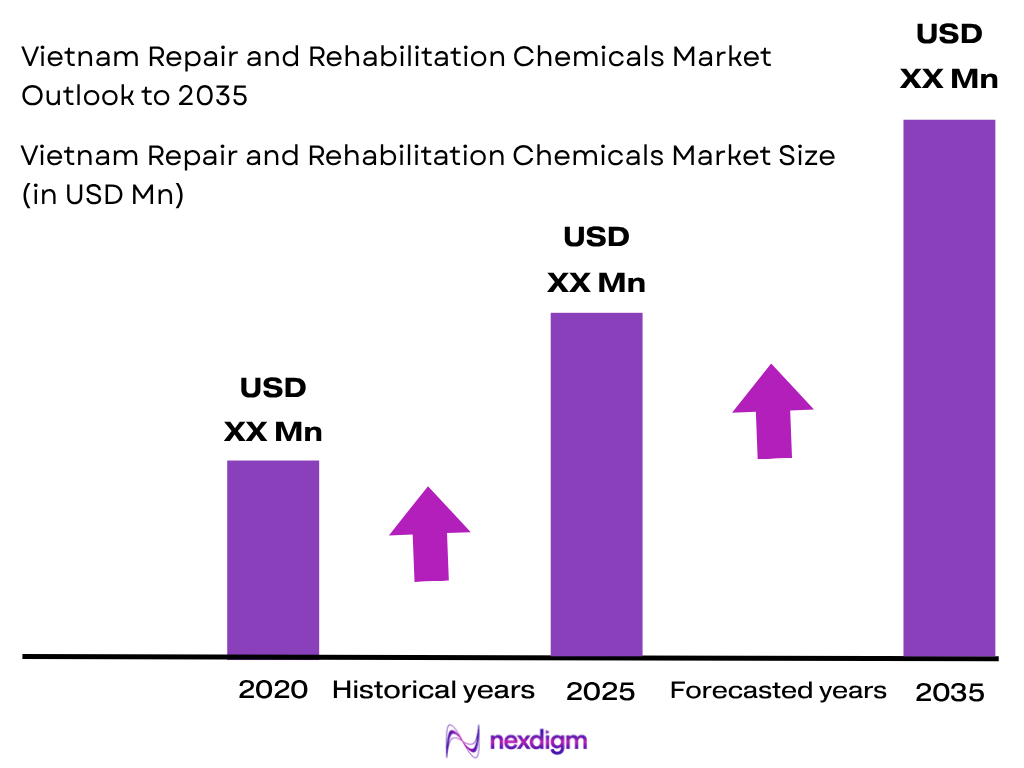
The Vietnam Repair and Rehabilitation Chemicals Market is valued at approximately ~USD XX million, supported by continued expansion of buildings and infrastructure that progressively require concrete repair, waterproofing and corrosion protection. Construction activity strengthened from 7.06% growth in the preceding period, while industry and construction recorded 8.35% growth in the latest fourth quarter. Commercial housing completions reached 69 projects covering 23,041 units, reinforcing the installed asset base requiring lifecycle rehabilitation.
Ho Chi Minh City, Hanoi, Binh Duong, Dong Nai, Bac Ninh and Hai Phong are key Vietnam Repair and Rehabilitation Chemicals Market centres because of their concentration of apartments, factories, warehouses and infrastructure. The national industrial-zone network expanded to 431 industrial and export-processing zones covering 132,300 hectares, with 301 zones operating, while the latest housing pipeline contained 937 commercial projects covering 403,349 units. These concentrations create recurring requirements for repair mortars, injection systems and protective coatings.
Market Segmentation
By Product Type
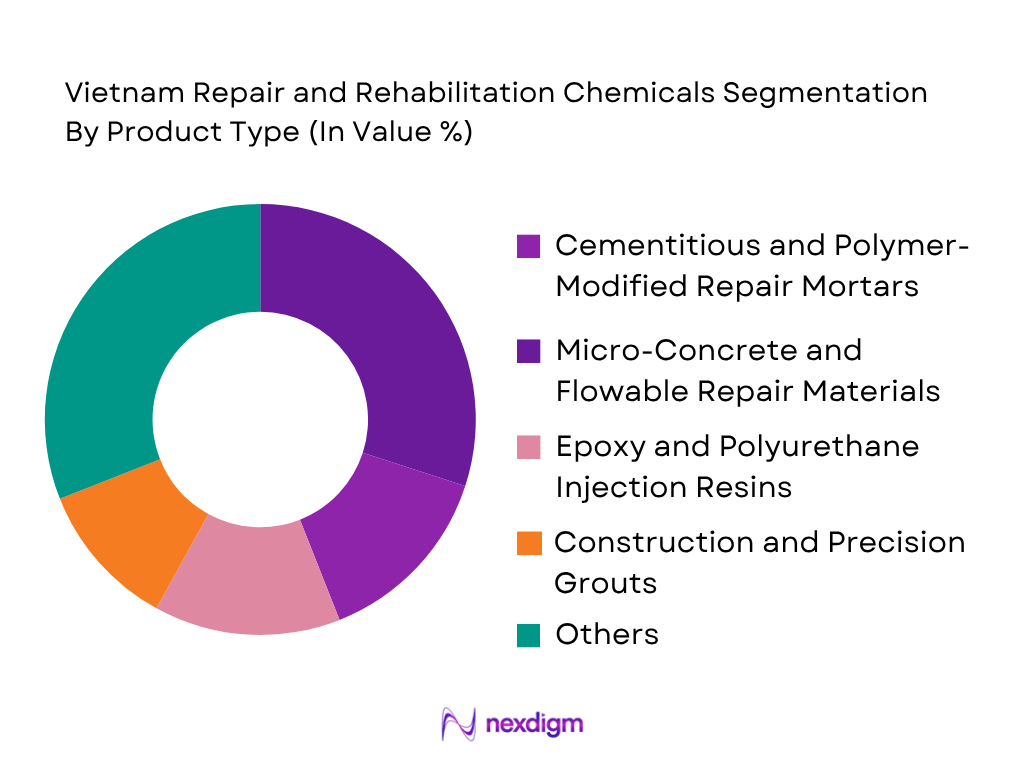
The Vietnam Repair and Rehabilitation Chemicals Market is segmented into cementitious repair mortars, polymer-modified repair mortars, flowable micro-concrete, epoxy and polyurethane injection systems, construction grouts, corrosion-protection systems, protective coatings, structural-strengthening systems and waterproofing rehabilitation chemicals. Cementitious and polymer-modified repair mortars hold the dominant share because Vietnam’s expanding reinforced-concrete building and infrastructure stock requires frequent patching, reprofiling, spall repair and section reinstatement. The latest Ministry of Construction data identify 937 commercial housing projects with 403,349 units under construction, alongside 69 projects covering 23,041 units completed during the year. Industrial structures add another substantial repair base: Vietnam had 301 operational industrial zones across the national network. Tropical humidity, water ingress and coastal chloride exposure further increase the relevance of low-permeability and polymer-modified systems. Flowable micro-concrete is particularly applicable for column, beam and structural-section restoration, while injection products address structural cracks and active leakage.
By Repair Application
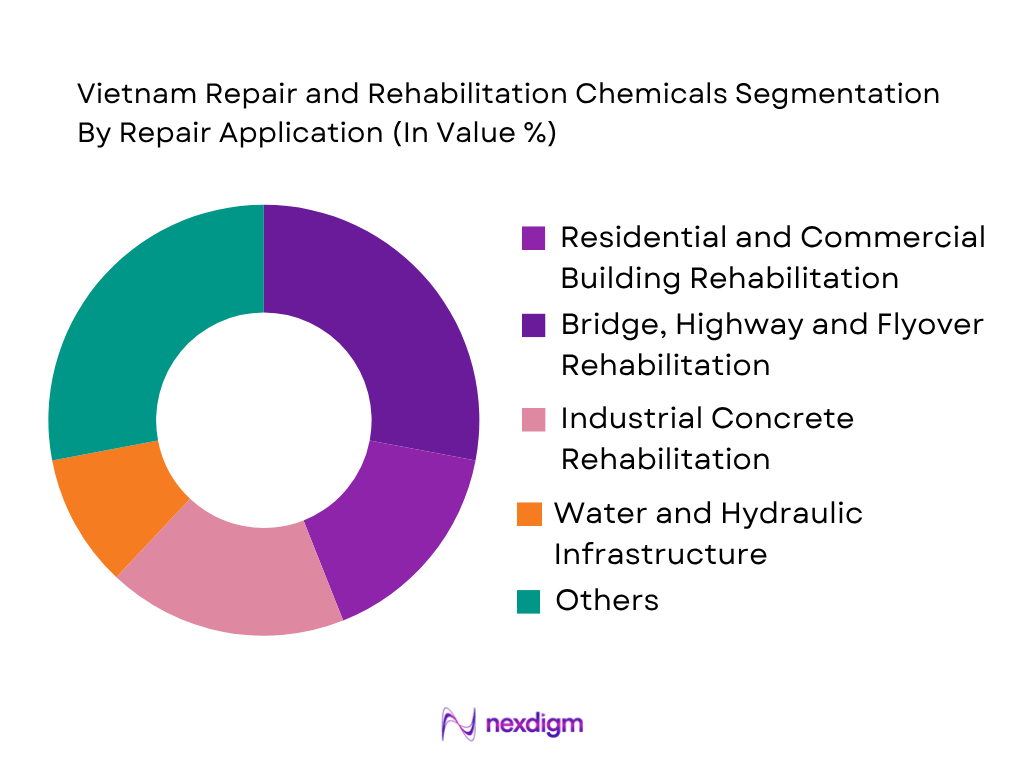
The Vietnam Repair and Rehabilitation Chemicals Market is segmented into building rehabilitation, industrial-facility repair, bridge and transport infrastructure rehabilitation, marine and port repair, tunnel and underground rehabilitation, water infrastructure repair, crack injection and structural strengthening. Residential and commercial building rehabilitation represents the dominant segment because Vietnam has a rapidly increasing stock of apartments and urban buildings requiring leakage remediation, façade restoration, spalling repair and structural maintenance. The Ministry of Construction recorded 79 newly licensed commercial housing projects covering 38,345 units and 69 completed projects covering 23,041 units in the latest full-year release. Social housing added 20,284 completed units, while another 25,399 units were licensed or started. Industrial assets materially expand the addressable market because 301 industrial zones were already operational. These facilities require floor repair, machine-base grouting, corrosion protection and rapid maintenance systems where production downtime must be controlled.
Competitive Landscape
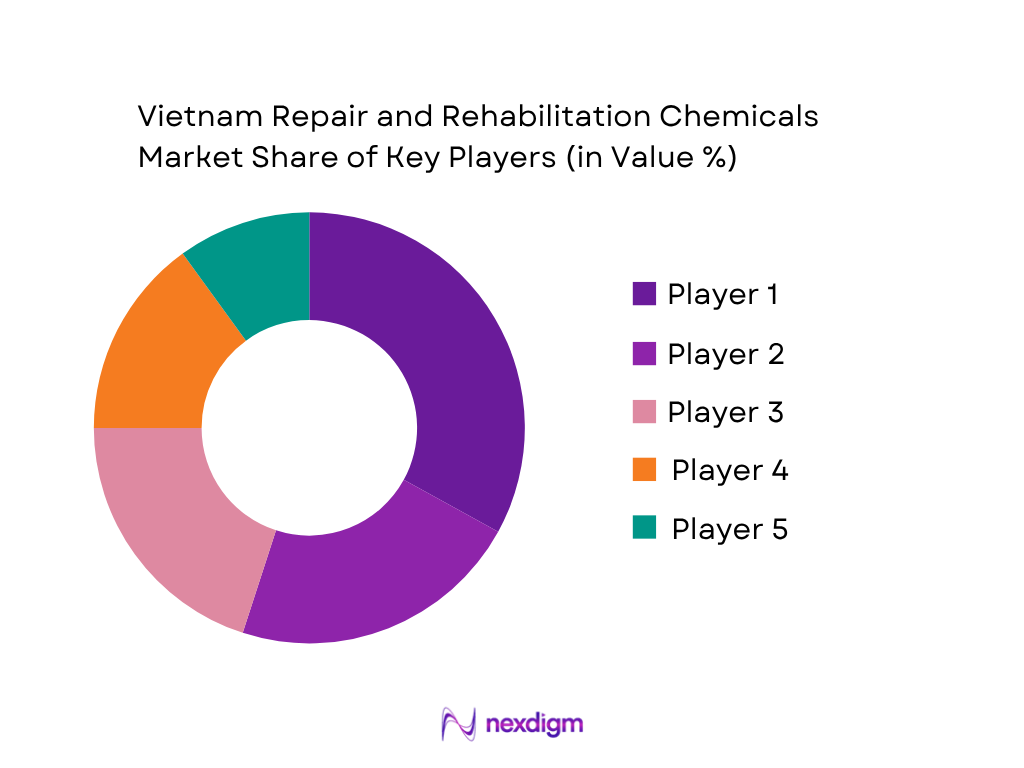
The Vietnam Repair and Rehabilitation Chemicals Market combines multinational construction-chemical suppliers with domestic specialist manufacturers. Competition is increasingly based on complete repair-system capability rather than individual products. Suppliers able to provide polymer-modified mortars, micro-concrete, injection resins, grouts, corrosion-control systems, waterproofing and CFRP strengthening can address a larger proportion of industrial, bridge, marine and building rehabilitation projects.
| Major Player | Establishment Year | Headquarters | Repair Mortars / Micro-Concrete | Injection & Grouting | Corrosion Protection | Structural Strengthening | Vietnam Presence | Technical Support |
| Sika | 1910 | Baar, Switzerland | ||||||
| Fosroc | 1972 | Dubai, UAE | ||||||
| MAPEI | 1937 | Milan, Italy | ||||||
| MC-Bauchemie | 1961 | Bottrop, Germany | ||||||
| Saint-Gobain | 1665 | Courbevoie, France |
Vietnam Repair and Rehabilitation Chemicals Market Analysis
Growth Drivers
Expressway, Bridge and Urban Infrastructure Expansion Is Creating a Larger Rehabilitation Base
Vietnam’s Repair and Rehabilitation Chemicals Market is supported by rapid expansion of transport infrastructure that progressively creates demand for concrete repair, crack injection, corrosion protection and structural strengthening. Government of Vietnam data reported around 1,700 km of expressways under construction in 2024, spanning the North-South corridor and east-west connectivity projects. The transport program included roughly 1,200 km scheduled for completion from this construction pipeline, significantly enlarging the stock of bridges, viaducts, culverts and reinforced-concrete structures requiring lifecycle maintenance. Long Thanh International Airport also mobilized more than 6,000 personnel and 2,200 pieces of construction equipment in late 2024, illustrating the scale of new infrastructure entering Vietnam’s future maintenance base. The Ministry of Construction separately recorded 937 commercial housing projects containing 403,349 units under construction, broadening rehabilitation demand beyond transport infrastructure. World Bank data show Vietnam’s nominal GDP reached USD476.39 billion in 2024, while GDP per capita reached USD4,717.3. This combination of transport expansion and urban construction supports recurring future demand for polymer-modified repair mortars, rapid-setting systems, epoxy injection, structural grouts, protective coatings and CFRP strengthening technologies.
Industrial Parks and Manufacturing Facilities Are Expanding the Installed Concrete Asset Base
Vietnam’s industrialization provides another major growth driver for repair and rehabilitation chemicals because factories, warehouses, electronics facilities and industrial utilities operate under heavy loads, vibration, moisture and chemical exposure. Ministry of Planning and Investment data show Vietnam had 431 industrial and export-processing zones covering approximately 132,300 hectares in 2024, with 301 zones already operational and around 89,900 hectares of industrial land available within the system. These facilities contain extensive reinforced-concrete floors, machine foundations, loading areas, drainage structures, production buildings and utility assets that require crack repair, precision grouting, protective coatings and structural reinstatement during their operating life. Manufacturing activity also drove substantial materials movement: General Statistics Office data recorded USD356.74 billion of processed and manufactured exports during 2024. The country’s broader macroeconomic base remained substantial, with World Bank data recording USD476.39 billion of nominal GDP in 2024 and GDP per capita of USD4,717.3. The combination of a large operational industrial-zone network and expanding manufacturing activity provides a durable demand base for micro-concrete, epoxy flooring repair, non-shrink grouts, corrosion protection, structural injections and rapid-maintenance rehabilitation systems.
Market Challenges
Dependence on Imported Specialty Inputs Creates Supply and Formulation Risks
Vietnam’s Repair and Rehabilitation Chemicals Market faces a material supply-chain challenge because higher-performance repair systems often depend on imported polymers, epoxy components, polyurethane chemistry, additives and specialty raw materials. General Statistics Office data show Vietnam imported USD380.76 billion of goods in 2024, of which USD356.43 billion consisted of production inputs. Imports of plastics alone reached USD11.8 billion, while machinery, equipment and tools reached USD48.9 billion, illustrating the country’s continuing dependence on imported industrial inputs. This matters for rehabilitation chemicals because products such as low-viscosity epoxy injection resins, polyurethane water-stopping systems, redispersible polymer-modified mortars, silane treatments and CFRP bonding systems rely on consistent specialty material quality. Supply interruptions or changes in imported feedstock specifications can complicate local formulation, inventory planning and contractor product availability. At the same time, Vietnam had 937 commercial housing projects containing 403,349 units under construction, creating a growing project base that requires reliable material supply. World Bank data record Vietnam’s nominal GDP at USD476.39 billion in 2024 and GDP per capita at USD4,717.3. Local production expansion and stronger raw-material sourcing therefore remain important competitive priorities.
Tropical Moisture, Flooding and Storm Damage Increase Repair Complexity and Failure Risk
Vietnam’s tropical climate creates demanding conditions for rehabilitation because structures experience persistent moisture, heavy rainfall, flooding and wind-driven water ingress. Government disaster data show Typhoon Yagi and associated flooding affected infrastructure across northern Vietnam in 2024, with more than 260,000 houses damaged, collapsed or swept away and around 1,900 schools affected. Authorities also recorded 305 incidents involving the dike system, demonstrating the extent of hydraulic and structural stress created by major weather events. Earlier assessments identified 231,413 damaged houses, while intense rainfall reached 760 mm at Nam Xay Luong and exceeded 500 mm at several other northern locations. These conditions increase the likelihood of saturated substrates, reinforcement corrosion, crack propagation, concrete delamination and leakage, while making repair application more difficult because adhesion and curing can be compromised by residual moisture. Rehabilitation contractors therefore require moisture-tolerant epoxies, PU injection systems, low-permeability mortars and protective coatings suited to humid service conditions. World Bank data place Vietnam’s nominal GDP at USD476.39 billion in 2024 and GDP per capita at USD4,717.3, highlighting the large economic asset base exposed to these recurring climatic stresses.
Market Opportunities
Rapid-Setting Repair, Crack Injection and CFRP Systems Can Benefit From Transport Asset Expansion
Vietnam offers strong future opportunity for rapid-setting repair mortars, low-viscosity epoxy injection and CFRP strengthening because the country is rapidly increasing the number of high-value transport assets that will require periodic structural maintenance. Government data show approximately 1,700 km of expressways were under construction in 2024, with projects distributed across the North-South corridor, east-west routes and regional connections. Long Thanh International Airport simultaneously mobilized more than 6,000 workers and engineers together with 2,200 pieces of equipment, demonstrating the scale of reinforced-concrete infrastructure being added to the national asset base. At an earlier construction stage, the airport project alone had already completed 941 foundations and cut 1,339 pile heads, indicating the structural intensity of such projects. These new bridges, terminals, viaducts and pavement structures will progressively require crack sealing, bearing-area reinstatement, rapid patching and structural strengthening as service exposure increases. World Bank data record Vietnam’s nominal GDP at USD476.39 billion in 2024 and GDP per capita at USD4,717.3. Current infrastructure construction therefore provides a substantial future platform for engineered rehabilitation systems focused on fast return to service and structural life extension.
Marine and Industrial Concrete Protection Can Become a Major High-Durability Application Segment
Marine and industrial rehabilitation represents a significant future opportunity because Vietnam combines intensive port operations with a large manufacturing base exposed to chlorides, abrasion, chemicals and continuous traffic. Government port data show Hai Phong handled 106.5 million tonnes of cargo in 2024, including approximately 7.2 million TEU of containers. Ho Chi Minh City ports processed more than 9.1 million TEU, while Cai Mep handled more than 7 million TEU, creating extensive operating infrastructure consisting of quay walls, wharves, yards, piles and reinforced-concrete logistics structures. At the same time, Vietnam had 431 industrial and export-processing zones covering 132,300 hectares, including 301 operational zones, creating additional demand for factory-floor repair, foundation grouting and chemical protection. High-throughput marine assets are particularly exposed to saltwater, wet-dry cycling and chloride-induced reinforcement corrosion, supporting silane treatments, corrosion inhibitors, marine-grade repair mortars and protective coatings. World Bank data record Vietnam’s nominal GDP at USD476.39 billion in 2024 and GDP per capita at USD4,717.3. These current assets create strong future potential for integrated marine, port and industrial rehabilitation systems.
Future Outlook
The Vietnam Repair and Rehabilitation Chemicals Market is expected to expand at approximately ~X.X% CAGR during 2026-2035, with demand progressively shifting from basic patching toward engineered lifecycle-rehabilitation systems. Expansion of Vietnam’s building, industrial and infrastructure base creates a larger stock of concrete assets that will require maintenance as they age.
Industrial facilities will provide a major long-term demand channel. Vietnam already has 431 industrial and export-processing zones covering approximately 132,300 hectares, including 301 operational zones, creating a broad base of factories, warehouses, utility structures and concrete floors requiring repair and protective treatments.
Major Players
- Sika Vietnam Ltd.
- Fosroc Vietnam / Saint-Gobain
- MAPEI Vietnam Ltd.
- Master Builders Solutions Vietnam / Regional Operations
- MC-Bauchemie Vietnam / Regional Solutions
- Saint-Gobain Vietnam
- Hilti Vietnam
- Penetron Vietnam / Regional Solutions
- Kryton International / Vietnam Distribution
- KÖSTER Vietnam / Regional Solutions
- Denka Vietnam
- Vinkems Co., Ltd.
- Neomax Construction Chemical JSC
- Intoc Construction Chemicals
- BestMix Corporation
Key Target Audience
- Repair and Rehabilitation Chemical Manufacturers
- Structural Repair and Injection Contractors
- Industrial and Manufacturing Facility Owners
- Bridge, Transport and Marine Infrastructure Contractors
- Property Developers and Commercial Asset Owners
- Investments and Venture Capitalist Firms
- Government and Regulatory Bodies (Ministry of Construction, Ministry of Transport, Vietnam Road Administration, Ministry of Industry and Trade, Ministry of Agriculture and Environment)
- Construction Chemical Distributors and Specialist Applicator Networks
Research Methodology
Step 1: Identification of Key Variables
The initial phase constructs an ecosystem map covering repair-chemical manufacturers, polymer and resin suppliers, distributors, structural engineers, repair contractors, property developers and infrastructure agencies. Secondary and proprietary databases are used to identify deterioration mechanisms and application patterns. Core variables include repair area, defect type, material intensity, asset age, structural requirement, industrial exposure and geographic concentration.
Step 2: Market Analysis and Construction
Historical demand is assessed using housing development, industrial-zone expansion, infrastructure construction and maintenance indicators. The top-down approach estimates demand from Vietnam’s addressable reinforced-concrete asset base, while the bottom-up approach analyses supplier sales, distributor throughput and contractor-level material consumption. Results are reconciled across repair mortars, injection systems, grouts, corrosion treatments, coatings and structural-strengthening products.
Step 3: Hypothesis Validation and Expert Consultation
Market hypotheses are validated through computer-assisted telephone interviews with repair-chemical manufacturers, structural engineers, industrial maintenance contractors, distributors, waterproofing specialists and infrastructure contractors. Discussions evaluate defect diagnosis, repair depth, injection requirements, product selection, humidity-related application constraints and specification practices. These findings are used to refine application-level demand and distinguish structural rehabilitation from routine cosmetic maintenance.
Step 4: Research Synthesis and Final Output
The final stage triangulates Ministry of Construction data, industrial-zone statistics, infrastructure indicators, supplier information and primary interviews. Demand is validated across product type, application, asset category and region. Forecasting incorporates industrial expansion, building ageing, transport maintenance, marine exposure, water-infrastructure rehabilitation and adoption of higher-performance repair and strengthening technologies.

- Executive Summary
- Research Methodology (Market Definitions and Assumptions, Vietnam Repair and Rehabilitation Chemicals Market Classification, Cementitious Repair Mortar Assessment, Polymer-Modified Repair Mortar Assessment, Flowable Micro-Concrete Assessment, Epoxy Repair Mortar Assessment, Epoxy Injection Resin Assessment, Polyurethane Injection Assessment, Cementitious Injection Grout Assessment, Non-Shrink Grout Assessment, Precision Grout Assessment, Reinforcement Passivation Assessment, Corrosion Inhibitor Assessment, Hydrophobic Impregnation Assessment, Anti-Carbonation Coating Assessment, Protective Coating Assessment, Structural Strengthening Assessment, CFRP System Assessment, Epoxy Bonding Assessment, Waterproofing Rehabilitation Assessment, Concrete Crack Assessment, Spalling and Delamination Assessment, Bridge and Expressway Rehabilitation Assessment, Industrial Plant Rehabilitation Assessment, Port and Marine Concrete Assessment, Metro and Tunnel Rehabilitation Assessment, Water Infrastructure Rehabilitation Assessment, Tropical Climate Exposure Assessment, Chloride Exposure Assessment, TCXDVN Concrete Maintenance Assessment, TCVN and Construction Maintenance Requirement Assessment, Adhesion Strength Assessment, Compressive Strength Assessment, Injection Viscosity Assessment, Top-Down Market Sizing, Bottom-Up Market Sizing, Contractor Interviews, Structural Engineer Interviews, Distributor Mapping, Infrastructure Project Mapping, Data Triangulation, Forecasting Framework)

- Definition and Scope
- Vietnam Repair and Rehabilitation Chemicals Industry Evolution and Development of Conventional Cementitious Patching, Polymer-Modified Repair Mortars, Flowable Micro-Concrete, Non-Shrink Grouts, Low-Viscosity Epoxy Injection, Polyurethane Water-Stopping Injection, Cementitious Grouting, Reinforcement Passivation, Corrosion Inhibitors, Hydrophobic Concrete Protection, Anti-Carbonation Coatings, Protective Elastomeric Coatings, Structural Epoxy Bonding, CFRP Strengthening, Waterproofing Rehabilitation, Bridge Deck Repair, Tunnel Leakage Injection, Marine Concrete Protection and Low-Carbon Rehabilitation Technologies
- Repair and Rehabilitation Chemicals Value Chain Analysis
- Repair and Rehabilitation Chemicals Supply Chain Analysis
- Cement and SCM Suppliers, Polymer Modifier Suppliers, SBR Latex Suppliers, Acrylic Polymer Suppliers, Epoxy Resin Suppliers, Polyurethane Resin Suppliers, Corrosion Inhibitor Suppliers, Silane and Siloxane Suppliers, Carbon Fibre Suppliers, Mineral Filler Suppliers, Specialty Additive Suppliers, Repair Chemical Manufacturers, Local Blenders, Importers, Construction Chemical Distributors, Structural Repair Contractors, Waterproofing Contractors, Injection Contractors, Bridge Contractors,
Industrial Maintenance Contractors, Marine Contractors, Structural Engineers, Developers, Industrial Park Operators and Government Infrastructure Agencies

- Growth Drivers (Rapid Expansion of Expressway and Bridge Infrastructure, Industrial Park and Manufacturing Asset Maintenance, High-Rise Building Aging, Residential Building Rehabilitation, Port and Marine Asset Maintenance, Metro Infrastructure Development, Water and Wastewater Infrastructure Renewal, Hydropower Asset Maintenance, Tropical Moisture Exposure, Chloride-Induced Corrosion, Structural Safety Requirements, Asset-Life Extension)
- Market Challenges (Skilled Repair Applicator Availability, Incorrect Defect Diagnosis, Poor Surface Preparation, Hidden Reinforcement Corrosion, High-Humidity Application Conditions, Chloride Contamination, Moisture Behind Repairs, Repair-Material Compatibility, Crack Reopening, Imported Specialty Resin Dependence, Product Substitution, Site Quality Control, Technical Specification Variation, Occupied-Building Repair Constraints)
- Market Opportunities (Polymer-Modified Structural Repair Mortars, High-Flow Micro-Concrete, Rapid-Setting Repair Systems, Low-Viscosity Epoxy Injection, PU Leakage Injection, Migrating Corrosion Inhibitors, Silane Hydrophobic Treatments, Anti-Carbonation Coatings, CFRP Strengthening, Bridge Rehabilitation Systems, Industrial Plant Rehabilitation, Port and Marine Concrete Protection, Tunnel Injection Systems, Low-Carbon Repair Materials)
- Market Trends (Polymer-Modified Repair Mortars, Prepacked Micro-Concrete, Low-Viscosity Epoxy Injection, Hydrophilic PU Injection, CFRP Strengthening, Silane Impregnation, Anti-Carbonation Coatings, Rapid-Cure Repair Systems, Integrated Repair-and-Waterproofing Solutions, Marine-Grade Repair Systems, Factory-Formulated Dry-Mix Products, Digital Condition Assessment, Lifecycle-Based Maintenance, Low-Carbon Rehabilitation)
- Government Regulations and Standards (Construction Law Maintenance Requirements, Decree on Construction Quality and Maintenance, Ministry of Construction Road Infrastructure Maintenance Regulations, TCXDVN Concrete and Reinforced Concrete Maintenance Guidance, TCVN Concrete Material Requirements, TCVN Epoxy-Coated Reinforcement Requirements, Structural Safety Requirements, Road and Bridge Maintenance Requirements, Environmental and Chemical Safety Requirements, Occupational Safety Requirements)
- SWOT Analysis
- Porter’s Five Forces Analysis
- PESTLE Analysis

- By Market Value (2020-2025)
- By Repair Chemical Consumption Volume (2020-2025)
- By Cementitious Repair Mortar Consumption (2020-2025)
- By Polymer-Modified Repair Mortar Consumption (2020-2025)
- By Flowable Micro-Concrete Consumption (2020-2025)
- By Epoxy Injection Resin Consumption (2020-2025)
- By Polyurethane Injection Consumption (2020-2025)
- By Construction and Precision Grout Consumption (2020-2025)

- By Product Type (In Value %)
Cementitious Repair Mortars
Polymer-Modified Repair Mortars
Flowable Micro-Concrete
Epoxy Repair Mortars
Rapid-Setting Repair Mortars
Low-Viscosity Epoxy Injection Resins
Polyurethane Injection Resins
Cementitious Injection Grouts
Non-Shrink Construction Grouts
Precision Grouts
Reinforcement Passivation Coatings
Corrosion Inhibitors - By Repair Application (In Value %)
Spalling Concrete Repair
Delaminated Concrete Repair
Honeycombing Repair
Structural Crack Injection
Non-Structural Crack Sealing
Rebar Corrosion Repair
Concrete Section Reinstatement
Column and Beam Repair
Slab Strengthening
Void Filling and Grouting
Baseplate and Machine Grouting - By Deterioration Mechanism (In Value %)
Reinforcement Corrosion
Carbonation-Induced Deterioration
Chloride-Induced Corrosion
Water Ingress
Delamination
Honeycombing
Chemical Attack
Abrasion and Erosion
High-Humidity Exposure
Thermal Movement
Saltwater Exposure
Construction Defects
Age-Related Deterioration - By Structure Type (In Value %)
Apartment and Residential Buildings
Commercial Buildings
Hotels and Resorts
Hospitals and Institutional Buildings
Factories
Industrial Parks
Warehouses and Logistics Facilities
Highway Bridges
Urban Flyovers
Expressway Structures
Railway Bridges - By Repair Technology (In Value %)
Hand-Applied Repair Mortar
Form-and-Pour Micro-Concrete
Wet-Spray Repair Mortar
Epoxy Pressure Injection
Polyurethane Injection
Cementitious Pressure Grouting
Non-Shrink Grouting
Reinforcement Passivation
Hydrophobic Impregnation
Protective Coating Application
Structural Epoxy Bonding
CFRP Wrapping
CFRP Laminate Bonding
Localized Patch Repair
Concrete Overlay Systems - By Performance Requirement (In Value %)
High Bond Strength
High Compressive Strength
Shrinkage Compensation
Low Permeability
Chloride Resistance
Water-Tightness
Chemical Resistance
Abrasion Resistance
Crack-Bridging Capability
Structural Load Transfer
High Flowability

- Market Share of Major Players (By Vietnam Revenue, Repair Mortar Volume, Micro-Concrete Portfolio, Injection Resin Portfolio, Grouting Portfolio, Corrosion Protection Portfolio, Protective Coating Portfolio, Structural Strengthening Exposure, Building Rehabilitation Exposure, Bridge and Expressway Exposure, Industrial Park Exposure, Marine and Port Exposure, Vietnam Manufacturing Capacity, Distributor Network, Technical Specification Support)
- Cross Comparison Parameters (Structural Repair Mortar Micro-Concrete and Grout Portfolio Breadth, Epoxy Polyurethane and Cementitious Injection Technology Capability, Reinforcement Corrosion Carbonation and Chloride Protection Capability, CFRP Structural Strengthening and Structural Bonding Capability, Bridge Expressway Industrial and Marine Rehabilitation Reference Base, Vietnam Manufacturing Warehousing and Construction Distribution Network Reach, Tropical Humidity Marine Exposure and Water-Ingress Performance Capability, Structural Engineer Contractor Training Field Testing and Technical Support Capability)
- SWOT Analysis of Major Players
- Major Companies
Sika Vietnam Ltd.
Fosroc Vietnam / Saint-Gobain
MAPEI Vietnam Ltd.
Master Builders Solutions Vietnam / Regional Operations
MC-Bauchemie Vietnam / Regional Solutions
Saint-Gobain Vietnam
Hilti Vietnam
Penetron Vietnam / Regional Solutions
Kryton International / Vietnam Distribution
KÖSTER Vietnam / Regional Solutions
Denka Vietnam
Vinkems Co., Ltd.
Neomax Construction Chemical JSC
Intoc Construction Chemicals
BestMix Corporation

- Structural Repair Contractor Requirement Assessment
- Injection Specialist Requirement Assessment
- Waterproofing Contractor Requirement Assessment
- Bridge Contractor Requirement Assessment
- Industrial Maintenance Contractor Requirement Assessment
- Marine Contractor Requirement Assessment
- Structural Engineer Specification Assessment
- Property Developer Requirement Assessment
- Industrial Park Operator Requirement Assessment

- By Market Value (2026-2035)
- By Repair Chemical Consumption Volume (2026-2035)
- By Cementitious Repair Mortar Consumption (2026-2035)
- By Polymer-Modified Repair Mortar Consumption (2026-2035)
- By Flowable Micro-Concrete Consumption (2026-2035)
- By Epoxy Injection Resin Consumption (2026-2035)
- By Polyurethane Injection Consumption (2026-2035)
- By Construction and Precision Grout Consumption (2026-2035)


 Request a Sample
 Ask for Customization
 Get a Quote
 Enquire Now
