

 Download PDF
Market Overview
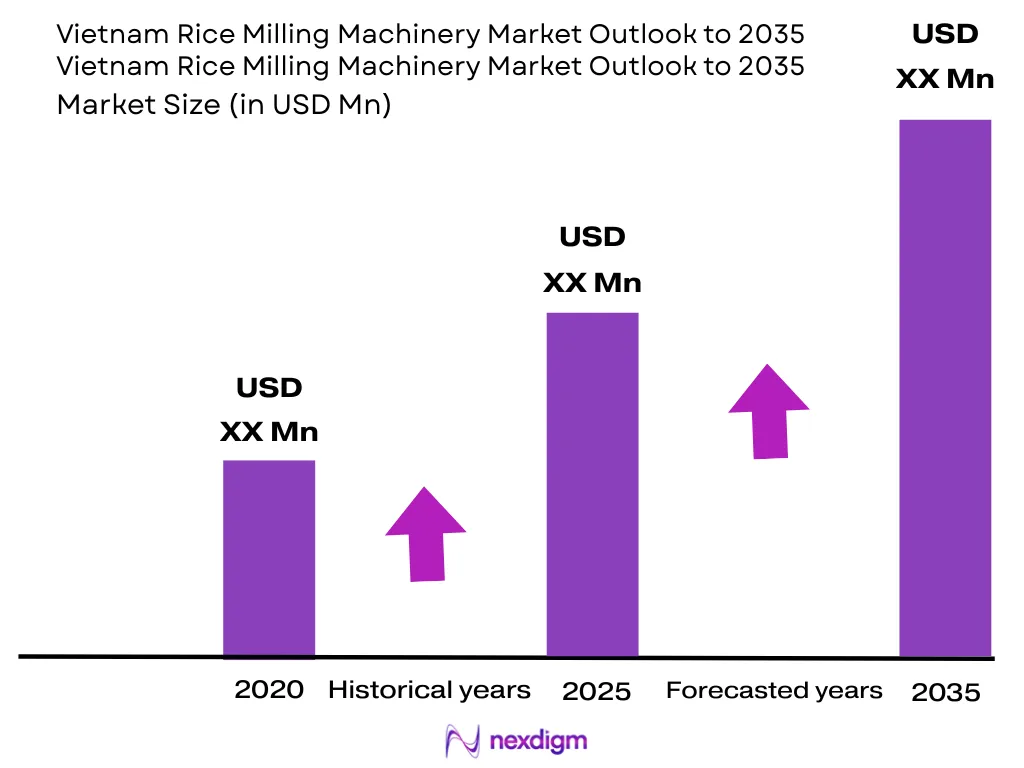
The Vietnam Rice Milling Machinery Market was valued at USD ~ Million in 2024, underpinned by the country’s position as the world’s third-largest rice exporter and one of Southeast Asia’s most significant paddy-producing nations. According to data published by the Ministry of Agriculture and Rural Development (MARD) and the Vietnam Food Association (VFA), Vietnam produced approximately 43 million metric tons of paddy rice, while rice exports surpassed 8 million metric tons annually, generating export revenues exceeding USD 4.7 billion. The Mekong River Delta, which accounts for more than 55% of national paddy production, remains the epicentre of the country’s rice milling and processing industry. Continuous modernization of milling infrastructure, growing demand for high-quality fragrant and export-grade rice, accelerating adoption of automated processing systems, and government-backed initiatives to improve post-harvest handling and reduce milling losses are the principal factors driving equipment demand across the country.
Market Segmentation
By Machinery Type
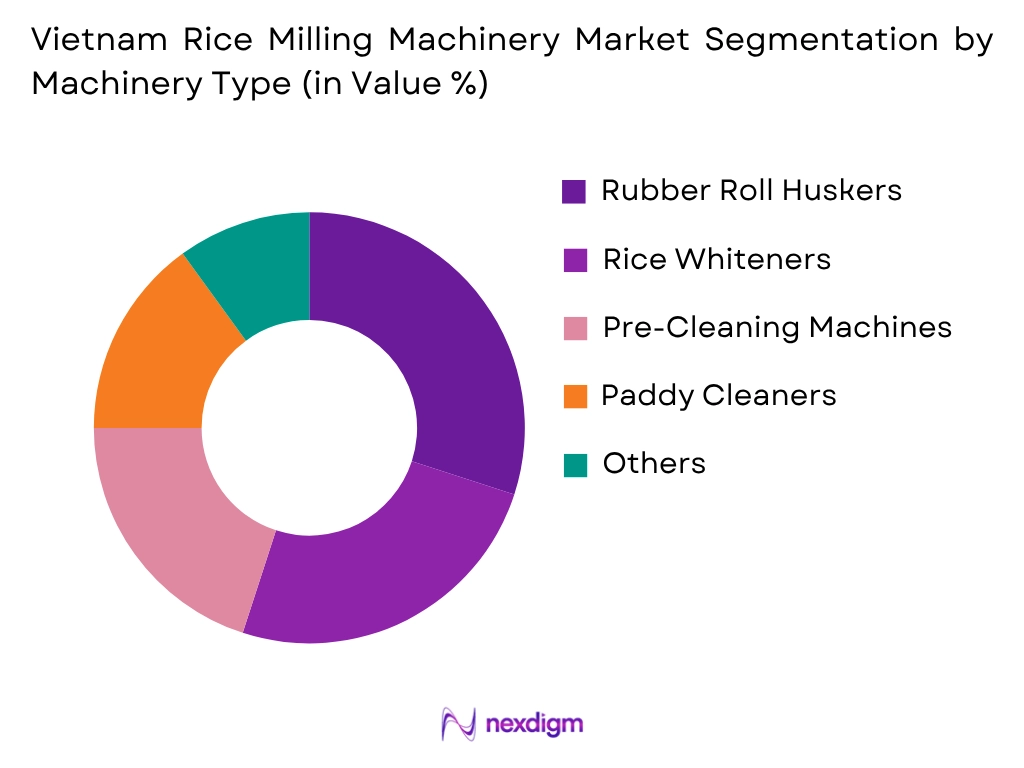
Vietnam Rice Milling Machinery Market is segmented by machinery type into Pre-Cleaning Machines, Paddy Cleaners, Destoners, Rubber Roll Huskers, Paddy Separators, Rice Whiteners, Rice Polishers, Color Sorters, Rice Graders, Length Graders, Packaging Systems, and Complete Rice Milling Plants. Recently, Rubber Roll Huskers and Rice Whiteners hold the dominant market share within this segmentation, reflecting their foundational role in Vietnam’s large-volume paddy processing operations concentrated in the Mekong River Delta. Vietnamese rice processors are increasingly focused on maximizing head rice recovery, reducing grain breakage during husking, and achieving the quality specifications required by key export markets including China, the Philippines, Indonesia, and the European Union. The ongoing expansion of large-scale commercial milling complexes, particularly among enterprises affiliated with Vietnam Food Corporation (VINAFOOD II) and provincial grain trading companies, has sustained high demand for high-throughput husking and whitening equipment. Furthermore, replacement demand from aging equipment installed during earlier modernization waves and increasing construction of integrated milling facilities serving export-oriented processing clusters have reinforced the dominance of these machinery categories. Their direct influence on final product quality, grain recovery efficiency, and profitability makes them critical capital investments for both medium-scale cooperative mills and large commercial rice processing enterprises operating across Vietnam.
By Automation Level
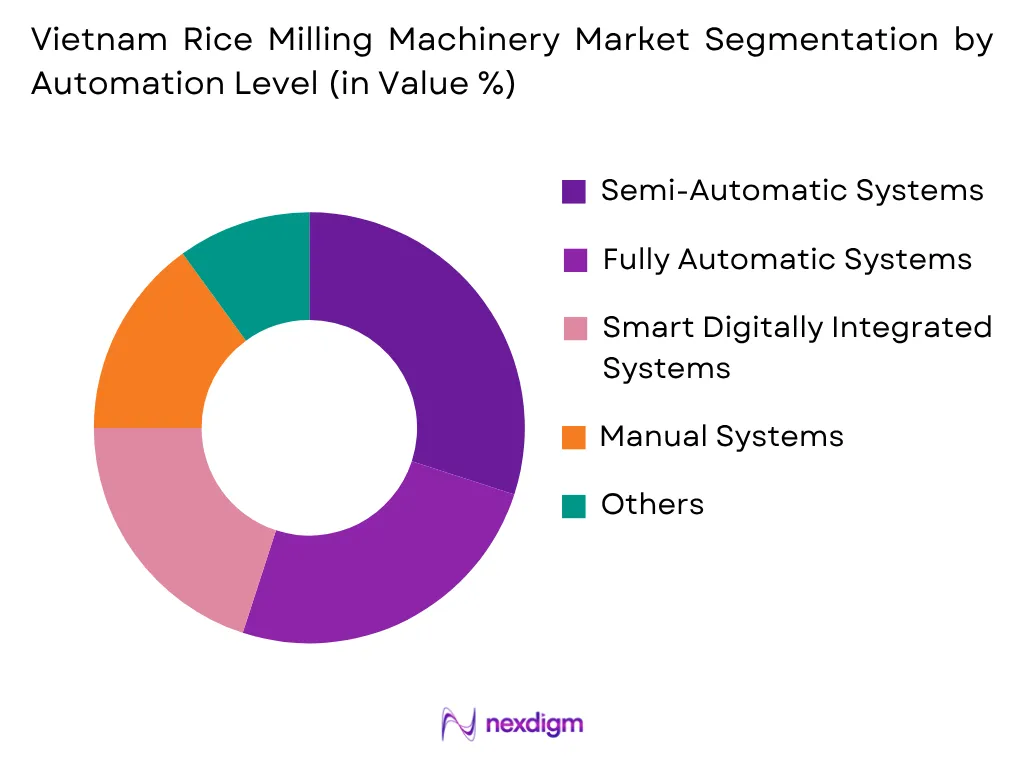
Vietnam Rice Milling Machinery Market is segmented by automation level into Manual Systems, Semi-Automatic Systems, Fully Automatic Systems, and Smart Digitally Integrated Systems. Currently, Semi-Automatic Systems hold the largest installed base, reflecting the prevalence of small and medium-scale milling operations distributed across Vietnam’s rice-growing provinces. However, Fully Automatic Systems represent the fastest-growing segment, driven by investment from large export-oriented commercial processors seeking to optimize throughput, reduce labor costs, and consistently achieve the quality specifications required by international buyers. Vietnam’s National Action Program for Agricultural Restructuring and the government’s Resolution 120 on sustainable Mekong Delta development are providing policy and financial support for milling modernization. Additionally, the rising cost of agricultural labor and increasing difficulty in recruiting workers for physically demanding milling operations are accelerating the transition toward automated systems. Large rice exporting companies are also investing in automated quality monitoring and traceability systems to comply with European Union food safety import requirements under the EU-Vietnam Free Trade Agreement (EVFTA), further reinforcing demand for fully automated and digitally integrated milling solutions across Vietnam’s commercial rice processing sector.
Competitive Landscape
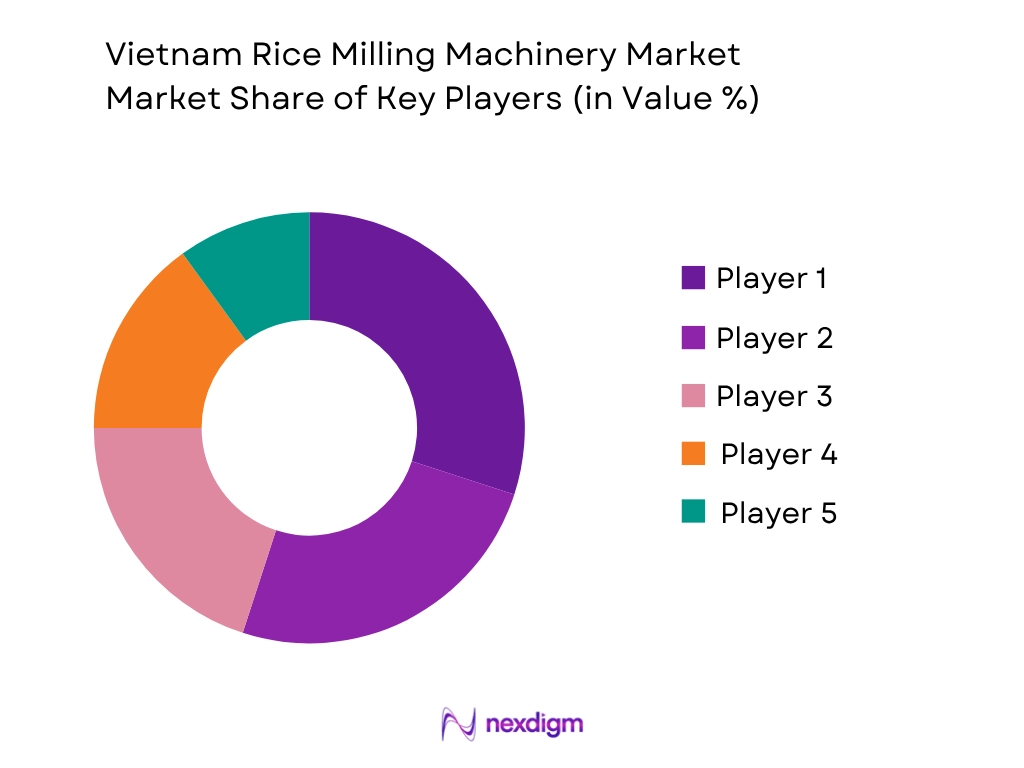
The Vietnam Rice Milling Machinery Market is characterized by the coexistence of global technology leaders, regional Asian manufacturers, and a growing base of domestic Vietnamese equipment suppliers serving the country’s large and diverse rice milling industry. International companies such as Bühler Group and Satake Corporation hold strong positions in the premium large-scale segment through advanced processing technologies and established service networks, while Chinese machinery suppliers including Zhengzhou VOS Machinery and Hunan Chenzhou Grain & Oil Machinery have captured significant market share in the mid-market and small-mill segments through cost-competitive offerings. Vietnamese domestic manufacturers and engineering companies provide locally fabricated equipment and modification services tailored to the specific operational requirements and budget constraints of Mekong Delta milling enterprises. Competition is primarily driven by equipment efficiency, rice recovery performance, total cost of ownership, availability of spare parts, and the strength of local after-sales service and technical support networks.
| Company | Establishment Year | Headquarters | Rice Milling Portfolio | Automation Capability
|
Color Sorting Technology | Service Network | Turnkey Plant Solutions | Processing Capacity Range |
| Bühler Group | 1860 | ~ | ~ | ~ | ~ | ~ | ~ | ~ |
| Satake Corporation | 1896 | ~ | ~ | ~ | ~ | ~ | ~ | ~ |
| Milltec Machinery | 1998 | ~ | ~ | ~ | ~ | ~ | ~ | ~ |
| Viet Hung Agricultural Machinery | 2001 | ~ | ~ | ~ | ~ | ~ | ~ | ~ |
| Cong Ty Co Phan May Nong Nghiep | 1995 | ~ | ~ | ~ | ~ | ~ | ~ | ~ |
Vietnam Rice Milling Machinery Market Analysis
Growth Drivers
World-Class Rice Export Industry and Expanding Commercial Processing Infrastructure
The Vietnam rice milling machinery market is fundamentally supported by the country’s established position as one of the world’s leading rice exporters and its ambitious goals to further expand high-quality rice export revenues. According to the Ministry of Agriculture and Rural Development (MARD) and the Vietnam Food Association (VFA), Vietnam exported more than 8 million metric tons of rice in 2023, achieving record export revenues exceeding USD 4.7 billion. The government’s National Strategy for the Development of the Rice Sector targets a continued shift toward high-quality, high-value rice varieties including ST25, Jasmine 85, and other fragrant varieties that command premium prices in export markets. The Mekong River Delta, encompassing provinces such as An Giang, Dong Thap, Kien Giang, Long An, and Can Tho, accounts for the majority of Vietnam’s paddy production and hosts the country’s largest concentration of commercial rice milling facilities. Ongoing investments in rice milling cluster infrastructure, provincial processing hub development, and the modernization of state-owned grain enterprises create sustained demand for huskers, polishers, graders, color sorters, and automated packaging systems. The Vietnam Food Corporation (VINAFOOD II) and a growing number of private rice exporting companies continue to expand and upgrade their milling and storage capacities to serve diversifying export markets in Asia, Africa, the Middle East, and the European Union under the EU-Vietnam Free Trade Agreement (EVFTA).
Government Modernization Programs and Agricultural Restructuring Policy Support
Vietnam’s national agricultural policy framework provides strong and sustained support for investment in rice milling machinery and post-harvest processing technology. Resolution 120 of the Government, focused on sustainable and climate-adaptive Mekong Delta development, has directed substantial public investment toward improving rice value chains, post-harvest infrastructure, and processing technology in Vietnam’s most important rice-producing region. The Ministry of Agriculture and Rural Development’s national agricultural restructuring program explicitly prioritizes quality improvement, value addition, and processing modernization as pillars of Vietnam’s rice sector competitiveness strategy. The State Bank of Vietnam has facilitated preferential lending programs supporting agro-processing enterprises, while the Ministry of Industry and Trade administers export promotion funds benefiting rice processing companies investing in quality improvement. According to the World Bank, Vietnam’s GDP growth trajectory and strong agricultural export performance reflect a favorable macroeconomic environment for agro-industrial investment. The Government of Vietnam’s target to achieve USD 5 billion in annual rice export revenue by 2030 requires significant upgrades in processing quality and capacity, creating direct and sustained demand for advanced milling technologies. Additionally, bilateral and multilateral trade agreements including EVFTA, RCEP, and CPTPP are raising the quality bar for Vietnamese rice exports, compelling processors to invest in modern equipment capable of meeting stricter food safety, traceability, and grain quality requirements imposed by partner country markets.
Market Challenges
Fragmented Milling Sector and Limited Financial Capacity Among Small Mill Operators
A significant structural challenge facing the Vietnam rice milling machinery market is the fragmentation of the domestic milling industry, where a large proportion of processing capacity remains distributed across thousands of small and micro-scale mills with limited financial resources for equipment modernization. While Vietnam has made substantial progress in consolidating rice processing into larger commercial operations, the MARD estimates that a considerable share of the country’s milling capacity still resides in small rural mills processing limited paddy volumes per day and operating with aging or basic equipment. These small mill operators typically lack access to formal bank credit, are unable to meet collateral requirements for equipment financing, and are highly sensitive to paddy price fluctuations and seasonal income variability. The Asian Development Bank has highlighted that access to agricultural finance for small agro-processing enterprises in the Mekong Delta remains constrained by limited collateral, informal land tenure arrangements, and inadequate rural financial infrastructure. Price sensitivity in the small-mill segment restricts adoption of advanced automation technologies, optical sorting systems, and energy-efficient milling solutions. Furthermore, the concentration of paddy purchasing power among large trading companies and state enterprises can compress margins for smaller independent mills, further limiting their investment capacity and extending equipment replacement cycles.
Climate Vulnerability of Mekong Delta Rice Production Affecting Processing Supply Chain
The pronounced climate vulnerability of the Mekong River Delta represents a significant and growing challenge for Vietnam’s rice milling machinery market. The Mekong Delta, which supplies the majority of paddy processed by Vietnam’s commercial rice mills, faces increasing threats from saltwater intrusion, seasonal flooding, drought, and the effects of upstream dam construction on river hydrology. The Intergovernmental Panel on Climate Change (IPCC) and the World Bank have identified the Mekong Delta as one of the most climate-vulnerable agricultural regions in the world, with projections indicating that rising sea levels and increased salinity intrusion could affect substantial areas of cultivated rice land by mid-century. Severe weather events and irregular water flows have already caused notable disruptions to paddy harvests and supply chains in key provinces including Ca Mau, Bac Lieu, and Soc Trang. For rice mill operators, reduced paddy availability during climate-affected crop cycles directly reduces processing throughput, compresses revenue, and delays investment in machinery upgrades. Uncertainty about the long-term availability of paddy supply in affected regions can also deter millers from committing to large capital expenditures in new milling equipment or processing line expansions. As climate risks intensify, Vietnam’s rice milling industry will require increasing investment in supply chain resilience, water management, and adaptive agricultural practices to sustain the paddy flows on which processing operations depend.
Market Opportunities
Rapid Adoption of Automated Color Sorting and Premium Quality Processing Technologies
Vietnam’s rice processing industry presents compelling and growing opportunities for suppliers of advanced automated sorting and precision quality processing solutions. With rice export revenues exceeding USD 4.7 billion and Vietnam’s strategic shift toward premium fragrant and high-value rice varieties, processors are under increasing commercial pressure to meet the stringent grain quality, visual appearance, and food safety specifications demanded by high-value markets in the European Union, Japan, South Korea, and the United States. The EU-Vietnam Free Trade Agreement (EVFTA) has significantly elevated quality requirements for Vietnamese rice entering European markets, including maximum residue limits, foreign matter tolerances, and traceability documentation standards that necessitate investment in advanced optical sorting, grading, and quality monitoring systems. Color sorters capable of detecting discolored grains, impurities, and defective kernels are increasingly essential for Vietnamese exporters targeting premium market segments. The growing domestic consumer market for branded premium rice within Vietnam is also stimulating investment in superior sorting, polishing, and packaging technologies. Furthermore, the Vietnamese government’s Quality Rice Program and support for ST25 and other award-winning fragrant rice varieties create strong incentives for millers to invest in equipment capable of preserving grain quality and achieving consistent premium presentation standards. As the volume and value of Vietnam’s high-quality rice exports continue to expand, demand for sophisticated color sorting and quality processing equipment is expected to grow substantially.
Expansion of Integrated Rice Processing Clusters and Post-Harvest Infrastructure Development
The development of integrated rice processing clusters and modern post-harvest infrastructure across Vietnam’s major rice-producing provinces represents a major and sustained opportunity for rice milling machinery suppliers. Vietnam’s government, through MARD and provincial authorities, has been actively promoting the development of high-technology agricultural zones and rice value chain clusters in the Mekong River Delta, including projects in An Giang, Dong Thap, Can Tho, and Kien Giang that bring together paddy drying, storage, milling, quality testing, and export logistics functions in integrated facility complexes. These cluster developments require comprehensive equipment packages encompassing dryers, pre-cleaners, huskers, whiteners, polishers, optical sorters, packaging lines, and automated warehouse management systems, representing significant procurement opportunities for full-service machinery suppliers and turnkey plant solution providers. Foreign direct investment in Vietnam’s agricultural processing sector, supported by favorable investment policies and improving infrastructure, is also bringing new processing facility construction that requires modern milling equipment. The Asian Development Bank and other development finance institutions continue to fund agricultural value chain improvement projects in Vietnam that include milling infrastructure components. Additionally, the Vietnamese government’s Resolution 120 and associated provincial investment programs are allocating substantial funding to post-harvest loss reduction and processing modernization in the Mekong Delta, directly expanding the addressable market for advanced rice milling equipment and integrated processing solutions.
Future Outlook
The Vietnam Rice Milling Machinery Market is expected to witness robust growth over the forecast period, supported by Vietnam’s expanding rice export ambitions, accelerating shift toward premium high-value rice varieties, and increasing adoption of automated processing technologies driven by international market quality requirements. Government support through MARD modernization programs, Resolution 120 infrastructure investments, and trade agreement quality compliance requirements are expected to continue stimulating investment in advanced milling equipment across commercial processing operations. Growing demand for fragrant and specialty rice in both export and domestic consumer markets will further encourage millers to upgrade processing lines. Digitalization, energy-efficient machinery, and integrated rice processing cluster development in the Mekong River Delta are anticipated to be key themes shaping the industry’s evolution through 2035.
Major Players
- Satake Corporation
- Bühler Group
- Milltec Machinery
- Viet Hung Agricultural Machinery Co., Ltd.
- Cong Ty Co Phan May Nong Nghiep Viet Nam
- An Giang Machinery Company (AGRIMACH)
- Vietnam Food Corporation (VINAFOOD II)
- Zhengzhou VOS Machinery
- Hunan Chenzhou Grain & Oil Machinery
- Wuhan Anon Tech
- Yanmar Holdings Co., Ltd.
- Kubota Corporation
- CIMBRIA Group
- Alvan Blanch Group
- AKY Technology
Key Target Audience
- Rice Milling Plant Owners and Operators
- Agricultural Equipment Manufacturers
- Grain Processing Equipment Distributors
- Rice Processing Cooperatives
- Food Processing and Packaging Companies
- Investments and Venture Capitalist Firms
- Government and Regulatory Bodies (MARD – Ministry of Agriculture and Rural Development, VFA – Vietnam Food Association, Ministry of Industry and Trade, State Bank of Vietnam, VINAFOOD – Vietnam Food Corporation)
- Agricultural Infrastructure and Industrial Development Companies
Research Methodology
Step 1: Identification of Key Variables
The initial phase involves constructing a comprehensive ecosystem map covering paddy producers, rice mill operators, equipment manufacturers, distributors, technology providers, and regulatory authorities within the Vietnam Rice Milling Machinery Market. Extensive secondary research is conducted using industry databases, trade publications, company reports, and government statistics published by MARD, VFA, the Ministry of Industry and Trade, and other relevant bodies to identify the critical variables influencing market performance.
Step 2: Market Analysis and Construction
Historical industry data is compiled and analyzed to evaluate machinery installations, equipment replacement cycles, milling capacity additions, and revenue generation across major rice-producing provinces and processing clusters. Market sizing is developed through both demand-side and supply-side assessments, enabling a robust understanding of industry dynamics and competitive positioning across Vietnam’s diverse regional milling landscape, with particular focus on the Mekong River Delta and Red River Delta processing ecosystems.
Step 3: Hypothesis Validation and Expert Consultation
Market assumptions and preliminary findings are validated through computer-assisted telephone interviews (CATIs) and consultations with rice mill operators, machinery manufacturers, distributors, and industry experts across major provinces including An Giang, Dong Thap, Can Tho, Kien Giang, and Long An. These interactions provide operational insights, purchasing behavior trends, technology adoption patterns, and future investment perspectives specific to the Vietnamese rice milling market.
Step 4: Research Synthesis and Final Output
The final phase involves triangulating data obtained from primary interviews, secondary sources, and proprietary databases. Information regarding product segments, machinery demand, regional consumption patterns, government program impacts, and competitive developments is consolidated to produce a comprehensive and validated assessment of the Vietnam Rice Milling Machinery Market.

- Executive Summary
- Research Methodology (Market Definitions and Assumptions, Abbreviations, Market Sizing Approach, Top-Down Analysis, Bottom-Up Analysis, Demand-Side Assessment, Supply-Side Assessment, Primary Industry Interviews with Rice Millers and Equipment Manufacturers, Trade Data Analysis, Data Triangulation, Forecasting Framework, Limitations and Future Conclusions)

- Definition and Scope
- Market Evolution and Industry Genesis
- Timeline of Major Industry Developments in Rice Processing Industry
- Vietnam Rice Production and Processing Ecosystem
- Rice Milling Industry Value Chain Analysis

- Growth Drivers (Rising Domestic Rice Production, Expansion of Commercial Rice Mills, Growing Demand for Premium Rice Quality, Increasing Processing Efficiency Requirements, Adoption of Automated Milling Technologies)
- Market Challenges (High Capital Investment Requirements, Fragmented Small-Scale Milling Sector, Inadequate Rural Infrastructure, Limited Access to Institutional Financing, Skilled Technician Shortages)
- Market Opportunities (Color Sorting Expansion, Smart Mill Automation, Energy-Efficient Milling Solutions, Rice Bran Value Recovery Systems, Integrated Turnkey Milling Plants)
- Market Trends (IoT-Enabled Milling Equipment, Optical Sorting Adoption, High Yield Milling Systems, Low Broken Rice Technologies, Digital Monitoring Platforms)
- Government Regulations (Vietnam Food Safety Law Compliance, Ministry of Agriculture and Rural Development (MARD) Standards, Vietnam Standards and Quality Institute (VSQI) Certifications, Export Quality Regulations, Environmental Protection Law)
- SWOT Analysis
- Porter’s Five Forces Analysis
- PESTLE Analysis
- Stakeholder Ecosystem
- Competition Ecosystem
- Rice Milling Cluster Analysis
- Rice Processing Infrastructure Assessment
- Machinery Localization and Manufacturing Assessment

- By Market Value (2020-2025)
- By Units Installed (2020-2025)
- By Average Selling Price (2020-2025)

- By Machinery Type (In Value %)
Pre-Cleaning Machines
Paddy Cleaners
Destoners
Rubber Roll Huskers
Paddy Separators
Rice Whitener Machines
Rice Polishers
Rice Graders
Color Sorters
Length Graders
Packaging and Bagging Systems
Complete Rice Milling Plants - By Milling Capacity (In Value %)
Less than 2 Tons/Hour
2–5 Tons/Hour
5–10 Tons/Hour
10–20 Tons/Hour
Above 20 Tons/Hour - By Automation Level (In Value %)
Manual Systems
Semi-Automatic Systems
Fully Automatic Systems
Smart and Digitally Integrated Systems - By Rice Processing Stage (In Value %)
Pre-Processing Equipment
Husking Equipment
Whitening Equipment
Polishing Equipment
Sorting and Grading Equipment
Packaging Equipment - By End User (In Value %)
Small-Scale Rice Mills
Medium-Scale Rice Mills
Large Commercial Rice Mills
Rice Processing Cooperatives
Integrated Rice Processing Companies - By Region (In Value %)
Mekong River Delta
Red River Delta
Central Coast
Central Highlands
Southeast Vietnam
Other Regions

- Market Share of Major Players (By Value, Units Sold, Installed Base, Product Category, Milling Capacity Segment)
- Cross Comparison Parameters (Rice Milling Capacity Range, Head Rice Recovery Performance, Energy Consumption per Ton Processed, Automation and Digital Integration Capability, Color Sorting Accuracy, After-Sales Service Network Strength, Spare Parts Availability and Lead Time, Turnkey Plant Installation Expertise)
- SWOT Analysis of Major Players
- Pricing Analysis by Equipment Category and Capacity
- Distributor and Dealer Network Assessment
- Detailed Profiles of Major Companies
Satake Corporation
Bühler Group
Milltec Machinery
Viet Hung Agricultural Machinery Co., Ltd.
Cong Ty Co Phan May Nong Nghiep Viet Nam
An Giang Machinery Company (AGRIMACH)
Vietnam Food Corporation (VINAFOOD II)
Zhengzhou VOS Machinery
Hunan Chenzhou Grain & Oil Machinery
Wuhan Anon Tech
Yanmar Holdings Co., Ltd.
Kubota Corporation
CIMBRIA Group
Alvan Blanch Group
AKY Technology

- Milling Capacity Utilization Assessment (Plant Throughput, Downtime, Processing Efficiency, Recovery Rates, Operational Hours)
- Investment and Procurement Analysis (Capex Allocation, Equipment Replacement Cycles, Financing Patterns, Vendor Selection Criteria)
- Rice Recovery and Yield Optimization Assessment (Head Rice Yield, Broken Rice Ratio, Bran Recovery, Milling Losses, Product Quality Consistency)
- Operational Pain Point Analysis (Maintenance Costs, Labor Dependency, Energy Consumption, Spare Parts Availability, Machine Downtime)
- Technology Adoption Assessment (Automation Penetration, Smart Controls Usage, Sensor Integration, Data Monitoring, Predictive Maintenance Adoption)

- By Market Value (2026-2035)
- By Units Installed (2026-2035)
- By Average Selling Price (2026-2035)


 Request a Sample
 Ask for Customization
 Get a Quote
 Enquire Now