

 Download PDF
Market Overview
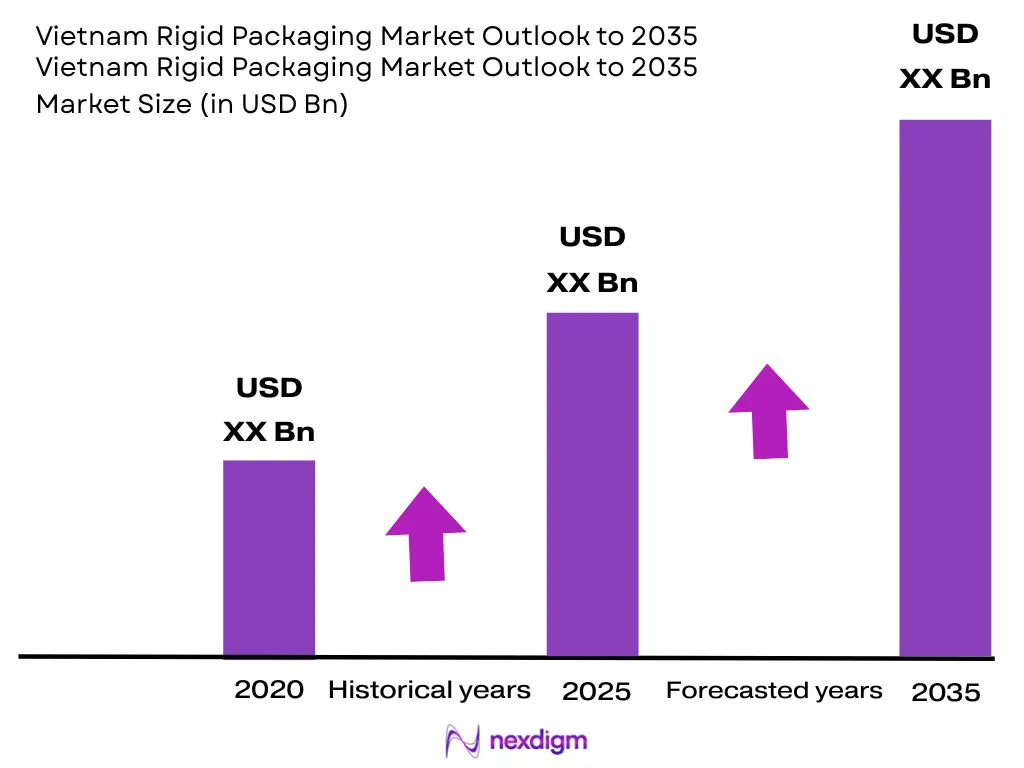
The Vietnam Rigid Packaging Market was valued at USD ~ Billion in 2024 and is anticipated to expand at a CAGR of ~% during 2026-2035. The market is primarily driven by Vietnam’s booming food and beverage and tourism sectors, rapid e-commerce growth, and continued expansion of export-oriented manufacturing supported by strong foreign direct investment inflows. According to industry estimates, the Vietnam rigid plastic packaging market reached approximately 0.78 million metric tons in 2024 and is projected to grow to approximately 0.95 million metric tons by 2030, registering a CAGR of approximately 3.32% by volume, while value-based estimates project growth at a CAGR of approximately 10.17% through 2033. As reported by Vietnam’s General Statistics Office, the country’s GDP reached approximately USD 430 billion in 2023, achieving a growth rate of approximately 5.05%, positioning Vietnam as the fifth largest economy within ASEAN and reinforcing sustained demand for rigid packaging across the country’s rapidly expanding food processing, personal care, and industrial manufacturing sectors.
Market Segmentation
By Material
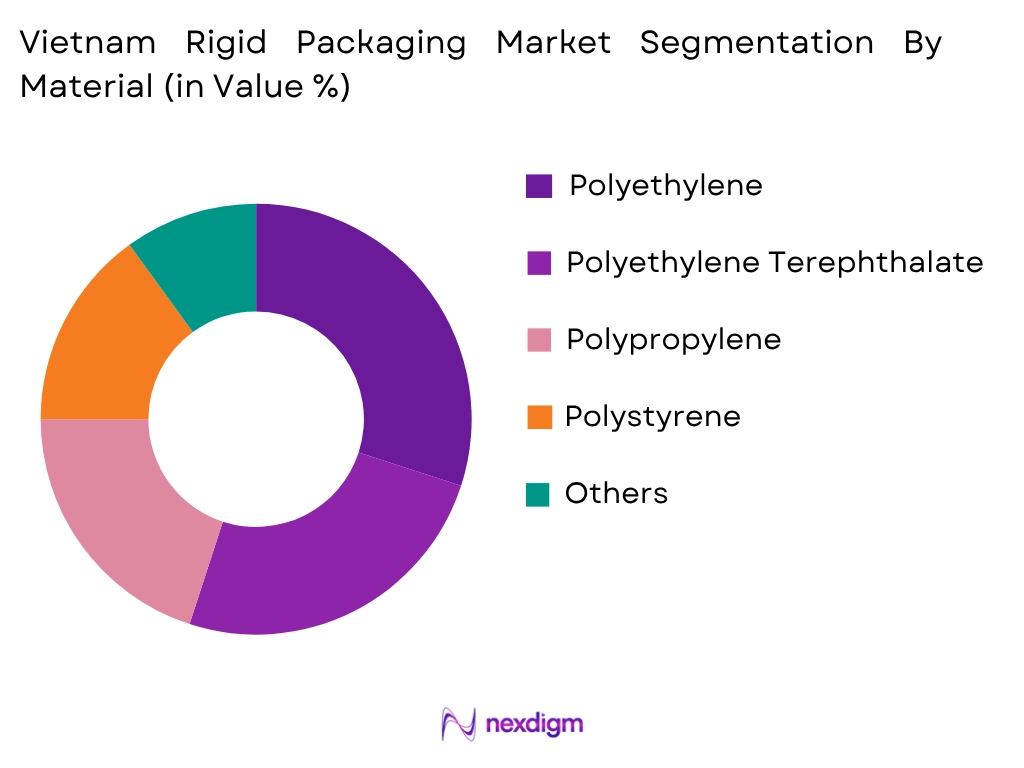
Among these, Polyethylene (PE) holds the largest revenue share of the Vietnam Rigid Packaging Market, attributable to its versatility, cost-effectiveness, and extensive application across both consumer and industrial packaging segments. Polyethylene Terephthalate (PET) is emerging as the fastest-growing material segment, supported by its widespread use in beverage bottles and its favorable recyclability profile, with companies such as ALPLA unveiling a recyclable PET wine bottle in May 2024, reflecting the broader industry shift toward sustainable PET packaging solutions. Polypropylene (PP) continues to see steady demand given its heat-resistance profile, which secures growth in hot-fill applications for sauces, condiments, and ready-to-eat food products even as resin price uncertainty leads converters to hedge procurement strategies. Vietnam’s intrinsic availability of a diverse range of plastic packaging products continues to fortify market dynamics, offering food, beverage, and personal care manufacturers varied material solutions across the country’s expanding range of end-use applications.
By Product Type
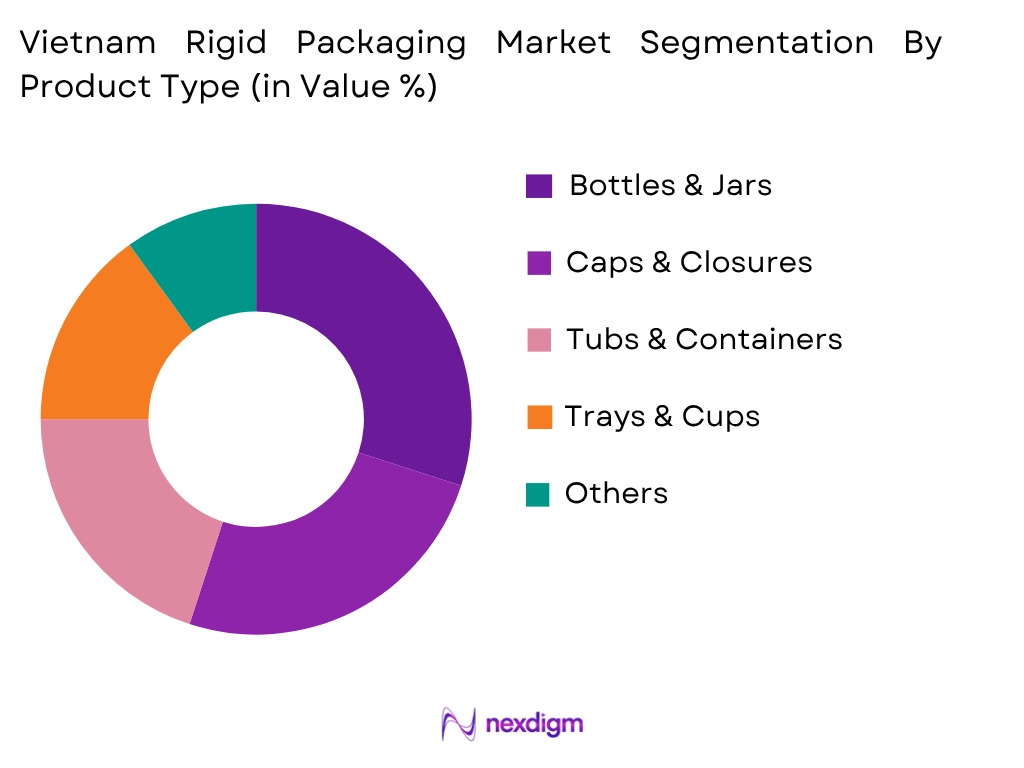
The Bottles & Jars segment holds a leading share of the Vietnam Rigid Packaging Market, driven by universal use across dairy products, bottled water, beverages, and over-the-counter pharmaceutical products. Trays & Containers continue to expand rapidly as rice, snack, and ready-to-eat food portfolios increasingly rely on barrier trays that extend shelf life under Vietnam’s humid tropical conditions, supported by rising demand for convenient and shelf-stable packaged goods across the country’s rapidly expanding quick-service restaurant and food processing industries. Caps & Closures represent a technically sophisticated segment, with global specialists such as Bericap maintaining strong positions supplying beverage and food manufacturers across the country. The growth of e-commerce and associated rise in online grocery delivery, supported by Vietnam’s online retail market reaching approximately USD 32 billion in 2024, continue to increase demand for durable and protective rigid packaging solutions capable of withstanding last-mile delivery across the country’s expanding logistics networks.
Competitive Landscape
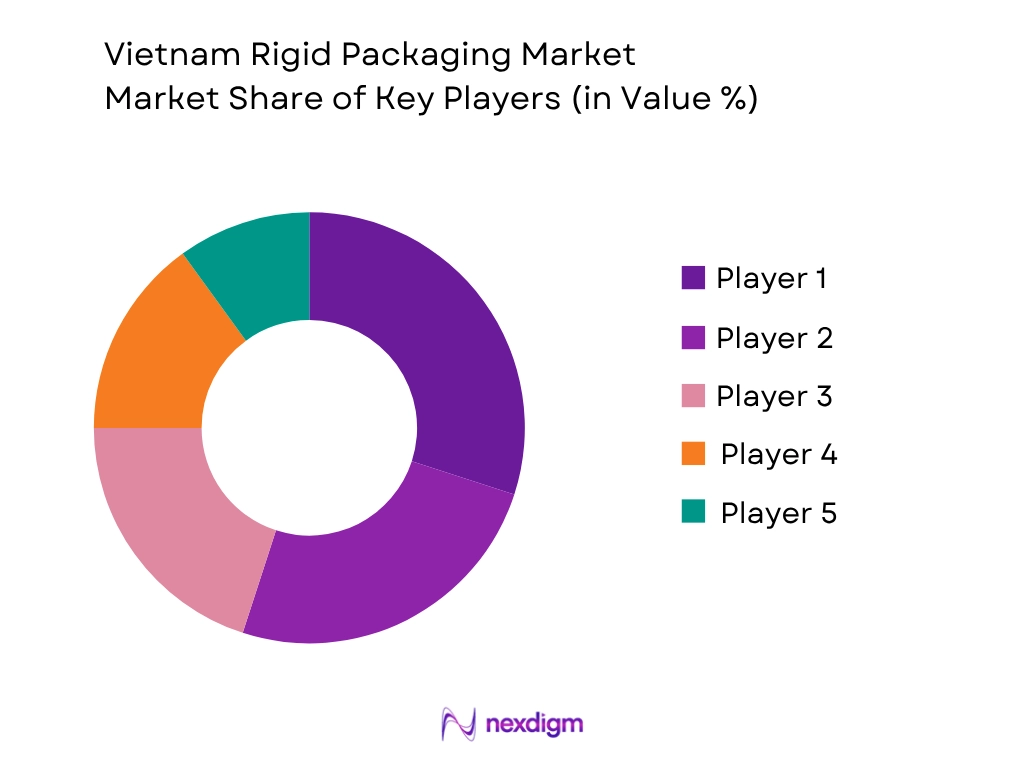
The Vietnam Rigid Packaging Market is moderately fragmented, comprising established domestic manufacturers alongside multinational packaging companies with local production facilities serving both domestic consumption and export-oriented manufacturing. Competition is primarily based on cost efficiency, design customization capability, regulatory compliance, sustainability credentials, and manufacturing scale. Duy Tan Plastics Corporation, one of Vietnam’s largest and most established domestic rigid plastic packaging manufacturers, maintains a strong position across the food, beverage, and household product sectors, while multinational players including ALPLA, Indorama Ventures, Bericap, and Taiwan Hon Chuan continue to expand their Vietnam manufacturing footprint to serve both the domestic market and the country’s growing export-oriented FDI sector, which generated approximately USD 290.9 billion in exports during 2024. Companies are increasingly investing in recycled content capability, lightweight design, and automated manufacturing processes to meet both evolving environmental regulations and the technical requirements of Vietnam’s expanding food, beverage, and pharmaceutical manufacturing base.
| Company | Established | Headquarters | Primary Product Portfolio | Rigid Packaging Portfolio | Manufacturing Presence | Major End-Use Industries | Key Strategic Focus | Certifications & Compliance |
| Duy Tan Plastics Corporation | 1987 | ~
|
~ | ~ | ~ | ~ | ~ | ~ |
| ALPLA Werke Alwin Lehner GmbH & Co KG | 1955 | ~
|
~ | ~ | ~ | ~ | ~ | ~ |
| Indorama Ventures Public Company Limited | 1994 | ~
|
~ | ~ | ~ | ~ | ~ | ~ |
| Bericap Holding GmbH | 1987 | ~ | ~ | ~ | ~ | ~ | ~ | ~ |
| Taiwan Hon Chuan Enterprise Co., Ltd. | 1974 | ~
|
~ | ~ | ~ | ~ | ~ | ~ |
Vietnam Rigid Packaging Market Analysis
Growth Drivers
Booming Food & Beverage and Tourism Sectors Driving Consumption
The Vietnam Rigid Packaging Market is experiencing sustained growth driven by the country’s booming food and beverage sector and flourishing tourism industry. According to the United States Department of Agriculture, a rising urban populace continues to propel Vietnam’s food processing industry, supported by an expanding middle-income demographic and a flourishing tourism sector that directly fuels food and beverage industry expansion. The food and beverage sector, particularly within the rapidly expanding quick-service restaurant and food processing industries, remains a significant catalyst for rigid packaging demand, driven by increasing consumer demand for convenient and shelf-stable packaged goods across healthcare, cosmetics, and industrial applications. Vietnam’s rapid economic development, coupled with its growing population and increasing urbanization, serves as a fundamental demand driver for rigid packaging, with the expanding middle class fueling consumption of packaged and convenience products across the country’s rapidly modernizing retail landscape.
Rapid E-Commerce Growth and Export-Oriented Manufacturing Expansion
The continued growth of e-commerce and Vietnam’s position as a major export-oriented manufacturing hub remain critical drivers for the rigid packaging market. Vietnam’s online retail market reached approximately USD 32 billion in 2024, with the proliferation of e-commerce and subsequent surge in online retail activities directly increasing demand for durable and protective rigid packaging solutions capable of withstanding last-mile delivery. Simultaneously, Vietnam’s foreign direct investment sector generated approximately USD 290.9 billion in exports during 2024, reflecting the country’s growing integration into global manufacturing supply chains and creating sustained demand for export-compliant rigid packaging across food, personal care, and industrial goods categories. Technological advancements in manufacturing processes, including improved durability, cost-effectiveness, and aesthetic appeal, continue to bolster market growth as domestic and multinational manufacturers invest in expanded production capacity to serve both Vietnam’s growing domestic consumption and its expanding role as a regional export manufacturing base.
Market Challenges
Environmental Regulations and Rising Consumer Concerns Over Plastic Waste
The Vietnam Rigid Packaging Market faces significant challenges from growing environmental concerns related to plastic waste, alongside stricter government regulations under the Law on Environmental Protection 2020 and its associated Extended Producer Responsibility framework. Companies must navigate evolving compliance requirements around recycled content, packaging registration, and reporting obligations administered by the Ministry of Natural Resources and Environment, creating administrative complexity particularly for smaller domestic converters with limited compliance resources. Rising consumer resistance to single-use plastics and growing regulatory scrutiny of plastic packaging waste continue to pressure manufacturers to reformulate existing rigid plastic products with recycled content or alternative materials, while Vietnam’s fragmented domestic recycling infrastructure makes it difficult for converters to consistently source sufficient volumes of high-quality recycled resin to meet both regulatory obligations and brand owner sustainability commitments.
Raw Material Price Volatility and Import Dependency for Specialty Resins
The Vietnam Rigid Packaging Market remains exposed to significant raw material price volatility, with fluctuating global petrochemical prices directly affecting virgin resin costs for polyethylene, polypropylene, and PET production. PP’s heat-resistance profile secures growth in hot-fill applications even as resin price uncertainty leads converters to hedge procurement strategies, reflecting the broader industry challenge of managing input cost volatility across the rigid packaging value chain. Vietnam’s continued dependence on imported specialty resins and high-barrier materials for premium food, pharmaceutical, and personal care applications creates additional currency exposure and supply chain complexity, particularly given the country’s growing role as an export manufacturing hub requiring internationally compliant packaging materials. These combined pressures require rigid packaging manufacturers to maintain diversified sourcing strategies and adequate inventory buffers to manage cost and availability fluctuations across the value chain.
Market Opportunities
Growth in Recyclable and Bio-Based Rigid Packaging Materials
Vietnam’s evolving regulatory environment and shifting consumer preferences present substantial opportunities for companies investing in recyclable and bio-based rigid packaging innovation. Sustainability initiatives are increasingly shaping the rigid packaging landscape as manufacturers focus on lightweight and recyclable materials to reduce carbon footprint, exemplified by ALPLA’s May 2024 launch of a recyclable PET wine bottle demonstrating the broader industry shift toward sustainable material innovation. Companies developing high-recycled-content bottles and containers, lightweight neck finishes that reduce resin usage per unit, and certified bio-based alternatives are well positioned to capture growing demand from food, beverage, and personal care brand owners seeking to meet both regulatory compliance requirements and evolving consumer sustainability expectations. As Vietnam continues to strengthen its domestic recycling ecosystem and circular packaging systems, opportunities continue to open up for both domestic manufacturers and multinational suppliers with proven sustainable material technology.
Expansion of Domestic Manufacturing Capacity to Serve Regional Export Markets
Vietnam’s growing strategic importance as a burgeoning Southeast Asian manufacturing economy presents substantial opportunities for companies expanding domestic rigid packaging production capacity to serve both local consumption and regional export markets. Domestic manufacturing continues to expand production capacity, with local manufacturers increasingly investing in automation capabilities to meet growing demand and compete at a global level. Advanced resin formulations and new engineering designs have produced lighter-weight rigid packaging products and tailored solutions that no longer sacrifice product integrity, creating opportunities for companies to differentiate through technical innovation. As Vietnam’s FDI-driven export sector continues to expand, generating approximately USD 290.9 billion in exports during 2024, companies with integrated manufacturing capabilities and strong export compliance credentials are well positioned to capture growing demand from both domestic brand owners and multinational companies seeking cost-competitive, technically sophisticated rigid packaging manufacturing within the region.
Future Outlook
The Vietnam Rigid Packaging Market is expected to witness steady expansion over the forecast period, supported by continued growth in food and beverage consumption, sustained e-commerce and export manufacturing expansion, and rising demand for recyclable and sustainable rigid packaging formats. Continued investment in domestic manufacturing capacity, automation, and recycled content technology is expected to further strengthen the market’s competitive positioning within the broader Southeast Asian region. Growing regulatory emphasis on Extended Producer Responsibility and plastic waste reduction will continue to accelerate the shift toward recyclable and lightweight rigid packaging formats through 2035.
Major Players
- Duy Tan Plastics Corporation
- ALPLA Werke Alwin Lehner GmbH & Co KG
- Indorama Ventures Public Company Limited
- Bericap Holding GmbH
- Taiwan Hon Chuan Enterprise Co., Ltd.
- Tetra Pak Vietnam
- Berry Global Inc.
- Amcor plc
- Reliance Industries Limited
- SABIC Innovative Plastics
- Jindal Poly Films Limited
- Rang Dong Plastic JSC
- Tan Phu Plastic Packaging JSC
- An Phat Holdings JSC
- Vietnam Southern Packaging Corporation
Key Target Audience
- Rigid Packaging Manufacturers
- Food & Beverage Processing Companies
- Pharmaceutical and Healthcare Companies
- Personal Care and Household Product Manufacturers
- E-Commerce and Retail Brands
- Investment and Venture Capitalist Firms
- Government and Regulatory Bodies (Ministry of Natural Resources and Environment (MONRE), Ministry of Health (MoH), Ministry of Industry and Trade)
- Recycling and Waste Management Infrastructure Providers
Research Methodology
Step 1: Identification of Key Variables
The research process begins with identifying the complete ecosystem of the Vietnam Rigid Packaging Market, including raw material suppliers, packaging manufacturers, converters, food and pharmaceutical processors, retailers, and regulatory authorities. Extensive secondary research is conducted using company annual reports, government publications, trade associations, customs statistics, industry journals, and proprietary databases to determine the variables influencing market demand, pricing, production, consumption, and technological developments.
Step 2: Market Analysis and Construction
Historical market information is collected and analyzed to estimate market size, import-export activity, application-wise demand, and pricing trends. A combination of top-down and bottom-up approaches is used to estimate market revenues and validate segment-level performance. Consumption patterns across food and beverage, pharmaceuticals, personal care, and industrial applications are evaluated to establish an accurate representation of the industry.
Step 3: Hypothesis Validation and Expert Consultation
The preliminary findings are validated through Computer-Assisted Telephone Interviews (CATIs) and structured discussions with packaging manufacturers, procurement managers, food technologists, regulatory experts, and senior executives operating within Vietnam’s rigid packaging industry. These interviews help verify market assumptions, competitive developments, technology adoption trends, pricing dynamics, and future investment opportunities while refining the overall market estimates.
Step 4: Research Synthesis and Final Output
The final stage integrates insights obtained from primary interviews with quantitative information collected through secondary sources. Data triangulation techniques are applied to reconcile differences between supply-side and demand-side estimates, ensuring robust market forecasting. The report is then reviewed through multiple quality assurance checkpoints to deliver a comprehensive analysis covering market size, segmentation, competitive landscape, future outlook, and strategic recommendations for industry stakeholders.

- Executive Summary
- Research Methodology (Market Definitions and Assumptions, Abbreviations, Market Sizing Approach, Top-Down Analysis, Bottom-Up Analysis, Demand-Side Assessment, Supply-Side Assessment, Primary Industry Interviews, Secondary Research Validation, Data Triangulation, Forecasting Framework, Limitations and Future Conclusions)

- Definition and Scope
- Market Evolution and Industry Genesis
- Timeline of Major Industry Developments
- Rigid Packaging Industry Value Chain Analysis
- Supply Chain Analysis

- Growth Drivers (Booming Food & Beverage and Tourism Sectors, Rapid E-Commerce Growth, Export-Oriented Manufacturing Expansion, Rising Urbanization and Middle-Class Consumption, Growth in Pharmaceutical and Personal Care Demand, Technological Advancements in Manufacturing Processes)
- Market Challenges (Environmental Regulations and Plastic Waste Concerns, Raw Material Price Volatility, Import Dependency for Specialty Resins, Competition from Flexible Packaging Formats, Fragmented Domestic Recycling Infrastructure, Rising Compliance Costs Under EPR)
- Market Opportunities (Growth in Recyclable and Bio-Based Rigid Packaging Materials, Expansion of Domestic Manufacturing Capacity for Export Markets, Investment in Automation and Lightweighting Technologies, Premium and Direct-to-Consumer Packaging Growth, Regional Manufacturing Hub Expansion, Sustainable Closure and Cap Innovation)
- Market Trends (Shift Toward Recycled PET Packaging, Growth in Lightweight Bottle and Closure Design, Rise of Barrier Trays for Ready-to-Eat Foods, Domestic Manufacturing Capacity Expansion, Adoption of Automation in Molding Processes, Premiumization of Beverage Packaging)
- Government Regulations (Law on Environmental Protection 2020 and Extended Producer Responsibility (EPR) Requirements, Ministry of Natural Resources and Environment (MONRE) Regulations, Ministry of Health (MoH) Food-Contact Packaging Requirements, National Technical Regulations (QCVN) on Food Packaging Materials, Draft Cosmetics and Consumer Goods Packaging Decree)
- Import and Export Analysis (Trade Volume, Major Import Sources, Export Destinations, HS Code Analysis, Trade Balance)
- Raw Material Availability Analysis (Virgin and Recycled Polymers, PET Resin Feedstocks, Aluminium and Steel, Bio-Based Feedstocks, Specialty Barrier Materials)
- Technology Landscape (Injection and Blow Molding Technologies, Thermoforming Technologies, Lightweight Neck Finish Design, Recycled Resin Processing, Automated Quality Inspection Systems)
- Sustainability Assessment (Recycled Content Utilization, Recyclability and Mono-Material Design, Carbon Footprint Reduction, Circular Economy Integration, Bio-Based Material Development)
- PESTLE Analysis
- SWOT Analysis
- Porter’s Five Forces Analysis
- Stakeholder Ecosystem
- Competition Ecosystem

- By Market Value (2020-2025)
- By Volume Consumption (2020-2025)
- By Average Selling Price (2020-2025)

- By Material (In Value %)
Polyethylene (PE)
Polypropylene (PP)
Polyethylene Terephthalate (PET)
Polystyrene (PS)
Others - By Product Type (In Value %)
Bottles & Jars
Cans
Trays & Containers
Caps & Closures
Others - By Application (In Value %)
Food & Beverages
Pharmaceuticals & Healthcare
Personal & Household Care
Industrial Packaging
Others - By End User (In Value %)
Food & Beverage Manufacturers
Pharmaceutical Companies
Personal Care Companies
Industrial Goods Manufacturers
E-Commerce & Retail Brands - By Region (In Value %)
Ho Chi Minh City
Hanoi
Da Nang
Other Provinces

- Market Share of Major Players (By Value, Volume, Material Type, Application Industry, Product Type)
- Cross Comparison Parameters (Recyclable Portfolio Breadth, Recycled Content Capability, Manufacturing Capacity, Application Technical Support Capability, Regulatory Compliance & Certifications, Food & Beverage Customer Base, Innovation & New Product Launch Frequency, Export Manufacturing Capability)
- SWOT Analysis of Major Players
- Pricing Analysis by Material Category and Format
- Production Capacity Analysis
- Manufacturing Footprint Analysis
- Distribution Network Analysis
- Innovation Benchmarking
- Detailed Profiles of Major Companies
Duy Tan Plastics Corporation
ALPLA Werke Alwin Lehner GmbH & Co KG
Indorama Ventures Public Company Limited
Bericap Holding GmbH
Taiwan Hon Chuan Enterprise Co., Ltd.
Tetra Pak Vietnam
Berry Global Inc.
Amcor plc
Reliance Industries Limited
SABIC Innovative Plastics
Jindal Poly Films Limited
Rang Dong Plastic JSC
Tan Phu Plastic Packaging JSC
An Phat Holdings JSC
Vietnam Southern Packaging Corporation

- Consumption Pattern Analysis (Order Volume, Batch Size, Product Category Penetration, Seasonal Demand, Reformulation Activity)
- Purchasing Criteria (Recyclability, Regulatory Compliance, Cost Efficiency, Shelf-Life Performance, Barrier Properties, Design Customization)
- Procurement and Supplier Selection Analysis
- Sustainable Packaging Adoption Assessment
- Premium vs Conventional Packaging Demand
- Product Attribute Preference Analysis (Recycled Content Percentage, Barrier Performance, Resealability, Shelf Appeal, Material Origin, Weight Efficiency)
- Consumer Sustainability and Convenience Expectations
- Pain Point Analysis
- Decision-Making Process

- By Market Value (2026-2035)
- By Volume Consumption (2026-2035)
- By Average Selling Price (2026-2035)


 Request a Sample
 Ask for Customization
 Get a Quote
 Enquire Now