

 Download PDF
Market Overview
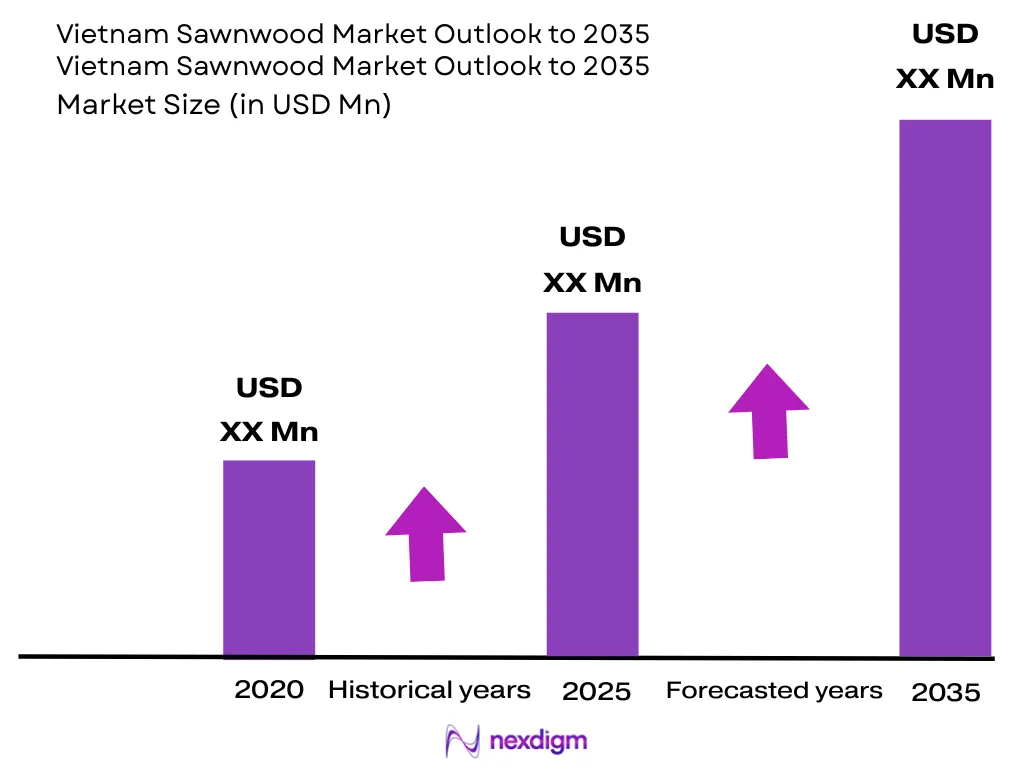
The Vietnam Sawnwood Market was valued at approximately USD ~ Million in 2024, underpinned by Vietnam’s emergence as one of the world’s most dynamic wood processing and furniture export economies. According to data published by the Food and Agriculture Organization, the Vietnam Administration of Forestry (VNFOREST), and the Vietnam Timber and Forest Products Association (VIFOREST), Vietnam has developed one of Southeast Asia’s most extensive plantation forestry programmes, with planted forest area exceeding 4.3 million hectares and domestic plantation timber, principally acacia and rubber wood, supplying the majority of raw material requirements for the country’s vast furniture manufacturing and wood processing industries. Vietnam has established itself as the world’s fifth-largest exporter of wood and wood products, with annual wood product export revenues consistently exceeding USD 14 billion, making timber processing and furniture manufacturing central pillars of the national industrial economy. The sawnwood market is primarily driven by the enormous and sustained demand from furniture manufacturers supplying export markets in the United States, European Union, Japan, South Korea, and Australia, alongside growing domestic construction sector requirements, increasing urbanisation, and rising middle-class consumer spending on wood-based interior products.
Market Segmentation
By Wood Species Type
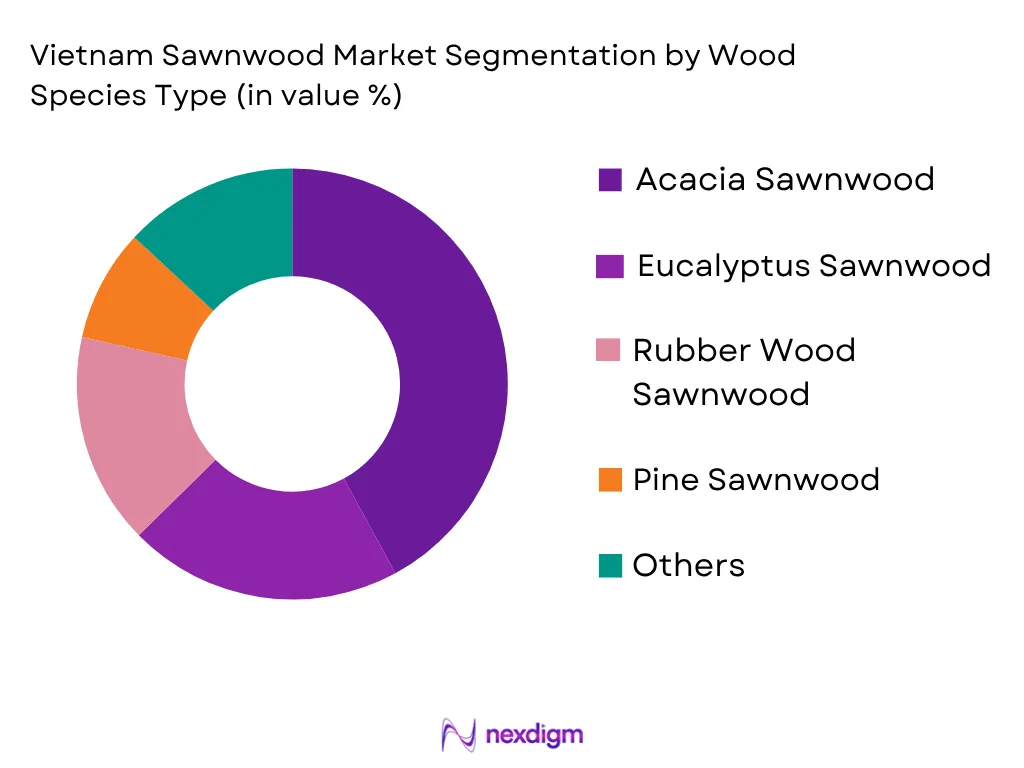
Vietnam Sawnwood Market is segmented by wood species type into Acacia Sawnwood, Rubber Wood Sawnwood, Eucalyptus Sawnwood, Pine Sawnwood, Tropical Hardwood Sawnwood, and Other Commercial Species. Acacia Sawnwood holds the dominant market share by volume, reflecting the central role of acacia plantation timber in supplying Vietnam’s wood processing industry. Vietnam has developed one of the most productive tropical plantation forestry programmes globally, with acacia hybrids and acacia mangium plantations covering millions of hectares across the Northern Midlands, Central Highlands, and Central Coast regions. Acacia timber is widely processed into sawnwood for furniture components, indoor flooring, MDF feedstock, and export lumber, with its relatively fast growth cycle of five to ten years making it an economically attractive plantation species for smallholder farmers and corporate plantation investors alike. The species benefits from favourable tropical growing conditions, high wood density relative to other fast-growing plantation species, and increasing acceptance in international furniture and construction markets as a certified sustainable alternative to slow-growing tropical hardwoods. Large-scale FSC-certified acacia plantation programmes managed by Vinafor, provincial forest companies, and private plantation investors have strengthened certified timber supply chains serving export-oriented furniture manufacturers. Continued expansion of acacia plantations under Vietnam’s National Target Programme on Sustainable Forestry Development is expected to consolidate the species’ dominant position in Vietnam’s sawnwood supply structure through the forecast period.
By End-Use Industry
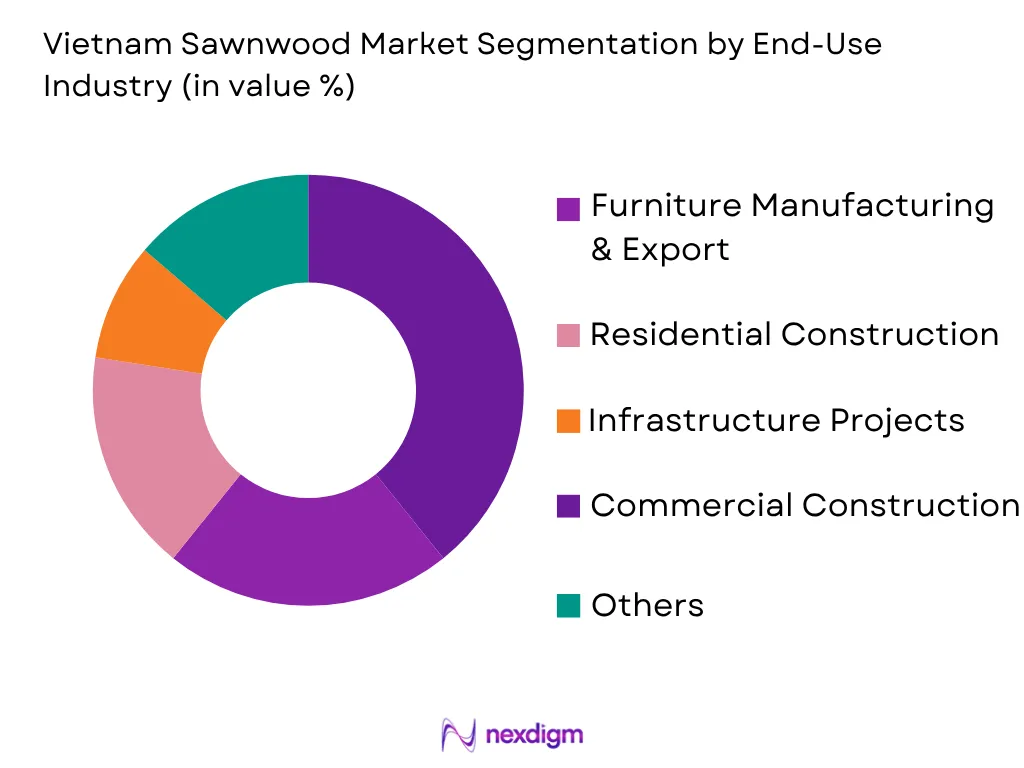
Vietnam Sawnwood Market is segmented by end-use industry into Furniture Manufacturing and Export, Residential Construction, Commercial Construction, Packaging & Pallets, Joinery & Interior Applications, and Industrial & Infrastructure Applications. Furniture Manufacturing and Export represents by far the largest end-use segment, reflecting Vietnam’s unique position as a global furniture export powerhouse whose wood processing industry is fundamentally oriented towards international market supply. The Binh Duong, Dong Nai, Ho Chi Minh City, and Binh Dinh furniture manufacturing clusters collectively process enormous volumes of acacia, rubber wood, pine, and imported hardwood sawnwood into finished and semi-finished furniture products destined for retail chains, e-commerce platforms, and interior specification projects across North America, Europe, and Asia-Pacific markets. Vietnam’s furniture export growth has been further accelerated by trade diversion effects following US-China trade tensions, which prompted American importers to diversify sourcing away from China and towards Vietnamese manufacturers. The organised furniture sector’s stringent quality, certification, and traceability requirements have driven progressive upgrades in sawnwood processing standards, kiln-drying adoption, and FSC chain-of-custody compliance throughout the domestic timber supply chain. Residential Construction represents the second-largest segment, supported by rapid urbanisation, government social housing programmes, and a growing middle-class consumer base investing in home improvement and renovation projects across major urban centres including Ho Chi Minh City, Hanoi, Da Nang, and Can Tho.
Competitive Landscape
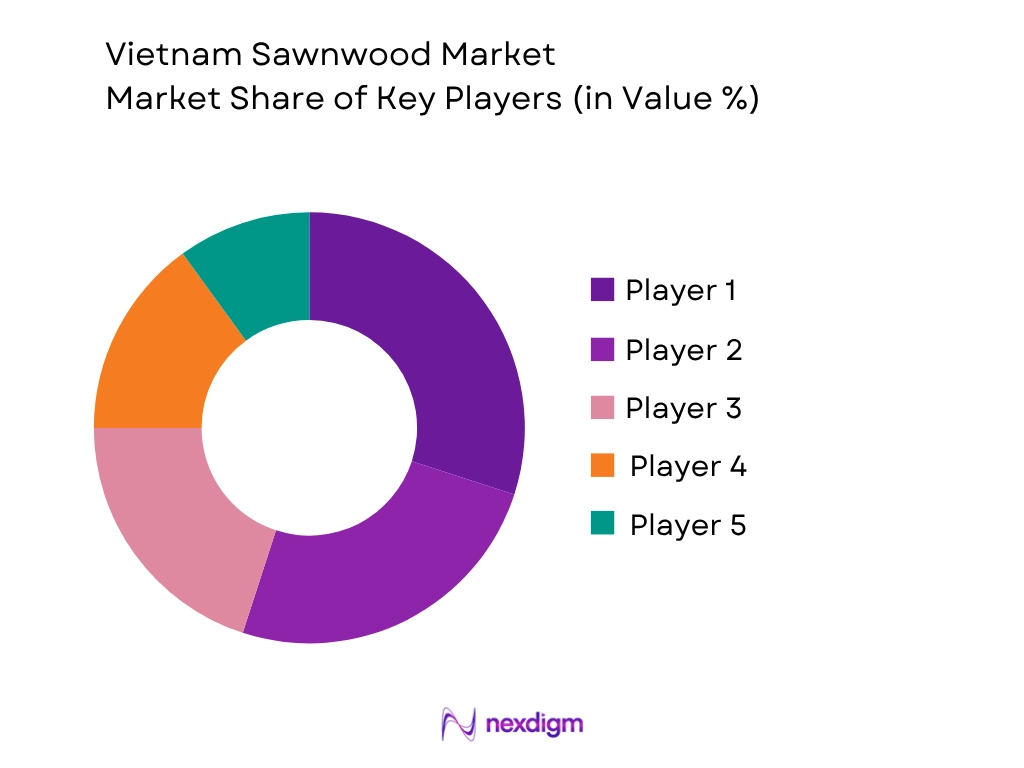
The Vietnam Sawnwood Market is moderately fragmented, with a combination of state-owned forestry corporations, large private wood processing and furniture manufacturing groups, provincial forest companies, and a large number of small and medium-sized sawmill operators concentrated in key furniture manufacturing provinces. The market’s structure is strongly shaped by the dominance of the furniture export industry, which acts as the primary demand anchor and quality standard-setter for upstream sawnwood supply chains. State-owned Vinafor and its affiliated provincial forest enterprises manage significant plantation assets and sawmill capacity, while private sector leaders such as Truong Thanh, An Cuong, and Scansia Pacific have built integrated wood processing operations serving both domestic and export markets. Companies with FSC chain-of-custody certification and documented timber legality compliance under Vietnam’s VNTLAS system are increasingly preferred by export-oriented furniture manufacturers seeking to satisfy EUDR, US Lacey Act, and UK Timber Regulation due diligence requirements.
| Company | Establishment Year | Headquarters | Plantation Assets | Sawmill Capacity | FSC/PEFC Certification | Export Presence | Product Portfolio | End-Use Focus |
| Vinafor (Vietnam National Forest Corporation) | 1995 | ~ | ~ | ~ | ~ | ~ | ~ | ~ |
| Scansia Pacific Co. Ltd. | 1994 | ~ | ~ | ~ | ~ | ~ | ~ | ~ |
| Truong Thanh Furniture Corporation | 1993 | ~ | ~ | ~ | ~ | ~ | ~ | ~ |
| An Cuong Wood Working Joint Stock Company | 1994 | ~ | ~ | ~ | ~ | ~ | ~ | ~ |
| Woodlands Joint Stock Company | 2005 | ~ | ~ | ~ | ~ | ~ | ~ | ~ |
Vietnam Sawnwood Market Analysis
Growth Drivers
Plantation Acacia Expansion and Domestic Timber Supply Growth
Vietnam’s sawnwood industry is strongly supported by one of Southeast Asia’s most extensive and productive plantation forestry programmes, centred on the rapid expansion of acacia hybrid and acacia mangium plantations that now represent the backbone of the country’s domestic timber supply. According to the Vietnam Administration of Forestry (VNFOREST) and the Ministry of Agriculture and Rural Development (MARD), Vietnam’s total planted forest area has grown consistently to exceed 4.3 million hectares, with plantation timber providing the majority of roundwood supply for the wood processing sector. The country plants millions of acacia seedlings annually across smallholder farmer plots, provincial forest company estates, and corporate plantation blocks in the Northern Midlands, Central Highlands, North Central Coast, and South Central Coast regions. Vietnam’s National Target Programme on Sustainable Forestry Development has set ambitious targets for plantation area expansion, forest quality improvement, and certification of commercially managed forests. According to VIFOREST, domestic timber supply from plantation sources has been growing steadily, progressively reducing Vietnam’s dependence on imported logs and sawnwood for lower-value wood processing applications. The rapid improvement of acacia clonal varieties, with enhanced wood density, straightness, and disease resistance developed by the Vietnamese Academy of Forest Sciences (VAFS), has further improved plantation productivity and sawnwood conversion yields. These supply-side investments create a strong and expanding raw material foundation for Vietnam’s sawnwood processing sector through the forecast period.
Furniture Export Industry Growth and Global Market Position
Vietnam’s position as a leading global furniture exporter is the defining structural driver of its sawnwood market, creating enormous and sustained demand for processed timber inputs across the country’s manufacturing provinces. Vietnam’s wood and wood product exports have grown from negligible volumes in the early 2000s to consistently exceeding USD 14 billion annually, making the sector one of the country’s top foreign exchange earners alongside electronics and garment manufacturing. The United States, Japan, China, South Korea, and the European Union represent the primary export destinations, with American buyers alone accounting for a substantial share of total wood product export value. The trade diversion effects of US-China tariff escalations from 2018 onwards significantly accelerated Vietnamese furniture export growth, as American retailers, importers, and interior designers redirected sourcing to Vietnamese manufacturers offering competitive pricing, product quality, and supply chain reliability. Vietnam’s established free trade agreement framework, including the EU-Vietnam Free Trade Agreement (EVFTA), the Comprehensive and Progressive Agreement for Trans-Pacific Partnership (CPTPP), and bilateral trade agreements with major markets, provides preferential market access that supports export competitiveness. The Vietnamese government’s targeted support for the wood processing sector through industrial zone development in Binh Duong, Binh Dinh, Dong Nai, and Long An, combined with foreign direct investment attraction policies, has deepened the manufacturing base and increased domestic sawnwood processing capacity and quality. Sustained growth in furniture export revenues directly underpins demand for certified, kiln-dried, and specification-grade acacia, rubber wood, pine, and imported hardwood sawnwood throughout the value chain.
Market Challenges
Timber Legality Compliance and EU Deforestation Regulation Requirements
Vietnam’s sawnwood and wood processing industry faces significant and growing compliance pressures arising from international timber legality regulations, most notably the EU Deforestation Regulation (EUDR), the US Lacey Act, and the UK Timber Regulation, all of which impose due diligence obligations on importers of wood products from Vietnam. These regulations require documented evidence that timber raw materials used in Vietnamese wood products do not originate from illegally harvested or deforestation-linked sources, including imported logs and sawnwood sourced from Cambodia, Laos, or other regional origins. Vietnam has made substantial progress in developing its Timber Legality Assurance System (VNTLAS) under the FLEGT Voluntary Partnership Agreement signed with the European Union, and implementing supplier declaration frameworks, timber origin verification procedures, and chain-of-custody documentation systems. However, the scale of Vietnam’s wood processing industry, the large number of small sawmill and furniture manufacturing operators, and historical reliance on informally sourced timber from regional markets create compliance gaps that represent ongoing risks for export market access. The EUDR’s requirements for geolocation-linked supply chain traceability down to the plot of land where timber was harvested represent a particularly demanding standard for Vietnamese processors working with plantation timber from thousands of smallholder farming households. Failure to achieve comprehensive compliance could restrict access to European markets and affect the competitiveness of Vietnamese wood products against suppliers from countries with cleaner certified supply chains. Investment in digital traceability systems, plantation certification, and industry-wide compliance capacity building is essential for protecting Vietnam’s market access position.
Import Dependency for Hardwood Species and Raw Material Cost Volatility
Despite the strength of its domestic plantation forestry sector, Vietnam’s wood processing industry remains significantly dependent on imported logs and sawnwood to supply the full range of species required by its diverse furniture and wood products manufacturing base. High-value furniture production requires species such as oak, ash, walnut, cherry, and tropical hardwoods that cannot be sourced from domestic plantations, necessitating imports from the United States, Europe, Africa, Chile, and New Zealand. According to VIFOREST and Vietnam Customs data, Vietnam consistently imports substantial volumes of logs and sawnwood annually, with import values fluctuating in response to international timber market conditions, exchange rate movements, and trade policy developments in supplying countries. The disruption to regional hardwood supply chains following Myanmar’s political crisis and subsequent timber export restrictions significantly affected Vietnamese processors that had historically relied on Myanmar teak and hardwood logs as a cost-effective regional source. Shifting global timber supply patterns, rising freight costs, and tightening sustainability requirements in supplying countries have increased raw material cost volatility for Vietnamese sawmills and furniture manufacturers. Exchange rate fluctuations between the Vietnamese dong and the US dollar, in which most timber imports are priced, create additional cost management challenges. Developing alternative certified supply relationships, improving domestic plantation species diversity, and investing in material efficiency technology are key priorities for reducing import dependency risk across the Vietnam sawnwood value chain.
Market Opportunities
EU Deforestation Regulation Compliance as Competitive Advantage
Vietnam’s advanced progress in implementing the FLEGT Voluntary Partnership Agreement and developing its Timber Legality Assurance System (VNTLAS) positions the country to leverage regulatory compliance as a competitive advantage in premium export markets increasingly demanding documented timber sustainability credentials. As the EUDR comes into full effect and imposes geolocation-based traceability requirements on wood product importers, Vietnamese producers with certified, documented plantation timber supply chains will be better positioned than competitors from countries with weaker forest governance systems. Vietnam’s investment in the VNTLAS platform, FSC and PEFC plantation certification programmes, and digital timber origin verification infrastructure creates a foundation for differentiated market positioning in European, Japanese, and American procurement channels where sustainability documentation is becoming a standard buyer requirement. The development of certified acacia plantation clusters in the Central Highlands, North Central Coast, and Northern Midlands regions, combined with verified chain-of-custody systems connecting plantation operators, sawmills, and furniture manufacturers, enables Vietnamese exporters to provide the supply chain transparency demanded by international retailers, specification architects, and institutional procurement frameworks. Countries that achieve credible EUDR compliance ahead of schedule will benefit from reduced regulatory friction, lower due diligence burdens for importing customers, and preferential positioning with environmentally focused buyers. Vietnam’s proactive engagement with the EU FLEGT process and ongoing VNTLAS implementation represents a strategic compliance investment that should yield tangible competitive and market access benefits through the forecast period.
Domestic Construction Market Growth and Value-Added Processing Expansion
Vietnam’s rapidly expanding domestic construction market and the opportunity to develop higher-value sawnwood processing capabilities present significant growth opportunities for sawnwood producers and processors beyond the furniture export sector. Vietnam’s urbanisation rate continues to accelerate, with the urban population projected to grow substantially through 2035 as rural-to-urban migration, new city development, and industrial zone expansion drive demand for residential, commercial, and infrastructure construction across all regions. Government social housing programmes, new urban development projects along the Ho Chi Minh City-Hanoi economic corridor, and the rapid expansion of industrial parks and logistics facilities generate growing demand for construction-grade sawnwood in formwork, structural framing, interior fitting, and infrastructure applications. Rising middle-class household incomes and homeownership aspirations are supporting growth in home renovation, interior design, and premium residential construction markets that demand higher-quality appearance-grade and certified sawnwood products. The development of domestic mass timber structural applications, including cross-laminated timber panels and engineered wood structural systems, represents an emerging opportunity for Vietnamese sawnwood producers capable of supplying consistent, high-quality, kiln-dried lamstock from certified plantation sources. Investment in precision sawing technology, continuous kiln systems, structural grading automation, and engineered wood manufacturing capabilities would enable Vietnamese processors to diversify revenue streams, reduce over-dependence on furniture export market cycles, and capture growing value from the country’s expanding domestic construction sector through the forecast period.
Future Outlook
The Vietnam Sawnwood Market is expected to witness sustained and robust growth over the forecast period, anchored by the continued expansion of the country’s globally significant furniture export industry, progressive growth in domestic plantation timber supply from acacia and rubber wood sources, and a rapidly expanding domestic construction market driven by urbanisation and government infrastructure investment. Vietnam’s ongoing implementation of the FLEGT VPA and VNTLAS timber legality framework is anticipated to progressively improve supply chain traceability, expand certified timber volumes, and strengthen export market access across premium regulatory environments in the European Union, United Kingdom, and United States. Expansion of FSC-certified plantation acacia programmes, investment in sawmill modernisation and kiln-drying infrastructure, and growing adoption of digital timber traceability platforms are expected to improve processing quality, reduce raw material waste, and enhance competitiveness of Vietnamese sawnwood products in international supply chains. Domestic construction demand growth, rising per-capita wood consumption among Vietnam’s expanding middle class, and government housing delivery programmes will provide additional demand diversification beyond the furniture manufacturing sector. The development of value-added processing capabilities, including engineered wood production and mass timber structural systems from domestically grown plantation timber, is anticipated to open new market segments and revenue streams for sawnwood industry participants through 2035.
Major Players
- Vinafor (Vietnam National Forest Corporation)
- Scansia Pacific Co. Ltd.
- Truong Thanh Furniture Corporation
- An Cuong Wood Working Joint Stock Company
- Woodlands Joint Stock Company
- AA Corporation (AA Wood)
- Minh Duong Furniture Corporation
- Savimex Corporation
- Pisico Binh Dinh Corporation
- Tan Viet Phat Wood Industry
- Hoang Anh Gia Lai Timber
- Vietnam Rubber Group (VRG) Wood Division
- Dai Thanh Furniture Joint Stock Company
- Nam Viet Corporation
- GDT Joint Stock Company
Key Target Audience
- Forestry and Timber Plantation Companies
- Sawmill Operators and Wood Processing Enterprises
- Furniture Manufacturing and Export Companies
- Residential and Commercial Construction Companies
- Building Material Distributors and Timber Traders
- Investments and Venture Capitalist Firms
- Government and Regulatory Bodies (Vietnam Administration of Forestry (VNFOREST), Ministry of Agriculture and Rural Development (MARD), Ministry of Natural Resources and Environment (MONRE), Vietnam Timber and Forest Products Association (VIFOREST))
- Timber Importers, Exporters and International Timber Trading Organisations
Research Methodology
Step 1: Identification of Key Variables
The initial phase involves constructing an ecosystem map covering plantation forestry operators, state forest corporations, sawmills, timber importers, furniture manufacturers, timber traders, and construction companies operating within the Vietnam Sawnwood Market. Extensive secondary research is conducted using industry associations, trade databases, forestry reports, and government publications including data from VNFOREST, VIFOREST, the Ministry of Agriculture and Rural Development (MARD), Vietnam Customs, and the General Statistics Office of Vietnam (GSO) to identify variables influencing market demand and supply across Vietnam’s export-oriented wood processing economy.
Step 2: Market Analysis and Construction
This phase focuses on gathering historical information relating to plantation timber harvesting volumes, sawnwood production, domestic consumption, furniture export performance, import volumes, pricing trends, and end-use demand. Market revenues are estimated using a combination of production volumes, average selling prices, and trade flow assessments while validating relationships between upstream plantation supply, sawmill processing capacity, and downstream furniture export demand.
Step 3: Hypothesis Validation and Expert Consultation
Market assumptions are validated through structured interviews with forestry plantation managers, sawmill operators, furniture export company executives, timber importers, VIFOREST representatives, and industry specialists. These consultations provide operational insights regarding plantation timber availability, sawmill capacity utilisation, export order trends, species procurement dynamics, certification compliance progress, and regulatory developments affecting Vietnam’s wood processing industry, ensuring greater accuracy of market estimates.
Step 4: Research Synthesis and Final Output
The final stage integrates findings from primary and secondary research to develop market forecasts, segmentation analysis, competitive benchmarking, and strategic recommendations. Data triangulation techniques are applied to validate market estimates and generate a comprehensive assessment of the Vietnam Sawnwood Market while ensuring consistency across all segments, regions, and stakeholder perspectives within this rapidly evolving and globally significant wood processing economy.

- Executive Summary
- Research Methodology (Market Definitions and Assumptions, Abbreviations, Market Sizing Approach, Top-Down Analysis, Bottom-Up Analysis, Demand-Side Assessment, Supply-Side Assessment, Primary Industry Interviews, Forestry Sector Validation Framework, Trade Flow Assessment, Data Triangulation, Forecasting Framework, Limitations and Future Conclusions)

- Definition and Scope
- Market Evolution and Industry Genesis
- Timeline of Major Industry Developments
- Forestry and Wood Processing Industry Ecosystem
- Sawnwood Value Chain Analysis

- Growth Drivers (Plantation Acacia Expansion, Furniture Export Industry Growth, Domestic Construction Activity, Foreign Direct Investment in Wood Processing, Rubber Wood Utilisation Increase)
- Market Challenges (Illegal Logging Regulations and Log Import Restrictions, Import Dependency for Hardwood Species, US and EU Trade Compliance Requirements, Sawmill Scale and Technology Constraints, Raw Material Cost Volatility)
- Market Opportunities (FSC-Certified Plantation Timber Expansion, EU Deforestation Regulation Compliance Advantage, Furniture Export Supply Chain Integration, Domestic Housing Market Growth, Sawmill Modernisation and Value-Added Processing)
- Market Trends (Acacia Plantation Timber Dominance, Rubber Wood Utilisation Growth, Kiln-Dried Lumber Adoption, Sawmill Automation, Sustainable Sourcing Compliance Investment)
- Government Regulations (Law on Forestry 2017, FLEGT Voluntary Partnership Agreement with EU, Timber Legality Assurance System (VNTLAS), Forest Protection and Development Fund, National Target Programme on Sustainable Forestry Development)
- SWOT Analysis
- Porter’s Five Forces Analysis
- PESTLE Analysis
- Stakeholder Ecosystem
- Competition Ecosystem

- By Market Value (2020-2025)
- By Volume (2020-2025)
- By Average Realized Price (2020-2025)

- By Wood Species Type (In Value %)
Acacia Sawnwood
Rubber Wood Sawnwood
Eucalyptus Sawnwood
Pine Sawnwood
Tropical Hardwood Sawnwood
Other Commercial Wood Species - By Product Form (In Value %)
Rough Sawn Lumber
Planed Sawnwood
Kiln-Dried Sawnwood
Treated Sawnwood
Structural Sawn Timber
Appearance Grade Lumber - By End-Use Industry (In Value %)
Furniture Manufacturing and Export
Residential Construction
Commercial Construction
Packaging and Pallets
Joinery and Interior Applications
Industrial and Infrastructure Applications - By Distribution Channel (In Value %)
Direct Sales to Furniture Manufacturers
Timber Traders and Wholesalers
Building Material Distributors
Retail Timber Yards
Export Trading Companies - By Region (In Value %)
Southeast Vietnam
Central Highlands
North Central and Central Coast
Red River Delta and Northern Vietnam
Mekong River Delta

- Market Share of Major Players (By Value, Production Volume, Export Volume, Sawmill Capacity)
- Cross Comparison Parameters (Annual Sawnwood Production Capacity, Plantation Area, Sawmill Recovery Rate, Kiln Drying Capacity, FSC/PEFC Certified Timber Share, Export Revenue Share, Number of Sawmill Facilities, Product Grade Portfolio)
- SWOT Analysis of Major Players
- Benchmarking Analysis of Major Players
- Pricing Analysis (By Species, Grade, Moisture Content, Thickness, Export vs Domestic Sales)
- Detailed Profiles of Major Companies
Vinafor (Vietnam National Forest Corporation)
Scansia Pacific Co. Ltd.
Truong Thanh Furniture Corporation
An Cuong Wood Working Joint Stock Company
Woodlands Joint Stock Company
AA Corporation (AA Wood)
Minh Duong Furniture Corporation
Savimex Corporation
Pisico Binh Dinh Corporation
Tan Viet Phat Wood Industry
Hoang Anh Gia Lai Timber
Vietnam Rubber Group (VRG) Wood Division
Dai Thanh Furniture Joint Stock Company
Nam Viet Corporation
GDT Joint Stock Company

- Consumption Pattern Assessment (Consumption Frequency, Product Mix, Industry Demand Share, Volume Utilisation, Seasonal Demand)
- Sawnwood Utilisation by Industry (Furniture Manufacturing Usage, Construction Sector Share, Packaging Consumption, Infrastructure Demand, Industrial Applications)
- Procurement and Sourcing Analysis (Contract Duration, Supplier Preference, Import Dependence, Procurement Volume, Lead Time Requirements)
- Buyer Preference Analysis (Species Preference, Grade Preference, Moisture Requirements, Certification Requirements, Delivery Expectations)
- Price Sensitivity Analysis (Price Elasticity, Grade-Based Pricing, Regional Price Variations, Volume Discounts, Export vs Domestic Pricing Trends)

- By Market Value (2026-2035)
- By Volume (2026-2035)
- By Average Realized Price (2026-2035)


 Request a Sample
 Ask for Customization
 Get a Quote
 Enquire Now