
 Download PDF
Market Overview
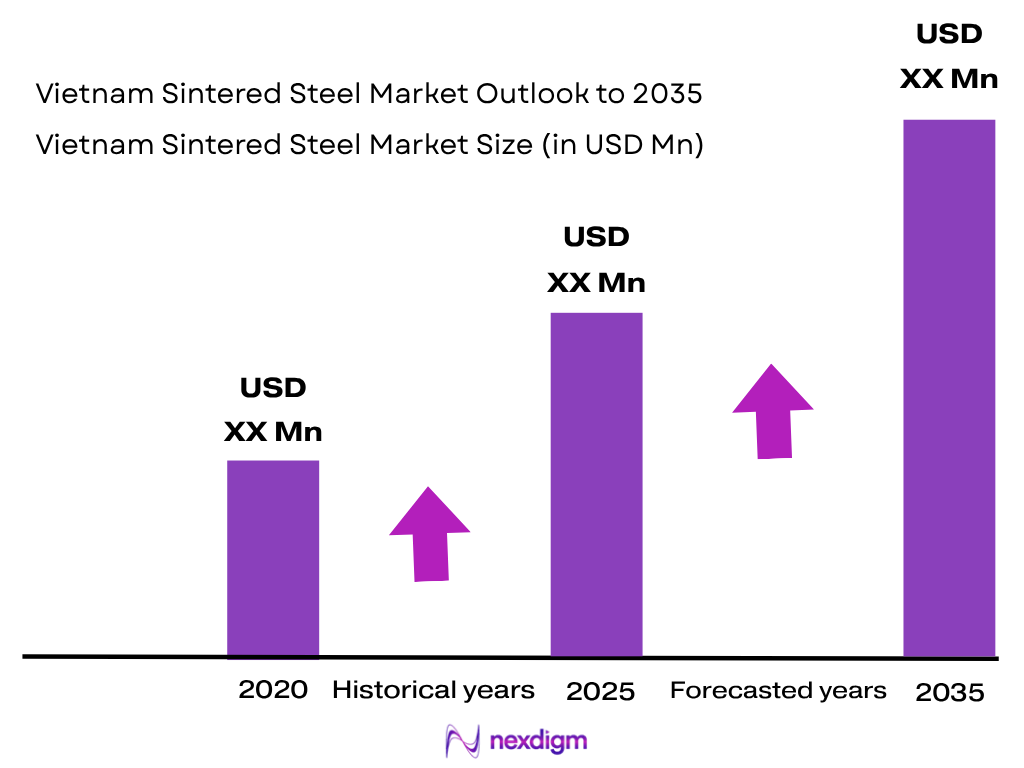
The Vietnam Sintered Steel Market is valued at ~USD XX million in 2024, with demand primarily linked to the country’s expanding automotive, motorcycle, electronics, machinery and precision-engineering manufacturing base. Vietnam’s industrial production index increased 8.4% in 2024, while manufacturing and processing increased 9.6%, according to the National Statistics Office. The country also recorded USD 405.53 billion in merchandise exports and USD 380.76 billion in imports, reinforcing its position as an export-oriented manufacturing hub.
The Vietnam Sintered Steel Market is concentrated around Ho Chi Minh City, Binh Duong, Dong Nai, Hanoi, Hai Phong and Bac Ninh, where automotive, electronics, machinery and supporting industries are clustered. Vietnam attracted USD 38.23 billion in foreign investment commitments, with processing and manufacturing receiving approximately USD 25.58 billion, according to the Ministry of Planning and Investment. Electronics and computer-component exports reached USD 72.6 billion, while machinery, equipment and parts exports reached USD 52.3 billion, creating substantial downstream demand for precision metal components.
Market Segmentation
By Product Type
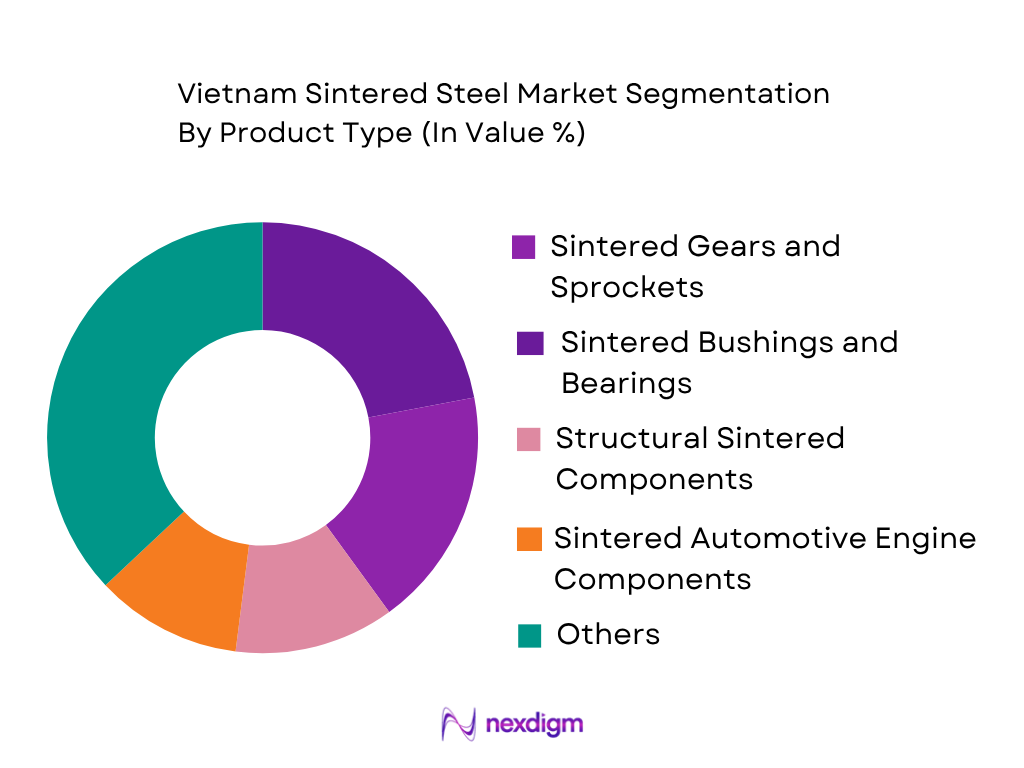
The Vietnam Sintered Steel Market is segmented by product type into sintered gears and sprockets, sintered bushings and bearings, structural sintered components, automotive engine components, transmission components, electrical and magnetic components, compressor components, pump components, motorcycle components and other precision sintered steel components. Sintered gears and sprockets are expected to represent the leading product category because Vietnam’s automotive and motorcycle manufacturing ecosystem requires high-volume precision components with repeatable geometry, controlled density and wear resistance. The country recorded 340,142 vehicle sales through VAMA members in 2024, while domestically produced and assembled vehicle sales reached 172,730 units. Vietnam’s broader machinery and industrial ecosystem also supports demand for gears, bushings and structural components. Electronics manufacturing provides an additional application channel, with electronics, computers and components generating USD 72.6 billion in exports. Sintered components are particularly suited to high-volume applications where near-net-shape production can reduce secondary machining. International powder-metallurgy suppliers also identify automotive, industrial equipment, compressors, robotics, e-bikes and electrical applications as established application
By End-Use Industry
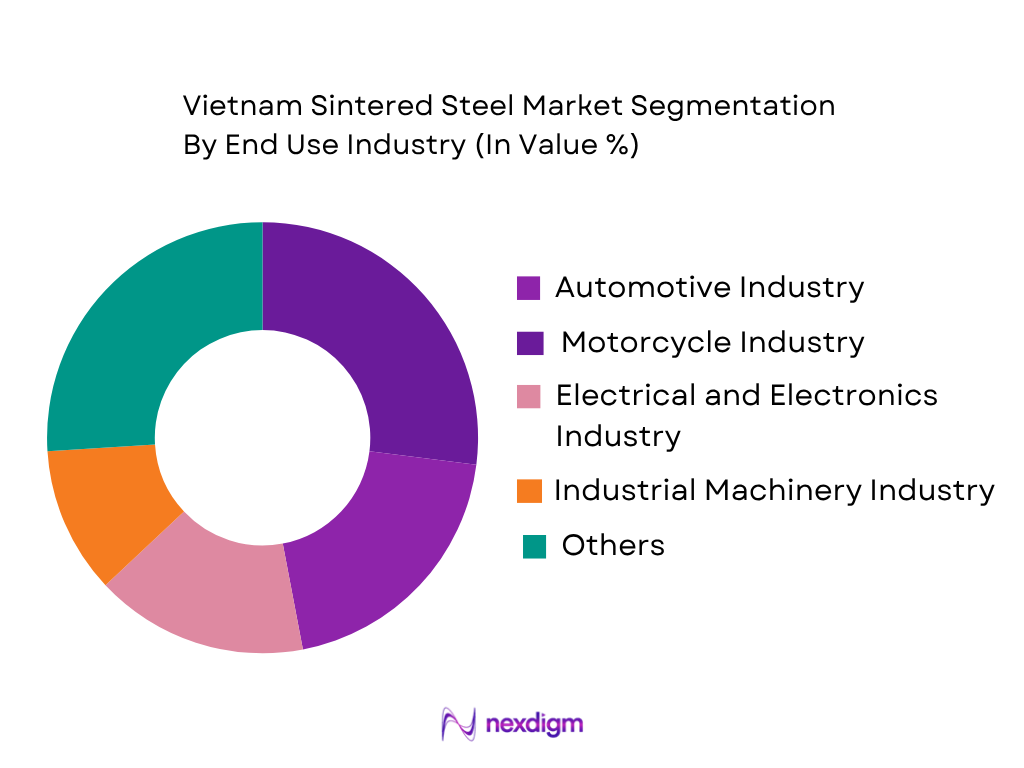
The Vietnam Sintered Steel Market is segmented by end-use industry into automotive, motorcycle, electrical and electronics, home appliances, industrial machinery, HVAC and refrigeration, power tools, consumer products manufacturing, precision engineering, and automation and robotics. Automotive Industry is expected to account for the leading demand because Vietnam is developing an integrated vehicle and supporting-component manufacturing ecosystem while attracting substantial foreign investment into processing and manufacturing. VAMA-member vehicle sales reached 340,142 units in 2024, an increase of 12.6% from the preceding year. Vietnam’s processing and manufacturing sector also attracted approximately USD 25.58 billion of foreign investment during the year. Electronics represents another important demand center, with electronics, computers and components generating USD 72.6 billion of exports. Sintered steel components can support vehicle gears, bushings, pump parts, structural components and other high-volume applications, while similar technologies are applicable to compressors, motors, industrial equipment and robotics.
Competitive Landscape
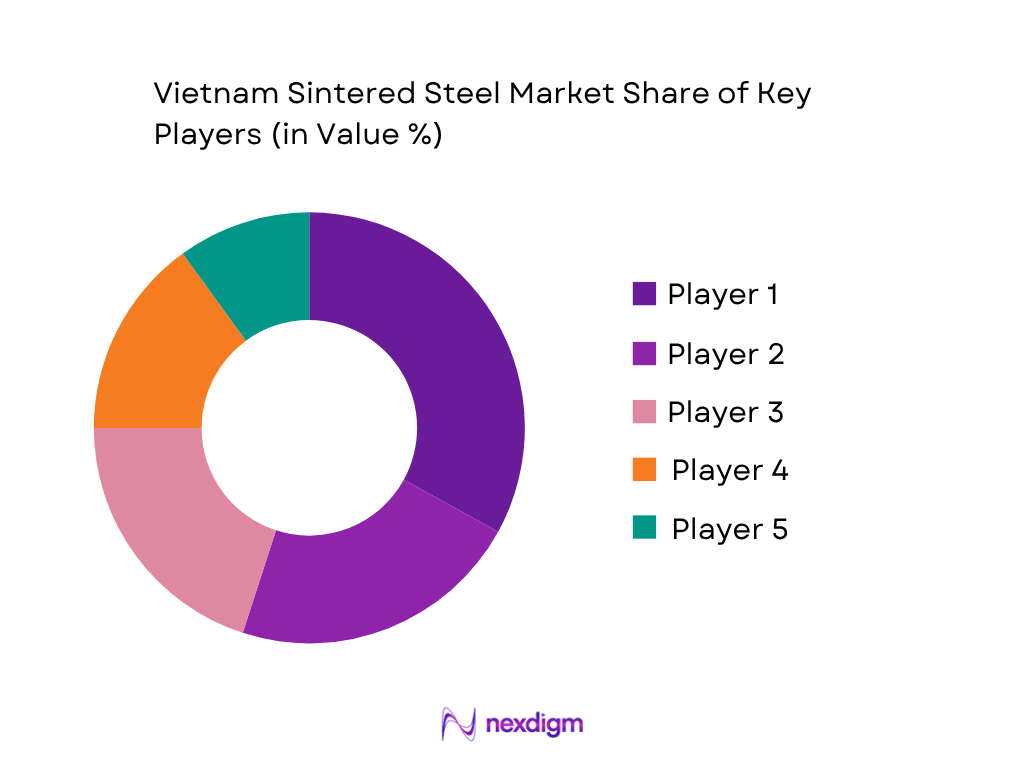
The Vietnam Sintered Steel Market comprises local powder-metallurgy manufacturers, international sintered-component producers and global metal-powder suppliers serving Vietnam’s automotive, electronics, industrial and machinery supply chains. Competitive differentiation is shaped by press-and-sinter capacity, material formulation, component complexity, dimensional control, secondary processing, automotive qualification, production localization and customer integration. PEACE-LON Vietnam manufactures oil-impregnated sintered bearings and mechanical components, including gears and pulleys, while its applications include automotive, home appliances and robotics. Global suppliers such as Höganäs, Miba and GKN Sinter Metals bring broader powder-metallurgy, material and engineering capabilities.
| Company | Establishment Year | Headquarters | Product Portfolio | Automotive Capability | Manufacturing Technology | Material Capability | Key Applications | Vietnam Presence |
| PEACE-LON Vietnam / Heiwa Sangyo | 1961 | Japan | ~ | ~ | ~ | ~ | ~ | ~ |
| GKN Sinter Metals | 1934 | Germany | ~ | ~ | ~ | ~ | ~ | ~ |
| Höganäs | 1797 | Sweden | ~ | ~ | ~ | ~ | ~ | ~ |
| Miba Sinter Group | 1927 | Austria | ~ | ~ | ~ | ~ | ~ | ~ |
| Sumitomo Electric Industries | 1897 | Japan | ~ | ~ | ~ | ~ | ~ | ~ |
Vietnam Sintered Steel Market Analysis
Growth Drivers
Expansion of Automotive and Motorcycle Component Manufacturing
Expansion of Vietnam’s automotive and motorcycle manufacturing ecosystem is creating a broader downstream requirement for precision metal components, including sintered gears, bushings, bearings, sprockets, rotors and structural parts. Vietnam’s manufacturing and processing sector recorded 9.6% growth in 2024, while the country’s total merchandise exports reached USD 405.53 billion, demonstrating the scale of its industrial and export-oriented production base. General Statistics Office of Vietnam The automotive supply chain is particularly relevant because Vietnam’s vehicle and component manufacturers increasingly operate within regional production networks. Transport equipment and spare-parts exports reached USD 15.1 billion, while machinery, equipment and spare-parts exports reached USD 52.3 billion. General Statistics Office of Vietnam Foreign investment further reinforces component-manufacturing demand: processing and manufacturing attracted nearly USD 25.58 billion of registered FDI, representing the largest sectoral destination of foreign investment. Ministry of Planning and Investment The country also had 42,002 valid FDI projects with registered capital of USD 502.8 billion accumulated by the end of 2024, highlighting the depth of its manufacturing ecosystem. Ministry of Planning and Investment For sintered-steel producers, this environment supports opportunities to supply high-volume, repeatable components to automotive and motorcycle manufacturers while reducing machining requirements. Increasing integration of Vietnamese suppliers into multinational production networks can further stimulate qualification of locally manufactured powder-metal components.
Growth of Electronics Manufacturing
Rapid expansion of electronics manufacturing is creating an important adjacent demand base for Vietnam’s sintered-steel industry, particularly for precision mechanical parts, magnetic components, miniature structural components, motor parts and components used in automation equipment. Electronics, computers and components generated USD 72.6 billion of exports in 2024, increasing by 26.6% from the previous year, while imports of the same category reached USD 107.1 billion. General Statistics Office of Vietnam The combined electronics trade therefore reached USD 179.7 billion, illustrating the substantial scale of Vietnam’s electronics manufacturing and assembly ecosystem. General Statistics Office of Vietnam Machinery, equipment and spare-parts exports also reached USD 52.3 billion, providing evidence of a broad industrial-equipment supply chain surrounding electronics production. General Statistics Office of Vietnam Foreign investment is another structural driver: Vietnam attracted USD 38.23 billion in total registered FDI during 2024, including nearly USD 25.58 billion in processing and manufacturing. Ministry of Planning and Investment The government also reported large-scale investments in semiconductors, component manufacturing, electronic products and other high-value-added activities. Ministry of Planning and Investment As electronics plants expand automation, motors, actuators, precision machinery and material-handling systems, demand can develop for compact powder-metal components manufactured to tight dimensional specifications. This creates a pathway for sintered-steel suppliers to move beyond conventional automotive applications and participate in Vietnam’s high-value electronics manufacturing ecosystem.
Market Challenges
Dependence on Imported Metal Powders
Dependence on imported metal powders presents a structural challenge for Vietnam’s sintered-steel industry because local component producers may require externally sourced iron powders, alloy powders, specialty powders and other controlled feedstock for applications demanding consistent density and metallurgical performance. Vietnam’s highly integrated manufacturing economy is strongly dependent on imported production inputs: total merchandise imports reached USD 380.76 billion in 2024, while production materials accounted for USD 356.43 billion, representing the overwhelming majority of import demand. General Statistics Office of Vietnam Electronics alone recorded imports of USD 107.1 billion, demonstrating the scale of imported inputs supporting advanced manufacturing. General Statistics Office of Vietnam Foreign-invested enterprises accounted for USD 241.6 billion of imports, reflecting the substantial role of international manufacturing supply chains in Vietnam. Ministry of Planning and Investment This structure creates exposure to international logistics, material availability, supplier qualification and trade-related disruptions. For powder-metallurgy producers, switching between powder suppliers can require extensive testing because particle-size distribution, apparent density, compressibility, alloy chemistry and sintering response can affect final component performance. The challenge is particularly relevant for automotive and electronics applications where component specifications and process consistency are tightly controlled. Consequently, greater development of domestic powder-processing capabilities, regional sourcing arrangements and qualified alternative suppliers would be important for improving supply resilience and supporting the localization of Vietnam’s sintered-steel component industry.
Limited Domestic Powder Metallurgy Capacity
Limited domestic powder-metallurgy capacity can constrain Vietnam’s ability to capture higher-value component manufacturing opportunities despite the country’s rapidly expanding industrial base. Vietnam’s processing and manufacturing sector attracted nearly USD 25.58 billion of FDI in 2024, while total registered FDI reached USD 38.23 billion, indicating strong industrial investment but also substantial participation by foreign-owned manufacturing networks. Ministry of Planning and Investment The country had 42,002 valid FDI projects with accumulated registered capital of USD 502.8 billion at the end of 2024. Ministry of Planning and Investment However, sophisticated powder metallurgy requires specialized compaction presses, precision dies, controlled-atmosphere sintering furnaces, sizing equipment, inspection systems and metallurgical process expertise. Vietnam’s manufacturing ecosystem is extensive, but establishing a complete local powder-metallurgy chain requires investment across material production, tooling, component manufacturing and secondary processing. The challenge is amplified by the scale of downstream manufacturing: electronics and component exports reached USD 72.6 billion, while machinery and equipment exports reached USD 52.3 billion. General Statistics Office of Vietnam These industries increasingly require miniature, high-precision and repeatable components. Building local powder-metallurgy capacity therefore requires manufacturers to develop validated processes capable of meeting demanding automotive, electronics and industrial specifications. Without sufficient local capability, some high-value applications may continue to depend on imported components or regional suppliers, limiting domestic value capture and technology development.
Market Opportunities
Automotive Sintered Components
Automotive sintered components represent a significant opportunity because Vietnam is strengthening its manufacturing and supporting-industry ecosystem while integrating more deeply with regional automotive supply chains. The country’s transport equipment and spare-parts exports reached USD 15.1 billion in 2024, while machinery, equipment and spare-parts exports reached USD 52.3 billion. General Statistics Office of Vietnam These trade flows indicate substantial demand for precision components across vehicle production and associated industrial equipment. Foreign investment provides another opportunity: processing and manufacturing attracted nearly USD 25.58 billion in registered investment, and FDI disbursement reached approximately USD 25.35 billion. Ministry of Planning and Investment Sintered steel can address automotive applications such as gears, sprockets, bushings, bearings, rotors, pump components and structural parts where repeatable geometry and efficient material utilization are important. Vietnam’s manufacturing and processing sector also expanded by 9.6% in 2024, supporting continued development of industrial production capacity. General Statistics Office of Vietnam The opportunity is strengthened by the presence of multinational automotive and component manufacturers that require qualified regional suppliers. Local sintered-component producers can potentially capture additional value by supplying directly to Tier-1 and Tier-2 manufacturers rather than relying exclusively on imported finished components. Developing local tooling, powder processing, sintering and secondary machining capabilities would allow suppliers to address increasingly complex automotive component requirements.
Motorcycle and Scooter Components
Motorcycle and scooter components provide another opportunity for Vietnam’s sintered-steel industry because two-wheelers require numerous compact, wear-resistant and repeatable components that can be manufactured efficiently through powder metallurgy. Applications include gears, sprockets, bushings, rotors, structural components and other precision parts used across drivetrain and mechanical systems. Vietnam’s broader manufacturing ecosystem provides an established base for such applications, with processing and manufacturing attracting nearly USD 25.58 billion in FDI in 2024. Ministry of Planning and Investment Merchandise exports reached USD 405.53 billion, while machinery, equipment and spare-parts exports reached USD 52.3 billion, demonstrating the depth of Vietnam’s component-oriented manufacturing environment. General Statistics Office of Vietnam The country’s transport equipment and spare-parts exports also reached USD 15.1 billion, providing direct evidence of a sizable vehicle-related industrial supply chain. General Statistics Office of Vietnam Powder metallurgy can be particularly suitable for high-volume motorcycle components because near-net-shape manufacturing can reduce material waste and secondary machining requirements while maintaining repeatable dimensions. As Vietnamese manufacturers continue integrating into regional production networks, locally produced sintered gears, bushings and other components could support supplier localization and shorten procurement routes. Investment in tooling, high-density compaction and automated inspection would further expand the range of motorcycle applications addressable by domestic powder-metallurgy manufacturers.
Future Outlook
Over the forecast period, the Vietnam Sintered Steel Market is expected to develop alongside the country’s expanding automotive, electronics, industrial machinery and precision-manufacturing ecosystem. Vietnam’s manufacturing and processing production increased 9.6% in 2024, while total merchandise trade reached USD 786.29 billion. Foreign investment into processing and manufacturing reached approximately USD 25.58 billion, supporting additional industrial capacity and supplier localization. Electronics exports of USD 72.6 billion and machinery exports of USD 52.3 billion further demonstrate the scale of downstream manufacturing.
Major Players
- PEACE-LON Vietnam Company Limited
- Heiwa Sangyo Co., Ltd.
- GKN Sinter Metals
- Höganäs AB
- Miba Sinter Group
- Sumitomo Electric Industries Ltd.
- Fine Sinter Co., Ltd.
- Diamet Corporation
- NTN Corporation
- Tsubaki Nakashima Co., Ltd.
- Daido Steel Co., Ltd.
- Hitachi Powder Metals
- Nippon Piston Ring Co., Ltd.
- Ames Group
- Powder Metal International / regional powder-metallurgy suppliers
Key Target Audience
- Automotive OEMs and Tier-1 Component Manufacturers
- Motorcycle and Scooter Manufacturers
- Electrical and Electronics Component Manufacturers
- Industrial Machinery and Automation Manufacturers
- Home Appliance and HVAC Component Manufacturers
- Investments and Venture Capitalist Firms
- Government and Regulatory Bodies (Ministry of Industry and Trade, Ministry of Planning and Investment, Ministry of Science and Technology)
- Metal Powder, Powder Metallurgy Equipment and Component Suppliers
Research Methodology
Step 1: Identification of Key Variables
The initial stage involves mapping the Vietnam Sintered Steel Market ecosystem across metal-powder suppliers, tooling companies, compaction-equipment providers, sintering manufacturers, secondary processors, automotive suppliers and end-use industries. Secondary research covers industrial production, automotive manufacturing, electronics exports, foreign investment and manufacturing-location data. The objective is to establish the variables directly influencing component production and consumption.
Step 2: Market Analysis and Construction
Historical market information is compiled through a combination of production-side and demand-side assessment. Component demand is evaluated across gears, bearings, bushings, structural parts, compressor components, electrical components and other powder-metal applications. Automotive, motorcycle, electronics, appliance and industrial-machinery production indicators are used to establish application-level consumption relationships and identify manufacturing clusters.
Step 3: Hypothesis Validation and Expert Consultation
Market hypotheses are validated through discussions with powder-metallurgy manufacturers, automotive suppliers, metal-powder companies, machinery manufacturers and industrial component buyers. Interviews focus on production capacity, material grades, component qualification, utilization rates, import dependence, localization requirements and customer procurement criteria. These inputs are used to refine component-level demand assumptions and competitive assessments.
Step 4: Research Synthesis and Final Output
The final research stage integrates top-down economic and manufacturing indicators with bottom-up component-level analysis. Company capabilities, production technologies, application exposure and supply-chain positioning are cross-checked against available industrial evidence. Data triangulation is then used to establish the market baseline, segmentation structure, competitive landscape and forward-looking market framework.

- Executive Summary
- Research Methodology (Market Definition and Scope, Vietnam Sintered Steel Market Classification, Powder Metallurgy Process Mapping, Sintered Steel Component Assessment, Metal Powder Specification Analysis, Compaction Technology Evaluation, Sintering Furnace Technology Assessment, Secondary Processing Evaluation, Quality and Dimensional Control Framework, Automotive Demand Assessment, Industrial Application Assessment, Supply-Side Assessment, Demand-Side Assessment, Top-Down Market Sizing, Bottom-Up Market Sizing, Primary Industry Interviews, Data Triangulation, Forecasting Framework, Market Limitations)

- Definition and Scope
- Vietnam Sintered Steel Industry Evolution
- Sintered Steel Manufacturing Process Analysis
- Sintered Steel Value Chain Analysis
- Sintered Steel Supply Chain Analysis

- Growth Drivers (Expansion of Automotive and Motorcycle Component Manufacturing, Growth of Electronics Manufacturing, Increasing Industrial Machinery Production, Development of Supporting Industries, Foreign Direct Investment in Manufacturing, Increasing Component Localization, Growth of Precision Engineering, Expansion of Automation and Robotics, Rising Demand for Material-Efficient Manufacturing)
- Market Challenges (Dependence on Imported Metal Powders, Limited Domestic Powder Metallurgy Capacity, High Tooling Investment Requirements, Specialized Sintering Equipment Requirements, Technical Qualification Requirements, Manufacturing Yield Management, Limited Local Alloy Powder Availability, Competition from Machining and Forging, Dependence on Foreign Technology and Expertise, Qualification Barriers for Safety-Critical Components)
- Market Opportunities (Automotive Sintered Components, Motorcycle and Scooter Components, EV Motor Components, Soft Magnetic Components, Electronics and Electrical Components, Industrial Automation Components, Compressor and Pump Components, Advanced Sintered Materials, High-Density Powder Metallurgy Components, Powder-Based Additive Manufacturing)
- Market Trends (Automotive Component Localization, Increasing Powder Metal Content, Electronics Miniaturization, Adoption of High-Density Sintered Components, Expansion of Soft Magnetic Materials, Automated Powder Compaction, Advanced Sintering Furnace Adoption, Integration of CNC Secondary Processing, Development of EV Components, Sustainable Material-Efficient Manufacturing)
- Government Regulations and Standards (Vietnam Ministry of Industry and Trade Manufacturing Framework, Ministry of Science and Technology Standards, Vietnam Standards and Quality Institute Requirements, Environmental Protection Regulations, Industrial Emissions Requirements, Occupational Safety Requirements, Imported Machinery Regulations, Chemical Management Requirements, Automotive Component Quality Requirements, ISO and IATF Manufacturing Standards)
- SWOT Analysis
- Porter’s Five Forces Analysis
- PESTLE Analysis
- Stakeholder Ecosystem
- Competition Ecosystem

- By Market Value (2020-2025)
- By Production Volume (2020-2025)
- By Consumption Volume (2020-2025)
- By Average Selling Price (2020-2025)
- By Sintered Steel Component Production Volume (2020-2025)
- By Automotive Sintered Component Consumption Volume (2020-2025)
- By Motorcycle Sintered Component Consumption Volume (2020-2025)

- By Product Type (In Value %)
Sintered Gears and Sprockets
Sintered Bushings and Bearings
Sintered Structural Components
Sintered Automotive Engine Components
Sintered Transmission Components
Sintered Chassis and Suspension Components
Sintered Electrical and Magnetic Components
Sintered Compressor Components
Sintered Pump Components
Other Precision Sintered Steel Components - By Material Type (In Value %)
Iron-Based Sintered Steel
Low-Alloy Sintered Steel
High-Alloy Sintered Steel
Stainless Steel Powder Components
Nickel-Alloy Sintered Steel
Copper-Alloyed Iron-Based Components
Soft Magnetic Powder Materials - By Manufacturing Process (In Value %)
Conventional Press-and-Sinter
High-Temperature Sintering
Vacuum Sintering
Atmosphere-Controlled Sintering
High-Density Compaction
Metal Injection Molding
Powder-Based Additive Manufacturing - By Application (In Value %)
Engine and Powertrain Components
Transmission and Driveline Components
Motorcycle Components
Industrial Machinery Components
Electrical and Magnetic Components
Compressor and Pump Components
Home Appliance Components
Automation and Robotics Components
Precision Engineering Components - By End-Use Industry (In Value %)
Automotive Industry
Motorcycle Industry
Electrical and Electronics Industry
Home Appliance Industry
Industrial Machinery Industry
HVAC and Refrigeration Industry
Power Tool Industry
Consumer Products Manufacturing
Precision Engineering Industry
Automation and Robotics Industry - By Region (In Value %)
Ho Chi Minh City
Hanoi
Binh Duong
Dong Nai
Hai Phong
Bac Ninh
Vinh Phuc
Hung Yen
Other Vietnamese Regions

- Market Share of Major Players (By Vietnam Revenue, Product Portfolio, Sintered Component Capacity, Automotive Exposure, Motorcycle Exposure, Industrial Application Coverage, Production Technology, Material Portfolio, Customer Base, Manufacturing Footprint, Quality Certifications, R&D Capability, Localization Capability, Export Capability, Supply Chain Integration)
- Cross Comparison Parameters (Sintered Component Product Portfolio Breadth, Press-and-Sinter Manufacturing Capacity, Automotive Component Capability, Motorcycle Component Capability, High-Density Compaction Capability, Sintering Furnace Technology, Material and Alloy Portfolio, Secondary Processing Integration)
- SWOT Analysis of Major Players
- Detailed Profiles of Major Companies
PEACE-LON VIETNAM CO., LTD
THACO INDUSTRIES
Powder Metall Việt Nam
Song Cong Diesel One Member Company Limited
Machinery Spare Parts No.1 Joint Stock Company
GKN Sinter Metals
Höganäs
Sumitomo Electric Industries Ltd.
Fine Sinter Co., Ltd.
Miba Sinter Group
AMES Group
Diamet Corporation
NTN Corporation
Tsubaki Nakashima Co., Ltd.
Daido Steel Co., Ltd.

- Automotive OEM Component Requirement Assessment
- Motorcycle Manufacturer Demand Assessment
- Automotive Tier-1 Supplier Procurement Assessment
- EV Component Manufacturer Requirement Assessment
- Electrical and Electronics Manufacturer Demand Analysis
- Home Appliance Manufacturer Requirement Assessment
- Industrial Machinery Manufacturer Demand Analysis
- HVAC and Refrigeration Component Demand Assessment

- By Market Value (2026-2035)
- By Production Volume (2026-2035)
- By Consumption Volume (2026-2035)
- By Average Selling Price (2026-2035)
- By Sintered Steel Component Production Volume (2026-2035)
- By Automotive Sintered Component Consumption Volume (2026-2035)
- By Motorcycle Sintered Component Consumption Volume (2026-2035)


 Request a Sample
 Ask for Customization
 Get a Quote
 Enquire Now