

 Download PDF
Market Overview
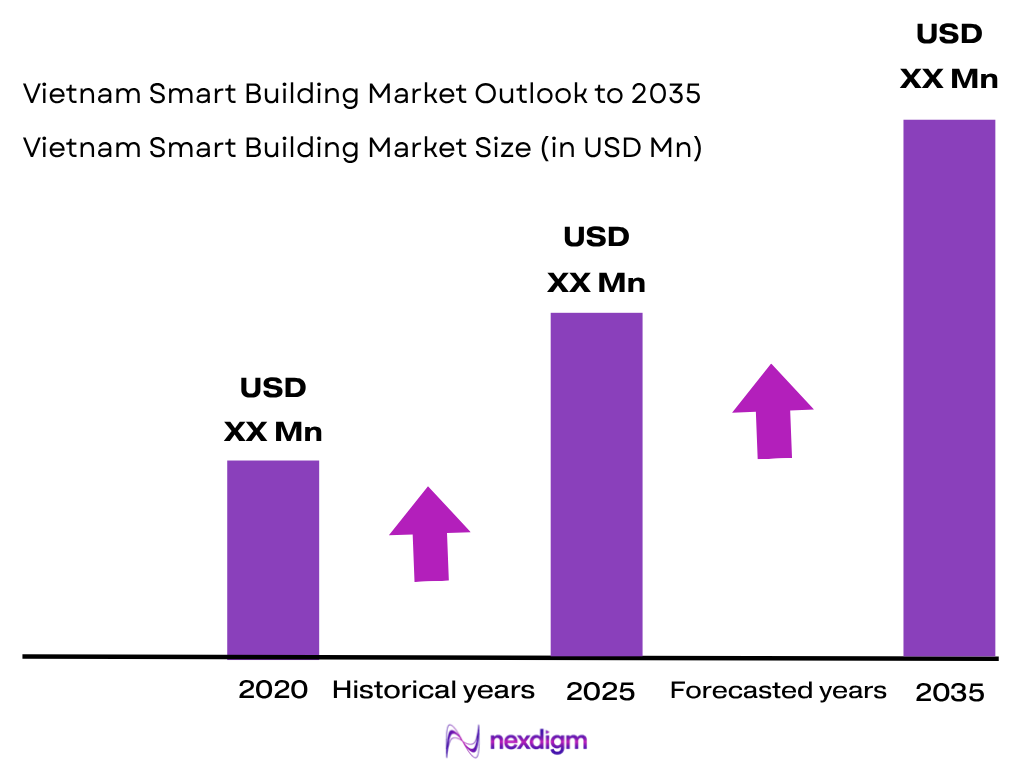
The Vietnam Smart Building Market is valued at approximately ~USD XX billion, with demand supported by commercial construction, energy efficiency and building digitalization. Vietnam’s GDP increased from USD 429.7 billion to USD 476.39 billion across consecutive annual periods, while buildings account for roughly 35–40% of national energy consumption. This combination supports adoption of building management systems, automated HVAC, smart metering, intelligent lighting, IoT sensors and centralized energy-management platforms.
Ho Chi Minh City and Hanoi dominate Vietnam Smart Building Market activity because they concentrate Grade-A offices, headquarters, hospitality assets, data centres and premium mixed-use projects. Ho Chi Minh City added nearly 170,000 sqm of office NLA in one annual period and subsequently introduced 117,500 sqm across five new Grade-A buildings. Hanoi’s office inventory reached approximately 1,768,190 sqm, including 46,480 sqm of new annual supply, strengthening demand for integrated automation and efficient building operations.
Market Segmentation
By Solution Type
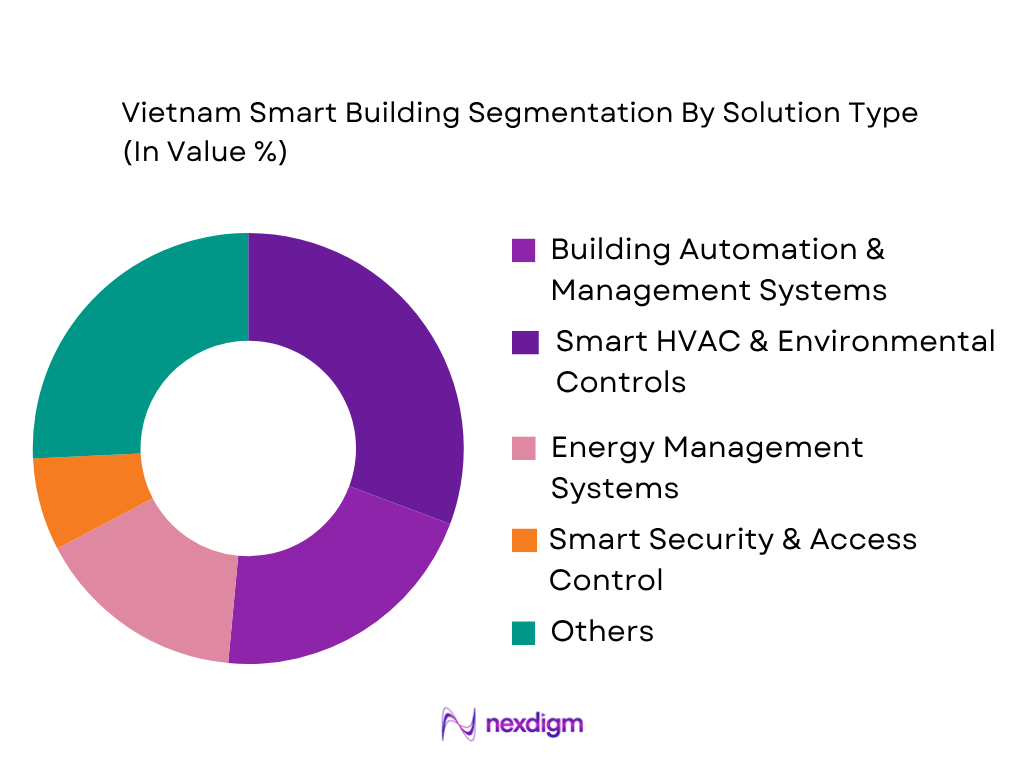
The Vietnam Smart Building Market is segmented into building management and automation systems, smart HVAC controls, energy management systems, security and access control, intelligent lighting, smart metering, and analytics platforms. Building management and automation systems hold the dominant position because they act as the central operating layer connecting HVAC, lighting, power, fire protection, security and connected sensors. This is particularly important in Vietnam, where the Ministry of Industry and Trade estimates buildings consume approximately 35–40% of national energy. Modern BMS platforms can consolidate information from multiple mechanical and electrical systems and provide centralized control, fault monitoring and energy optimization. New Grade-A offices, hotels, hospitals and data centres increasingly require this integrated functionality rather than standalone controllers. Growing use of open protocols such as BACnet, Modbus, KNX and MQTT is additionally making BMS deployment more practical in both greenfield developments and existing-building modernization projects.
By Building Type
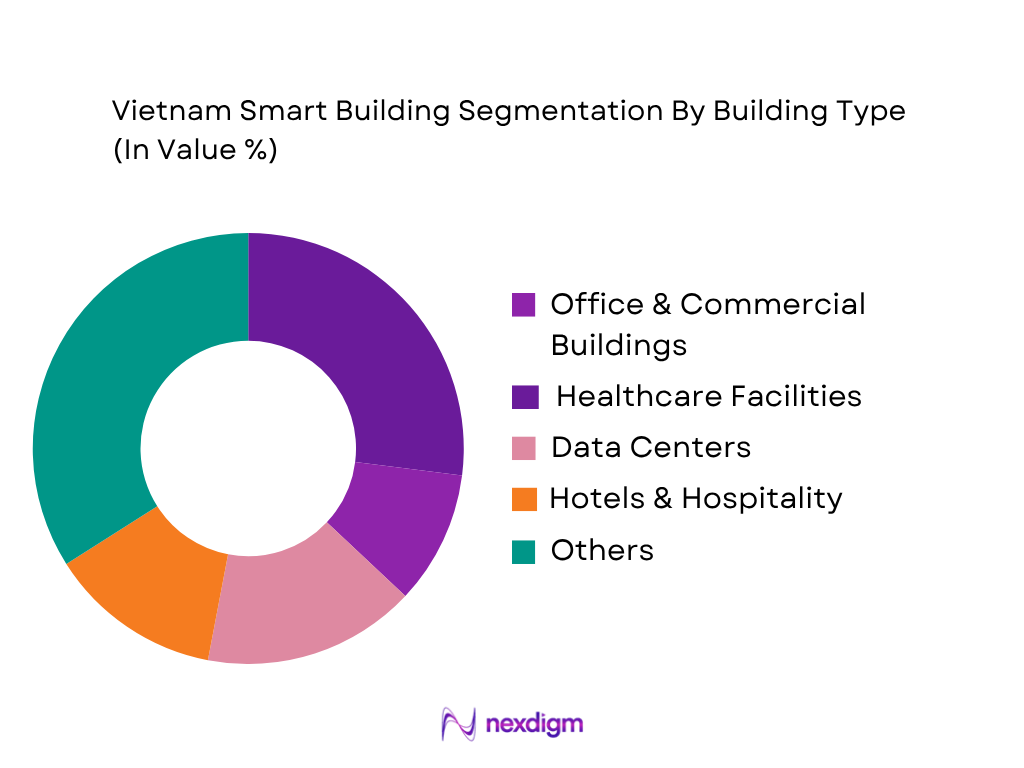
The Vietnam Smart Building Market is segmented into office and commercial buildings, data centres, hospitality properties, retail buildings, healthcare facilities, industrial buildings, government facilities and high-rise residential developments. Office and commercial buildings represent the dominant subsegment because Hanoi and Ho Chi Minh City contain Vietnam’s largest concentration of premium properties and multinational occupiers. Ho Chi Minh City had approximately 1.63 million sqm of Grade-A and Grade-B office supply at the end of the referenced annual period, while Hanoi recorded approximately 1.77 million sqm. Premium tenants increasingly require efficient cooling, access control, indoor-environment monitoring and building data visibility. Data centres are also becoming strategically important: Viettel inaugurated a major facility at Hoa Lac Hi-Tech Park with rack capacities approximately three times Vietnam’s previous average and a commitment to source part of its electricity from renewable energy. Such facilities intensify demand for integrated power, cooling and environmental monitoring.
Competitive Landscape
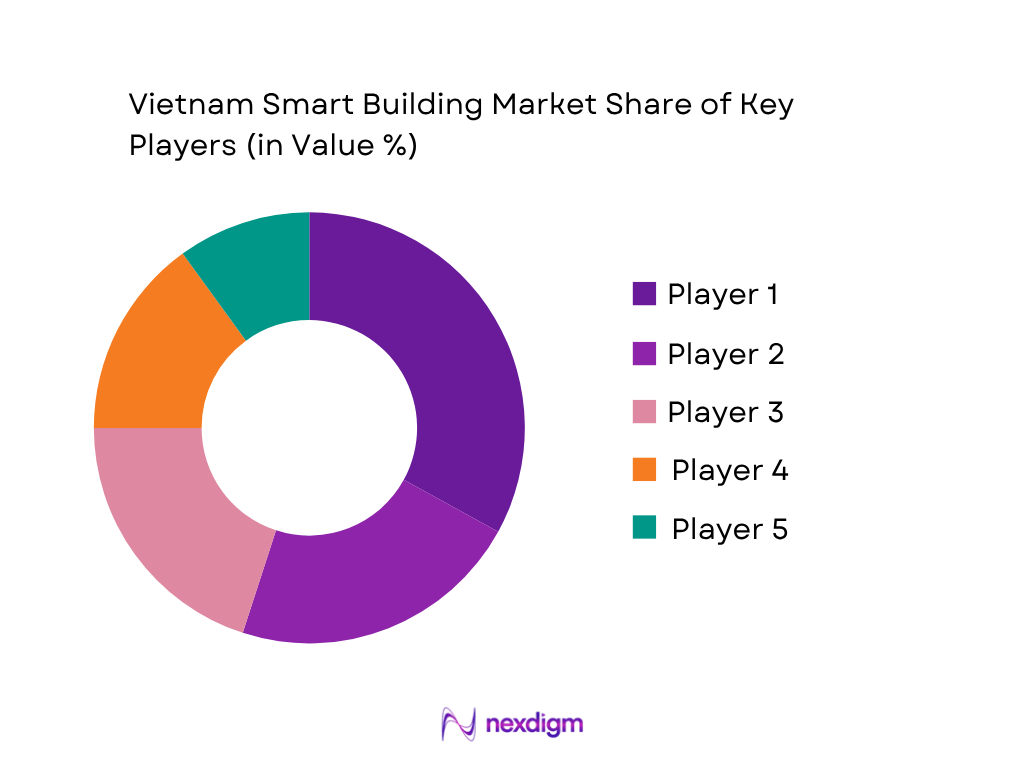
The Vietnam Smart Building Market combines global building-automation companies with electrical, HVAC, digital-infrastructure and domestic technology providers. Honeywell, Schneider Electric, Siemens, Johnson Controls and ABB provide broad platforms covering building automation, HVAC supervision, energy management, cloud connectivity and analytics. Competitive differentiation is shifting from standalone equipment toward interoperability, remote operation, portfolio analytics, cybersecurity and AI-enabled optimization. Schneider Electric, for example, supports BACnet, Modbus, LonWorks, MQTT and third-party systems, while Siemens Building X consolidates secure building data for energy, maintenance, safety and operational applications.
| Major Player | Established | Headquarters | Core Smart Building Platform | BMS/HVAC Capability | Energy Management | AI & Analytics | Interoperability | Key Applications |
| Honeywell | 1906 | Charlotte, USA | ||||||
| Schneider Electric | 1836 | Rueil-Malmaison, France | ||||||
| Siemens | 1847 | Munich & Berlin, Germany | ||||||
| Johnson Controls | 1885 | Cork, Ireland | ||||||
| ABB | 1988 | Zurich, Switzerland |
Vietnam Smart Building Market Analysis
Growth Drivers
Expansion of Commercial Building Stock, Green Buildings and Energy-Efficiency Requirements
Vietnam’s expanding commercial and institutional building base is creating a stronger foundation for building management systems, automated HVAC, smart metering, intelligent lighting and energy analytics. The Ministry of Construction reported 559 certified green buildings covering more than 13.6 million m² of floor area at the end of 2024, demonstrating that energy and environmental performance are becoming increasingly embedded in new Vietnamese real-estate development. The Ministry of Industry and Trade separately identifies buildings as consuming roughly 35–40 units out of every 100 units of national energy, making HVAC, lighting and electrical systems strategically important targets for automation. Its 2024 energy-efficiency programme also identified 3,068 key energy-consuming facilities, each meeting a consumption threshold equivalent to at least 1,000 tonnes of oil equivalent or 6 million kWh annually, reinforcing the need for detailed monitoring, control and optimization technologies in energy-intensive properties. The broader macroeconomic environment supports continued building modernization: World Bank data record Vietnam’s 2024 GDP at USD 476.39 billion, GDP per capita at USD 4,717.3, and population at 100,987,686 people. Vietnam’s National Statistics Office also recorded total social investment of VND 3,692.1 trillion and realized foreign direct investment of USD 25.35 billion during 2024, providing additional economic capacity for offices, manufacturing facilities, hotels, logistics properties and mixed-use developments. For smart-building vendors, this translates into demand not only for conventional centralized BMS installations but also for sub-metering, occupancy sensing, chiller optimization, automated ventilation, indoor environmental monitoring and cloud-connected building analytics. Green-building adoption also creates an operating-performance requirement after construction, making continuous digital measurement and control increasingly relevant throughout the building lifecycle rather than only during commissioning.
Data Center Expansion and Digitization of Building Infrastructure
Vietnam’s rapid expansion of data infrastructure is strengthening demand for sophisticated smart-building controls because data centres require continuous management of cooling, electrical distribution, environmental conditions, access control and equipment alarms. The Ministry of Information and Communications reported that Viettel’s Hoa Lac data centre, inaugurated in 2024, provides 21,000 m² of floor space, 2,400 racks and 30 MW of power demand. Across its data-centre portfolio, Viettel reported 230,000 servers, 81,000 m² of floor area, 11,500 racks and 87 MW of electrical capacity, indicating the scale of infrastructure already requiring mission-critical facility automation. This momentum continued when Viettel began construction in 2025 on a Ho Chi Minh City hyperscale facility spanning nearly 4 hectares, designed for 140 MW and approximately 10,000 racks. The facility specifies average rack density of 10 kW and maximum rack density of 60 kW, requirements that intensify demand for precision cooling, real-time electrical monitoring, predictive maintenance and fault detection. The macroeconomic context reinforces this digital expansion: World Bank data show Vietnam generated USD 476.39 billion of GDP and supported 100,987,686 residents in 2024, while the National Statistics Office recorded USD 25.35 billion of realized foreign direct investment. Vietnam’s digital-infrastructure strategy also explicitly calls for international-standard, secure and green data centres alongside integration of sensors and digital applications into transport, energy, water and urban infrastructure. For the Vietnam Smart Building Market, this expands demand beyond conventional offices toward high-availability facilities requiring cloud BMS, edge processing, IoT environmental sensors, electrical power-quality monitoring, AI-supported cooling optimization and centralized command platforms capable of operating continuously under mission-critical conditions.
Market Challenges
Legacy Building Integration and Fragmented Multi-Vendor Automation Architecture
Vietnam’s existing building base creates a significant implementation challenge because modern smart-building platforms often need to connect with older chillers, ventilation systems, meters, fire systems, access-control devices and controllers that were installed under different technical standards. The contrast between the total building ecosystem and digitally advanced assets remains substantial. The Ministry of Construction reported 559 certified green buildings with 13.6 million m² of certified floor area at the end of 2024, while the Ministry of Industry and Trade identified 3,068 key energy-consuming facilities requiring enhanced energy-management attention. These properties can contain equipment installed across multiple development cycles, meaning BMS modernization frequently requires protocol gateways, replacement controllers, additional sensors and data normalization rather than a straightforward software deployment. Vietnam’s National Data Center implementation directive provides a wider illustration of the same interoperability problem: the government identified duplicated and overlapping databases, inconsistent standards and difficulty connecting and sharing data across existing systems during 2024. Such fragmentation is directly relevant to smart buildings, where BACnet, Modbus, KNX, DALI, proprietary HVAC controllers and newer IoT devices can coexist within the same property. The macroeconomic environment also increases the scale of the challenge. World Bank figures place Vietnam’s GDP at USD 476.39 billion, GDP per capita at USD 4,717.3, and population at 100,987,686 in 2024, while national investment reached VND 3,692.1 trillion according to the National Statistics Office. Consequently, Vietnam is simultaneously adding new technology-enabled assets and operating large quantities of existing building infrastructure. Smart-building providers therefore need strong brownfield engineering capability, open-protocol integration, phased controller modernization and lifecycle commissioning expertise. Without those capabilities, data silos and inconsistent equipment interfaces can limit the effectiveness of AI analytics, predictive maintenance and centralized portfolio management even when the higher-level software itself is technologically advanced.
Building OT Cybersecurity Risks and Connected-System Management Complexity
Cybersecurity is becoming an increasingly important challenge for Vietnam’s Smart Building Market as BMS controllers, access systems, security cameras, meters, IoT sensors and cloud dashboards become connected through enterprise and public networks. Vietnam’s Ministry of Information and Communications recorded 4,483 cyber incidents affecting domestic information systems during January–October 2024, demonstrating that connected infrastructure operates within a material threat environment. Its September 2024 cybersecurity report further identified more than 45,000 vulnerabilities in government information systems. At that point, 87 government units comprising 63 provinces and cities and 24 ministries or agencies had connected cybersecurity monitoring to the National Cyber Security Center, but only 74 units had fully shared monitoring data and 13 units remained incomplete. Centralized malware-prevention infrastructure covered 294,800 monitored computers, providing another indicator of the scale involved in protecting interconnected systems. These figures are not limited to building automation, but they establish the national digital-security environment into which connected building operational technology is increasingly integrated. This is particularly relevant for data centres, hospitals, commercial offices and government buildings where remote access to HVAC, power and security systems can affect physical operations. Vietnam’s macroeconomic scale adds to the number of connected assets: World Bank data record USD 476.39 billion of GDP, USD 4,717.3 of GDP per capita and 100,987,686 people in 2024. Smart-building implementations must consequently incorporate network segmentation, controller authentication, encrypted communication, secure remote maintenance and patch management from project design onward. Multi-vendor buildings create additional complexity because cybersecurity responsibilities can span landlords, facility managers, HVAC contractors, IT departments, systems integrators and cloud-platform providers. As buildings become more software-defined, the ability to maintain secure connectivity throughout a building’s lifecycle becomes as important as the original automation functionality.
Market Opportunities
AI-Driven Autonomous Buildings and High-Density Data Center Controls
Vietnam’s growing high-density computing infrastructure creates a strong opportunity for AI-driven building operations because data centres provide environments where even small improvements in cooling, airflow, power distribution and fault detection can materially affect operational reliability. Viettel’s Hoa Lac data centre entered operation in 2024 with 2,400 racks, 21,000 m² of floor space and 30 MW of power demand, while Viettel’s broader data-centre footprint comprised 230,000 servers, 11,500 racks, 81,000 m² and 87 MW. The opportunity became even more significant in 2025 with construction of the Tân Phú Trung hyperscale data centre in Ho Chi Minh City, designed for approximately 10,000 racks and 140 MW across nearly 4 hectares. Rack density is specified at an average 10 kW and a maximum 60 kW, creating operating conditions where conventional fixed HVAC schedules are increasingly inadequate. AI-based platforms can use temperature, humidity, airflow, electrical-load and equipment-state data to dynamically sequence chillers, identify underperforming components, optimize cooling distribution and detect anomalies before they develop into service interruptions. World Bank data place Vietnam’s 2024 GDP at USD 476.39 billion, GDP per capita at USD 4,717.3, and population at 100,987,686, providing the macroeconomic foundation for expanding digital infrastructure. The same technologies proven in data centres can subsequently migrate to large office campuses, hospitals, hotels and industrial properties. Digital twins can represent physical HVAC and electrical assets, while automated fault detection can compare actual operation against expected performance. Portfolio-wide cloud platforms can then aggregate data across buildings and prioritize maintenance interventions. This creates an opportunity for Vietnam’s smart-building sector to progress from monitoring-oriented BMS platforms toward systems that increasingly diagnose, predict and autonomously optimize building operations.
Grid-Interactive Buildings, Green Retrofits and Distributed Energy Integration
Vietnam’s electricity transition creates a substantial opportunity for smart buildings to integrate building loads with renewable generation, distributed energy resources and advanced energy-management platforms. Ministry of Industry and Trade data show Vietnam had 22,370 MW of installed non-hydropower renewable capacity in 2024, including 16,630 MW of solar generation, 5,345 MW of wind and 395 MW of biomass. Renewable sources generated 43.96 billion kWh, while total electricity generation in the cited system dataset reached 214.16 billion kWh. Electricity-system operating conditions further demonstrate the value of flexible building loads: the Ministry’s transparency platform recorded a system peak demand of 48,923 MW in August 2024, compared with available capacity of 44,016 MW under the platform’s stated methodology for that month. At year-end, EVN reported 29 transitional renewable projects totaling 1,577.65 MW in commercial operation, which had cumulatively delivered more than 4.660 billion kWh to the grid. At the building level, the Ministry of Construction reported 559 certified green buildings covering 13.6 million m² at the end of 2024. Together, these statistics create a pathway for smart buildings to coordinate HVAC schedules, batteries, rooftop solar, thermal storage, EV charging and controllable electrical loads through an integrated energy-management layer. World Bank figures show Vietnam’s 2024 economy generated USD 476.39 billion, with GDP per capita of USD 4,717.3, supporting continuing investment in modern energy infrastructure. The opportunity is therefore not limited to new green buildings. Existing hotels, offices, retail properties and industrial campuses can be retrofitted with smart meters, gateways and automated controls that respond to building demand and grid conditions. As renewable penetration and electrification increase, grid-interactive building controls can become an important bridge between individual property efficiency and wider electricity-system flexibility.
Future Outlook
The Vietnam Smart Building Market is expected to expand at approximately ~XX% CAGR during 2026-2035, supported by urban development, energy-efficiency requirements, high-quality commercial construction and expansion of digital infrastructure. Future smart-building deployments are expected to move from conventional BMS installations toward connected, data-centric platforms linking HVAC, lighting, security, energy, occupancy and equipment maintenance. Existing-building modernization should become increasingly important as landlords compete with newer Grade-A developments. Schneider Electric’s current BMS modernization framework, for example, supports phased replacement of legacy software and hardware rather than requiring immediate removal of all existing building systems.
Major Players
- Honeywell
- Schneider Electric Vietnam
- Siemens Vietnam
- Johnson Controls
- ABB Vietnam
- Bosch Building Technologies
- Delta Electronics Vietnam
- Legrand Vietnam
- Mitsubishi Electric Vietnam
- Carrier
- Daikin Vietnam
- Trane Technologies
- Panasonic Vietnam
- FPT Corporation
- Lumi Vietnam
Key Target Audience
- Smart Building Automation and Building Management System Manufacturers
- Commercial Real Estate Developers and Property Owners
- Facility Management and Building Operations Companies
- Data Center and Mission-Critical Infrastructure Operators
- MEP Contractors and Smart Building System Integrators
- Investments and Venture Capitalist Firms
- Government and Regulatory Bodies (Ministry of Construction, Ministry of Industry and Trade, Ministry of Science and Technology, Ministry of Public Security)
- Energy Service Companies and Utility Infrastructure Providers
Research Methodology
Step 1: Identification of Key Variables
The initial phase involves constructing an ecosystem map encompassing building-automation OEMs, HVAC manufacturers, property developers, system integrators, MEP contractors, facility managers, IoT providers and building owners within the Vietnam Smart Building Market. Critical variables include installed building stock, BMS penetration, office supply, energy usage, retrofit activity, technology architecture and building-segment adoption.
Step 2: Market Analysis and Construction
Historical information is compiled for building automation, smart HVAC, energy management, lighting controls, security systems and software platforms. A top-down assessment of construction activity, commercial-building stock and energy requirements is combined with bottom-up analysis of equipment deployment, smart-building projects, system integrations and vendor activity to construct the market framework.
Step 3: Hypothesis Validation and Expert Consultation
Market hypotheses are validated through CATIs and structured discussions with automation vendors, MEP contractors, property developers, facility managers, system integrators and equipment suppliers. These consultations assess building technology procurement, retrofit cycles, interoperability requirements, cloud migration, customer pain points, energy-management priorities and the adoption of AI-enabled building analytics.
Step 4: Research Synthesis and Final Output
The final phase triangulates primary information with Ministry of Construction policies, Ministry of Industry and Trade energy data, office-building activity, data-centre developments and company disclosures. Bottom-up supplier analysis is reconciled with top-down building demand to establish segmentation, competitive positioning, technology adoption patterns and the long-term outlook for the Vietnam Smart Building Market.

- Executive Summary
- Research Methodology (Market Definition and Scope, Smart Building Technology Classification, Building Automation System Mapping, Building Management System Assessment, Energy Management System Evaluation, Smart HVAC Controls Assessment, Intelligent Lighting Assessment, IoT Sensor Mapping, Smart Metering Assessment, Security and Access Control Assessment, Fire and Life-Safety Integration, Indoor Environmental Quality Monitoring, Cloud BMS Assessment, AI Building Analytics Assessment, Digital Twin Evaluation, Installed Building Stock Assessment, Greenfield versus Retrofit Assessment, Supply-Side Assessment, Demand-Side Assessment, Top-Down Market Sizing, Bottom-Up Market Sizing, Primary Industry Interviews, System Integrator Interviews, Data Triangulation, Forecasting Framework)

- Definition and Scope
- Vietnam Smart Building Industry Evolution and Development of Building Automation Systems, Integrated Building Management Systems, Smart HVAC Controls, Intelligent Lighting, IoT-Connected Building Devices, Energy Management Systems, Smart Metering, Integrated Security, Cloud-Based Building Platforms, AI-Enabled Building Optimization, Digital Twins, Grid-Interactive Buildings and Smart Urban Infrastructure
- Smart Building Value Chain Analysis

- Growth Drivers (Expansion of Grade-A Commercial Building Stock, Rising Building Electricity Demand, Energy-Efficiency Regulation, Data Center Infrastructure Expansion, Smart Urban Development, Increasing IoT Sensor Deployment, Growing Cloud BMS Adoption, Green Building Certification, Corporate Sustainability Requirements, Demand for Predictive Maintenance)
- Market Challenges (Legacy Building Integration, High Retrofit Complexity, Fragmented Automation Architecture, Proprietary Control Protocols, Building OT Cybersecurity Risks, Limited Controls Engineering Expertise, Multi-Vendor Interoperability, Building Data Silos, Integration of Imported and Domestic Equipment, Capital Allocation Constraints)
- Market Opportunities (AI-Driven Autonomous Building Operations, Existing Commercial Building Retrofits, Smart Data Center Controls, Digital Twin Deployment, Cloud-Based Portfolio Management, Grid-Interactive Efficient Buildings, Smart EV Charging Integration, Distributed Energy Resource Coordination, Automated Fault Detection and Diagnostics, Net-Zero and Green Building Transformation)
- Market Trends (AI-Based HVAC Optimization, Occupancy-Based Controls, Cloud-Native BMS, Wireless Building Controls, Digital Twins, Indoor Environmental Quality Monitoring, Remote Facility Operations, Predictive Maintenance, Building-to-Grid Connectivity, Integrated Energy and Carbon Management)
- Government Regulations and Standards (Law on Economical and Efficient Use of Energy, National Technical Regulation for Energy-Efficient Civil Buildings, Smart Urban Development Regulations, Ministry of Construction Smart Urban Guidance, Vietnam National Energy Efficiency Programme, Building Energy Management Requirements, Fire and Life-Safety Regulations, Electrical Safety Standards, Data and Cybersecurity Requirements)
- SWOT Analysis
- Porter’s Five Forces Analysis
- PESTLE Analysis

- By Market Value (2020-2025)
- By Smart Building Installed Base (2020-2025)
- By Building Automation System Deployment Value (2020-2025)
- By Building Management System Deployment Value (2020-2025)
- By Energy Management System Revenue (2020-2025)
- By Smart HVAC and Environmental Control Revenue (2020-2025)

- By Building Type (In Value %)
Grade-A Office Buildings
Retail and Shopping Centers
Hotels and Hospitality Properties
Hospitals and Healthcare Facilities
Educational Campuses
Data Centers
Industrial and Manufacturing Facilities
Warehouses and Logistics Facilities
Government and Public Buildings
High-Rise Residential and Mixed-Use Developments - By Deployment Model (In Value %)
Greenfield Smart Building Deployment
Existing Building Retrofit
Single-Building Deployment
Multi-Building and Campus Deployment
Enterprise Portfolio Deployment
On-Premise Building Management
Cloud-Connected Building Management
Hybrid Cloud-Edge Deployment - By Technology Architecture (In Value %)
IoT-Enabled Building Automation
Cloud-Based BMS
Edge-Enabled Building Controls
Artificial Intelligence and Machine Learning
Digital Twin-Enabled Building Operations
Wireless Building Automation
Integrated Smart Building Platforms
Grid-Interactive Building Architecture - By Building Function (In Value %)
HVAC Automation and Optimization
Lighting Automation
Energy Monitoring and Optimization
Electrical and Power Management
Physical Security and Access Management
Fire Detection and Life Safety
Indoor Air Quality Monitoring
Occupancy and Space Optimization
Predictive Maintenance and Asset Management
Water and Utility Management
EV Charging and Distributed Energy Integration - By Communication Protocol and Connectivity (In Value %)
BACnet-Based Systems
Modbus-Based Systems
KNX-Based Systems
DALI Lighting Networks
IP and Ethernet-Based Systems
Wi-Fi Connected Building Systems
Bluetooth Low Energy Networks
Zigbee and Mesh Networks
MQTT and API-Based Integration
Proprietary Building Automation Networks - By End User (In Value %)
Commercial Real Estate Developers
Corporate Enterprises
Facility Management Companies
Data Center Operators
Hospitality Operators
Healthcare Providers
Industrial Facility Operators
Retail Property Operators
Government and Municipal Authorities
Residential and Mixed-Use Developers - By Geography (In Value %)
Ho Chi Minh City
Hanoi
Da Nang
Hai Phong
Binh Duong
Dong Nai
Bac Ninh
Rest of Vietnam

- Market Share of Major Players (By Vietnam Revenue, BMS Installed Base, Building Automation Projects, Commercial Building Presence, Data Center Presence, Smart HVAC Capability, Energy Management Capability, Software Portfolio, Systems Integration Capability, Service Network)
- Cross Comparison Parameters (BMS and Building Automation Portfolio Breadth, HVAC and Energy Optimization Capability, Open-Protocol and Multi-Vendor Interoperability, AI and Predictive Analytics Capability, Cloud and Edge Platform Capability, Building OT Cybersecurity Capability, Digital Twin and Occupancy Analytics Capability, Vietnam Systems Integration and Lifecycle Service Coverage)
- SWOT Analysis of Major Players (Product Portfolio, Technology Capability, Local Presence, Partner Network, Software Capability, Service Coverage, Competitive Strengths, Strategic Gaps)
- Detailed Profiles of Major Companies
Honeywell
Schneider Electric Vietnam
Siemens Vietnam
Johnson Controls
ABB Vietnam
Bosch Building Technologies
Delta Electronics Vietnam
Legrand Vietnam
Mitsubishi Electric Vietnam
Carrier
Daikin Vietnam
Trane Technologies
Panasonic Vietnam
FPT Corporation
Lumi Vietnam

- Commercial Property Developer Requirement Assessment
- Grade-A Office Building Automation Requirement Assessment
- Data Center Smart Infrastructure Requirement Assessment
- Hotel and Hospitality Automation Requirement Assessment
- Healthcare Facility Smart Building Requirement Assessment
- Industrial and Manufacturing Building Assessment

- By Market Value (2026-2035)
- By Smart Building Installed Base (2026-2035)
- By Building Automation System Deployment Value (2026-2035)
- By Building Management System Revenue (2026-2035)
- By Energy Management System Revenue (2026-2035)
- By Smart HVAC and Environmental Controls Revenue (2026-2035)


 Request a Sample
 Ask for Customization
 Get a Quote
 Enquire Now
