
 Download PDF
Market Overview
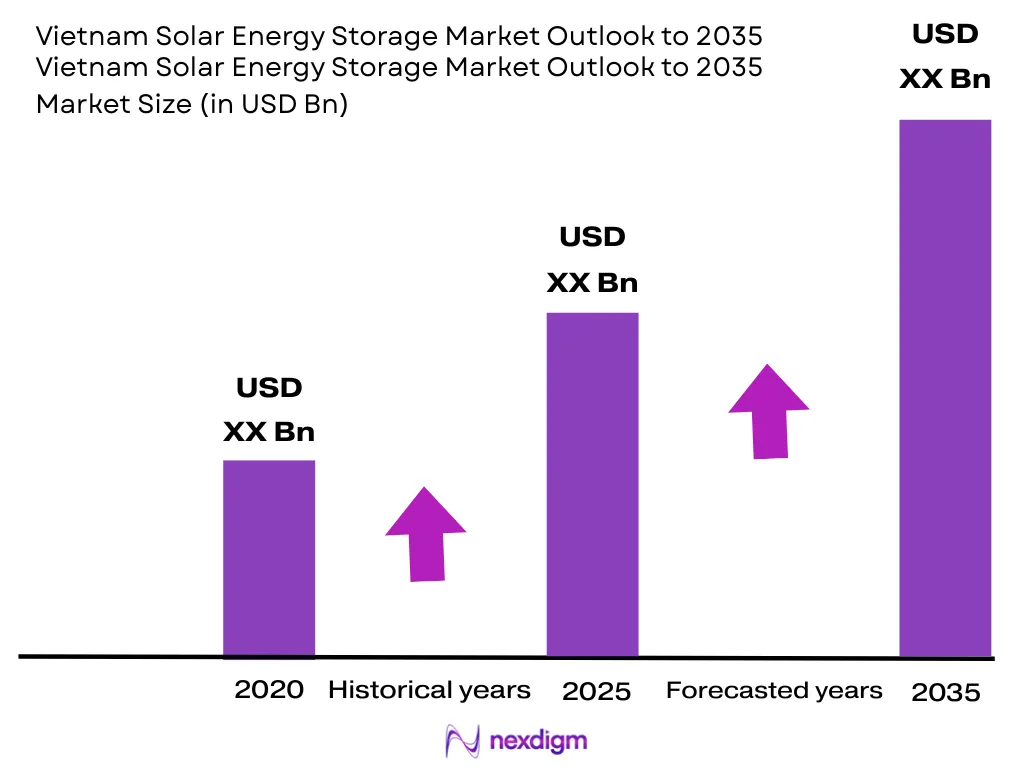
The Vietnam Solar Energy Storage Market is valued at USD ~ Billion in 2024 based on a five-year historical assessment, with the market supported by the rapid expansion of solar photovoltaic installations and increasing investments in battery energy storage systems (BESS). Vietnam’s cumulative installed solar PV capacity exceeded 18 GW by the end of 2023, making it one of Southeast Asia’s largest solar markets according to the International Renewable Energy Agency (IRENA). The country’s electricity generation reached approximately 306 TWh in 2024, reflecting steadily rising power demand driven by industrialization, manufacturing expansion, and urbanization. Growing concerns regarding solar curtailment, grid congestion, and energy security have accelerated investments in energy storage solutions alongside renewable energy deployment.
Market Segmentation
By Battery Technology
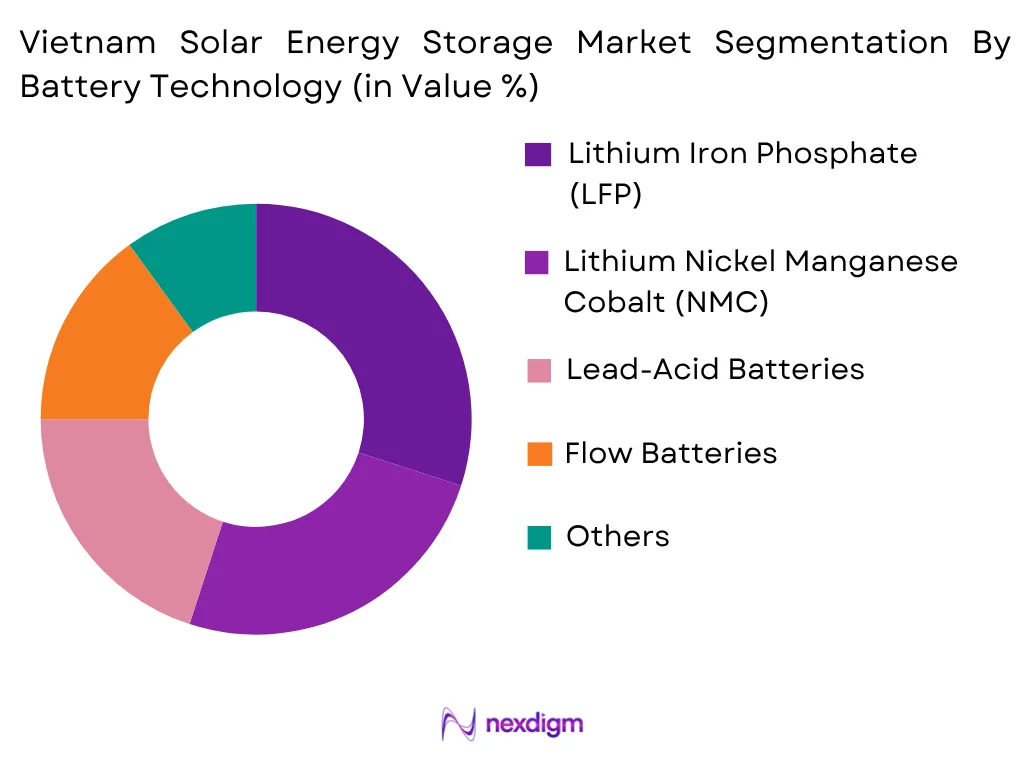
Lithium Iron Phosphate (LFP) dominates the Vietnam Solar Energy Storage Market under the battery technology segment due to its superior thermal stability, enhanced safety profile, long operational life, and competitive lifecycle costs compared with alternative battery chemistries. Vietnam’s tropical climate favors battery technologies capable of maintaining consistent performance under elevated temperatures, making LFP particularly attractive for both residential and utility-scale installations. The chemistry’s high cycle life significantly lowers maintenance and replacement costs, making it well suited for commercial and industrial energy storage projects where frequent charging and discharging cycles are common. Global battery manufacturers such as CATL, BYD, Sungrow, Huawei Digital Power, and VinES have increasingly focused on LFP-based solutions because of their scalability and cost-effectiveness. Furthermore, the growing deployment of large-scale Battery Energy Storage Systems (BESS) integrated with solar photovoltaic plants has reinforced the dominance of LFP batteries as project developers prioritize reliability, safety, and long-term operational efficiency over higher energy density alternatives.
By End User
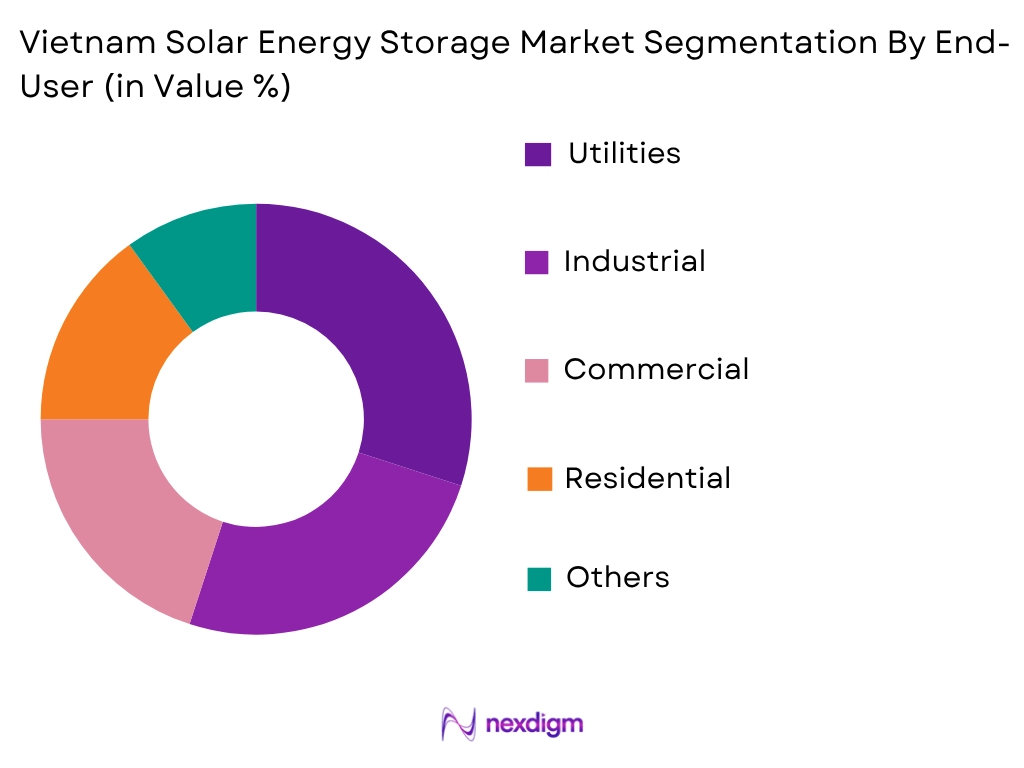
Utilities account for the dominant share within the end-user segment owing to Vietnam’s accelerating renewable energy integration and the increasing need to improve grid flexibility and stability. Large-scale battery storage projects enable utilities to manage solar intermittency, reduce renewable energy curtailment, provide frequency regulation, and enhance transmission network reliability during peak demand periods. Vietnam’s Power Development Plan VIII has further strengthened interest in utility-scale battery energy storage by emphasizing grid modernization and renewable integration. State-owned electricity providers, independent power producers, and renewable energy developers continue investing in large-capacity BESS projects to improve dispatchability of renewable generation while supporting long-term energy security objectives. Utility operators also benefit from economies of scale that lower project costs per installed megawatt-hour, making this segment more commercially attractive than smaller distributed installations. As electricity demand from manufacturing clusters and urban centers continues to rise, utility-scale deployments are expected to remain the largest contributor to energy storage capacity additions.
Competitive Landscape
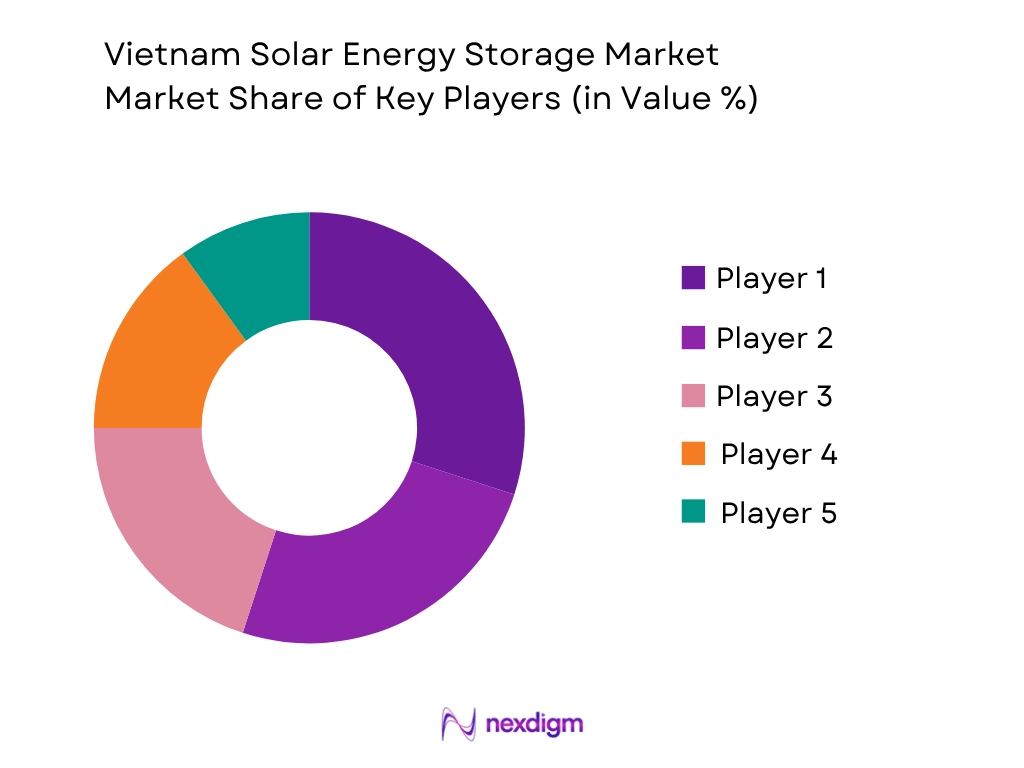
The Vietnam Solar Energy Storage Market is moderately consolidated, with competition led by a combination of global battery manufacturers, power electronics companies, and domestic renewable energy developers. International companies such as Huawei Digital Power, Sungrow, CATL, BYD, Tesla Energy, LG Energy Solution, Samsung SDI, Fluence Energy, Schneider Electric, and Siemens Energy have established a strong presence through battery systems, inverters, and energy management platforms. Domestic companies including VinES Energy Solutions and VinFast Energy are strengthening local battery manufacturing capabilities, supported by Vietnam’s growing clean energy ambitions and industrial ecosystem. Competition is increasingly centered on battery technology, system efficiency, lifecycle performance, EPC capabilities, after-sales service, and software-enabled energy management solutions.
| Company | Establishment Year | Headquarters | Battery Technology
|
Primary Offering
|
Utility-Scale BESS Capability | Major End-Use Industries | Key Strategic Focus | Certifications & Compliance |
| VinES Energy Solutions | 2021 | ~ | ~ | ~ | ~ | ~ | ~ | ~ |
| Huawei Digital Power | 2021 | ~ | ~ | ~ | ~ | ~ | ~ | ~ |
| Sungrow Power Supply | 1997 | ~ | ~ | ~ | ~ | ~ | ~ | ~ |
| CATL | 2011 | ~ | ~ | ~ | ~ | ~ | ~ | ~ |
| BYD Energy Storage | 1995 | ~ | ~ | ~ | ~ | ~ | ~ | ~ |
Vietnam Solar Energy Storage Market Analysis
Growth Drivers
Expansion of Renewable Energy Integration
Vietnam’s rapid deployment of solar photovoltaic capacity has significantly increased the need for battery energy storage systems to improve grid flexibility and manage renewable energy intermittency. According to the International Renewable Energy Agency (IRENA), Vietnam had over 18 GW of installed solar photovoltaic capacity in operation, making it one of Southeast Asia’s largest solar power producers. The International Energy Agency (IEA) notes that Vietnam’s Power Development Plan VIII (PDP8) prioritizes energy storage as a critical technology for maintaining grid reliability while supporting higher renewable penetration. The country’s electricity demand continues to rise alongside industrial expansion, requiring greater system flexibility to avoid renewable energy curtailment. The IEA further highlights that Vietnam must substantially modernize its transmission infrastructure and deploy storage technologies to ensure stable integration of solar and wind generation into the national grid. Rapid urban expansion, manufacturing growth, and increasing electrification across multiple sectors continue to strengthen the business case for solar-plus-storage projects. The transition toward a cleaner power mix therefore directly supports the deployment of battery energy storage systems capable of balancing daily generation fluctuations, improving power quality, and strengthening energy security while enabling Vietnam to meet its long-term decarbonization objectives.
Rising Electricity Demand and Grid Modernization
Vietnam’s growing economy continues to increase pressure on the national electricity system, creating strong demand for energy storage solutions capable of supporting peak loads and improving network resilience. The World Bank estimates Vietnam’s GDP exceeded USD 470 billion in 2024, while industrial production and export-oriented manufacturing remain major electricity consumers. The International Energy Agency reports that annual investment in Vietnam’s power sector needs to increase from less than USD 10 billion currently to at least USD 25 billion annually to support future electricity requirements and renewable integration. PDP8 also outlines more than USD 130 billion of cumulative investment requirements for generation and transmission infrastructure by 2030, including significant upgrades to transmission networks. As renewable electricity capacity expands, storage systems are becoming increasingly important for frequency regulation, voltage support, congestion management, and reserve capacity. Energy storage further enables utilities to defer expensive transmission upgrades while maintaining system stability. These structural investments in power infrastructure and increasing electricity consumption create sustained demand for battery energy storage technologies across utility-scale, commercial, and industrial applications.
Market Challenges
Grid Infrastructure Constraints
Despite significant renewable energy expansion, Vietnam’s transmission infrastructure has struggled to keep pace with the rapid deployment of solar power projects, creating operational challenges for energy storage adoption. According to Vietnam Electricity (EVN) and the Ministry of Industry and Trade, several renewable-rich provinces have experienced transmission bottlenecks and renewable energy curtailment due to insufficient grid capacity. The International Energy Agency emphasizes that expanding and modernizing the electricity grid is essential for integrating higher shares of solar generation while maintaining power system adequacy. PDP8 includes approximately USD 15 billion in planned transmission network investment by 2030, reflecting the scale of required infrastructure upgrades. Until these investments are completed, battery energy storage systems alone cannot fully eliminate transmission congestion, increasing project complexity for developers. Limited grid flexibility, interconnection delays, and evolving technical standards continue to influence investment decisions, particularly for utility-scale battery storage projects connected to renewable generation facilities. These structural constraints slow deployment despite strong long-term demand fundamentals.
Dependence on Imported Battery Technologies
Vietnam’s solar energy storage industry continues to rely heavily on imported lithium-ion cells, battery management systems, power conversion equipment, and advanced energy management technologies. Global manufacturers including CATL, BYD, LG Energy Solution, Samsung SDI, Huawei Digital Power, and Sungrow remain major technology suppliers for domestic energy storage projects. While Vietnam has expanded local battery manufacturing through companies such as VinES, the domestic supply chain for advanced battery materials, cells, and critical components remains under development. The International Energy Agency identifies battery manufacturing and storage deployment as strategic priorities for strengthening Vietnam’s long-term electricity transition. Heavy reliance on imported technologies exposes developers to global supply chain disruptions, logistics constraints, exchange-rate volatility, and longer procurement timelines. These factors can delay project implementation and increase operational complexity for EPC contractors and utilities seeking rapid deployment of battery energy storage systems across renewable energy projects.
Market Opportunities
Commercial & Industrial Energy Storage Adoption
Vietnam’s manufacturing sector presents a significant opportunity for commercial and industrial battery energy storage deployment as companies seek to improve power reliability and reduce electricity costs. According to the World Bank, Vietnam remains one of Asia’s leading manufacturing destinations, supported by strong foreign direct investment and export-oriented industrial production. Industrial parks, electronics manufacturers, textile producers, and food processing facilities require uninterrupted electricity supplies to maintain production efficiency. The introduction of Direct Power Purchase Agreements (DPPAs) and increasing renewable electricity procurement provide additional incentives for businesses to integrate solar photovoltaic systems with battery storage. Battery energy storage enables peak shaving, demand charge reduction, backup power, and improved renewable energy utilization, making it increasingly attractive for large industrial consumers. As Vietnam continues expanding industrial zones and attracting global manufacturers, commercial and industrial energy storage represents one of the strongest long-term demand opportunities within the country’s clean energy transition.
Government Support for Renewable Energy and Storage
Vietnam’s policy framework continues to create favorable conditions for future battery energy storage deployment through long-term renewable energy planning and electricity market reforms. Under PDP8, energy storage has been formally recognized as an essential component of future power system development. According to EVN and the Institute of Energy under the Ministry of Industry and Trade, the national power system targets 2,700 MW of energy storage capacity by 2030, including 300 MW of battery energy storage systems alongside pumped-storage hydropower. The government has also introduced policies supporting rooftop solar expansion, direct renewable electricity procurement, and increased grid modernization investments. Reuters reports that Vietnam currently operates approximately 103,000 rooftop solar systems with 9.5 GW of installed capacity while aiming to significantly expand rooftop solar adoption across residential and commercial buildings. These policy initiatives strengthen long-term demand for battery energy storage solutions by improving renewable energy integration, increasing grid flexibility, and encouraging private-sector investment in distributed energy resources.
Future Outlook
The Vietnam Solar Energy Storage Market is expected to witness robust expansion over the forecast period, supported by increasing renewable energy deployment, favorable government policies, and the modernization of the national electricity grid. As Vietnam continues to pursue its long-term carbon neutrality commitments and reduce dependence on fossil fuel-based electricity generation, battery energy storage systems will become an essential component of grid infrastructure. Falling battery prices, advancements in battery chemistry, and improvements in energy management software are expected to improve project economics across residential, commercial, industrial, and utility-scale applications.
Major Players
- VinES Energy Solutions
- VinFast Energy
- Huawei Digital Power
- Sungrow Power Supply
- BYD Energy Storage
- CATL
- Tesla Energy
- LG Energy Solution
- Samsung SDI
- Fluence Energy
- Trina Storage
- Schneider Electric
- Siemens Energy
- Hitachi Energy
- ABB
Key Target Audience
- Battery Energy Storage System Manufacturers
- Solar Photovoltaic Project Developers
- Independent Power Producers (IPPs)
- Electric Utility Companies and Grid Operators
- Commercial & Industrial Energy Consumers
- Investments and Venture Capitalist Firms
- Government and Regulatory Bodies (Ministry of Industry and Trade (MOIT), Electricity Regulatory Authority of Vietnam (ERAV), Vietnam Electricity (EVN), Ministry of Natural Resources and Environment (MONRE))
- Engineering, Procurement and Construction (EPC) Contractors
Research Methodology
Step 1: Identification of Key Variables
The initial phase involves constructing a comprehensive ecosystem map covering all major stakeholders operating within the Vietnam Solar Energy Storage Market. Extensive desk research is conducted using government publications, energy agencies, company annual reports, industry associations, renewable energy databases, and proprietary research sources. The objective is to identify the critical variables influencing market performance, including battery deployment, installed solar capacity, electricity demand, grid infrastructure development, technology adoption, investment activity, and regulatory policies.
Step 2: Market Analysis and Construction
In this stage, historical market information is collected and analyzed to establish the current structure of the Vietnam Solar Energy Storage Market. Both top-down and bottom-up approaches are employed to estimate market size by assessing battery energy storage installations, solar photovoltaic deployment, project investments, battery pricing, and revenue generation across residential, commercial, industrial, and utility-scale applications. Demand-side and supply-side indicators are evaluated to ensure accurate market estimation and segmentation.
Step 3: Hypothesis Validation and Expert Consultation
Market hypotheses are formulated based on secondary research findings and validated through Computer-Assisted Telephone Interviews (CATI) and structured discussions with industry experts. Participants include battery manufacturers, renewable energy developers, EPC contractors, utility companies, distributors, technology providers, government officials, and energy consultants. These expert interactions provide operational, technical, financial, and regulatory insights, enabling refinement of assumptions and verification of market estimates and future growth prospects.
Step 4: Research Synthesis and Final Output
The final phase integrates findings from secondary research, primary interviews, and quantitative analysis to produce a comprehensive assessment of the Vietnam Solar Energy Storage Market. Data obtained through the bottom-up methodology are cross-verified using top-down market analysis and multiple independent sources to ensure consistency and accuracy. The report is further validated through interactions with key industry participants regarding technology trends, competitive positioning, pricing, investment pipeline, and future deployment plans before final publication.

- Executive Summary
- Research Methodology (Market Definitions and Assumptions, Abbreviations, Market Sizing Approach, Top-Down Analysis, Bottom-Up Analysis, Demand-Side Assessment, Supply-Side Assessment, Primary Industry Interviews, Secondary Research Validation, Data Triangulation, Forecasting Framework, Limitations and Future Conclusions)

- Definition and Scope
- Market Evolution and Industry Genesis
- Timeline of Major Industry Developments
- Solar Energy Storage Industry Value Chain Analysis
- Supply Chain Analysis

- Growth Drivers (Growing Solar PV Capacity, Increasing Grid Curtailment, Rising Electricity Demand, Declining Battery Prices, Industrial Decarbonization, Expansion of Rooftop Solar, Government Renewable Energy Targets, Grid Modernization Investments)
- Market Challenges (High Initial Capital Cost, Limited Energy Storage Regulatory Framework, Grid Infrastructure Constraints, Battery Import Dependence, Financing Challenges, Fire Safety Concerns, Limited Battery Recycling Infrastructure, Long Project Approval Timelines)
- Market Opportunities (Utility-Scale Battery Energy Storage Deployment, Commercial & Industrial Peak Demand Management, Floating Solar + Storage Projects, Virtual Power Plants, Smart Grid Development, Local Battery Manufacturing, Carbon Credit Opportunities, Energy-as-a-Service Business Models)
- Market Trends (LFP Battery Dominance, AI-Based Energy Management Systems, Hybrid Solar-Wind-Storage Projects, Long-Duration Energy Storage Development, Second-Life EV Batteries, Digital Monitoring Platforms, Increasing Domestic Assembly, Smart Microgrid Adoption)
- Government Regulations (Power Development Plan VIII (PDP8), Renewable Energy Development Policies, Electricity Regulatory Framework, Grid Code Compliance, Battery Safety Standards, Environmental Protection Regulations, Fire Prevention Standards, Import Duty & Investment Incentives)
- SWOT Analysis
- PESTLE Analysis
- Porter’s Five Forces Analysis
- Stakeholder Ecosystem
- Competition Ecosystem

- By Market Value (2020-2025)
- By Installed Capacity (2020-2025)
- By Average Selling Price (2020-2025)

- By Battery Technology (In Value %)
Lithium Iron Phosphate (LFP)
Lithium Nickel Manganese Cobalt (NMC)
Lead-Acid Batteries
Flow Batteries
Sodium-Ion Batteries
Solid-State Batteries - By System Type (In Value %)
Standalone Battery Energy Storage Systems (BESS)
Solar PV Coupled Battery Energy Storage Systems
Behind-the-Meter Energy Storage Systems
Front-of-the-Meter Utility Storage Systems
Hybrid Renewable Energy Storage Systems
Microgrid Energy Storage Systems - By End User (In Value %)
Residential
Commercial
Industrial
Utilities
Telecommunication Infrastructure
Data Centers
Government & Public Infrastructure - By Application (In Value %)
Renewable Energy Integration
Peak Shaving
Load Shifting
Backup Power
Frequency Regulation
Voltage Support
Energy Arbitrage
Microgrid Support
EV Charging Infrastructure - By Region (In Value %)
Northern Vietnam
Central Vietnam
Southern Vietnam
Mekong Delta
Central Highlands

- Market Share of Major Players (By Value, Installed Capacity, Battery Technology, Application, End User)
- Cross Comparison Parameters (Battery Manufacturing Capacity, Annual BESS Deployment Capacity, Battery Chemistry Portfolio, Utility-Scale Project Experience, Energy Management Software Capability, Round-Trip Efficiency, Warranty & Lifecycle Performance, Local EPC & Service Network)
- SWOT Analysis of Major Players
- Pricing Analysis (Battery Pack Price per kWh, Installed BESS Cost per kWh, Residential System Pricing, Commercial System Pricing, Utility-Scale Project Pricing)
- Detailed Profiles of Major Companies
VinES Energy Solutions
VinFast Energy
Huawei Digital Power
Sungrow Power Supply
BYD Energy Storage
CATL
Tesla Energy
LG Energy Solution
Samsung SDI
Fluence Energy
Trina Storage
Schneider Electric
Siemens Energy
Hitachi Energy
ABB

- Energy Consumption Pattern Analysis (Load Profile, Peak Demand, Energy Consumption Intensity, Renewable Energy Utilization)
- Battery Utilization Analysis (Depth of Discharge, Cycle Frequency, Capacity Utilization, Round Trip Efficiency)
- Investment and Budget Allocation Analysis (CAPEX, OPEX, Payback Period, ROI Expectations)
- Procurement and Vendor Selection Analysis (Battery Chemistry Preference, EPC Selection Criteria, Warranty Requirements, Lifecycle Cost Assessment)
- Needs, Desires and Pain Point Analysis (Grid Reliability, Electricity Cost Reduction, Energy Security, Sustainability Targets, Backup Power Requirements)
- Decision-Making Process (Technical Evaluation, Financial Assessment, Regulatory Compliance, Vendor Qualification)

- By Market Value (2026-2035)
- By Installed Capacity (2026-2035)
- By Average Selling Price (2026-2035)


 Request a Sample
 Ask for Customization
 Get a Quote
 Enquire Now