
 Download PDF
Market Overview
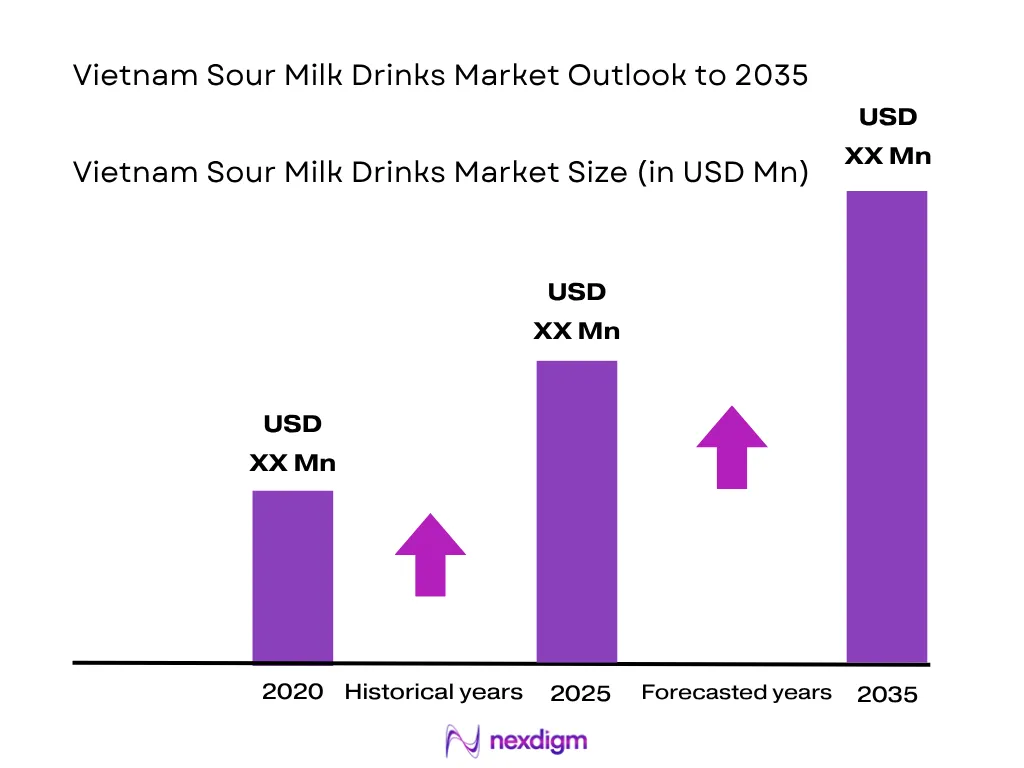
The Vietnam Sour Milk Drinks Market is valued at USD ~ million under the yogurt probiotic drink scope, while the narrower drinkable yogurt category is valued at USD 161.20 million. The broader Vietnam yogurt category is valued at USD ~ billion, confirming sour milk drinks as a meaningful functional-dairy subcategory. Historical category expansion from USD ~ million to USD ~ million shows demand being driven by chilled retail expansion, probiotic positioning, premium formats, and higher willingness to pay for fortified dairy beverages.
Ho Chi Minh City and Hanoi dominate Vietnam Sour Milk Drinks Market demand because they combine dense urban populations, higher disposable income, wider supermarket and convenience-store penetration, stronger cold-chain execution, and higher exposure to functional nutrition claims. Vietnam’s population exceeded 101.1 million in the latest census release, while Ho Chi Minh City had more than 9 million registered residents and a much larger daytime consumption base. Urban population also reached around 39 million, supporting chilled, single-serve, and on-the-go dairy beverage uptake.
Market Segmentation
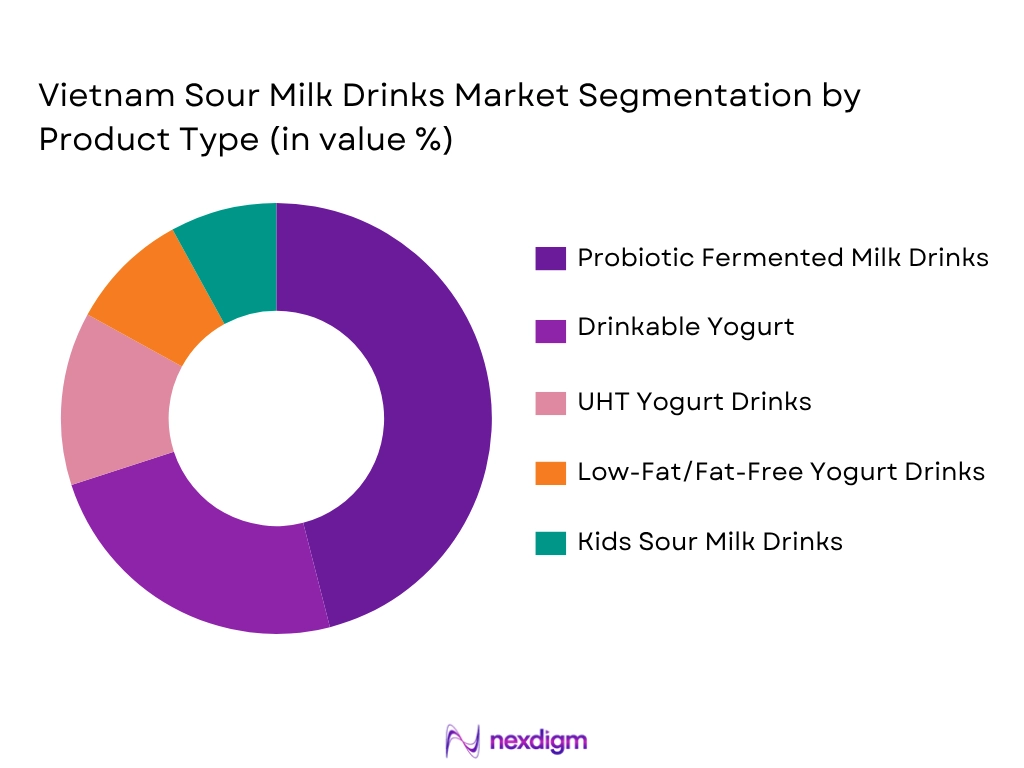
By Product Type
Vietnam Sour Milk Drinks Market is segmented by product type into probiotic fermented milk drinks, drinkable yogurt, UHT yogurt drinks, low-fat/fat-free yogurt drinks, and kids sour milk drinks. Probiotic fermented milk drinks dominate the product type segment because Vietnamese consumers associate fermented dairy with digestive health, daily immunity support, and child nutrition. The segment also benefits from strong brand education by Vinamilk Probi, Yakult, TH true YOGURT Probiotics, and Betagen, which use small bottles, multipacks, strain claims, and daily-consumption messaging. Chilled retail expansion further supports repeat purchase, while low-sugar and fortified products help the category move beyond indulgence into everyday functional nutrition. TH true YOGURT Probiotics, for example, communicates high probiotic content and fresh-milk origin, showing how leading brands use health claims and farm-quality positioning to defend premium pricing.
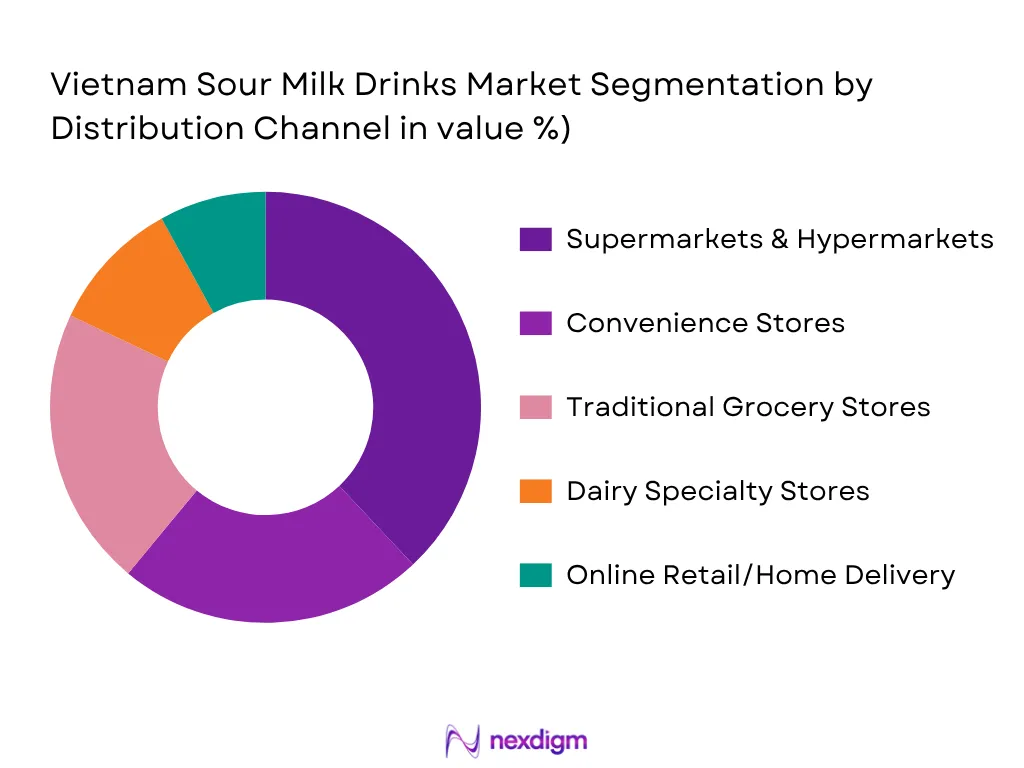
By Distribution Channel
Vietnam Sour Milk Drinks Market is segmented by distribution channel into supermarkets/hypermarkets, convenience stores, traditional grocery stores, dairy specialty stores, and online retail/home delivery. Supermarkets and hypermarkets dominate because they provide the strongest refrigerated shelf infrastructure, higher SKU visibility, multipack promotions, and trusted dairy storage conditions. Nexdigm identifies hypermarkets as the dominant channel in Vietnam yogurt, while 6WResearch also tracks drinkable yogurt by supermarkets/hypermarkets, convenience stores, specialty stores, online retailers, and others. Convenience stores are gaining importance in Ho Chi Minh City and Hanoi for chilled impulse consumption, but large-format modern trade remains more influential for family multipacks, price comparison, and brand discovery. Traditional grocery retains reach but faces cold-chain limitations in fermented dairy.
Competitive Landscape
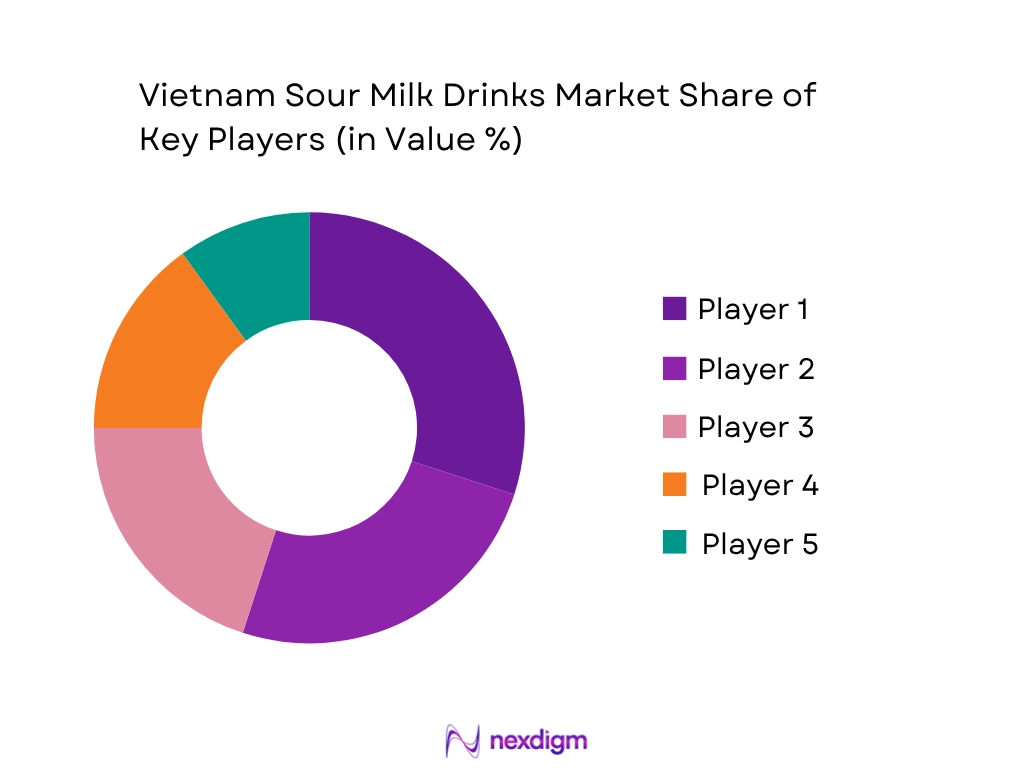
Vietnam Sour Milk Drinks Market is concentrated around national dairy majors and probiotic specialists. Vinamilk remains the leading player in yogurt and sour milk products, supported by a broad portfolio across children’s products, regular yogurt, Greek yogurt, and fermented variants. TH Group competes through fresh-milk provenance and premium health positioning, while Yakult and Betagen focus on probiotic specialization. Friesland Campina and IDP add scale through dairy distribution, kids nutrition, and branded retail execution.
| Company | Establishment Year | Headquarters | Core Sour Milk Drink Brands | Market Positioning | Key Product Formats | Route-to-Market Strength | Probiotic/Health Claim Focus | Packaging Architecture | Channel Focus |
| Vinamilk | 1976 | Ho Chi Minh City, Vietnam | ~ | ~ | ~ | ~ | ~ | ~ | ~ |
| TH Group | 2009 | Hanoi, Vietnam | ~ | ~ | ~ | ~ | ~ | ~ | ~ |
| Yakult Vietnam | 2006 | Binh Duong, Vietnam | ~ | ~ | ~ | ~ | ~ | ~ | ~ |
| FrieslandCampina Vietnam | 1995 | Binh Duong, Vietnam | ~ | ~ | ~ | ~ | ~ | ~ | ~ |
| IDP / Kun / Love’in Farm | 2004 | Ho Chi Minh City, Vietnam | ~ | ~ | ~ | ~ | ~ | ~ | ~ |
Vietnam Sour Milk Drinks Market Analysis
Growth Drivers
Urbanization
Urbanization is a direct growth driver for Vietnam Sour Milk Drinks Market because sour milk drinks are highly dependent on modern retail access, refrigerated display, single-serve consumption, and daily repeat purchases by urban households. Vietnam’s total population reached 100,987,686 people in 2024, while the World Bank reported Vietnam’s urban population share at 40.2% in 2024. Government census-linked reporting also recorded 38,599,637 urban residents and 28,146,939 households in 2024, creating a large consumer base for chilled probiotic bottles, kids’ yogurt drinks, and UHT yogurt drinks sold through supermarkets, convenience stores, dairy shops, and online grocery channels. Hanoi and Ho Chi Minh City remain especially important because official population reporting placed Hanoi at 8,685,607 people and Ho Chi Minh City at 9,521,886 people in 2024, supporting dense retail distribution, faster stock rotation, and stronger acceptance of refrigerated dairy beverages. For sour milk drink manufacturers, this urban concentration reduces last-mile inefficiency, improves chilled shelf productivity, and enables smaller pack formats to be marketed for school snacks, office consumption, and after-meal digestive routines. Urbanization also supports brand education, as consumers in large cities are more exposed to probiotic claims, low-sugar labels, nutrition messaging, and premium farm-origin positioning across retail shelves and digital channels.
Disposable Income Growth
Disposable income growth supports Vietnam Sour Milk Drinks Market by increasing household ability to buy value-added dairy drinks rather than only basic liquid milk or lower-priced beverages. The World Bank reported Vietnam’s GDP at USD 476.39 billion in 2024 and GDP per capita at USD 4,717.3 in 2024, reflecting a broader income base for packaged nutrition and functional dairy products. The IMF reported Vietnam’s real GDP growth at 7.1 in 2024, with the economy continuing to expand in early 2025; its Article IV data also placed unemployment at 2.2 in 2024 and projected GDP at USD 527.27 billion for 2026, indicating continued macroeconomic capacity to support consumer spending. At household level, Vietnam’s National Statistics Office reported average income per capita of about VND 5.4 million/person/month in 2024, while total retail sales of consumer goods and services reached VND 6.39 quadrillion in 2024 and VND 7,008.9 trillion in 2025. For sour milk drinks, these indicators matter because the category is purchased frequently in small packs, multipacks, and children-oriented formats; higher income allows households to trade up to probiotic shots, low-sugar variants, fortified SKUs, and premium farm-origin drinking yogurt. Rising income also improves the commercial case for brand-led innovation, as manufacturers can create separate price ladders across mass-market, kids, functional, and premium chilled formats.
Market Challenges
Cold-Chain Leakage
Cold-chain leakage is a critical challenge for Vietnam Sour Milk Drinks Market because fermented milk beverages require reliable temperature control from processing plants to distributors, retail shelves, and last-mile delivery. The challenge becomes more important as the market serves a national population of 100,987,686 people across both urban and rural consumption points, including 38,599,637 urban residents and 62,513,019 rural residents recorded in 2024. Sour milk drinks sold as chilled probiotic bottles or pasteurized yogurt drinks face greater operational risk outside dense urban routes, where store-level refrigeration, distributor discipline, and transport temperature monitoring are less consistent. Electricity availability is high, but cold-chain performance depends on continuous commercial reliability: EVN reported commercial power output of 135.64 billion kWh in the first six months of 2024, transmission power output of 121.47 billion kWh, and strong growth in commerce-and-service electricity demand. Vietnam’s whole power system output also reached 179.44 billion kWh in the first seven months of 2024, showing the scale of electricity dependence behind refrigerated retail and logistics operations. For sour milk drinks, any leakage in storage temperature can shorten usable shelf life, affect live-culture integrity, increase product returns, and weaken consumer confidence in probiotic efficacy. This makes cold-chain execution a competitive barrier, particularly for brands expanding beyond Ho Chi Minh City, Hanoi, Da Nang, Hai Phong, and Can Tho into secondary provinces and traditional grocery networks.
Short Shelf Life
Short shelf life is a market-specific challenge because sour milk drinks are not only packaged beverages but fermented dairy products whose quality depends on microbial safety, temperature stability, distribution speed, and retail sell-through. Vietnam’s regulatory framework applies food-safety norms to fermented milk products, with Circular No. 41/2010/TT-BYT covering national technical regulation for fermented milk products and applying to organizations and individuals importing, producing, and selling fermented milk products in Vietnam. In 2026, Vietnam also introduced an updated national technical regulation for fluid milk products, QCVN 28:2026/BCT, with implementation scheduled from September 1, 2026, reinforcing the direction of tighter technical standards for liquid dairy. The shelf-life issue is intensified by Vietnam’s large retail base: total retail sales of consumer goods and services reached VND 6.39 quadrillion in 2024 and VND 7,008.9 trillion in 2025, meaning sour milk drink producers must manage high product movement across multiple store formats without overstocking chilled SKUs. Vietnam also had 28,146,939 households in 2024, creating broad consumption potential but also fragmented route-to-market complexity. Short shelf life affects production planning, stock replenishment, promotion timing, and wastage provisions, especially for fresh probiotic and pasteurized yogurt drinks. Brands with stronger demand forecasting, regional depots, store-level replenishment data, and controlled cold-chain logistics can reduce expiry-related losses and maintain better retail availability.
Opportunities
Low-Sugar Probiotic Shots
Low-sugar probiotic shots represent a strong opportunity for Vietnam Sour Milk Drinks Market because the category can align daily digestive-health positioning with Vietnam’s policy focus on healthier packaged foods. The Ministry of Health’s National Nutrition Strategy emphasizes reasonable, safe diets and includes policy directions such as reducing consumption of unhealthy food and drink, improving nutrition information, and strengthening control over sugar, salt, trans fats, cholesterol, and total energy content on food labels. In March 2024, the Ministry of Health’s General Department of Preventive Medicine issued Guidelines No. 249 on maximum sodium recommendations for processed and packaged foods, covering 11 main food groups and 46 sub-groups, showing the government’s active attention to reformulated packaged foods. Vietnam’s demand base is large: the World Bank recorded 84 individuals using the internet per 100 people in 2024, while total population reached 100,987,686 people, giving brands a large digital audience for education around probiotics, low sugar, portion control, and daily gut-health routines. Low-sugar probiotic shots fit this environment because they offer a small, controlled serving format that can be positioned differently from carbonated soft drinks and high-sugar beverages. Manufacturers can use strain-led labeling, reduced-sugar claims, and child/family digestive-wellness communication to capture urban consumers looking for functional benefits without excessive sweetness. This opportunity is especially relevant in supermarkets, convenience stores, schools-adjacent retail, and online grocery, where labels and claims are easier to compare.
Premium Farm-Origin Yoghurt Drinks
Premium farm-origin yoghurt drinks offer a future growth opportunity because Vietnam’s domestic dairy supply base is improving but still leaves room for brands to differentiate through fresh-milk sourcing, traceability, farm standards, and controlled production. Vietnam’s dairy cow sector had approximately 335,000 dairy cows in 2024 and produced over 1.2 million tons of raw milk in 2024, while domestic raw fresh milk production met only about 40 units out of every 100 units of local demand, according to Ministry of Agriculture-linked reporting cited in domestic agricultural coverage. Another 2025 industry update stated that dairy imports reached an estimated USD 1.129 billion in 2024, showing that imported ingredients still play a large role in Vietnam’s dairy ecosystem. For sour milk drinks, this creates a premiumization route: products made with local fresh milk, identifiable farms, controlled feed, and vertically integrated supply chains can be positioned above generic UHT yogurt drinks and mass probiotic beverages. Vietnam’s macro backdrop strengthens the opportunity: World Bank data recorded GDP per capita at USD 4,717.3 in 2024, while IMF data reported GDP growth of 7.1 in 2024 and GDP projected at USD 527.27 billion in 2026. Consumers with higher purchasing power are more likely to value farm-origin claims, cleaner ingredient lists, and premium chilled formats. Brands with owned farms, regional milk collection, and visible quality systems can use this opportunity to build trust, justify differentiated shelf placement, and expand into urban family households.
Future Outlook
Vietnam Sour Milk Drinks Market is expected to expand steadily, supported by health-oriented dairy consumption, premium probiotic formats, low-sugar reformulation, and wider cold-chain retail infrastructure. For the 2026–2035 period, the report applies a forecast CAGR benchmark of 7.15%, aligned with the most specific publicly available Vietnam probiotic drinks forecast horizon. Growth will remain strongest in Ho Chi Minh City, Hanoi, and urban provinces where convenience-store density, chilled dairy penetration, and functional nutrition awareness are higher. Future demand will be shaped by three structural shifts. First, sour milk drinks will increasingly move from children’s snacking into adult digestive health and daily wellness routines. Second, premium brands will differentiate through fresh-milk origin, strain transparency, lower sugar, botanical flavors, and clean-label claims. Third, channel economics will become more complex as supermarkets, convenience chains, e-commerce platforms, and direct dairy delivery compete on cold-chain assurance, multipack promotions, and delivery speed.
Major Players
- Vinamilk
- TH true MILK / TH true YOGURT
- Dutch Lady
- Yakult Vietnam
- Betagen Vietnam
- Nutifood Nutrition Food Joint Stock Company
- IDP / Kun / Love’in Farm
- Moc Chau Milk
- Dalatmilk
- Lothamilk / Long Thanh Milk
- Ba Vi Milk
- Nestlé Vietnam
- VitaDairy Vietnam
- Nutricare
- Morinaga Nutritional Foods Vietnam
Key Target Audience
- Dairy product manufacturers
- Probiotic drink and functional beverage companies
- Supermarket, hypermarket, and convenience-store chains
- Dairy distributors and cold-chain logistics operators
- Packaging suppliers for chilled dairy beverages
- Investments and venture capitalist firms
- Government and regulatory bodies (Ministry of Health, Vietnam Food Administration, Ministry of Industry and Trade, National Statistics Office of Vietnam)
- Ingredient suppliers and probiotic culture manufacturers
Research Methodology
Step 1: Identification of Key Variables
The initial phase involves constructing an ecosystem map covering dairy farms, processors, probiotic culture suppliers, packaging vendors, cold-chain logistics providers, modern trade chains, traditional retailers, e-commerce platforms, and regulatory bodies. The objective is to define key variables such as product format, channel contribution, probiotic positioning, pack size, pricing ladder, and chilled retail reach.
Step 2: Market Analysis and Construction
Historical market values are analyzed using published data from yogurt, drinkable yogurt, and probiotic drinks sources. The analysis links revenue generation with category penetration, urban retail expansion, SKU availability, consumer price points, and volume indicators such as liters sold. Top-down sizing is cross-checked with brand-level product portfolios and channel availability.
Step 3: Hypothesis Validation and Expert Consultation
Market hypotheses are validated through structured interviews with dairy processors, distributors, category managers, packaging suppliers, and nutrition product specialists. The validation process tests assumptions on product-type shares, channel contribution, price-tier movement, cold-chain constraints, and the adoption rate of probiotic and low-sugar sour milk drinks.
Step 4: Research Synthesis and Final Output
The final phase consolidates desk research, primary inputs, retail observations, and company portfolio mapping. Market estimates are refined through triangulation across category size, brand activity, channel mix, and consumer-use occasions. The final output provides a validated view of Vietnam Sour Milk Drinks Market structure, competitive intensity, future growth, and strategic opportunities.

- Executive Summary
- Research Methodology (Market definitions and assumptions for sour milk drinks, fermented milk product taxonomy, drinkable yoghurt inclusion/exclusion criteria, probiotic strain scope, QCVN fermented milk compliance mapping, SKU-level price tracking, retail audit approach, distributor interviews, cold-chain validation, primary research coverage, secondary source triangulation, top-down and bottom-up market sizing, limitations and future conclusions)

- Definition and Scope
- Market Genesis and Category Evolution
- Timeline of Major Players
- Business Cycle
- Supply Chain and Value Chain Analysis
- Sour Milk Drinks Category Architecture
- Vietnam Dairy Consumption Landscape
- Cold-Chain and Refrigerated Retail Ecosystem
- Consumer Occasion Mapping
- Product Claim and Labeling Landscape

- Growth Drivers (Urbanization, disposable income growth, digestive health awareness, children’s nutrition, convenience-led snacking, modern trade expansion, e-commerce grocery adoption)
- Market Challenges (Cold-chain leakage, short shelf life, dairy input volatility, sugar-content scrutiny, fragmented general trade, counterfeit/fake dairy risk, claim substantiation requirements)
- Opportunities (Low-sugar probiotic shots, premium farm-origin yoghurt drinks, botanical flavors, school nutrition programs, regional white spaces, women’s gut-health positioning, family subscription packs)
- Trends (Probiotic strain communication, clean-label positioning, premium limited editions, bottle-to-carton mix optimization, family multipacks, cross-channel pricing, health influencer education)
- Government Regulation (QCVN fermented milk products, food safety self-declaration, nutrition labeling, product label compliance, import inspection, microbiological criteria, contaminant limits, health claim control)
- SWOT Analysis (Brand trust, cold-chain capability, probiotic differentiation, rural reach, input dependency, claim-risk exposure, premiumization potential, informal competition)
- Stakeholder Ecosystem (Dairy farms, milk collectors, powder importers, probiotic culture suppliers, processors, packaging vendors, cold-chain logistics, distributors, modern retailers, traditional retailers, e-commerce platforms, schools, regulators, testing labs)
- Porter’s Five Forces (Supplier concentration, buyer power by retail chains, substitute threat from kombucha/plant-based drinks/juice, rivalry among dairy majors, entry barriers from cold chain and brand trust)
- Competition Ecosystem (National dairy leaders, probiotic specialists, premium farm-origin brands, regional dairies, imported functional beverage brands, private labels, online-first wellness beverages)
- Pricing and Promotion Ecosystem (Everyday low price, multipack discounts, school-season promotions, family case packs, online vouchering, chilled delivery premiums)
- Import and Raw Material Dependency (Milk powder, whey, cultures, fruit preparations, packaging resins, FX exposure, import inspection)

- By Value (2020-2025)
- By Volume (2020-2025)
- By Average Retail Selling Price (2020-2025)
- By Pack-Adjusted Price per Liter (2020-2025)
- By Chilled vs Ambient Format Contribution (2020-2025)
- By Modern Trade vs General Trade Contribution (2020-2025)

- By Product Format (In Value%)
Probiotic Drinking Yoghurt
UHT Drinking Yoghurt
Pasteurized Drinking Yoghurt
Fermented Milk Shots
Kids Drinking Yoghurt
Premium Farm-Origin Drinking Yoghurt - By Fermentation and Culture Type (In Value%)
Single-Strain Probiotic Drinks
Multi-Strain Probiotic Drinks
Live-Culture Fermented Yoghurt Drinks
Heat-Treated/UHT Fermented Yoghurt Drinks
Gut-Health Positioning Drinks - By Flavor Profile (In Value%)
Plain/Sweetened
Citrus Flavors
Berry Flavors
Pomegranate and Functional Fruit Flavors
Botanical and Premium Limited-Edition Flavors
Kids Fruit-Mix Flavors - By Sugar and Nutrition Positioning (In Value%)
Regular Sweetened Drinks
Low-Sugar Drinks
Added-Vitamin Drinks
Calcium and Protein-Fortified Drinks
Digestive Wellness Drinks
Immunity and Daily Health Drinks - By Packaging Type (In Value%)
Mini Probiotic Bottles
Single-Serve Bottles
Family-Size Bottles
Tetra Pak Cartons
Multipack Cases
Kids Portion Packs - By Pack Size (In Value%)
Less than 100 ml
100–130 ml
131–180 ml
181–300 ml
Above 300 ml
Multipack/Case Formats - By Consumer Age Group (In Value%)
Children
School-Age Consumers
Teenagers
Young Adults
Family Households
Health-Conscious Adults - By Consumption Occasion (In Value%)
Breakfast and Morning Nutrition
School Snack and Lunchbox
After-Meal Digestion
On-the-Go Refreshment
Office and Convenience Consumption
Daily Family Wellness - By Distribution Channel (In Value%)
Supermarkets and Hypermarkets
Convenience Stores
Dairy Specialty Stores
Online Retail and Marketplaces
Quick Commerce and Home Delivery
School and Institutional Channels - By Region (In Value%)
North Vietnam
South Vietnam
Central Vietnam
Hanoi Metropolitan Area
Ho Chi Minh City Metropolitan Area
Tier-2 and Tier-3 Provinces
Rural and Semi-Urban Markets

- Market Share of Major Players by Value and Volume
Market Share by Product Format (Probiotic drinks, UHT drinking yoghurt, pasteurized drinking yoghurt, kids drinking yoghurt, premium farm-origin drinks) - Cross Comparison Parameters(Probiotic strain and culture claim, chilled distribution reach, SKU and flavor depth, pack-size architecture, price per liter, modern trade shelf presence, general trade penetration, online and home-delivery capability)
- Pricing Analysis by SKU and Pack Size (80 ml probiotic shots, 100–130 ml bottles, 110 ml kids cartons, 180 ml pasteurized bottles, family-size bottles, multipack cases)
- Brand Positioning Matrix (Mass family nutrition, kids fun nutrition, premium farm-origin, digestive wellness, low-sugar health, imported-quality probiotic)
- Distribution Benchmarking (Supermarket/hypermarket listing, convenience store penetration, traditional trade reach, dairy specialty stores, e-commerce availability, direct delivery)
- Product Innovation Benchmarking (Low sugar, botanical flavor, multi-strain probiotic, premium farm milk, children’s formats, limited editions)
- SWOT Analysis of Major Players (Brand equity, manufacturing capacity, cold-chain control, portfolio gaps, price competitiveness, innovation speed)
- Detailed Profiles of Major Companies
Vinamilk
TH true MILK / TH true YOGURT
Dutch Lady
Yakult Vietnam
Betagen Vietnam
Nutifood Nutrition Food Joint Stock Company
IDP / Love’in Farm / Kun
Moc Chau Milk
Dalatmilk
Lothamilk / Long Thanh Milk
Ba Vi Milk
Nestlé Vietnam
VitaDairy Vietnam
Nutricare
Morinaga Nutritional Foods Vietnam

- Market Demand and Utilization (Daily probiotic routine, kids school snack, family consumption, urban convenience consumption, digestive support usage)
- Purchasing Power and Budget Allocation (Household dairy wallet, single-serve affordability, multipack economics, premium yoghurt drink willingness-to-pay)
- Needs, Desires, and Pain Point Analysis (Taste, gut health, low sugar, child acceptance, brand safety, availability, cold freshness, price promotions)
- Decision-Making Process (Mother-led household purchase, child flavor influence, retailer availability, doctor/nutritionist influence, brand advertising, online reviews)
- Voice of Customer (Brand awareness, flavor preference, repeat purchase, pack-size preference, claim trust, channel preference, satisfaction score)
- Customer Cohort Analysis (Kids, young mothers, office workers, students, gym/health consumers, rural family households)
- Consumption Frequency Analysis (Daily, several times weekly, weekly, occasional, promotion-led consumption)

- By Value (2020-2025)
- By Volume (2020-2025)
- By Average Retail Selling Price (2020-2025)
- By Pack-Adjusted Price per Liter (2020-2025)
- By Chilled vs Ambient Format Contribution (2020-2025)
- By Modern Trade vs General Trade Contribution (2020-2025)


 Request a Sample
 Ask for Customization
 Get a Quote
 Enquire Now