

 Download PDF
Market Overview
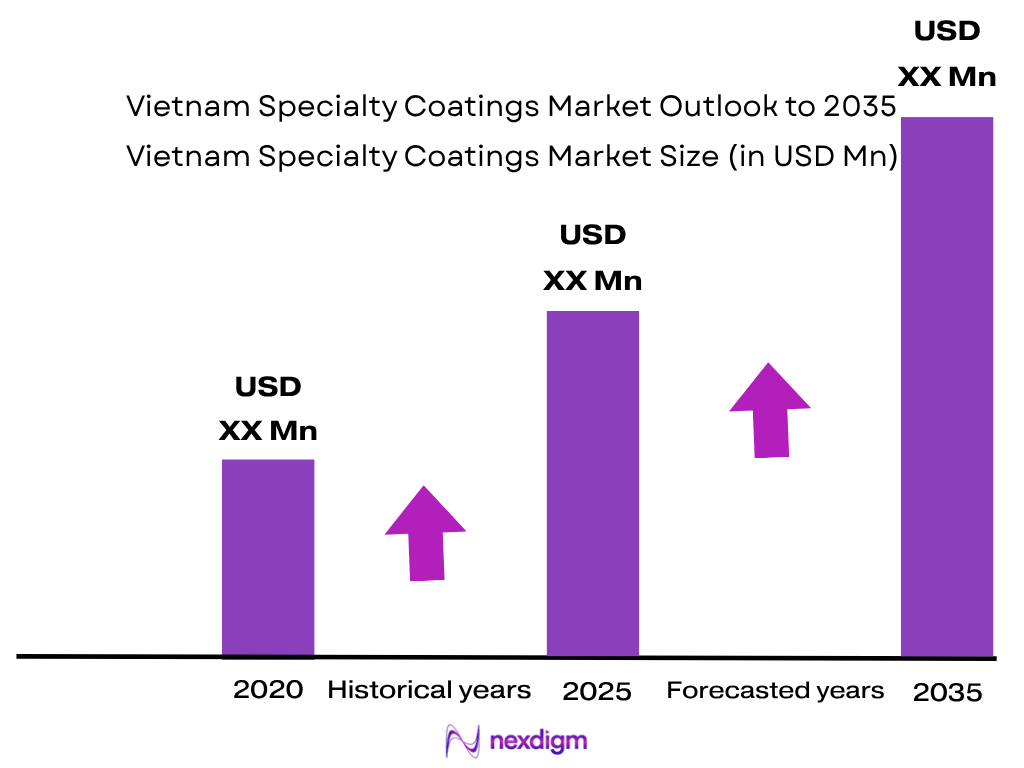
The Vietnam Specialty Coatings Market is valued at approximately USD ~ million, used as the report placeholder for the requested market definition. Public benchmarks place Vietnam’s broader paints and coatings market at USD 2.95 billion, while industrial-coatings studies confirm a substantial specification-driven submarket. Demand is supported by electronics exports increasing from USD 57.3 billion in the preceding reported period to USD 72.6 billion in the latest full-year period, alongside expanding automotive, machinery and industrial production.
Bắc Ninh, Đồng Nai, Ho Chi Minh City and Hải Phòng form the principal specialty-coatings demand clusters because they combine electronics, automotive components, fabricated metals, shipbuilding and industrial manufacturing. Samsung’s Vietnamese manufacturing operations generated USD 62.5 billion in revenue and USD 54.4 billion in exports in the latest reported period, with major operations in Bắc Ninh. Đồng Nai’s industrial zones attracted USD 1.36 billion in investment and host extensive supporting-industry manufacturing, reinforcing demand for powder, protective and industrial coatings.
Market Segmentation
By Coating Type
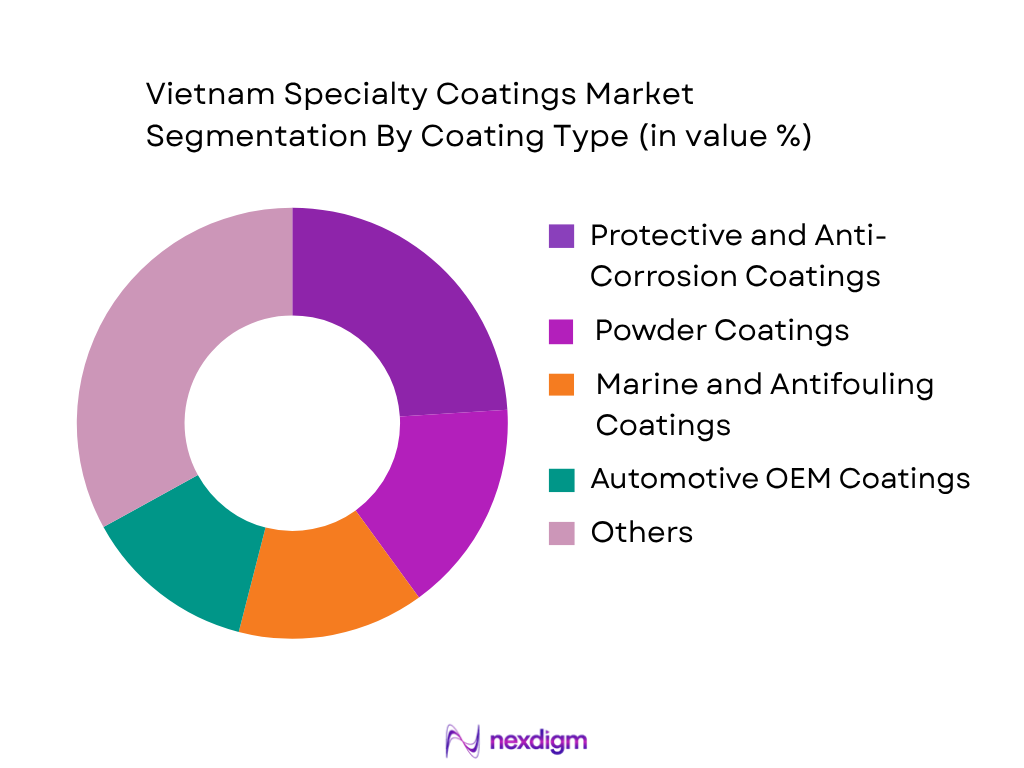
Vietnam Specialty Coatings Market is segmented by coating type into protective and anti-corrosion coatings, marine coatings, automotive OEM coatings, automotive refinish coatings, powder coatings, electronics coatings, coil coatings, industrial wood coatings and industrial flooring coatings. Protective and anti-corrosion coatings hold the dominant share due to Vietnam’s large installed base of factories, steel structures, ports, logistics facilities, energy assets and coastal infrastructure exposed to humidity, salt and industrial chemicals. Heavy industrial users increasingly require epoxy and polyurethane systems capable of extending maintenance intervals and reducing lifecycle costs. Marine and powder coatings also represent important demand pools because of ship repair, metal fabrication, appliances and export manufacturing. Vietnam’s manufacturing IIP strengthened markedly during 2024, including strong growth in motor vehicles, furniture, chemicals and electrical equipment, creating an increasingly diversified requirement for specification-led coating systems.
By Resin Type
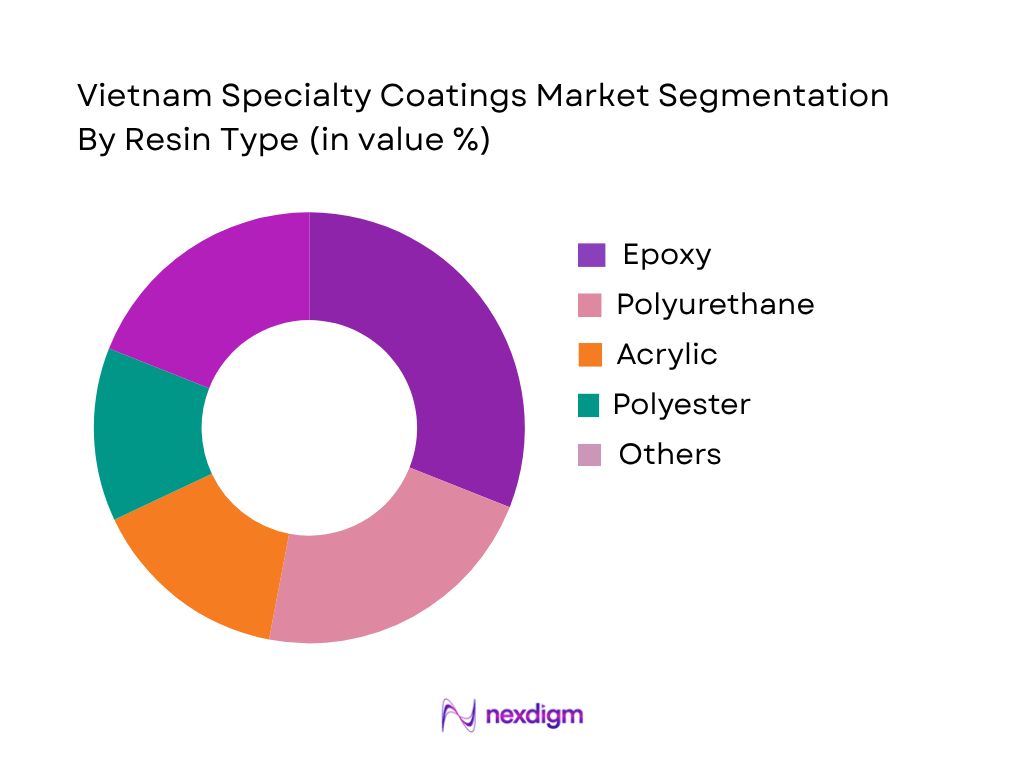
Vietnam Specialty Coatings Market is segmented by resin type into epoxy, polyurethane, acrylic, polyester, alkyd, fluoropolymer/PVDF, silicone, vinyl and other performance resin systems. Epoxy resins hold the dominant market share because their adhesion, corrosion resistance, chemical resistance and high-build capability make them central to protective primers, marine systems, industrial floors, steel structures, tank linings and factory maintenance coatings. Vietnam’s humid tropical climate and long coastline further increase requirements for robust corrosion-control systems. Polyurethane follows because of its weatherability, appearance retention and use in automotive, industrial and protective topcoats, while polyester demand is strongly connected with powder coatings. PVDF remains smaller in volume but strategically important in premium coil and architectural metal applications. Supplier portfolios from companies such as KCC illustrate the market’s use of epoxy, urethane, fluoropolymer and high-solids technologies across industrial applications.
Competitive Landscape
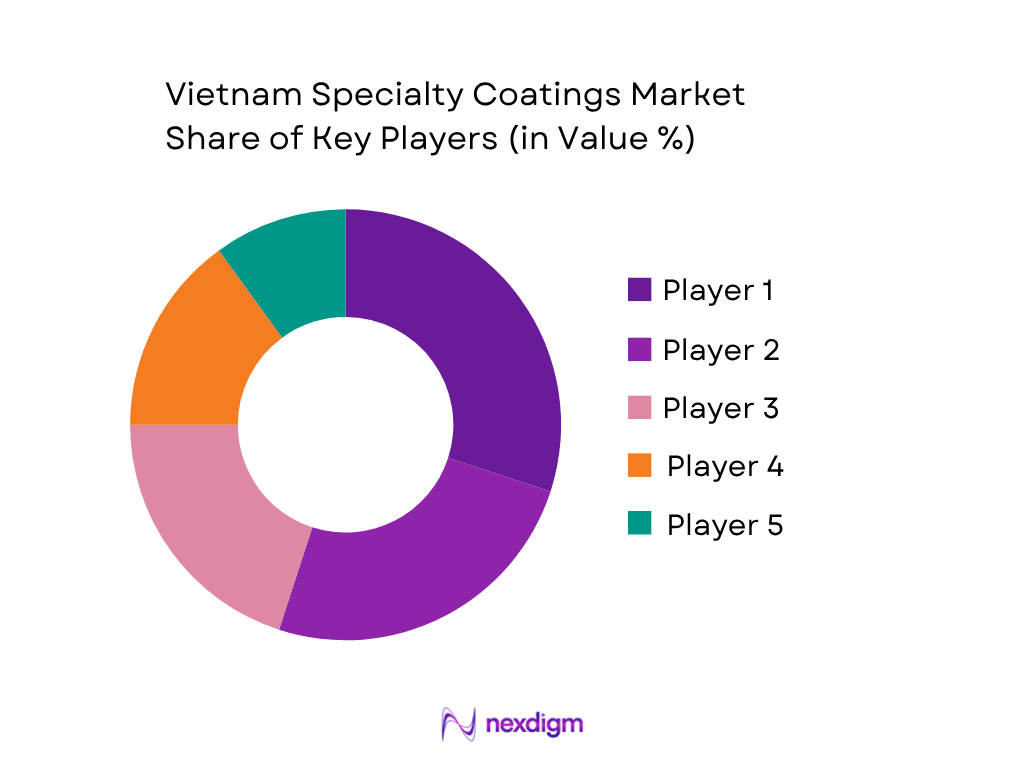
The Vietnam Specialty Coatings Market is characterized by competition between major multinational coatings companies and established regional suppliers. AkzoNobel, Jotun, Nippon Paint, PPG and KCC possess particularly relevant capabilities because their portfolios extend beyond decorative paints into industrial, automotive, marine, powder, electronics and protective applications. Competition is increasingly influenced by local manufacturing capacity, OEM approvals, technical service, sustainability credentials, formulation capability and proximity to Vietnam’s northern and southern industrial clusters.
| Company | Establishment Year | Headquarters | Vietnam Manufacturing Footprint | Key Specialty Portfolio | Core Resin/Technology Capability | Major End Uses | Local Technical Capability | Strategic Positioning |
| AkzoNobel | 1911 | Amsterdam, Netherlands | ~ | ~ | ~ | ~ | ~ | ~ |
| Jotun | 1926 | Sandefjord, Norway | ~ | ~ | ~ | ~ | ~ | ~ |
| Nippon Paint | 1881 | Tokyo, Japan | ~ | ~ | ~ | ~ | ~ | ~ |
| PPG | 1883 | Pittsburgh, USA | ~ | ~ | ~ | ~ | ~ | ~ |
| KCC | 1958 | Seoul, South Korea | ~ | ~ | ~ | ~ | ~ | ~ |
Vietnam Specialty Coatings Market Analysis
Market Growth Drivers
Export-Oriented Electronics, Automotive and Industrial Manufacturing Expansion
Vietnam’s expanding manufacturing base is a direct demand engine for specialty coatings used on electronic housings, automotive components, machinery, fabricated metal, electrical equipment and export furniture. World Bank data place Vietnam’s manufacturing value added at USD 116.38 billion in 2024, demonstrating the economic scale of industries requiring industrial surface finishing. Electronics, computers and components generated USD 72.6 billion in merchandise exports, while phones and components contributed USD 53.9 billion, machinery and equipment reached USD 52.3 billion, wood and wood products reached USD 16.3 billion, and transport equipment and parts generated USD 15.1 billion. These industries create recurring requirements for powder coatings, polyurethane systems, acrylic finishes, electronic-device coatings, automotive OEM coatings and industrial wood finishes. The industrial production data reinforce this demand environment: production of motor vehicles, furniture, chemicals, electrical equipment and electronic products all expanded during 2024. For specialty-coating suppliers, the breadth of Vietnam’s export manufacturing base is particularly significant because international OEM supply chains require controlled adhesion, corrosion protection, appearance, chemical resistance and repeatable coating quality rather than standard decorative formulations.
Manufacturing FDI and New Industrial Capacity Formation
Foreign direct investment is strengthening the addressable customer base for Vietnam specialty coatings because new factories require coating systems during equipment installation, building commissioning and subsequent production. Vietnam received USD 38.23 billion in registered foreign investment in 2024, comprising 3,375 newly licensed projects with USD 19.7 billion of capital and 1,539 existing projects receiving another USD 14.0 billion. Processing and manufacturing alone attracted USD 25.58 billion, making it the largest destination for new foreign capital. At the end of 2024, Vietnam contained 42,002 valid foreign-invested projects carrying approximately USD 502.8 billion of registered capital, while accumulated investment in processing and manufacturing exceeded USD 308.76 billion. These investments are directly relevant to protective coatings, industrial flooring, powder systems, electronics coatings, coil coatings and automotive finishes because semiconductor, battery, photovoltaic, electronic-component and high-value manufacturing projects require specialized factory surfaces and production-line finishing technologies. The large installed FDI base also favors coating suppliers capable of meeting multinational OEM specifications and providing local technical service, color matching and application engineering near industrial clusters.
Market Challenges
High Dependence on Imported Industrial Inputs and Specialty Raw Materials
Vietnam’s specialty-coatings supply chain remains exposed to imported production inputs, particularly chemicals, plastics, metals, additives, pigments and upstream resin-related materials. Official merchandise data show that Vietnam imported USD 356.43 billion of production materials and capital inputs in 2024. Electronics, computers and components alone accounted for USD 107.1 billion of imports, machinery and industrial equipment reached USD 48.9 billion, iron and steel imports were valued at USD 12.6 billion, and plastics imports reached USD 11.8 billion. This import-intensive industrial structure matters for specialty coatings because epoxy, polyurethane, acrylic, fluoropolymer and advanced additive packages often depend on internationally sourced chemical feedstocks or intermediates. The World Bank also recorded Vietnam’s manufacturing value added at USD 116.38 billion, indicating how a large domestic manufacturing platform relies on substantial flows of imported intermediate goods. For coating formulators, disruption in these material streams can complicate production scheduling, formulation consistency and inventory management, particularly for specification-controlled marine, electronics, automotive and protective systems where substitute raw materials cannot be introduced without technical validation or renewed customer approval.
Complex OEM Qualification Across a Highly Internationalized Manufacturing Base
Vietnam’s specialty-coatings suppliers face demanding technical qualification requirements because the industrial customer base is dominated by globally integrated manufacturers rather than homogeneous domestic buyers. At the end of 2024, the country hosted 42,002 valid foreign-invested projects representing approximately USD 502.8 billion of registered capital and investors from 147 countries and territories. Processing and manufacturing accounted for more than USD 308.76 billion of accumulated registered foreign investment. During 2024 alone, authorities licensed 3,375 new foreign-invested projects and processed capital additions for another 1,539 projects. This diversity creates a fragmented specification environment: Korean electronics manufacturers, Japanese automotive suppliers, European industrial groups and other international OEMs can each impose different coating approvals, curing parameters, restricted-substance requirements, appearance standards and durability tests. The challenge is especially significant for automotive OEM, electronics, coil, marine and high-performance protective coatings, where qualification can require laboratory testing, line trials and consistent batch performance. Suppliers therefore need more than manufacturing capacity; they require local laboratories, application engineering, documentation systems and technical-service teams capable of supporting multiple international customer standards simultaneously.
Market Opportunities
Localization of Advanced Coatings for Electronics and High-Value Manufacturing
Vietnam’s electronics manufacturing platform creates a substantial opportunity for local production of higher-performance coatings rather than continued reliance on imported finished formulations. Electronics, computers and components generated USD 72.6 billion in exports during 2024, while phones and components generated another USD 53.9 billion. Imports of computers, electronic products and components reached USD 107.1 billion, demonstrating the scale of the domestic electronics assembly and component ecosystem. Machinery, equipment and parts exports added USD 52.3 billion, further broadening demand for specialty finishes used on housings, metal components and engineered equipment. Vietnam also attracted USD 25.58 billion of foreign investment into processing and manufacturing, including semiconductor, electronic-component, battery and photovoltaic projects. These current operating indicators support future opportunities for waterborne coatings, powder coatings, plastic-substrate finishes, electrically functional coatings, scratch-resistant systems and high-durability industrial finishes. Suppliers that localize formulation, color matching, quality control and technical troubleshooting near northern electronics clusters can shorten supply chains and respond more effectively to OEM production changes, particularly where global manufacturers require tightly controlled coating performance across large export-oriented production runs.
Expansion of Protective, Marine and Industrial Asset Coating Applications
Vietnam’s continuing industrial-capacity buildout provides a forward opportunity for protective and corrosion-control coatings used across factories, steel structures, utilities, logistics assets and industrial equipment. World Bank data record national manufacturing value added of USD 116.38 billion in 2024, while the Ministry of Planning and Investment recorded USD 308.76 billion of accumulated registered foreign investment in processing and manufacturing at the end of the same period. New manufacturing investment reached USD 25.58 billion, creating additional plants and production assets that require floor protection, structural-steel coatings, chemical-resistant linings and maintenance systems. Vietnam also imported USD 12.6 billion of iron and steel and exported USD 15.1 billion of transport equipment and components, indicators of a large metal-intensive industrial economy requiring surface protection. The opportunity extends beyond initial construction: every additional factory, fabricated-metal asset and production line expands the installed base requiring inspection, repair and recoating over its operating life. This supports future adoption of epoxy primers, polyurethane topcoats, high-solids systems, intumescent coatings, industrial flooring and corrosion-resistant technologies engineered for Vietnam’s humid, coastal and chemically demanding operating environments.
Future Outlook
The Vietnam Specialty Coatings Market is expected to expand steadily through the forecast period, with a placeholder CAGR of approximately ~6.0% during 2026-2035. Demand will increasingly shift toward higher-performance, longer-life and environmentally preferable coating systems as Vietnam deepens its role in electronics, automotive components, metal fabrication and export manufacturing. Expansion of industrial parks and foreign-invested manufacturing will support powder, electronics and general industrial coatings, while ports, coastal infrastructure, steel assets and energy projects will maintain demand for protective and marine technologies. The development of domestic formulation and manufacturing capacity should also reduce delivery lead times and improve application support for Vietnamese OEM customers.
Waterborne, high-solids and powder technologies are expected to gain strategic importance as manufacturers seek lower-VOC processes and greater application efficiency. AkzoNobel’s investment in new powder lines and water-based consumer-electronics capacity demonstrates this technology direction. PPG has similarly expanded sustainable industrial-coating capacity in Bắc Ninh. Vietnam’s manufacturing fundamentals provide an additional demand base. Industrial production increased strongly during the latest reported full year, with particularly significant expansion in motor vehicles, furniture, chemicals, electrical equipment, plastics and electronics. These industries require differentiated coating chemistries rather than standard architectural paints, strengthening the long-term addressable market for specialty suppliers.
Major Players
- AkzoNobel Vietnam
- Jotun Paints Vietnam
- Nippon Paint Vietnam
- PPG Vietnam
- KCC Vietnam
- Hempel Vietnam
- Kansai Paint
- TOA Paint Vietnam
- 4 Oranges
- KOVA
- Beckers Industrial Coatings Vietnam
- Sika Vietnam
- Sherwin-Williams
- Axalta Coating Systems
- Chugoku Marine Paints
Key Target Audience
- Specialty Coatings Manufacturers
- Paint, Resin, Pigment and Coating Raw-Material Suppliers
- Automotive, Electronics, Marine and Industrial OEMs
- Industrial Coating Distributors and Applicators
- EPC, Infrastructure and Asset-Protection Companies
- Investments and Venture Capitalist Firms
- Government and Regulatory Bodies (Ministry of Industry and Trade, Ministry of Agriculture and Environment, Ministry of Construction, Vietnam Chemicals Agency, National Standards Committee)
- Private Equity Firms, Strategic Investors and Industrial Conglomerates
Research Methodology
Step 1: Identification of Key Variables
The initial phase involves constructing an ecosystem map covering specialty-coating manufacturers, resin suppliers, pigment and additive producers, distributors, applicators, OEM customers and industrial end users. Extensive secondary research is used to identify critical variables including coating consumption, resin mix, technology adoption, application intensity, domestic manufacturing capacity, imported supply and realized selling prices.
Step 2: Market Analysis and Construction
Historical market information is analyzed through both top-down and bottom-up frameworks. Top-down analysis evaluates Vietnam’s paints and coatings industry, industrial output, manufacturing activity and end-use production, while bottom-up analysis reconstructs specialty-coating demand from supplier revenues, plant capabilities, distributor throughput and coating consumption across electronics, automotive, marine, steel, wood and industrial applications.
Step 3: Hypothesis Validation and Expert Consultation
Market hypotheses are validated through computer-assisted telephone interviews and structured discussions with coating manufacturers, distributors, raw-material suppliers, applicators, OEM procurement teams and technical professionals. Interviews are designed to validate product pricing, resin consumption, application trends, technology shifts, supplier positioning and competitive intensity while identifying differences between published industry information and actual market operating conditions.
Step 4: Research Synthesis and Final Output
The final phase triangulates company information, government industrial statistics, trade flows, end-user production indicators and primary research findings. Market estimates are reconciled using top-down and bottom-up approaches, followed by segment-level validation. Forecast assumptions consider manufacturing growth, industrial investment, electronics exports, automotive production, coating localization, technology migration and regulatory changes affecting specialty-coating consumption.

- Executive Summary
- Research Methodology (Market Definition and Scope, Vietnam Specialty Coatings Taxonomy, Coating Chemistry Classification, Functional Performance Mapping, Market Sizing Framework, Top-Down Analysis, Bottom-Up Analysis, Domestic Production Assessment, Import Dependency Assessment, Demand-Side Assessment, Supply-Side Assessment, End-Use Application Mapping, Industrial Consumption Assessment, Primary Industry Interviews, Trade-Flow Validation, Data Triangulation, Forecasting Framework, Scenario Analysis, Assumptions and Limitations)

- Definition and Scope
- Vietnam Specialty Coatings Industry Evolution and Technology Development
- Specialty Coatings Manufacturing and Formulation Process
- Specialty Coatings Value Chain Analysis
- Vietnam Specialty Coatings Supply Chain Analysis

- Growth Drivers (Electronics Manufacturing Expansion, Automotive and Motorcycle Production Growth, Industrial Park Development, Export-Oriented Manufacturing, Marine and Port Infrastructure Expansion, Steel and Metal Processing Growth, Asset Corrosion Protection Requirements, Low-VOC Coating Adoption)
- Market Challenges (Imported Raw-Material Dependency, Epoxy and Polyurethane Feedstock Volatility, Solvent Price Fluctuation, OEM Qualification Requirements, Skilled Applicator Constraints, Price Competition, VOC Compliance Costs, Specialty Formulation Complexity)
- Market Opportunities (Electronics Functional Coatings, Waterborne Industrial Coatings, High-Performance Powder Coatings, Marine Protective Coatings, ESD Flooring Systems, High-Solids Epoxy Systems, PVDF Coil Coatings, Premium Automotive Refinish, Renewable-Energy Protective Coatings)
- Market Trends (Waterborne Conversion, Powder Coating Capacity Expansion, High-Solids Technology Adoption, Low-VOC Formulation, Localized OEM Technical Support, Functional Surface Coatings, Fast-Cure Systems, Longer-Life Corrosion Protection)
- Regulatory and Standards Landscape (Lead Content Regulations, VOC Emission Requirements, Chemical Management Regulations, Hazardous Chemical Compliance, Product Labeling Requirements, Environmental Permitting, Industrial Waste Management, Worker Safety Standards)
- SWOT Analysis
- Porter’s Five Forces Analysis
- PESTLE Analysis

- By Market Value (2020-2025)
- By Coating Consumption Volume (2020-2025)
- By Domestic Production Volume (2020-2025)
- By Import Volume (2020-2025)
- By Export Volume (2020-2025)
- By Industrial Coatings Consumption Volume (2020-2025)
- By Specialty Coatings Production Capacity (2020-2025)
- By Average Realized Selling Price (2020-2025)
- By Application Revenue (2020-2025)

- By Coating Type (In Value %)
Protective and Anti-Corrosion Coatings
Marine and Antifouling Coatings
Automotive OEM Coatings
Automotive Refinish Coatings
Powder Coatings
Electronics and Electrical Coatings
Coil Coatings
Industrial Wood Coatings
Industrial Floor Coatings
Fire-Protective and Intumescent Coatings - By Resin Type (In Value %)
Epoxy
Polyurethane
Acrylic
Polyester
Alkyd
Fluoropolymer and PVDF
Silicone
Vinyl
Epoxy-Polyester Hybrid
Other High-Performance Resin Systems - By Technology (In Value %)
Waterborne Coatings
Solvent-Borne Coatings
Powder Coatings
High-Solids Coatings
UV-Cured Coatings
Two-Component Coatings
Moisture-Cured Coatings
Advanced Functional Coatings - By End-Use Industry (In Value %)
Consumer Electronics and Electrical Equipment
Automotive Manufacturing
Motorcycle and Two-Wheeler Manufacturing
Marine, Shipbuilding and Ship Repair
Steel and Metal Fabrication
Oil, Gas and Petrochemicals
Power and Renewable Energy
Industrial and Logistics Infrastructure
Wood and Furniture Manufacturing
Machinery and General Industrial - By Substrate (In Value %)
Carbon Steel
Galvanized Steel
Aluminium
Stainless Steel
Concrete
Wood and Engineered Wood
Plastics and Engineering Polymers
Composite Materials
Electronic Components and Housings - By Sales Channel (In Value %)
Direct-to-OEM Sales
Direct Industrial Project Sales
Specialty Coating Distributors
Marine and Protective Coating Distributors
Automotive Refinish Distributors
Industrial Applicators and Contractors
EPC and Specification Sales
Dealer and Specialist Retail Networks

- Market Share of Major Players (By Revenue, Volume, Coating Type, Resin Type, Technology, Application, End-Use Industry, Distribution Channel)
- Cross Comparison Parameters (Specialty Coating Portfolio Breadth, Vietnam Installed Manufacturing Capacity, Resin and Technology Coverage, OEM and Specification Approval Depth, Marine and Protective Project Presence, Electronics and Automotive OEM Penetration, Local Technical Service and R&D Capability, Distribution and Industrial-Cluster Reach)
- SWOT Analysis of Major Players
- Detailed Profiles of Major Companies
AkzoNobel Vietnam
Jotun Paints Vietnam
Nippon Paint Vietnam
PPG Vietnam
KCC Vietnam
Hempel Vietnam
Kansai Paint
TOA Paint Vietnam
4 Oranges
KOVA
Beckers Industrial Coatings Vietnam
Sika Vietnam
Sherwin-Williams
Axalta Coating Systems
Chugoku Marine Paints

- Buyer Segmentation
- Procurement Behaviour
- Supplier Selection Criteria
- Buyer Pain Points
- Technology Adoption Assessment
- Replacement and Repurchase Behaviour

- By Market Value (2026-2035)
- By Coating Consumption Volume (2026-2035)
- By Domestic Production Volume (2026-2035)
- By Import Volume (2026-2035)
- By Export Volume (2026-2035)
- By Industrial Coatings Consumption Volume (2026-2035)
- By Specialty Coatings Production Capacity (2026-2035)
- By Average Realized Selling Price (2026-2035)
- By Application Revenue (2026-2035)


 Request a Sample
 Ask for Customization
 Get a Quote
 Enquire Now