
 Download PDF
 Download PDF
Market Overview
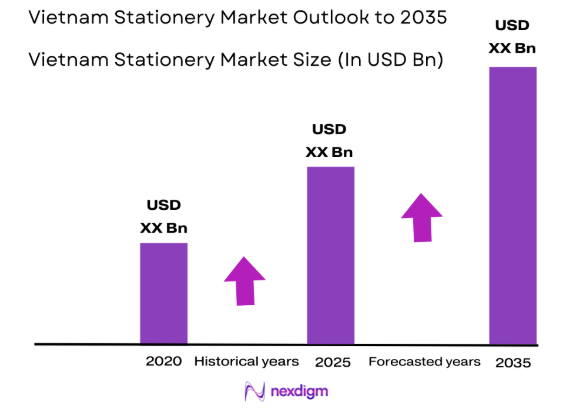
The Vietnam Stationery market current size stands at around USD ~ million, supported by steady replacement demand from schools, offices, households, and creative users. Category consumption remains broad-based across writing instruments, notebooks, student accessories, and art supplies, with recurring purchase cycles sustaining stable movement through both institutional and retail channels. Product depth has expanded as buyers increasingly seek better design, smoother writing performance, improved durability, refill options, and more organized study and work essentials, while local manufacturing and imported assortments continue to shape shelf availability across mainstream and premium stationery ranges.
Demand concentration in the Vietnam Stationery market is strongest in Ho Chi Minh City and Hanoi, where dense school networks, corporate office clusters, modern retail penetration, and stronger e-commerce fulfillment support higher product circulation. Hai Phong and Da Nang are also important secondary consumption centers due to growing urban household demand and improving commercial infrastructure. Southern Vietnam benefits from deeper wholesale linkages and distribution efficiency, while Northern Vietnam retains strong institutional procurement activity. Regional demand is also influenced by localized education spending patterns, urbanization intensity, and increasing consumer exposure to branded and design-led stationery products.
Market Segmentation
By Category
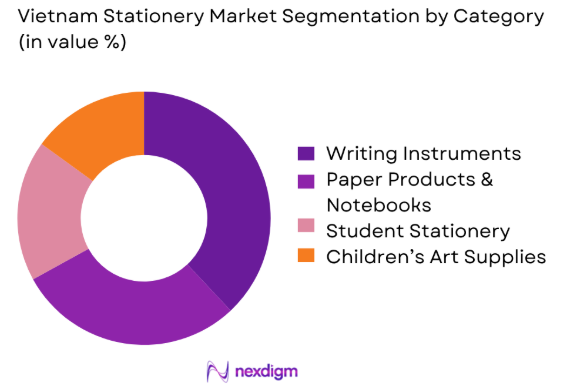
Writing Instruments remain the dominant category within the Vietnam Stationery market due to their high purchase frequency, broad use across students and office workers, and strong replacement demand. Pens, pencils, and refills are everyday essentials, giving this segment a larger consumption base than more occasional purchase categories. Gel pens and ballpoint pens perform especially well because they combine affordability with functional convenience. Paper products and notebooks follow closely, supported by school demand and note-taking habits, while student stationery and children’s art supplies benefit from seasonal and curriculum-linked buying cycles. Category dominance is also reinforced by easy shelf visibility, low unit decision complexity, and widespread availability across traditional and modern retail channels nationwide.
By Distribution Channel
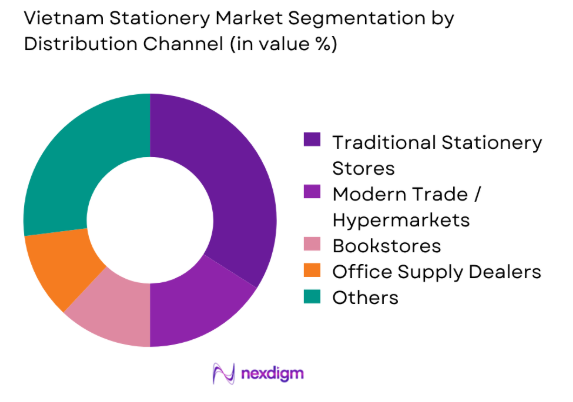
Traditional stationery stores continue to dominate the Vietnam Stationery market because they remain deeply embedded in neighborhood purchasing behavior, especially for school-related and low-ticket daily needs. These outlets benefit from convenience, proximity to schools and residential clusters, and the ability to stock localized assortments. Modern trade and bookstores perform well in urban centers, while e-commerce is gaining momentum among younger consumers and office buyers seeking variety and bundled value. Office supply dealers and direct institutional sales remain important for business and school procurement. Distribution leadership depends not only on store presence, but also on replenishment speed, retailer relationships, merchandising flexibility, and seasonal inventory responsiveness during peak education and office buying cycles.
Competitive Landscape
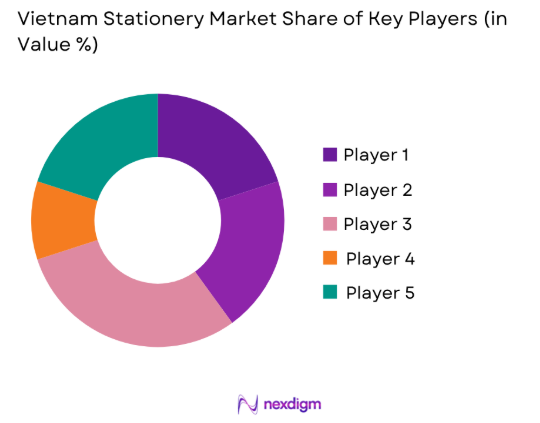
The Vietnam Stationery market is moderately fragmented, with domestic leaders maintaining strong school and office distribution while international brands compete through product quality, brand familiarity, and premium positioning. Competitive strength is largely shaped by portfolio breadth, retail presence, refill ecosystems, institutional supply capability, and omnichannel adaptability.
| Company Name | Establishment Year | Headquarters | Formulation Depth | Distribution Reach | Regulatory Readiness | Service Capability | Channel Strength | Pricing Flexibility |
| Thiên Long Group | 1981 | Ho Chi Minh City, Vietnam | ~ | ~ | ~ | ~ | ~ | ~ |
| Hồng Hà Stationery | 1959 | Hanoi, Vietnam | ~ | ~ | ~ | ~ | ~ | ~ |
| Bến Nghé Stationery | 1981 | Ho Chi Minh City, Vietnam | ~ | ~ | ~ | ~ | ~ | ~ |
| Deli Group | 1988 | Ningbo, China | ~ | ~ | ~ | ~ | ~ | ~ |
| Pilot Corporation | 1918 | Tokyo, Japan | ~ | ~ | ~ | ~ | ~ | ~ |
Vietnam Stationery Market Analysis
Growth Drivers
Rising student enrollment and education-related stationery consumption
Vietnam’s education pipeline continues to support recurring stationery demand across public and private learning environments. The country recorded more than 23 million students across general education and vocational systems in 2024, sustaining regular purchases of pens, notebooks, pencils, correction products, rulers, and art materials. Urban enrollment expansion in Ho Chi Minh City and Hanoi has reinforced category turnover, especially before semester openings and examination periods. The literacy rate remained above 95 in 2024, while school participation in lower and upper secondary levels continued to improve. Increased household focus on tutoring, extracurricular learning, and exam preparation also drives more frequent replenishment of study-related stationery items throughout the academic calendar.
Expansion of office-based and hybrid workplace demand
Office-linked stationery consumption remains supported by Vietnam’s expanding formal employment base, especially in services, administration, finance, logistics, education support, and back-office operations. Vietnam’s labor force exceeded 52 million in 2025, while the number of active enterprises continued rising across urban commercial centers. Hybrid work has not eliminated stationery demand; instead, it has diversified purchase occasions between office procurement and household work setups. Demand persists for writing instruments, memo products, filing accessories, planners, and desk organizers used in both centralized and distributed work environments. Growth in coworking spaces, business registrations, and SME formalization in Hanoi, Ho Chi Minh City, and Da Nang continues to reinforce routine office stationery consumption patterns.
Challenges
Price sensitivity in mass-market school and office stationery categories
Price sensitivity remains a structural constraint in Vietnam’s mass stationery segment, especially where parents, schools, and small offices prioritize affordability over brand loyalty. Consumer spending discipline tightened in 2024 as households adjusted non-essential budgets amid broader cost-of-living pressure. This affects conversion into premium pens, imported notebooks, branded art supplies, and refill-led systems. Many retailers therefore continue to depend on high-volume, low-margin categories such as ballpoint pens, pencils, and basic notebooks. Informal retail and wholesale clusters further intensify discount-driven competition, making differentiation difficult. As a result, suppliers often face limited pricing power despite product upgrades, stronger packaging, or enhanced writing performance across mainstream stationery categories.
Dependence on imported raw materials and finished goods in select segments
Vietnam’s stationery ecosystem still relies on imported inputs and finished products in several categories, especially premium writing instruments, specialized inks, art materials, and certain paper-based formats. This creates vulnerability to shipping delays, exchange-rate pressure, and uneven inventory cycles. In 2024 and 2025, businesses across consumer goods sectors continued to manage supply uncertainty linked to imported industrial materials and regional logistics variability. Stationery brands that depend on overseas sourcing face longer replenishment windows and reduced flexibility in responding to promotional peaks or school-season demand surges. This challenge is particularly visible in premium and niche categories where domestic substitution remains limited and product quality consistency is tightly linked to imported manufacturing ecosystems.
Opportunities
Rising demand for eco-friendly and recycled stationery products
Sustainability-led product development is emerging as a meaningful growth avenue in the Vietnam Stationery market, particularly among urban households, premium school buyers, modern retailers, and multinational office purchasers. Vietnam’s policy environment has become more supportive of waste reduction, circular packaging, and greener consumer products, creating room for recycled paper notebooks, refillable pens, and lower-plastic stationery formats. Younger consumers in major cities are increasingly responsive to reusable, minimalist, and environmentally conscious products, especially in premium and lifestyle stationery categories. Brands that align product design with sustainability narratives can improve shelf differentiation and institutional relevance. This opportunity is strongest in modern trade, bookstores, gifting formats, and digitally led direct-to-consumer stationery channels.
Premiumization in gifting, journaling, and aesthetic stationery categories
Aesthetic consumption is reshaping demand in select stationery categories, opening premiumization opportunities beyond functional school and office use. Urban Gen Z and young working consumers are increasingly purchasing journals, planners, imported pens, pastel-themed accessories, and design-oriented paper products for self-expression, gifting, and productivity routines. Vietnam’s digital commerce ecosystem, especially short-form video and social commerce channels, has accelerated visibility for curated stationery kits, collectible writing tools, and niche imported brands. This shift allows suppliers to move beyond commodity positioning into higher-margin, design-led segments. Premium stationery also benefits from occasions such as school milestones, office gifting, seasonal campaigns, and lifestyle-led purchases, particularly in Hanoi and Ho Chi Minh City.
Future Outlook
The Vietnam Stationery market is expected to remain resilient through 2035, supported by sustained education demand, urban office activity, and broader consumer interest in organized study and lifestyle stationery. Growth will likely become more segmented, with mass categories retaining scale while premium, eco-friendly, and design-led products expand faster. Omnichannel retail, localized product development, and institutional supply capabilities will shape competitive advantage. Demand intensity should remain highest in major urban centers while secondary cities offer expansion headroom.
Major Players
- Thiên Long Group
- Hồng Hà Stationery
- Bến Nghé Stationery
- Deli Group
- M&G Stationery
- BIC
- Pilot Corporation
- Pentel
- Mitsubishi Pencil
- Zebra Pen
- Maped
- Faber-Castell
- Kokuyo
- Plus Corporation
- Newell Brands
Key Target Audience
- Stationery manufacturers and brand owners
- Writing instruments and paper product distributors
- Modern trade and bookstore retail chains
- E-commerce marketplaces and online stationery sellers
- Corporate and institutional procurement departments
- Investments and venture capital firms
- Ministry of Industry and Trade, Vietnam Competition Commission, and Directorate for Standards, Metrology and Quality
- Packaging, printing, and stationery component suppliers
Research Methodology
Step 1: Identification of Key Variables
The research process began with defining the stationery value chain across writing instruments, notebooks, student accessories, office supplies, and children’s art products. Core variables included institutional demand, retail turnover, product mix evolution, pricing architecture, distribution density, import dependence, and regional consumption intensity. Channel-specific purchase behavior and end-user concentration were also mapped.
Step 2: Market Analysis and Construction
The market was constructed through a bottom-up review of product categories, end-user demand clusters, and distribution pathways across Vietnam. Analytical modeling incorporated retail movement, school and office consumption logic, urban demand concentration, product replacement cycles, and premiumization trends. Segmentation was then structured by product category and end-user demand relevance.
Step 3: Hypothesis Validation and Expert Consultation
Preliminary assumptions were tested against commercial realities such as procurement behavior, shelf rotation, seasonal demand spikes, refill patterns, and institutional ordering practices. Validation focused on verifying category dominance, regional demand pockets, premium adoption, and supply-side constraints. Expert interpretation helped refine segment weightings, market structure assumptions, and competitive positioning dynamics.
Step 4: Research Synthesis and Final Output
All validated findings were synthesized into a structured analytical framework aligned with consulting-grade reporting standards. Final output development prioritized commercial clarity, segment relevance, competitive logic, and decision-useful interpretation. The report was designed to support strategic planning, channel prioritization, product portfolio decisions, and long-term opportunity mapping within the Vietnam Stationery market.

- Executive Summary
- Research Methodology (Market Definitions and Product Scope, Retail and Institutional Demand Mapping, Import-Export and Trade Flow Assessment, Distribution Channel and Pricing Benchmarking, Consumer and Office Supply Purchase Behavior Analysis, Competitive Intelligence and Brand Tracking, Forecast Modeling and Assumption Framework)

- Definition and Scope
- Market Evolution
- Usage Patterns Across Education, Office, and Household Segments
- Ecosystem Structure
- Supply Chain and Distribution Channel Structure
- Regulatory Environment

- Growth Drivers
Rising student enrollment and education-related stationery consumption
Expansion of office-based and hybrid workplace demand
Growth in organized retail and modern trade distribution
Increasing penetration of e-commerce for school and office supplies
Higher demand for creative, art, and hobby stationery among younger consumers
Growing consumer preference for branded and premium stationery products - Challenges
Price sensitivity in mass-market school and office stationery categories
Dependence on imported raw materials and finished goods in select segments
Intense competition from low-cost unorganized and private label products
Margin pressure across distributors and retailers due to discount-led selling
Counterfeit and imitation branded stationery in informal channels
Demand volatility linked to academic calendars and office procurement cycles - Opportunities
Rising demand for eco-friendly and recycled stationery products
Premiumization in gifting, journaling, and aesthetic stationery categories
Institutional supply opportunities from schools, corporates, and government offices
Product innovation in ergonomic, refillable, and multifunctional stationery
Expansion into tier 2 and tier 3 cities through omnichannel distribution
Localized branding and Vietnam-focused design themes for consumer appeal - Trends
Growing popularity of aesthetic and lifestyle stationery among Gen Z consumers
Increased use of bundled back-to-school kits and promotional packs
Shift toward refillable pens and reusable stationery formats
Expansion of digital-first stationery brands via social commerce channels
Rising demand for planners, journals, and productivity-oriented paper products
Broader assortment of imported Japanese and Korean stationery brands - Government Regulations
- SWOT Analysis
- Stakeholder and Ecosystem Analysis
- Porter’s Five Forces Analysis
- Competition Intensity and Ecosystem Mapping

- By Value, 2020–2025
- By Volume, 2020–2025
- By Distribution Channel, 2020–2025
- By Average Selling Price, 2020–2025

- By Category (in Value %)
Writing Instruments
– Gel Pens
– Ballpoint Pens (Medium Oil-Based)
– Heat-Erasable Pens
– Highlighters
– Fountain Pens
– Pencils
– Refills
Paper Products & Notebooks (in Value %)
– Exercise Books / Workbooks
– Notebooks
– Other Paper Products
Student Stationery
– Erasers
– Correction Tape / Liquid – Sharpeners
– Rulers & Compasses
– Pencil Cases / Bags
Children’s Art Supplies
– Markers / Watercolor Pens
– Paints
– Crayons
– Oil Pastels
– Colored Pencils
- By End User (in Value %)
Students
Educational Institutions
Corporate Offices
Government Offices
SMEs and Small Businesses
Households
Artists and Hobby Users - By Age Group (in Value %)
Children (3–12 Years)
Teenagers (13–18 Years)
Young Adults (19–24 Years)
Adults (25–44 Years)
Mature Adults (45 Years and Above) - By Distribution Channel (in Value %)
Traditional Stationery Stores
Modern Trade / Hypermarkets
Bookstores
Office Supply Dealers
E-commerce Marketplaces
Direct Institutional Sales
Wholesale / Distributors - By Region (in Value %)
Northern Vietnam
Hanoi
Hai Phong
Central Vietnam
Da Nang
Hue
Southern Vietnam
Ho Chi Minh City
Can Tho

- Market Structure and Competitive Positioning
- Market Share Snapshot of Major Players
- By Value, 2025
- By Volume, 2025
- Cross Comparison Parameters (Product Portfolio Breadth with pricing by SKU, Core Category Strength, Price Positioning, Brand Recognition, Product Quality Perception, Revenue, Revenue split by products, Revenue split by distribution channel, Distribution Reach, Traditional Trade Presence, Modern Trade Presence, E-commerce Presence, Institutional Sales Strength, School Channel Penetration, Corporate / Office Channel Strength, Innovation Pipeline, Localization / Product Adaptation, Sustainability Positioning, Manufacturing Footprint, Sourcing Footprint, Supply Chain Strength, Promotional Strength, Overall Competitive Position)
- SWOT Analysis of Key Players
- Pricing and Commercial Model Benchmarking
- Detailed Profiles of Major Companies
Thiên Long Group
Hồng Hà Stationery
Bến Nghé Stationery
Deli Group
M&G Stationery
BIC
Pilot Corporation
Pentel
Mitsubishi Pencil
Zebra Pen
Maped
Faber-Castell
Kokuyo
Plus Corporation
Newell Brands

- Demand and Utilization Drivers
- Procurement and Tender Dynamics
- Buying Criteria and Vendor Selection
- Need, Desire, and Pain Points
- Current Product Gap in the Market
- Implementation Barriers and Risk Factors
- Post-Purchase Service Expectations

- By Value, 2026–2035
- By Volume, 2026–2035
- By Distribution Channel, 2026–2035
- By Average Selling Price, 2026–2035


 Request a Sample
 Ask for Customization
 Get a Quote
 Enquire Now