
 Download PDF
Market Overview
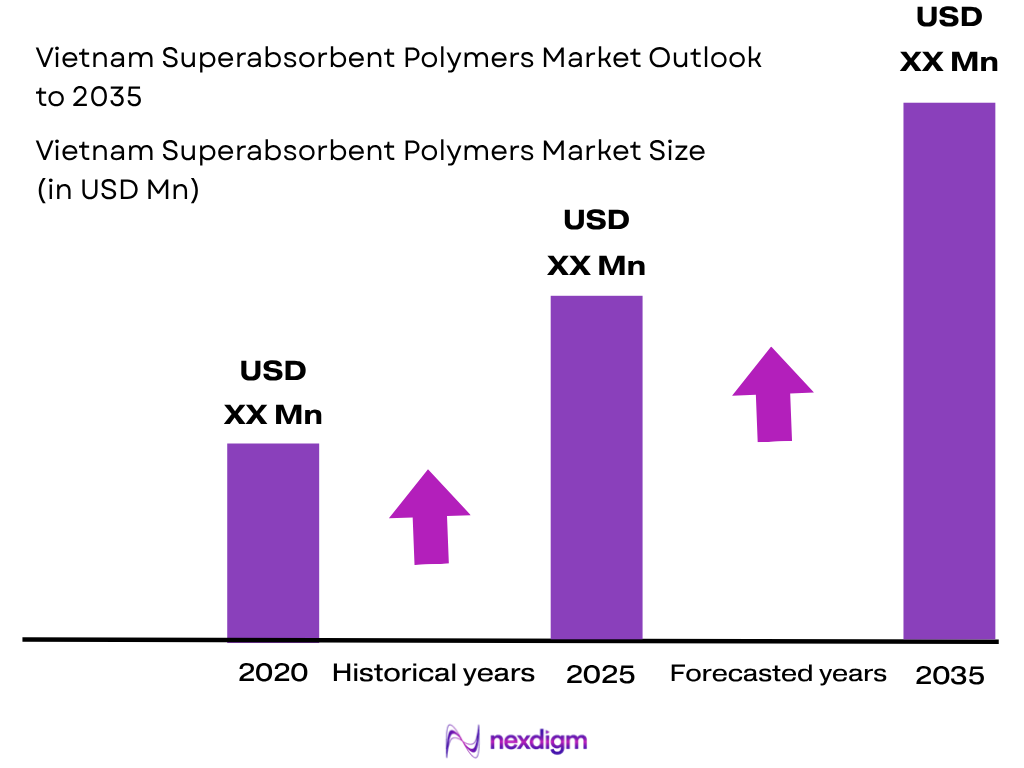
The Vietnam Superabsorbent Polymers Market is estimated at ~USD XX million in the latest historical period, with demand primarily generated by disposable diapers, feminine hygiene products, adult incontinence products and selected medical and agricultural applications. Vietnam’s economic base supports downstream demand, with GDP reaching USD 476.39 billion and GDP per capita reaching USD 4,717.3 in the latest World Bank observations. Industrial production also expanded strongly, with the manufacturing and processing sector increasing by 9.6, supporting broader demand for polymer-based materials and converted hygiene products.
Demand for superabsorbent polymers is concentrated around Vietnam’s principal manufacturing and consumption centers, particularly Ho Chi Minh City, Hanoi, Binh Duong, Dong Nai and Hai Phong, where consumer-goods manufacturing, industrial activity, logistics and export-oriented production are concentrated. Vietnam’s population reached 101,112,656 in the latest national census reference, while the country recorded 405.53 billion USD of goods exports and 380.76 billion USD of imports, demonstrating the scale of its manufacturing and trading ecosystem. Electronics, machinery, textiles, footwear and wood products are particularly important industrial clusters supporting broader material demand.
Market Segmentation
By Product Type
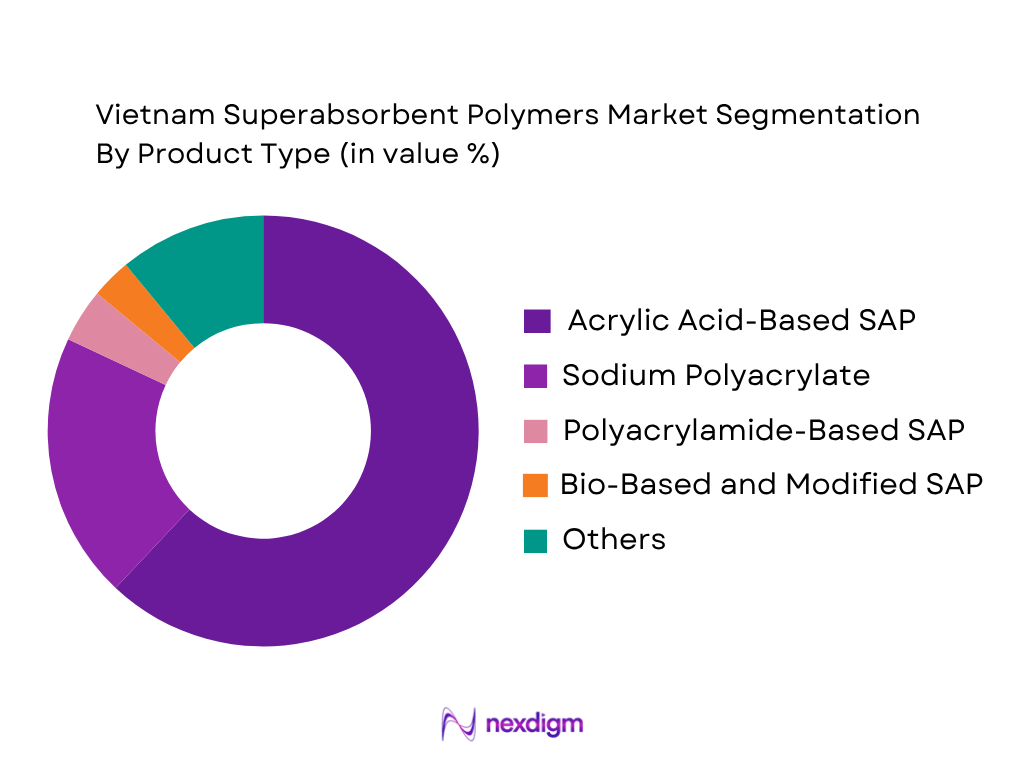
The Vietnam Superabsorbent Polymers Market is segmented by product type into acrylic acid-based SAP, sodium polyacrylate, polyacrylate/polyacrylamide copolymers, polyacrylamide-based SAP, bio-based and modified SAP, and other specialty SAP grades. Acrylic acid-based SAP represents the dominant product category because conventional disposable diapers and feminine hygiene products require polymers capable of rapid liquid uptake, high swelling capacity and strong liquid retention. The extensive use of SAP in absorbent cores makes acrylic-based formulations the established material choice for high-volume hygiene applications. Vietnam’s population of more than 101 million creates a substantial underlying consumer base, while the country’s manufacturing sector provides infrastructure for converting imported absorbent materials into finished hygiene products. Demand is also reinforced by Vietnam’s export-oriented manufacturing system: goods exports reached USD 405.53 billion, with processing-industry products accounting for USD 356.74 billion. This industrial orientation supports the development of increasingly automated hygiene-product manufacturing and creates demand for consistent SAP particle size, absorption performance and gel-strength characteristics.
By Application
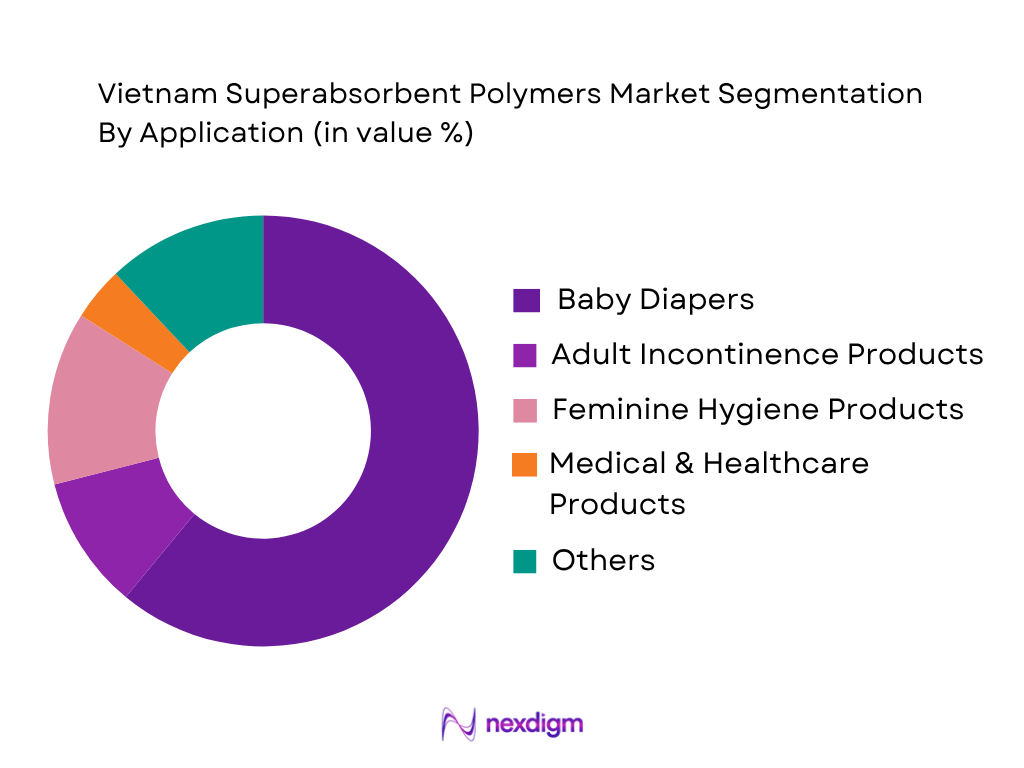
The Vietnam Superabsorbent Polymers Market is segmented by application into baby diapers, adult incontinence products, feminine hygiene products, medical absorbent products, agriculture and horticulture, industrial absorbent applications and other specialty applications. Baby diapers represent the dominant application because SAP is central to modern absorbent-core construction, providing liquid retention while allowing manufacturers to reduce product thickness and improve leakage protection. Vietnam’s demographic base remains significant, with the national population exceeding 101 million, while the country’s demographic structure is simultaneously changing. The national statistics office recorded 14.2 million people aged 60 and above, highlighting the emerging importance of adult-care applications alongside established infant-care demand. The country’s economic development also supports broader hygiene-product manufacturing: GDP reached USD 476.39 billion, while industrial production increased by 8.4. The combination of large-scale consumer demand, expanding manufacturing infrastructure and changing demographic requirements creates opportunities for differentiated SAP grades designed around absorption speed, retention under pressure, low rewet and improved gel strength.
Competitive Landscape
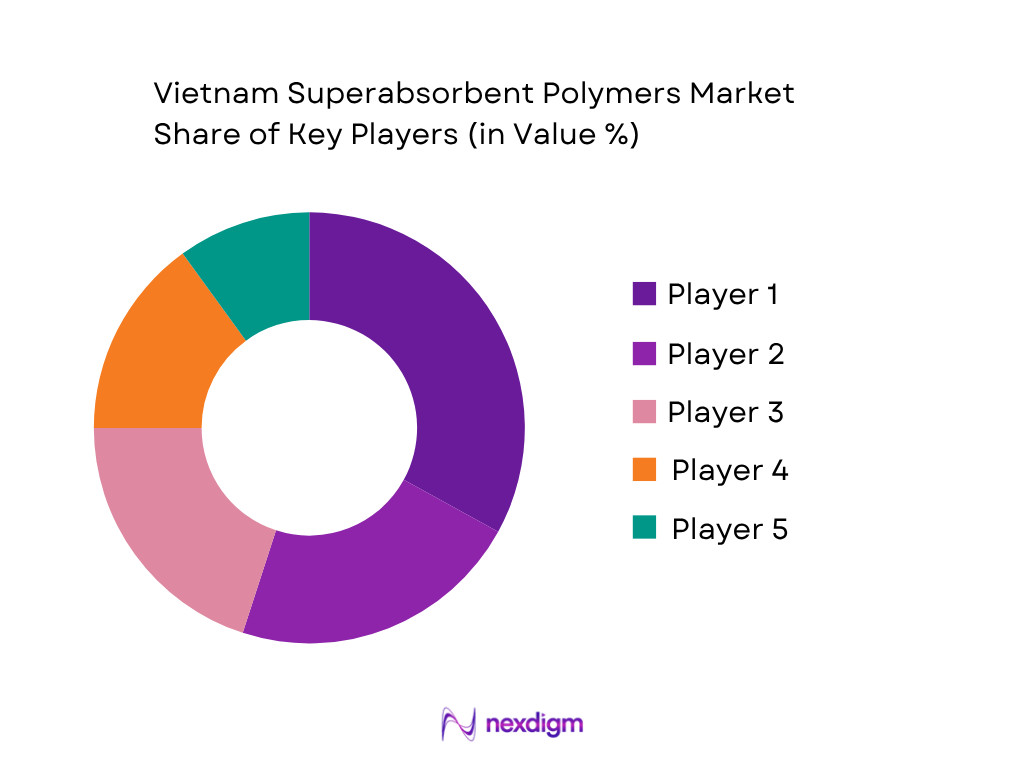
The Vietnam Superabsorbent Polymers Market includes international polymer manufacturers, Asian specialty-chemical producers and regional suppliers serving Vietnam’s hygiene-product manufacturing base through direct sales, distributors and import channels. Competitive differentiation is centered on SAP absorption capacity, centrifuge retention capacity, gel strength, particle-size distribution, surface crosslinking, rewet performance, supply reliability and technical support. Vietnam’s manufacturing ecosystem strengthens the relevance of these parameters, with electronics, machinery, plastics and other processing industries expanding alongside export-oriented production. Major suppliers therefore compete not only through polymer performance but also through regional supply availability and technical qualification capabilities.
| Company | Establishment Year | Headquarters | SAP Product Portfolio | Core Application | Production Capability | Vietnam Supply Model | Key Technical Capability |
| Nippon Shokubai Co., Ltd. | 1941 | Osaka, Japan | ~ | ~ | ~ | ~ | ~ |
| Sumitomo Seika Chemicals Co., Ltd. | 1944 | Hyogo, Japan | ~ | ~ | ~ | ~ | ~ |
| BASF SE | 1865 | Ludwigshafen, Germany | ~ | ~ | ~ | ~ | ~ |
| Evonik Industries AG | 2007 | Essen, Germany | ~ | ~ | ~ | ~ | ~ |
| LG Chem Ltd. | 1947 | Seoul, South Korea | ~ | ~ | ~ | ~ | ~ |
Vietnam Superabsorbent Polymers Market Analysis
Growth Drivers
Expansion of Disposable Diaper Manufacturing
Expansion of disposable diaper manufacturing is a key demand driver for the Vietnam Superabsorbent Polymers Market because SAP is the principal high-absorbency material used in modern diaper cores. Vietnam’s population reached 100,987,686 in 2024, while the National Statistics Office reported an average population of approximately 101.3 million. The country’s demographic structure remains favorable for hygiene-product consumption, with 23.3% of the population below 15 years of age and 14.2 million people aged 60 or above. Although these demographic indicators do not directly measure diaper consumption, they demonstrate the scale of both infant-care and emerging adult-care demand. Vietnam’s manufacturing ecosystem further strengthens the downstream opportunity: industrial production increased 8.4% in 2024, while manufacturing and processing increased 9.6%. In the first quarter of 2025, manufacturing and processing increased another 9.5%, while rubber and plastic-product manufacturing increased 12.7%. These figures indicate continuing expansion in industrial processing relevant to hygiene-product conversion, packaging and polymer-intensive manufacturing. The country’s goods exports also reached USD 405.53 billion in 2024, reinforcing Vietnam’s role as an export-oriented manufacturing base. This combination supports greater utilization of high-retention SAP in thinner diapers, improved leakage-control structures and increasingly automated hygiene-product manufacturing.
Rising Elderly Population and Expansion of Hygiene and Healthcare Products
Vietnam’s rapidly changing demographic profile is creating additional demand potential for superabsorbent polymers through adult incontinence, medical absorbent materials and feminine hygiene products. The National Statistics Office recorded 14.2 million people aged 60 and above in the population census reference, while the share of people aged 65 and above reached 9.3%. The number of older people had increased by 2.8 million compared with the earlier census benchmark, demonstrating the expansion of the potential adult-care consumer base. At the same time, Vietnam’s population reached approximately 101.3 million, providing a broad domestic market for hygiene and healthcare products. Economic conditions are also supporting downstream manufacturing: GDP reached USD 476.39 billion in 2024 and GDP per capita reached USD 4,717.3, according to the World Bank. Industrial production increased 8.4%, while manufacturing and processing expanded 9.6%. In the first quarter of 2025, production of rubber and plastic products increased 12.7%, while pharmaceutical and medical-related manufacturing forms part of the country’s increasingly diversified processing ecosystem. These conditions support greater use of SAP grades offering high retention, low rewet and improved absorption under pressure in adult incontinence products, medical pads and other absorbent structures.
Market Challenges
Dependence on Imported SAP Grades and Acrylic Acid Feedstock Exposure
Dependence on imported SAP grades and acrylic-acid-related chemical inputs creates a structural challenge for the Vietnam Superabsorbent Polymers Market because advanced absorbent polymers require specialized production capabilities and reliable upstream chemical supply. Vietnam’s merchandise imports reached USD 380.76 billion in 2024, while imports of production materials reached USD 356.43 billion, demonstrating the scale of the country’s dependence on imported industrial inputs. The country’s total goods trade reached USD 786.29 billion, making international logistics and external supply conditions important to polymer availability. Vietnam’s manufacturing base is expanding rapidly, with industrial production increasing 8.4% and manufacturing and processing increasing 9.6% in 2024. This increases the importance of dependable access to specialty chemical materials as domestic converters scale production. The challenge is particularly relevant for high-performance SAP grades requiring controlled particle-size distribution, surface crosslinking, high centrifuge retention capacity and strong gel performance. Import dependence can increase procurement complexity because hygiene-product manufacturers often qualify specific SAP grades before incorporating them into high-speed converting processes. Vietnam’s foreign-investment manufacturing sector also generated USD 290.94 billion of goods exports in 2024, showing the scale of internationally integrated industrial production that depends on consistent imported materials.
Environmental and End-of-Life Constraints for Conventional SAP Products
Environmental and end-of-life considerations represent a significant challenge because conventional SAP is extensively incorporated into disposable hygiene products, creating waste-management requirements after use. Vietnam’s population reached approximately 101.3 million, while the World Bank reports GDP of USD 476.39 billion, indicating a large and increasingly urbanized consumer economy generating substantial volumes of packaged consumer and hygiene products. The National Statistics Office recorded 14.2 million people aged 60 and above, increasing the relevance of disposable adult-care products alongside infant and feminine hygiene applications. Vietnam’s environmental-management infrastructure is also becoming more important as industrial activity expands: industrial production increased 8.4% in 2024, while the water supply, waste-management and wastewater-treatment sector increased 10.7%. Manufacturing and processing increased 9.6%, indicating continued expansion of material-intensive industrial activity. The challenge for SAP manufacturers is that conventional absorbent polymers are difficult to recover economically from used diapers and other contaminated hygiene products. This limits straightforward recycling and encourages development of materials compatible with improved waste-management systems, reduced material intensity and alternative end-of-life pathways. The issue becomes more relevant as high-absorbency products expand and as Vietnam strengthens environmental controls under its developing circular-economy framework.
Market Opportunities
High-Performance Hygiene-Grade SAP and Adult Incontinence Applications
High-performance hygiene-grade SAP and adult incontinence applications offer a substantial opportunity for the Vietnam Superabsorbent Polymers Market as demographic ageing and manufacturing expansion create demand for specialized absorbent materials. Vietnam has 14.2 million people aged 60 and above, while the population aged 65 and above represents 9.3% of the population, according to the National Statistics Office. The country’s population is approximately 101.3 million, providing a substantial domestic consumer base. Economic capacity is also expanding, with GDP reaching USD 476.39 billion and GDP per capita reaching USD 4,717.3 according to World Bank data. Manufacturing and processing increased 9.6% in 2024, and production of rubber and plastic products increased 12.7% during the first quarter of 2025. These indicators support increasing downstream manufacturing capability for absorbent hygiene products. Advanced SAP grades can enable manufacturers to develop thinner products while maintaining liquid retention, absorption speed and pressure-resistance performance. Adult incontinence products provide an additional application where high-retention and low-rewet characteristics are particularly relevant. Suppliers can therefore expand from standard diaper-grade polymers toward differentiated surface-crosslinked and high-gel-strength products. Vietnam’s export-oriented manufacturing structure, with USD 405.53 billion of goods exports in 2024, also creates potential for locally converted hygiene products to serve regional markets.
Agricultural Water-Retention Applications and Domestic SAP Manufacturing Integration
Agricultural water-retention applications and domestic SAP manufacturing integration provide opportunities to diversify Vietnam’s SAP demand beyond disposable hygiene products. Vietnam’s agricultural economy remains significant, while climate-related water-management requirements are particularly relevant to the Mekong Delta and other agricultural regions. A World Bank-supported sustainable agriculture program in the Mekong Delta has already worked with more than 156,000 rice-farming households on practices designed to reduce water use and improve agricultural sustainability. Vietnam’s broader economic base is also strengthening: GDP reached USD 476.39 billion in 2024 and GDP growth was 7.1, according to the World Bank. Manufacturing and processing increased 9.6%, demonstrating an expanding industrial base capable of supporting specialty-material production. Agricultural SAP formulations can be designed to absorb and retain water around plant roots, potentially supporting moisture management in selected horticulture, nursery and cultivation applications. At the supply level, Vietnam’s goods imports reached USD 380.76 billion, with USD 356.43 billion attributed to production materials, highlighting both the scale of industrial input demand and the potential rationale for greater domestic material integration. Developing local SAP formulation, processing and application expertise could reduce reliance on imported specialty grades while creating a foundation for regional supply.
Future Outlook
Over the forecast period, the Vietnam Superabsorbent Polymers Market is expected to develop through increasing sophistication of hygiene-product manufacturing, greater demand for high-performance absorbent cores and diversification into adult-care, medical and agricultural applications. Vietnam’s manufacturing ecosystem provides a substantial downstream base, with processing and manufacturing production increasing by 9.6 and industrial production increasing by 8.4. The country’s export-oriented structure is also significant, with goods exports reaching USD 405.53 billion. Meanwhile, population ageing creates an additional long-term application pathway: people aged 60 and above already numbered 14.2 million.
Major Players
- Nippon Shokubai Co., Ltd.
- Sumitomo Seika Chemicals Co., Ltd.
- BASF SE
- Evonik Industries AG
- LG Chem Ltd.
- Sanyo Chemical Industries, Ltd.
- Kao Corporation
- Formosa Plastics Corporation
- SNF Group
- Wanhua Chemical Group Co., Ltd.
- Shandong Nuoer Biological Technology Co., Ltd.
- Satellite Chemical Co., Ltd.
- Yixing Danson Technology Co., Ltd.
- Qingdao SOCO New Material Co., Ltd.
- Songwon Industrial Co., Ltd.
Key Target Audience
- Disposable Diaper and Baby Hygiene Product Manufacturers
- Feminine Hygiene Product Manufacturers
- Adult Incontinence and Senior-Care Product Manufacturers
- Medical Absorbent Material Manufacturers
- Agricultural Input and Water-Retention Product Manufacturers
- Investments and Venture Capitalist Firms
- Government and Regulatory Bodies (Ministry of Industry and Trade, Ministry of Agriculture and Environment, Ministry of Health)
- Chemical Importers, Specialty Polymer Distributors and Industrial Raw-Material Suppliers
Research Methodology
Step 1: Identification of Key Variables
The initial phase involves constructing a Vietnam Superabsorbent Polymers ecosystem map covering SAP manufacturers, importers, chemical distributors, hygiene-product converters and downstream users. Key variables include SAP consumption, application mix, polymer chemistry, import dependency, production capacity and downstream hygiene-product output.
Step 2: Market Analysis and Construction
Historical market information is compiled through analysis of SAP supply, downstream hygiene manufacturing, import and export flows and application-level consumption. The assessment separates hygiene-grade SAP from agricultural and industrial applications and evaluates demand through product, application and end-user channels.
Step 3: Hypothesis Validation and Expert Consultation
Market hypotheses are validated through structured discussions with industry participants involved in SAP procurement, hygiene-product manufacturing, polymer distribution and technical formulation. Interviews focus on grade specifications, qualification requirements, supplier selection, absorption performance and procurement practices.
Step 4: Research Synthesis and Final Output
The final stage integrates bottom-up demand estimates with supply-side information and macroeconomic indicators. Data are triangulated across manufacturing activity, trade statistics, demographic indicators, downstream applications and company-level information to establish a consistent Vietnam Superabsorbent Polymers Market assessment.

- Executive Summary
- Research Methodology (Market Definition and Scope, Vietnam Superabsorbent Polymers Market Classification, SAP Product Mapping, Polymer Chemistry Assessment, Production Process Mapping, Application-Level Demand Analysis, Hygiene Product Consumption Assessment, Agricultural Application Assessment, Domestic Supply Assessment, Import Dependency Analysis, Raw Material Supply Mapping, Demand-Side Assessment, Supply-Side Assessment, Top-Down Market Sizing, Bottom-Up Market Sizing, Primary Industry Interviews, Data Triangulation, Forecasting Framework, Market Share Validation, Limitations and Future Conclusions)

- Definition and Scope
- Vietnam Superabsorbent Polymers Industry Evolution
- Superabsorbent Polymers Value Chain Analysis
- Superabsorbent Polymers Supply Chain Analysis

- Growth Drivers (Expansion of Disposable Diaper Manufacturing, Rising Hygiene Product Adoption, Growth of Feminine Hygiene Consumption, Increasing Adult Incontinence Product Demand, Expansion of Healthcare Product Manufacturing, Growth of Agricultural Water-Retention Applications, Urbanization and Modern Retail Expansion, Increasing Demand for High-Absorbency Hygiene Materials)
- Market Challenges (Dependence on Imported SAP Grades, Acrylic Acid Feedstock Exposure, Petrochemical Raw Material Volatility, Limited Domestic SAP Manufacturing Infrastructure, Import Logistics Dependency, Environmental and End-of-Life Concerns, Recycling Limitations for Used Hygiene Products, Product Qualification Requirements, Competition from Alternative Absorbent Materials)
- Market Opportunities (High-Performance Hygiene-Grade SAP, Adult Incontinence Applications, Sustainable and Bio-Based SAP, Agricultural Water-Retention Applications, Medical Absorbent Materials, Surface-Crosslinked High-Retention SAP, Specialty Industrial Absorbents, Domestic SAP Manufacturing, Regional SAP Supply Development, Vietnam-Based Export-Oriented Hygiene Manufacturing)
- Market Trends (Thin Diaper Core Development, Higher SAP Loading in Hygiene Products, Premium Absorbency Grades, Surface-Crosslinked SAP Adoption, Low-Rewet Absorbent Structures, Sustainable SAP Development, Adult Incontinence Product Innovation, Agricultural Hydrogel Applications, Automated Hygiene Product Converting, Localized Regional Supply Chains)
- Government Regulations and Standards (Vietnamese Product Quality Regulations, Chemical Management Requirements, Environmental Protection Regulations, Industrial Chemical Import Requirements, Personal Hygiene Product Safety Requirements, Medical Product Standards, Agricultural Input Regulations, Waste Management Requirements, Packaging and Product Labeling Requirements)
- SWOT Analysis
- Porter’s Five Forces Analysis
- PESTLE Analysis
- Stakeholder Ecosystem
- Competition Ecosystem

- By Market Value (2020-2025)
- By Market Volume (2020-2025)
- By SAP Consumption Volume (2020-2025)
- By Hygiene-Grade SAP Consumption Volume (2020-2025)
- By Non-Hygiene SAP Consumption Volume (2020-2025)

- By Product Type (In Volume %)
Acrylic Acid-Based SAP
Sodium Polyacrylate
Polyacrylate / Polyacrylamide Copolymers
Polyacrylamide-Based SAP
Bio-Based and Modified SAP
Other Superabsorbent Polymer Grades - By Polymerization Process (In Volume %)
Gel Polymerization
Solution Polymerization
Suspension / Inverse-Suspension Polymerization
Cross-Linking and Surface-Cross-Linking Processes
Other Polymerization Routes - By Physical Form (In Volume %)
Powder SAP
Granular SAP
Flake SAP
Fiber-Based SAP
Specialty Formulated SAP - By Application (In Volume %)
Baby Diapers
Adult Incontinence Products
Feminine Hygiene Products
Agriculture and Horticulture
Industrial Absorbent Applications
Other Specialty Applications - By End-User Industry (In Volume %)
Personal Hygiene Product Manufacturers
Healthcare and Medical Product Manufacturers
Agricultural Input Manufacturers
Horticulture and Nursery Operators
Industrial Product Manufacturers
Food and Pharmaceutical Packaging Applications
Other Industrial End Users - By Distribution Channel (In Volume %)
Direct Manufacturer Sales
Authorized Chemical Distributors
Specialty Polymer Distributors
Industrial Chemical Importers
Hygiene Material Suppliers
Online Industrial Procurement Platforms

- Market Share of Major Players (By Vietnam Revenue, SAP Sales Volume, Hygiene-Grade SAP Volume, Product Chemistry, Application Exposure, Production Capacity, Regional Supply Coverage, Import Presence, Customer Coverage, Distribution Network, Technical Support Capability, Product Qualification Coverage)
- Cross Comparison Parameters (SAP Product Portfolio Breadth, Acrylic Acid and Feedstock Integration, SAP Production Capacity, High-Retention Grade Capability, Hygiene Application Coverage, Agriculture-Grade SAP Capability, Vietnam Supply and Distribution Reach, Technical Application and Qualification Support)
- SWOT Analysis of Major Players
- Detailed Profiles of Major Companies
Nippon Shokubai Co., Ltd.
Sumitomo Seika Chemicals Co., Ltd.
BASF SE
Evonik Industries AG
LG Chem Ltd.
Sanyo Chemical Industries, Ltd.
Formosa Plastics Corporation
Kao Corporation
SNF Floerger
Satellite Chemical Co., Ltd.
Shandong Nuoer Biological Technology Co., Ltd.
Yixing Danson Technology Co., Ltd.
Qingdao SOCO New Material Co., Ltd.
Wanhua Chemical Group Co., Ltd.
Songwon Industrial Co., Ltd.

- Baby Diaper Manufacturer SAP Procurement Assessment
- Adult Incontinence Product SAP Requirement Analysis
- Feminine Hygiene Manufacturer Absorbency Requirement Assessment
- Medical Absorbent Product SAP Procurement Analysis
- Agricultural SAP Requirement Assessment

- By Market Value (2026-2035)
- By Market Volume (2026-2035)
- By SAP Consumption Volume (2026-2035)
- By Hygiene-Grad SAP Consumption Volume (2026-2035)
- By Non-Hygiene SAP Consumption Volume (2026-2035)


 Request a Sample
 Ask for Customization
 Get a Quote
 Enquire Now