

 Download PDF
Market Overview
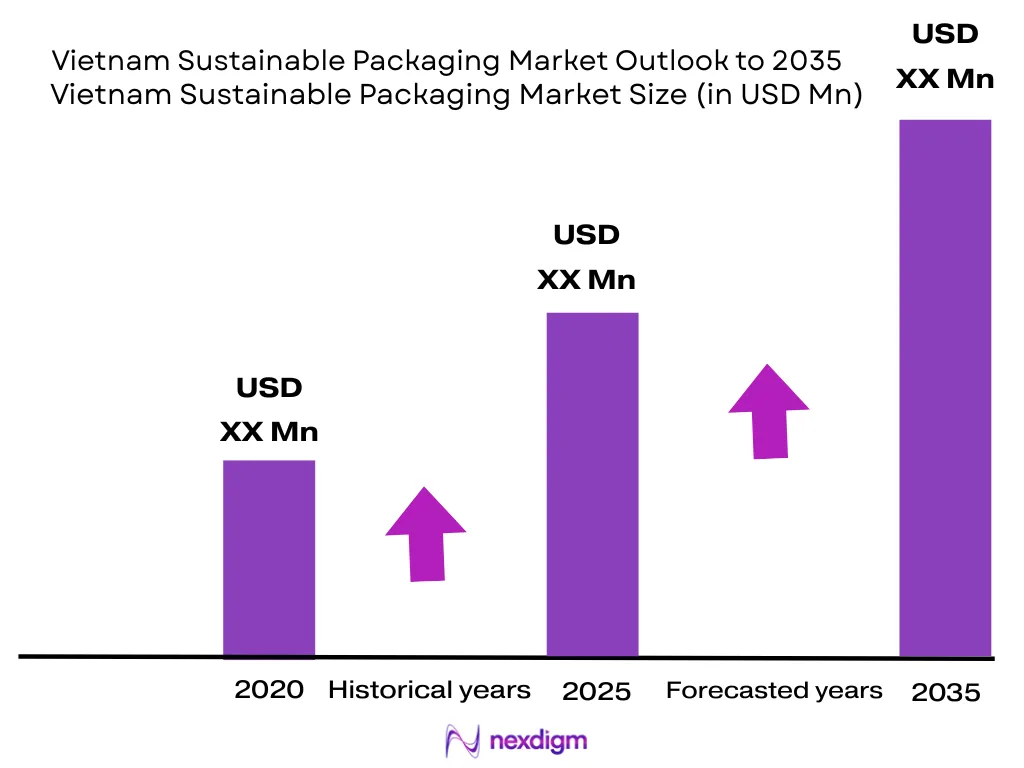
The Vietnam Sustainable Packaging Market is valued at approximately USD ~ million in 2024 and is forecast to expand at a CAGR of % during 2026–2035. Vietnam’s nominal GDP increased from approximately USD 430 billion to USD 476.3 billion, while merchandise exports reached USD 405.53 billion. Demand is supported by food processing, electronics, textiles, seafood exports, modern retail, e-commerce, packaging EPR implementation, and multinational companies’ material-reduction commitments. Ho Chi Minh City, Binh Duong, Dong Nai, Long An, Hanoi, Bac Ninh, Hai Phong, Hung Yen, Da Nang, and Ba Ria–Vung Tau dominate the Vietnam Sustainable Packaging Market. These locations concentrate consumer-goods factories, export manufacturers, industrial parks, ports, packaging converters, paper mills, resin users, recyclers, and distribution centres. Southern Vietnam is particularly strong in flexible, rigid-plastic, carton, paper, and foodservice packaging, while northern clusters serve electronics, food, beverage, textile, and export-oriented manufacturers.
Market Segmentation
By Material Type
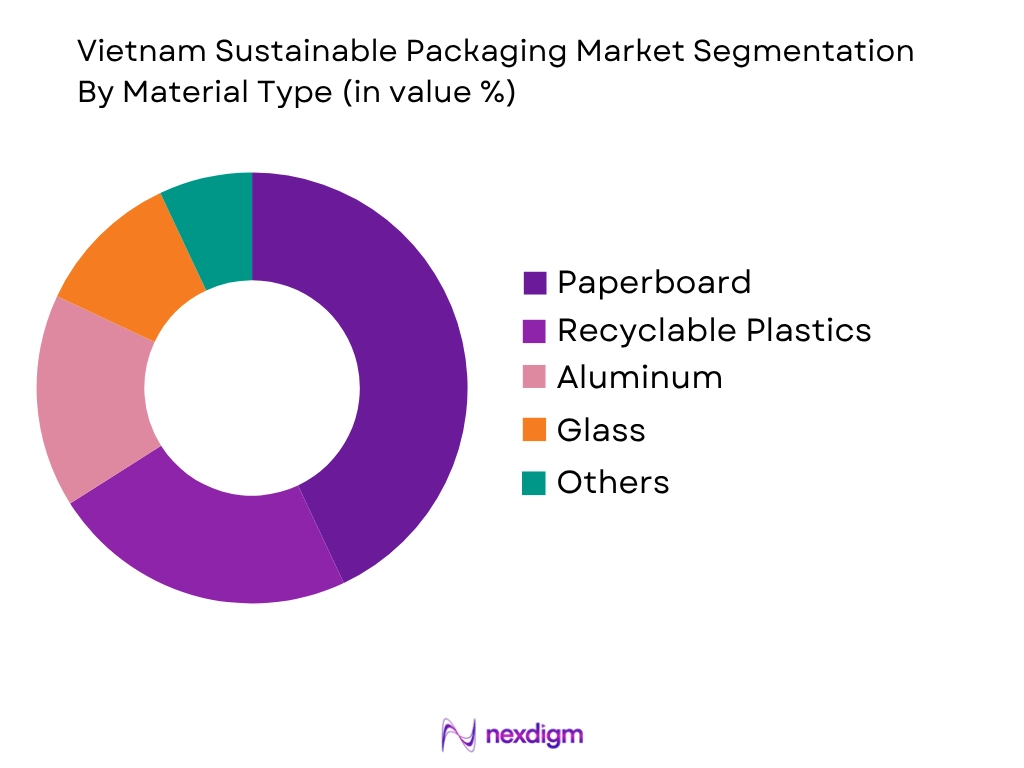
The Vietnam Sustainable Packaging Market is segmented into paper and paperboard, recycled and recyclable plastics, metals, glass, bio-based and compostable materials, bamboo and agricultural fibers, and sustainable multi-material structures. Paper and paperboard hold the dominant position because corrugated cases, cartons, molded-fiber products, paper bags, industrial sacks, and e-commerce mailers serve food, beverages, electronics, footwear, textiles, seafood, and agricultural exports. Vietnam has substantial corrugated and paper-packaging conversion capacity, including integrated operations in Binh Duong and other industrial provinces. SCG Packaging’s Vietnam portfolio covers packaging paper, fiber packaging, rigid packaging, flexible packaging, foodservice products, and recycling-related activities. Paper-based formats also support exporters responding to customer requirements concerning plastic reduction and recyclability. Plastics remain essential where low weight, transparency, moisture resistance, sealing, puncture strength, or complex barriers are required. Metals and glass retain relevance in beverages, preserved food, pharmaceuticals, cosmetics, and returnable-container systems.
By End-Use Industry
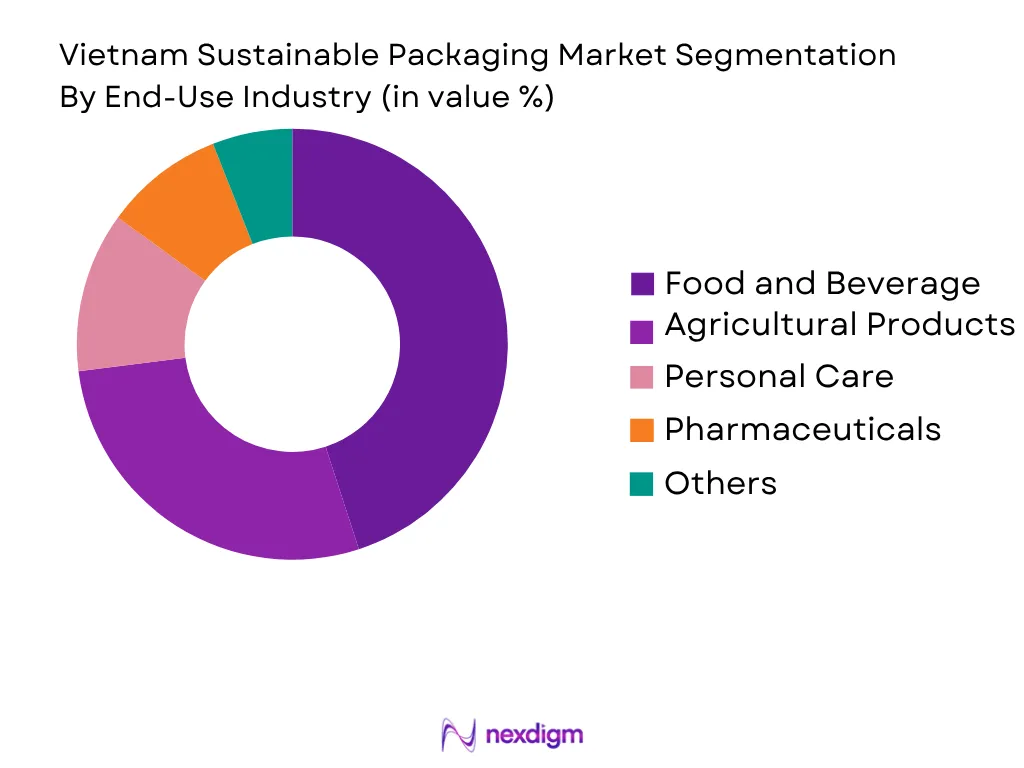
The Vietnam Sustainable Packaging Market is segmented into food and beverage, seafood and agriculture, electronics, textiles and footwear, personal and household care, healthcare and pharmaceuticals, e-commerce and retail, foodservice, and industrial goods. Food and beverage hold the dominant position because processors require bottles, pouches, cartons, cans, trays, films, corrugated cases, cups, and labels that preserve safety, freshness, aroma, texture, and shelf life. Vietnam’s large beverage, dairy, coffee, instant-food, condiment, seafood, and agricultural-processing industries create demand across primary and transport packaging. Tetra Pak’s expanded Binh Duong facility increased its annual packaging-material capacity from 12 billion to 30 billion packages, demonstrating the scale of regional liquid-food and beverage packaging demand. Export sectors also require protective packaging capable of meeting overseas customer requirements concerning traceability, material composition, transit performance, and carbon reporting. Electronics, footwear, and textiles create substantial secondary and tertiary packaging demand through molded-fiber inserts, corrugated boxes, garment bags, and reusable transport materials.
Competitive Landscape
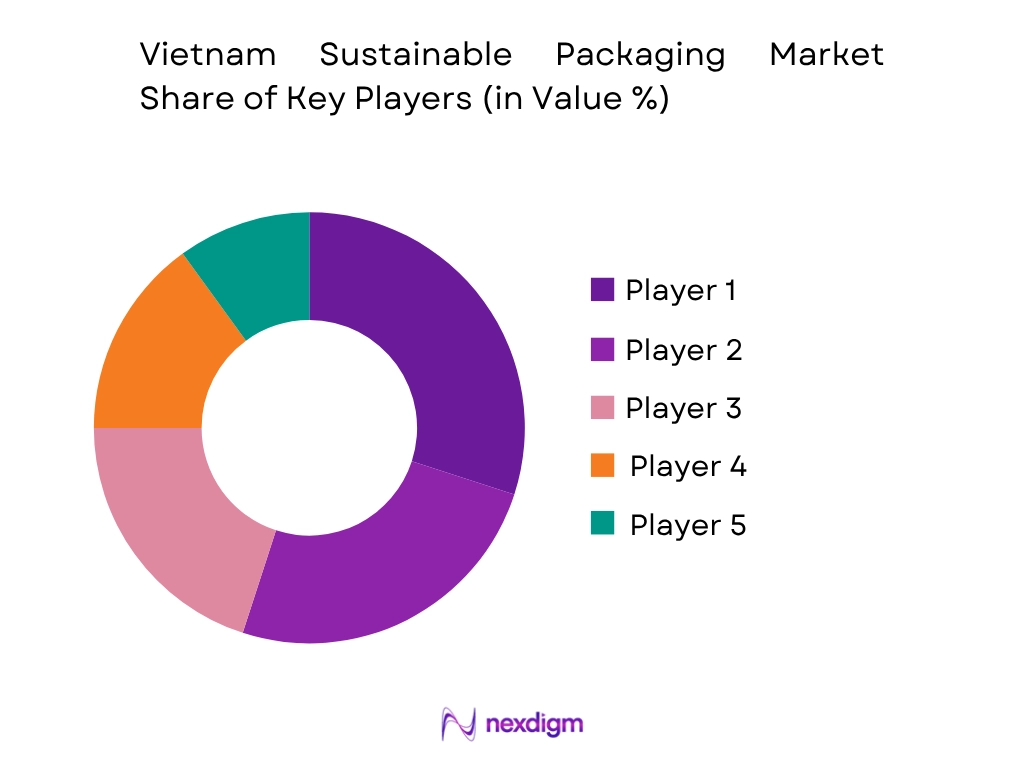
The Vietnam Sustainable Packaging Market combines domestic packaging manufacturers, ASEAN packaging groups, multinational carton and flexible-packaging suppliers, paper companies, rigid-plastic producers, and emerging bioplastic businesses. SCG Packaging has one of the broadest local portfolios through fiber, flexible, rigid, paper, and foodservice operations. Duy Tan is prominent in rigid packaging, while Tetra Pak participates in aseptic cartons and food-processing systems. An Phat Bioplastics focuses on biodegradable and compostable materials, and Oji operates an extensive paper and corrugated-packaging network. Competition is based on production footprint, export compliance, lightweighting, recyclability, recycled-content capability, food-contact safety, EPR support, and the ability to qualify new materials without compromising product performance.
| Company | Establishment | Headquarters | Core Sustainable Portfolio | Principal End Uses | Material Capability | Vietnam Footprint | Circularity Capability | Strategic Differentiation |
| SCG Packaging | 1913 group heritage | Bangkok, Thailand | ~ | ~ | ~ | ~ | ~ | ~ |
| Duy Tan Plastics | 1987 | Ho Chi Minh City, Vietnam | ~ | ~ | ~ | ~ | ~ | ~ |
| Tetra Pak Vietnam | 1994 local presence | Ho Chi Minh City, Vietnam | ~ | ~ | ~ | ~ | ~ | ~ |
| An Phat Bioplastics | 2002 | Hai Duong, Vietnam | ~ | ~ | ~ | ~ | ~ | ~ |
| Oji Interpack Vietnam | Oji founded 1873 | Tokyo, Japan | ~ | ~ | ~ | ~ | ~ | ~ |
Vietnam Sustainable Packaging Market Analysis
Growth Drivers
Export-Oriented Industrialization and Packaging Demand
Vietnam’s export-oriented manufacturing economy is increasing demand for recyclable corrugated cases, molded-fiber protection, lightweight films, mono-material pouches, beverage cartons, reusable transport containers, and packaging that complies with overseas sustainability requirements. The country’s GDP reached VND 11,511.9 trillion, equivalent to USD 476.3 billion, in 2024, while merchandise exports reached USD 405.53 billion. Freight transport also exceeded 620.1 million tonnes during the first quarter of 2024, demonstrating the scale at which packaged products, components, raw materials, and finished goods move through domestic and international supply chains. Electronics, smartphones, textiles, footwear, seafood, coffee, furniture, processed food, beverages, and agricultural products require primary, secondary, and tertiary packaging capable of surviving factory handling, containerization, port storage, humidity, long-distance shipping, and customer distribution. Export customers increasingly evaluate packaging weight, recyclability, restricted substances, recycled content, labeling, forest certification, and product carbon information. Electronics manufacturers are replacing selected foam inserts with molded fiber and optimizing corrugated structures, while textile and footwear exporters are evaluating paper garment bags, thinner polybags, recycled-content films, and right-sized cartons. Seafood processors require vacuum pouches, insulated cases, moisture-resistant cartons, and reusable crates that preserve cold-chain integrity. The country’s industrial production index increased during 2024, reinforcing demand for packaging machinery, films, board, labels, inks, adhesives, and protective materials. Export-oriented converters located in Ho Chi Minh City, Binh Duong, Dong Nai, Long An, Hanoi, Bac Ninh, Hai Phong, and Hung Yen are consequently investing in lighter board grades, recyclable laminates, automated printing, digital inspection, and high-speed forming equipment. The driver is not industrialization in isolation; it is the interaction between USD 405.53 billion in exports, more than USD 476 billion in economic output, high freight movement, and customer requirements imposed by multinational supply chains. Sustainable packaging suppliers that can maintain moisture resistance, compression strength, sealing, shelf life, traceability, and export certification while reducing material complexity are positioned to benefit from Vietnam’s continuing role as a regional manufacturing and export platform.
Packaging EPR and Formal Recycling Obligations
Vietnam’s extended producer responsibility framework is transforming packaging recovery from a voluntary brand activity into a documented obligation for producers and importers. Comprehensive recycling responsibilities for covered packaging took effect from 1 January 2024, requiring obligated businesses to organize recycling directly or use the approved financial-contribution mechanism. The framework increases demand for package-level material declarations, recycling plans, qualified processors, recovery evidence, compliance reporting, and packaging designs that can meet prescribed recycling specifications. Collective systems have already demonstrated significant operating scale. PRO Vietnam collected and recycled more than 64,500 tonnes of packaging during 2024, compared with approximately 14,000 tonnes in 2023 and more than 3,000 tonnes during its earlier pilot activity. Recovered materials included PET bottles, used beverage cans, multilayer cartons, flexible plastics, shrink film, HDPE, and polypropylene packaging. These figures indicate that EPR implementation is creating a commercial ecosystem linking brand owners, collection operators, informal workers, sorting companies, recyclers, paper mills, plastics processors, and compliance organizations. The regulatory framework was further updated through Decree No. 110/2026/ND-CP, issued on 1 April 2026, addressing recycling responsibilities for products and packaging and waste-treatment obligations for producers and importers. Regulatory development favours packaging formats that are easy to identify, sort, recycle, or reuse. Plastic converters are simplifying laminates, reducing pigments, improving label removability, and developing polyethylene- or polypropylene-dominant structures. Paper converters are improving repulpability and reducing coatings that interfere with fiber recovery. Beverage businesses are supporting bottle and can collection, while liquid-carton suppliers are strengthening partnerships with collectors and paper recyclers. EPR also increases demand for digital systems capable of recording packaging tonnage, material type, geographic origin, recycler acceptance, and final recovered output. Companies unable to provide reliable composition data or recycling evidence face greater compliance and reputational exposure. Government authorities have also introduced a three-year review cycle under which mandatory recycling rates may be reassessed and increased within the regulatory framework. Sustainable packaging demand is therefore being driven by a shift from broad environmental commitments toward measurable recovery tonnage, verified recycling, producer reporting, and material-specific compliance.
Market Challenges
Fragmented Collection and Low-Quality Recycled Feedstock
Vietnam’s sustainable packaging market is constrained by weak source separation, fragmented collection, informal recovery networks, and inconsistent secondary-material quality. Government information indicates that Vietnam releases approximately 1.8 million tonnes of plastic waste into the environment annually, including between 280,000 and 730,000 tonnes entering marine environments. Only a limited part of this material is recovered through formal facilities and enterprises. Although PRO Vietnam recycled more than 64,000 tonnes of packaging in 2024, this volume represents only part of the packaging entering national consumption and waste streams. Collection remains strongest for high-value PET bottles, aluminum cans, corrugated paper, and selected rigid plastics. Flexible films, multilayer sachets, small closures, dark-colored plastics, contaminated food packs, and composite cartons are more difficult to aggregate and process. Waste is often collected through informal workers, scrap shops, intermediaries, craft villages, municipal contractors, and commercial generators operating under different quality and documentation practices. Recycled plastic may contain food residue, moisture, labels, adhesives, pigments, incompatible polymers, and degraded resin. These contaminants affect melt flow, odor, color, mechanical strength, transparency, and suitability for food-contact applications. Recovered paper may contain wax, plastic coatings, grease, wet-strength additives, or excessive moisture, reducing its value to paper mills. Glass presents another difficulty. Vietnam generates approximately 220,000 tonnes of glass waste annually, but collection remains limited because glass is heavy, fragile, and costly to transport. Collection facilities must separate color, remove ceramics and contaminants, and deliver cullet to suitable furnaces. In August 2024, retail collection stations were established at selected Ho Chi Minh City locations, but this represents an early-stage model rather than universal infrastructure. Craft-village recycling can recover valuable materials but may use outdated equipment and inadequate wastewater, residue, and emissions controls. Regional imbalance compounds the problem because southern industrial provinces have greater access to converters and processors than many rural or mountainous areas. The central market challenge is therefore not the absence of recyclable material. It is the inability to convert dispersed post-consumer packaging into traceable, clean, standardized feedstock that meets industrial specifications across paper, PET, HDPE, polypropylene, glass, metals, and flexible packaging.
Technical Conversion and Regulatory Compliance Complexity
Sustainable packaging conversion is technically demanding because packaging must remain compatible with products, processing equipment, distribution systems, food-safety rules, and export-customer specifications. A conventional flexible pouch may combine PET, polyethylene, polypropylene, polyamide, aluminum, adhesives, coatings, and inks to deliver oxygen, moisture, aroma, puncture, and heat resistance. Replacing this structure with a mono-material film can improve recyclability but may reduce shelf life, sealing speed, retort performance, or mechanical strength. Molded fiber can replace plastic or foam protection, but it must withstand Vietnam’s humidity, long export journeys, stacking pressure, vibration, and moisture exposure. Paper-based food packaging may require grease and liquid barriers that can reduce repulpability. Recycled resin may vary in odor, color, clarity, contamination, and molecular properties, creating production instability in high-speed bottle, film, tray, or closure manufacturing. These technical requirements demand polymer specialists, paper engineers, food-contact experts, machinery technicians, quality-control staff, and accredited testing services. Vietnam’s environmental technology sector remains dependent on imported treatment and recycling equipment in several areas, limiting the availability of locally adapted sorting, washing, deodorization, filtration, pelletizing, and quality-control systems. Compliance requirements are also becoming more complex. Packaging producers and importers must classify materials, calculate quantities, choose direct recycling or financial contributions, maintain evidence, and submit information through EPR systems. Decree No. 110/2026/ND-CP introduced further changes to packaging recycling responsibilities, requiring companies to update internal data and contracts. Exporters must additionally consider requirements from the European Union, Japan, the United States, and multinational customers regarding food contact, chemical restrictions, recyclability, recycled content, labeling, and carbon disclosure. A packaging format acceptable in Vietnam may need redesign for an overseas buyer. Environmental claims such as recyclable, biodegradable, compostable, or containing recycled material also require credible evidence. Compostable packaging may meet laboratory standards but lack a realistic collection and treatment route. Smaller domestic converters and food manufacturers often lack dedicated regulatory, testing, and sustainability teams, making qualification slower. The market challenge is therefore the need to integrate packaging science, machinery performance, recycling compatibility, EPR reporting, food safety, and export compliance within each commercial package development project.
Market Opportunities
Advanced Sorting, Mono-Material Packaging, and Closed-Loop Recycling
Technological advancement creates a major opportunity to raise the quantity and quality of packaging recovered within Vietnam. PRO Vietnam expanded its collection and recycling activity from approximately 14,000 tonnes in 2023 to more than 64,000 tonnes in 2024, showing that coordinated collection, processor contracting, and producer funding can scale rapidly when supported by clear demand. The next stage involves applying optical sorting, near-infrared detection, artificial intelligence, digital watermarks, automated bale inspection, improved washing, deodorization, filtration, and data-management systems. These technologies can separate PET, HDPE, polypropylene, films, cartons, metals, and contaminants more accurately than manual sorting alone. Cleaner feedstock would enable more packaging-to-packaging recycling rather than conversion into lower-value applications. PET bottles offer a particularly strong opportunity because beverage containers can be identified, collected, washed, and processed through closed-loop systems. Glass recovery also has substantial potential because approximately 220,000 tonnes of glass waste are generated annually. Retail collection points, hospitality partnerships, beverage take-back, color separation, and regional cullet-processing centres could supply cleaner material to glass plants. Flexible packaging represents a larger technical challenge but also a significant innovation opportunity. Polyethylene- or polypropylene-dominant structures can replace selected multilayer laminates while maintaining sealing, puncture, moisture, and aroma performance. Compatible inks, wash-off labels, reduced metalization, and recyclable adhesives can improve processing outcomes. Paper and molded-fiber development can use bamboo, bagasse, rice straw, and recycled fiber for trays, protective inserts, foodservice packs, and e-commerce packaging. Digital packaging passports or QR-linked material information could support EPR reporting, recycler identification, and consumer instructions. Vietnam’s GDP increased from approximately USD 476 billion in 2024 to USD 514 billion in 2025, demonstrating continued industrial and consumer expansion capable of supporting investment in conversion and recycling technologies. Technology providers can partner with brand owners, industrial parks, municipalities, retailers, informal collectors, and recyclers to establish material-specific systems. Market growth will be strongest where innovation connects packaging design, collection, sorting, quality assurance, verified recycling output, and long-term offtake from manufacturers.
Rural Collection Networks and International Circular-Economy Partnerships
Expansion beyond Vietnam’s main metropolitan and industrial centres creates an opportunity to build regional packaging collection, aggregation, reuse, and recycling networks. Rural and coastal communities generate packaging from beverages, household products, agricultural inputs, instant food, personal care, pharmaceuticals, aquaculture, tourism, and e-commerce. These areas often lack dedicated sorting centres and rely on informal collectors, small scrap dealers, local authorities, or transport to distant processors. Hub-and-spoke systems could consolidate PET bottles, paper cartons, corrugated board, HDPE containers, polypropylene crates, aluminum cans, glass, and selected films from multiple districts before shipment to industrial recyclers. Vietnam’s circular-economy development framework identifies the collection and appropriate treatment of rural organic waste as a strategic priority, with a national objective covering 70 parts out of every 100 parts of rural organic waste under the longer-term program. Packaging recovery can be integrated with these local waste systems through shared collection points, material separation, retailer take-back, and community enterprises. International cooperation can accelerate implementation. During 2024–2025, Ba Ria–Vung Tau worked with Sakai City in Japan on circular economy, solid-waste management, environmental monitoring, and low-carbon development. Japanese technical assistance also supported environmental-management capacity, equipment, mapping, and industrial pollution control. Similar partnerships can be extended to packaging through material-recovery technology, deposit models, reusable transport systems, wastewater treatment for recyclers, and digital traceability. Vietnam’s export relationships with the European Union, Japan, the United States, South Korea, and ASEAN provide additional incentives because packaging that meets international circularity requirements can improve supplier access to global value chains. Producer-funded systems could provide balers, sorting tables, covered storage, weighing equipment, collection vehicles, safety equipment, and working capital to local organizations. Reusable crates and pallets are particularly suitable for agriculture, seafood, beverages, automotive parts, and institutional supply chains where containers circulate repeatedly between defined users. The opportunity is not limited to collecting larger volumes. Regional networks can create cleaner feedstock, formalize informal work, reduce leakage, improve EPR evidence, and support domestic manufacturing with locally recovered materials. Current recovery volumes and international cooperation provide the operational base for future expansion without relying on speculative future statistics.
Future Outlook
The Vietnam Sustainable Packaging Market is expected to expand during 2026–2035 as EPR compliance, export-market requirements, foreign manufacturing investment, brand commitments, and consumer-goods growth influence packaging procurement. The transition will involve lighter packages, mono-material films, higher recycled content, paper and molded-fiber substitution, reusable logistics packaging, and more formal collection and recycling arrangements. Vietnam began comprehensive packaging EPR implementation from 1 January 2024 under the Law on Environmental Protection and its implementing framework. Producers and importers can generally organize recycling directly or make financial contributions through the designated environmental fund mechanism. The system increases demand for packaging-material declarations, recycling evidence, compliant processors, annual reporting, and packaging designs that align with approved recovery methods.
Major Players
- SCG Packaging
- Duy Tan Plastics Manufacturing Corporation
- Huhtamaki Flexible Packaging Vietnam
- Tetra Pak Vietnam
- An Phat Bioplastics
- Oji Interpack Vietnam
- Rengo Vietnam
- Tin Thanh Packing
- Dong Tien Packaging and Paper
- Bien Hoa Packaging
- Ngoc Nghia Industry
- ALPLA Vietnam
- Amcor Vietnam
- Mondi Vietnam
- Stavian Recycling
Key Target Audience
- Packaging material manufacturers and converters
- Food, beverage, seafood, electronics, textile, and footwear manufacturers
- Retailers, e-commerce platforms, and foodservice operators
- Recyclers, collection companies, and EPR compliance organizations
- Packaging distributors and contract packagers
- Investments and venture capitalist firms
- Private-equity and strategic packaging investors
- Government and regulatory bodies
Research Methodology
Step 1: Identification of Key Variables
The first phase constructs an ecosystem map covering material suppliers, converters, producers, importers, brand owners, collectors, scrap dealers, recyclers, EPR organizations, regulators, and export customers. The analysis identifies material type, package weight, recycled content, barrier requirements, recovery pathway, manufacturing capacity, EPR status, and end-use demand as core variables.
Step 2: Market Analysis and Construction
Historical information is compiled by material, format, end-use industry, packaging level, region, and sustainability strategy. The bottom-up model evaluates converter shipments, packaging units, material tonnage, customer utilization, and recycled-content adoption. The top-down model reviews industrial output, merchandise exports, packaging trade, material consumption, company revenues, and EPR recovery data.
Step 3: Hypothesis Validation and Expert Consultation
Market hypotheses are validated through computer-assisted telephone interviews with packaging engineers, converters, food processors, exporters, procurement teams, recyclers, EPR professionals, and material suppliers. Discussions assess packaging qualification, feedstock quality, EPR compliance, export requirements, conversion barriers, investment needs, and supplier-selection criteria.
Step 4: Research Synthesis and Final Output
Supply-side and demand-side findings are triangulated to reconcile converter output, raw-material supply, customer procurement, and recycling activity. Segment shares and forecasts are tested against packaging weights, unit volumes, capacity additions, export production, regulatory implementation, and expert feedback to produce a consistent market assessment.

- Executive Summary
- Research Methodology (Market Definitions and Assumptions, Sustainable Packaging Inclusion and Exclusion Criteria, Abbreviations, Market Sizing Approach, Top-Down Analysis, Bottom-Up Analysis, Packaging-Volume Conversion Model, Material Flow Analysis, Demand-Side Assessment, Supply-Side Assessment, Converter Capacity Assessment, Primary Industry Interviews, Data Triangulation, Regulatory Scenario Modelling, Forecasting Framework, Limitations and Future Conclusions)

- Definition and Scope
- Market Evolution and Industry Genesis
- Transition from Conventional Packaging to Circular Packaging Systems
- Evolution of Packaging Lightweighting and Material Reduction
- Development of Recycled-Content Packaging
- Expansion of Fiber-Based and Paper Packaging
- Development of Reusable and Refillable Packaging Systems
- Growth of Bio-Based and Compostable Packaging

- Growth Drivers (Packaging EPR, Export Manufacturing, Food and Beverage Production, E-Commerce Expansion, Seafood Exports, Brand Sustainability Commitments, Paper Packaging Capacity and Single-Use Plastic Reduction)
- Market Challenges (Fragmented Collection, Informal Recycling Dependence, Plastic Scrap Quality, Flexible Packaging Recovery Gaps, Multi-Layered Packaging Disposal, Recycling Craft-Village Pollution, Food-Contact Compliance and Capital-Intensive Conversion)
- Market Opportunities (High-Barrier Recyclable Paper, Mono-Material Flexible Packaging, Food-Grade Recycled PET, Molded Fiber, Compostable Packaging, Export-Compliant Packaging, Smart Sorting and Closed-Loop Brand Partnerships)
- Market Trends (Paperization, Lightweighting, High-PCR Packaging, Refill Pouches, Reusable Crates, Recyclable Laminates, Fiber-Based Foodservice Packaging, Digital EPR Reporting, Wash-Off Labels and Packaging Carbon Disclosure)
- SWOT Analysis
- Porter’s Five Forces Analysis
- PESTLE Analysis

- By Market Value (2020-2025)
- By Packaging Volume (2020-2025)
- By Packaging Unit Shipments (2020-2025)

- By Material Type (In Value %)
Paper and Paperboard
Corrugated Board
Molded Fiber
Recycled Plastic
Bio-Based Plastic
Compostable Plastic - By End-Use Industry (In Value %)
Food and Beverage
Seafood and Aquatic Products
Personal Care and Cosmetics
Household Care
Healthcare and Pharmaceuticals
E-Commerce
Retail and Consumer Goods - By Distribution Channel (In Value %)
Direct Sales to Brand Owners
Packaging Distributors
Contract Packaging Companies
Digital Packaging Platforms
Industrial Wholesalers
Retail Packaging Suppliers
E-Commerce Packaging Providers - By Region (In Value %)
Northern Vietnam
Central Vietnam
Southern Vietnam
Mekong River Delta
Northern Midlands and Mountain Areas
Central Highlands

- Market Share of Major Players (By Value, Packaging Volume, Material Type, Packaging Format, End-Use Industry and Region)
- Cross Comparison Parameters (Sustainable Material Portfolio Breadth, Post-Consumer Recycled Content Capability, Mono-Material and Design-for-Recycling Expertise, Vietnam Manufacturing and Conversion Footprint, EPR Reporting and Recycling Support Capability, Food-Contact and Export Compliance Capability, End-Use Industry Coverage, Packaging Innovation and Commercialization Speed)
- SWOT Analysis of Major Players
- Detailed Profiles of Major Companies
SCG Packaging
Duy Tan Plastics Manufacturing Corporation
Huhtamaki Flexible Packaging Vietnam
Tetra Pak Vietnam
An Phat Bioplastics
Oji Interpack Vietnam
Rengo Vietnam
Tin Thanh Packing
Dong Tien Packaging and Paper
Bien Hoa Packaging
Ngoc Nghia Industry
ALPLA Vietnam
Amcor Vietnam
Mondi Vietnam
Stavian Recycling

- Food and Beverage Brand Analysis
- Seafood Exporter Analysis
- Coffee and Agricultural Exporter Analysis
- Fast-Moving Consumer Goods Analysis
- Retailer and E-Commerce Analysis
- Foodservice Operator Analysis

- By Market Value (2026-2035)
- By Packaging Volume (2026-2035)
- By Packaging Unit Shipments (2026-2035)


 Request a Sample
 Ask for Customization
 Get a Quote
 Enquire Now