

 Download PDF
Market Overview
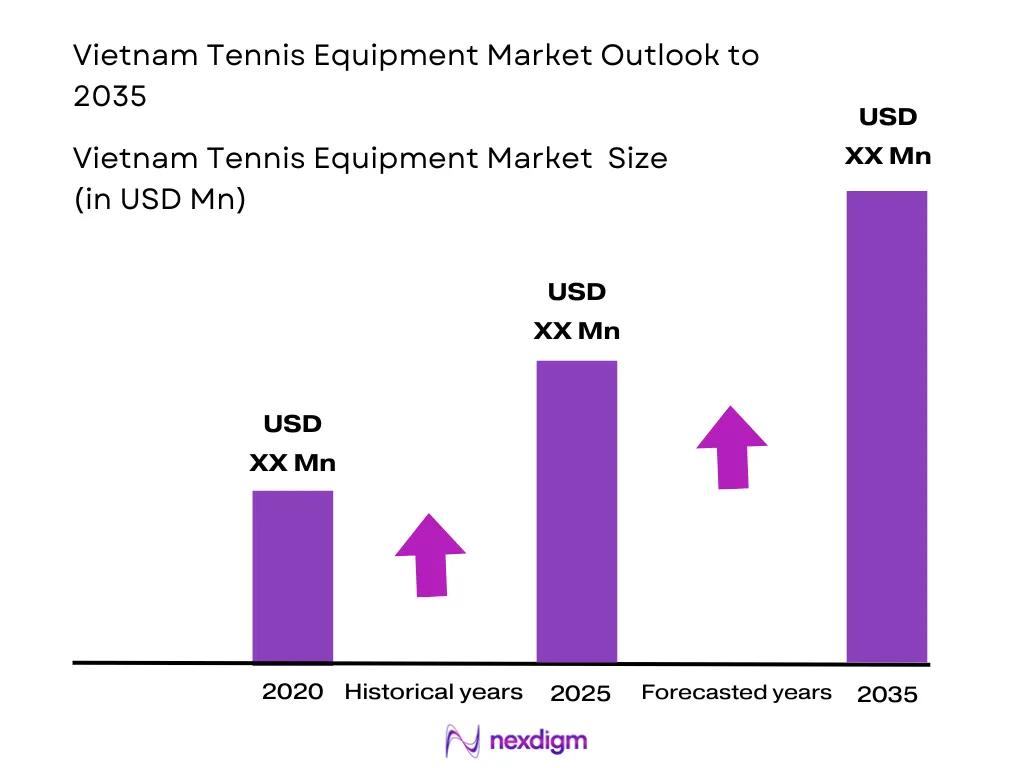
The Vietnam Tennis Equipment market is valued at approximately USD ~ million in 2025. The market is primarily driven by increasing sports participation, especially among youth and urban populations, which is contributing to a surge in the demand for tennis equipment. The rise in disposable income, urbanisation, and health-consciousness among consumers are key factors fuelling this growth. Furthermore, the expansion of tennis infrastructure, particularly in urban areas, and the increasing popularity of tennis events and tournaments have also bolstered demand for equipment. The growth trajectory is supported by Vietnam’s improving GDP, which stands at USD ~ billion in 2025, reinforcing a stable foundation for consumer spending on leisure and sports activities.
The dominant regions for the Vietnam Tennis Equipment market include Ho Chi Minh City and Hanoi. These urban centres have high levels of tennis participation due to superior infrastructure, tennis clubs, and training academies. Ho Chi Minh City, as the largest economic hub, with a population exceeding 11.3 million, leads the demand, while Hanoi, with a population of around 8 million, follows closely. The concentration of the country’s wealth and the increasing trend of health and fitness awareness among the urban population significantly contributes to the dominance of these cities in the tennis market. Furthermore, the growing number of tennis events and the establishment of international sports academies are fueling market growth in these areas.
Market Segmentation
By Equipment Type
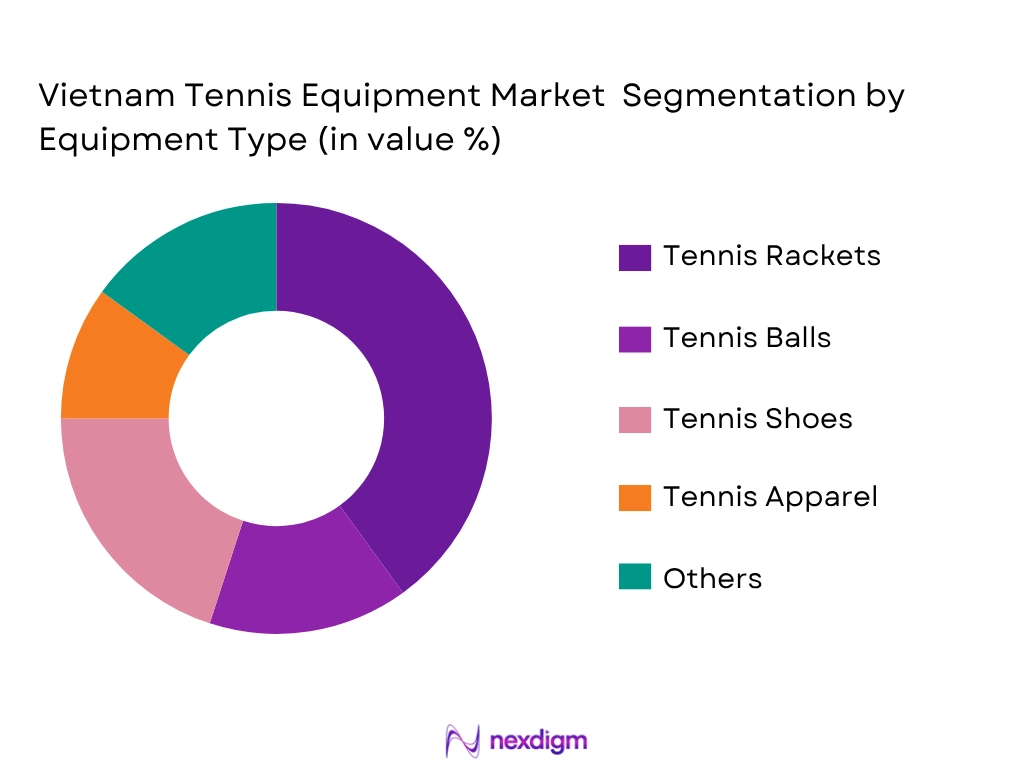
The Vietnam Tennis Equipment market is segmented by product type into Tennis Rackets, Tennis Balls, Tennis Shoes, Tennis Apparel, Tennis Bags, and Accessories. Among these, Tennis Racquets have a dominant market share in 2025. This dominance is due to their essential role in tennis and the increasing consumer preference for advanced racquets. Brands like Wilson, Babolat, and Head continue to drive market demand, thanks to their reputation and technological advancements, such as better materials and enhanced performance features. Tennis racquets are a key part of every player’s equipment set, whether they are recreational or professional, contributing to the segment’s strong share in the market.
By Distribution Channel
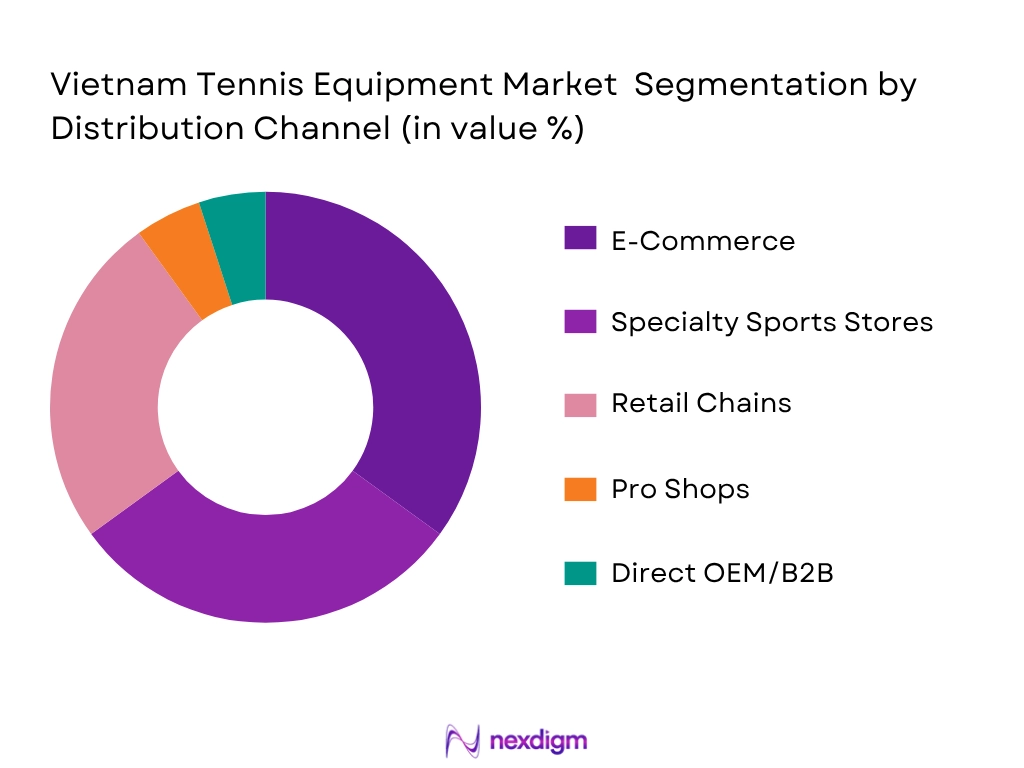
The market is also segmented by distribution channels, which include Specialty Sports Stores, E-Commerce, Retail Chains, Pro Shops, and Direct OEM/B2B. E-Commerce channels are dominating the market due to the growing trend of online shopping and digital penetration in Vietnam, which stands at 84% in 2025. This has made tennis equipment more accessible to a wider range of consumers, including those in smaller towns or regions with limited access to physical stores. The rise of online retail platforms like Lazada and Shopee has also made it easier for consumers to find specific equipment that may not be available in local stores, contributing to the higher market share of e-commerce in 2025.
Competitive Landscape
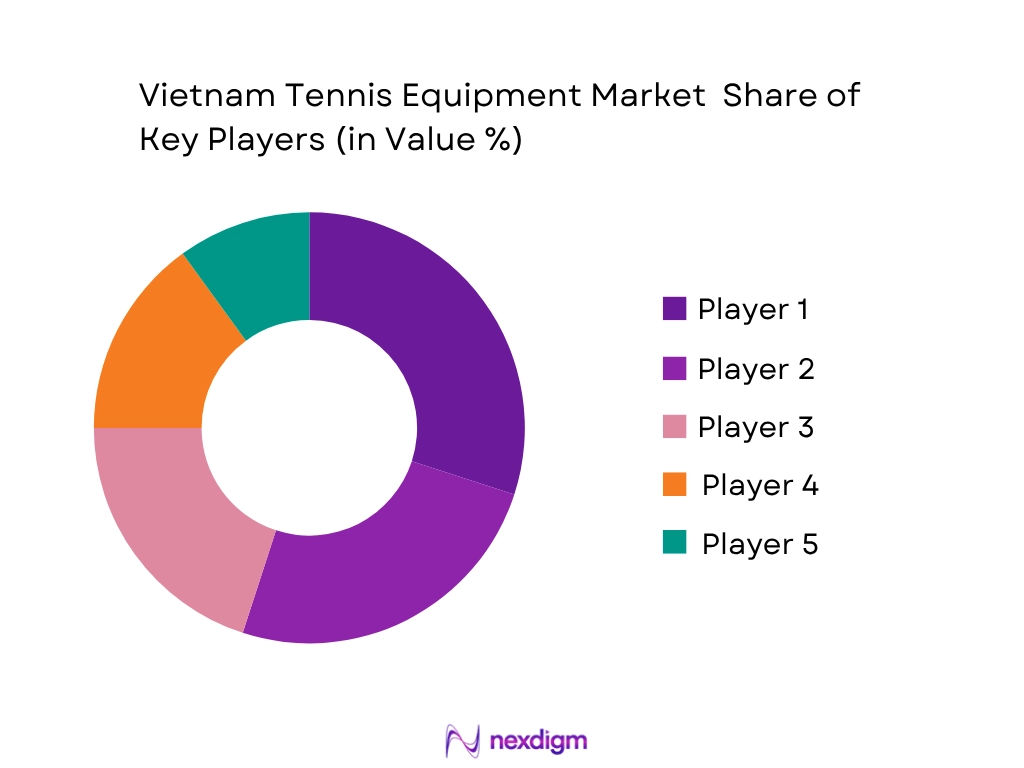
The Vietnam Tennis Equipment market is dominated by both local and international brands, with a few key players leading the market. These include globally recognised brands such as Wilson, Babolat, Head, Asics, and Nike, which are well-established in the market due to their strong brand equity, premium quality, and extensive distribution networks. Additionally, local distributors play a crucial role in the availability of products through retail channels and online platforms. These brands continue to innovate with product features, offering enhanced performance, lightweight designs, and advanced materials in their racquets, shoes, and apparel, strengthening their positions in the market.
| Company Name | Establishment Year | Headquarters | Key Market Parameters | Product Range | Distribution Channels | Revenue |
| Wilson | 1914 | Chicago, USA | ~ | ~ | ~ | ~ |
| Babolat | 1875 | Lyon, France | ~ | ~ | ~ | ~ |
| Head | 1950 | Austria | ~ | ~ | ~ | ~ |
| Nike | 1964 | Beaverton, USA | ~ | ~ | ~ | ~ |
| Asics | 1949 | Kobe, Japan | ~ | ~ | ~ | ~ |
Vietnam Tennis Equipment Market Analysis
Growth Drivers
Rising Sports Participation and Youth Engagement
Vietnam’s demographic profile and broader health awareness trends underscore a growing base of potential tennis players, particularly among youth and urban populations. According to World Bank data, Vietnam’s total population in 2025 was approximately 100,987,686 people, with an urban population share that has been steadily increasing (with urbanisation continuing to rise, according to World Bank indicators), indicating larger concentrations of young people in cities where organised sports facilities are more accessible. Increasing urbanisation often correlates with greater participation in structured recreational activities, including tennis, as urban residents are more likely to have access to courts, clubs, and formal coaching environments, compared with rural populations where such infrastructure is limited. Moreover, Vietnam’s GDP per capita stood at USD 5,026 in 2025, reflecting rising disposable income that enables families to invest in sports equipment and club memberships. This combination of a sizeable population base (~101 million), rising urban concentration, and increasing consumer capacity creates a broader participatory pool for tennis and associated equipment demand, as youth and adults seek structured physical activity. These socio‑economic contexts support enhanced engagement with physical activity and sports, which underpins growing interest and participation rates in tennis and the consumption of tennis equipment.
Development of Tennis Infrastructure & Events
While detailed Vietnam‑specific tennis infrastructure data is limited in publicly available national statistics, broader trends in sports infrastructure expansion and government urban development initiatives suggest rising potential for sports facility growth, including courts. Urbanisation trends show increasing city populations for example, Ho Chi Minh City’s population alone is reported at over 11.3 million residents by 2025, reflecting significant urban densification that supports demand for recreational infrastructure, including sports courts. Urban Centres with large, dense populations typically see greater investment in multipurpose sports facilities due to higher utilisation rates. Macro patterns from broader Asia Pacific indicate that Asia Pacific accounted for an estimated USD 3.11 billion of global multipurpose courts market activity in 2025, driven by urbanisation and governmental investment in public sports infrastructure, a trend that applies to emerging markets such as Vietnam where urban municipalities increasingly prioritise community recreation spaces. Public investment in Puerto urban development and sports precincts has been flagged as a priority in municipal growth strategies, aligning with broader GDP growth. Vietnam’s GDP grew by about 7 percent in 2024, providing scope for public infrastructure spending. These economic and urbanisation fundamentals support the gradual expansion of tennis courts, training centres, and competitive events, directly influencing the demand for tennis equipment among club players, training programmes, and event participants nationally.
Market Restraints
Price Sensitivity and Import Dependence
Vietnam’s tennis equipment market remains heavily reliant on imports for advanced racquets, premium shoes, and technical gear, with limited local manufacturing capabilities in speciality sports equipment (global racquet technology is oriented towards foreign brands). At an aggregate economic level, Vietnam’s GDP per capita was USD 4,717.3 in 2024, and although rising, this figure remains lower than many developed economies, which influences discretionary spending patterns toward essential goods rather than sporting equipment purchases. Imported sports goods often carry additional costs due to tariffs, freight, and distribution, which can elevate retail pricing. Consumer price inflation in Vietnam was recorded at 3.6 percent in 2024 (moderate inflation), which nonetheless adds to overall cost sensitivities, especially for imported discretionary products such as tennis racquets and shoes. Additionally, unemployment remained low at about 1.5 percent in 2025 indicating employment availability, yet real wages for many workers remain constrained relative to the prices of premium imported sports gear. High dependency on imports for quality tennis equipment (racquets, balls, specialized shoes) combined with the pricing constraints implied by these macroeconomic conditions places upward pressure on retail costs, dampening broad‑based consumption in price‑sensitive demographic segments. Thus, import reliance and household cost constraints represent a material restraint on mass‑market expansion, particularly among middle‑ and lower‑income groups.
Limited Local Manufacturing Scale
Vietnam’s sports equipment manufacturing ecosystem primarily supports textile and footwear production at scale (e.g., contract manufacturing for global brands), but specialised tennis equipment production (high‑performance racquets, technical stringing, advanced shoes engineered for court play) remains minimal. Official macroeconomic data shows Vietnam’s economy at USD 514 billion in total GDP in 2025, with industrial production expanding in certain segments, yet specialised niche manufacturing such as precision sports gear remains underdeveloped when measured against broader industrial capacity. The World Bank’s economic monitoring indicates robust industrial expansion but notes supply chain focus on key export sectors such as electronics and textiles, rather than precision sports goods. As a result, most quality tennis equipment must be imported, constraining local value‑add and limiting opportunities for domestic innovation and cost competitiveness. The absence of significant local tech‑driven manufacturing also restricts job creation within high‑skill sports equipment production segments. This limitation is a structural restraint as it inhibits domestic firms from scaling production of bespoke racquets, performance strings, and court footwear, creating dependency on multinational brands. The broader industrial trend highlights rapid export growth in other sectors but not in specialised sports equipment manufacture, underscoring the challenge for Vietnam to elevate its manufacturing base in this niche area.
Market Opportunities
Custom & Smart Equipment Adoption
The emergence of smart and custom sports equipment presents a differentiated opportunity within the Vietnam tennis equipment context. While Vietnam’s current tennis equipment manufacturing is limited, the broader adoption of advanced athletics products is supported by macro trends in connected device usage, with Internet penetration at 84 percent of the population in 2025. High digital connectivity suggests consumers are increasingly receptive to tech‑enabled products, including smart racquets, sensor‑integrated shoes, and performance monitoring gear that interfaces with mobile applications. Urban consumers, particularly younger, digitally savvy segments in cities such as Hanoi and Ho Chi Minh City, are more likely to adopt connected and form‑fitted equipment that supports personalised training. Vietnam’s GDP growth of 7.1 percent in 2025 and rising disposable income metrics reinforce consumer capacity to consider premium gear, especially when tied to performance analytics or custom fitting for play style. Smart product features such as embedded sensors that track swing speed, spin, or foot movement may attract committed recreational players and clubs seeking marginal performance insights. This macro‑backdrop of widespread Internet access and rising consumer purchasing power provides a foundation for increased adoption of customised and technologically advanced tennis equipment, offering a compelling diversification path for importers and local retailers targeting mid‑to‑upper income segments.
School & Community Tennis Program Procurement
National socio‑economic conditions in Vietnam, specifically improvements in education access with net primary and secondary enrolment rates near universal levels, as reported in global development metrics, suggest a growing infrastructure for youth activities through formal schooling systems. While detailed Vietnam tennis participation statistics are scarce, public investment in physical education and school sports programs often correlates with educational enrolment rates and urban community engagement. Governmental support for public infrastructure extends to community sports facilities, with external analyses on public recreation expenditure noting that investments in outdoor sports amenities, youth leagues, and community recreation fields are fundamental to broader wellness and activity goals. In countries with rising GDP per capita and strong urban growth, local authorities and schools allocate budgetary resources to physical education infrastructure, which often includes courts for a range of sports, including tennis. Given Vietnam’s relatively high school enrolment rates and concentrated urban populations, there is increasing opportunity for procurement of tennis rackets, balls, nets, and training aids at scale for school curriculums and community programmes. These institutional purchasing streams represent a future growth vector, as they can stimulate consistent demand for entry‑level and training‑oriented equipment, optimising equipment utilisation across hundreds of institutions in major urban regions.
Future Outlook
Over the next decade, the Vietnam Tennis Equipment market is expected to see substantial growth driven by the rising middle-class population, increased awareness of health and fitness, and the development of sports infrastructure. With the growing penetration of e-commerce and the popularity of online shopping, there is potential for greater accessibility and availability of premium tennis equipment. Additionally, the expansion of tennis academies and the increasing number of international tournaments in Vietnam are set to drive further demand for high-quality tennis products. The increasing emphasis on technology integration, such as smart racquets and performance tracking, is also expected to play a pivotal role in shaping the future of the market.
Major Players
- Wilson Sporting Goods
- Babolat
- Head
- Nike
- Asics
- Yonex Co., Ltd.
- Prince Sports
- Dunlop Sports Co.
- New Balance Athletics
- Adidas AG
- Tecnifibre
- Li-Ning
- Lotto Sport Italia
- Puma SE
- Under Armour, Inc.
Key Target Audience
- Investments and Venture Capitalist Firms
- Government and Regulatory Bodies (Vietnam Ministry of Culture, Sports, and Tourism)
- Tennis Associations and Federations (Vietnam Tennis Federation)
- Sports Equipment Manufacturers
- Retailers and E-commerce Platforms
- Sports Academies and Training Institutes
- Fitness Clubs and Recreation Centres
- Professional Tennis Players and Coaches
Research Methodology
Step 1: Identification of Key Variables
The first step involves identifying key factors that drive the demand for tennis equipment in Vietnam. Through a combination of secondary research and consultations with industry experts, we define variables such as product demand, consumer demographics, market trends, and distribution channels.
Step 2: Market Analysis and Construction
This phase focuses on gathering historical data about market growth and consumer preferences. Key metrics such as equipment types, sales volumes, and geographical breakdowns will be analysed to construct a model of the market’s structure.
Step 3: Hypothesis Validation and Expert Consultation
In this stage, hypotheses about market dynamics are validated by engaging with industry professionals, retailers, and distributors. Insights gathered from one-on-one expert interviews and surveys help refine and support the initial market assumptions.
Step 4: Research Synthesis and Final Output
The final phase involves synthesising all gathered data into a cohesive analysis. Insights from manufacturers, retailers, and industry experts are integrated into the final report to ensure a comprehensive and accurate representation of the Vietnam Tennis Equipment market.

- Executive Summary
- Research Methodology (Market Definitions and Assumptions, Abbreviations, Vietnam Sports Equipment Data Sources, Tennis Equipment Value Chain Approach, Primary and Secondary Research, Market Sizing Model, Forecasting Methodology, Limitations and Confidence Intervals)

- Market Definition and Scope
- Market Genesis and Adoption Trends
- Tennis Facility & Court Infrastructure Evolution
- Consumer Purchase Behavior & Brand Affinity
- Distribution System and Supply Chain Dynamics

- Growth Drivers (Rising Sports Participation and Youth Engagement, Development of Tennis Infrastructure & Events, Rising Disposable Income and Fitness Spending, Impact of E‑Commerce & Digital Marketing)
- Market Restraints (Price Sensitivity and Import Dependence, Limited Local Manufacturing Scale, Intellectual Property & Counterfeit Risks)
- Market Opportunities (Custom & Smart Equipment Adoption, School & Community Tennis Program Procurement, Sustainable Material Innovation)
- Market Trends (Premiumisation Across Categories, Online Sales Channel Acceleration, Tech‑Enabled Gear)
- Regulatory Environment (Import Tariffs and Trade Agreements, Quality & Safety Standards for Sports Gear)
- SWOT Analysis (Strengths, Weaknesses, Opportunities, Threats of the Vietnam tennis equipment market)
- Stakeholder Ecosystem (Relationships among manufacturers, distributors, retail chains, sports federations, tennis clubs and coaches)
- Porter’s Five Forces Analysis (Competitive Rivalry, Buyer Power, Supplier Power, Threat of Substitutes, New Entrants)

- By Value (2020-2025)
- By Volume (2020-2025)
- By Average Selling Price (2020-2025)
- By Future Growth Areas based on Product Type (2020-2025)

- By Product Type (In Value %)
Tennis Racquets
Tennis Balls
Tennis Shoes
Tennis Apparel
Tennis Bags & Carry Gear
Tennis Accessories - By Distribution Channel (In Value %)
Specialty Sports Stores (Store Footprint Penetration)
E‑Commerce and Online Marketplaces
Large Retail & Sporting Goods Chains
Pro Shop / Tennis Club Sales Channels
Direct OEM & B2B Institutional Supply - By Consumer Tier (In Value %)
Beginner/Recreational Players
Intermediate Club Players
Professional & Competitive Players
Institutional (Schools/Franchised Clubs) - By Price Tier (In Value %)
Economy / Value Segment
Mid‑Tier Performance Segment
Premium & Pro‑Level Segment - By Region (In Value%)
Northern Vietnam
Central Vietnam
Southern Vietnam (Ho Chi Minh & Ho Tram Growth Corridors)

- Market Share Composition (By Value/Volume) Across Equipment Categories
- Cross‑Comparison Parameters (Product Portfolio Breadth; R&D Spend; Distribution Footprint; Retail/Club Touchpoints; Price Positioning Matrix; Average ASP by Category; Warranty & After‑Sales Service; Brand Equity Index)
- SWOT of Major Players (Strengths, Weaknesses, Opportunities, Threats for key companies)
- Pricing Analysis (Average selling prices and SKU-level pricing for major brands, premium vs standard product lines)
- Detailed Profiles of Key Companies
Nike, Inc.
Adidas AG
Wilson Sporting Goods Co.
Head NV
Babolat SAS
Yonex Co., Ltd.
Asics Corporation
New Balance Athletics, Inc.
Puma SE
Decathlon SA
Prince Sports, LLC
Dunlop Sports Co. Ltd.
Lotto Sport Italia
Tecnifibre SA
Li‑Ning Company Limited

- Demand and Utilization (Sales breakdown by end-user type: recreational players vs professional athletes, club/academy purchases)
- Consumer Demographics and Purchasing Behavior (Age, income, gender distribution, purchasing frequency, channel preferences)
- Budget and Price Sensitivity (Pricing tiers: premium vs mid-range vs value segment, consumer spending patterns on equipment and apparel)
- Needs, Desires and Pain Points (Comfort, performance, and durability requirements, desire for brand/image, issues like gear availability or fitting)
- Decision-Making Process (Influencers in purchase decisions: coaches’ recommendations, peer reviews, online research, role of professional endorsements and demo clinics)

- By Value (2026-2035)
- By Volume (2026-2035)
- By Average Price (2026-2035)
- By Future Growth Areas based on Product Type (2026-2035)


 Request a Sample
 Ask for Customization
 Get a Quote
 Enquire Now