

 Download PDF
Market Overview
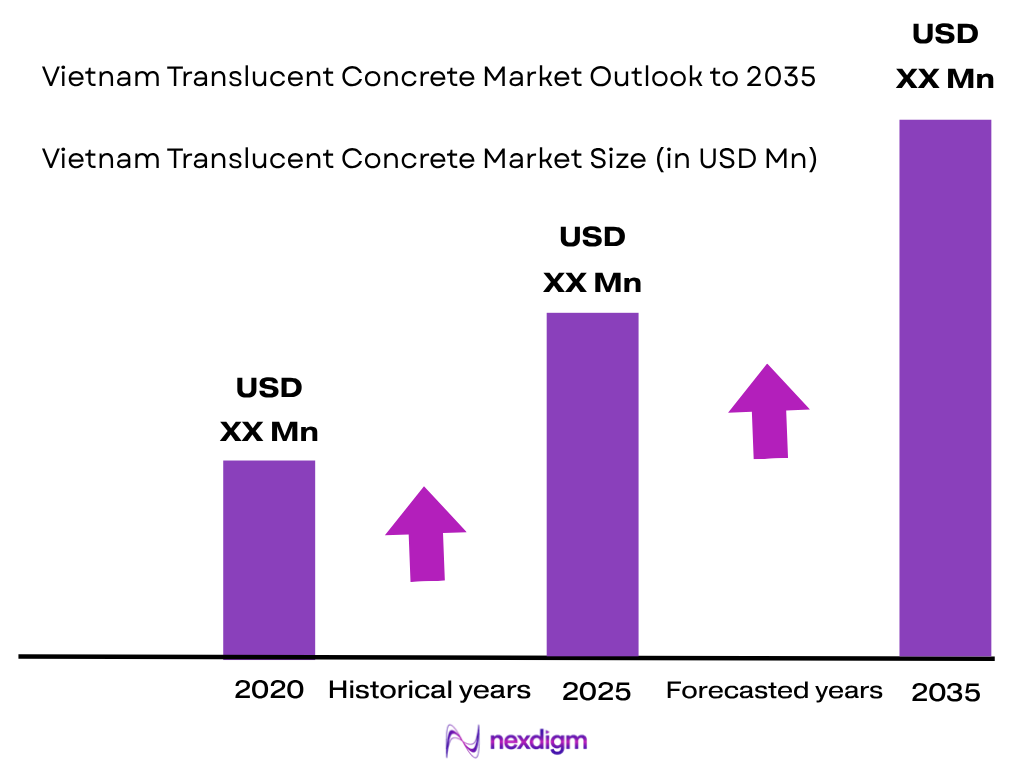
The Vietnam Translucent Concrete Market is valued at approximately USD 12 million, based on a five-year historical analysis, compared with a smaller commercial base in the preceding period. Demand is being supported by premium construction, energy-efficient architecture, urban infrastructure and interest in light-transmitting building materials. Vietnam added 163 green-certified buildings, compared with 76 buildings in the preceding period, strengthening the addressable environment for innovative façade and interior materials.
Ho Chi Minh City and Hanoi represent the principal demand centers for Vietnam translucent concrete because they concentrate premium residential, commercial, hospitality and architectural development. Vietnam had approximately 300 green buildings covering around 7.2 million m² before the latest expansion, while the subsequent cumulative green-certified stock reached 559 projects and 13.6 million m². Ho Chi Minh City alone accounts for more than 3.4 million m² of certified green floor space, followed by Hanoi with more than 2.1 million m², reinforcing their relevance for advanced architectural materials.
Market Segmentation
By Type
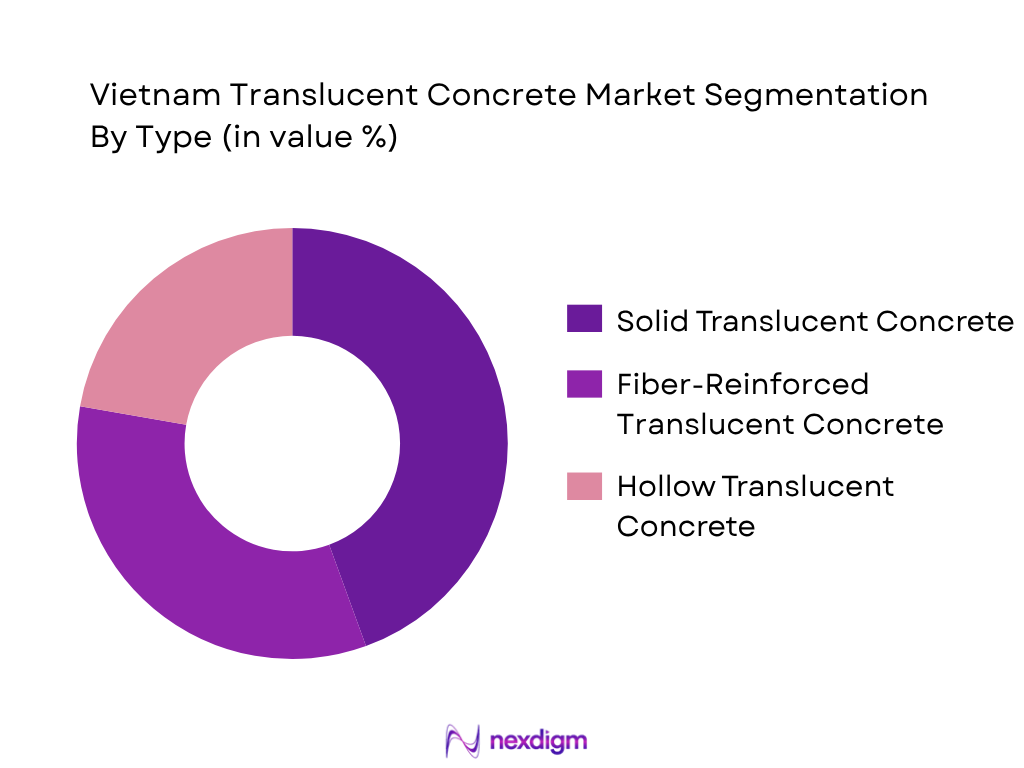
The Vietnam Translucent Concrete Market is segmented by type into Solid Translucent Concrete, Hollow Translucent Concrete, Fiber-Reinforced Translucent Concrete and Others. Solid translucent concrete represents the dominant sub-segment in the available Vietnam market assessment because it combines the visual effect of light transmission with the solidity and versatility expected from architectural concrete. It is particularly suitable for premium walls, façade components, partitions and decorative installations where designers require an architectural surface rather than a conventional transparent glazing system. Its applicability across residential and commercial construction gives it a broader addressable base than more specialized configurations. However, fiber-reinforced/light-transmitting systems remain strategically important because optical elements are central to modern translucent-concrete technology. Improvements in optical-fiber placement, concrete matrices and prefabrication are expected to expand technically advanced solutions, particularly for illuminated façades, feature walls and bespoke architectural installations.
By End User
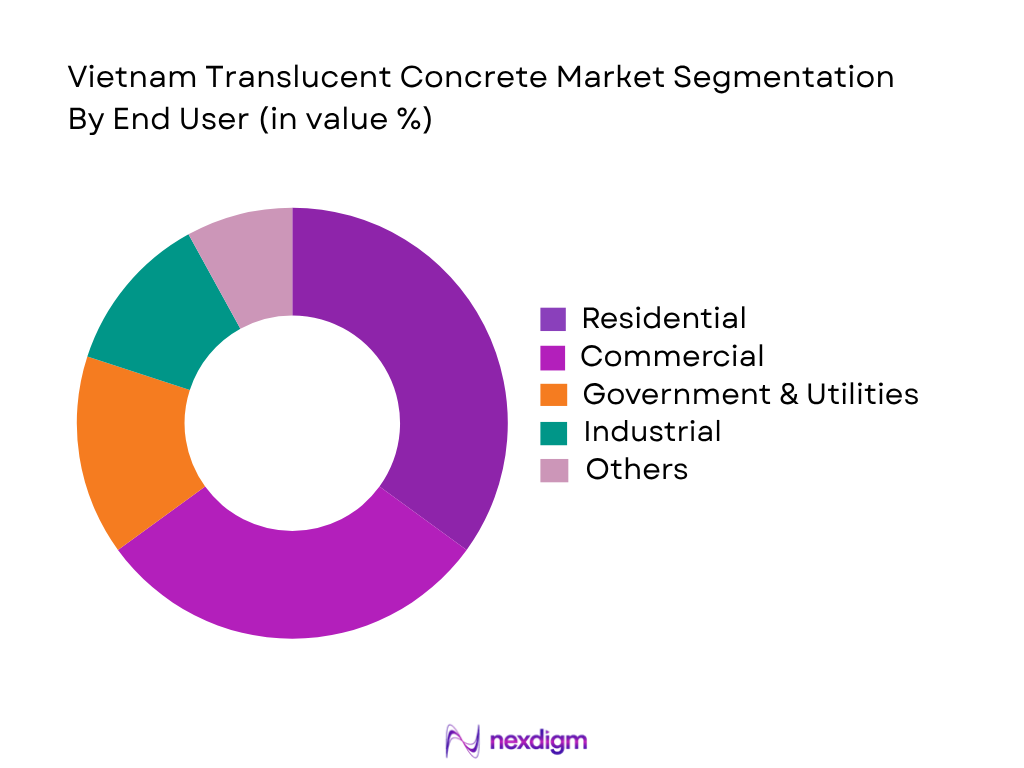
The Vietnam Translucent Concrete Market is segmented by end user into Residential, Commercial, Industrial, Government & Utilities and Others. Residential construction is identified as the leading Vietnam sub-segment in the available market assessment, supported by demand for modern housing concepts, premium architectural finishes and visually differentiated building materials. Translucent concrete can be incorporated into feature walls, partitions, façade components, illuminated surfaces and decorative architectural elements, enabling developers to differentiate high-value projects. Commercial applications nevertheless represent an important opportunity as hotels, offices, shopping facilities and branded spaces increasingly incorporate premium materials and energy-conscious designs. Vietnam’s wider green-building transition strengthens this addressable market: the country recorded 163 newly certified green buildings, while green-certified offices reached their highest recorded scale. Globally, commercial and non-residential projects are also significant users because translucent concrete is well suited to façade, public-space and feature-wall applications.
Competitive Landscape
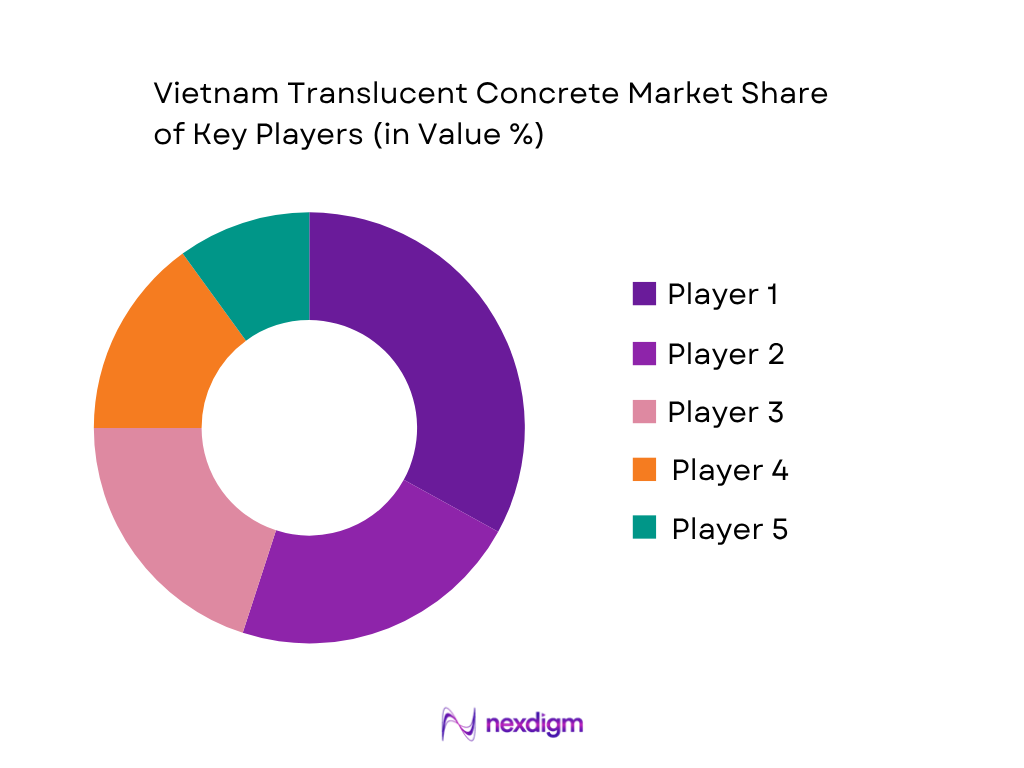
The Vietnam Translucent Concrete Market has a relatively specialized competitive structure involving global translucent-concrete technology developers, architectural concrete manufacturers, façade-system suppliers and companies capable of serving projects through imports, technical partnerships or regional distribution. Competition is shaped less by conventional concrete scale alone and more by light-transmission performance, optical-fiber technology, panel engineering, customization, façade integration, project references and technical support. Global specialist suppliers therefore remain important benchmarks for Vietnam’s emerging ecosystem.
| Major Player | Establishment Year | Headquarters | Core Technology | Key Product Form | Light-Transmission Technology | Façade Application Capability | Customization Capability | Vietnam / Southeast Asia Relevance |
| LUCEM GmbH | 2007 | Aachen, Germany | ~ | ~ | ~ | ~ | ~ | ~ |
| LiTraCon / Litracon | 2001 | Csongrád, Hungary | ~ | ~ | ~ | ~ | ~ | ~ |
| Heidelberg Materials / Italcementi | 1873 | Heidelberg, Germany | ~ | ~ | ~ | ~ | ~ | ~ |
| Pan-United Corporation Ltd. | 1958 | Singapore | ~ | ~ | ~ | ~ | ~ | ~ |
| Fapinex LLC | 2016 | Dubai, UAE | ~ | ~ | ~ | ~ | ~ | ~ |
Vietnam Translucent Concrete Market Analysis
Growth Drivers
Expansion of Green Buildings and Advanced Architectural Construction
Vietnam’s accelerating green-building pipeline is creating a larger addressable application base for translucent concrete across façades, feature walls, partitions, daylighting systems and premium architectural installations. The Ministry of Construction reported that Vietnam had 559 certified green buildings covering approximately 13.58 million square metres of certified floor area at the end of 2024. During 2024 alone, 163 buildings received green certification, compared with 76 buildings during 2023 and 54 buildings during 2022. The momentum continued into 2025, when the national stock surpassed 600 green buildings with nearly 17 million square metres of certified floor area by the end of the second quarter. This remains modest relative to approximately 60,000 buildings permitted nationwide annually, demonstrating the scale of the potential construction base into which advanced architectural materials can penetrate. World Bank data put Vietnam’s 2024 GDP at approximately USD 476.4 billion, GDP per capita at USD 4,717.3, and population at 100,987,686. These conditions support continued investment in urban buildings with higher architectural specifications. For translucent concrete suppliers, growth in certified construction creates opportunities for optical-fiber panels, illuminated walls and daylight-transmitting façades. Increasing requirements for distinctive building identities can additionally support bespoke translucent concrete in hotels, offices, retail spaces and landmark developments.
Strong Construction-Linked Economy and Investment Environment
Vietnam’s economic and investment environment supports the underlying construction activity required for adoption of specialized materials such as translucent concrete in premium offices, hotels, retail developments, mixed-use complexes, institutional facilities and infrastructure. World Bank data show that Vietnam generated approximately USD 476.4 billion of GDP in 2024, with GDP per capita reaching USD 4,717.3 and the national population standing at 100,987,686. Industry and construction together represented a substantial component of national economic activity, providing a large operating ecosystem of contractors, concrete manufacturers, prefabricators, engineering companies and building-material suppliers. Gross capital formation also represented a significant component of economic activity, indicating continued investment in productive assets, buildings and infrastructure. The IMF reported strong Vietnamese economic expansion during 2024, supported by exports, foreign direct investment and supportive economic policies. These fundamentals matter specifically for translucent concrete because the product requires a sufficiently sophisticated project pipeline to justify customized panel fabrication, optical-fiber integration, specialized installation and architectural engineering. Vietnam’s expanding urban economy also creates opportunities for signature buildings where developers can differentiate projects through illuminated façades and interior feature surfaces. Increasing development sophistication should encourage closer collaboration between architects, façade consultants, lighting designers and precast manufacturers, expanding the potential specification ecosystem for light-transmitting concrete.
Market Challenges
Limited Green-Building Penetration within the Wider Construction Pipeline
A major market-specific challenge is that the building segment most naturally aligned with translucent concrete—high-performance, architecturally differentiated and green-certified construction—still represents a relatively narrow portion of Vietnam’s enormous construction pipeline. The Ministry of Construction reported 559 green-certified buildings and approximately 13.58 million square metres of certified floor area at the end of 2024. During 2024, 163 buildings achieved certification, demonstrating rapid progress but also highlighting the early stage of green-building penetration relative to the broader market. By the end of the second quarter of 2025, the total exceeded 600 buildings and approached 17 million square metres, while approximately 60,000 buildings are permitted nationwide annually. This gap indicates that advanced environmental and architectural specifications still have considerable room to diffuse into mainstream construction. Translucent concrete is particularly exposed because it requires architects, façade engineers, developers and contractors to deliberately specify optical-fiber or light-transmitting cementitious systems instead of conventional concrete, masonry or glazing. The challenge persists despite Vietnam reaching 100,987,686 residents, approximately USD 476.4 billion in GDP and USD 4,717.3 in GDP per capita in 2024. Suppliers therefore require reference installations, physical samples, technical documentation and local engineering support to translate construction activity into actual specifications.
Real-Estate Recovery and Project-Specification Risk
Translucent concrete demand is disproportionately connected with architecturally sophisticated developments, making adoption sensitive to conditions affecting real estate, construction execution and discretionary architectural specifications. The IMF’s assessment of Vietnam highlighted the importance of addressing bottlenecks in real estate, affordable housing and public investment while recognizing that normalization of the property sector requires continued policy and financial-sector attention. This is particularly relevant for translucent concrete because illuminated walls, optical-fiber façades, customized blocks and bespoke precast panels are normally incorporated during architectural design and material specification rather than purchased as standardized commodity inputs. Vietnam nevertheless entered this environment with considerable economic scale. World Bank data record approximately USD 476.4 billion of GDP in 2024, USD 4,717.3 of GDP per capita and a population of 100,987,686, providing substantial long-term foundations for construction demand. However, individual projects can still experience redesign, procurement delays or material substitution. For translucent concrete suppliers, this creates a higher specification risk than for conventional cement and concrete products. Manufacturers must therefore demonstrate structural performance, durability, optical performance and installation compatibility early in the design process. Developing relationships with architects, façade consultants and developers becomes especially important because substitution decisions made before construction can eliminate translucent concrete from an otherwise suitable project.
Market Opportunities
Localization through Vietnam’s Expanding Green-Construction Ecosystem
Vietnam presents a significant opportunity to shift translucent concrete from predominantly specialist project sourcing toward greater local fabrication and integration with domestic precast, façade and architectural-material capabilities. The immediate demand environment is becoming deeper: Vietnam recorded 163 newly certified green buildings during 2024, taking the national stock to 559 buildings and approximately 13.58 million square metres of certified floor area. By the end of the second quarter of 2025, the country had surpassed 600 certified green buildings representing nearly 17 million square metres. The Ministry of Construction also indicates that approximately 60,000 buildings receive permits annually, creating a substantial underlying pipeline in which advanced light-transmitting materials could progressively gain specification. Macroeconomic scale reinforces the opportunity. World Bank data place Vietnam’s 2024 GDP at approximately USD 476.4 billion, population at 100,987,686, and GDP per capita at USD 4,717.3. These conditions provide technology owners with a basis for partnerships with Vietnamese precast manufacturers, façade fabricators and architectural-material distributors. A practical localization pathway could involve domestic production of high-performance cementitious matrices while specialized optical fibers or light guides continue to be imported. Local finishing, cutting, anchoring and lighting integration could subsequently expand domestic value addition and enable manufacturers to respond more efficiently to customized project specifications.
Premium Façade and Daylighting Applications in Major Urban Green-Building Clusters
The concentration of certified construction in Vietnam’s largest urban centers creates a focused opportunity for translucent concrete across premium façades, entrance areas, lobby walls, partitions, hospitality interiors, retail environments and daylight-transmitting architectural surfaces. Ministry of Construction information shows that Vietnam had more than 13.6 million square metres of green-certified floor area at the end of 2024, distributed across 559 certified projects. Hanoi accounted for more than 2.16 million square metres of certified space, while Ho Chi Minh City maintained the largest concentration nationally. The pipeline expanded to more than 600 buildings and nearly 17 million square metres by the end of the second quarter of 2025. This geographic concentration is commercially important because translucent concrete typically requires coordinated involvement from architects, façade consultants, lighting designers, precast fabricators, contractors and specialist installers. Vietnam’s population of 100,987,686, GDP of approximately USD 476.4 billion, and GDP per capita of USD 4,717.3 in 2024 provide additional macroeconomic foundations for continued metropolitan development. Suppliers can therefore prioritize Ho Chi Minh City and Hanoi for reference installations and architectural specification campaigns. Successful projects can demonstrate light transmission, privacy, concrete aesthetics and integrated illumination, providing tangible precedents that can support subsequent adoption in Da Nang, Hai Phong and other development centers.
Future Outlook
The Vietnam Translucent Concrete Market is expected to expand at a forecast CAGR of approximately ~XX% during 2026-2035. Growth will be linked to premium construction, green-building adoption, façade modernization, luxury hospitality investment and improvements in translucent-concrete manufacturing. Increasing familiarity among architects and developers should gradually broaden adoption beyond highly bespoke projects toward standardized panels, interior surfaces and modular façade solutions.
Vietnam’s green-building ecosystem provides an important structural tailwind. Green-certified buildings increased sharply, while cumulative certified floor area reached approximately 13.6 million m². Buildings account for around 35-40% of Vietnam’s total energy consumption, making energy-efficient architecture an important policy and design priority. Translucent concrete’s ability to combine daylight transmission with solid architectural surfaces gives the material relevance in projects seeking differentiated daylighting and façade solutions.
Major Players
- LUCEM GmbH
- LiTraCon / Litracon
- Heidelberg Materials / Italcementi
- Pan-United Corporation Ltd.
- Dupont Lightstone
- CRE Panel GmbH
- LCT GesmbH
- Glass Block Technology Ltd.
- Fapinex LLC
- Beton Brož
- Florack Bauunternehmung GmbH
- Concrete LCDA
- Gravelli / LiCrete
- GBA Architectural Products
- Translucent Crete LLC
Key Target Audience
- Translucent Concrete and Architectural Concrete Manufacturers
- Precast Concrete and Façade System Manufacturers
- Real Estate Developers and Construction Companies
- Architects, Façade Designers and Architectural Lighting Companies
- Building Material Importers, Distributors and Technology Licensees
- Investments and Venture Capitalist Firms
- Government and Regulatory Bodies (Ministry of Construction, Ministry of Industry and Trade, Ministry of Agriculture and Environment)
- Banks, Infrastructure Funds and Project Financing Institutions
Research Methodology
Step 1: Identification of Key Variables
The initial phase involves constructing an ecosystem map covering cement and optical-fiber suppliers, translucent-concrete technology developers, precast manufacturers, façade contractors, architects, developers, distributors and end users. Extensive desk research is used to identify market-specific variables including installed area, panel prices, optical-fiber content, application mix, import dependence, specification rates and addressable construction activity.
Step 2: Market Analysis and Construction
Historical market development is assessed using a combination of top-down and bottom-up approaches. The top-down model examines Vietnam’s premium construction, green-building and architectural-material environment, while the bottom-up model evaluates project numbers, estimated translucent-concrete surface requirements, panel consumption, supplier activity and average selling prices to construct and cross-check market revenue.
Step 3: Hypothesis Validation and Expert Consultation
Market hypotheses are validated through computer-assisted telephone interviews (CATIs) and direct discussions with precast manufacturers, architects, façade specialists, building-material distributors, developers and construction contractors. These interviews are designed to validate application preferences, specification behavior, project lead times, material pricing, optical-fiber requirements, procurement channels and barriers to translucent-concrete adoption in Vietnam.
Step 4: Research Synthesis and Final Output
The final phase triangulates secondary research, primary interviews and market-model outputs. Supplier information is compared with demand-side construction indicators, green-building development and architectural project pipelines. Findings are reconciled through top-down and bottom-up validation to establish market size, segmentation, competitive positioning, application opportunities and the long-term outlook for the Vietnam Translucent Concrete Market.

- Executive Summary
- Research Methodology (Market Definition and Scope, Vietnam Translucent Concrete Market Classification, Light-Transmitting Concrete Technology Mapping, Optical-Fiber-Embedded Concrete Assessment, PMMA Optical Fiber Concrete Evaluation, Glass-Fiber Light-Transmitting Concrete Analysis, Resin and Polymer-Based Translucent Concrete Assessment, Precast Translucent Concrete Panel Evaluation, Translucent Concrete Block Assessment, Architectural Panel Performance Mapping, Light Transmission Efficiency Analysis, Compressive Strength Assessment, Flexural Strength Evaluation, Optical Fiber Density Analysis, Panel Thickness and Dimension Assessment, Surface Finish Evaluation, Façade Application Mapping, Interior Application Assessment, Building Type Demand Mapping, Precast Manufacturing Assessment, Architectural Specification Analysis, Import Dependency Assessment, Domestic Manufacturing Capability Assessment, Supply-Side Assessment, Demand-Side Assessment, Top-Down Market Sizing, Bottom-Up Market Sizing, Primary Industry Interviews, Data Triangulation, Forecasting Framework)

- Definition and Scope
- Vietnam Translucent Concrete Industry Evolution and Development of Optical-Fiber-Embedded Concrete, Light-Transmitting Cementitious Materials, Precast Translucent Concrete Panels, Architectural Façade Systems, Interior Feature-Wall Applications, Daylighting Solutions, High-Performance Concrete Matrices, PMMA Optical Fiber Integration, Glass Light-Guide Technologies, Custom Architectural Elements, Smart Concrete Surfaces, LED-Integrated Concrete, Low-Carbon Concrete Matrices, Automated Fiber Placement, Digital Fabrication and Advanced Precast Manufacturing
- Translucent Concrete Value Chain Analysis
- Translucent Concrete Supply Chain Analysis
- Cement and Binder Suppliers, Fine Aggregate Suppliers, Optical Fiber Manufacturers, PMMA Fiber Suppliers, Glass Light-Guide Suppliers, Admixture Manufacturers, Translucent Concrete Technology Developers, Precast Concrete Manufacturers, Architectural Panel Fabricators, Façade System Suppliers, Specialty Building Material Importers, Construction Material Distributors, Architects, Façade Consultants, Lighting Designers, General Contractors, Specialty Installers, Property Developers and Building Owners

- Growth Drivers (Increasing Demand for Premium Architectural Materials, Expansion of Luxury Hospitality Construction, Development of Grade-A Commercial Buildings, Increasing Demand for Daylighting Solutions, Adoption of Signature Building Façades, Growth of High-End Interior Fit-Out Projects, Increasing Precast Construction Adoption, Green Building Development, Expansion of Smart Building Concepts, Demand for Material Differentiation in Landmark Projects)
- Market Challenges (High Translucent Concrete Production Cost, High Optical Fiber Cost, Dependence on Imported Optical Fibers and Specialized Components, Limited Domestic Commercial-Scale Manufacturing, Labor-Intensive Fiber Placement, Complex Precast Manufacturing Requirements, Limited Architect and Contractor Familiarity, Structural and Façade Integration Challenges, Long Project-Specific Lead Times, Specialty Installation Requirements, Limited Standardization, Competition from Architectural Glass and Alternative Daylighting Materials)
- Market Opportunities (Domestic Translucent Concrete Manufacturing, Localization of Precast Panel Production, Technology Licensing and Joint Ventures, Automated Optical Fiber Placement, Lightweight Translucent Concrete Panels, Low-Carbon Cementitious Matrices, Integrated LED Concrete Systems, Smart and Interactive Façades, Modular Translucent Concrete Systems, Luxury Hotel and Resort Applications, Airport and Transportation Infrastructure Applications, Landmark Public Building Applications, High-End Interior Applications, Additive Manufacturing and 3D-Printed Translucent Concrete)
- Market Trends (Increasing Adoption of Optical-Fiber-Embedded Concrete, Growth of Custom Precast Panels, Integration of LED Backlighting, Development of Lightweight Panels, Increasing Use in Feature Walls and Signature Façades, Growing Interest in Locally Fabricated Architectural Concrete, Adoption of Digital Fabrication, Development of Low-Carbon Concrete Matrices, Application-Specific Panel Engineering, Growth of Smart Concrete Surfaces, Increasing Architectural Material Customization)
- Government Regulations and Standards (Vietnam Building Code Requirements, QCVN Construction Material Requirements, Concrete and Reinforced Concrete Standards, Construction Product Quality Management Requirements, Structural Anchorage Requirements, Façade Wind-Load Requirements, Fire Prevention and Fire Safety Requirements, Building Energy Efficiency Requirements, Building Envelope Performance Requirements, Imported Construction Material Compliance Requirements, Product Conformity Assessment Requirements, Occupational Safety Requirements)
- SWOT Analysis
- Porter’s Five Forces Analysis
- PESTLE Analysis
- Stakeholder Ecosystem
- Competition Ecosystem

- By Market Value (2020-2025)
- By Installed Volume (2020-2025)
- By Installed Surface Area (2020-2025)
- By Average Selling Price per Square Meter (2020-2025)
- By Precast Translucent Concrete Panel Consumption Volume (2020-2025)
- By Optical-Fiber-Embedded Concrete Consumption Volume (2020-2025)
- By Translucent Concrete Block and Tile Consumption Volume (2020-2025)
- By Exterior Façade Application Volume (2020-2025)
- By Interior Architectural Application Volume (2020-2025)

- By Light-Transmitting Technology (In Value %)
Optical-Fiber-Embedded Cementitious Concrete
PMMA Optical-Fiber Concrete
Glass-Fiber and Glass-Element-Based Concrete
Polymer and Resin-Based Translucent Concrete
Hybrid Light-Guide Concrete Systems
Integrated LED Translucent Concrete
Alternative Light-Transmitting Cementitious Systems - By Product Form (In Value %)
Precast Translucent Concrete Panels
Translucent Concrete Slabs
Translucent Concrete Blocks and Bricks
Translucent Concrete Tiles
Custom Architectural Elements
Decorative Concrete Components
Furniture and Interior Elements
Bespoke Formed and 3D Elements - By Application (In Value %)
Building Façades
Exterior Wall Cladding
Interior Feature Walls
Partitions and Space Dividers
Flooring and Pavements
Staircases and Vertical Circulation Elements
Reception Desks and Countertops
Signage and Branded Architectural Surfaces
Landscape and Public-Realm Installations
Furniture and Decorative Applications - By End-Use Building Type (In Value %)
Grade-A Offices and Corporate Buildings
Hotels and Luxury Resorts
Retail Malls and Luxury Stores
Airports and Transportation Facilities
Museums, Galleries and Cultural Buildings
Educational and Institutional Buildings
Healthcare Facilities
Government and Civic Buildings
High-End Residential Buildings
Mixed-Use Developments - By Functional Property (In Value %)
Daylighting and Light-Transmitting Systems
Structural and Load-Bearing Systems
Non-Structural Architectural Systems
Thermal-Performance-Oriented Systems
Acoustic-Performance-Oriented Systems
Decorative and Aesthetic Systems
Integrated LED and Artificially Illuminated Systems - By Construction Route (In Value %)
Factory-Manufactured Precast Systems
Project-Specific Custom Precast Systems
Modular Panel Systems
Custom Fabricated Architectural Elements
Imported Finished Translucent Concrete Systems
Imported Optical Components with Local Fabrication
Additive-Manufactured and 3D-Printed Systems - By Project Type (In Value %)
New Construction
Major Renovation
Façade Retrofit
Interior Fit-Out
Public-Realm Redevelopment
Landmark and Signature Architecture
Luxury Hospitality Development - By Region (In Value %)
Ho Chi Minh City
Hanoi
Da Nang
Hai Phong
Quang Ninh
Binh Duong
Dong Nai
Khanh Hoa
Rest of Vietnam

- Market Share of Major Players (By Vietnam Revenue, Translucent Concrete Product Portfolio, Optical-Fiber Technology Capability, Precast Panel Portfolio, Light Transmission Performance, Panel Size and Thickness Range, Exterior Façade Capability, Interior Application Coverage, Customization Capability, Integrated Lighting Capability, Manufacturing Capacity, Vietnam and Southeast Asia Distribution Network, Architectural Specification Reach, Project Portfolio, Technical Support Capability)
- Cross Comparison Parameters (Light Transmission Efficiency, Compressive Strength Performance, Panel Size and Thickness Range, Optical Fiber and Light-Guide Technology Capability, Vietnam and Southeast Asia Project and Distribution Presence, Exterior Façade Application Capability, Customization and Integrated Lighting Capability, Manufacturing Scalability and Lead-Time Capability)
- SWOT Analysis of Major Players
- Competitive Positioning Matrix
- Translucent Concrete Technology and Architectural Application Benchmarking
- Panel Performance, Anchorage and Building System Integration Assessment
- Vietnam Distribution, Architectural Specification and Technical Support Assessment
- Detailed Profiles of Major Companies
LUCEM GmbH
LiTraCon / Litracon
Heidelberg Materials / Italcementi
Pan-United Corporation Ltd.
Dupont Lightstone
CRE Panel GmbH
LCT GesmbH
Glass Block Technology Ltd.
Fapinex LLC
Beton Brož
Florack Bauunternehmung GmbH
Concrete LCDA
Gravelli / LiCrete
GBA Architectural Products
Translucent Crete LLC

- Architectural Façade Requirement Assessment
- Exterior Wall Cladding Demand Analysis
- Interior Feature-Wall Requirement Assessment
- Grade-A Office and Corporate Building Demand Analysis
- Luxury Hotel and Resort Application Assessment
- Luxury Retail Application Requirement Analysis
- Airport and Transportation Facility Demand Assessment
- Museum and Cultural Building Application Analysis
- Institutional Building Requirement Assessment

- By Market Value (2026-2035)
- By Installed Volume (2026-2035)
- By Installed Surface Area (2026-2035)
- By Average Selling Price per Square Meter (2026-2035)
- By Precast Translucent Concrete Panel Consumption Volume (2026-2035)
- By Optical-Fiber-Embedded Concrete Consumption Volume (2026-2035)
- By Translucent Concrete Block and Tile Consumption Volume (2026-2035)
- By Exterior Façade Application Volume (2026-2035)
- By Interior Architectural Application Volume (2026-2035)


 Request a Sample
 Ask for Customization
 Get a Quote
 Enquire Now