
 Download PDF
Market Overview
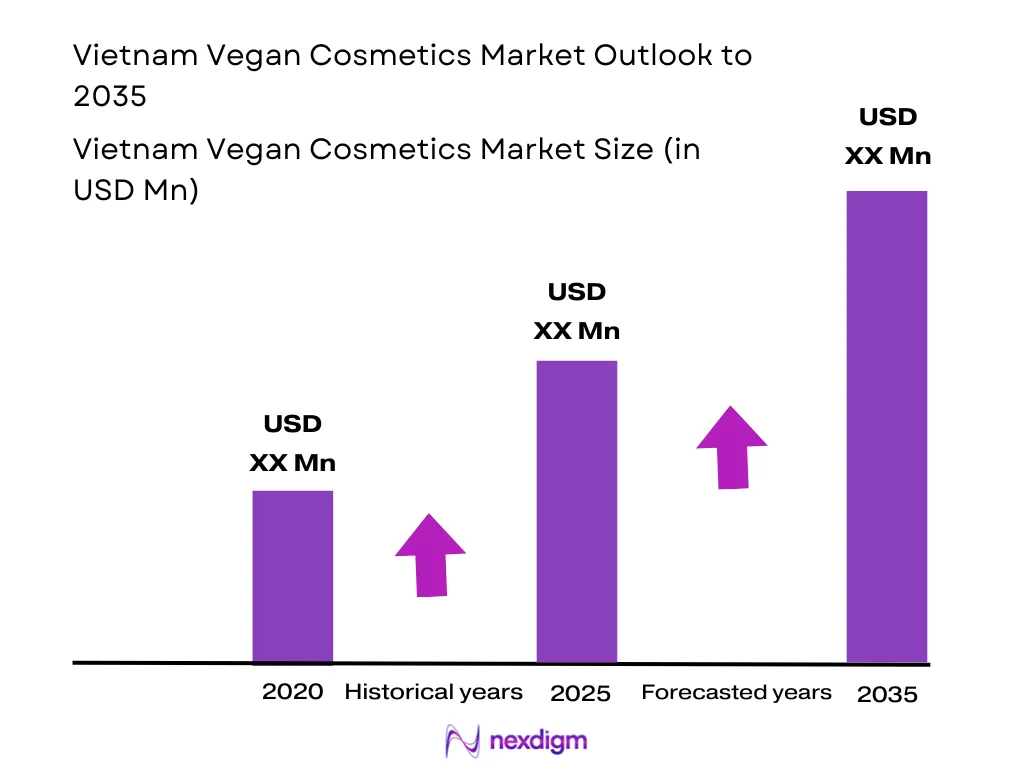
Statista data cited by the U.S. Commercial Service places Vietnam’s beauty and personal care market at USD ~billion in 2023, and USD ~ billion in 2024. Within that wider pool, Nexdigm values the Vietnam vegan cosmetics market at USD ~ million in 2024. The niche is being pulled upward by ingredient transparency, cruelty-free positioning, stronger online beauty discovery, and consumer migration toward botanical and “clean” formulations in skincare-led routines.
Domestic demand is concentrated in Ho Chi Minh City and Hanoi because these cities concentrate modern retail, premium mall traffic, beauty specialty chains, and the densest e-commerce infrastructure. On the supply side, France supplied USD ~ million, Singapore USD ~ million, and Japan USD ~ million of Vietnam’s beauty-product imports in 2023; from 2023 to 2024, the fastest-growing origins were South Korea (+USD ~ million), Singapore (+USD ~ million), and Hong Kong (+USD ~ million), reflecting K-beauty influence and regional distribution-hub strength.
Market Segmentation
By Product Category
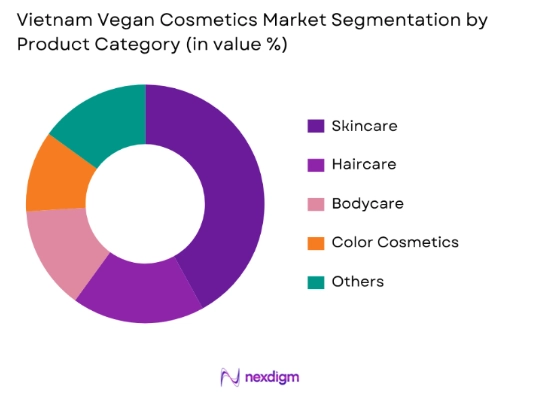
Vietnam vegan cosmetics market is segmented by product category into skincare, haircare, bodycare, color cosmetics, lipcare, and sun care. Recently, skincare has held the dominant market share in Vietnam under product category segmentation. Its lead is tied to Vietnam’s humid climate, high concern around acne, barrier repair, oil control, brightening, and sun exposure, and the fact that skincare routines are deeper and more repeat-driven than color cosmetics. Vegan positioning also fits especially well in facial care because buyers scrutinize ingredients, origin, and testing claims more closely in leave-on products such as serums, moisturizers, masks, and cleansers. Local brands like Cocoon and other botanical-led players have expanded facial and treatment formats quickly, while imported Korean and Australian vegan brands reinforce consumer trust in functional skincare. This makes skincare the most scalable, highest-frequency, and most discoverable entry point for vegan beauty brands in Vietnam.
By Distribution Channel
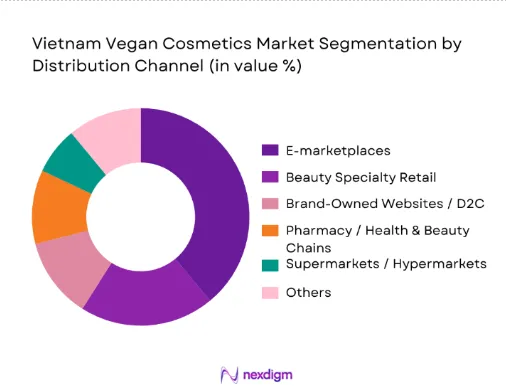
Vietnam vegan cosmetics market is segmented by distribution channel into brand-owned websites, e-marketplaces, beauty specialty retail, pharmacy/health and beauty chains, supermarkets/hypermarkets, salons/spas/clinics, and social commerce/resellers. Recently, e-marketplaces have held the dominant market share in Vietnam under distribution channel segmentation. Their lead comes from the combination of official-brand stores, high review visibility, livestream selling, flash-promotion mechanics, and nationwide logistics reach that allows vegan brands to scale beyond the two largest cities. Vietnamese beauty buying has become heavily digital, and category discovery increasingly happens through TikTok Shop, Shopee, and Lazada rather than traditional shelf browsing alone. For vegan cosmetics specifically, these platforms reduce trust barriers by showing ingredient claims, certification cues, tutorial content, and user reviews in one place. They also let smaller local brands compete with imported labels without investing immediately in a large offline footprint, making e-marketplaces the market’s most efficient demand-conversion engine
Competitive Landscape
The Vietnam vegan cosmetics market is led by a mix of fast-scaling domestic botanical brands and imported vegan or cruelty-free specialists. Competition is not fully consolidated, but a small group of recognized names shape category discovery, online reviews, and premium shelf visibility. Local brands win through Vietnam-native ingredient stories and affordable pricing, while foreign brands bring certification credibility, established routines, and premium clean-beauty positioning. The result is a market where channel execution, hero-SKU strength, and trust signaling matter more than breadth alone.
| Company | Establishment Year | Headquarters | Core Market Focus | Vegan / Cruelty-Free Positioning | Hero Categories | Vietnam Channel Strength | Price Tier | Market-Specific Differentiator |
| Cocoon Vietnam | 2013 | Ho Chi Minh City, Vietnam | ~ | ~ | ~ | ~ | ~ | ~ |
| Cỏ Mềm | 2015 | Hanoi, Vietnam | ~ | ~ | ~ | ~ | ~ | ~ |
| BareSoul | 2015 | Vietnam | ~ | ~ | ~ | ~ | ~ | ~ |
| The Body Shop | 1976 | Brighton, United Kingdom | ~ | ~ | ~ | ~ | ~ | ~ |
| Aromatica | 2004 | Seoul, South Korea | ~ | ~ | ~ | ~ | ~ | ~ |
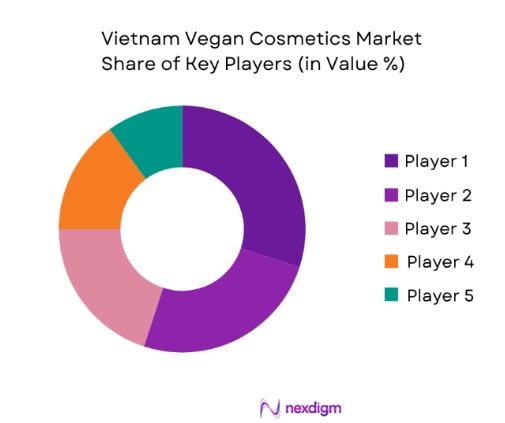
Vietnam Vegan Cosmetics Market Analysis
Growth Drivers
Clean-Beauty Adoption
Vietnam’s vegan cosmetics demand is being supported by a consumer environment that is becoming larger, wealthier, and more formalized in beauty retail. The country’s population reached 100,987,686 in 2024, giving vegan and clean-beauty brands a broad addressable base across urban skincare, family care, and digitally discovered personal care. On the spending side, the IMF places Vietnam’s GDP at USD 527.27 billion in 2024, with GDP per capita at USD 5,209, which matters for vegan cosmetics because clean-beauty baskets usually depend on discretionary spending power and repeat purchase capacity rather than one-off trial. The channel side is equally important: Vietnam’s total retail sales of goods and consumer services reached VND 6,391.0 trillion in 2024, showing that consumer-product throughput is large enough to support specialized subcategories such as vegan skincare, botanical bodycare, and low-irritation haircare. Import data also points to deeper category availability. Vietnam’s imports of “essential oils and resinoids; perfumery, cosmetic or toilet preparations” reached USD 1,391,370,521 in 2024, up from USD 978,311,822 in the first nine months and USD 549,280,470 in the first five months. That import intensity matters for clean beauty because it expands access to plant-based inputs, preservative systems, fragrance alternatives, functional actives, and finished vegan-positioned products. In practical market terms, clean-beauty adoption is not being driven by image alone; it is being enabled by a larger consumer base, stronger purchasing capacity, a much bigger formal retail system, and a cosmetics import pipeline that is now large enough to sustain ingredient-led differentiation at scale.
Animal-Welfare Awareness
Animal-welfare awareness is becoming commercially meaningful in Vietnam because ethical claims now sit inside a broader ecosystem of rising beauty consumption, stronger exposure to international standards, and more visible brand filtering in formal channels. Vietnam’s population of 100,987,686 and GDP per capita of USD 5,209 in 2024 create the scale and spending base needed for consumers to move beyond basic efficacy and start rewarding values-based propositions such as cruelty-free testing, vegan ingredient decks, and transparent sourcing. Vietnam also welcomed more than 17.5 million international visitors in 2024, while total retail sales of goods and consumer services reached VND 6,391.0 trillion. Together, those two figures matter because tourism, premium retail traffic, airport retail, and social-media spillover expose consumers and retailers to international ethical-beauty norms much faster than in a purely domestic beauty ecosystem. Supply-side numbers reinforce the same shift: imports of essential oils, perfumery, cosmetics, and toilet preparations reached USD 1.39 billion in 2024, showing that Vietnam’s market is being fed by a large cross-border assortment where cruelty-free and vegan labeling are increasingly part of product comparison. In other words, animal-welfare awareness in this market is less a standalone advocacy trend and more a retail behavior supported by rising income, stronger international exposure, larger formal cosmetics inflows, and bigger digital catalog depth. That combination helps cruelty-free and vegan claims convert from niche ethical language into visible purchase filters, especially in skincare, lipcare, and bodycare where consumers read ingredient and testing claims more closely.
Market Challenges
Consumer Confusion Between Vegan, Cruelty-Free, Natural, and Organic
Consumer confusion remains a real challenge in Vietnam vegan cosmetics because the category is expanding faster than claim literacy and enforcement quality. The market is now operating inside a large and fast-moving consumer economy: Vietnam posted USD 527.27 billion in GDP and USD 5,209 GDP per capita in 2024, while total retail sales reached VND 6,391.0 trillion and cosmetics-related imports climbed to USD 1.39 billion. Those numbers are positive for category growth, but they also mean a much denser shelf and marketplace environment where vegan, cruelty-free, botanical, herbal, natural, and organic language can overlap or be misread. The compliance burden is visible in official enforcement data. From 15/12/2023 to 22/8/2024, the market surveillance force checked 50,445 cases and handled 35,510 violations, with total handling value of VND 674 billion; during the same eight-month span, the E-commerce and Digital Economy Agency transferred information on more than 500 websites and applications showing legal-violation signals to police. Cosmetics-specific cases underline why claim confusion persists online: authorities in Bac Giang seized around 70,000 cosmetic products worth about VND 1 billion in a warehouse selling mainly on e-commerce platforms; in another case, authorities found over 50,000 expired cosmetic and toothpaste products with a combined weight of over 20 tons; and Ho Chi Minh City authorities seized 748 cosmetic and perfume items with invoice and trademark issues. For vegan cosmetics, this creates a direct commercial problem: when provenance, labeling, and authenticity are noisy, genuine vegan brands must spend more on proof, education, and official-store control just to separate themselves from misleading or unauthorized listings.
Counterfeit Risk
Counterfeit risk is one of the sharpest constraints on Vietnam’s vegan cosmetics market because the category relies heavily on trust, ingredient transparency, and authentication at the point of purchase. Vietnam’s macro backdrop is large enough to attract illicit sellers: the IMF reports GDP of USD 527.27 billion and GDP per capita of USD 5,209 in 2024, the World Bank records a population of 100,987,686, and the National Statistics Office places total retail sales at VND 6,391.0 trillion. Vietnam Customs also reports USD 1,433,102,329 in imports of “essential oils and resinoids; perfumery, cosmetic or toilet preparations,” indicating a broad and valuable cosmetics flow that counterfeit operators can mimic or piggyback on. Enforcement cases show the risk is not theoretical. In 2024, authorities in Bac Giang uncovered more than 70,000 cosmetic units worth around VND 1 billion in an online business warehouse, while Hanoi market surveillance officials seized over 50,000 expired children’s toothpaste, cosmetics, and beauty products that had been relabeled with new expiry dates. Separate reporting on early-2024 enforcement in Ho Chi Minh City described strengthened inspections of cosmetics advertised on Facebook, TikTok, Zalo, and YouTube, reflecting official concern over the digital beauty channel. For vegan cosmetics specifically, counterfeit risk is especially damaging because the category’s value proposition depends on belief in ingredient purity, ethical claims, and safety. Once fake or relabeled products circulate in the same online spaces as legitimate vegan brands, consumers become more hesitant, and genuine players must invest more in authentication, official-store control, and post-sale trust building to protect brand integrity.
Market Opportunities
Localized Botanicals
Localized botanicals are one of the clearest expansion routes for Vietnam vegan cosmetics because the country already has the agricultural base needed to support ingredient storytelling, local extraction, and Vietnam-specific product development. The macro backdrop remains supportive: Vietnam’s economy reached USD 527.27 billion in 2024, GDP per capita was USD 5,209, and the population stood at 100,987,686, which gives domestic brands both a manufacturing case and a sizable home market for formulations built around Vietnamese raw materials. On the supply side, the National Statistics Office reported that coffee production reached 2,116.1 thousand tons in 2025. It also reported coconut output of 546.7 thousand tons in the first quarter of 2025 and 593.8 thousand tons in the first quarter of 2026. These numbers matter directly for vegan cosmetics because coffee, coconut, rice-derived derivatives, fruit enzymes, herbal distillates, and nut oils are not just marketing narratives; they can anchor exfoliants, scalp care, lipcare, body scrubs, cleansing oils, and emulsion systems with local provenance. Vietnam’s cosmetics import pipeline is still large at USD 1.39 billion in 2024, which means local brands are competing in a market full of imported actives and finished products. That makes localized botanicals strategically valuable: they help domestic players avoid pure imitation, reduce dependence on fully imported storytelling, and create differentiation that is harder for foreign brands to copy credibly. For vegan beauty in particular, local botanicals can combine three purchase triggers at once—plant-based identity, national ingredient familiarity, and stronger traceability messaging—making this one of the most commercially attractive future growth pockets in the market.
Vegan Sun Care
Vegan sun care has unusually strong upside in Vietnam because the category sits at the intersection of climate exposure, tourism intensity, skincare-first routines, and retail throughput. Vietnam’s consumer base reached 100,987,686 people in 2024, while the economy generated USD 527.27 billion in GDP and USD 5,209 in GDP per capita, giving brands a wider pool of buyers who can add specialized daily-protection products to existing skincare routines. Demand conditions are reinforced by mobility and exposure: Vietnam welcomed more than 17.5 million international visitors in 2024, and total retail sales of goods and consumer services reached VND 6,391.0 trillion. Climate data makes the case more specific. The National Centre for Hydro-Meteorological Forecasting stated that the average temperature in the first four months of 2024 was 0.5°C to 1.5°C higher than the average of many years, and official weather updates said heat in the north would persist until August, while the central region could remain hot through September, with many places recording 36°C–39°C and some locations exceeding 40°C. For vegan sun care, these conditions matter because protection products are not occasional-use items in such an environment; they can become high-frequency, replenishment-led staples tied to commuting, tourism, outdoor work, and daily urban exposure. This creates room for mineral or hybrid vegan sunscreens, lighter textures for humid climates, reef-friendlier travel formats, and family-use body SPF lines. The opportunity is therefore not based on abstract future optimism; it is supported by current heat conditions, current tourist traffic, and a current consumer economy already large enough to support daily-use protective skincare
Future Outlook
Vietnam vegan cosmetics market is positioned for sustained expansion as ethical beauty moves from a niche preference into a more mainstream premium-mass purchase behavior. The category should benefit from rising online beauty spend, stronger official-store penetration on marketplaces, and continued demand for skin-sensitive, botanical, and climate-fit formulations. Packaging sustainability, refill formats, and ingredient traceability will become sharper differentiators, especially in urban consumers and younger cohorts. For long-range planning, a 7.0% CAGR for 2026–2035 is a reasonable benchmark from broader vegan cosmetics industry forecasting, while Vietnam’s published medium-term outlook of 8.02% through 2033 indicates the country may outpace the wider market if local brands continue scaling effectively.
Major Players
- Cocoon Vietnam
- Cỏ Mềm
- BareSoul
- Herbario
- Herb n’ Spice
- Naunau
- The Body Shop
- Lush
- Dear, Klairs
- Sukin
- Aromatica
- I’m From
- Melixir
- Pacifica Beauty
- e.l.f. Cosmetics
Key Target Audience
- Vegan and clean beauty brand owners
- Beauty and personal care distributors and importers
- E-commerce platforms and official store operators
- Beauty specialty retail chains and pharmacy-led beauty retailers
- Contract manufacturers, OEM/ODM formulators, and packaging suppliers
- Investments and venture capitalist firms
- Government and regulatory bodies (Drug Administration of Vietnam, Ministry of Health; Vietnam E-Commerce and Digital Economy Agency, Ministry of Industry and Trade)
- Private-label cosmetic houses and cross-border brand licensors
Research Methodology
Step 1: Identification of Key Variables
The first step maps the Vietnam vegan cosmetics ecosystem across local brands, importers, e-marketplaces, beauty retailers, contract manufacturers, and regulators. Secondary research is used to identify the variables that most affect market formation, including vegan and cruelty-free claims, skincare-led category demand, digital channel dependence, botanical sourcing narratives, and premiumization triggers.
Step 2: Market Analysis and Construction
Historical market construction begins with the broader Vietnam beauty and personal care base, then isolates the vegan cosmetics layer using claim-led brand mapping and category filtering. Product assortment, active-SKU counts, price ladders, online storefront intensity, and retail visibility are reviewed to build a practical picture of category scale, segment weight, and monetization pools.
Step 3: Hypothesis Validation and Expert Consultation
Working assumptions are validated through structured discussions with distributors, marketplace operators, ingredient suppliers, retail buyers, and brand-side managers. This stage tests which categories convert best, how trust is built in vegan positioning, what role certification plays in purchase decisions, and where local brands outperform imported competitors in Vietnam.
Step 4: Research Synthesis and Final Output
The final stage triangulates source data, company evidence, channel observations, and expert feedback into a market model that is both commercially useful and internally consistent. Bottom-up findings from SKU and channel mapping are reconciled with top-down market indicators to produce sizing, segmentation, competitive positioning, and strategic outlook for the Vietnam vegan cosmetics market.

- Executive Summary
- Research Methodology (Market Definitions and Boundary Conditions for Vegan/Cruelty-Free/Clean Beauty, Abbreviations, Top-to-Bottom Market Modeling, Bottom-to-Top SKU and Channel Mapping, Price-Point Benchmarking, Brand Universe Construction, Primary Expert Interviews with Brand Owners/Distributors/E-Retailers/Contract Manufacturers/Dermatology Clinics, Demand-Side Consumer Assessment, Forecasting Framework, Data Triangulation and Validation, Limitations and Assumptions)

- Definition and Scope
- Market Taxonomy: Vegan vs Cruelty-Free vs Natural vs Organic
- Market Genesis and Evolution of Vegan Beauty in Vietnam
- Consumer Adoption Lifecycle
- Vietnam Beauty Retail and E-Commerce Ecosystem
- Manufacturing, Import Dependence and Contract Filling Landscape
- Supply Chain and Value Chain Analysis
- Trade Route and Go-to-Market Architecture
- Stakeholder Ecosystem

- Growth Drivers (Clean-Beauty Adoption, Animal-Welfare Awareness, Ingredient Transparency, Climate-Specific Skincare Needs, E-Commerce Acceleration, Social Commerce Influence)
- Market Challenges (Consumer Confusion Between Vegan/Natural/Organic, Counterfeit Risk, Imported Brand Intensity, Compliance Burden, Claim Substantiation, Higher Cost of Certified Inputs)
- Market Opportunities (Localized Botanicals, Vegan Sun Care, Men’s Vegan Grooming, Refill Formats, Affordable Premium Tier, Export-Led Brand Building)
Market Trends (Skinimalism, Multifunctional SKUs, Fragrance-Light / Sensitive-Skin Ranges, Live-Commerce Selling, Certification Signaling, Eco-Packaging) - Regulatory and Compliance Landscape (DAV Notification Process, ASEAN Cosmetic Alignment, Labeling and Claims Discipline, Product Information File Readiness, Recall / Withdrawal Exposure, Advertising Compliance)
- Import-Local Manufacturing Balance (Imported Finished Goods, Local Filling, ODM/OEM Reliance, Domestic Ingredient Sourcing, Lead Time and Minimum Order Structures)
- Supply Chain Risk Analysis (Raw Material Volatility, Packaging Dependency, Counterfeit Leakage, Cross-Border Sourcing Risk, Last-Mile Service Levels)
- Porter’s Five Forces
- SWOT Analysis
- Market Attractiveness Matrix (Category Profit Pool, White Space Depth, Entry Complexity, Brand-Build Cost, Channel Scalability)

- By Value (2020-2025)
- By Volume (2020-2025)
- By Average Selling Price (2020-2025)
- By Per Capita Spending (2020-2025)
- By Online vs Offline Revenue Mix (2020-2025)

- By Product Category (In Value%)
Skincare
Haircare
Bodycare
Color Cosmetics
Lipcare
Sun Care
Men’s Grooming
Mother & Baby / Family Care - By Formulation / Claim Cluster (In Value%)
100% Vegan Certified
Vegan + Cruelty-Free
Vegan + Natural/Botanical
Vegan + Organic / Eco-Cert Positioned
Vegan + Dermatology / Sensitive-Skin Focused
Vegan + Sustainability / Refill / Low-Waste Positioned - By Ingredient Origin and Hero Botanical Platform (In Value%)
Vietnam-Sourced Botanicals
ASEAN-Sourced Botanicals
Korean / Japanese Functional Actives
Western Clean-Beauty Actives
Hybrid Formulations with Local Botanicals + Imported Actives - By Consumer Group (In Value%)
Gen Z
Millennials
Gen X / Mature Consumers
Women
Men
Sensitive-Skin / Problem-Skin Consumers
Ethical / Sustainability-Led Buyers - By Distribution Channel (In Value%)
Brand-Owned Website / D2C
E-Marketplaces
Shopee
TikTok Shop
Lazada
Beauty Specialty Retail
Pharmacy / Health & Beauty Chains
Supermarkets / Hypermarkets
Department Stores / Premium Beauty Counters
Salons / Spas / Clinics
Social Commerce / Reseller Networks - By Geography (In Value%)
Ho Chi Minh City
Hanoi
Da Nang
Can Tho
Hai Phong
Other Tier-2 and Tier-3 Cities - By Price Tier (In Value%)
Mass / Entry
Affordable Premium
Premium
Prestige / Niche - By Packaging Format (In Value%)
Tubes
Bottles
Pumps / Dispensers
Jars
Sticks / Balms
Sachets / Minis / Trial Packs
Refill Packs / Low-Waste Formats

- Market Share of Major Players (By Value / Volume, By Product Category, By Online vs Offline Sales, By Domestic vs Imported Brand Positioning)
- Cross Comparison Parameters (Vegan Certification Portfolio, Cruelty-Free Verification Status, Hero Botanical / Active Ingredient Strategy, Average Selling Price by Core SKU, SKU Breadth by Category, Official Store Presence Across Shopee-TikTok Shop-Lazada, Live-Commerce / Influencer Activation Intensity, Refill / Sustainable Packaging Adoption)
- SWOT Analysis of Major Players (Brand Trust, Certification Moat, Channel Reach, Pricing Power, Localization Strength, Innovation Speed)
- Pricing Analysis Basis SKUs for Major Players in Vietnam Vegan Cosmetics Market (Cleanser, Serum, Moisturizer, Sunscreen, Shampoo, Body Wash, Lip Balm, Mask)
- Detailed Profiles of Major Companies
Cocoon Vietnam
Cỏ Mềm
BareSoul
Herbario
Herb n’ Spice
Naunau
The Body Shop
Lush
Dear, Klairs
Sukin
Aromatica
I’m From
Melixir
Pacifica Beauty
e.l.f. Cosmetics

- Demand by Skin/Hair Concern (Acne, Oil Control, Hydration, Brightening, Barrier Repair, Sun Protection, Hair Fall, Scalp Care)
- Purchase Decision Funnel (Awareness Source, Consideration Filters, Trial Route, Conversion Trigger, Repeat-Purchase Trigger)
- Buying Criteria Mapping (Certification Logos, Ingredient Deck, Country of Origin, Dermatology Endorsement, Price, Texture, Fragrance, Review Volume)
- Consumer Spend and Budget Allocation (Routine Depth, Category Prioritization, Basket Size, Promotion Dependence, Subscription / Bundle Acceptance)
- Channel Preference and Discovery Journey (Influencer Seeding, Livestream Conversion, Store Trial, Clinic Recommendation, Peer Review Reliance)
- Unmet Needs and Pain Points (Sensitive-Skin Safety, Humid-Climate Suitability, Authenticity Assurance, Shade/Texture Localization, Affordable Certified Vegan Options)
- Brand Loyalty and Repurchase Behavior (Repeat Rate, Hero SKU Pull, Community Building, CRM Effectiveness, Membership / Loyalty Leverage)

- By Value (2026-2035)
- By Volume (2026-2035)
- By Average Selling Price (2026-2035)
- By Per Capita Spending (2026-2035)
- By Online vs Offline Revenue Mix (2026-2035)


 Request a Sample
 Ask for Customization
 Get a Quote
 Enquire Now