

 Download PDF
Market Overview
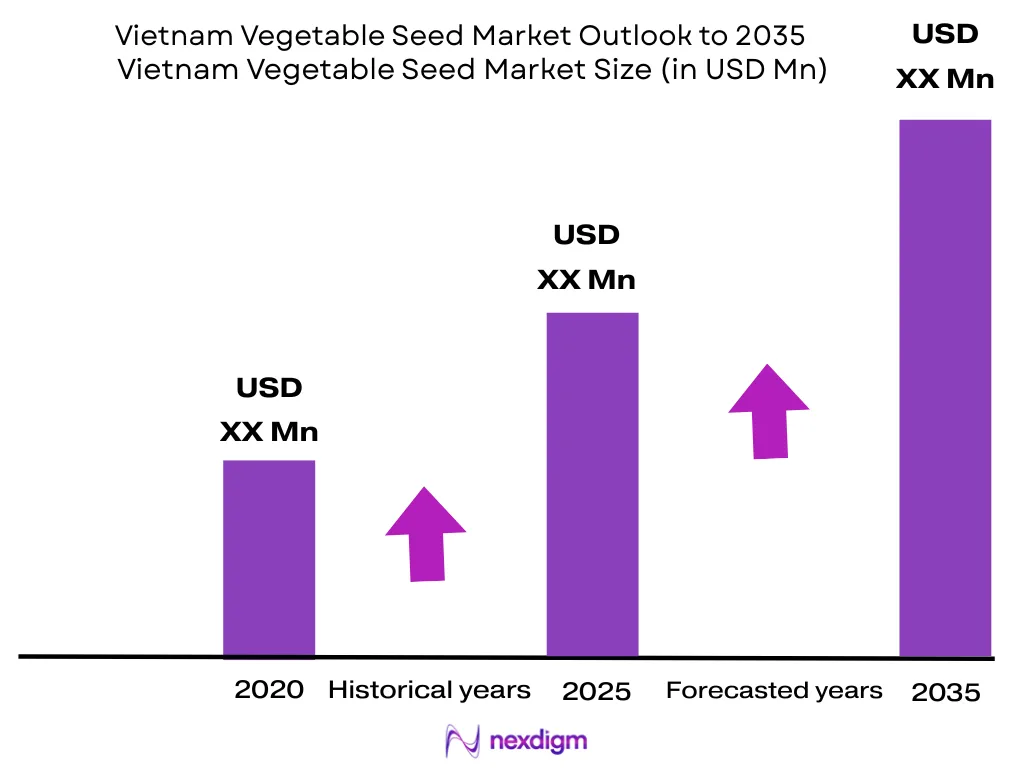
The Vietnam Vegetable Seed Market is valued at USD ~ million, based on a five-year historical analysis. Demand is driven by hybrid adoption, vegetable intensification, safe-vegetable zones, protected farming and imported seed use. Vegetable farming area increased to 1.03 million hectares from 1.00 million hectares, while output rose to 19.7 million tonnes from about 19.1 million tonnes. The market is forecast to grow at around 6.9% CAGR during the long-range outlook period. Mekong Delta, Red River Delta, Central Highlands, Southeast Vietnam, Hanoi and Ho Chi Minh City dominate Vietnam Vegetable Seed Market demand because they combine commercial vegetable acreage, high-tech farms, cooperatives, wet-market demand and retail-linked safe-vegetable supply. Mekong Delta supports cucurbits, chilli and tropical vegetables; Red River Delta supports leafy greens and brassicas; Da Lat in Lam Dong dominates greenhouse vegetables, lettuce, tomato, bell pepper and high-value temperate crops.
Market Segmentation
By Breeding Technology
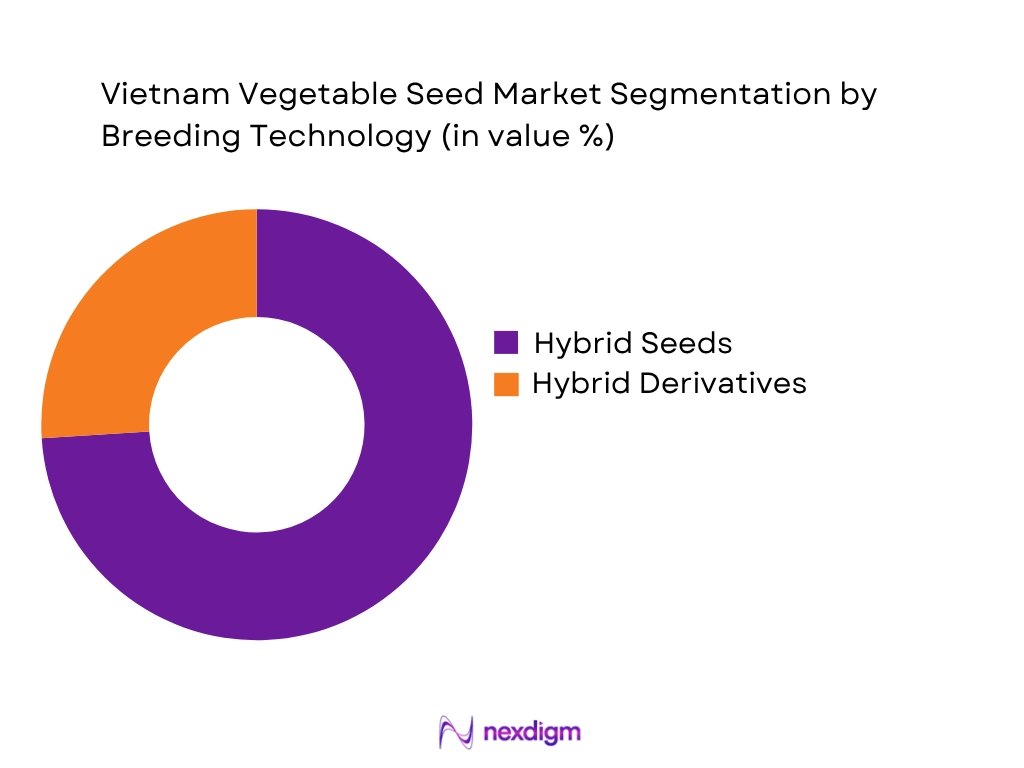
Vietnam Vegetable Seed Market is segmented by breeding technology into hybrid seeds and open-pollinated varieties with hybrid derivatives. Recently, hybrid seeds have a dominant market share in Vietnam under the breeding technology segmentation because farmers require better yield stability, disease resistance, uniform maturity and stronger crop performance in tropical growing conditions. Hybrid seeds are widely used for tomato, cucumber, chilli, watermelon, melon, cabbage, cauliflower, bitter gourd, leafy greens and greenhouse vegetables. Commercial growers prefer hybrids because vegetable production in Vietnam is affected by high humidity, bacterial wilt, downy mildew, whitefly pressure, heavy rainfall, flooding and salinity exposure in delta regions. Imported hybrid seeds also remain important because several global companies have deeper breeding pipelines for tropical and protected-crop varieties. Open-pollinated seeds continue to serve smallholders, wet-market crops and home gardening, but their commercial role is lower due to weaker uniformity and fewer disease-resistance traits.
By Cultivation Mechanism
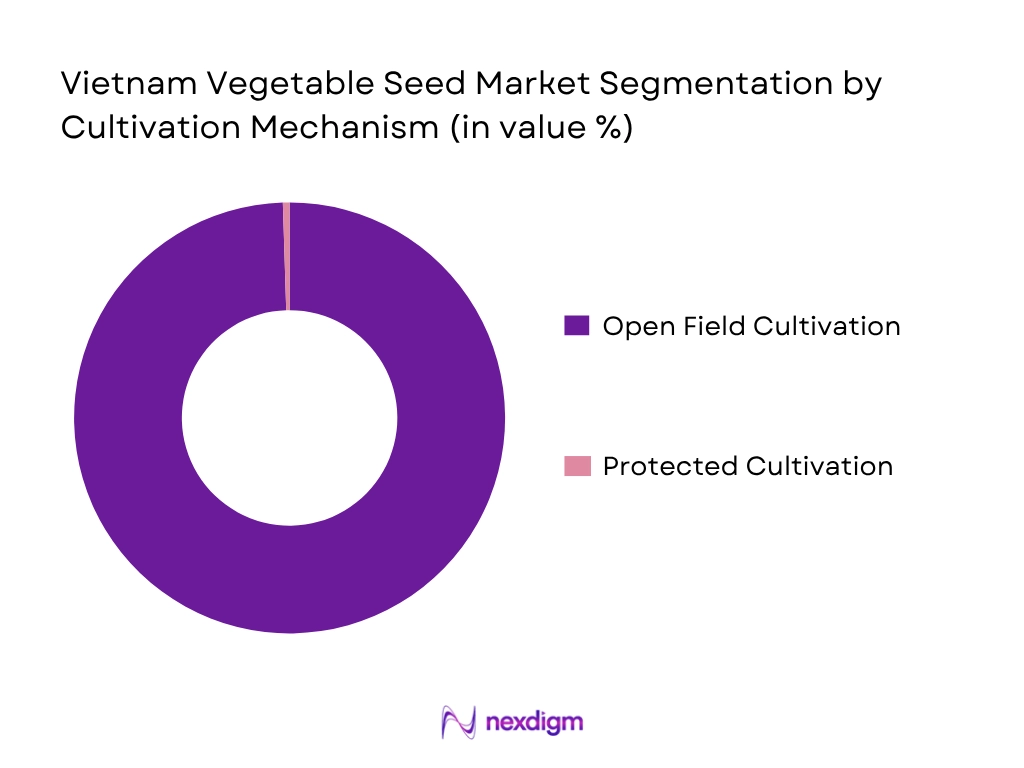
Vietnam Vegetable Seed Market is segmented by cultivation mechanism into open field cultivation and protected cultivation. Recently, open field cultivation has a dominant market share in Vietnam under the cultivation mechanism segmentation because most vegetables are grown by smallholder and semi-commercial farmers across the Mekong Delta, Red River Delta, Southeast Region and coastal production belts. Leafy greens, cucurbits, chilli, tomato, cabbage, cauliflower, root vegetables and local tropical vegetables are produced in repeated planting cycles, creating frequent demand for small packs and commercial seed lots. Open-field dominance is supported by wet markets, provincial wholesalers, input dealers and cooperatives. Protected cultivation is smaller but strategically important, especially in Da Lat, Hanoi, Ho Chi Minh City and high-tech farm clusters. Greenhouses, net houses and hydroponic farms use premium tomato, cucumber, lettuce, bell pepper, melon, basil and microgreen seeds, but adoption remains limited by capital intensity and technical requirements.
Competitive Landscape
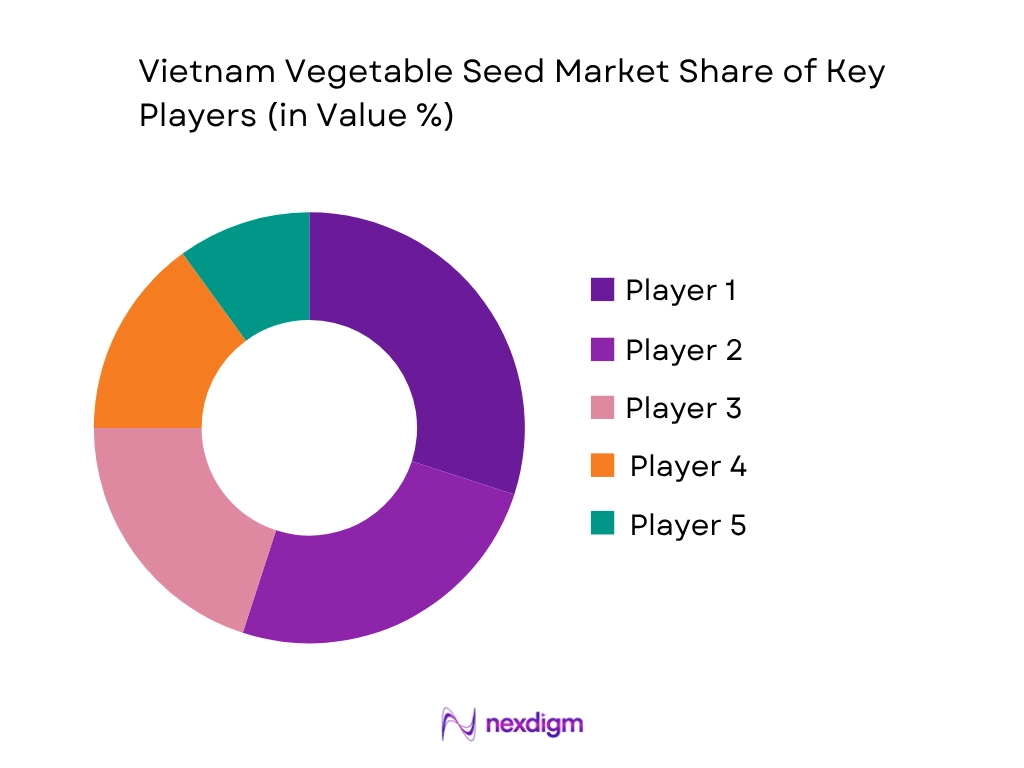
The Vietnam Vegetable Seed Market is moderately concentrated, with multinational hybrid seed companies competing alongside regional Asian seed suppliers and domestic seed firms. East-West Seed, Syngenta, Bayer/Seminis, BASF/Nunhems and Rijk Zwaan are strong in premium hybrids, greenhouse vegetables, cucurbits, tomato, pepper and leafy green categories. Domestic and regional firms compete through smallholder access, local OP varieties, provincial dealer relationships and price-sensitive packs. Competition is shaped by import capability, dealer networks, tropical disease-resistance traits, MARD-compliant seed circulation, farmer demonstrations and support for protected cultivation.
| Company | Establishment Year | Headquarters | Key Vietnam Vegetable Seed Focus | Main Crop Families | Distribution Strength | Protected Cultivation Portfolio | Seed Technology Focus | Market Positioning |
| East-West Seed | 1982 | Nonthaburi, Thailand | ~ | ~ | ~ | ~ | ~ | ~ |
| Syngenta Vietnam | 2000 | Basel, Switzerland / Vietnam operations | ~ | ~ | ~ | ~ | ~ | ~ |
| Bayer CropScience / Seminis | 1863 | Leverkusen, Germany | ~ | ~ | ~ | ~ | ~ | ~ |
| BASF Vegetable Seeds / Nunhems | 1865 | Ludwigshafen, Germany | ~ | ~ | ~ | ~ | ~ | ~ |
| Rijk Zwaan Vietnam | 1924 | De Lier, Netherlands | ~ | ~ | ~ | ~ | ~ | ~ |
Vietnam Vegetable Seed Market Analysis
Growth Drivers
Expanding Vegetable Area Supports Recurring Hybrid and Open-Field Seed Demand
Vietnam Vegetable Seed Market is supported by expanding vegetable cultivation and recurring short-cycle planting. MARD-cited data shows vegetable farming area at 1.03 million hectares, increasing by 30,000 hectares from 1.00 million hectares, while output reached 19.7 million tonnes, rising by 624,000 tonnes from about 19.1 million tonnes. This scale directly supports demand for tomato, chilli, cucumber, melon, leafy green, brassica and gourd seeds across open-field and peri-urban production belts. Vietnam’s macro base strengthens the demand environment, with World Bank data showing GDP of USD 476.39 billion, population of 100,987,686 people, and GDP per capita of USD 4,717.3. These indicators support continued commercial seed replacement through dealers, cooperatives and high-value vegetable farms.
Fruit and Vegetable Export Activity Encourages Quality-Oriented Vegetable Seed Use
Vietnam Vegetable Seed Market benefits from quality-linked horticulture growth because export-oriented and retail-linked producers require uniformity, disease resistance and traceable varieties. MARD-cited data shows fruit farming area at 1.29 million hectares, rising by 20,000 hectares, while total fruit output reached 13.5 million tonnes. The same source reports watermelon export turnover of USD 56.42 million, mango at USD 76.5 million, and jackfruit at USD 81.15 million, showing demand for standardized horticulture supply chains. For vegetable seed suppliers, this supports hybrids for melon, watermelon, chilli, cucumber, leafy greens and tomato where shape, shelf life and crop uniformity matter. World Bank data shows Vietnam’s GDP at USD 476.39 billion and FDI net inflows at 4.2 of GDP, supporting modern agri-input adoption.
Market Challenges
Typhoon and Flood Damage Create Seed Demand Volatility Across Northern Vegetable Belts
Vietnam Vegetable Seed Market faces climate-related planning risk because vegetable farms are exposed to typhoons, flooding, landslides and crop loss. OCHA reported that Typhoon Yagi affected approximately 286,660 hectares of rice fields and 63,350 hectares of other crops, creating direct disruption for seed demand, nursery schedules and dealer inventory planning. Reuters reported total damage of 81.5 trillion dong and 299 deaths, showing the wider economic and agricultural shock from the disaster. These disruptions matter for leafy greens, cucurbits, chilli, tomato and brassicas in northern and delta-linked regions. Vietnam still has a large food-consumption base, with World Bank reporting 100,987,686 people, GDP of USD 476.39 billion, and GDP per capita of USD 4,717.3.
Seed Import and Variety Approval Rules Add Compliance Burden for Hybrid Suppliers
Vietnam Vegetable Seed Market faces operational complexity because imported plant varieties require compliance with formal import, documentation and approval rules. FAOLEX’s Vietnam regulatory text states that plant varieties not included in Vietnam’s permitted production and business list must obtain written approval from the Department of Crop Production, while applications include an import form, technical declaration and enterprise-registration documents. This affects hybrid vegetable seed importers supplying tomato, cucumber, chilli, melon, brassica and greenhouse varieties. Compliance is important because Vietnam’s production base includes 1.03 million hectares of vegetables and 19.7 million tonnes of output. World Bank data also shows GDP of USD 476.39 billion, population of 100,987,686 people, and GDP per capita of USD 4,717.3, making uninterrupted seed availability commercially important.
Market Opportunities
Safe-Vegetable and Traceability Gaps Create Opportunity for Certified, Disease-Tested Seeds
Vietnam Vegetable Seed Market has an opportunity in safe-vegetable and traceable seed channels because certified production remains limited relative to total vegetable area. A 2025 report citing the national survey published in 2024 states that about 150,000 hectares across six crop groups had VietGAP certification, while vegetables had just over 8,000 hectares certified out of 1.15 million hectares. This gap supports future demand for branded seeds with germination assurance, lot traceability, disease testing and dealer accountability. Vegetable suppliers can target VietGAP cooperatives, urban retail-linked farms and safe-production zones with cucumber, leafy green, chilli, tomato and brassica seed lines. World Bank data shows 84 individuals using the internet per 100 people, supporting digital traceability and dealer-ordering channels.
High-Tech Vegetable Farming Creates Scope for Premium Greenhouse and Hydroponic Seeds
Vietnam Vegetable Seed Market has an opportunity in high-tech vegetable farming because protected systems require specialized seed genetics rather than ordinary open-field varieties. A 2025 agriculture report noted that a Moc Chau project upgraded around 4 hectares of high-tech greenhouses, including 32 production houses and 3 nurseries, while greenhouse vegetable production expanded from around 1.5 hectares to nearly 50 hectares. This supports demand for premium tomato, cucumber, lettuce, basil, bell pepper, melon and microgreen seeds with uniform germination, disease resistance and controlled-environment performance. Vietnam’s macro base also supports this shift: the World Bank reports GDP of USD 476.39 billion, population of 100,987,686 people, GDP per capita of USD 4,717.3, and FDI net inflows at 4.2 of GDP.
Future Outlook
Vietnam Vegetable Seed Market is expected to grow at around 6.9% CAGR during the forecast period, supported by hybrid adoption, imported seed demand, safe-vegetable production, high-tech agriculture and protected cultivation. Demand will remain strongest in leafy greens, cucurbits, tomato, chilli, brassicas, melon and greenhouse vegetables. Over the next phase, the market will shift toward tropical hybrids, disease-resistant seed lines, salinity-tolerant varieties, seedling nursery systems and traceable seed distribution. The Mekong Delta will require varieties suited to flooding and salinity stress, while Da Lat and urban greenhouse clusters will increase demand for lettuce, tomato, cucumber, bell pepper and herb seeds. Cooperatives and VietGAP-oriented producers will create additional demand for branded, quality-tested and traceable seed lots. Domestic seed companies will continue serving open-pollinated and smallholder seed needs, while multinationals will compete in premium hybrid and protected-crop categories.
Major Players
- East-West Seed Vietnam
- Syngenta Vietnam
- Bayer CropScience / Seminis / De Ruiter
- BASF Vegetable Seeds / Nunhems
- Rijk Zwaan Vietnam
- Enza Zaden Vietnam
- Sakata Seed Vietnam
- HM.CLAUSE Vietnam
- Bejo Seeds Vietnam
- Known-You Seed Vietnam
- Takii Seed Vietnam
- Chia Tai Seeds Vietnam
- Trang Nong Seeds
- Southern Seed Corporation
- Vinaseed / Vietnam National Seed Group
Key Target Audience
- Vegetable Seed Manufacturers
- Hybrid Vegetable Seed Breeding Companies
- Commercial Vegetable Farmers
- Greenhouse and High-Tech Farming Operators
- Seedling Nurseries and Grafted Plant Producers
- Agri-Input Distributors and Seed Dealers
- Investments and Venture Capitalist Firms
- Government and Regulatory Bodies
Research Methodology
Step 1: Identification of Key Variables
The initial phase involves constructing an ecosystem map for the Vietnam Vegetable Seed Market, covering breeders, seed importers, distributors, dealers, cooperatives, nurseries, greenhouse operators and regulators. The objective is to identify critical variables such as crop family, hybrid adoption, cultivation mechanism, seed import dependence, protected farming and regional crop clusters.
Step 2: Market Analysis and Construction
In this phase, historical data is compiled for vegetable production area, crop output, seed demand, imported seed usage, commercial seed penetration and cultivation mechanism. The model links seed use with crop acreage, planting cycles, seed replacement frequency, pack format, grower type, distribution channel and provincial production concentration.
Step 3: Hypothesis Validation and Expert Consultation
Market hypotheses are validated through computer-assisted interviews with seed companies, distributors, input dealers, cooperatives, seedling nurseries, greenhouse operators and commercial growers. These consultations provide insights into farmer buying behaviour, hybrid adoption, dealer influence, crop-specific seed preferences, import dependence and protected cultivation demand.
Step 4: Research Synthesis and Final Output
The final phase integrates secondary data, primary insights, company portfolio mapping and bottom-up crop-demand modelling into a validated market report. The output is cross-checked across market size, segmentation, competitive landscape, regulatory framework and future outlook to provide a business-focused view of the Vietnam Vegetable Seed Market.

- Executive Summary
- Research Methodology (Market Definitions and Assumptions, Vegetable Seed Taxonomy, Hybrid/Open-Pollinated/Heirloom/Organic/Untreated Seed Classification, Market Sizing Approach, Top-Down Seed Revenue Validation, Bottom-Up Crop Area-to-Seed Requirement Model, Primary Interviews with Seed Importers/Distributors/Farmers/Cooperatives/High-Tech Farm Operators, Dealer Channel Mapping, Import and Quarantine Validation, Limitations and Future Conclusions)

- Definition and Scope
- Overview Genesis
- Evolution of Vegetable Seed Industry in Vietnam
- Timeline of Major Players
- Business Cycle

- Growth Drivers (Hybrid Adoption, Vegetable Area Expansion, High-Tech Agriculture, Seed Replacement, Safe-Vegetable Demand, Export-Oriented Production)
- Market Challenges (Seed Import Dependency, Phytosanitary Compliance, Price Sensitivity, Climate Risk, Informal Seed Use, Disease Outbreaks)
- Opportunities (Protected Cultivation Genetics, Domestic Breeding, Organic/Safe-Vegetable Seeds, Seed Enhancement, Digital Advisory, Export-Oriented Vegetable Seeds)
- Trends (Hybridization, Tropical Disease Resistance, Seed Enhancement, Greenhouse Adoption, Cooperative Procurement, Digital Distribution)
- SWOT Analysis
- Porter’s Five Forces
- PESTLE Analysis

- By Value (2020-2025)
- By Volume (2020-2025)
- By Average Realization per Kilogram/Thousand Seeds (2020-2025)

- By Crop Family (In Value %)
Leafy Green Seeds
Cucurbit Seeds
Tomato Seeds
Chilli and Pepper Seeds
Brassica Seeds - By Distribution Channel (In Value %)
Direct-to-Grower Sales
Seed Dealers and Provincial Distributors
Agri-Input Retailers
Cooperatives and Safe-Vegetable Groups
Online B2B Platforms - By End User (In Value %)
Commercial Vegetable Farmers
Smallholder Farmers
Greenhouse Operators
Hydroponic Producers - By Region (In Value %)
Mekong Delta
Red River Delta
Central Highlands
Southeast Region
North Central Coast

- Market Share of Major Players (Commercial Vegetable Seed Revenue, Crop-Family Share, Hybrid Share, Regional Presence)
- Cross Comparison Parameters (Hybrid Vegetable Portfolio Breadth, Tropical Disease-Resistance Trait Depth, MARD-Compliant Variety Circulation Capability, Seed Import and Quarantine Management Strength, Dealer and Provincial Distributor Network Coverage, Protected-Cultivation Variety Portfolio, Seed Treatment and Priming Capability, Regional Trial and Farmer Advisory Support)
- SWOT Analysis of Major Players
- Detailed Profiles of Major Companies
East-West Seed Vietnam
Syngenta Vietnam
Bayer CropScience / Seminis / De Ruiter
BASF Vegetable Seeds / Nunhems
Rijk Zwaan Vietnam
Enza Zaden Vietnam
Sakata Seed Vietnam
HM.CLAUSE Vietnam
Bejo Seeds Vietnam
Known-You Seed Vietnam
Takii Seed Vietnam
Chia Tai Seeds Vietnam
Trang Nong Seeds
Southern Seed Corporation
Vinaseed / Vietnam National Seed Group

- Commercial Vegetable Farmer Analysis
- Smallholder Farmer Analysis
- Greenhouse and High-Tech Farm Operator Analysis
- Hydroponic Producer Analysis
- Cooperative and Safe-Vegetable Producer Analysis

- By Value (2026-2035)
- By Volume (2026-2035)
- By Average Realization per Kilogram/Thousand Seeds (2026-2035)


 Request a Sample
 Ask for Customization
 Get a Quote
 Enquire Now