
 Download PDF
Market Overview
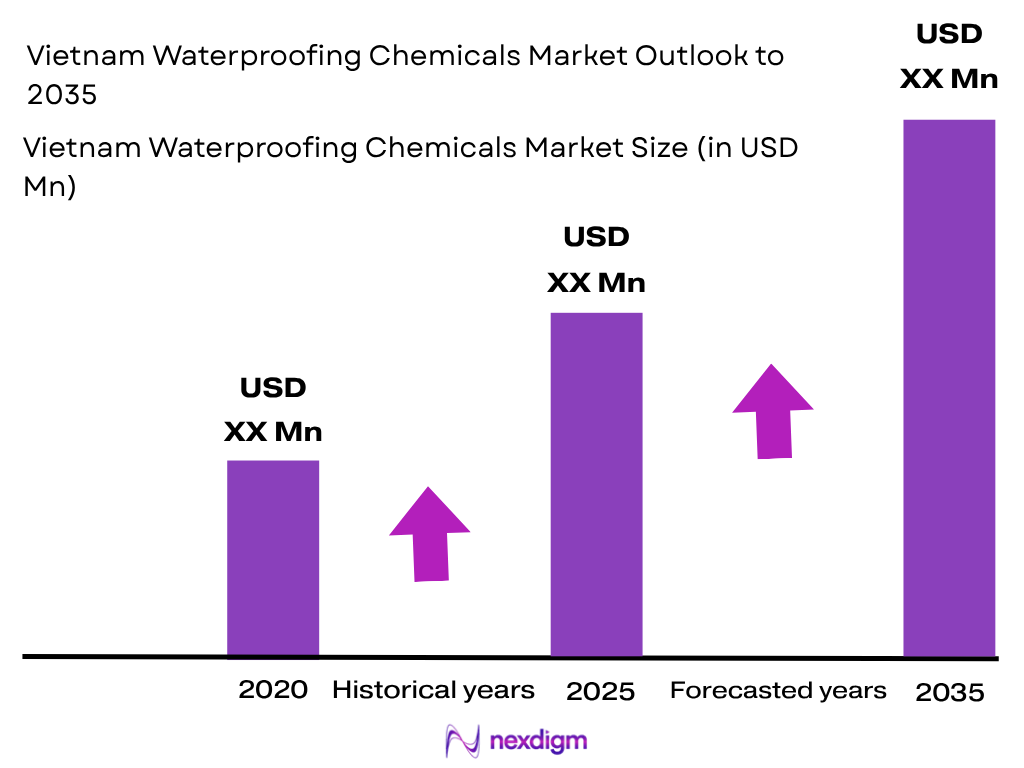
The Vietnam Waterproofing Chemicals Market is estimated at ~USD million in 2024, with the market supported by construction activity, infrastructure development, industrial expansion, urban redevelopment and increasing requirements for concrete durability. The National Statistics Office reported that Vietnam’s GDP increased 7.09% in 2024, while the industry and construction sector increased 8.24%, demonstrating strong activity across construction-intensive economic segments. The Ministry of Construction also published official construction-sector statistics covering building activity and infrastructure development, supporting the market’s underlying demand environment.
Ho Chi Minh City and Hanoi represent the principal demand centers for Vietnam Waterproofing Chemicals Market because they combine dense construction activity, commercial development, residential projects, infrastructure investment and extensive renovation requirements. Southern Vietnam has also emerged as a major waterproofing demand zone because Ho Chi Minh City and surrounding industrial provinces support large-scale commercial, industrial and residential construction. Binh Duong, Dong Nai and Hai Phong further strengthen regional demand through industrial facilities, logistics infrastructure and manufacturing-oriented development.
Market Segmentation
By Chemistry Type
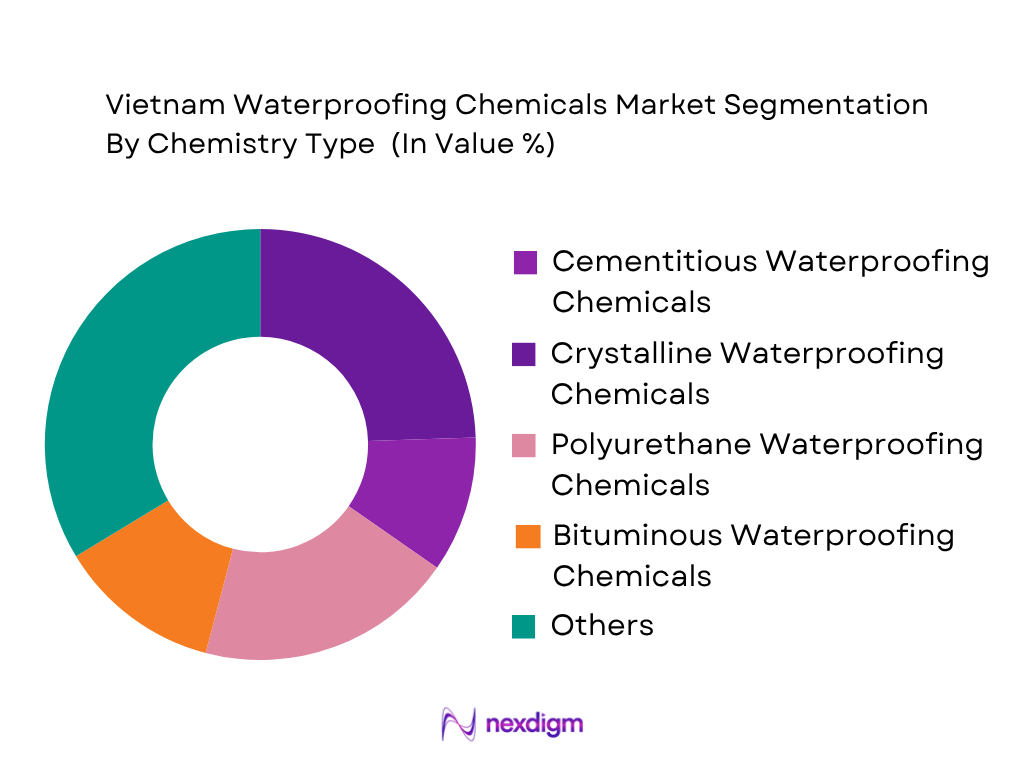
Vietnam Waterproofing Chemicals Market is segmented by chemistry type into cementitious waterproofing chemicals, polyurethane waterproofing chemicals, acrylic waterproofing chemicals, bituminous waterproofing chemicals, crystalline waterproofing chemicals, polyurea waterproofing chemicals, epoxy waterproofing chemicals, silane and siloxane water-repellent chemicals, integral waterproofing admixtures and hybrid waterproofing formulations. Cementitious waterproofing chemicals are positioned as the dominant segment because they can be applied directly to concrete and masonry substrates and are suitable for foundations, basements, bathrooms, water-retaining structures and general concrete protection. Their compatibility with conventional construction practices supports application across both new construction and renovation projects. Polyurethane systems are important for areas requiring flexible crack-bridging performance, while crystalline products are relevant where integral protection of concrete is required. Bituminous systems remain applicable to below-grade and foundation environments, whereas acrylic systems serve selected exposed surfaces and coating applications. Polyurea and epoxy technologies address more specialized requirements involving rapid application, chemical resistance or demanding industrial environments. The broad applicability of cementitious systems across concrete-intensive construction gives this chemistry a strong position within the Vietnam waterproofing chemicals ecosystem.
By Application
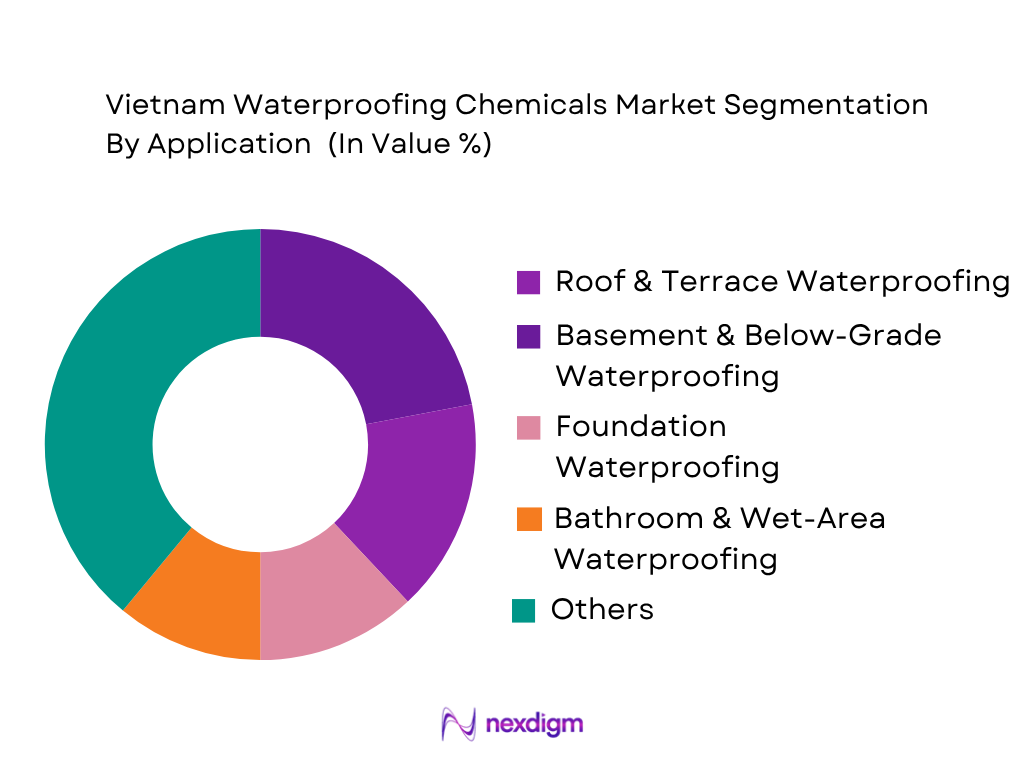
Vietnam Waterproofing Chemicals Market is segmented by application into roof and terrace waterproofing, basement and below-grade waterproofing, foundation waterproofing, bathroom and wet-area waterproofing, water tanks and swimming pools, concrete deck and slab waterproofing, bridge and infrastructure waterproofing, tunnel and underground-structure waterproofing, water and wastewater infrastructure, industrial floor and process-area waterproofing, and podium and parking-structure waterproofing. Roof and terrace waterproofing is positioned as the leading application because Vietnam’s humid and rainfall-intensive environment creates recurring exposure to water ingress across residential, commercial and institutional buildings. Below-grade applications are also significant because underground structures require protection against groundwater and moisture migration. Infrastructure applications are gaining importance as transportation and public-utility construction expands. Industrial facilities require specialized systems for floors, foundations, process areas and water-exposed structures. Water and wastewater infrastructure provides another specialized demand pool for crystalline, polyurethane, epoxy and cementitious systems. The breadth of roof, foundation, wet-area and infrastructure applications allows waterproofing chemicals to penetrate multiple construction categories rather than depending on a single end-use segment. This diversified application base supports continuing specification of chemical waterproofing systems across Vietnam’s construction ecosystem.
Competitive Landscape
The Vietnam Waterproofing Chemicals Market includes global construction-chemical manufacturers alongside established domestic producers. International participants compete through broad waterproofing portfolios, technical support, contractor networks and infrastructure-project capabilities, while Vietnamese companies compete through local market knowledge, distribution relationships and product responsiveness. The competitive environment therefore combines multinational technology platforms with domestic manufacturing and distribution capabilities. Publicly available industry sources identify companies including Sika, MAPEI, Fosroc, KOVA, BASF, Jotun, TOA and Henkel among the relevant participants.
| Major Player | Establishment Year | Headquarters | Waterproofing Chemistry Coverage | Key Application Focus | Local Manufacturing / Supply Capability | Technical Support | Distribution Reach | Project Capability |
| Sika AG | 1910 | Baar, Switzerland | ~ | ~ | ~ | ~ | ~ | ~ |
| MAPEI S.p.A. | 1937 | Milan, Italy | ~ | ~ | ~ | ~ | ~ | ~ |
| Fosroc | 1934 | Birmingham, UK | ~ | ~ | ~ | ~ | ~ | ~ |
| KOVA Group | 1993 | Ho Chi Minh City, Vietnam | ~ | ~ | ~ | ~ | ~ | ~ |
| BASF SE / Master Builders Solutions | 1865 | Ludwigshafen, Germany | ~ | ~ | ~ | ~ | ~ | ~ |
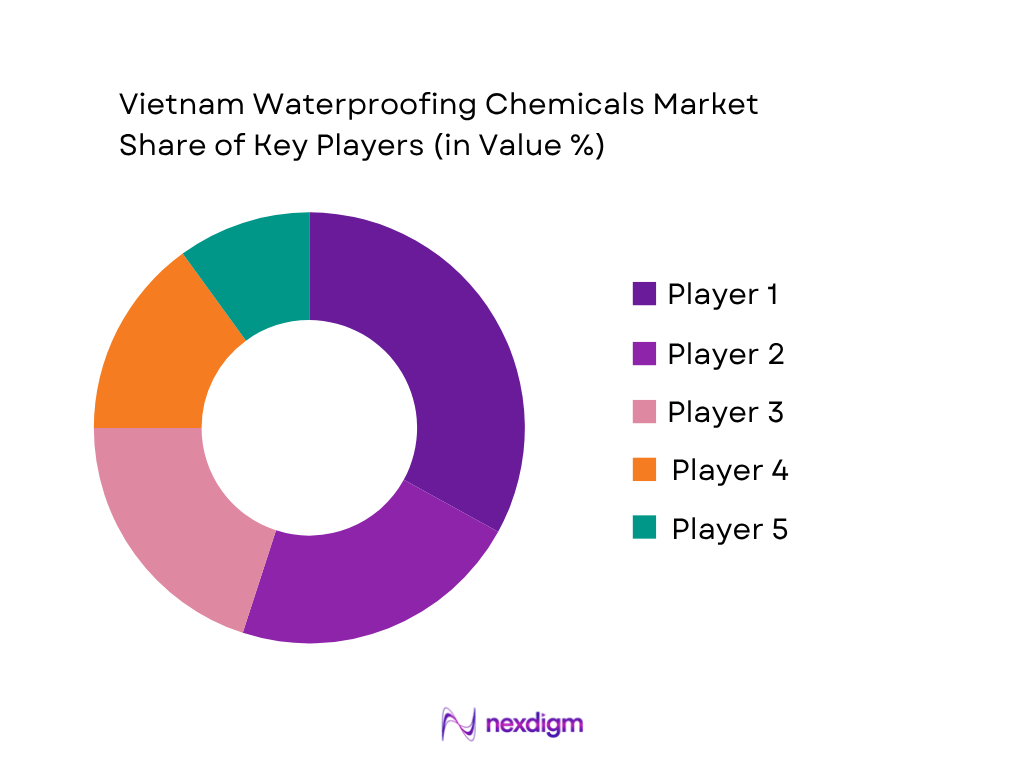
Vietnam Waterproofing Chemicals Market Analysis
Growth Drivers
Urban Residential Construction
Urban residential construction is a key growth driver for the Vietnam Waterproofing Chemicals Market because new apartments, houses, mixed-use developments and residential complexes require protection across roofs, bathrooms, balconies, foundations, basements and wet areas. Vietnam’s GDP expanded by 7.09% in 2024, while the construction industry increased by 7.87%, demonstrating continued construction activity. Total social investment reached VND 3,692.1 trillion, creating a substantial project pipeline across private and public construction. The Ministry of Construction reported 28 social-housing projects comprising 20,284 units completed during the year, while another 23 projects comprising 25,399 units received approval and commenced construction. Commercial housing activity also remained substantial, with 34 projects comprising approximately 13,836 units completed in the fourth quarter alone. These developments require waterproofing chemicals for concrete foundations, underground structures, bathrooms, roofs and external building elements. Rising urban density further increases the importance of moisture protection because high-rise residential construction contains numerous interfaces where water ingress can affect structural and finishing systems. Consequently, cementitious, polyurethane, acrylic, crystalline and polymer-modified waterproofing products can gain applications throughout residential construction and associated renovation activity.
Industrial Park and Manufacturing Facility Development
Industrial expansion is supporting demand for waterproofing chemicals across factories, warehouses, logistics facilities, industrial floors, foundations, roofs and water-management structures. Vietnam’s manufacturing sector recorded 9.83% growth in 2024, while the broader industry and construction sector increased by 8.24%. Total realized foreign direct investment reached USD 25.35 billion, the highest level since 2020, demonstrating continued capital deployment into Vietnam-based production capacity. Total registered foreign investment reached USD 38.23 billion, providing an additional indicator of the scale of industrial and commercial investment activity. The country also recorded total social investment of VND 3,692.1 trillion, with the non-state sector contributing VND 2,064.2 trillion and the foreign-invested sector contributing VND 608.6 trillion. Industrial facilities require waterproofing for foundations, production floors, loading areas, roofs, underground utilities and water-retaining structures. Manufacturing environments can also require chemically resistant and high-performance systems where conventional protection may be inadequate. Polyurethane, polyurea, epoxy, cementitious and crystalline technologies can therefore address different industrial exposure conditions. The combination of manufacturing growth, foreign investment and industrial construction provides a broad project base for waterproofing chemical suppliers targeting factories, logistics facilities and industrial parks.
Market Challenges
Dependence on Imported Specialty Chemicals
Dependence on imported specialty chemical inputs can create supply-chain challenges for the Vietnam Waterproofing Chemicals Market, particularly for advanced polyurethane, polyurea, epoxy, acrylic and polymer-modified formulations. Vietnam recorded USD 38.23 billion of registered foreign investment and USD 25.35 billion of realized FDI in 2024, highlighting the country’s integration with international supply chains and manufacturing networks. At the same time, total merchandise imports reached approximately USD 381.31 billion, while total imports and exports combined reached USD 786.29 billion. This extensive trade environment supports access to imported chemical intermediates but also exposes manufacturers to international logistics conditions, foreign-exchange movements and availability constraints. Waterproofing manufacturers using specialized resins, additives, catalysts and performance modifiers may face longer procurement cycles than producers relying predominantly on locally available mineral inputs. The challenge is especially relevant for technically demanding systems where formulation consistency depends on specific grades of polymers or chemical additives. Vietnam’s construction sector increased by 7.87% in 2024, creating sustained demand for construction chemicals while simultaneously increasing the importance of reliable material availability. Manufacturers can mitigate this challenge through supplier diversification, local formulation, strategic inventory management and greater use of domestically available raw materials without compromising technical performance.
Skilled Applicator Shortages and Application Quality
Skilled application remains a challenge for the Vietnam Waterproofing Chemicals Market because final waterproofing performance depends on substrate preparation, moisture conditions, mixing ratios, application thickness, curing and joint detailing. Vietnam employed approximately 51.9 million people in 2024, including 17.4 million workers in industry and construction, demonstrating the scale of the labor pool supporting construction activity. However, approximately 33.2 million workers were engaged in informal employment in the fourth quarter, illustrating the importance of standardized training and quality-control systems across a fragmented construction environment. Waterproofing systems are particularly sensitive to installation quality because failures can originate from contaminated substrates, inadequate surface preparation, incorrect layer thickness, insufficient curing or poorly treated construction joints. Vietnam’s construction industry expanded by 7.87% in 2024, increasing the volume of projects requiring competent waterproofing installation. Advanced systems such as polyurethane, polyurea and crystalline waterproofing can require greater technical understanding than basic construction coatings. Contractors also work across Vietnam’s varied climatic conditions, including high humidity and heavy rainfall, which can complicate application scheduling and curing. Suppliers therefore face a continuing requirement to strengthen installer training, application supervision, technical documentation and project-level inspection. Improved application standards can reduce failure rates while increasing confidence in specialized waterproofing technologies.
Market Opportunities
Infrastructure Rehabilitation
Infrastructure rehabilitation represents an important opportunity for the Vietnam Waterproofing Chemicals Market because existing bridges, tunnels, concrete structures, transportation facilities and public infrastructure require recurring protection against water penetration and deterioration. Vietnam recorded VND 3,692.1 trillion of total social investment in 2024, while public-sector investment and infrastructure development continued to support construction activity. The industry and construction sector expanded by 8.24%, with construction itself increasing by 7.87%. Transportation and warehousing activity also increased by 10.82%, indicating strong movement across logistics and transport-related economic infrastructure. These conditions create opportunities for waterproofing systems used during rehabilitation of bridge decks, underground structures, retaining walls, parking structures, tunnels and concrete utility facilities. Crystalline waterproofing can provide integral protection to concrete, while polyurethane and polyurea systems can address flexible or rapid-application requirements. Cementitious coatings can support repair applications where compatibility with mineral substrates is important. The rehabilitation opportunity is not limited to large transportation assets; industrial facilities, commercial properties and public buildings also require periodic waterproofing renewal as structures age or experience moisture-related deterioration. Suppliers offering combined waterproofing, crack repair, concrete protection and surface-treatment systems can address broader rehabilitation specifications. This creates an opportunity to move from individual chemical products toward integrated concrete-protection packages for infrastructure owners and contractors.
Water and Wastewater Infrastructure Modernization
Water and wastewater infrastructure modernization creates a specialized opportunity because treatment facilities, reservoirs, pumping stations, drainage structures and wastewater systems require concrete protection under continuous or recurring water exposure. Vietnam’s water supply, sewerage, waste-management and remediation activities recorded 9.43% growth in 2024, demonstrating strong activity within water-related infrastructure services. The broader industry and construction sector increased by 8.24%, while total social investment reached VND 3,692.1 trillion. These indicators provide a current economic foundation for investment in concrete-intensive water infrastructure. Waterproofing chemicals can be specified for water-retaining tanks, treatment basins, underground chambers, concrete channels, reservoirs and other structures where moisture penetration can compromise durability. Crystalline systems are particularly relevant where integral concrete waterproofing is required, while polyurethane, epoxy and cementitious systems can address different substrate and exposure requirements. Vietnam’s rapid urbanization and industrial development also increase the requirement for reliable drainage and wastewater infrastructure around residential communities, industrial parks and manufacturing facilities. Suppliers capable of combining waterproofing with crack sealing, concrete repair and chemical-resistance solutions can address more comprehensive project requirements. This opportunity can therefore support higher-value technical applications rather than relying exclusively on conventional building waterproofing, particularly across municipal, industrial and infrastructure projects requiring durable concrete protection.
Future Outlook
Over the coming years, the Vietnam Waterproofing Chemicals Market is expected to benefit from continued construction activity, infrastructure development, industrial expansion and building modernization. Demand is likely to become increasingly diversified across roofs, basements, foundations, industrial facilities, transportation infrastructure and water-related structures. Advanced polyurethane, crystalline, polyurea and integrated concrete-protection systems can gain greater relevance as project specifications become more performance-oriented. Local manufacturing, technical training and stronger contractor networks are also expected to influence adoption.
Major Players
- Sika AG
- MAPEI S.p.A.
- Fosroc
- KOVA Group
- BASF SE / Master Builders Solutions
- AkzoNobel N.V.
- NIPSEA Group
- Jotun
- TOA Paint Vietnam
- Henkel Adhesive Technologies
- Saint-Gobain / Weber
- MC-Bauchemie
- Bestmix Corporation
- Bostik / Arkema
- Euro Paint Vietnam
Key Target Audience
- Waterproofing Chemicals Manufacturers and Formulators
- Construction Chemical Distributors and Importers
- Real Estate Developers and Property Development Companies
- Infrastructure Developers and Civil Engineering Contractors
- Industrial Park, Manufacturing and Logistics Developers
- Investments and Venture Capitalist Firms
- Government and Regulatory Bodies (Ministry of Construction, Ministry of Industry and Trade, Ministry of Transport)
- Water, Wastewater and Municipal Infrastructure Authorities
Research Methodology
Step 1: Identification of Key Variables
The initial phase involves constructing a Vietnam Waterproofing Chemicals Market ecosystem covering manufacturers, distributors, contractors, applicators, developers and infrastructure stakeholders. Secondary research is used to identify construction activity, infrastructure development, waterproofing applications, chemistry categories and regional demand variables.
Step 2: Market Analysis and Construction
Historical market information is compiled and analyzed across chemistry, technology, application, end-use sector and region. The assessment incorporates construction activity, infrastructure development, industrial expansion, building renovation and waterproofing-material adoption to construct the market framework.
Step 3: Hypothesis Validation and Expert Consultation
Market hypotheses are validated through discussions with manufacturers, distributors, waterproofing contractors, applicators and construction-material specialists. Industry consultations are used to assess product specifications, application practices, technology adoption, procurement behavior and competitive positioning.
Step 4: Research Synthesis and Final Output
The final stage integrates bottom-up company and application assessments with top-down construction and infrastructure indicators. Data triangulation is conducted across company information, government statistics, industry documentation and expert inputs to develop the final Vietnam Waterproofing Chemicals Market assessment.

- Executive Summary
- Research Methodology (Market Definition and Scope, Vietnam Waterproofing Chemicals Market Classification, Waterproofing Chemistry Mapping, Waterproofing Technology Assessment, Construction Application Mapping, End-Use Sector Assessment, Regional Demand Mapping, Market Sizing Approach, Top-Down Analysis, Bottom-Up Analysis, Demand-Side Assessment, Supply-Side Assessment, Primary Industry Interviews, Data Triangulation, Forecasting Framework, Market Validation)

- Definition and Scope
- Vietnam Waterproofing Chemicals Industry Evolution and Development of Cementitious Waterproofing, Polymer-Modified Cementitious Systems, Polyurethane Waterproofing, Acrylic Waterproofing, Bituminous Coatings, Crystalline Waterproofing, Polyurea Systems, Epoxy Waterproofing, Integral Waterproofing Admixtures, Penetrating Water Repellents, Waterproofing Membranes, Joint Sealing Systems, Concrete Protection Systems and Advanced Waterproofing Formulations
- Waterproofing Chemicals Value Chain Analysis
- Waterproofing Chemicals Supply Chain Analysis
Cement and Binder Suppliers, Polymer and Resin Suppliers, Bitumen Suppliers, Chemical Additive Manufacturers, Waterproofing Chemical Manufacturers, Membrane Producers, Construction Chemical Importers, Local Formulators, Precast Concrete Manufacturers, Ready-Mix Concrete Producers, Waterproofing Contractors, Applicators, Construction Material Distributors, Real Estate Developers, Infrastructure Contractors, Architects, Structural Engineers and Building Owners

- Growth Drivers (Urban Residential Construction, Commercial Real Estate Development, Industrial Park Expansion, Manufacturing Facility Development, Infrastructure Investment, Highway and Bridge Construction, Metro and Transportation Infrastructure, Water and Wastewater Development, Hospitality and Tourism Construction, Increasing Concrete Durability Requirements)
- Market Challenges (Polymer and Resin Feedstock Volatility, Dependence on Imported Specialty Chemicals, Skilled Applicator Shortages, Inconsistent Surface Preparation, Informal Construction Practices, Regional Distribution Constraints, Product Compatibility Requirements, Climate-Specific Waterproofing Performance, High Application Complexity, Quality Variability Across Installation Contractors)
- Market Opportunities (Infrastructure Rehabilitation, Below-Grade Waterproofing Expansion, Industrial Park Waterproofing, Data Center Construction, Water and Wastewater Infrastructure Modernization, Low-VOC Formulations, Crystalline Waterproofing Technologies, High-Performance Polyurethane Systems, Polyurea Spray Applications, Integrated Concrete Protection Systems, Roof Restoration, Long-Life Bridge and Tunnel Protection)
- Market Trends (Growth of Liquid-Applied Systems, Increasing Use of Crystalline Waterproofing, Expansion of Polyurethane Systems, Adoption of Polyurea Spray Technology, Greater Use of Integral Waterproofing Admixtures, Increasing Below-Grade Waterproofing, Growth of Infrastructure Rehabilitation, Low-VOC Product Development, Integrated Waterproofing and Concrete Repair Systems, Advanced Waterproofing for Industrial Facilities)
- Government Regulations and Standards (Vietnam Construction Law Requirements, Ministry of Construction Technical Regulations, TCVN Concrete Standards, Waterproofing Material Quality Requirements, Construction Product Conformity Requirements, Fire and Safety Requirements, Environmental Protection Requirements, Chemical Management Requirements, Building Quality Management Requirements, Infrastructure Construction Standards)
- SWOT Analysis
- Porter’s Five Forces Analysis
- PESTLE Analysis
- Stakeholder Ecosystem
- Competition Ecosystem

- By Market Value (2020-2025)
- By Volume Consumption (2020-2025)
- By Waterproofing Chemical Consumption Volume (2020-2025)
- By Construction Application Volume (2020-2025)
- By Residential Construction Application Volume (2020-2025)
- By Commercial Construction Application Volume (2020-2025)
- By Infrastructure Application Volume (2020-2025)

- By Chemistry Type (In Value %)
Cementitious Waterproofing Chemicals
Polyurethane Waterproofing Chemicals
Acrylic Waterproofing Chemicals
Bituminous Waterproofing Chemicals
Crystalline Waterproofing Chemicals
Polyurea Waterproofing Chemicals
Epoxy Waterproofing Chemicals
Silane and Siloxane Water-Repellent Chemicals
Integral Waterproofing Admixtures
Hybrid Waterproofing Formulations - By Technology (In Value %)
Liquid-Applied Waterproofing Systems
Cementitious Waterproofing Systems
Crystalline Waterproofing Systems
Spray-Applied Polyurethane Systems
Spray-Applied Polyurea Systems
Penetrating Waterproofing Treatments
Integral Concrete Waterproofing Systems
Elastomeric Waterproofing Systems
Bituminous Waterproofing Systems - By Application (In Value %)
Roof and Terrace Waterproofing
Basement and Below-Grade Waterproofing
Foundation Waterproofing
Bathroom and Wet-Area Waterproofing
Water Tanks and Swimming Pools
Concrete Deck and Slab Waterproofing
Bridge and Infrastructure Waterproofing
Tunnel and Underground-Structure Waterproofing
Water and Wastewater Infrastructure
Industrial Floor and Process-Area Waterproofing
Podium and Parking-Structure Waterproofing - By End-Use Sector (In Value %)
Residential Buildings
Commercial Buildings
Industrial Facilities
Infrastructure Projects
Hospitality and Tourism Facilities
Retail and Shopping Centers
Industrial Parks and Manufacturing Facilities
Warehouses and Logistics Facilities
Healthcare Facilities
Educational Buildings
Water and Wastewater Facilities
Transportation Infrastructure - By Region (In Value %)
Ho Chi Minh City - Hanoi
Hai Phong
Da Nang
Binh Duong
Dong Nai
Bac Ninh
Long An
Ba Ria–Vung Tau
Rest of Vietnam

- Market Share of Major Players (By Vietnam Revenue, Waterproofing Product Portfolio, Chemistry Coverage, Waterproofing Technology Capability, Application Coverage, Infrastructure Project Capability, Industrial Project Coverage, Residential and Commercial Coverage, Local Manufacturing Capability, Distribution Network Reach, Technical Support Capability, Contractor Network, Specification Influence, Project Portfolio and Product Certification)
- Cross Comparison Parameters (Waterproofing Chemistry Portfolio Breadth, Liquid-Applied System Capability, Below-Grade Waterproofing Capability, Concrete and Crystalline Waterproofing Technology, Polyurethane and Polyurea System Capability, Infrastructure and Tunnel Project Experience, Local Manufacturing and Distribution Reach, Technical Application Support and Contractor Network)
- SWOT Analysis of Major Players
- Detailed Profiles of Major Companies
Sika Limited (Vietnam)
Saint-Gobain Vietnam
MAPEI Vietnam Ltd
BASF Vietnam Co., Ltd.
Fosroc Vietnam
KOVA Group
NIPSEA Group
Jotun Paints (Vietnam) Co., Ltd.
TOA Paint Vietnam
Henkel Adhesive Technologies Vietnam Co., Ltd.
Bestmix Corporation
Dow Chemical Vietnam LLC
Solenis Vietnam Company Limited
Ecolab Vietnam Co., Ltd.
Euro Paint Vietnam Co., Ltd.

- Residential Building Waterproofing Requirement Assessment
- Commercial Building Waterproofing Requirement Assessment
- Industrial Facility Waterproofing Requirement Assessment
- Industrial Park and Manufacturing Facility Demand Analysis
- Basement and Foundation Waterproofing Requirement Assessment
- Roof and Terrace Waterproofing Demand Analysis
- Bridge and Transportation Infrastructure Waterproofing Assessment
- Tunnel and Underground-Structure Waterproofing Analysis
- Water and Wastewater Infrastructure Requirement Assessment

- By Market Value (2026-2035)
- By Volume Consumption (2026-2035)
- By Waterproofing Chemical Consumption Volume (2026-2035)
- By Construction Application Volume (2026-2035)
- By Residential Construction Application Volume (2026-2035)
- By Commercial Construction Application Volume (2026-2035)
- By Infrastructure Application Volume (2026-2035)


 Request a Sample
 Ask for Customization
 Get a Quote
 Enquire Now