
 Download PDF
Market Overview
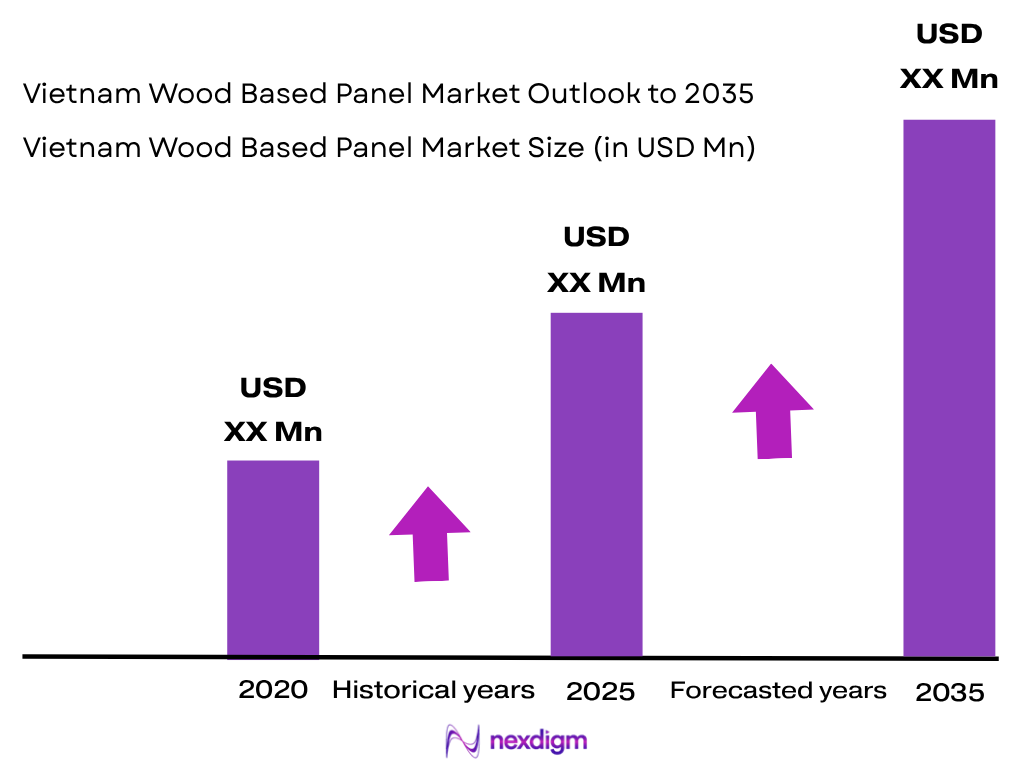
The Vietnam Wood Based Panel Market is valued at approximately ~USD XX million, supported by the country’s large furniture, construction and wood-processing ecosystem. Vietnam’s timber and wood-product exports increased from USD 13.4 billion to USD 16.25 billion, while processed wood-product exports reached USD 11.2 billion. Domestic wood harvesting also reached 22.7 million cubic meters, strengthening feedstock availability for MDF, plywood, particleboard and other engineered panels used across furniture, interiors and construction applications.
Binh Duong, Dong Nai, Ho Chi Minh City and Vietnam’s southeastern industrial corridor are major centers for wood-panel consumption and processing because they combine furniture factories, industrial parks, export infrastructure and proximity to plantation resources. VRG Dongwha operates its major MDF/HDF facility in the southern industrial region, while Vietnam’s forestry base supplied 22.7 million cubic meters of harvested wood and more than 270,000 hectares of newly planted concentrated forests, supporting large-scale downstream wood manufacturing.
Market Segmentation
By Product Type
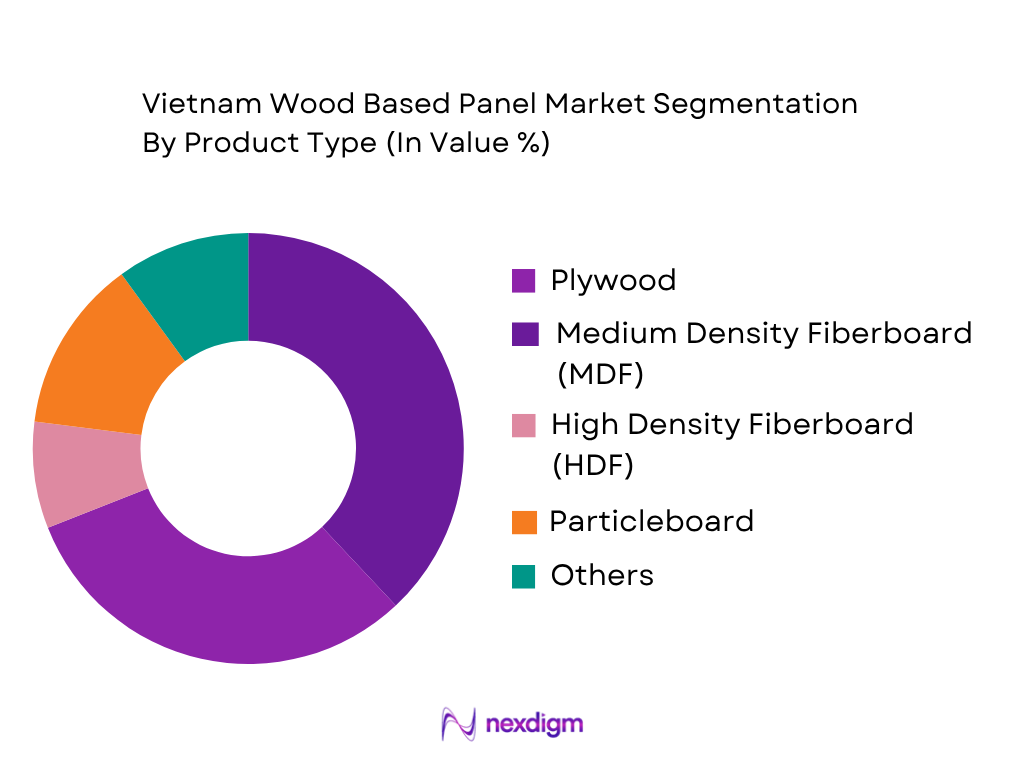
The Vietnam Wood Based Panel Market is segmented into plywood, MDF, HDF, particleboard, OSB, softboard and hardboard. Plywood is considered the leading sub-segment in the report model, supported by Vietnam’s established veneer and plywood manufacturing ecosystem and its suitability for furniture, cabinets, construction, packaging and export applications. Vietnam produced approximately 3.4 million cubic meters of plywood, compared with around 2.7 million cubic meters in the preceding period, according to FAOSTAT-derived production data. MDF is another strategically important category because Vietnam has developed large industrial-scale fibreboard facilities. VRG Dongwha alone reports annual production capacity of approximately 300,000 cubic meters, while the country also hosts additional MDF manufacturing investments. Demand for MDF and HDF is supported by modular furniture, cabinets, interior decoration, doors and laminated-panel manufacturing. OSB remains comparatively less established but provides longer-term potential in engineered construction and structural applications.
By Application
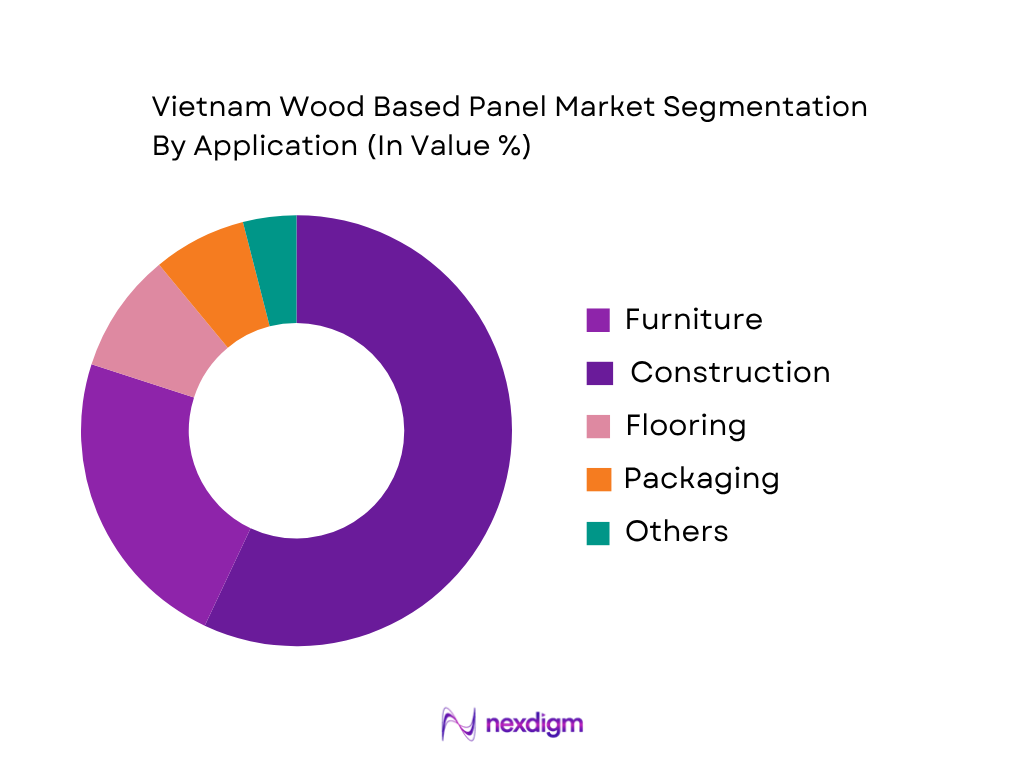
The Vietnam Wood Based Panel Market is segmented into furniture, construction, flooring, packaging and other industrial applications. Furniture is considered the dominant application in the report model, reflecting Vietnam’s extensive downstream wood-processing and export-manufacturing infrastructure. Wood and wood-product exports reached USD 16.25 billion, of which processed wood products accounted for approximately USD 11.2 billion. The scale of this downstream industry creates sustained consumption of MDF, plywood, particleboard and decorative panels for wardrobes, kitchen cabinets, tables, shelving, bedroom furniture and office furniture. Construction represents another substantial demand channel as plywood, MDF and specialty panels are used for formwork, doors, partitions, interior fit-outs and architectural components. Flooring uses higher-density and surface-treated boards, while packaging generates demand for plywood and other lower-cost engineered panels. Vietnam’s combination of export furniture factories and domestic construction activity therefore gives furniture applications a particularly strong position within panel consumption.
Competitive Landscape
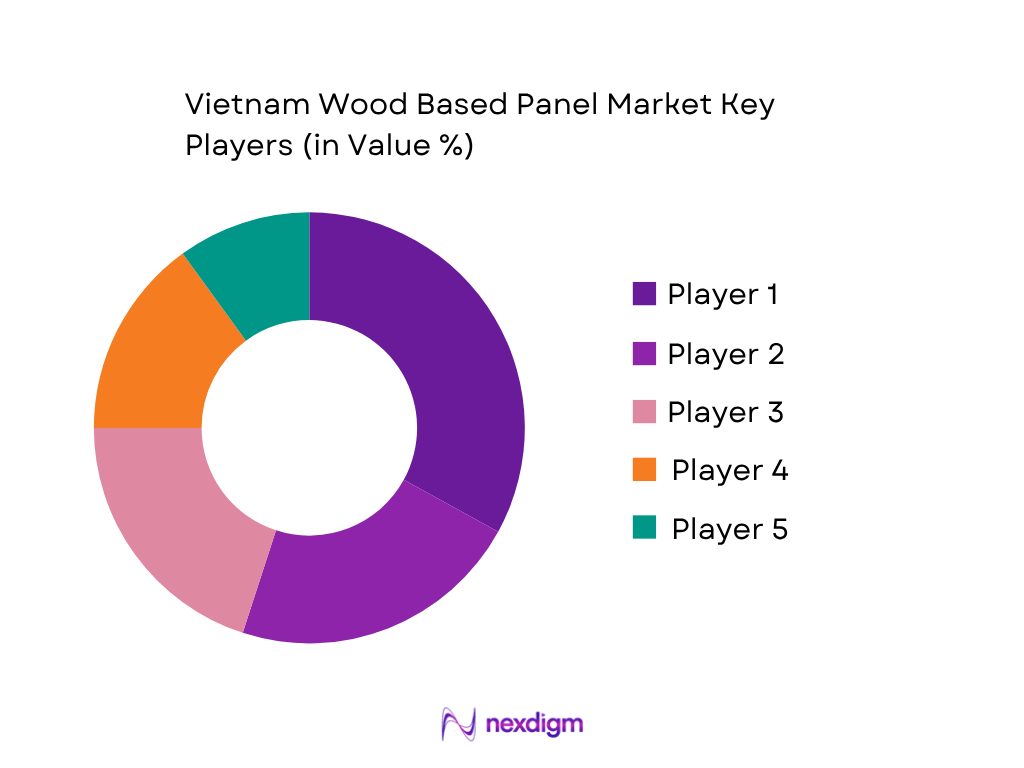
The Vietnam Wood Based Panel Market combines domestic wood processors, plantation-linked manufacturers, furniture-material suppliers and foreign-invested engineered-panel producers. Competition increasingly revolves around MDF/HDF production capacity, secure timber feedstock, panel density, moisture resistance, surface finishing, low-emission grades, FSC-certified products and access to furniture-manufacturing customers. VRG Dongwha represents a major integrated MDF/HDF producer, while An Cuong and KES/Kim Tin participate extensively in Vietnam’s engineered and decorative wood-material ecosystem.
| Company | Established | Headquarters | Key Products | Manufacturing Capability | Raw Material Strategy | Surface/Value-Added Capability | Certifications/Technology Focus | Primary Applications |
| VRG Dongwha MDF | 2008 | Vietnam | ||||||
| KES Group / Kim Tin | 2000 | Vietnam | ||||||
| An Cuong Wood Working | 1994 | Ho Chi Minh City, Vietnam | ||||||
| VRG Quang Tri MDF | 2005 | Quang Tri, Vietnam | ||||||
| Thanh Thanh Dat | 2002 | Vietnam |
Vietnam Wood Based Panel Market Analysis
Growth Drivers
Expansion of Export-Oriented Furniture Manufacturing
Vietnam’s export-oriented furniture and wood-processing base is a major demand engine for plywood, MDF, HDF, particleboard and decorative panels. Timber and wood-product exports reached USD 16.25 billion in 2024, while processed wood products alone generated USD 11.2 billion. The United States purchased approximately USD 9.1 billion of Vietnamese timber and wood products, demonstrating the production scale required from furniture factories supplying overseas buyers. Vietnam’s broader economic base also supported manufacturing activity, with GDP reaching USD 476.39 billion and GDP per capita reaching USD 4,717.3 in 2024. Processing and manufacturing attracted USD 25.58 billion of foreign investment during the same period, reinforcing industrial capacity across furniture, cabinetry, interiors and related material-processing industries. These conditions directly support wood-based panel consumption because export furniture manufacturers require standardized substrates for wardrobes, cabinets, tables, shelving, bedroom furniture and office products. MDF and particleboard are particularly compatible with automated furniture production, while plywood remains important for load-bearing and higher-strength applications. Continued upgrading from contract manufacturing toward finished furniture and value-added products also creates demand for panels offering better machinability, dimensional consistency, surface quality and compatibility with laminates, veneers and decorative coatings.
Plantation Timber Availability and Expansion of Panel Manufacturing
Vietnam’s domestic plantation forestry system provides an increasingly substantial raw-material foundation for MDF, HDF, plywood and other engineered panels. Plantation-forest wood harvesting reached approximately 22.88 million cubic meters in 2024, while concentrated forest planting covered approximately 282,000 hectares and another 130 million scattered trees were planted. Sustainable forest-management certification, including FSC and VFCS/PEFC schemes, covered approximately 610,000 hectares, providing an expanding base of traceable fibre for manufacturers serving domestic and export customers. This supply base is particularly important for fibreboard production because MDF and HDF facilities require continuous volumes of wood chips, small-diameter plantation timber and processing residues. Vietnam’s industrial environment simultaneously supports further panel-processing investment: processing and manufacturing received USD 25.58 billion in foreign investment in 2024, while the country approved 3,375 new foreign-invested projects involving USD 19.7 billion of registered capital across economic sectors. Domestic plantation resources also reduce the need to rely entirely on imported timber for mass-market engineered boards. For panel manufacturers, greater availability of plantation acacia, eucalyptus and rubberwood supports integrated procurement networks connecting forests, sawmills, chipping facilities, board plants and furniture clusters, strengthening Vietnam’s position as a vertically connected engineered-wood production center.
Market Challenges
Wood Traceability, Certification and Export Compliance Pressure
Traceability has become a significant operational requirement for Vietnam’s wood-based panel manufacturers because the industry is deeply connected with international furniture and wood-product supply chains. Vietnam exported USD 16.25 billion of timber and wood products in 2024, including USD 9.1 billion shipped to the United States, meaning documentation of timber origin can directly affect a substantial downstream customer base. Domestic forestry provides a stronger compliance foundation, with approximately 610,000 hectares holding FSC or VFCS/PEFC sustainable forest-management certification and plantation harvesting reaching approximately 22.88 million cubic meters. However, panel manufacturers commonly aggregate wood fibre, chips, veneers and residues from numerous plantations, processors and collection points, making chain-of-custody documentation operationally demanding. The challenge becomes greater for plywood and decorative panels combining multiple wood species, adhesives, veneers and imported components. International regulatory scrutiny is also increasing. In 2025, hardwood and decorative plywood from Vietnam became subject to a U.S. trade-remedy investigation covering products mainly classified under HS 4412 and 9403; Vietnamese shipments of products covered by the investigation to the United States were approximately USD 244 million in 2024. Consequently, manufacturers need stronger supplier records, origin verification, certification systems, production documentation and customs compliance alongside conventional quality-control capabilities.
Raw-Material Quality, Chemical Inputs and Manufacturing Requirements
Wood-based panel production requires consistent fibre geometry, moisture content, resin performance and pressing conditions, creating challenges when plantation timber varies by species, rotation period and harvesting source. Vietnam harvested approximately 22.88 million cubic meters of plantation wood in 2024, providing substantial domestic feedstock, but converting this volume into uniform MDF, HDF and particleboard requires sorting, debarking, chipping, fibre preparation and moisture control. Panel manufacturing also depends on adhesives, resins, waxes, hardeners, coatings and surface-treatment chemicals, leaving producers exposed to industrial-input supply conditions beyond the forestry sector. The wider manufacturing environment is substantial: Vietnam recorded GDP of USD 476.39 billion in 2024, while processing and manufacturing attracted USD 25.58 billion in foreign investment. This expanding industrial base increases competition for electricity, industrial land, skilled technicians, logistics capacity and chemical inputs. Formaldehyde-emission requirements add another production constraint, particularly for panels entering furniture supply chains serving the United States, European Union and other regulated destinations. Manufacturers therefore need controlled resin dosing, continuous pressing technology, laboratory testing and stable fibre composition. Smaller producers can face greater difficulty maintaining identical density, thickness, moisture resistance and emission performance across production batches, limiting access to demanding export-grade furniture applications.
Market Opportunities
Low-Emission, Moisture-Resistant and Value-Added MDF Panels
Vietnam has a strong current industrial base from which manufacturers can expand production of moisture-resistant MDF, low-emission panels, fire-retardant boards and pre-laminated furniture substrates. The opportunity is supported by approximately USD 11.2 billion of processed wood-product exports recorded in 2024, demonstrating a substantial downstream industry requiring furniture-ready materials rather than only commodity boards. Domestic construction also provides a second application channel: 79 commercial housing projects representing approximately 38,345 units received new licenses during 2024, while 69 projects comprising around 23,041 units were completed. Social housing added another 28 completed projects containing approximately 20,284 units, creating applications for cabinets, wardrobes, doors, partitions and interior fittings. Vietnam’s GDP reached USD 476.39 billion and GDP per capita reached USD 4,717.3 in 2024, supporting broader urban consumption of finished furniture and interior products. These conditions create room for panel producers to move beyond untreated MDF toward boards supplied with melamine surfaces, moisture protection, low-emission resin systems and furniture-ready dimensions. Such products can reduce secondary processing requirements for furniture manufacturers while increasing domestic value addition. Producers integrated with decorative-paper impregnation, lamination, cutting and component machining are particularly positioned to supply modular furniture and commercial interior manufacturers.
Certified Panels, Furniture-Ready Components and Engineered Wood Diversification
Vietnam’s existing forestry and furniture ecosystem provides a platform for expanding FSC-certified panels, recycled-fibre boards, OSB, high-density flooring substrates and precision-cut furniture components. Approximately 610,000 hectares of forest already carried FSC or VFCS/PEFC sustainable-management certification in 2024, while plantation wood harvesting reached 22.88 million cubic meters and concentrated forest planting covered approximately 282,000 hectares. This certified and renewable feedstock base can support panel products designed for international furniture manufacturers requiring documented chain-of-custody systems. The downstream opportunity is substantial because timber and wood-product exports reached USD 16.25 billion in 2024 and processed products generated USD 11.2 billion. At the broader industrial level, Vietnam attracted USD 38.23 billion in foreign investment, including USD 25.58 billion directed to processing and manufacturing, strengthening the manufacturing ecosystem in which engineered-panel suppliers operate. Future opportunity therefore extends beyond simply adding board-production volume. Manufacturers can convert MDF, HDF, plywood and emerging engineered boards into drilled, edged, laminated and cut-to-size components that move directly into automated furniture assembly. Recycled fibre can improve wood-residue utilization, while OSB and specialty structural boards can broaden exposure to construction applications. Certified, low-emission and application-specific products also strengthen access to demanding international supply chains.
Future Outlook
The Vietnam Wood Based Panel Market is expected to expand through 2035 as the country strengthens its position in furniture manufacturing, engineered wood processing and export-oriented production. The report assumes a ~XX% CAGR during 2026–2035, with future demand increasingly shifting toward MDF, HDF, pre-laminated boards, moisture-resistant panels, certified plywood and low-emission engineered products. Capacity expansion is likely to be increasingly linked with plantation timber availability and improved utilization of wood residues. Vietnam harvested 22.7 million cubic meters of wood and established more than 270,000 hectares of concentrated forest planting, providing an important raw-material foundation for future panel production.
Export-oriented furniture will remain an important demand catalyst. Vietnam shipped approximately USD 16.25 billion of timber and wood products, including around USD 11.2 billion of processed wood products. Greater domestic production of furniture-ready panels could allow manufacturers to capture more value within this supply chain.
Major Players
- VRG Dongwha MDF
- KES Group/Kim Tin
- An Cuong Wood Working
- VRG Quang Tri MDF
- VRG Kien Giang MDF
- Thanh Thanh Dat
- Dong Phu MDF
- Quang Nam MDF Wood
- Vietnam Plywood Corporation
- Tan Viet A Wood
- Mekong Wood MDF
- Thanh Thuy Wood Processing
- Dongwha Enterprise
- Vanachai Group; and Kronospan
Key Target Audience
- Wood Based Panel Manufacturers
- MDF, HDF, Plywood and Particleboard Producers
- Furniture and Modular Furniture Manufacturers
- Timber, Wood Fibre, Resin and Adhesive Suppliers
- Building Material Distributors and Interior Product Suppliers
- Real Estate Developers and Interior Fit-Out Companies
- Investments and Venture Capitalist Firms
- Government and Regulatory Bodies (Ministry of Agriculture and Environment, Ministry of Industry and Trade, Vietnam Customs, Department of Forestry and Forest Protection)
Research Methodology
Step 1: Identification of Key Variables
The initial phase involves developing an ecosystem map covering plantation forestry, timber harvesting, veneer producers, MDF/HDF mills, plywood manufacturers, particleboard producers, distributors and downstream furniture manufacturers. Desk research identifies production capacity, raw-material availability, trade flows, product grades, application demand and manufacturing clusters that influence the Vietnam Wood Based Panel Market.
Step 2: Market Analysis and Construction
Historical production, imports, exports and downstream consumption are assessed to construct the Vietnam Wood Based Panel Market. The top-down approach analyzes forestry output, panel production and furniture-manufacturing activity, while the bottom-up approach aggregates manufacturer capacities, product-level sales and application demand across MDF, plywood, particleboard, HDF and other panels.
Step 3: Hypothesis Validation and Expert Consultation
Market hypotheses are validated through CATIs and structured consultations with panel manufacturers, furniture producers, timber suppliers, distributors and industrial buyers. Discussions focus on plant utilization, product substitution, fibre procurement, customer specifications, domestic versus export demand, certification requirements and adoption of moisture-resistant, low-emission and decorative panels.
Step 4: Research Synthesis and Final Output
The final stage triangulates manufacturer information, forestry indicators, trade flows and downstream demand from furniture, construction, flooring and packaging. Supply-side panel availability is reconciled with demand-side consumption to refine market estimates, segmentation and competitive positioning. Forecast assumptions incorporate capacity additions, engineered-panel substitution, furniture exports, construction demand and changes in timber availability.

- Executive Summary
- Research Methodology (Market Definitions and Assumptions, Product Classification Framework, Plywood-MDF-HDF-Particleboard-OSB Mapping, Domestic Production Assessment, Installed Capacity Assessment, Capacity Utilization Analysis, Apparent Consumption Method, Import-Export Reconciliation, Furniture Manufacturing Demand Assessment, Construction and Interior Fit-Out Demand Assessment, Top-Down Market Sizing, Bottom-Up Manufacturer Revenue Aggregation, Supply-Side Assessment, Demand-Side Assessment, Primary Interviews with Panel Manufacturers and Furniture Producers, Distributor Checks, Data Triangulation, Forecasting Framework, Scenario Analysis, Limitations and Future Conclusions)

- Definition and Scope
- Vietnam Wood Based Panel Industry Evolution and Development
- Evolution from Sawn Timber and Conventional Plywood toward MDF, HDF, Particleboard, Decorative Panels and Value-Added Engineered Wood
- Wood Based Panel Value Chain Analysis
- Wood Based Panel Supply Chain Analysis
- Plantation Forests and Rubberwood Supply, Wood Chips and Fibre Procurement, Resin and Adhesive Suppliers, Veneer Producers, MDF/HDF Manufacturers, Particleboard Manufacturers, Plywood Mills, Surface Treatment and Lamination Companies, Furniture Manufacturers, Interior Contractors, Building Material Distributors, Exporters and Institutional Buyers

- Growth Drivers (Expansion of Export-Oriented Furniture Manufacturing, Plantation Timber Availability, Growth of MDF and HDF Manufacturing Capacity, Residential Furniture Demand, Modular Furniture Production, Construction and Interior Fit-Out Activity, Expansion of Wood Processing Clusters, Growth of Decorative Panel Manufacturing)
- Market Challenges (Wood Origin Traceability Requirements, Dependence on Resin and Chemical Inputs, Formaldehyde Emission Compliance, Plantation Timber Quality Variation, Export Market Concentration, Trade Remedy Exposure, Competition from Regional Panel Producers, Energy-Intensive Board Manufacturing, Raw Material Procurement Pressure)
- Market Opportunities (Moisture-Resistant MDF, Low-Emission Panels, Fire-Retardant Boards, Pre-Laminated MDF, Decorative Surface Panels, Furniture-Ready Components, High-Density Flooring Substrates, OSB Adoption, Recycled Fibre Panels, FSC-Certified Panels, Export-Grade Engineered Wood Products)
- Market Trends (Shift toward Engineered Panels, Increasing MDF Penetration in Furniture, Automated Continuous Press Manufacturing, Decorative Surface Integration, Low-Formaldehyde Resin Adoption, FSC and Chain-of-Custody Certification, CNC-Compatible Panels, Lightweight Furniture Components, Digital Surface Printing, Integrated Panel-to-Furniture Manufacturing)
- Government Regulations and Standards (Vietnam Timber Legality Assurance System, Legal Timber Traceability Requirements, Building Material Quality Regulations, Formaldehyde Emission Requirements, Fire Safety Requirements, Environmental Protection Requirements for Wood Processing Plants, Plantation Forest Certification, Export Market Traceability Compliance, EUDR Readiness, FSC Chain-of-Custody Requirements)
- SWOT Analysis
- Porter’s Five Forces Analysis
- PESTLE Analysis
- Stakeholder Ecosystem
- Competition Ecosystem

- By Market Value (2020-2025)
- By Domestic Production Volume (2020-2025)
- By Apparent Consumption Volume (2020-2025)
- By Installed Wood Panel Manufacturing Capacity (2020-2025)
- By Capacity Utilization (2020-2025)

- By Product Type (In Value %)
Plywood
Medium Density Fibreboard (MDF)
High Density Fibreboard (HDF)
Oriented Strand Board (OSB)
Hardboard
Softboard
Other Engineered Wood Panels - By Panel Grade (In Value %)
Standard/General Purpose Panels
Moisture-Resistant Panels
High-Moisture-Resistant Panels
Fire-Retardant Panels
Low-Formaldehyde Panels
Exterior-Grade Panels
Marine and Structural Plywood
Furniture-Grade Panels - By Surface Finish (In Value %)
Raw/Unfinished Panels
Melamine-Faced Panels
Pre-Laminated Panels
Veneer-Faced Panels
High-Pressure Laminate-Faced Panels
Painted and UV-Coated Panels
Decorative Printed Panels
Overlay and Film-Faced Panels - By Application (In Value %)
Residential Furniture
Office and Commercial Furniture
Kitchen Cabinets and Wardrobes
Interior Wall Panels and Partitions
Doors and Door Components
Flooring Substrates
Construction and Concrete Formwork
Packaging and Industrial Applications
Retail and Hospitality Fit-Outs
Ready-to-Assemble Furniture - By End-User Industry (In Value %)
Furniture Manufacturing
Residential Construction
Commercial Construction
Interior Design and Fit-Out
Real Estate Development
Hospitality
Retail Infrastructure
Industrial Packaging
Export Furniture Manufacturing
Building Material and Component Manufacturing - By Distribution Channel (In Value %)
Direct Sales to Furniture Manufacturers
Direct Sales to Construction Companies
Panel and Building Material Distributors
Furniture Component Manufacturers
Dealer and Wholesale Networks
Interior Material Retailers
Project and Institutional Sales
Export Channels - By Region (In Value %)
Southeast Vietnam
Red River Delta
North Central and Central Coastal Vietnam
Mekong River Delta
Northern Midlands and Mountain Areas
Central Highlands
Ho Chi Minh City Industrial Cluster
Dong Nai-Binh Phuoc Manufacturing Cluster
Hanoi-Bac Ninh-Bac Giang Manufacturing Cluster
Binh Duong Furniture and Wood Processing Cluster

- Market Share of Major Players (By Revenue, Production Volume, Installed Capacity, MDF/HDF Capacity, Plywood Capacity, Particleboard Capacity, Domestic Sales, Export Sales)
- Cross Comparison Parameters (Installed Panel Production Capacity, MDF/HDF Technology Capability, Raw Material Integration, Product Grade Breadth, Decorative Surface Capability, Formaldehyde Emission Compliance, FSC/Chain-of-Custody Certification Capability, Furniture Manufacturing Customer Penetration)
- SWOT Analysis of Major Players (Manufacturing Scale, Technology, Distribution, Raw Material Security, Export Exposure, Product Diversification)
- Detailed Profiles of Major Companies
VRG Dongwha MDF Joint Stock Company
Kim Tin MDF / KES Group
An Cuong Wood Working Joint Stock Company
VRG Quang Tri MDF Joint Stock Company
VRG Kien Giang MDF Joint Stock Company
Thanh Thanh Dat Joint Stock Company
Dongwha Vietnam
Mekong Wood MDF
Vanachai Group Vietnam
Kronospan Vietnam
Dong Phu MDF Joint Stock Company
Quang Nam MDF Wood Joint Stock Company
Vietnam Plywood Corporation
Tan Viet A Wood Joint Stock Company
Thanh Thuy Wood Processing Joint Stock Company

- Furniture Manufacturer Procurement Assessment
- Construction Buyer Requirement Assessment
- Interior Fit-Out Contractor Assessment
- Export Furniture Manufacturer Assessment

- By Market Value (2026-2035)
- By Domestic Production Volume (2026-2035)
- By Apparent Consumption Volume (2026-2035)
- By Installed Wood Panel Manufacturing Capacity (2026-2035)
- By Capacity Utilization (2026-2035)


 Request a Sample
 Ask for Customization
 Get a Quote
 Enquire Now