
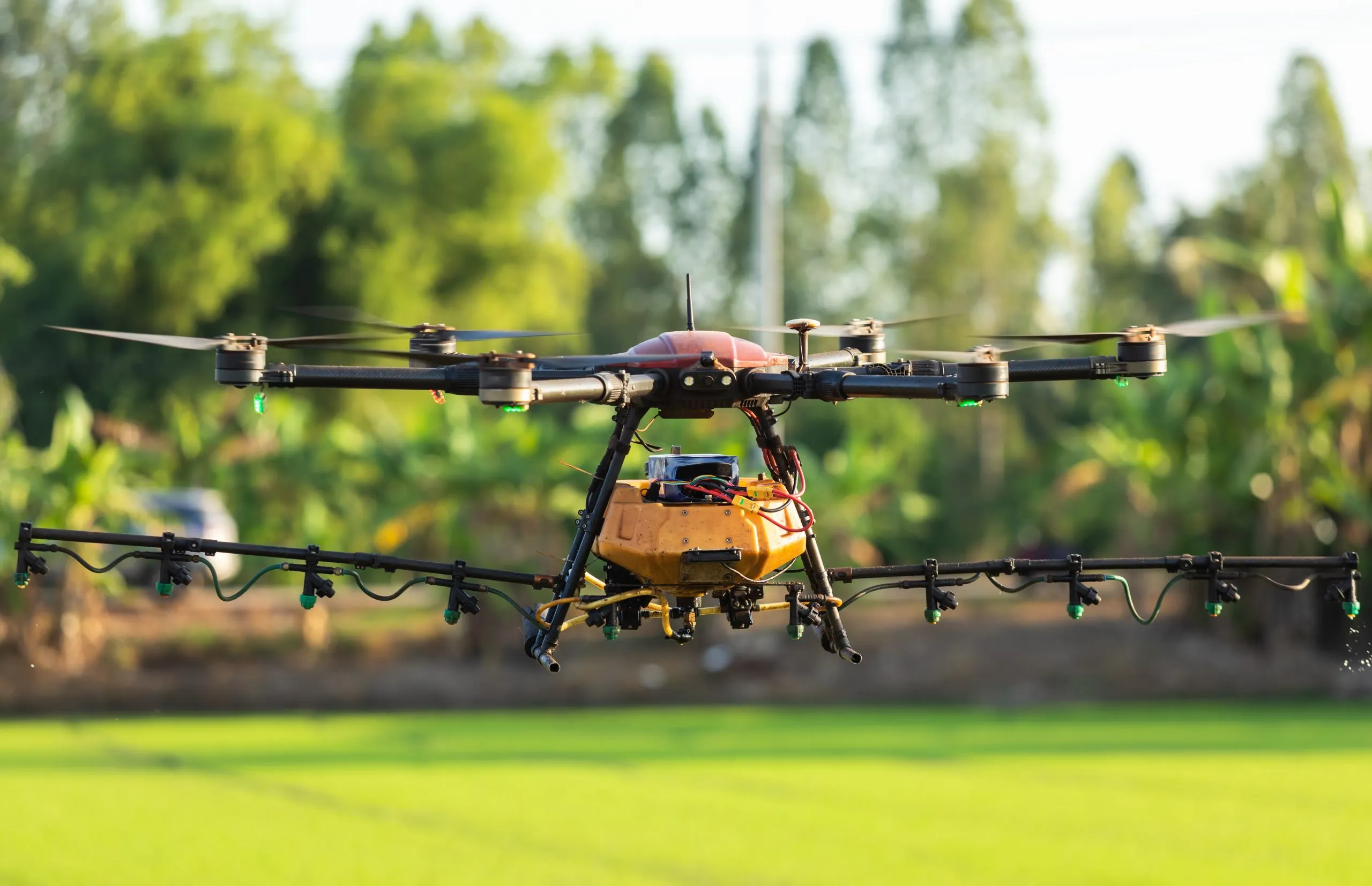
The Brazil agriculture drones market is expanding as growers, agribusinesses, cooperatives, and crop service providers look for faster and more precise ways to manage large farms. Drones are increasingly used for crop monitoring, field mapping, spraying, pest detection, irrigation assessment, plant health analysis, and yield planning. Brazil’s agriculture drones market is projected to grow at 19% CAGR, supported by the country’s strong position in soybeans, corn, sugarcane, coffee, cotton, and livestock production. As farms become larger and more technology-led, drones are becoming practical tools for improving visibility, reducing input wastage, and making field decisions faster.
Key market drivers are strengthening agriculture drone demand in Brazil
Large-scale farming is increasing the need for efficient field monitoring
Brazil has one of the world’s largest agricultural landscapes, with extensive crop areas spread across major producing regions such as Mato Grosso, Goiás, Paraná, São Paulo, Bahia, and Rio Grande do Sul. On large farms, manual scouting can be time-consuming, expensive, and inconsistent. Drones help farmers inspect fields quickly, identify crop stress, detect pest or disease pressure, map uneven growth, and assess irrigation or drainage problems. In South America, crop monitoring accounts for around 48% of agriculture drone demand, showing how important aerial visibility has become for farm management. For Brazilian growers, drone-based monitoring can help reduce delayed decisions and improve crop protection planning.
Spraying drones are supporting targeted input application
Drone spraying is gaining relevance in Brazil because it can support precise application of crop protection products, biological inputs, micronutrients, and fertilizers in areas where tractors or aircraft may be less practical. This is useful for uneven terrain, smaller plots, border areas, wet fields, specialty crops, and operations that require fast treatment windows. Crop spraying in the agriculture drone market is projected to grow at 18.4% CAGR, reflecting rising demand for more targeted and flexible input application. With farmers facing pressure from input costs and pest resistance, drones can help improve application timing and reduce unnecessary chemical use.
Digital agronomy is improving the value of drone-based insights
Drones are becoming more useful when combined with farm management software, satellite data, soil maps, sensors, GPS equipment, and AI-based crop analytics. These tools help convert images into practical recommendations for spraying, irrigation, crop nutrition, replanting, and harvest planning.
Government agriculture and aviation frameworks are supporting safer drone adoption
Government policies around agricultural modernization, digital farming, aviation safety, environmental monitoring, and rural productivity are shaping Brazil’s agriculture drones market. Drone operators must work within civil aviation and operational rules, while agriculture-focused use cases also need alignment with safety, environmental, and application standards. Public research institutions, cooperatives, and agricultural extension networks are helping introduce farmers to digital tools, precision agriculture, and improved field management practices. These efforts are important because drone adoption depends not only on equipment availability but also on training, responsible use, compliance, and trust among farmers and service providers.
Competitive landscape is expanding across hardware, software, and drone services
The Brazil agriculture drones market includes drone manufacturers, spraying drone suppliers, sensor providers, farm software companies, agritech startups, cooperatives, crop consultants, dealers, and drone-as-a-service operators. Competition is shaped by flight range, payload capacity, camera quality, battery life, spraying accuracy, software integration, local service support, pricing, and regulatory compliance. Fixed-wing drones account for 54.8% of South America’s agriculture drone market, while multirotor drones are growing at 14.8% CAGR. Suppliers that combine reliable hardware, agronomic interpretation, Portuguese-language support, training, and strong after-sales service are better positioned to serve Brazilian farms.
Market challenges continue to affect adoption and operational scale
Upfront costs and technical skills can slow adoption
Drones, sensors, batteries, software subscriptions, maintenance, and operator training can require meaningful investment. Smaller farms may hesitate unless service providers can clearly show savings in labor, inputs, crop protection, or yield protection.
Regulation and field-level execution remain important barriers
Operators must manage airspace rules, safety requirements, chemical application standards, weather conditions, battery limitations, and data interpretation. In large agricultural regions, reliable service coverage can also be difficult.
Future outlook
The future outlook for the Brazil agriculture drones market remains strong, supported by large-scale farming, precision agriculture, digital crop management, labor efficiency, and rising adoption of targeted spraying. South America’s agriculture drones market is estimated to grow from USD 179.81 million to USD 342.91 million at 13.78% CAGR, while Brazil is expected to remain one of the region’s most important adoption markets. Opportunities are expected across crop monitoring drones, spraying drones, fixed-wing mapping drones, multirotor platforms, multispectral sensors, AI-based analytics, livestock monitoring, sugarcane management, soybean and corn applications, and drone-as-a-service models. Businesses that combine affordability, technical support, regulatory guidance, and measurable farm outcomes will be better positioned for long-term growth.
Consultants at Nexdigm, in their latest publication “Brazil agriculture drones market outlook to 2035,” analyze the sector By Drone Type (Fixed-Wing Drones, Rotary-Wing Drones, Hybrid VTOL Drones, Spraying Drones), By Application (Precision Spraying, Crop Health Monitoring, Field Mapping & Surveying, Irrigation Management)
Nexdigm suggests that businesses in the Brazil agriculture drones market should focus on precision-driven, scalable, and farm-ready drone solutions that support demand for crop monitoring, field mapping, spraying, pest detection, irrigation assessment, livestock tracking, and yield planning.
To take the next step, simply visit our Request a Consultation page and share your requirements with us.
Harsh Mittal
+91-8422857704